Why MOQ Negotiation Starts With the Pouch Program
For cotton drawstring pouches for hotel retail, MOQ is usually not a single factory number. It is built from fabric availability, cutting efficiency, drawcord color, print setup, packing labor, and how many SKUs the order contains. A buyer who only writes, “Please quote 500 pieces custom cotton pouch,” will often receive either an inflated price or a rejection. A buyer who explains the pouch program can usually get a more practical answer.
Hotel retail orders often include small assortments: a pouch for soap, one for candles, one for spa accessories, and one for a gift set. The factory sees four sizes, possibly four artworks, and several packing instructions. MOQ negotiation becomes easier when the supplier can combine fabric purchasing, use one drawcord trim, and schedule one print setup series instead of treating each pouch as a completely separate order.
- Strong RFQ wording: “Please quote 3 pouch sizes using the same natural cotton fabric and natural cotton cord.”
- Weak RFQ wording: “Please quote low MOQ cotton pouches in different sizes.”
- Commercial target: reduce per-SKU friction without forcing the factory into wasteful cutting or uneconomic print setup.
- Buyer priority: compare MOQ logic, not just the headline MOQ number.
Set the Fabric GSM Before Discussing Quantity
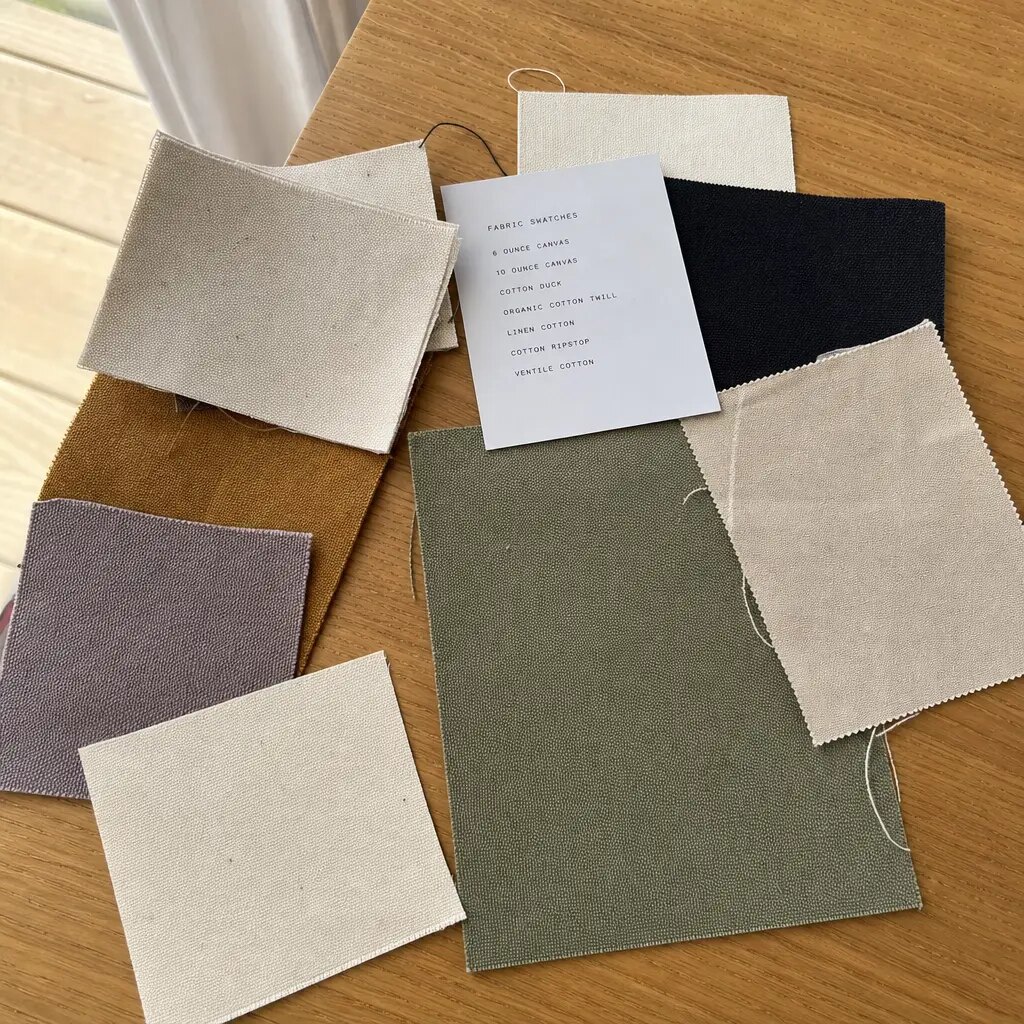
Fabric weight drives the look, cost, carton weight, and minimum fabric purchase. For hotel retail, common cotton pouch weights are around 4 oz, 5 oz, 6 oz, 8 oz, and sometimes 10 oz. Light 4 oz cotton may be acceptable for inner dust bags or low-value amenity items, but it can feel too thin for a paid retail product. A 5 oz natural cotton pouch is often a practical balance for soaps, small candles, jewelry, or welcome gifts. A 6-8 oz pouch gives better structure and a more premium hand feel, but it increases fabric cost and may require stronger drawcord handling.
MOQ pressure increases when the buyer wants a nonstandard GSM, special weave, custom dyed color, or organic cotton with transaction certificates. If the hotel retail program is still testing sales volume, start with a stock natural cotton in a common weight. If the brand story requires custom color or certified organic cotton, treat the MOQ discussion as a fabric sourcing discussion, not only a pouch sewing discussion.
- 4 oz cotton: lowest cost, best for dust bag or giveaway use, weaker for premium shelf presentation.
- 5 oz cotton: common hotel retail option, good print surface, manageable carton weight.
- 6 oz cotton: better hand feel and opacity, useful for candles, cosmetics, and boutique packaging.
- 8 oz cotton: stronger and more reusable, but higher unit cost and bulkier drawcord channel.
- Custom dyed cotton: needs lab dip approval and may create fabric MOQ beyond the pouch MOQ.
Use Size Standardization to Reduce MOQ Friction
The fastest way to damage MOQ negotiation is to create too many similar sizes. A hotel buyer may request 10 x 14 cm, 11 x 15 cm, 12 x 16 cm, and 13 x 18 cm because each product team measured its own item. In production, these sizes create separate cutting markers, separate packing counts, and higher risk of carton mixing. The factory may respond with MOQ per size because each size consumes fabric and labor differently.
A better approach is to build a size ladder with clear product use. For example, use one small pouch for soaps and jewelry, one medium pouch for candles and spa bottles, and one large pouch for robes or gift sets. Standardization does not mean every product fits perfectly. It means the pouch program has enough commonality to make cutting, inspection, and replenishment more efficient.
- Small retail pouch example: 10 x 14 cm for jewelry, soap, or key card gift packaging.
- Medium retail pouch example: 15 x 20 cm for candles, small cosmetics, or spa accessories.
- Large retail pouch example: 25 x 35 cm for gift sets, slippers, robes, or resort merchandise.
- RFQ data to include: finished size, opening direction, cord channel width, and whether size is measured flat before filling.
- MOQ tactic: ask whether sizes can be nested on one cutting plan to reduce fabric waste.
Print Method Choices That Change MOQ
Most hotel retail cotton pouches use one-color screen printing because it is stable, cost-effective, and suitable for natural cotton. Screen printing has setup work: artwork separation, screen making, ink mixing, test printing, drying or curing, and print inspection. The factory may accept a lower pouch quantity if the print is simple and uses one common ink color across all sizes. The same quantity becomes harder if each size uses different artwork, metallic ink, or multiple print colors.
Heat transfer can handle more detailed artwork, gradients, and small text, but it changes the hand feel and may not match the natural look many hotels want. Embroidery can look premium, especially for resort or spa retail, but it is slower, more expensive, and may distort lightweight cotton. Woven labels are useful when the buyer wants a subtle branded touch without printing on every pouch face, but labels have their own MOQ and lead time.
- Best low-MOQ print setup: one-color screen print, same logo, same ink color, adjusted size by pouch size.
- Higher-risk artwork: fine lines under 0.3 mm, distressed textures, gradients, metallic ink, or full-coverage print.
- Approval standard: print placement tolerance stated in centimeters from top edge and side seam.
- Durability check: rub the cured print by hand and review cracking after opening and closing the pouch.
- Cost driver: each print color can require separate screen setup and alignment time.
How Factories Calculate MOQ Behind the Quote
A factory’s MOQ usually comes from several smaller minimums added together. Fabric mills or fabric suppliers may sell by roll, dye lot, or minimum meterage. Cord suppliers may require a minimum length per color. Printing may require a minimum setup quantity to avoid losing money on screen making and machine preparation. Sewing lines also need enough pieces to justify line setup, cutting, bundling, inline QC, and final packing.
This is why one supplier may say 300 pieces is possible and another may insist on 1,000 pieces. They may not be quoting the same structure. The first may use stock fabric, stock cord, outsourced print, and a higher unit price. The second may assume custom fabric purchase, tighter packing, and lower unit cost. The procurement team should request itemized MOQ logic so the comparison is not based on a vague “minimum order” statement.
- Fabric MOQ: influenced by GSM, color, width, dyeing, and certification requirements.
- Trim MOQ: affected by cotton cord color, cord diameter, stopper use, and label style.
- Print MOQ: affected by number of colors, artwork count, print size, and setup method.
- Sewing MOQ: affected by size variation, seam complexity, channel stitching, and production line setup.
- Packing MOQ: affected by individual polybags, barcodes, hangtags, inner cartons, and carton mark requirements.
Negotiation Levers That Do Not Damage Quality
The best MOQ negotiations reduce complexity rather than asking the factory to absorb unproductive work. A buyer can combine several sizes under one fabric color, use one drawcord color, keep the logo one color, and accept bulk flat packing. These changes reduce setup time and material leftovers while keeping the pouch quality acceptable for hotel retail.
Quality-damaging negotiation usually looks different. It pushes the supplier toward thinner fabric, loose stitching, untested print curing, or rushed packing. A lower MOQ is not useful if the first shipment arrives with transparent fabric, off-center logos, or mixed cartons. The practical target is a negotiated structure: maybe a lower trial quantity with slightly higher unit price, then a price break at reorder volume.
- Good lever: same fabric and cord across all SKUs.
- Good lever: one print color and one shared artwork direction.
- Good lever: accept carton bulk packing instead of individual retail polybag.
- Good lever: consolidate production with another buyer’s stock fabric only if shade and GSM are approved.
- Bad lever: change from 6 oz to unknown lightweight cotton without a new sample.
- Bad lever: skip pre-production sample to save one week.
Sample Approval Should Lock the Commercial Assumptions
The sample is not only a visual approval tool. It should confirm the assumptions used in the quote: fabric weight, shrinkage behavior, cord type, print method, seam construction, packing style, and finished size. If the approved sample uses 6 oz cotton but the supplier later produces with a lighter stock fabric, the unit price comparison becomes meaningless. The RFQ should state that bulk must match the approved sample unless a written change is accepted.
For hotel retail, sample approval should also reflect shelf presentation. A pouch may pass basic sewing inspection but still look weak when filled with a candle or folded on a boutique display. The buyer should test the actual product inside the pouch, tie and untie the drawcord several times, and review whether the logo remains visible after filling.
- Request one flat empty sample and one filled reference test if product dimensions are available.
- Record fabric GSM, finished size, cord diameter, print color, and print position on the sample approval sheet.
- Photograph the approved sample with a ruler and close-ups of seams, cord channel, and logo print.
- Keep one signed sample with the supplier and one with the buyer or inspection company.
- Do not approve a digital photo only when color, GSM, or print hand feel is critical.
Packing Decisions Affect Unit Price and Receiving Cost
Hotel retail buyers often underestimate packing. A cotton drawstring pouch can be bulk packed flat by SKU, individually polybagged, folded with a belly band, stickered with barcode, or packed as part of a gift set. Every packing decision changes labor time, material cost, carton cube, and inspection workload. For a hotel warehouse, simple bulk flat packing may be enough. For a retail shelf or boutique backroom, barcode stickers and clean folding may be necessary.
Packing should be quoted as a separate line when the buyer is comparing suppliers. A low unit price that excludes individual polybag, barcode label, carton mark, or inner pack may become expensive after revision. Carton size also matters for landed cost. Heavy cotton pouches do not usually create major dimensional weight issues, but bulky drawcords and loose packing can waste carton space.
- Bulk flat pack: lowest cost, good for hotel receiving, less retail-ready.
- Individual polybag: cleaner handling, more labor and plastic compliance review.
- Barcode sticker: necessary for retail inventory systems, must match SKU and destination rules.
- Inner pack by size or color: reduces warehouse sorting errors.
- Carton mark: include PO number, SKU, quantity, destination, carton number, and gross/net weight.
Lead Time Risks in Small MOQ Orders
Small MOQ orders do not always ship faster. If the order uses stock natural cotton, simple screen print, and bulk packing, sampling and production can move quickly. If it requires custom dyeing, embroidery, woven labels, individual barcoding, or multiple approval rounds, the small order may wait behind larger factory programs. A realistic lead time should be counted from deposit and approved pre-production sample, not from the first RFQ email.
Hotel retail programs also need to consider launch dates, resort opening dates, seasonal campaigns, and local receiving schedules. A pouch order that is only part of a larger amenity or gift program can delay the whole set if specs are not frozen. Procurement should build a schedule with approval gates: artwork confirmation, material sample, pre-production sample, bulk start, inline inspection, packing review, and shipment booking.
- Fastest route: stock natural cotton, stock cord, one-color screen print, no individual packing.
- Slower route: custom dyed cotton, embroidery, woven label, hangtag, barcode, or gift-set assembly.
- Schedule risk: supplier holiday, rainy season drying issues, fabric shade rework, and late artwork changes.
- RFQ requirement: state target delivery date and ask which spec items threaten that date.
- Approval rule: no bulk cutting before fabric and pre-production sample are approved.
Quote Data Needed for a Fair Landed-Cost Comparison
Procurement teams should compare more than the EXW or FOB unit price. For cotton drawstring pouches, landed cost can change through setup charges, packing method, carton volume, defect allowance, sample courier cost, and order split by SKU. A supplier quoting 800 pieces at a low unit price may be more expensive than another quoting 1,200 pieces if the first excludes screen charge, packing labor, or has a higher carton cube.
A useful quote format includes separate lines for fabric, printing, drawcord, label or hangtag, packing, sample, tooling or screen, carton specification, and shipping term. Buyers should also request quote validity and price break points. If a hotel retail concept is being tested, the first PO may be smaller, but the RFQ should show expected reorder quantity so the factory can quote a trial order and a replenishment price.
- Quote basis: size, GSM, color, print method, print colors, cord, packing, quantity, and Incoterm.
- Cost breaks: request pricing at trial MOQ, planned launch quantity, and reorder quantity.
- Hidden charges: screen fee, sample fee, courier, barcode setup, hangtag printing, and carton customization.
- Operational data: carton dimensions, gross weight, pieces per carton, and estimated CBM.
- Commercial terms: payment schedule, production tolerance, over/under shipment policy, and quote validity.
Specification comparison for buyers
| Spec decision | Recommended option | When it fits | Buyer risk to check |
|---|---|---|---|
| Supplier route for first hotel retail order | Direct pouch factory with in-house cutting, stitching, and print coordination | Best when the buyer needs 1,000-10,000 pieces, custom size, private logo, and clear sample control | Confirm whether printing is in-house or subcontracted, because subcontracted print often adds hidden MOQ and proofing time |
| MOQ negotiation method | Negotiate by shared fabric, shared drawcord color, and fewer print setups instead of only pushing unit quantity down | Useful when hotel boutiques need several pouch sizes under one visual program | Factories may quote one MOQ per SKU unless the RFQ states combined fabric consumption and shared trims |
| Fabric weight | 5 oz cotton for light retail gift pouches; 6-8 oz cotton for premium amenity or reusable retail packaging | 5 oz fits soaps, candles, jewelry, or small accessories; heavier cloth fits higher shelf price or repeated guest use | Low GSM can become transparent after printing, while high GSM can increase carton weight and drawstring bulk |
| Fabric color | Natural cotton or stock dyed color for MOQ-sensitive orders; custom dyed color only for larger programs | Natural cotton works for resort, spa, eco, and boutique hotel retail with faster sampling | Custom dye requires lab dip approval, shade tolerance, and usually a higher fabric MOQ than the pouch sewing MOQ |
| Print method | One-color screen print for most hotel retail logos; heat transfer only for small detailed artwork; embroidery for premium but slower SKUs | Screen print gives strong cost control on 500-5,000 piece runs with simple branding | Fine serif logos, metallic ink, or full-bleed designs can change the print MOQ, reject rate, and sample approval cycle |
| Drawcord and closure | Cotton cord in natural or matched stock color with reinforced channel stitching | Appropriate for retail pouches that must look soft, natural, and hotel-friendly | Cord diameter, knot style, and colorfastness affect perceived quality and may trigger trim MOQ |
| Size strategy | Use 2-3 standardized sizes with common fabric and print placement rather than many close custom sizes | Good for hotel retail assortments such as soap pouch, candle pouch, and robe accessory pouch | Too many size variants create cutting waste, packing complexity, and higher per-SKU inspection cost |
| Packing route | Flat bulk pack with inner polybag by SKU and export carton labels; individual polybag only when retail shelf handling requires it | Flat bulk pack reduces material cost and carton volume for hotel warehouse receiving | Individual packing adds labor, plastic compliance review, barcode work, and longer packing lead time |
| Quote comparison basis | Require itemized quote by fabric, print, trim, packing, sample, mold/screen, and inland freight if applicable | Essential when comparing direct factories, trading companies, and promotional suppliers | A low unit price may exclude print screen charge, pre-production sample, overrun tolerance, or retail packing |
Buyer checklist before sampling
- Define pouch use: retail packaging, amenity kit, gift-with-purchase, spa product pouch, jewelry pouch, or minibar accessory pouch.
- List each SKU by finished size, fabric GSM, color, drawcord type, print position, print colors, and packing method.
- Separate must-have specifications from negotiable items before discussing MOQ with suppliers.
- Use shared fabric and shared trim colors across SKUs where possible to reduce fabric and accessory minimums.
- Provide artwork in vector format and include print size in centimeters, not only a logo file.
- Request sample photos showing front, back, inside seam, drawcord channel, print close-up, and packed carton.
- Set acceptance tolerances for size, fabric weight, print placement, shade, and carton quantity before production.
- Confirm whether MOQ is per size, per color, per print design, or combined by fabric consumption.
- Require quote validity, sample lead time, production lead time, payment terms, and over/under shipment tolerance.
- State whether products need individual barcode stickers, hangtags, retail-ready folding, or only bulk hotel warehouse packing.
Factory quote questions to send
- What is your MOQ per size, per fabric color, per print artwork, and per drawcord color?
- Can multiple pouch sizes share one fabric order to reduce MOQ, and how will you calculate fabric consumption?
- Which cotton weights are available from stock, and which weights require weaving, dyeing, or a higher fabric minimum?
- Is the logo screen printed, heat transferred, embroidered, woven label, or outsourced to another workshop?
- What are the separate charges for sample making, print screen, artwork adjustment, lab dip, and pre-production sample?
- What size tolerance, GSM tolerance, print placement tolerance, and shade tolerance do you apply for bulk production?
- How many pieces are packed per inner polybag and export carton, and what is the estimated carton size and gross weight?
- What is the realistic lead time after deposit and approved pre-production sample, including any national holiday risk?
- Can you provide fabric photos, stitching close-ups, print test photos, and carton mark layout before shipment?
- What inspection standard do you accept: AQL level, defect categories, and replacement policy for critical defects?
Quality-control points to confirm
- Finished pouch size within agreed tolerance, commonly plus or minus 0.5 cm for small pouches and plus or minus 1 cm for larger pouches.
- Fabric weight checked against approved swatch, with GSM variation documented before cutting bulk fabric.
- Drawcord channel stitching secure, with no skipped stitches, broken threads, or tight channel that blocks cord movement.
- Print position measured from top edge and side seam, not judged only by visual centering.
- Logo print tested for smearing, cracking, poor curing, and color difference against approved sample.
- Inside seam allowance and overlock quality checked to avoid fraying after repeated opening and closing.
- Cord ends tied or finished consistently, with no loose fibers that look unfinished on retail display.
- Packing quantity verified by SKU, size, color, and print design before cartons are sealed.
- Carton marks matched to purchase order, destination, SKU code, and hotel retail receiving requirements.
- Moisture and odor checked, especially for natural cotton stored during humid seasons.