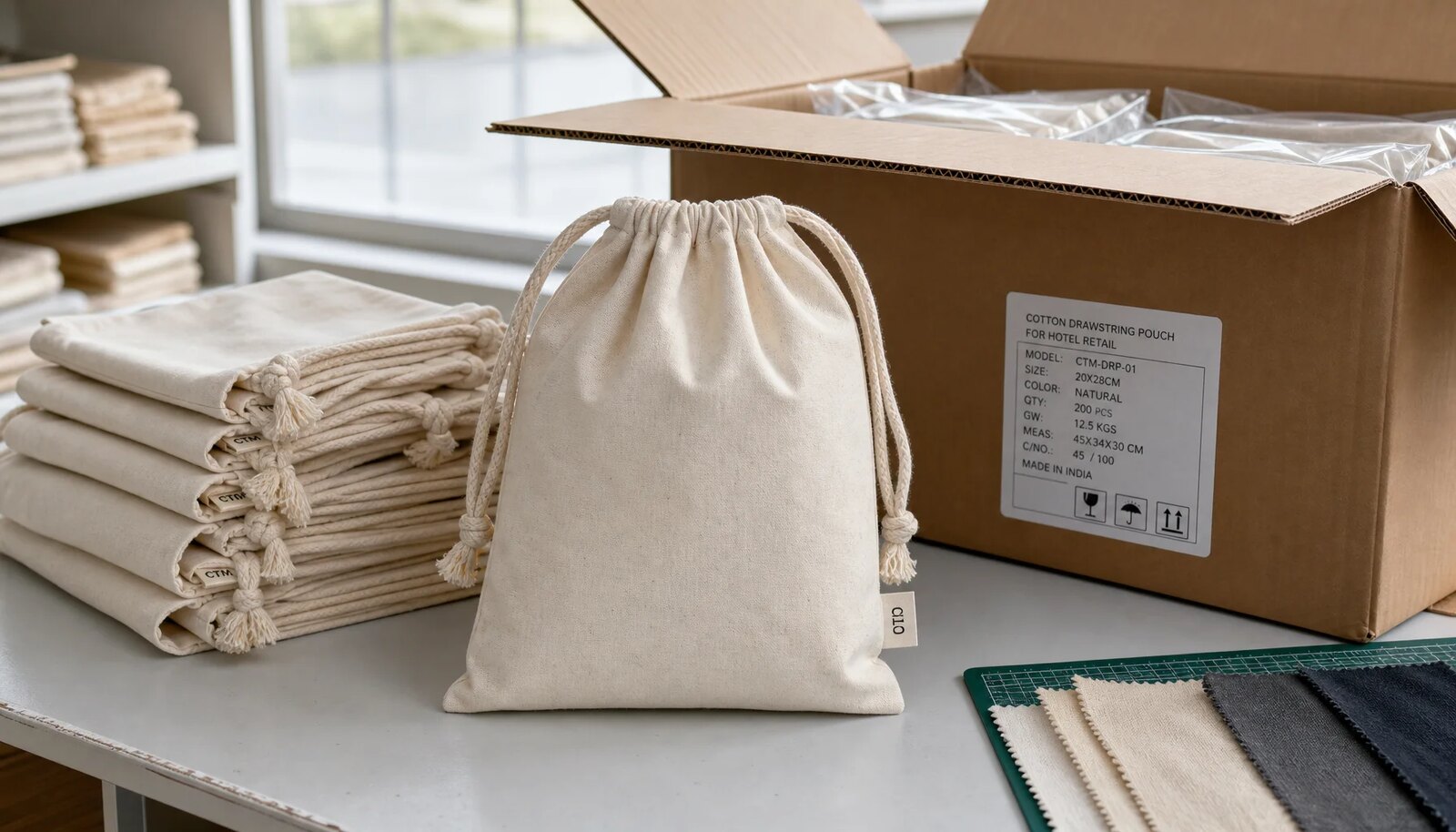
Start With The Packing Problem, Not Just The Pouch
Cotton drawstring pouches are small, soft, and easy to underestimate. For hotel retail, however, the carton packing plan can affect landed cost, receiving speed, retail appearance, and allocation accuracy. A pouch may pass artwork approval and still cause problems if cartons are too heavy, bundle counts vary, logo versions are mixed, or printed faces arrive with sharp creases. Many hotel buyers split one purchase order across spa boutiques, room-gift programs, minibar retail, opening kits, and several properties. The carton plan has to support that distribution reality, not simply survive export transit.
A useful cotton drawstring pouches for hotel retail carton packing plan connects the pouch specification with the shipping and receiving data. The RFQ should cover finished pouch size, fabric GSM, logo method, cord details, pieces per inner bundle, pieces per carton, carton dimensions, carton ply, net weight, gross weight, carton label fields, and CBM per 1,000 pieces. Without those details, two suppliers can quote what looks like the same pouch and still deliver very different freight efficiency and warehouse workload.
Fix the packing plan before final quotation whenever possible. If the factory decides carton count after production, it may choose the fastest packing method rather than the best method for hotel operations. For example, 600 small pouches in one carton may reduce carton count, but it becomes awkward if each property receives 150 pieces. Packing by approximate weight creates another issue: carton counts can vary, which slows receiving and increases the chance of shortage disputes. Fixed unit-count cartons are usually cleaner for procurement, finance, and hotel stockrooms.
Ask the supplier to quote the pouch and carton as one controlled specification. The factory should confirm how each pouch is folded, whether the logo faces inward or outward, how many pieces go into each bundle, how the bundle is sealed, how many bundles go into one carton, and whether compression affects visible logos, labels, or cords. These are not cosmetic details. They determine whether the goods arrive ready for allocation or arrive as a repacking project.
- Begin with finished pouch size, actual contents, fill weight, display needs, and property allocation.
- Require pieces per bundle, pieces per carton, carton size, net weight, gross weight, carton ply, and CBM per 1,000 pieces.
- Use fixed unit-count cartons where possible so hotel receivers can count without opening every bundle.
- Approve fold direction and logo orientation before bulk packing.
- Treat carton packing as part of the product specification, not a warehouse decision made after sewing.
Define The Use Case Before Selecting GSM
The right cotton GSM depends on the job the pouch needs to do. A 120 GSM pouch can work for light soap, jewelry cards, key-card gifts, sample sachets, or amenity inserts where a soft drape is acceptable. A 140-160 GSM pouch is a common middle range for welcome gifts, spa items, and boutique products. A 160-180 GSM pouch usually gives stronger guest-facing presence while keeping carton volume under control. A 200 GSM pouch can feel firmer and more retail-oriented, but it also increases folded bulk, carton CBM, sewing tension, and drawcord-channel stiffness.
GSM alone does not guarantee performance. Weave, cotton type, seam allowance, stitch consistency, channel construction, and product fit all matter. A lighter pouch with clean sewing may perform better than a heavier pouch with weak seams. A pouch holding a candle, glass bottle, or sharp-edged box needs more internal allowance and better seam control than a pouch holding a flat card. For that reason, the RFQ should describe the contents and handling conditions instead of asking only for a premium cotton bag.
Procurement teams should reduce vague language in the specification. Words such as natural, thick, soft, eco, luxury, or gift quality may describe the buying intent, but they are not enough for production control. The RFQ should state cotton type, GSM, GSM tolerance, color standard, finished size, logo method, drawcord details, and packing method. If natural unbleached cotton is selected, approve the acceptable level of seed flecks and shade variation. If bleached, dyed, recycled, or certified organic cotton is required, confirm MOQ, documentation, dye-lot control, and whether the supplier can repeat the shade on replenishment orders.
The use case also changes cleanliness and presentation standards. A pouch sold with a spa product or boutique accessory needs tighter control for stains, loose threads, print sharpness, fold marks, and carton protection. A pouch used only for back-of-house assembly may allow simpler bulk packing and lighter fabric. Put that distinction in the RFQ so the supplier does not underbuild a retail pouch or overbuild a distribution pouch.
- 100-120 GSM: lightweight amenity pouches, cards, sample kits, and low-fill items.
- 140-160 GSM: common for hotel welcome gifts, spa packaging, and general boutique packaging.
- 160-180 GSM: stronger guest-facing hand feel with manageable carton bulk.
- 200 GSM and above: firmer retail presentation, but check CBM, folded thickness, and cord operation.
- Natural cotton: approve shade, flecks, and odor standard before production.
- Dyed cotton: confirm MOQ, color tolerance, lab dip approval, and dye-lot variation risk.
Specify Finished Size And Usable Capacity
Cotton drawstring pouch size should be quoted as finished size after sewing and drawcord insertion, not as cut-panel size. Side seams, bottom seams, channel height, fabric thickness, and gathered closure all reduce usable internal capacity. If a buyer gives only the product dimensions, the supplier may estimate too tightly and still meet the written measurement. A 10 x 15 cm product should not be planned into a 10 x 15 cm pouch because there is no allowance for insertion, seams, fabric movement, or clean closure.
List the actual item that goes inside the pouch. Hotel retail contents may include soap bars, candles, room sprays, slipper sets, folded towels, jewelry cards, welcome notes, mini bottles, boxed amenities, or minibar gifts. Each product creates a different sizing risk. Hard box corners stress seams. Round bottles pull the fabric forward. Folded towels can compress during packing and expand after release. A thick item may need a gusseted pouch instead of a larger flat pouch.
Define the look after closing. Some pouches should close tightly above the contents. Others need a relaxed gathered top so the logo remains flat and readable. If the logo sits too close to the upper section, drawcord gathering can distort it. If the filled pouch must stand upright on a retail shelf, a flat pouch may not perform well without a gusset, heavier fabric, or insert card. These issues are much cheaper to solve during sampling than after cartons are packed.
Tolerance should be realistic for sewn cotton. Many small pouches can be controlled at +/-0.5 cm when cutting and sewing are stable. Medium and larger pouches often need +/-1 cm. State the measurement method clearly: finished pouch laid flat, no stretching, measured after sewing, drawcord insertion, and finishing. Keep logo position tolerance separate from pouch size tolerance because both affect retail display.
- Quote finished width and height after sewing, not fabric panel dimensions.
- State gusset depth if the pouch must hold a thick or rigid product.
- Allow space for insertion, side seams, bottom seam, fabric gathering, and closure above the contents.
- Use +/-0.5 cm for many small pouches and +/-1 cm for larger pouches unless sampling proves tighter control.
- Measure laid flat without stretching after drawcord insertion.
- Approve a filled sample for rigid boxes, bottles, candles, slippers, or products with sharp edges.
Choose Branding With Production And Packing QC In Mind
Logo method affects much more than appearance. It changes packing, curing time, inspection, folding, and retail presentation. Screen printing is usually practical for solid hotel logos, property names, spa marks, and one to three spot colors. It gives controlled cost for volume orders, but heavy ink coverage can stiffen cotton. If pouches are stacked before ink is fully cured, blocking or transfer marks can occur. Large prints placed across fold lines can also arrive creased even when the printing itself is acceptable.
Heat transfer can reproduce gradients, fine lines, and artwork that is difficult to screen print. It may suit short runs or detailed marks, but buyers should check adhesion, rub resistance, edge appearance, and heat sensitivity. Transfers can feel less integrated with natural cotton, and the transfer border may show depending on fabric texture. Approval should be made on the final cotton GSM, not on a substitute swatch that behaves differently under heat and pressure.
Woven labels, printed cotton labels, and sewn tabs are good options for repeat hotel retail programs because they reduce cracking risk and keep the pouch fabric clean. The tradeoff is separate MOQ, artwork approval, label lead time, color tolerance, and placement control during sewing. Label position should be reviewed in a packed sample because labels can fold, wrinkle, or create pressure marks when cartons are compressed.
Embroidery can work on heavier cotton with small logos, but it can pucker thin fabric, distort small pouch panels, or create rough backing that catches the contents. If embroidery is required, approve stitch density, backing, thread color, and packed appearance. The practical rule for B2B procurement is simple: approve the branding method on final fabric, then review it again after the intended fold and carton packing method.
- Screen print: best for solid marks, repeat branding, and cost-controlled volume orders.
- Heat transfer: useful for gradients and fine detail, but needs adhesion, heat, rub, and peeling checks.
- Woven label: premium and repeatable, but confirm MOQ, placement, sewing quality, and lead time.
- Embroidery: test on final GSM for puckering, backing roughness, and panel distortion.
- Set print position tolerance, such as +/-0.5 cm or the supplier’s confirmed achievable tolerance, in the PO.
- Require curing, rub, blocking, cracking, and fold-line checks before carton release.
Break Down MOQ Layers Before Comparing Prices
MOQ for cotton drawstring pouches is rarely one simple number. The factory may have one minimum for sewing, another for dyed fabric, another for screen printing, another for woven labels, another for custom cords, and another for individual retail packing. A natural cotton pouch with a stock cord and one-color logo may be flexible. A dyed pouch with custom cord, woven label, hangtag, insert card, barcode sticker, and property-specific carton labels has a higher practical MOQ even when the sewing itself is straightforward.
Separate total program quantity from version quantity. A hotel group may order 20,000 pouches total but split them across five hotel names, three spa concepts, or several boutique SKUs. If the body fabric, size, cord, and construction are shared, production can often be grouped while printing, labeling, or carton marking is split later. That structure is usually more efficient than treating every property as a fully separate SKU from the start.
Launch orders and replenishment orders need different planning. A first order may cover opening inventory, boutique display fill, assembly stock, and safety stock. Reorders may be smaller and more frequent. If the pouch will repeat, ask which materials can be repeated consistently and which may vary by lot. Exact cotton shade matching across natural or dyed lots should not be assumed unless lab dip, swatch approval, and tolerance are specified.
MOQ can also change the packing plan. Property-specific allocation may require extra counting labor, separate labels, extra packing lists, and more time at the end of production. These are legitimate costs when they are quoted clearly. Ask for a base pouch price plus separate line items for setup, labels, hangtags, barcode stickers, individual polybags, insert cards, custom cartons, and allocation packing.
- Ask for MOQ by component: sewing, fabric dyeing, printing, label, cord, hangtag, barcode, insert card, and packing.
- Request total program pricing plus quantity and setup charge per artwork version.
- Group shared pouch bodies where possible, then split by logo or carton allocation.
- Confirm whether screens, labels, or custom materials can be reused for repeat orders.
- Ask which charges are one-time and which repeat when artwork or property versions change.
- Price allocation packing separately instead of hiding it inside a vague unit cost.
Build A Carton Plan Suppliers Can Quote The Same Way
A comparable carton packing plan gives more than pieces per carton. It explains how pouches are folded, whether logos face inward or outward, how many pieces go into each inner bundle, whether bundles are polybagged, how bundles are arranged inside the carton, carton dimensions, net weight, gross weight, carton ply, and CBM. With this data, buyers can compare landed cost and receiving workload across suppliers using the same standard.
Over-compression is a common hidden issue. Tight cartons can create hard fold lines across prints, flatten cotton cords, deform labels, and make lower layers arrive crushed. Under-packing causes the opposite problem: it wastes freight volume and allows bundles to shift, which can lead to wrinkles or print scuffing. The best plan balances cube efficiency with retail appearance. For many hotel receiving environments, gross weight should stay practical for staff handling, commonly under 15 kg unless heavier cartons are approved.
Inner bundle quantity should match hotel operations. Bundles of 25 or 50 pieces are easy for stockrooms, gift-assembly teams, spa counters, and boutique replenishment. If each pouch is individually polybagged, carton count may need adjustment because plastic and trapped air increase volume. If pouches carry barcode stickers or hangtags, the fold and bundle method must protect those items from rubbing, bending, and adhesive transfer.
Carton labels should be designed for receiving, not just export. Include PO number, SKU, pouch size, fabric color, logo version, quantity, carton number, total cartons, net weight, gross weight, destination, and country of origin where required. Multi-property programs should avoid labels that only say cotton pouch or gift bag. Packing lists must match carton labels exactly so the warehouse, 3PL, or property receiver can reconcile inventory quickly.
- Inner bundles: 25 or 50 pieces are practical for many hotel retail programs.
- Carton quantity: choose fixed counts that match property allocation and replenishment cycles.
- Carton weight: keep gross weight commonly under 15 kg unless heavier handling is approved.
- Carton strength: specify 5-ply cartons for heavier fabric, long transit, mixed consolidation, or stacking.
- Fold method: avoid hard fold lines across the main logo when possible.
- Quote data: require carton dimensions, net weight, gross weight, carton ply, pieces per carton, and CBM per 1,000 pieces.
Approve Samples In Stages, Including A Packed Review
A loose sample is useful, but it does not prove the bulk order will arrive retail-ready. Hotel buyers should move through controlled approval stages. First, approve a fabric swatch or plain pouch for GSM, color, finished size, sewing, and drawcord function. Second, approve a print strike-off, label sample, or branded sample on the actual fabric. Third, approve a pre-production sample with final fabric, final cord, final logo, final label, final stitching, and final finishing.
The packed sample step catches problems that a loose pouch cannot show. A logo may look correct on the table but land on a fold line inside the bundle. A cord may feel good on one sample but become bulky when 50 pouches are stacked. A woven label may wrinkle under compression. A pouch may meet measurement tolerance when empty but look strained when filled with the real product. None of these issues should wait until final inspection.
If a full packed carton sample is not practical, request a detailed packing photo set. The photos should show pouch folding, logo orientation, bundle count, inner polybag closure, carton loading sequence, carton label, and sealed carton. For higher-value or opening-date orders, a partial carton review is better because it shows lower-layer compression and real carton fit.
Approval records should be specific. Instead of writing sample approved, record the approved finished size, fabric GSM, fabric color, drawcord type, cord length, logo size, logo position, label placement, fold method, bundle count, carton quantity, and carton label format. If the buyer approves an exception, such as a logo crossing a fold line, document that exception for final inspection.
- Fabric swatch or plain sample: GSM, color, hand feel, size, sewing, and drawcord operation.
- Logo strike-off: color, opacity, edge sharpness, curing, and fabric reaction.
- Pre-production sample: final pouch construction before bulk cutting and sewing.
- Filled sample: confirms product fit, closure, logo readability, and guest-facing presentation.
- Packing sample or photo set: fold direction, print orientation, bundle count, carton loading, and carton mark.
- Approval record: attach measurements, photos, artwork position, packing data, and exceptions to the PO.
Quote For Landed Cost, Not Only Unit Price
Cotton drawstring pouches are often low in weight but sensitive to volume. Freight efficiency can change landed cost more than a small difference in unit price. A buyer comparing suppliers should not stop at the FOB pouch price. The quote must include carton dimensions and CBM because excess air, weak cartons, or poor bundle planning can increase freight, storage, handling, and receiving cost.
A strong quote lets the buyer calculate cost per pouch, per carton, per 1,000 pieces, and per property allocation. If Supplier A packs 500 pieces per carton and Supplier B packs 300 pieces per carton, normalize the comparison using CBM per 1,000 pieces and gross weight per carton. If individual polybags, hangtags, barcode stickers, insert cards, or allocation labels are required, those costs should be shown separately because they affect both unit price and carton volume.
Ask which charges are one-time and which are recurring. Screen setup, label setup, insert-card die cutting, barcode template setup, and artwork revisions may apply at launch or repeat when designs change. Dyed fabric may have a minimum batch quantity. Property-specific carton packing may add labor and documentation time. None of these are problems when they are visible in the quotation.
Landed cost should also include risk cost. A cheaper pouch that arrives with crushed cartons, mixed logo versions, incorrect counts, or unreadable labels can require repacking, relabeling, recounting, or urgent replacement. For hotel procurement, the best value is usually the supplier that combines a correct finished specification, controlled logo quality, efficient CBM, safe carton weight, clear labels, and inspection-ready packing.
- Request unit price by quantity tier, fabric option, logo method, and packing method.
- Separate charges for screens, labels, hangtags, inserts, barcode stickers, individual polybags, and allocation packing.
- Require carton dimensions, pieces per carton, net weight, gross weight, carton ply, and CBM before PO release.
- Calculate CBM per 1,000 pieces for freight comparison.
- Check whether mixed logos, destination labels, or property allocation create extra labor charges.
- Include inspection, inland transport, relabeling risk, and repacking risk in the commercial comparison.
Control Schedule Risk From Artwork To Carton Release
A realistic schedule includes artwork review, material confirmation, sampling, sample approval, bulk fabric preparation, cutting, printing or label sewing, pouch sewing, finishing, packing, inspection, and shipping handover. Buyers often lose time at the front end because artwork files are incomplete, Pantone references are missing, product dimensions change, or packing requirements are added after sampling.
Hotel retail launches may be tied to opening dates, spa menu updates, seasonal promotions, boutique resets, or brand campaigns. The PO should include a decision calendar, not only a requested ship date. Identify the last acceptable date for artwork approval, fabric approval, logo strike-off approval, pre-production sample approval, packing approval, and inspection booking. If these dates are missed, the ship date may no longer be realistic even when factory capacity is available.
Production sequence affects timing. Some pouches are printed before sewing because panel printing improves position control. Others are printed after sewing when the shape and placement allow. Woven labels are usually attached during sewing, so label approval must happen before bulk construction. Dyed cotton must be approved before cutting. Property-specific packing adds time at the end because cartons must be sorted, counted, labeled, and checked by version.
Inspection should be scheduled after packing is complete when carton packing matters. The inspector needs finished cartons to verify carton labels, inner bundle count, gross weight, carton dimensions, version separation, and lower-layer condition. If the buyer needs photos, carton measurement records, or allocation packing lists, state those requirements early so documentation does not delay handover.
- Artwork review: allow time for file correction, Pantone confirmation, logo size, and position approval.
- Sampling: separate swatch, plain sample, logo strike-off, pre-production sample, and packing approval for retail-visible orders.
- Material lead time: confirm whether natural, bleached, dyed, recycled, or organic cotton changes MOQ or timing.
- Production sequence: clarify whether printing happens before or after sewing and when labels are attached.
- Packing time: allow extra days for barcode stickers, hangtags, insert cards, individual polybags, and property labels.
- Inspection booking: schedule after final packing so carton data and allocation accuracy can be checked.
Inspect Carton-Ready Goods Before Shipment
Quality control for hotel retail pouches should inspect both the finished pouch and the packed carton. A loose-pouch inspection is incomplete if goods will ship directly to properties or a 3PL. The inspection protocol should cover finished size, fabric condition, sewing, drawcord function, logo quality, label placement, count accuracy, inner packing, carton labels, carton condition, and shipping marks.
Measurements should be taken on finished pouches laid flat without stretching. Inspectors should measure width, height, gusset if applicable, drawcord channel height, and logo position. Fabric should be checked for stains, holes, weaving defects, shade problems, odor, and contamination. If natural cotton flecks are acceptable, define that in advance so normal fabric character is not treated as a bulk defect.
Functional checks matter because drawstring pouches are handled by guests, staff, and warehouse teams. The cord should pull smoothly, the channel should not tear, cord lengths should be balanced, and knots or tips should remain secure. Seams should show no skipped stitches, open ends, loose threads, weak stress points, or needle damage. For heavier contents, add a basic fill-and-pull check using the intended product weight.
Carton QC verifies whether the approved packing plan was followed. Random cartons should be opened to check inner bundle quantity, pouch count, logo version, fold direction, and lower-layer condition. Carton labels should match the packing list and PO. Gross weight and carton dimensions should match the quote within agreed tolerance. If cartons show moisture exposure, crushing, weak sealing, or mixed versions, investigate before shipment release.
- Use AQL inspection for appearance, measurement, function, and packing defects where appropriate.
- Measure finished pouches after sewing and drawcord insertion, laid flat without stretching.
- Check print rubbing, blocking, curing, cracking, peeling, and transfer risk before release.
- Open random cartons to verify bundle count, carton quantity, logo version, fold direction, and compression marks.
- Match carton labels to PO, SKU, logo version, quantity, destination, net weight, gross weight, and carton numbering.
- Document defects with photos, measurements, carton numbers, severity, and agreed corrective action before shipment approval.
Specification comparison for buyers
| Spec decision | B2B recommendation | When it fits | Quote or QC risk to check |
|---|---|---|---|
| Fabric weight | Use 120-160 GSM for light amenity or gift pouches; 160-180 GSM for most guest-facing hotel retail; 200 GSM when the pouch needs a firmer retail hand feel. | Soap, jewelry cards, spa samples, room gifts, boutique accessories, mini bottles, slippers, candles, or small boxed merchandise. | State the GSM tolerance, commonly +/-5% or the supplier’s confirmed mill tolerance. Too light can look promotional; too heavy can raise CBM, sewing tension, cord-channel stiffness, and carton weight. |
| Finished size | Quote finished size after sewing and drawcord channel formation. Typical tolerances are +/-0.5 cm for many small pouches and +/-1 cm for larger pouches. | Planograms, gift kits, boxed inserts, retail shelf displays, and property-specific replenishment. | Some suppliers quote cut-panel size. Usable capacity is reduced by side seams, bottom seam, fabric thickness, drawcord channel, and top gathering. |
| Sizing allowance | Add insertion clearance beyond product dimensions. For rigid boxes, bottles, candles, or slippers, approve a filled sample before bulk production. | Candles, glass bottles, boxed amenities, folded towels, slippers, and items with hard edges. | A pouch that matches the product size on paper may not close cleanly. Corners can stress seams and distort printed logos. |
| Logo method | Use screen print for solid marks; heat transfer for gradients or fine detail; woven or printed labels for repeat premium branding; embroidery only after puckering checks. | Hotel logos, spa marks, property names, boutique SKU branding, welcome gifts, and opening kits. | Approve on final fabric. Check print position tolerance, curing, rub, blocking, fold-line risk, label sewing, and color match under consistent lighting. |
| Drawcord specification | Define material, diameter, color, cord length, closure style, and end treatment. Cotton cord gives a natural look; polyester cord can pull more smoothly and hold consistent color. | Guest-handled retail pouches, gift assembly, spa counters, room drops, and back-of-house replenishment. | Cord ends can fray, channels can bind, and thick cords can deform small pouches. Confirm single or double drawstring and balanced cord length after knotting. |
| Unit packing | Use bulk bundles of 25 or 50 pieces per inner polybag unless barcode, hygiene, retail display, or property allocation requires individual packing. | Hotel stockrooms, gift-room assembly, central warehouse allocation, spa boutique replenishment. | Individual polybags increase labor, plastic use, carton volume, and counting time. Bulk packing can scuff prints if ink is not cured or fold orientation is wrong. |
| Export carton | Use a fixed count per carton. Keep gross weight practical, commonly under 15 kg unless the hotel, 3PL, or freight plan approves heavier cartons. Use 5-ply cartons for heavier or long-transit orders. | Sea freight, mixed consolidation, central warehouses, regional distribution, and multi-property rollouts. | Weak cartons collapse under stacking. Overfilled cartons crease logos and deform cords; underfilled cartons waste freight and allow shifting. |
| Carton label | Include PO, SKU, pouch size, fabric color, logo version, quantity, carton number, total cartons, net weight, gross weight, destination, and country of origin if required. | Multi-SKU hotel retail orders, property allocation, 3PL receiving, boutique launch kits, and replenishment inventory. | Generic carton marks cause misallocation and force receivers to open cartons. Packing list and carton labels must match exactly. |
| Sample route | Approve fabric swatch, plain sample, logo strike-off, pre-production sample, and packed sample or packing photo set. | Retail-visible pouches, chain approvals, opening-date programs, and repeat branded SKUs. | A loose pouch can pass while carton packing fails. Review fold direction, inner bundle count, lower-layer compression, label position, and carton mark before shipment. |
Buyer checklist before sampling
- Define the exact use: hotel amenity gift, spa retail, minibar item, welcome kit, laundry accessory, boutique merchandise, opening gift, housekeeping issue, or back-of-house packaging.
- Classify the pouch as guest-facing retail packaging, protective secondary packaging, or distribution-only packaging because this changes fabric grade, cleanliness standard, branding tolerance, and packing method.
- Provide finished pouch width and height after sewing; include gusset depth if needed and state whether measurements are taken laid flat without stretching.
- Share actual contents, including dimensions, edge shape, fill weight, insertion method, and whether the filled pouch must stand, hang, lie flat, or close with a gathered top.
- Specify cotton type, fabric color, GSM, GSM tolerance, dye or bleaching requirement, shade standard, and whether natural flecks are acceptable.
- Provide production artwork, print size, print position, Pantone references, logo version list, minimum readability requirement, and whether logos may cross fold lines.
- Define drawcord material, color, diameter, length, closure style, end treatment, and whether the pouch uses one cord, two cords, knots, tips, or sealed ends.
- Decide between bulk bundle packing, individual polybag, barcode sticker, hangtag, insert card, warning label, retail-ready fold, or property allocation packing.
- Require pieces per inner polybag, pieces per carton, carton dimensions, net weight, gross weight, carton ply, carton mark, and CBM per 1,000 pieces in the quotation.
- Ask the supplier to quote setup charges separately for screens, labels, hangtags, barcode stickers, insert cards, custom cords, dyed fabric, and special allocation packing.
Factory quote questions to send
- What exact cotton type, weave, color, GSM, and GSM tolerance are included in the price?
- Is the quoted measurement the finished pouch size after sewing and drawcord channel formation, or the cut fabric panel size before sewing?
- What finished size do you recommend for the stated product dimensions, fill weight, and desired closing appearance?
- What seam allowance, drawcord channel height, and gusset construction are included?
- Which logo method is included, what maximum print or label area is covered, and when does the unit price change?
- How many print colors are included, are screen or setup charges separate, and what artwork format do you require?
- What logo position tolerance, color tolerance, and print-curing standard will you use for bulk production?
- What drawcord material, diameter, color tolerance, length, closure style, and end treatment are included?
- What MOQ applies separately to pouch sewing, dyed fabric, printed logo, woven label, custom cord, hangtag, barcode sticker, insert card, and individual polybag?
- How many pieces are packed per inner polybag and per export carton, and what are the carton dimensions, net weight, gross weight, carton ply, and CBM?
Quality-control points to confirm
- Finished size measured after sewing and drawcord channel formation, with the pouch laid flat and not stretched.
- Fabric GSM checked from approved bulk fabric or finished pouch panels against the agreed tolerance.
- Fabric color checked against the approved swatch under consistent lighting, with acceptable natural cotton flecks or shade variation defined before production.
- Drawcord channel width consistent enough for smooth opening and closing, with no trapped cord, tearing, bunching, or uneven gathering.
- Side seams, bottom seams, channel seams, and stress points secure with no skipped stitches, loose threads, open seam ends, needle cuts, or seam slippage.
- Drawcord material, diameter, color, length, closure style, and end treatment match the approved sample.
- Print position within agreed tolerance and print color matched to the approved strike-off or sample under consistent lighting.
- Ink or transfer fully cured with no tackiness, blocking, cracking, peeling, obvious rub loss, or transfer marks during normal handling checks.
- Logo not placed directly on a hard fold line unless the buyer has approved the crease risk in the packing sample.
- Woven labels, hangtags, barcode stickers, warning labels, and insert cards match the approved SKU, logo version, language, and retail requirement.