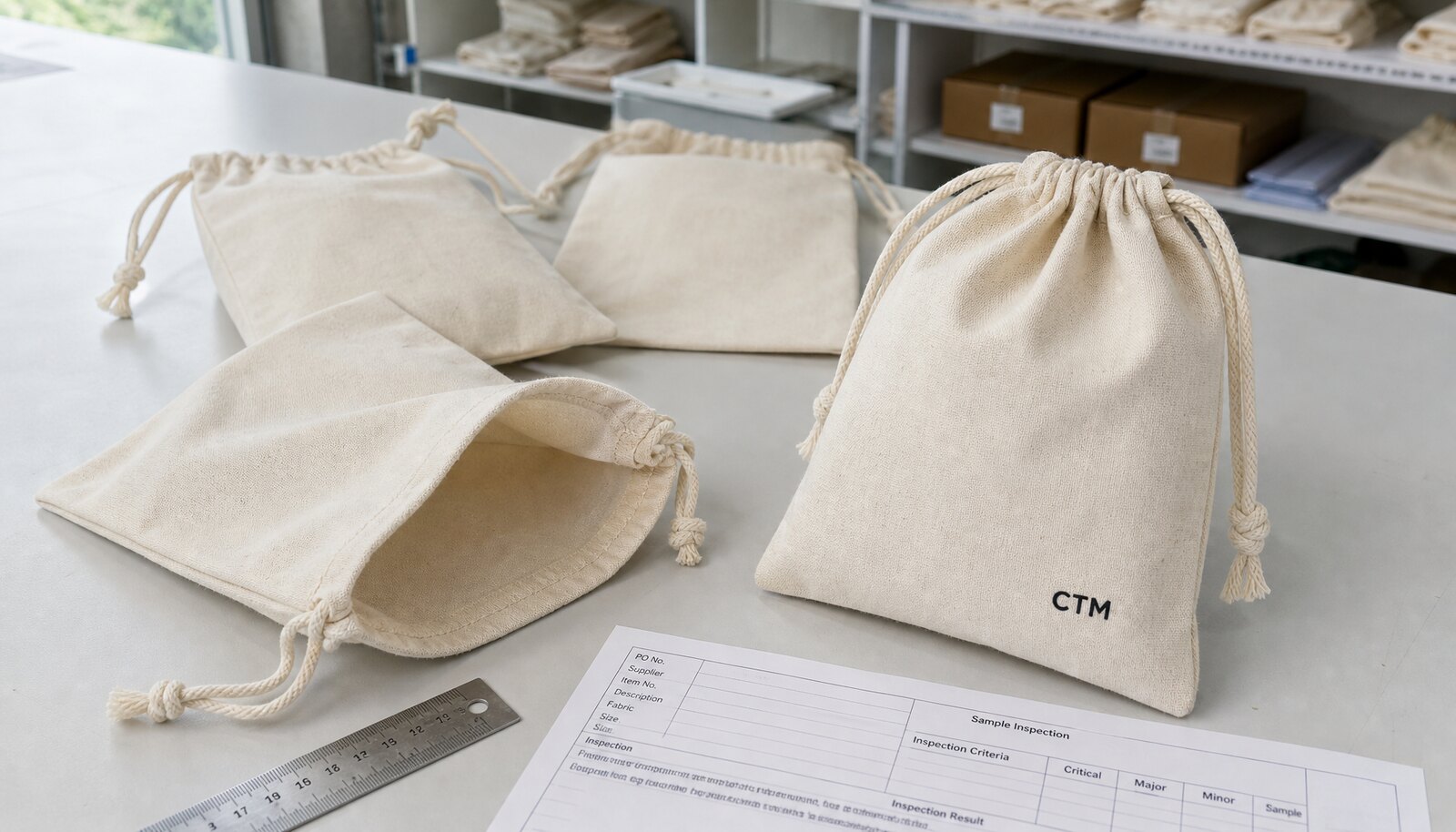
Start with the retail job, not the unit price
Cotton drawstring pouches for gift shops are rarely just packaging. They may sit inside a gift set, hold a small retail item on its own, or act as the visible piece that makes the customer feel the purchase is finished. That means the buying decision is not only about fabric and sewing. It is also about how the pouch looks in a display box, how it feels when handled, and whether it still looks clean after the customer opens and closes it a few times.
A pouch used as an insert can tolerate a simpler build. A pouch sold over the counter needs more body, cleaner print, and more consistent packing. A pouch that carries candles or glass items may need stronger seams and a deeper channel so it does not distort when cinched. If the application is unclear, the factory will default to a standard build, and that build may be wrong for the actual retail use.
Write the brief like a production spec. State the product it will carry, the expected fill weight, whether the pouch is for shelf display or carton insertion, and what defects the customer will see first. That gives the supplier a real target and gives procurement a way to compare quotations on the same basis.
- Separate insert use, counter display use, and gift-set use before quoting.
- Tie the spec to the actual product weight or dimensions the pouch must carry.
- Set the retail finish expectation in writing, not in a verbal approval.
Choose fabric and weave for the shelf, not only the swatch
For most gift-shop programs, plain cotton or light canvas in the 120-180 GSM range covers the practical middle. Lower GSM is usually enough for light items and low-cost giveaway programs. Higher GSM gives more body, better opacity, and a more premium feel, but it also increases material cost and can make cartons bulkier. The right choice is the one that matches the product and the channel, not the one that sounds premium in a quote line.
A fabric description alone is not enough. Ask for the exact GSM, weave style, color basis, and shrinkage or finishing behavior of the approved material. Natural and unbleached cotton can show shade variation from lot to lot, so buyers should decide how much variation is acceptable before production starts. If the pouch will sit in a curated gift assortment, the shade control needs to be tighter than for a generic promo item.
Use a weighed swatch from the actual production roll when possible. A photo of the fabric tells you almost nothing about density, hand feel, or opacity. If the supplier cannot explain whether the fabric is cut before or after finishing, or cannot state how shrinkage is handled, the quote is still a sample discussion rather than a production-ready offer.
- Ask for GSM, weave type, color basis, and shrinkage behavior on the same line item.
- Treat natural shade variation as a controlled risk, especially for unbleached cotton.
- Use a weighed production swatch instead of relying on photos or hand feel alone.
Lock the construction details before the factory starts talking price
A clean sample can hide a weak build. The details that matter are seam allowance, stitch density, cord channel width, cord diameter, and how the cord ends are finished. If the seam allowance is too narrow or inconsistent, the bag can open under load. If the channel is too tight, the cord will snag. If the cord ends are poorly finished, the bag can look worn before it reaches the shelf.
Ask the supplier to state the finished dimensions and the construction dimensions separately. Finished width and height matter, but the opening after cinching matters too. A pouch for jewelry may need a tidy mouth and a compact folded shape. A pouch for a candle or jar needs enough height and body to sit properly around the product without collapsing at the top edge.
Do a simple mechanical check on the sample. Open and close it several times. Look for twisting, uneven cinching, broken stitches around the top channel, or thread buildup that catches the cord. If the pouch is intended to look premium, treat visible seam wandering or an uneven closure line as a reject condition rather than a cosmetic tolerance.
- Confirm seam allowance, stitch density, cord channel width, and cord diameter before approval.
- Test the pouch with the real fill weight, not just by holding it empty.
- Reject any pouch that twists visibly when cinched or shows open seam, skipped stitch, or channel snagging.
Match print method to the order pattern
Print is where many cotton pouch programs lose control. A logo that looks fine on the sample can become soft, dull, or off-position in bulk if the print method changes, the ink is under-cured, or the factory switches operators. Screen print is usually the safest choice for simple logos and repeat runs because it is durable and easy to control. Transfer and digital methods are more flexible for short runs or detailed art, but they add more process variables.
The quote should state the print method, the number of colors, the print area, and whether the price assumes one side or both sides. Ask for the Pantone reference or an equivalent color standard if your brand needs it. A buyer should not approve a logo by file alone. Review a production sample and check where the print sits relative to the seam, how sharp the edges are, and whether the mark is centered within your written tolerance.
A basic rub test and tape test are worth doing before bulk release. If the print leaves visible transfer on a white cloth, lifts at the edge, or looks dusty after handling, the method is not ready for shipment. The main failure modes are easy to spot: edge bleeding, off-register placement, weak coverage on darker fabric, and cracking after the pouch is folded or flexed.
- State the print method, color count, print area, and side count in the quote.
- Run rub and tape tests on the production sample before bulk release.
- Reject soft edges, visible transfer, cracking, or any print that shifts off the approved position.
Plan variants so MOQ does not distort the assortment
A lot of pouch orders become expensive because the buyer asks for too many variants too early. If you need one hero size for a gift shop line, keep the order simple and use one fabric base across the assortment. If you need a small family of sizes, make sure each size has a clear retail purpose. The factory should not be guessing which size matters most. A clean assortment is easier to source, easier to inspect, and easier to reorder.
Variant planning matters even more when the pouches are tied to a retail program. For a jewelry shop, a smaller pouch with a single-color logo and a lighter fabric may be enough. For candle or soap gift sets, a more substantial cotton body and a slightly larger format can improve shelf value. For seasonal or bridal assortments, the same base pouch can often support different prints, but only if the MOQ by print color and packaging line is understood upfront.
Ask the supplier to quote by variant rather than as one blended total. A low headline MOQ can hide a much higher minimum per size or per print version. If the order includes woven labels, hangtags, or different pack formats, the MOQ can move again. This is where buyers lose margin when they compare only the unit price and ignore the setup structure.
- Use one hero size when possible, and add sizes only when the retail use case is clear.
- Quote MOQ by size, color, and print color instead of accepting one blended number.
- Treat labels, hangtags, and special pack formats as separate setup events.
Use the supplier route as a risk filter
The cheapest quote is not always the most efficient route. Factory-direct sourcing gives the best chance of stable control over cutting, sewing, printing, and packing because one production owner is accountable for the whole order. Trading companies can still be useful when they actually add coordination value, but they also add a layer between the buyer and the real factory. If you use that route, you need to know exactly who is making the pouch and who is checking it.
The practical question is simple: who owns the fabric, who prints it, who inspects it, and who packs it? If the answer is vague, the process is not controlled. Ask for the business license, current production photos, and the document set your retail channel needs before release. If your customer requires compliance paperwork, collect it before you place the order. Waiting until the goods are booked is how shipments stall.
Compare offers line by line. Unit price by itself does not tell you whether the order is actually manageable. Ask what is included in the quote and what is not. If a supplier says the price is lower because cartons, labels, or testing are excluded, then you do not yet have a comparable quote. You have only a partial number.
- Ask for the actual production site, not only the sales office.
- Request the document set your retail channel needs before order release.
- Treat vague claims as unverified until the factory shows the supporting record.
Read quote sheets as a production document
A quote for cotton drawstring pouches can look straightforward and still hide most of the cost. The base pouch may be cheap, but the real order also needs print, labels, cartons, inner packing, barcode stickers, and sometimes a tighter inspection plan. If those items are not broken out, the buyer cannot compare offers fairly. The low quote may simply be the one that omitted the expensive parts.
Compare suppliers on landed cost, not just ex-factory price. That means the cost to get approved pouches into your warehouse after freight, duty, local handling, and expected rework are included. A slightly higher unit price can still be the better buy if the factory has cleaner packing, fewer defects, and fewer document errors. For gift-shop buyers, presentation defects often cost more in labor than the price difference on the pouch.
Watch the MOQ structure carefully. A supplier can quote a low total order minimum while requiring a much higher minimum per color or artwork version. That breaks assortment planning fast. Ask how setup cost changes if you add woven labels, hangtags, a different carton size, or a separate retail sleeve. If the quote is not broken into those pieces, it is not ready for procurement comparison.
- Separate fabric, sewing, printing, labels, packing, cartons, and setup costs.
- Ask for MOQ by size, color, and print color, not only one total number.
- Compare suppliers on landed cost and rework risk, not only unit price.
Use a sample and change-control process that protects the bulk order
The sample is the reference point, not the end of the process. A real pre-production sample should use the same fabric basis, the same cord, the same print method, and the same packing approach as the bulk order. If the supplier sends a hand-finished mockup or a sample made from different materials, you are approving a concept, not a production standard. That is how bulk lots drift while still looking close enough to pass a casual review.
Keep one sealed golden sample and make the factory acknowledge it as the bulk benchmark. Any material substitution, print position change, or packing change should require written approval before production continues. If the supplier says a different roll is equivalent, ask for the reason in writing and compare it against the approved sample. The goal is not to block every change. The goal is to make substitutions visible before the goods are already sewn.
A short production checkpoint before bulk release is usually worth it. Confirm the approved artwork file, the approved sample, the inspection plan, and the carton format in one place. Then ask who will run the order and who will sign off at the end of the line. Many small orders fail because the sample was made by one person and the bulk was run by another line with looser control.
- Approve a pre-production sample made from production materials.
- Keep one sealed golden sample and tie it to the purchase order.
- Require written approval for any material, print, or packing substitution.
Pack for retail and distribution without creating receiving problems
Packing is not a clerical detail. For gift-shop pouches, it changes both shelf appearance and warehouse efficiency. If the bags are packed too tightly, they arrive creased and are harder to display. If they are packed too loosely, carton density drops and freight rises. The right pack method depends on the route to market. Retail-ready bagging may suit a boutique program, while flat-packed cartons often work better for distribution centers that re-label or re-pack locally.
Confirm the pack-out sample before bulk. Review the fold, the bag count per inner pack, the master carton mark, and the SKU label format. If the order includes multiple sizes or colors, write the separation rule into the order so the factory does not mix variants by assumption. Do not rely on memory or informal practice for this step. The receiving team should be able to open a carton and know exactly what it contains.
Carton strength matters as well. Ask for carton dimensions, gross weight, and whether the shipment needs palletization. If the route is long, humid, or multi-stop, ask for stronger cartons or moisture protection. You do not need over-engineered packaging for every pouch, but you do need packaging that survives transit without crushed corners, dirt, or label errors. Those are the defects that turn a low-risk textile item into a receiving problem.
- Choose flat pack, folded pack, or retail-ready bagging based on the route to market.
- Verify carton count, master marks, and SKU separation before bulk starts.
- Reject cartons that are wet, dirty, crushed, or mislabeled, even if the pouches inside are acceptable.
Inspect against a buyer-friendly acceptance plan
A good inspection plan keeps emotion out of acceptance. For cotton drawstring pouches, a practical starting point is zero tolerance for critical defects, AQL 2.5 for major defects, and AQL 4.0 for minor defects, unless your retailer or brand standard is stricter. Critical defects are the ones that make the pouch unusable or unacceptable for the order: wrong SKU, wrong artwork, mold, contamination, missing cords, or severe damage. Major defects are the ones that hurt function or retailability: open seams, print misplacement beyond your tolerance, broken or missing stitches in visible areas, obvious stains, or mixed variants. Minor defects are cosmetic issues that do not change use but still need control, such as small loose threads or light fold marks.
The inspection should be tied to real consequences. If the same defect appears in several cartons, do not wait for the full lot to be counted. Contain the issue, stop acceptance, and ask for a root cause and sort plan. Repeated defects are usually process-related, not random. That is the point where a buyer gains leverage by asking for rework evidence, line correction, or a fresh final inspection before release.
Inspect by lot and by variant. Do not mix sizes or print colors into one vague approval decision. Keep a record of the approved sample, the measured dimensions, the carton count, and the defect callouts. If the shipment fails, the paperwork should tell you exactly why. If it passes, the same paperwork becomes the reference for the reorder.
- Use zero tolerance for critical defects, AQL 2.5 for major, and AQL 4.0 for minor as a baseline.
- Stop the lot if the same defect repeats across cartons or variants.
- Keep a signed record of measured size, print position, carton count, and approved sample reference.
Specification comparison for buyers
| Procurement decision | What usually wins | How to verify it | Failure mode to watch |
|---|---|---|---|
| Supplier model | Factory-direct when sewing, printing, and packing need one owner | Ask for the actual factory name, production photos from the current line, and the QC person who signs off | Hidden subcontracting changes fabric, stitch quality, and packing control without notice |
| Fabric basis | 120-140 GSM for light inserts; 160-180 GSM when the pouch must look fuller on shelf | Request a weighed swatch from the approved roll and a note on shrinkage or finishing behavior | Thin cloth shows contents, prints unevenly, and looks weak after handling |
| Size strategy | One hero size for repeat orders; a small size family only when the retail range is clear | Ask for finished dimensions, seam allowance, and tolerance by size and by variant | Too many sizes push MOQ up and create mixed-stock errors in packing |
| Closure and construction | Single drawstring for simple utility; deeper channel or double drawcord when presentation matters | Check seam allowance, stitch density, cord diameter, channel width, and opening behavior | The mouth twists when cinched, cords fray, or the top edge looks uneven |
| Print method | Screen print for simple logos and reorder programs; transfer or digital for short runs or complex art | Confirm method, cure process, Pantone reference, and a rub or tape test on the production sample | Edges soften, ink cracks, or bulk color looks different from the approved sample |
| Retail packaging | Flat-packed for distribution, folded with a clean retail presentation for counter display | Review the pack-out sample, fold method, inner pack count, and label format | Wrinkles, mixed sizes, or loose packing create receiving delays and shelf defects |
| MOQ structure | MOQ by variant, not just one headline number | Request MOQ by size, color, print color, and any added label or hangtag | A low total MOQ can hide a much higher minimum per color or artwork version |
| QC model | Pre-production sample plus inline and final checks with written defect definitions | Ask for the inspection plan, defect list, and who controls rework release | Problems are found only at the end, when sorting is expensive or impossible |
| Commercial terms | Landed cost, not only ex-factory price | Compare freight, duty, cartons, labels, local handling, and rework risk by variant | A cheap unit price can become the most expensive order after packing or freight is added |
Buyer checklist before sampling
- Define the pouch job first: insert, bundle sleeve, retail presentation, or resale packaging.
- Freeze the spec before quoting: finished size, fabric basis, GSM target, seam allowance, cord type, and print area.
- State your zero-tolerance items in writing: wrong SKU, wrong artwork, mold, contamination, missing cord, or mixed variants.
- Choose one approval sample made from actual production fabric, actual cord, and the final print method.
- Keep one sealed golden sample and have the supplier acknowledge it as the bulk reference.
- Ask the quote to break out fabric, sewing, printing, labels, packing, cartons, and setup charges by variant.
- Confirm who owns each production step: fabric source, printing, inline QC, packing, and final inspection.
- Compare offers on landed cost, not only unit price, and include freight, duty, inland handling, and a rework allowance.
- Get carton data before approval: pack count, carton size, gross weight, master carton mark, and palletization requirement.
- Write the acceptance standard for size, placement, color, and stitching before the order is released.
Factory quote questions to send
- What is the exact fabric composition, GSM, weave type, and shrinkage or finishing allowance for this pouch?
- Which factory will cut, sew, print, inspect, and pack the order, and which steps, if any, are subcontracted?
- What are the finished dimensions, seam allowance, cord diameter, cord channel width, and allowed size tolerance by variant?
- Which print method will you use, what is the cure standard, and what pass/fail test do you use for rub resistance or tape adhesion?
- How do you define major, minor, and critical defects for this pouch, and what AQL levels do you apply for each?
- Can you provide the business license, material declaration, test report, and any audit files needed before PO release?
- What is the MOQ by size, color, and print color, and what setup costs change if we add woven labels, hangtags, or special packing?
- How will the cartons be packed and labeled, and what are the exact carton count, carton size, gross weight, and ship-date milestones?
- Can you show a pre-production sample made from the same fabric roll or same material lot that will run the bulk order?
Quality-control points to confirm
- Measure finished width and height on a flat table after the sample has conditioned at room temperature for several hours. Check at least 10 pieces per variant, drawn from the start, middle, and end of the run. Accept only if every piece falls within the written PO tolerance and no single piece exceeds the tolerance by more than 3 mm.
- Check seam allowance at three points per pouch, usually left side, right side, and bottom seam. The allowance should match the approved spec, and the variation within one seam should stay within 2 mm. Reject any seam that falls below the minimum allowance or shows seam wandering that is visible from normal viewing distance.
- Count stitches over 25 mm on the side seams and top channel. For many cotton pouches, 6-8 stitches per inch is common on lighter fabrics and 8-10 on heavier canvas-like builds. Reject skipped stitches longer than 10 mm, open seams, or loose sections that begin to unravel when handled.
- Open and close each sample several times to confirm the drawcord runs smoothly through the channel. Reject if the cord catches, the mouth cinches unevenly, the channel twists, or the cord end frays after repeated pulls.
- Check artwork placement against the approved template or ruler mark. For a simple centered logo, many buyers hold a plus or minus 3 mm placement tolerance; for larger art or off-center graphics, use a written tolerance that fits the design. Reject any print that looks visibly off-center at arm's length.
- Compare color, print density, and fabric shade to the golden sample under neutral daylight or a D65-style light source. Reject visible tone drift across cartons, patchy coverage, or a logo color that no longer matches the approved reference.
- Run a tape test and a small rub test on the approved print. Use five samples per variant as a practical minimum. Reject if the tape lifts pigment, if ink transfers to a white cloth, or if the print cracks or flakes after handling.
- Inspect the fabric surface for holes, oil marks, contamination, slubs, weave skips, or shade bands. As a practical buyer rule, reject defects that are visible at about 1 meter or that would be obvious to a retail customer on shelf.
- Check cord ends and knots for secure finishing. Reject exposed cut ends that fray easily, knots that slip, or cord lengths that differ enough to make the pouch close unevenly.
- Open at least three cartons per variant and verify count, SKU label, size, color, and pack format. Treat any mixed SKU carton, short pack, wet carton, crushed carton, or unreadable label as a hold condition until the supplier explains and sorts it.