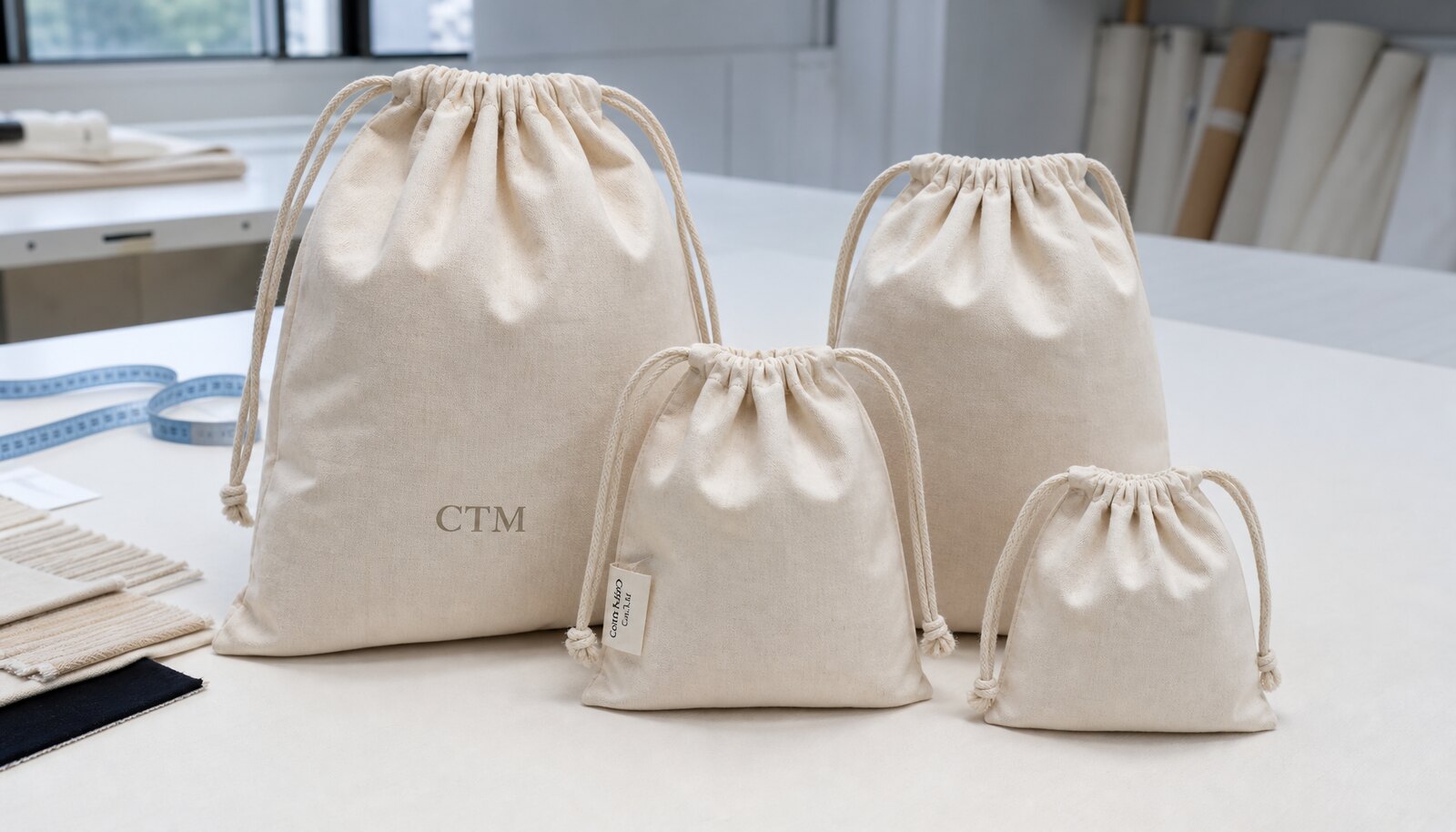
1) Why lead-time planning matters for gift shop pouches
Cotton drawstring pouches look simple, but for a gift shop buyer they are often tied to a launch date, seasonal display, or a bundled product set that must arrive on time. The pouch may be low in unit value, yet the business risk is real: if it misses the receiving date, the store team has to rework pack-out, delay merchandising, or switch to a less suitable substitute. That creates avoidable labor and weakens the customer presentation.
For procurement, the useful mindset is to treat the pouch as a schedule-managed component rather than a commodity line item. The important question is not only what it costs, but whether the supplier can reliably deliver the right fabric, decoration, and packing format before the goods need to hit the shelf. A clean lead-time plan lets you compare suppliers on timeline ownership instead of only on price.
Gift shop orders usually have a hard in-store date, not a flexible replenishment window. That makes timing checks more important than usual because the order is often linked to holidays, museum store programs, tourist-season resets, or campaign bundles. A one-week slip can matter more than a small unit-price difference if the launch window is fixed.
The lead-time planning challenge is that small spec changes can move the calendar more than buyers expect. A switch from bulk packing to retail-ready pack-out, a change from screen print to woven label, or a new cord color can each add approval steps and materials handling. These are the places where a generic quotation often breaks down. A buyer-focused RFQ should force the supplier to show what actually happens before production starts.
- Use the shelf date or receiving date as the true deadline, not the order submission date.
- Treat approval and packing as schedule items, not afterthoughts.
- Compare suppliers on production ownership as well as price.
2) Start with the end use, not the pouch dimension
The best pouch brief starts with what the pouch will hold and how visible it will be in the gift shop environment. A pouch for small jewelry cards, one for soap bars, and one for a bundled gift set are not the same sourcing problem. The contents affect pouch width, opening size, seam strength, opacity, and the amount of structure needed to look neat on a shelf. That is why procurement should define the end use before requesting prices.
For primary packaging, the pouch may need to protect the contents and keep them centered. For secondary packaging, the pouch may mainly support brand presentation and unboxing. For a gift bag role, the opening and closure matter more because customers will handle the pouch more frequently. If the supplier does not know the end use, the quote often defaults to a generic size and fabric weight that may not fit the store program.
Presentation is just as important as fit for gift shops. A pouch that is too thin can look inexpensive and show the contents too clearly, while a pouch that is too heavy can add cost and freight weight without improving the customer experience. The procurement goal is usually to choose the lightest fabric that still gives the presentation, opacity, and durability the retailer needs. That tradeoff should be stated in the RFQ rather than left to the factory to guess.
If the assortment includes multiple item types, group them by use case first and dimension second. For example, one spec can cover jewelry and small accessories, while another covers bundled gift items or seasonal sets. That gives the supplier a better read on which sizes need tighter weave, stronger seams, or a more structured opening. It also reduces quote noise because the factory is not trying to interpret every SKU as a separate design problem.
- State the contents that go inside the pouch.
- Clarify whether the pouch must conceal the item or intentionally show a silhouette.
- Decide whether the buyer wants a soft natural look or a firmer retail finish.
3) Fabric, cord, and decoration choices that change both timing and cost
Fabric weight is one of the first variables that affects the schedule. Lighter cotton is usually easier to source and easier to sew, so it can shorten the path from approval to production. It can also wrinkle more and show what is inside. Heavier cotton or a tighter weave can improve the retail look and reduce transparency, but the material may take longer to book and can slow cutting and sewing slightly. In practice, the right choice is often the lightest fabric that still meets the store’s presentation standard.
The cord is a smaller line item but a common hidden delay. Cotton cord preserves a natural look, while polyester or mixed-fiber cord may behave differently in production and during use. Ask whether the cord is stocked in the factory, pre-cut, or sourced to order. If a special cord diameter or color has to be purchased, that is often the first place a timeline slips even when the fabric itself is available.
Decoration has the biggest effect on approval cycles. A simple one-color screen print is usually the quickest choice for repeat orders because the artwork is easy to proof and the setup is straightforward once the design is approved. Woven labels and sewn patches add a premium look, but they bring another step for position review and stitching control. Embroidery can work well on thicker cloth, but it needs digitizing and can distort on lighter fabric. The more complex the decoration, the more important it becomes to approve the sample physically rather than by file only.
A practical spec decision is to keep the decoration method aligned with the buying purpose. If the pouch is a low-cost add-on or a simple branded insert, speed and consistency should matter more than embellishment. If the pouch is part of a gift-shop merchandising story, the label or print may need to carry more of the visual load. Buyers should choose the simplest method that still looks intentional on shelf.
- 120–140 gsm: lower cost and faster sourcing, but higher transparency risk.
- 140–180 gsm: a common commercial range for better structure and a cleaner shelf look.
- Screen print: fastest path for simple logos and repeat orders.
- Label, patch, or embroidery: stronger retail feel, but more setup and inspection sensitivity.
4) MOQ planning: how complexity inflates lead time
MOQ is best understood as the factory’s way of protecting line efficiency. One size, one fabric, one decoration method, and one packing style create the smoothest production flow. Once you add multiple artwork versions, several cord colors, or mixed sizes, the factory has to split material use, re-set printing, re-sort finished goods, and manage more carton labeling. That does not only affect unit price; it also stretches the calendar.
Procurement teams should ask how MOQ is applied. Some suppliers quote MOQ by style, others by color, print version, or total order value. A quote that looks flexible on total quantity may become expensive if the order is spread across too many tiny versions. For gift shop programs, it is usually smarter to simplify the order and keep one or two strong SKUs than to dilute volume across several small variants.
There is also a packing-MOQ interaction that buyers often miss. A retail-ready pouch with individual polybags, barcode stickers, and assorted carton marks can require more handling than the sewing itself. If the factory must count and re-pack every piece into display-friendly units, the order may meet the nominal MOQ but still move slowly because the packing line becomes the bottleneck. That is why the RFQ should ask for pricing and calendar impact by packing format, not just by pouch size.
If you need multiple sizes, keep the shared components as standard as possible. One fabric, one cord type, one print method, and one carton style make the order easier to book and easier to inspect. The dimension can change; the rest should stay stable unless there is a commercial reason to vary it. That approach reduces the chance that a small assortment becomes an operational headache.
- Ask whether MOQ is calculated by style, by color, by print version, or by total order value.
- Request a simplified quote and a multi-SKU quote to see the real cost of variation.
- Check whether retail-ready packing changes MOQ or production sequence.
5) Supplier route comparison: who really owns the schedule?
The supplier route affects how much timeline visibility you actually have. A direct factory relationship is often easier to manage when the delivery date is fixed because sewing, printing, and packing can be traced more clearly. It is easier to ask who is doing each step and whether the line is already booked. That visibility matters for gift shop orders because buyers usually care more about on-time arrival than about squeezing out the last cent of unit cost.
Trading companies and sourcing agents can still be useful, especially when the buying program includes more than one product or when the buyer wants consolidation. The challenge is that the person quoting may not control the sewing line, the print shop, or the packing schedule. If a supplier cannot tell you where the fabric is booked, where the print will happen, and who will do final packing, the timeline is harder to trust.
A commercial supplier should be able to show timeline ownership in plain terms: who buys the fabric, who approves artwork, who signs off the sample, who runs the production, and who handles the final carton release. If those answers are vague, the quote may be based on a best-case estimate rather than a real plan. That is the point where procurement should push for a more detailed schedule before accepting the lead time.
For time-sensitive gift shop programs, the safest route is usually the one with the fewest handoffs. That does not mean every direct factory is better than every trading partner. It means the buyer needs proof of control. If a middleman can document the actual production site, process flow, and approval path, the route may still be workable. If not, the risk sits with the buyer.
- Direct control usually makes delays easier to trace and resolve.
- Trading routes can help with consolidation, but need stronger documentation.
- Ask who owns fabric booking, sample approval, production, inspection, and dispatch.
6) Lead-time checkpoints buyers should expect from quote to ship date
A realistic lead-time plan has checkpoints, not just one quoted number. The most useful sequence is: spec confirmation, artwork review, sample or strike-off, sample approval, fabric booking, production, packing, inspection, and shipment. Each step has its own owner, and each step can slip for a different reason. Buyers get better control when they ask which step is the current critical path rather than asking only for a total number of days.
The first checkpoint is spec lock. Before the factory starts, the buyer should confirm size, fabric weight, cord type, decoration method, packing format, and label requirements. If the supplier is still asking questions at this stage, the lead time is not really started yet. The second checkpoint is artwork or decoration proof. For a simple screen print, a clean proof may be enough; for labels, patches, or embroidery, the supplier should confirm position, thread or print color, and finish. This is where many orders lose days because the artwork round-trips through several departments.
The third checkpoint is the pre-production sample or approval sample. Buyers should expect this sample to match the real material and the real packing method. A fabric swatch alone is not enough for a retail-facing order. The sample should show the finished size, cord behavior, print placement, and how the pouch looks when empty. If the sample reveals an issue, the buyer should ask for a written correction plan instead of assuming the bulk run will “work itself out.”
The fourth checkpoint is fabric and component booking. This is especially important when the order uses a specified cord or a heavier or tighter weave. Even if the pouch itself is simple, missing one component can stop the line. The final checkpoints are production, inspection, and shipment release. Buyers should ask when the first goods will come off the line, when the last carton will be packed, and what would stop the dispatch if the inspection finds an issue. That gives you a better view of whether the quoted lead time is operating on normal capacity or on a thin schedule with little room for correction.
- Spec lock should happen before the supplier books material or starts cutting.
- Sample approval should confirm the real fabric, decoration, cord, and packing method.
- Ask for the first-run date, last-pack date, inspection date, and dispatch date separately.
7) Sample approval: what to check before mass production starts
The sample is the control point that prevents expensive bulk mistakes. For cotton drawstring pouches for gift shops, the pre-production sample should verify actual fabric hand-feel, finished size, opening width, drawcord movement, print placement, and the way the pouch sits when empty. If the pouch is meant to feel premium, the sample should also show how it wrinkles, folds, and closes under normal lighting. These are the details that customers notice even if they never articulate them.
A better approval process splits the sample into manageable pieces. First approve the fabric swatch if the supplier is using a nonstandard weight or weave. Then approve the artwork proof or strike-off, because print color and placement can be different from what appears on screen. Then review the full pre-production sample, including cord, label, and packing format. This sequence is faster to troubleshoot than waiting for one large sample and trying to isolate the problem after the fact.
The buyer should keep a signed reference sample with date and version number. That matters because the bulk run may happen weeks later under a different shift or with different packing labor. If a dispute arises, the signed sample is the simplest way to show what was approved. For seasonal gift programs, this record is especially useful because a late-stage change is easy to forget once the launch pressure starts.
Do not rely on photos alone when the pouch has a retail-facing role. Photos are useful for speed, but they can hide small problems such as uneven closure, a cord that feels too stiff, print texture, or seam puckering. If the order is going to be displayed directly to shoppers, the physical sample is worth the extra day or two it may add to the schedule. That small delay is usually cheaper than reworking a bulk lot.
- Check the actual finished size, not only the cut size.
- Measure cord length and make sure both sides are even enough for shelf presentation.
- Confirm print position from seam reference points.
- Test the pouch with the intended item if fit or visual balance matters.
8) QC and acceptance criteria: practical tolerances buyers can use
A lead-time guide only becomes useful when quality is defined in practical terms. For cotton pouches, the most useful checks are dimensional, visual, and functional. Dimensional checks confirm that the pouch fits the intended gift item. Visual checks catch stain marks, loose threads, print shift, and poor seam finish. Functional checks confirm that the drawcord closes smoothly and that the pouch opens and closes without snagging. Buyers do not need a long laboratory test sheet for every order, but they do need a written acceptance standard.
The simplest commercial approach is to agree on a few measurable points. For example, the finished size should stay within the approved range, the print should remain within the placement window, and the drawcord should not jam or twist excessively. If the order uses labels or patches, define stitching security and edge condition in advance. If the pouch is part of a premium gift set, add a presentation standard so the goods are judged on how they look in normal retail light, not only how they pass a factory hand inspection.
Inspection should use random sampling across the lot, not only the first cartons or the top layer. In real production, the first cartons are often the cleanest, while later cartons reveal packing inconsistency or a drift in sewing quality. A buyer or third-party inspector should review cartons from the start, middle, and end of the batch when practical. That helps catch problems before the shipment is released.
The supplier should also know what triggers rework or hold. Common escalation points include size mismatch beyond the approved window, print bleed into a seam area, broken or missing drawcords, stains, holes, loose label stitching, carton mix-ups, or missing barcode labels. A clear defect threshold prevents arguments at the end of production because the supplier knows what must be fixed before dispatch. That is often the difference between a controlled rework and a missed delivery date.
- Dimensional checks: finished width, height, and usable opening should match the approved range.
- Functional checks: cord glide, closure symmetry, and seam integrity should be tested on sampled units.
- Visual checks: print clarity, stain-free fabric, loose-thread trimming, and label alignment should be reviewed under normal light.
- Carton checks: sample cartons from different parts of the lot, not only the first packed cartons.
9) Packing choices that affect labor time and receiving efficiency
Packing is one of the most underestimated timing variables in pouch sourcing. Bulk packing is the fastest option because the factory can count pieces by size and load cartons with minimal handling. It works well when the buyer will unpack and redistribute goods internally. But bulk packing only saves time if the cartons are clearly labeled and the SKUs are kept separate. Mixed cartons create receiving delays, count disputes, and extra sorting work on the buyer side.
Retail-ready packing adds labor but can reduce handling after receipt. If the pouch must arrive individually polybagged, barcoded, tagged, or protected for shelf presentation, that should be written into the RFQ from the start. These requirements are not small details; they affect how many operators the factory needs, how long the order sits in packing, and whether the goods need a second approval for labels or carton marks. Buyers often think of this as a packing preference, but operationally it is a production step.
The best packing choice is not automatically the cheapest. It is the one that lowers total receiving and store setup cost. A slightly more expensive pack-out can save time in the warehouse, reduce store labor, and prevent shrinkage or mix-ups. For gift shop programs that are seasonal or launch-driven, that can be worth more than a small unit-price discount. The buyer should ask the supplier to quote packing separately so the labor effect is visible.
A useful way to compare packing options is to ask what the receiving team has to do next. If the team must reopen cartons, sort by size, apply barcodes, or repack for shelf, the order may be cheaper at the factory but more expensive overall. If the goods can move from carton to shelf with minimal handling, the higher factory cost may still be the better commercial choice.
- Bulk pack if the buyer will unpack and redistribute internally.
- Choose retail-ready packing if the goods must go directly to shelf or need barcode control.
- Specify inner pack count, carton count, moisture protection, and carton marks in the quote request.
10) Backward planning example and escalation rules for tight calendars
The safest way to manage cotton drawstring pouch lead time is to work backward from the shelf date, not forward from the quote date. Start with the date the goods must be available for store receiving or display. Then subtract freight transit and customs if relevant, final inspection and packing release, bulk production, sample approval, and any correction time. This is the difference between a theoretical schedule and a usable one.
A practical planning rule is to ask what would happen if one step slips by three days. If the answer is “nothing, we still have buffer,” the schedule is healthy. If the answer is “the whole launch date moves,” the plan is too tight. Buyers should know the escalation triggers before they commit. For example, if the artwork is not approved by a certain date, the factory should not begin mass cutting. If the first sample reveals a material mismatch, the buyer should hold the production start until the correction is confirmed in writing. If the inspection finds a carton or packing issue, the supplier should know whether the shipment can be sorted, partially released, or fully held.
It also helps to define who owns the timeline inside the buying team. One person should own spec lock, one person should own artwork approval, and one person should own shipment release or logistics booking. When many people review the pouch at once, the calendar slips because no one is responsible for closing the loop. A short RFQ checklist and a named approver list will usually save more time than chasing status updates after the factory has already started.
If the schedule is tight, simplify the product before trying to rush production. A single print color may be faster than multi-color artwork. Bulk packing may be safer than retail-ready packing. One SKU may be better than three. These are commercial decisions, not just production decisions, because the real goal is to protect the selling date. The buyer who reduces complexity early usually gets a more reliable lead time than the buyer who asks the factory to absorb every late change.
- Use the store launch date as the true deadline.
- Escalate if artwork, sample approval, or packing details are still changing after the planned lock date.
- If the schedule tightens, simplify decoration or packing before requesting rush production.
Specification comparison for buyers
| Decision area | Option A | Option B | Lead-time impact | Cost / risk tradeoff to check |
|---|---|---|---|---|
| Fabric weight and weave | 120–140 gsm cotton, lighter plain weave | 140–180 gsm cotton, tighter weave or cotton twill | Lighter fabric is usually faster to source and easier to sew; heavier fabric can add time at fabric booking, cutting, and quality review | Lighter fabric lowers unit cost and may be fine for small inserts, but it can feel thin, wrinkle more, or show contents; heavier fabric improves shelf presentation and opacity but increases fabric cost, cutting load, and freight weight |
| Decoration method | 1-color screen print with approved artwork | Woven label, sewn patch, embroidery, or multi-step decoration | Simple print is often the fastest path after artwork approval; labels, embroidery, and patch sewing add sampling, positioning, and stitching time | Premium decoration can improve retail appeal, but it may also create more approval rounds, higher setup charges, and more sensitivity to placement errors |
| Packing format | Bulk packed by size and color | Individually polybagged, barcoded, tagged, or retail-ready packed | Bulk pack usually shortens packing time and lowers handling complexity; retail-ready packing adds labor, labeling, and inspection time | Retail-ready packing can reduce receiving work and improve shelf control, but it raises labor cost and makes packing mistakes more expensive |
| SKU structure | One size, one color, one logo version | Multiple sizes, cord colors, fabric colors, or artwork versions | Each additional SKU adds cutting, sorting, labeling, and approval touchpoints; mixed versions also increase calendar risk if one component runs late | More SKUs can improve assortment coverage, but they often trigger MOQ pressure, carton mix-up risk, and slower inspection |
| Supplier route | Direct factory with visible sewing/printing/packing control | Trading company or sourcing agent coordinating multiple production sites | Direct control usually gives clearer timing ownership and faster escalation; multi-site coordination can add handoff time and delay accountability | Direct sourcing is easier to manage when the timeline is tight, while trading routes may be useful for consolidation but require stronger documentation |
| Sampling path | Photo proof plus one pre-production sample | Multiple samples: fabric swatch, print strike-off, full pre-production sample | A single approved sample is faster; multiple sample layers add time but reduce downstream rework | More sample steps lower the risk of a bulk mistake, especially when the order is seasonal or retail-facing |
| Inspection and release | Factory self-check with buyer photo review | Third-party or buyer-appointed final inspection with written criteria | Formal inspection adds calendar time, especially if defects require rework or a recheck | Inspection costs time, but it protects the receiving date if the order has strict presentation, labeling, or pack-out requirements |
| Delivery plan | One ship date with no buffer | Backward schedule with buffer for approvals, production, packing, and freight | A buffered plan absorbs late artwork, label, or packing changes; no-buffer plans are fragile | The tighter the launch date, the more important it is to keep buffer time available for the stages that usually slip |
| MOQ strategy | One consolidated order with minimal variation | Split order across many sizes, colors, or artwork versions | Consolidated orders usually move faster because material booking and line setup are simpler | More variation can improve store assortment, but it often increases MOQ friction, carton complexity, and sample approvals |
Buyer checklist before sampling
- Define the item that will go inside the pouch, because contents drive fabric weight, opacity, opening width, and seam strength.
- Specify whether the pouch is primary packaging, secondary packaging, or a retail gift bag so the supplier quotes the correct construction and packing labor.
- Lock size, fabric weight, cord type, print method, and packing format before requesting pricing; late changes are the most common cause of schedule slips.
- Separate each SKU by size, color, and artwork version so the supplier can show how MOQ, setup time, and carton mix will change.
- Ask for the factory’s real production calendar, not only a generic lead-time range, and request known bottlenecks by step.
- Approve a full pre-production sample that shows actual fabric, finished size, cord behavior, decoration, and packing together.
- Request carton count, inner pack count, carton labels, and any barcode or retail sticker requirements in the quotation stage.
- Use a backward schedule from the shelf or receiving date and include sample transit, internal review, rework, inspection, and booking time.
- Collect supplier quotes on the same spec sheet so you can compare lead time and cost on a like-for-like basis.
- Confirm whether sewing, printing, label attachment, and packing are done in-house or subcontracted, and ask who owns each handoff.
Factory quote questions to send
- What is the exact fabric composition, weave, and GSM, and is that GSM based on pre-wash or finished fabric?
- What cord material, diameter, and cut length are included in the price, and is the cord sourced in-house or purchased separately?
- Which processes are in-house, and which are outsourced, such as printing, label sewing, embroidery, or carton packing?
- What is your MOQ by size, by color, and by print version, and how does MOQ change if we split the order across multiple SKUs?
- What is your actual production calendar for this order from fabric booking to dispatch, and which steps are currently on the critical path?
- What are the likely bottlenecks right now: fabric availability, cord sourcing, screen setup, sewing capacity, packing labor, or inspection scheduling?
- Can you provide a pre-production sample, photo proof, or strike-off before bulk cutting starts?
- What decoration method is included in the quote, and what setup fees, screen fees, digitizing charges, or embroidery costs apply?
- What packing options can you quote separately: bulk carton, inner pack, individual polybag, barcode sticker, hangtag, or retail insert?
- What inspection standard do you use, and what defects would trigger sorting, rework, replacement, or shipment hold?
Quality-control points to confirm
- Fabric weight should match the approved range across the lot; small practical variation is normal, but carton-to-carton inconsistency should be flagged before shipment.
- Finished size should stay within the agreed tolerance so the intended gift item fits comfortably; confirm width, height, and usable opening separately if needed.
- Seam lines should be straight with no skipped stitches, broken thread, seam puckering, or weak corners that affect closure or durability.
- The drawcord tunnel should allow smooth movement without snagging, and both sides should close evenly without obvious twist or binding.
- Drawcord length should be even enough for retail presentation; large left-right imbalance should be treated as a defect if it affects shelf appearance.
- Print placement should be checked against seam reference points, not only by eye, so the logo is not too high, too low, or too close to a seam.
- Print clarity, ink coverage, and edge sharpness should be reviewed under normal lighting, since factory inspection lamps can hide small defects.
- Loose threads, oil stains, broken yarns, holes, untrimmed cord ends, and fabric mends should be removed or rejected before packing.
- If labels or patches are used, verify stitch security, orientation, edge finish, and whether the label curls, lifts, or distorts after handling.
- Carton count, size label, color label, packing format, and carton mark wording should match the purchase order and packing list exactly.