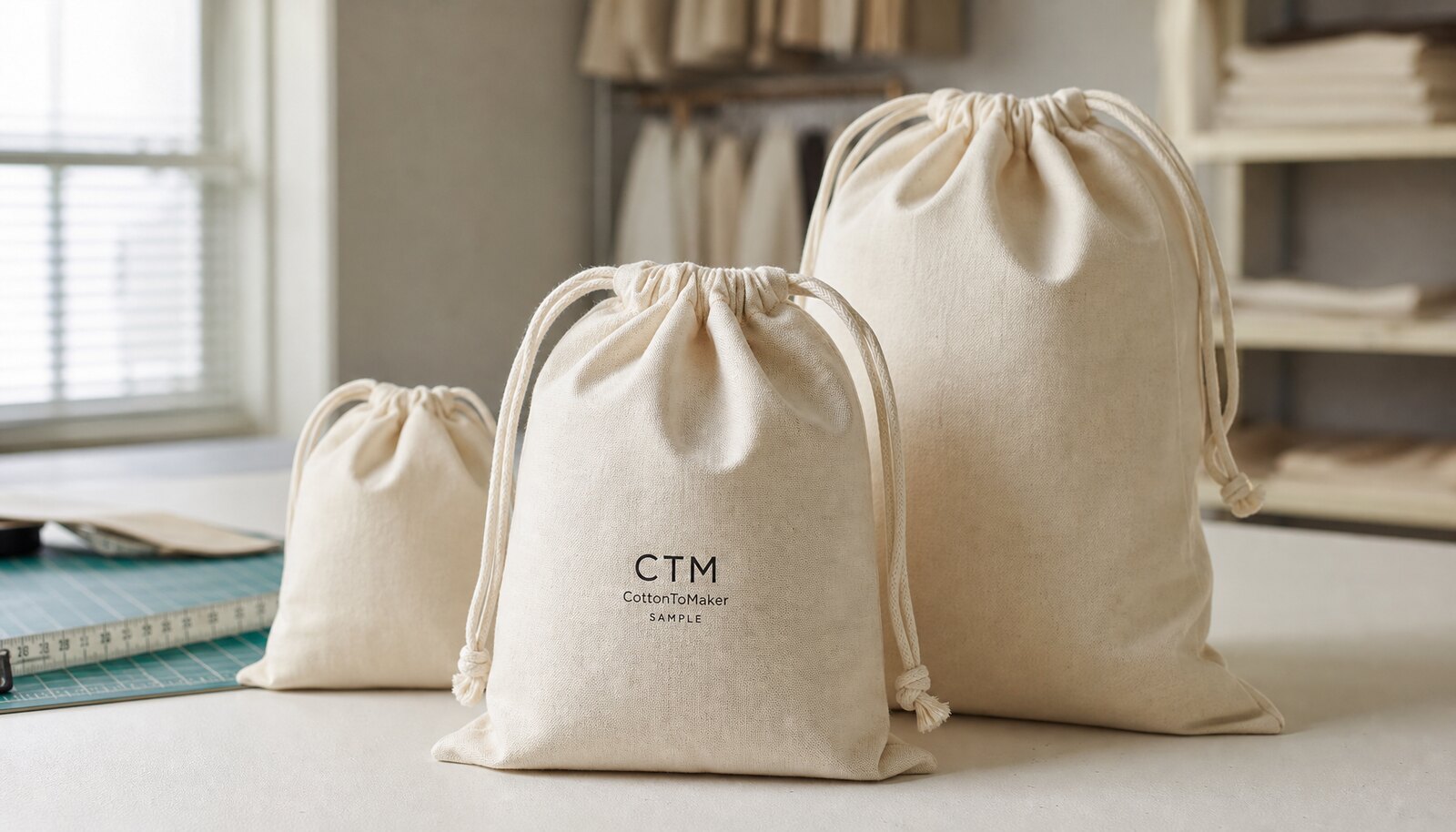
Why hotel buyers get cotton drawstring pouches wrong
For hotel programs, the pouch is not just a packaging accessory. It has to fit a defined kit, survive handling by housekeeping or guests, and look clean enough to sit in a room, spa basket, or welcome pack without making the brand look careless. Most sourcing problems start when buyers treat it as a simple textile item and skip the functional details that matter in daily use.
The most common failure is not a dramatic product defect. It is a spec mismatch: the pouch is a few millimeters too narrow for the intended bundle, the cord channel is too loose so the top edge ripples, or the print shifts just enough to look off-center in a room setting. A good RFQ for cotton drawstring pouches for hotels should reduce those risks before the quote arrives, not after the first shipment.
The buyer also needs to think in terms of usage frequency. A one-time welcome pouch can tolerate a lighter fabric and simpler stitching than a pouch meant for spa retail, reusable gift packs, or guest-facing repeat use. In hotel procurement, that difference changes the acceptable GSM, seam reinforcement, packing method, and inspection threshold. When those variables are not written into the PO, factories fill the gap with their own assumptions, and the result is often inconsistent.
The easiest way to prevent that outcome is to define the pouch as a component of a wider hotel kit. Measure the real contents, confirm how the pouch will be presented, and decide whether the pouch must merely hold items or also reinforce the brand image after opening. Those are different requirements, and the sourcing strategy should reflect that difference.
- Write the use case first: guest amenities, spa kit, laundry bundle, retail gift pouch, or room-service accessory.
- Measure the actual contents and specify the loaded dimension, not only the flat pouch size.
- Decide whether the pouch is disposable, reused a few times, or expected to survive multiple guest-handling cycles.
Select fabric weight, opacity, and finish based on the hotel use case
Fabric weight is one of the most important cost and quality decisions, and it is often described too loosely. If you only specify 'cotton pouch,' suppliers may quote very different materials. For most hotel uses, 120 to 140 GSM cotton is the practical range. It gives a soft hand feel, folds well in amenity packs, and keeps unit cost under control. If the pouch will carry slippers, multiple toiletries, or reused retail items, 160 GSM is a safer choice because it improves body and reduces collapse.
Do not over-specify heavyweight cotton unless the pouch truly needs structure. A 180 GSM fabric can feel premium, but it may become too bulky for small hotel kits and will raise freight cost because the finished carton becomes heavier. It can also make a small pouch harder to close neatly once filled. The right spec is not simply the thickest cloth; it is the weight that preserves presentation while keeping pack-out efficient.
Opacity matters as much as GSM. A light natural cotton pouch can look fine in a sample room and still show the outline of the contents when used in a guest room. If the hotel wants a cleaner front-of-house appearance, ask the supplier to confirm opacity using the actual intended contents inside the pouch. If the pouch will be washed, request a pre-shrunk or washed sample because finishing can change both GSM and hand feel.
The finish also affects perception. A slightly brushed or softened cotton may feel more premium, but it can also increase lint and raise the risk of print fuzziness. A tighter weave gives crisper print edges and better body, but may look less rustic. For B2B buyers, the decision should be tied to brand positioning and handling requirements, not only to the factory's stock fabric availability.
- 120 GSM: low-cost amenity pouch, lightweight inserts, short-use applications.
- 140 GSM: balanced option for most hotel and spa programs.
- 160 GSM: better for heavier contents, retail resale, or repeated guest use.
- Request a pre-production swatch or finished sample, not just a fabric card.
- If laundering is expected, ask for finished GSM after wash or finishing, not only base cloth weight.
Size, seam allowance, stitching, and cord details that affect usability
The finished size should be defined around what the pouch actually carries. A 10 x 15 cm pouch can work for soap, samples, or small jewelry items, but it is too small for a multi-piece welcome kit. A 15 x 20 cm size is a safer middle ground for standard hotel amenities. If the pouch must hold slippers, spa accessories, or laundry items, move to 20 x 30 cm or larger and confirm the loaded closure line, not only the flat size.
Procurement teams should state three dimensions, not one: flat width, height, and seam allowance. That matters because cotton fabric can vary slightly during sewing and pressing, and a pouch that looks compliant on paper can still arrive a few millimeters short if the seam allowance is not controlled. For branded hotel programs, that small difference can matter when the pouch must fit inside a tray, basket, or amenity box.
Stitch construction is another detail buyers should not leave vague. Single-needle side seams are common, but the top channel should have reinforced construction so the drawcord does not tear out under repeated use. A practical benchmark is around 8–12 stitches per 2.5 cm for woven cotton pouches, adjusted for fabric thickness and load. If the pouch is meant for reuse, ask for reinforcement at the cord entry points, such as a bartack or backstitch.
Cord and channel dimensions should be quoted together. A 2.5–4 mm cord is often suitable for small to medium hotel pouches, while the channel width typically needs to be around 1.5–2.5 cm depending on fabric and closure load. If the channel is too narrow, the cord abrades and the opening becomes difficult to pull. If the channel is too wide, the top edge may ripple and the pouch loses its clean silhouette. Ask the supplier to show the exact construction in the sample, not just describe it in the quote.
- Specify flat width, height, and seam allowance separately.
- State cord diameter and channel width together.
- Ask for stitch density and reinforcement method at the cord opening.
- If the pouch will be reused, request a pull test on the drawcord path.
Print method choice: appearance, durability, and cost tradeoffs
For hotel branding, one-color screen print is usually the most reliable and cost-effective option. It gives crisp logo edges on cotton, especially when the design is simple and the fabric is not too rough. It is the best choice when the pouch is part of a room amenity set, spa package, or housekeeping-controlled distribution. If the logo has fine lines or small text, make sure the line thickness is strong enough for screen print. Very thin details can fill in on textured cotton.
Heat transfer can work for small runs or more detailed artwork, but buyers should not treat it like a long-term equal replacement. It is faster to set up, yet the finish can show wear faster if pouches are handled often. It also increases the risk of visible edge lift after rubbing or folding. For a hotel item that may be touched by guests before the contents are removed, the visual durability of the logo matters as much as the unit price.
Woven labels, side labels, or sewn patches can create a more premium branded touch, but they add labor and can affect lead time. They also change the presentation of the pouch in subtle ways. A side label may be ideal when the logo should remain small and discreet, while a front label can become a brand feature. The best way to compare options is to ask the supplier to quote the same artwork in two methods if you are undecided: screen print versus sewn label. Then compare not just price, but also appearance, touch, and defect risk.
If the hotel program includes laundering or heavy rubbing, request a simple durability check on the approved sample. Even if the buyer does not need a formal lab test, a quick rub check and repeated fold test can reveal whether the logo will stay legible. That is especially useful for properties that want the pouch to be reused or kept by the guest after checkout.
- Simple logo: screen print usually wins on cost and consistency.
- Detailed art or short run: heat transfer may be acceptable, but durability is lower.
- Premium brand look: woven label or sewn patch may justify the added cost.
- For repeat-use programs, test print durability on the actual fabric, not only the artwork file.
How MOQ works when factories quote cotton drawstring pouches
MOQ for cotton drawstring pouches for hotels is usually driven by three things: fabric availability, print setup, and packing customization. A factory can sometimes make 500 pieces from stock cotton with one-color print, but if you want custom color fabric, a special cord, or branded labels, the MOQ rises because each variable adds setup and material risk. Buyers sometimes compare unit prices without noticing that one quote includes a basic stock pouch while another includes all branded elements.
A practical MOQ for a first order is often 500 to 1,000 pieces per design when using stock natural cotton and a single logo print. If the hotel group needs multiple property names, different sizes, or several print placements, the order should be split carefully. It is better to keep one base pouch spec and vary only the print if you want the best price and easiest replenishment later. That gives procurement a more predictable reordering path and lowers the chance of leftover inventory in the wrong design.
When the supplier offers a very low MOQ, confirm whether they are using stock leftovers, mixed production lots, or higher print charges hidden in the sample fee. Also ask whether the MOQ is tied to one design, one print color, one fabric color, or one carton label version. Those details determine whether the quote is genuinely usable for hotel procurement or only attractive on paper.
For buyers managing multiple hotel properties, there is often a threshold where it is better to standardize one pouch across all sites. If the only variation is the property name on the logo, the specification stays stable and the factory can hold the same cutting, stitching, and packing process. If the group keeps changing size, label, and print method by property, the MOQ becomes more expensive and replenishment becomes more fragile.
- One design, one size, one print color gives the cleanest MOQ.
- Custom dyeing, special labels, and complex artwork push MOQ up fast.
- Ask whether setup fees are refundable or amortized into unit price.
- Clarify whether the MOQ applies per SKU, per artwork version, or per shipment.
Decision matrix: direct factory vs trading company vs local converter
The right sourcing route depends on buying structure and control needs. A hotel procurement team with repeat annual replenishment usually benefits from direct factory sourcing because it gives better control over fabric, stitch quality, and reorders. Importers and distributors may prefer a trading company when they need multiple products consolidated in one shipment or when internal resources are thin. Local converters can be useful when the final packaging, kitting, or last-mile presentation matters more than the textile itself.
The economic question is not only unit price; it is landed cost. Direct factory sourcing often wins when volume is stable, specs are clear, and the buyer can manage sampling and inspection discipline. A trading company can be economically superior if it reduces project management time, consolidates several items into one shipment, or solves language and time-zone friction that would otherwise delay the launch. A local converter may cost more per pouch, but it can save money if it avoids kitting errors, shortens replenishment cycles, or handles special room-by-room distribution packaging.
A useful rule is this: choose direct factory when you care most about unit cost, repeatability, and spec control; choose trading when your order has multiple SKUs, changing timelines, or a need for coordinated service; choose local conversion when the pouch is part of a broader packaging or gifting workflow that must be assembled close to the destination market. The important point is that the route should match the operational burden, not just the price quote.
Buyers should ask every route for the same documentation: spec sheet, sample, production lead time, packing format, and inspection method. Without that, the cheapest quote is often the least comparable one. In hotel supply, a few cents saved on paper can disappear quickly if the goods arrive with the wrong size, the wrong logo placement, or pack-out errors that require manual rework at receiving.
- Direct factory: best when volume is repeatable and the buyer can enforce detailed QC.
- Trading company: best when multiple SKUs, faster coordination, or lower internal sourcing capacity matter.
- Local converter: best when kitting, packing, or last-mile presentation is more important than textile-only cost.
- Compare landed cost, not only ex-factory price.
Comparison table: sourcing routes for hotel pouch buyers
Use the same spec sheet for every route so the comparison is real. A quote that looks cheaper may still be more expensive once sampling, internal coordination, freight, relabeling, and rework risk are included. The matrix below is designed for procurement teams that need a practical decision, not a generic supplier list.
When comparing routes, remember that packaging and labeling can shift the cost structure. If the pouches need individual polybags, barcode labels, room-number labels, or bundled sets by property, the extra labor may sit with the supplier or with your own warehouse team depending on the route. That is part of landed cost and should be included in the decision.
- Ask each supplier to quote the same spec version and packing format.
- Include sample cost, freight mode, and carton configuration in the comparison.
- Score not just price, but also responsiveness, QC transparency, and repeat-order stability.
What a usable quote should include and what landed cost really depends on
A good factory quote should let you compare apples to apples. It should state the exact fabric composition and GSM, the finished size, cord type, print method, packing count, and delivery lead time. If the offer only says 'cotton pouch with logo,' the quote is too vague to support a purchasing decision. Buyers need enough detail to see where the price is coming from and where the risk sits.
You should also separate one-time charges from recurring charges. Screen setup, artwork preparation, custom label development, and sample courier fees can distort the first quote. If the supplier spreads those costs across the unit price without stating it clearly, repeat orders may be cheaper or more expensive than expected. The most useful quote format lists sample cost, setup cost, production unit price, packing cost, and shipping terms independently.
Landed cost depends on more than production price. For cotton drawstring pouches for hotels, the practical cost drivers are fabric weight, print method, cord type, sewing complexity, packing format, inspection burden, and freight density. A heavier pouch can increase carton volume and freight cost; a more detailed label can increase labor; and a custom inner pack can turn a low-cost textile item into a handling-heavy goods flow. Buyers should request separate pricing for base pouch, logo application, packing, and carton markings if they want to know where savings are possible.
There is also a decision threshold by use case. If the pouch is for a one-time amenity or temporary welcome kit, paying for premium construction may not be necessary. If it will be reused, kept by the guest, or used in a spa retail setting, the cost premium for better print durability, tighter stitching, and a cleaner finish is easier to justify. Procurement works best when the spec matches the commercial role of the pouch.
- One-time charges: screen setup, dye match, label development, sample freight.
- Recurring charges: fabric, cord, sewing labor, print, packing, cartons.
- Commercial terms: Incoterms, payment milestone, and quotation validity.
- Ask for a separate line showing any handling charge for inner bundling or room-ready packing.
QC thresholds that stop avoidable hotel complaints
For hotel supply, QC should focus on visible consistency and functional performance, not just a generic inspection pass. The pouch must look neat when placed on a tray or in a guest room, so print placement and seam quality matter as much as strength. A practical tolerance can be written as finished size within a narrow range, correct print position, secure top channel, and no loose threads or oil marks. If the hotel brand is strict about presentation, a slightly higher visual standard is worth the extra sorting time at the factory.
Sample approval should be based on use, not only appearance. Fill the pouch with the real amenity bundle and close it several times. That simple check reveals whether the cord is too thin, whether the opening collapses awkwardly, and whether the fabric weight feels right once loaded. Also inspect the sample under room lighting, not only under factory daylight. A logo that looks clean in the sample room can appear off-center or too faint in a hotel room with warmer light.
A stronger QC plan uses a written checklist with specific acceptance criteria. For example: no more than one minor stitching defect in the inspection sample; size within agreed tolerance; print centered within the approved visual window; cord moves smoothly without snagging; no smell, contamination, or visible stain; carton count exact; and no mixed SKU packing. For AQL planning, many buyers use a standard visual inspection framework such as AQL 2.5 for major defects and a tighter check for critical presentation defects, but the exact target should be stated in the PO or inspection plan.
Sampling logic also matters. A small initial order may justify 100% review of the first production batch or a more intensive pre-shipment inspection because the cost of a failure is higher than the inspection effort. Larger repeat orders can use randomized sampling, but only if the supplier has proven process control. In other words, the inspection method should reflect order size and risk, not remain fixed for every program.
- Inspect the first sample with the actual hotel kit inside.
- Write a tolerance range for width, height, print placement, and cord length.
- Define major versus minor defects before production starts.
- Use AQL sampling plus a practical function test; do not rely on visual pass alone.
Packing, labeling, and lead time planning for hotel distribution
Packing format changes the handling cost more than many buyers expect. Bulk pack by carton is usually the lowest-cost option, but if the hotel wants direct distribution to rooms or gift bags, inner packs may be needed. That adds labor and may increase carton size. Cotton pouches can also crease if over-compressed, so the carton count should be set to avoid flattening the product too tightly. For branded hotel supply, a clean pack-out matters because the pouch may be seen immediately after opening.
Labeling should be specified as carefully as the pouch itself. If the hotel needs barcodes, property names, SKU codes, or room-ready labels, the supplier should confirm label size, position, adhesive type, and whether labels go on each pouch, each inner pack, or each outer carton. A labeling mistake can create receiving delays and inventory confusion even when the pouch itself is correct.
Lead time should be built around approvals. A typical cycle for a simple cotton drawstring pouch is sample confirmation, material preparation, printing and sewing, then final inspection and packing. If the quote says four weeks but sample approval is still pending, the real schedule is longer. Procurement teams should separate sample lead time from mass production lead time and keep a buffer for artwork changes or reprint issues. Rush orders often cost more because factories must reschedule print lines or source stock fabric at a higher price.
For hotel opening projects, the safest approach is to fix the spec early and lock the artwork before the production slot is booked. The closer the delivery is to a launch date, the more important it becomes to avoid complex customizations that slow down approval. A simple, repeatable pouch with stable artwork is easier to replenish than a highly customized run that requires re-approval every time a property needs stock.
- Bulk carton pack is cheapest, but only if warehouse handling is controlled.
- Inner packs help room distribution and retail presentation.
- Specify barcode, property label, and carton mark requirements separately.
- Protect the schedule by approving artwork, PPS, and carton markings before production starts.
Specification comparison for buyers
| Spec decision | Recommended option | When it fits | Buyer risk to check |
|---|---|---|---|
| Fabric weight | 120–140 GSM cotton for toiletry and amenity pouches; 160 GSM if the pouch must hold heavier items or feel premium | Hotel welcome kits, spa sets, laundry accessories, small retail add-ons | Too-light fabric can look wrinkled, show contents, and distort after filling; too-heavy fabric increases unit cost, carton weight, and freight |
| Closure style | Single drawstring channel with cotton cord for standard use; double cord only when uniform closure tension or faster opening is required | Amenity sets, laundry pouch use, travel kits, branded giveaway packs | Weak channel stitching causes cord pull-out; inconsistent cord length creates poor symmetry and a lower-end presentation |
| Stitch construction | Single-needle side seams with reinforced top channel; bartack or backstitch at cord entry points if the pouch will be reused | Spa programs, retail resale, premium welcome gifts, repeated guest handling | No reinforcement at stress points increases fraying and seam opening after repeated closure cycles |
| Stitch density | About 8–12 stitches per 2.5 cm for woven cotton pouches, adjusted for fabric thickness and seam load | Most hotel pouches, especially where appearance and durability both matter | Too-low density can loosen under load; too-high density can pucker light cotton and reduce visual quality |
| Print method | 1-color screen print for simple logos; heat transfer only for short runs or detailed artwork; woven label when durability and a premium look matter more than lowest cost | Hotel logos, resort branding, retail gift sets, repeat replenishment programs | Fine lines may fill in on screen print; transfer prints can crack or peel if rubbed hard or washed |
| Pouch size | 10 x 15 cm to 15 x 20 cm for small amenities; 20 x 30 cm for slippers, toiletries, or accessory bundles | Depends on product bundle and whether the pouch is reused by guests | Ordering by guesswork leads to wasted fabric or a pouch that cannot close properly when filled |
| Cord material | Cotton cord for a natural look; polyester cord only if abrasion resistance matters more than a fully natural hand feel | Eco-focused hotels, lifestyle brands, spa and resort sourcing | Cord diameter too thin makes the pouch hard to close; too thick can distort the opening or jam the channel |
| Cord/channel dimensions | Cord diameter commonly 2.5–4 mm for small pouches; channel width typically 1.5–2.5 cm, depending on fabric and closure load | Standard amenity packs and lightweight gift pouches | If the channel is too narrow the cord abrades; too wide weakens the top edge and looks sloppy |
| Factory route | Direct factory sourcing for stable repeat orders; trading company only if consolidation, faster communication, or mixed SKU sourcing is needed | Multi-property hotel groups, importers managing several lines, buyers with limited sourcing staff | Trading quotes may hide actual fabric specs, finishing method, or subcontracting risk |
Buyer checklist before sampling
- Define the pouch use case first: guest amenity, spa kit, laundry bag, retail add-on, or room-service accessory.
- Set the spec around the loaded use case, not the empty pouch photo. Include the heaviest intended contents, fill level, and how often the pouch will be reused.
- Lock the fabric target in GSM, not just 'cotton': specify 120, 140, or 160 GSM depending on feel, opacity, and load.
- State finished size, seam allowance, and dimensional tolerance so the pouch still closes when the hotel kit is inserted.
- Specify stitch type, seam allowance, stitch density, and reinforcement points at the cord opening and side seams.
- Choose one print method and one artwork color for the first quote unless you truly need multi-color decoration.
- Specify cord type, cord diameter, channel width, and whether cord ends need knots, heat sealing, or metal tips.
- Ask for color control details: PMS reference, print tolerance, and whether natural cotton shade variation is considered acceptable.
- Request sample photos or a pre-production sample showing print placement, stitch line, seam finish, and cord closure before mass production.
- Confirm packing count per polybag, carton count, carton mark requirements, and any hotel-specific labeling.
Factory quote questions to send
- What is the exact fabric composition and finished GSM after washing or finishing?
- Is the quote based on dyed fabric, greige stock fabric, pre-shrunk fabric, or a custom color match?
- Which print method is included, how many colors are covered, and what is the screen/setup charge?
- What finished size tolerance do you guarantee on width, height, and drawcord length?
- What seam allowance, stitch density, and reinforcement method are included in the offer?
- What cord diameter, cord type, and channel construction are included in the offer?
- Is the MOQ tied to one design, one print color, one fabric color, or one carton label version?
- What is the sample cost, sample lead time, and can the sample fee be refunded against the order?
- What packing format is included: bulk pack, individual polybag, or branded insert packing?
- What is the standard production lead time after sample approval and deposit?
Quality-control points to confirm
- Fabric weight must match the approved range; confirm both stated GSM and the actual hand feel after finishing, and reject thin patches, slubs, or visible transparency beyond the agreed level.
- Finished dimensions must stay within written tolerance on width and height; check at least three points across multiple samples because cotton can vary after sewing and pressing.
- Side seams and bottom seam must be straight and secure, with no skipped stitches, open ends, loose threads, seam puckering, or seam wave at the top channel.
- Stitch density should match the approved spec; if the sample shows long stitches or visibly uneven lockstitch tension, do not release production.
- Drawcord must pass smoothly through the channel, close the pouch without twist or jam, and maintain similar left-right pull length after repeated opening and closing.
- Cord ends must be consistent: both ends knotted, heat-sealed, or tipped as specified; frayed ends are not acceptable on hotel-facing products.
- Print must be centered to the approved artwork position, with clean edges, correct logo color, no smearing, no cracking, and no obvious show-through from the reverse side.
- If a woven label or side label is used, placement must be consistent, label edges must be clean, and the label must not interfere with closure or comfort.
- Random samples should be checked for odor, contamination, oil marks, needle damage, broken threads, and fabric discoloration before shipment.
- Carton count must be exact, inner pack labeling must match the PO, and no mixed sizes, mixed artwork, or mixed shades are allowed in the same shipment unless approved.