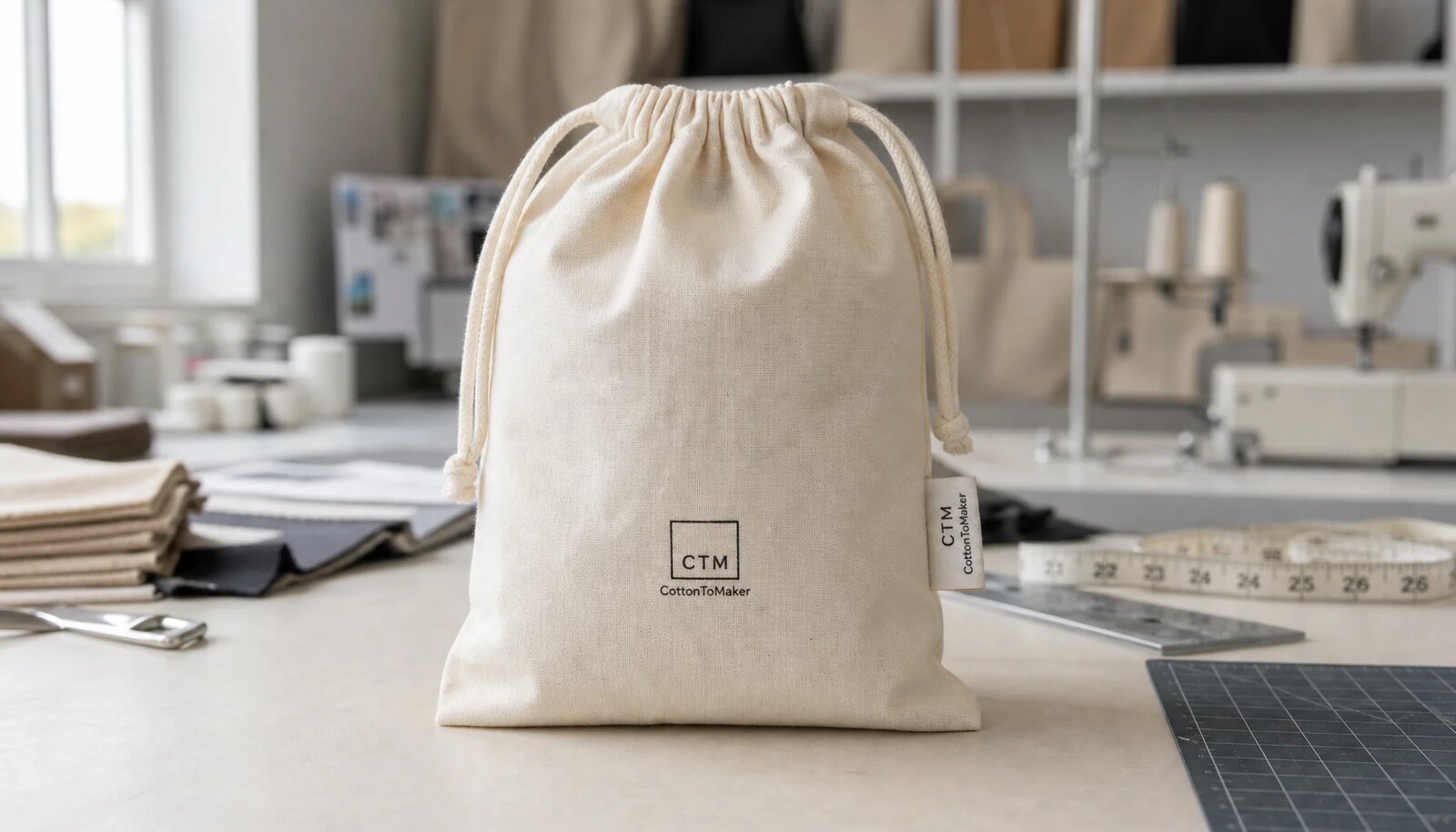
Start with the hotel retail use case, not the pouch name
A cotton drawstring pouch for hotel retail is not the same buying problem as a giveaway bag. It may be sold in a boutique gift shop, bundled with spa products, used as a branded amenity upsell, or placed beside travel accessories where guests judge the hotel brand by small details. Procurement still needs a competitive unit price, but the product also has to look orderly on a shelf, scan correctly at checkout, arrive in clean cartons, and carry the right compliance information for the destination market.
That is why a supplier compliance checklist should begin with how the pouch will move through the business. Will the hotel receive mixed SKUs at property level, or will a distributor break cartons down? Does the pouch need an external barcode, hang tag, price ticket, or inner pack label? Will the pouch sit loose in a basket, hang on a peg, or be sold as part of a kit? These choices affect fabric weight, fold direction, label placement, carton count, and inspection standards. A beautiful pouch that requires hotel staff to relabel every unit is not a bargain.
The commercial goal is to remove assumptions before suppliers quote. If one supplier prices a 90 GSM plain cotton pouch in bulk cartons and another prices a 140 GSM pouch with barcode labels, hang tags, SKU-separated inner packs, and stronger cartons, the lower quote is not really lower. It is simply missing work that someone else will pay for later.
- Define the retail role: standalone item, gift-with-purchase, spa kit, amenity upsell, or product packaging.
- Map the receiving path: factory to distributor, warehouse to hotel, or direct-to-property shipment.
- Treat barcode, label, fold, carton, and documentation requirements as part of the product spec, not afterthoughts.
Build a spec that suppliers can price without guessing
The strongest RFQ for cotton drawstring pouches is specific enough that every supplier prices the same item. Start with finished size, not cut size. Finished width and height should be measured flat, with the drawcord channel included or excluded according to your standard. If the pouch must hold a boxed soap, candle, jewelry item, skincare bottle, key card set, or small resort gift, include the product dimensions and target usable internal space. The drawcord channel can reduce usable depth more than buyers expect.
Fabric specification needs the same discipline. State fiber content, weave, GSM, finish, and color. For many hotel retail uses, 80-120 GSM cotton can work for lightweight packaging or low-price goods, while 120-160 GSM usually gives a cleaner handfeel, stronger shelf presence, and better print opacity. Heavier cotton canvas can be appropriate for premium products, but it changes folding, freight weight, and carton compression behavior. If the fabric is natural cotton, confirm acceptable seed specks and shade variation; if it is dyed, specify the color standard and colorfastness expectation.
Do not leave the drawcord vague. Cord material, diameter, length, color, knot style, and end finish affect both appearance and function. A thin cord can make the pouch look cheap even when the fabric is acceptable. A cord that sheds, frays, or snags can create returns or poor guest experience. For retail goods, the closure is visible branding, not a minor trim line.
Decoration should be quoted with artwork position, print size, color reference, and print method. Single-color screen print is often the most stable option for simple hotel logos. Heat transfer, digital print, woven labels, or sewn side tags may be better for different artwork or handfeel requirements, but each has different testing needs. The RFQ should state whether the supplier must match Pantone, brand color files, or an approved physical sample.
- Specify finished measurements, usable space, measurement method, and tolerance.
- Define cotton by composition, weave, GSM, finish, shade standard, and shrinkage expectation.
- Include cord diameter, length, color, end finish, print method, artwork size, and label placement in the RFQ.
Make compliance evidence specific to retail cotton pouches
Generic compliance language is not enough for hotel retail. A buyer should ask what documents are required by the destination market and by the hotel brand, then connect those documents to the actual fabric, cord, ink, label, and packaging used in production. A factory profile, old test report, or broad statement that goods are compliant does not prove the bulk order is ready for retail.
For cotton pouches, likely checks include fiber content labeling, country-of-origin marking, care or warning labels if applicable, and restricted-substance controls. Depending on destination and product positioning, buyers may need evidence related to banned azo dyes, formaldehyde, lead, cadmium, phthalates where relevant, nickel in metal trims if used, REACH SVHC screening for the EU or UK, and California Prop 65 review for goods sold into California. Requirements differ by market, product claim, and sales channel, so the supplier should not decide the document list alone. Confirm requirements with your importer, compliance team, legal advisor, or destination-market specialist before PO release.
Packaging compliance matters too. If individual polybags are used, suffocation warnings may be required by some buyers or jurisdictions. If hang tags, paper inserts, recycled claims, organic claims, or sustainability marks are used, the claims need supporting records. If the pouch is sold as retail packaging for another product, label requirements may depend on the filled item as well as the pouch. Procurement should clarify whether the pouch itself is the retail product, packaging for a product, or part of a kit.
Traceability is the practical foundation. Ask the supplier to identify fabric lot, cord lot, ink batch, label batch, and production date. The compliance pack should show which records are supplier declarations and which are third-party lab reports. For repeat orders, require notice before fabric source, dyehouse, printer, or packing method changes. Substitution is where many pouch orders lose compliance discipline.
- Ask for fiber content, country-of-origin, restricted-substance, and packaging documentation tied to the actual bulk materials.
- Confirm market-specific needs such as REACH, UK REACH, Prop 65, CPSIA only if relevant, and retailer-specific documentation before placing the PO.
- Require change notification for fabric, trim, ink, label, printing site, packing method, or production factory changes.
Compare supplier quotes by total landed work, not unit price
A useful quote separates what is included from what is assumed. For hotel retail cotton drawstring pouches, ask suppliers to break out fabric, cutting, sewing, drawcord, decoration setup, decoration run cost, labels, hang tags, barcode stickers, inserts, inner packs, master cartons, testing, inspection support, export documents, and freight terms. A single unit price may look efficient, but it hides the choices that create later cost.
The most common quote distortion is fabric weight. A 100 GSM pouch and a 140 GSM pouch may both be called cotton drawstring pouches, but they do not have the same handfeel, opacity, print result, or shelf presence. Print assumptions create a second distortion. One supplier may include a one-color screen print at one position, while another assumes blank goods or charges setup later. Packing is the third distortion. Bulk packed pouches can be fine for warehouse repacking; they are expensive if hotel staff must sort, label, fold, and rebag them before selling.
Normalize every quote before comparison. Use the same finished size, GSM, color, print method, artwork position, label placement, barcode format, inner pack count, carton mark, AQL expectation, and test plan. Then look at commercial terms: MOQ per SKU, lead-time stages, payment terms, overrun or underrun allowance, sample cost, reprint policy, and who pays for failed inspection or retesting. The better supplier is the one whose quote makes the landed workflow predictable.
For hotel retail, repacking cost deserves special attention. If a cheaper supplier ships mixed SKUs in weak cartons with no barcode separation, the buyer may pay for sorting, relabeling, counting, and handling claims. A retail-ready supplier may look higher on unit price but lower after labor, receiving delays, shrink, and launch risk are included.
- Compare quotes only after normalizing fabric, print, label, pack-out, QC, and documentation assumptions.
- Ask suppliers to separate fixed setup charges from repeat-order unit pricing.
- Include downstream work such as barcode correction, repacking, sorting, and receiving exceptions in the cost comparison.
Control MOQ, SKU structure, and lead time before artwork approval
MOQ is rarely just one number. It can apply per fabric color, per size, per print color, per artwork position, per barcode, per hang tag, or per carton configuration. If a hotel group wants the same pouch for multiple properties with small logo differences, the program may become several small production runs rather than one efficient order. Before artwork approval, procurement should decide which variations are commercially necessary and which can be standardized.
A simple first order often performs better than a wide assortment. One fabric, one size, one logo color, one packing format, and one barcode is easier to control. After the supplier proves fabric consistency, printing, packing, and documentation, the buyer can add sizes or property-specific branding. If the first order launches with too many variants, the risk of mixed cartons, wrong labels, mismatched artwork, and delayed packing increases.
Lead time should be written as a sequence. Ask for dates for artwork proof, sample making, sample transit, sample approval, fabric booking, fabric dyeing or preparation if needed, printing, sewing, in-line inspection, final inspection, packing, and ex-factory release. A supplier who gives only one shipment date may still be reliable, but the buyer has no early warning system. Stage dates make delays visible while they can still be corrected.
Peak-season planning is especially important for hotel retail. Resort openings, holiday gift shop resets, spa promotions, and conference events often have fixed dates. If printing or packing is outsourced, confirm the subcontractor schedule and holiday calendar. If barcode files, hang tags, or inserts are supplied by the buyer, build approval time into the plan. Many pouch delays are not sewing delays; they are artwork, label, or packing-detail delays.
- Clarify MOQ per size, color, print, barcode, hang tag, and carton setup.
- Reduce first-order variation when possible, then expand the program after the supplier proves control.
- Require a stage-based lead time with dates for sample, material, print, sewing, inspection, packing, and ex-factory release.
Sample approval should test the final retail reality
A sample is not an approval tool unless it is made from the same material stack planned for bulk. Sales samples often use available cotton, substitute cord, different ink, or hand-finished stitching. They can help with early design direction, but they should not release production. For procurement, the important sample is the pre-production sample: final fabric, final GSM, final cord, final print, final label, final fold, final barcode, and final packing method.
Measure the sample the same way the final inspector will measure it. State whether width is measured across the top opening or body, whether height includes the drawcord channel, and whether the pouch is measured before or after packing recovery. For small pouches, a few millimeters can determine whether the hotel product fits. Keep one signed control sample with the buyer and one with the factory, including swatches, trim references, and approved artwork placement.
The sample should be handled like retail stock, not protected like a showroom item. Pull the drawcord repeatedly, place the intended product inside, check whether seams strain, inspect whether the print cracks or rubs, fold it into the proposed pack-out, and leave it compressed long enough to see whether creasing is acceptable. If the pouch will sit under store lighting, view the print in that environment. Natural cotton can show slubs and seed flecks; decide what is acceptable before production, not after cartons arrive.
Top-of-production approval adds another control point. Ask the supplier to send photos or samples from the first bulk line output before full production continues. This is where buyers catch fabric shade drift, print placement movement, weaker cord, label misplacement, or packing deviations. It is cheaper to stop after the first cartons than after the full order is packed.
- Use sales samples for design direction only; use final-material pre-production samples for approval.
- Approve measurement method, tolerance, print position, cord function, label placement, and pack-out together.
- Request top-of-production evidence before the factory completes the full bulk run.
QC points that belong in the purchase order
Quality control should be written into the PO or inspection checklist, not negotiated after a defect appears. A typical soft-goods inspection may use General Inspection Level II with AQL targets such as 0.0 critical, 2.5 major, and 4.0 minor, but the exact plan should match buyer policy, order size, and product risk. The key is to define the standard before production so the supplier understands what will trigger rework or rejection.
Measurement control comes first. Inspectors should check finished width, height, drawcord channel depth, usable internal space, and cord length against the approved tolerance. The method should be consistent: flat, relaxed, on a clean table, with a calibrated ruler or tape, and with enough samples across cartons to catch variation. If the pouch is dyed or washed, add shrinkage expectations and test method where relevant.
Construction checks should include stitch density, seam allowance, skipped stitches, loose threads, broken seams, needle cuts, bar-tack or reinforcement placement, bottom corner strength, and drawcord function. For light to midweight cotton pouches, buyers often specify a practical stitch density such as 8-10 stitches per inch unless the design requires a different standard. A simple seam-strength or load test should reflect the expected contents. A pouch sold with a small soap does not need the same load target as one carrying a glass candle, but both need a written expectation.
Print and color checks are equally important. Confirm artwork position, registration, opacity, color match, edge sharpness, pinholes, smearing, cracking, and rub resistance. A dry rub and light wet rub check can reveal poor ink cure or transfer risk. For dyed cotton, check dry and wet colorfastness expectations and confirm the cord does not bleed onto the pouch body. For retail goods, barcodes should be scanned, not just visually inspected.
Packing QC should verify inner counts, SKU separation, carton marks, label placement, moisture protection, and carton strength. Run carton handling checks appropriate to the route, including drop handling, tape security, compression risk, and carton condition. Defect classes should be clear: wrong barcode, wrong country-of-origin mark, unsafe contamination, or mixed SKU cartons can be critical; weak seams, wrong size, poor print, or failed drawcord can be major; slight loose threads or minor fold marks within tolerance may be minor.
- Set AQL, inspection level, defect classes, measurement method, and acceptance tolerances before production.
- Inspect size, GSM, stitching, seam strength, cord function, shrinkage, colorfastness, print rub, barcode scanability, and carton strength.
- Make failed inspection responsibility clear, including rework timing, retesting cost, and shipment-release rules.
Retail packing and receiving rules can protect margin
Hotel retail programs often lose money after production because receiving rules were not translated into the supplier pack-out. A distributor may require one SKU per carton, scannable carton labels, specific carton dimensions, or advance packing lists. A hotel property may need smaller inner packs because storage space is limited. A boutique gift shop may want pouches pre-folded, hang tagged, or individually bagged so staff can place them on shelf without extra handling. These details belong in the RFQ.
Barcode and SKU control deserve precise instructions. State whether the barcode goes on the pouch, hang tag, polybag, inner pack, or master carton. Confirm barcode size, quiet zone, print contrast, and scanability. If the same pouch is sold across several properties with different price tickets or property codes, require clear carton separation and packing-list detail. Mixed labels are a small factory mistake that becomes a large receiving problem.
Shelf presentation should guide folding and protection. A natural cotton pouch can arrive wrinkled if packed too tightly or compressed unevenly. A printed face can abrade if pouches rub against each other during transit. Ask for approved fold direction, bundle count, tissue or separator use where needed, and carton fill that prevents both crushing and shifting. If individual polybags are used, confirm material, warning text where required, ventilation holes if specified, and whether the buyer accepts the plastic footprint.
Carton marks should be operational, not decorative. Useful marks include buyer name, PO number, SKU, color, size, quantity, carton number, country of origin where required, net weight, gross weight, carton dimensions, and handling marks if needed. Packing lists should match the carton contents exactly. For hotel retail buyers, clean receiving means fewer manual counts, fewer shortages, fewer chargebacks, and fewer emergency repacks before a launch date.
- Specify fold direction, bundle count, barcode position, inner pack, master carton count, and carton marks.
- Require one SKU per carton unless mixed cartons are intentionally approved and clearly documented.
- Check whether shelf-ready packing costs less than downstream hotel or distributor repacking labor.
Choose the sourcing path that matches risk, speed, and control
Direct factories, trading companies, specialized workshops, and retail-ready suppliers can all be valid choices. The right route depends on what the order needs most. If the program is repeatable, branded, and compliance-sensitive, a direct sewing factory or specialized cotton bag workshop gives procurement better visibility into fabric, construction, sampling, and in-line correction. The buyer may need to manage more detail, but the control is valuable.
A trading company can make sense when the hotel retail assortment includes multiple product categories, small runs, or complicated coordination across inserts, labels, gift boxes, and freight. The key is transparency. Ask for the production factory name, subcontracted steps, who owns QC decisions, and whether compliance documents are tied to the actual pouch or only to the trader's supplier network. The trading company should add coordination value, not hide the production trail.
Retail-ready suppliers can be worth the premium when receiving efficiency is a real cost. If the supplier can handle barcode labels, hang tags, SKU separation, carton marks, packing lists, and stronger cartons correctly, the buyer may save more in warehouse and hotel labor than the unit price difference suggests. This is especially true for launches, seasonal promotions, or distributed hotel groups where errors multiply across locations.
Before awarding the order, score suppliers on evidence, not sales confidence. Review the quote, sample, compliance pack, QC plan, packing plan, and lead-time schedule together. Ask what happens if fabric shade changes, if print fails a rub test, if cartons are short, if barcodes do not scan, or if final inspection fails. A supplier that answers these questions clearly is usually safer than one that promises the lowest price with few details.
- Use direct or specialized suppliers when compliance, construction control, and repeatability matter most.
- Use trading or retail-ready suppliers when coordination, mixed assortments, or shelf-ready packing is the larger need.
- Award based on spec control, document quality, QC discipline, packing capability, and clear corrective-action process.
Specification comparison for buyers
| Supplier option | What to verify | Commercial advantage | Buyer risk to control |
|---|---|---|---|
| Direct sewing factory | cord material proof, reinforcement close-ups, load-test photos, approved sample tag, and bulk-line first-piece record | Better sample-to-bulk control and faster production feedback | May be weaker on export paperwork or branded packing unless checked early |
| Trading company | Factory name, production photos, trim-source proof, and who owns QC decisions | Can coordinate small mixed orders and extra services | Markup can hide real factory capability and slow defect decisions |
| Specialized bag workshop | cord diameter, eyelet or reinforced channel, bottom corner reinforcement, seam allowance, bar-tack position, and load target | More practical for detailed construction, trims, and repeat programs | Capacity may be limited during peak seasons |
| Low-price general supplier | 6-10 oz cotton canvas, 210D polyester, rPET, or blended cotton with shrinkage and colorfastness expectations set before sampling | Useful for simple promotional runs with loose specs | Material downgrades, weak packing, and vague inspection scope can erase savings |
| Retail-ready supplier | fold direction, cord protection, bundle count, carton compression, moisture bag, and retail label position | Can handle labels, SKU separation, carton marks, and receiving rules | Higher unit cost must be compared against reduced warehouse work |
| Compliance-focused supplier | Fabric records, labeling review, test plan, and production traceability | Safer for retail programs and repeat brand orders | Documentation claims need evidence, not only sales language |
| Local sample room plus bulk factory | Signed sample, bulk factory handoff, first-piece photos, and deviation owner | Good for complex branding before large production | Sample room quality may not match bulk line unless handoff is controlled |
Buyer checklist before sampling
- Define finished pouch size, usable internal space, seam allowance, drawcord opening, cord length, and closure style before requesting price.
- Lock body fabric by fiber content, weave, GSM, finish, color standard, shrinkage limit, and approved tolerance range.
- State whether cotton must be conventional, organic, recycled-content blend, undyed, bleached, dyed, or certified to a specific buyer requirement.
- Specify print method, artwork count, print position, maximum print area, color reference, ink type, and acceptable print variation.
- Confirm fiber content labeling, country-of-origin marking, care or warning labels if required, and retail label placement for the destination market.
- Ask for restricted-substance evidence relevant to the order, such as azo dye, formaldehyde, lead, phthalates where applicable, REACH SVHC, or California Prop 65 review.
- Separate product price, decoration charge, labeling charge, barcode or hang tag charge, retail packing, testing, carton cost, and freight assumptions in the quote.
- Confirm whether MOQ applies per size, per color, per print, per fabric lot, per barcode/SKU, or per carton configuration.
- Request a pre-production sample made with final fabric, cord, label, print, fold, barcode, insert, and carton packing method.
- Set AQL, inspection level, measurement method, stitch-density expectation, seam-strength or load-test requirement, shrinkage limit, and defect classification in writing.
Factory quote questions to send
- What is the exact pouch body composition, weave, finish, GSM, and color reference, and what tolerance are you quoting against?
- Is the cotton fabric greige, bleached, dyed, washed, brushed, organic, recycled blend, or otherwise treated, and can you document that material?
- Which production site will cut, sew, print, label, and pack the order, and which steps, if any, are subcontracted?
- What compliance documents can you provide for the actual fabric, drawcord, ink, label, and packaging used in bulk production?
- Can you support fiber content labeling, country-of-origin marking, and destination-market documentation for the United States, European Union, United Kingdom, Canada, or our named market?
- Have the dyes, inks, or trims been screened for restricted substances such as banned azo dyes, formaldehyde, lead, phthalates where applicable, REACH SVHC, and Prop 65-listed chemicals where applicable?
- What is the standard finished-size tolerance after sewing, and do you measure flat, relaxed, before packing, or after packing recovery?
- What stitch density, seam allowance, channel construction, bar-tack position, and drawcord diameter are included in the price?
- Which print method are you quoting, what setup charges apply, and how will you test adhesion, rub resistance, and color matching on cotton?
- What is the MOQ per size, fabric color, print color, artwork position, barcode/SKU, and retail packaging format?
Quality-control points to confirm
- Use a written inspection plan, commonly General Inspection Level II with AQL targets such as 0.0 for critical defects, 2.5 for major defects, and 4.0 for minor defects unless the buyer requires a different standard.
- Measure finished pouch width, height, drawcord channel depth, usable internal space, and cord length on flat, relaxed samples using the same method at sample, top-of-production, and final inspection.
- Set size tolerance before production, for example plus or minus 3 mm for small pouches and plus or minus 5 mm for larger pouches, or a buyer-approved tolerance suited to the product.
- Verify fabric GSM against the approved swatch or lab result and confirm the bulk fabric lot matches the approved fiber content, color, weave, and finish.
- Check stitch density, commonly around 8-10 stitches per inch for light to midweight cotton unless construction requires otherwise, with no skipped stitches, loose threads, broken seams, or needle damage.
- Inspect seam allowance, drawcord channel security, bar-tacks or reinforced points, bottom corners, and cord ends; run a practical load or pull test based on the expected retail contents.
- Confirm drawcord diameter, length, color, centering, knotting or tip finish, smooth pull function, and absence of fraying, snagging, or sharp trim edges.
- Check shrinkage after washing or steam exposure when relevant to the product claim, especially for dyed, washed, or natural cotton pouches that may be handled by consumers.
- Test colorfastness expectations for dyed fabric, including dry and wet rubbing where relevant, and confirm the fabric or cord does not transfer color onto white tissue or adjacent pouches.
- Inspect print position, registration, opacity, edge sharpness, pinholes, cracking, and smearing; use a dry rub and light wet rub check or buyer-approved print rub method before shipment.