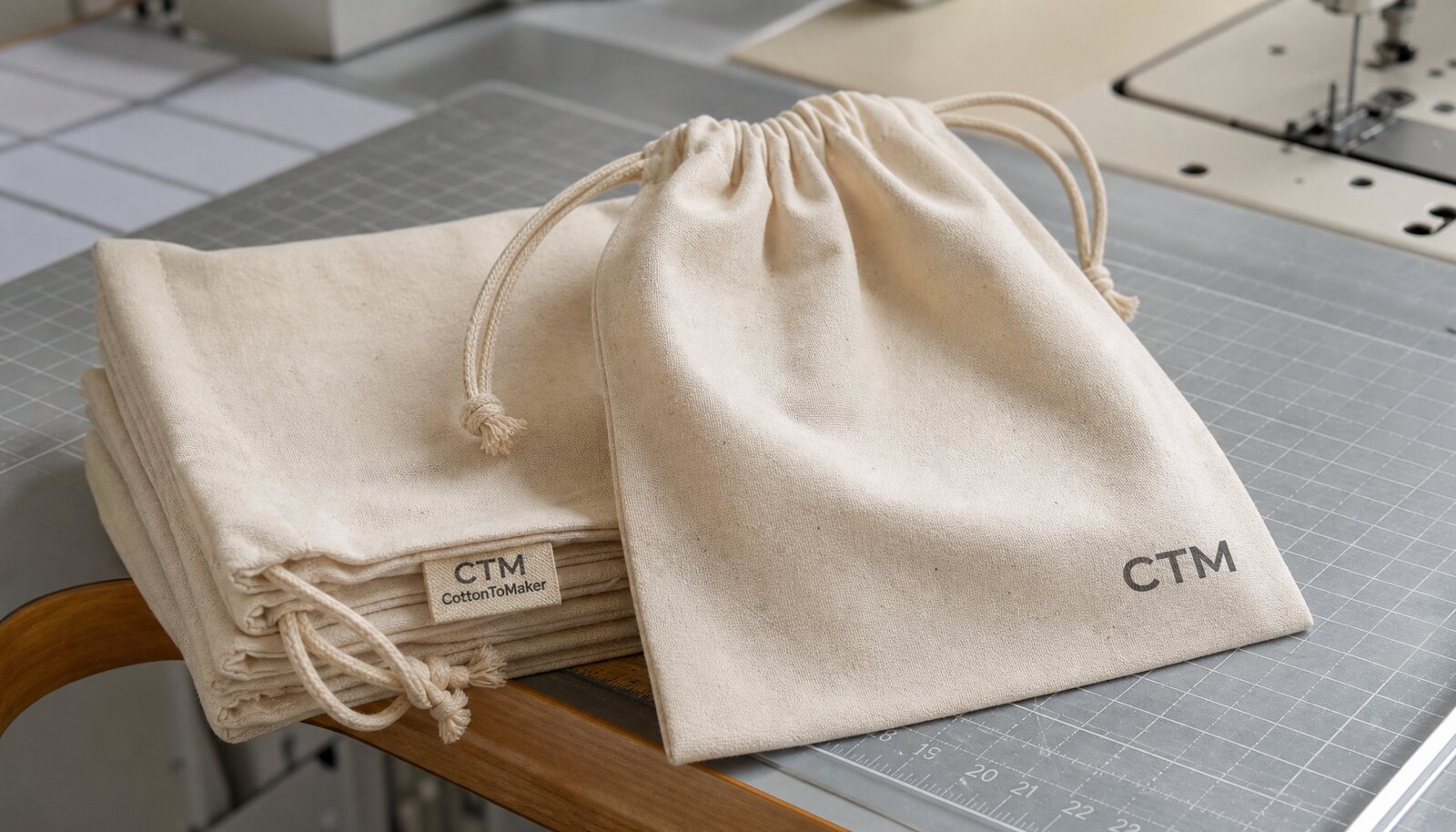
Why gift shop buyers need a tighter checklist for cotton drawstring pouches
Cotton drawstring pouches look like a simple accessory, but in gift retail they often play two different roles at once: they protect the item and they shape the customer’s first impression. That means the buying decision is not only about unit price. It also affects shelf appearance, packing labor, return risk, and how easily the store or distribution center can receive and replenish stock.
The most common sourcing mistake is treating all pouches as interchangeable. A pouch for jewelry, a candle jar, a soap bar, or a souvenir set may share the same family of materials, but the commercial spec is rarely identical. The right bag needs the right balance of opacity, size tolerance, print quality, cord performance, and carton format. If the buyer does not define those items in writing, the supplier will fill in the blanks with its own assumptions.
For procurement teams, the best starting point is to describe the use case in operational terms. What is being packed, how often will it be replenished, does the pouch need to present as premium, and will it be sold as part of a retail set or used as internal packaging? A clear answer to those questions will usually save more time than a long debate over a few cents on the unit price.
- Define whether the pouch is for resale, gift presentation, in-box packaging, or promotional distribution.
- Name the exact product it must contain, not only the pouch size.
- Treat print, packing, and freight as part of the buying decision, not as later add-ons.
- Assume that shelf appearance and warehouse receiving both matter in a retail program.
Start with the right spec: size, GSM, and fabric finish
For most cotton drawstring pouches for gift shops, the practical fabric range is usually around 120–140 GSM. That range tends to give enough body for retail use without making the pouch too heavy or expensive. Lower-GSM cloth can feel economical, but it may be too translucent for premium gifting or too soft to hold a neat shape. Higher-GSM cloth may feel sturdier, yet it can cost more and can make the drawcord channel less forgiving if the weave is very dense.
The second part of the spec is finished size, and this is where first-time buyers often under-specify. A pouch that fits on paper may still be awkward in production if the item is a tight fill or if the design includes a wide closure channel, seam allowance, or a thick cord. Procurement teams should define the minimum internal clearance required for insertion and closure, then ask the factory to confirm whether the quoted size is cut size or finished size. Those are not the same thing.
Fabric finish matters more than many buyers expect. Unwashed cotton can change after humidity exposure, ironing, or warehouse storage. If the pouch will be used in a program where size stability matters, ask whether the cloth is pre-shrunk, washed, or heat-set before cutting. If the supplier cannot answer clearly, that is a signal to probe the process more deeply before you move to sample approval.
- Common retail sizes include 10x15 cm, 12x18 cm, 15x20 cm, and 20x30 cm.
- Allow extra depth for bulky or hard-edged items rather than only increasing width.
- If presentation matters, ask for tighter weave consistency and cleaner edge finishing.
- Clarify whether dimensions are cut size, finished size, or usable internal size.
Compare sourcing routes before you compare quotes
Two suppliers can quote the same cotton drawstring pouch and still create very different outcomes for the buyer. A direct factory route is often stronger when you need clear accountability across cutting, sewing, printing, and packing. It is usually easier to manage sample sign-off, follow one quality standard, and resolve defects when the same production team owns the entire process. For repeat programs, that clarity is often worth more than a slightly lower introductory price.
A trading or consolidating route can still make sense, especially for small test orders, catalog consolidation, or programs that need mixed product categories in one shipment. The tradeoff is that the buyer may need to work harder to confirm who actually controls the fabric lot, the print setup, and the final carton count. If the supplier cannot explain the chain of responsibility, the buyer may end up paying for coordination problems later.
For procurement teams evaluating cotton drawstring pouches wholesale, the best route is the one that gives the cleanest production chain and the least ambiguity in QC ownership. The cheapest quote on paper is not always the lowest-cost order if it creates correction cycles, delayed replenishment, or receiving disputes at the warehouse.
- Direct factory: usually better for repeat orders, clearer QC ownership, and better material traceability.
- Trader or consolidator: useful for smaller programs, but confirm who owns sewing, printing, and final packing.
- Mixed procurement route: only works well if carton marks, SKU separation, and lead time are tightly controlled.
- Ask every supplier to name the person or team that signs off the golden sample.
Use the quote to expose hidden cost drivers
A useful quote should show more than a single unit price. It should show which assumptions are built into that number. Fabric weight, cord type, decoration method, carton setup, and packing format all affect cost. If those details are not transparent, the quote comparison becomes unreliable because each supplier may be pricing a different product while using the same description.
The most common hidden cost items are artwork setup, label tooling, special packing, and incremental waste from custom sizing. Buyers should ask the supplier to split the price into base pouch cost, decoration cost, and packing cost where possible. That makes the comparison easier and helps the procurement team decide where to spend money. A clean pouch with a premium woven label can sometimes outperform a cheaper printed option if the target customer values feel and reuse more than ink coverage.
Be careful with MOQ logic. A supplier may offer a low piece price but only if the order is repeated at the same artwork, same size, and same fabric source. A slightly higher unit cost may be smarter if it reduces MOQ pressure, lowers scrap risk, and allows replenishment without reopening the full setup fee. For seasonal gift shop orders, that flexibility can matter more than a one-time discount.
- Ask whether the quote includes artwork setup, label fees, cord changes, and carton charges.
- Check whether custom sizes increase cutting waste and therefore raise MOQ or price.
- Request the re-order price separately from the first-order price.
- Compare the quote on the same spec version, not on loosely similar wording.
What a useful supplier comparison looks like
A strong supplier comparison for cotton drawstring pouches for gift shops should evaluate commercial and operational performance together. Price matters, but so do defect control, artwork risk, replenishment consistency, and how the supplier handles packaging for retail distribution. If you only compare unit price, you can miss the supplier that is actually more reliable for a store program.
The comparison table below is meant to help procurement teams screen suppliers quickly. It is not a final award model, but it does force the conversation into dimensions that affect total landed cost and store readiness. In practice, buyers should use the same matrix for every quote so the supplier can be scored on the same criteria, including sample quality, batch consistency, carton marking, and whether the supplier can support a reorder without changing the look of the product.
If a supplier is strong on price but weak on testing, ask for clarification before giving the order away. If a supplier is strong on artwork accuracy but weak on replenishment consistency, that can be a problem for multi-store retail. The right partner is not simply the cheapest or the fanciest; it is the one that can keep the pouch stable through repeat buying cycles.
- Score price, QC, lead time, and replenishment together rather than separately.
- Ask for sample photos and at least one physical approval sample for important programs.
- Keep quotation, sample approval, and inspection notes tied to one spec version.
- Use the same comparison grid for all suppliers so the quote is truly comparable.
Sampling and approval: where most avoidable errors show up
Sampling is the stage where most pouch problems become visible, but only if the buyer checks the right things. The sample should confirm fabric feel, opacity, finished size, cord glide, print placement, and the way the pouch sits when it is open and closed. It is not enough to approve a logo on a flat photo if the actual pouch will be handled, pulled, packed, and displayed in a retail setting.
The most useful approval method is to keep one golden sample and note the acceptable characteristics directly on it or in a linked spec sheet. That reference should include fabric color or shade, seam shape, cord length, logo position, and package count. If the supplier offers a photo sample first, use it to catch obvious alignment or artwork issues, then request the physical sample before bulk cutting begins. That sequence usually saves time and reduces the chance of a full-batch correction.
It is also smart to test the sample as a buyer, not only as a designer. Insert the actual product, close the cord repeatedly, check whether the pouch can be opened easily by store staff, and see whether the logo still reads well from normal shelf distance. A sample that looks good in a photo can still be awkward in real receiving or display conditions.
- Check logo centering against the sewn seam, not only against the pouch edge.
- Measure finished size after the sample has rested, not immediately after ironing or pressing.
- Open and close the drawcord several times to catch snagging or uneven channel stitching.
- Use the actual gift item, not a placeholder, during sample fit testing.
QC thresholds that are worth putting into the PO
If the purchase order does not contain measurable QC language, the factory will usually default to its own standard. That may be fine for a commodity item, but it is risky for retail packaging or gift sets where visual consistency matters. The PO should clearly state what the buyer will accept and what will trigger rework, replacement, or shipment hold.
A practical quality control spec for cotton drawstring pouches should cover fabric weight, size tolerance, seam integrity, print alignment, cord function, and carton accuracy. For size, many buyers use a simple tolerance band such as ±0.5 cm for smaller pouches and ±1.0 cm for larger ones, unless the fit is especially tight. For stitching, ask for no skipped stitches, no open seams, no loose seam ends, and no broken stress points at the channel or bottom corners. If the factory uses stitch count per inch, ask them to state the minimum on critical seams so there is no ambiguity.
Print quality should be defined in measurable terms as well. A logo that sits slightly crooked may be acceptable on a natural craft pouch but not on a premium gift item. The buyer should set a visible positioning tolerance and define how far the print can shift from the approved sample. Where small text is involved, the buyer should also require that the text remain legible at normal retail viewing distance rather than only under close inspection.
Carton acceptance rules matter too. The receiving team should know the correct carton count, the expected SKU labels, the weight range, and whether the boxes can be stacked or palletized. If cartons arrive mixed, crushed, or mislabeled, the issue becomes a warehouse problem even if the pouch itself is perfect.
- Set a finished-size tolerance band in writing, not just a nominal dimension.
- Require no skipped stitches, no open seams, and no broken stress points at channel ends or bottom corners.
- Define print position tolerance and legibility expectations in the approved sample or PO.
- Ask for a carton acceptance rule: correct count, clean marks, dry cartons, and no crushed corners.
- If needed, use an AQL-style inspection plan with major, minor, and carton defect thresholds.
Packing details that matter in wholesale replenishment
Packing can make or break a retail replenishment order because the pouch is often received by a distribution center before it reaches the store. If the cartons are unclear, mixed, or overpacked, the receiving team spends time sorting product that should have arrived shelf-ready. That creates labor cost even if the product quality is acceptable.
The packing instruction should cover inner pack quantity, outer carton quantity, carton dimensions, gross and net weight, and whether the pouches are folded or laid flat. For cotton drawstring pouches sold as presentation items, avoid excessive compression. Strong compression can leave crease marks, flatten the fabric texture, and reduce the premium feel when the shopper opens the item. If the pouch needs to arrive with a neat opening shape, tell the supplier how much compression is acceptable and whether inserts or tissue are required.
Retail buyers should also think about SKU labeling in a warehouse context. One carton label format across all sizes is easier to receive and audit than several inconsistent mark styles. If there are multiple sizes or artworks, each carton should carry a unique SKU code, a clear size callout, and a quantity statement that matches the pack sheet. Where distribution is seasonal or multi-store, palletization rules and box strength become important because cartons may be stacked for a long period before they are unpacked.
- Use one clear carton label format and a unique SKU code per size or artwork.
- Keep fold direction consistent so staff can display the product uniformly.
- Confirm whether palletization is needed before shipping, especially for heavy or seasonal orders.
- Avoid over-compression if the pouch will be sold as a gift presentation item.
Lead time planning for seasonal gift shop orders
The most important schedule question is not the quoted lead time itself, but the point at which the clock begins. Procurement teams should measure lead time from sample approval and deposit confirmation, not from the first inquiry. That distinction matters because artwork revisions, material confirmation, and pack-mark approval can take longer than expected, especially when the order includes custom printing or a special label.
Seasonal gift shop programs are particularly sensitive to late decisions. A pouch line that is meant to support a holiday display or a store launch can become less valuable if the delivery window slips by even a few weeks. To reduce that risk, the buyer should separate the schedule into sample lead time, bulk production lead time, and freight handoff time. If any of those are not stated clearly, the quote is incomplete.
Buyers should also ask whether the needed fabric, cord, or label material is already in stock. If the factory has to source a specific cotton shade or custom label material, there may be a hidden delay even if the sewing capacity is available. A small buffer for customs, port congestion, or inland transport can be the difference between a ready-to-sell item and a missed retail season.
- Ask the factory to distinguish sample time, bulk production time, and shipping handoff time.
- Confirm whether raw material is in stock before final PO release.
- Leave room for at least one sample correction cycle if artwork or size is not yet final.
- If the launch is seasonal, build in transport buffer instead of relying on the fastest-case schedule.
How to benchmark suppliers without turning the RFQ into busywork
A good RFQ should be short enough for suppliers to answer accurately and detailed enough for procurement to compare. When the request becomes a long block of generic instructions, vendors often answer with the minimum possible detail and buyers still end up chasing clarification. The better approach is to ask a small set of questions that uncover the commercial variables that change price, quality, or delivery risk.
For cotton drawstring pouches wholesale, the most useful benchmarking questions are the ones that force the supplier to state assumptions. Ask what fabric and finish are included, which decoration method is priced, whether the MOQ is per size or per artwork, and what costs are excluded. Then ask how the supplier handles repeat orders. A supplier that can repeat the same pouch without resetting the entire process is often more valuable than one that only offers a sharp first-order price.
It also helps to ask one operational question that reveals how the factory manages exceptions: what happens if the approved fabric lot is unavailable, or if the print position drifts during bulk production? The answer tells procurement whether the supplier is disciplined enough to protect a retail program when things do not go perfectly. That is often the real test in wholesale buying.
- Ask suppliers to state assumptions, exclusions, and re-order terms in plain language.
- Separate first-order pricing from repeat-order pricing.
- Use one or two operational exception questions to reveal how the factory handles risk.
- Keep your RFQ focused on decisions that affect landed cost and sell-through.
Specification comparison for buyers
| Spec decision | Recommended option | When it fits | Buyer risk to check | Supplier-performance dimension |
|---|---|---|---|---|
| Fabric weight | 120–140 GSM cotton for standard retail gifting | Most gift shops need a balance of opacity, hand feel, shelf appearance, and cost | Too thin can show contents; too heavy raises cost and can reduce drawcord smoothness | Ask for mill certificate, incoming fabric inspection, and shrinkage test results |
| Fabric finish | Plain cotton with consistent weave; pre-washed or pre-shrunk if size stability matters | Programs where the pouch must stay true after warehouse handling or humidity changes | Unwashed fabric may shrink after first wash, steam, or heat exposure | Request wash-shrinkage data and confirm the factory’s lot-to-lot fabric traceability |
| Print method | 1–2 color screen print for simple logos; woven label or side label for premium branding | Orders with clean artwork and repeat replenishment; premium gift sets needing understated branding | Fine detail, small text, and gradients can blur on textured cotton | Check print adhesion, registration tolerance, rub resistance, and artwork setup fee |
| MOQ route | Standard production MOQ only if the supplier can hold material and packing consistency across runs | Buyers testing gift shop assortments or multiple seasonal sizes | Too many variants can increase carton cost and picking errors | Benchmark MOQ by size, artwork, and cord color; ask if re-order MOQ is lower |
| Closure style | Self-color cotton drawcord with secure knot or stitched channel finish | Everyday retail pouches and resale packaging | Weak cord locking or rough channel stitching can create complaints | Ask for cord pull test, channel seam inspection, and knot retention check |
| Sizing strategy | 10x15 cm, 12x18 cm, 15x20 cm, 20x30 cm, or custom to the reference product | Jewelry, soap, candles, souvenir sets, and kits | Inner item clearance must allow easy insertion without tearing seams | Request finished-size tolerance bands and a fit test with the actual product or insert |
| Supplier route | Direct factory with in-house cutting, sewing, printing, and packing | Programs needing price clarity, repeatability, and QC accountability | Split production can lead to blame shifting between printer, sewer, and packer | Confirm who owns each process step and who signs off on the golden sample |
| Packing method | Bulk packed by size, then carton sorted with clear outer marks and carton count sheet | Wholesale shipments to DCs or multiple store locations | Mixed-size cartons raise receiving errors and stock discrepancies | Ask for carton content sheet, pack mark format, and palletization rules |
| Lead time model | Sample approval plus confirmed material availability before PO release | Seasonal gift shop replenishment and launch programs | Missing material confirmation can push delivery beyond the retail window | Separate sample time, bulk time, and freight handoff time in the quote |
Buyer checklist before sampling
- Confirm the exact pouch use case: product fill, gift wrapping, promotional giveaway, or resale packaging.
- Lock the fabric weight target in GSM and allow a tolerance only if the supplier states it in the quote.
- Specify finished size, seam allowance, drawcord length, and whether the pouch must fit a reference product, tray, or insert.
- State print method, logo size, color count, and the acceptable print position on the pouch.
- Request a pre-production sample or measured photo approval sample before bulk cutting starts.
- Ask for carton quantity, carton dimensions, net/gross weight, outer marks, and pallet pattern before booking freight.
- Clarify whether the quote includes labels, polybags, hangtags, inserts, carton liners, and export cartons.
- Compare lead time from sample approval, not from inquiry date.
- Get defect tolerance in writing for print misregistration, broken stitches, loose cords, loose threads, and size variation.
- Confirm whether the factory will keep a production golden sample and a signed QC reference sheet.
Factory quote questions to send
- What GSM, weave type, and fabric finish are included in this quote, and what tolerance do you allow?
- Is the price based on no decoration, one-color screen print, woven label, or side label, and what is the cost for each extra color or placement?
- What is the MOQ per size and per artwork, and can mixed sizes be packed in one shipment without a surcharge?
- What sample types do you provide before bulk production, and how long does each sample stage take?
- What are your standard packing details per inner pack and per carton, including carton count, carton size, and outer marks?
- Which QC checks do you perform before shipment, and can you share your acceptance standard for stitching, print alignment, and cord function?
- What lead time applies after sample approval and deposit, and what material risks could delay the order?
- Which costs are excluded from the quote, such as labels, shipping cartons, testing, freight, artwork setup, or export documentation?
- Do you keep fabric lot records and production photos in case of a quality dispute?
- What is your re-order lead time if the same size and artwork are repeated without changes?
Quality-control points to confirm
- Fabric weight should match the agreed GSM within a clearly stated tolerance; if the quote does not specify a tolerance, the buyer should ask for one before PO release.
- Finished size should stay within an agreed tolerance band, such as ±0.5 cm for small pouches and ±1.0 cm for larger sizes, unless the use case requires tighter control.
- Seam allowance should be consistent so the pouch does not twist, pucker, or shrink visually after closure; uneven side seams should be treated as a reject trend, not a cosmetic note.
- A practical stitch standard should be set, for example no skipped stitches, no open seams, and no visible seam break at stress points; buyers can also ask for a stitch density target such as a minimum stitch count per inch on critical seams if the factory uses that metric.
- Drawcord channels should be even, with no blocked passage, and cord ends should be secured so they do not fray excessively or pull out during normal handling.
- Print registration should stay within the approved sample and should not shift enough to touch the seam line or appear off-center; for simple logos, a visible positional tolerance should be written into the PO.
- Ink coverage should be opaque enough that the logo remains legible from normal retail viewing distance, and rub resistance should be checked with a simple dry-rub test on the approved sample.
- Cartons should arrive with the agreed item count, size separation, and outer mark format; mixed counts, wrong SKU labeling, or carton shortages should trigger a receiving hold.
- Carton condition should be intact, dry, and free from crushing or water damage; if the product is for shelf display, buyers should also specify acceptable crease levels on the pouch itself.
- A random inspection plan should define how many cartons and how many pieces per carton are opened, plus what defect rate triggers rework, replacement, or shipment hold.