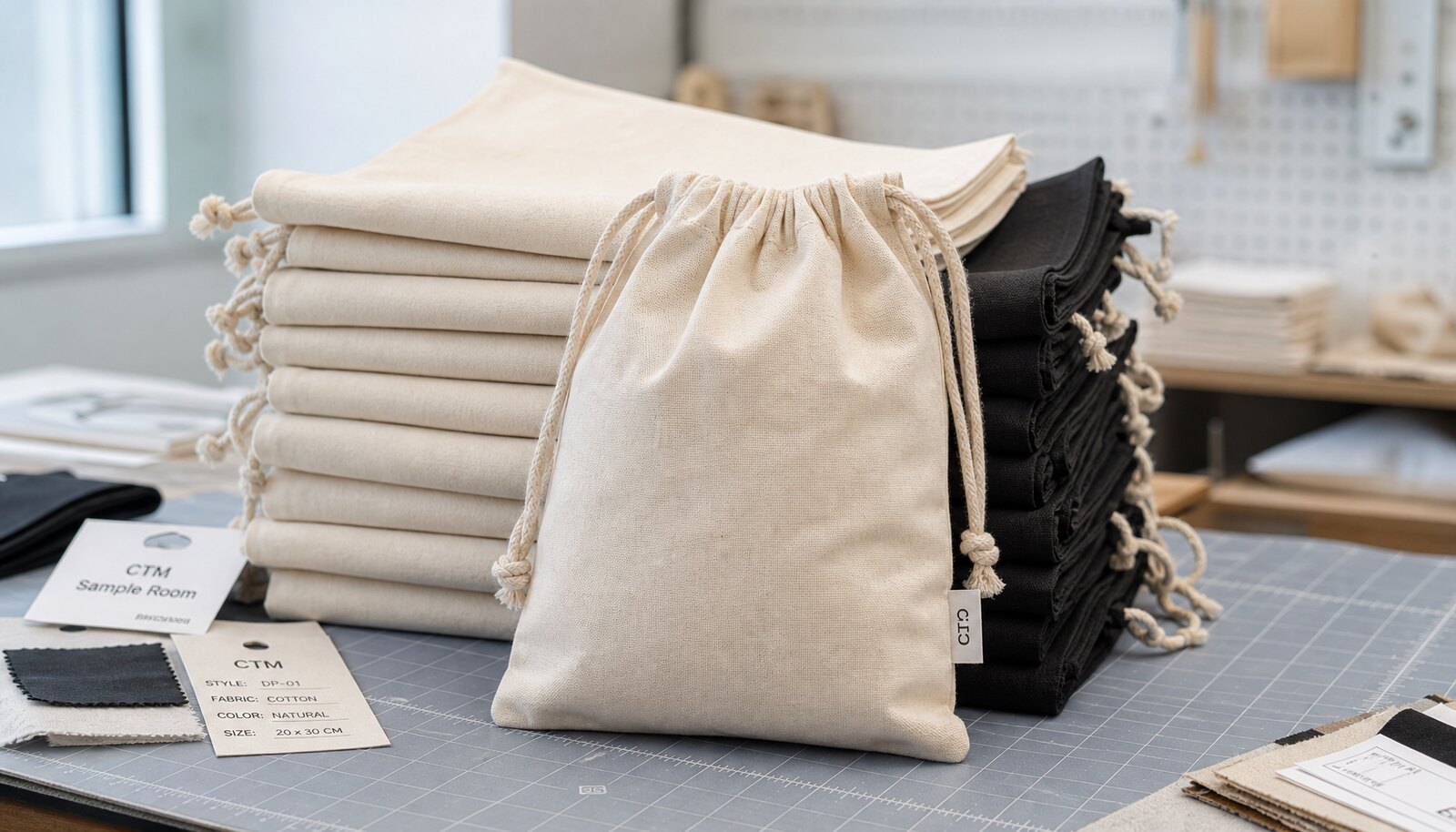
Why MOQ negotiation matters for gift-shop pouch buying
Gift shop buyers often treat cotton drawstring pouches as a simple accessory and accept the first MOQ they are quoted. That is where margin quietly disappears. The number on the quote is rarely just a production minimum. It is usually a bundle of separate limits tied to fabric availability, dye lot size, print setup, sewing efficiency, packing labor, and carton configuration. If you understand which of those items is actually driving the minimum, you can negotiate the right part of the order instead of pushing blindly on unit price.
For cotton drawstring pouches for gift shops, the commercial risk is not only the purchase cost. It is also the cost of unusable stock, slow warehouse intake, rework, and shelf presentation that looks less premium than expected. A supplier might offer a low unit price but force a high minimum because the quote includes custom-dyed cloth, multiple print colors, or retail-ready packing. Another supplier may look more expensive at first but give you a lower-risk structure with stock fabric, simpler decoration, and more flexible reorder terms.
Procurement buyers should think of MOQ as a negotiation outcome, not a fixed fact. You can often lower commitment by simplifying one part of the spec, splitting a quoted program into blank and decorated phases, or asking the factory to price separate options for stock-supported components and custom components. That is more effective than asking the factory to lower the MOQ without changing the underlying cost structure. In practice, the smartest buyers trade complexity for flexibility only where it does not weaken the retail result.
The best negotiating position starts with a clear use case. A pouch for jewelry, small soaps, or gift cards has a different tolerance for fabric weight and seam strength than a pouch for candles, ceramics, or boxed souvenirs. If the product fit is not defined, the factory is likely to protect itself with a larger MOQ, broader tolerance, or a generic construction that may not work well in your channel. Clear specification is not bureaucracy; it is the basis for a better quote.
- Treat MOQ as a bundle of fabric, print, sewing, and packing decisions.
- Negotiate the component that creates the minimum, not only the final unit price.
- Use the product’s actual retail purpose to define the right construction level.
Start with the pouch specification, not the negotiation
Negotiating cotton drawstring pouch MOQ works better when the specification is already tight. If the pouch size, product fit, and decoration method are vague, each supplier will quote a different construction and your comparison becomes unreliable. The first task is to define the finished size, the intended fill item, the opening width, and whether the pouch is meant to protect the product, present it on shelf, or both. For most gift-shop applications, 140–180 GSM cotton is the workable range, but the right point in that range depends on how much structure the pouch needs and how premium it must feel to the customer.
A useful way to specify size is to tie it to the packaged item. For example, if the pouch is meant to hold a candle box, a jewelry set, a cosmetic kit, or a mug, ask the supplier to confirm the finished dimensions against the actual retail pack dimensions, not a generic pouch size. This avoids the common problem where the pouch is technically made to spec but opens too narrowly, slouches too much, or leaves too much empty space, which makes the product appear less considered on shelf.
Size tolerance should be written before negotiation begins. For pouch programs, buyers often focus on nominal dimensions and forget that sewing shrinkage can move the actual opening and finished length. Ask the supplier what tolerance they can hold on length, width, and opening width after sewing, and whether the tolerance is measured before or after final pressing and packing. For stable retail programs, it is reasonable to ask for a measured tolerance band by size, not just a verbal promise.
The same logic applies to fabric finish. Natural cotton, bleached cotton, and dyed cotton may look similar in photographs, but they behave differently in production and in the store. Natural cotton can vary more from lot to lot. Bleached cloth gives a cleaner retail appearance but may cost more and require tighter shade approval. Dyed fabric usually adds the most MOQ pressure because the factory needs a dye lot commitment or a minimum mill run. That is why the spec comes first: it tells you where the cost and MOQ pressure really sit.
- Define the finished pouch size against the packaged item it must hold.
- Write tolerance bands for finished length, width, and opening width.
- Choose natural, bleached, or dyed fabric with MOQ implications in mind.
How fabric weight changes quote behavior and MOQ
Fabric weight is one of the most useful levers in sourcing cotton drawstring pouches for gift shops because it changes both the retail feel and the factory’s cost structure. Standard greige or stock-supported cotton is easier for most factories to buy in volume than specialty-finished cloth. Once you ask for custom color, brushed surface, or a heavier canvas-like hand-feel, the factory may need to commit to a specific fabric lot or production slot. That is where MOQ increases, even if the pouch design itself is simple.
A strong procurement practice is to ask the supplier to quote three fabric-weight options side by side. For example, you might request a 140 GSM version for value-driven packaging, a 160 GSM version for the core assortment, and a 180 GSM version for the premium set. This does two things. First, it makes the cost of upgrading hand-feel visible. Second, it gives your merchandising or retail team a realistic view of which pouch belongs in a low-price bundle and which belongs in a premium set. Without those options, you can end up paying for a heavier pouch where a lighter one would have sold just as well.
Do not focus on GSM alone. The same quoted GSM can feel different depending on weave tightness, finishing, and shrinkage. Ask whether the supplier’s quote is based on pre-washed, pre-shrunk, or standard greige fabric. If shrinkage matters, request the expected after-wash range and how the supplier measures it. If the pouch must fit a boxed retail product, a small shrinkage shift can make the opening too tight even if the nominal size is correct.
In gift shop programs, the most common commercial mistake is over-specifying cloth before testing the shelf result. A very heavy fabric may look premium in hand but can make the pouch stiff, increase sewing burden, and push unit cost up without improving sell-through. A fabric that is too light can save cost but may wrinkle, show silhouette from the contents, and look weak under retail lighting. The right answer is rarely the heaviest cloth the factory can make; it is the lightest cloth that still feels intentional and durable for the channel.
- Ask for 140 GSM, 160 GSM, and 180 GSM quotes to see the true cost curve.
- Confirm whether the fabric is greige, bleached, pre-washed, or dyed.
- Check how much shrinkage and opacity change with each fabric option.
Choose the print method that matches reorder pattern and shelf use
The decoration method affects MOQ almost as much as the fabric. For most gift shop pouches, the artwork is simple: a logo, short brand line, seasonal icon, or one-color retail motif. For that type of design, screen printing is usually the best baseline because setup costs are predictable and the print tends to hold up better under repeated handling than low-grade transfer films. The setup fee is real, which is why buyers should understand whether they are buying a one-off seasonal run or a repeating assortment that can amortize that setup cost over multiple orders.
Heat transfer can be useful for small runs or complex multicolor artwork, but it should be treated as a controlled exception rather than the default. If the pouch will be handled a lot, folded, refolded, or stuffed into a display basket, transfer edges may crack, peel, or become glossy in a way that feels less retail-worthy. Buyers should ask the factory what transfer material is used, what wash or rub performance they expect, and whether the print sits well on the selected GSM without wrinkling around the image. If the supplier cannot answer clearly, the method is probably not ideal for a procurement order that needs consistency.
For lower-MOQ testing, a woven label, sewn side label, or small center-front mark can be a better route than a full-front multicolor print. It usually reduces setup complexity and may let the supplier run the order on stock-supported pouch bodies. The tradeoff is branding presence: a small woven label looks cleaner and more premium, but it carries less shelf impact than a larger print. A procurement buyer should decide whether the pouch needs to sell as a branded object or simply function as a polished packaging accessory.
The strongest approach is to ask for pricing by decoration path: blank pouch, one-color screen print, two-color screen print, woven label, and retail-packed version. That lets you compare not only unit price, but also the real MOQ and the amount of labor locked into each method. If your order is seasonal or uncertain, buy the version that keeps the most optionality. If the program is repeatable, pay for the method that is most stable under handling and replenishment.
- Screen print is usually the baseline for simple, repeatable logos.
- Heat transfer is better for limited runs or complex art, but test durability carefully.
- Woven or sewn labels can reduce setup burden and improve perceived quality.
Read the MOQ logic hidden inside the factory quote
A useful supplier quote should tell you more than the final unit price. If the quote only says MOQ 5,000 pcs, the procurement buyer still does not know what the factory is protecting. Is the minimum tied to fabric dyeing, print screen setup, cutting yield, sewing line efficiency, or retail packing labor? Each of those creates a different negotiation path. When you identify the specific driver, the conversation becomes commercial instead of generic. You can then ask for an alternative construction, a split quote, or a stock-supported option that lowers the minimum without making the product worse.
One of the most effective quote-reading habits is to separate the pouch into three cost blocks: blank body, decoration, and packing. The blank body is the cloth, cut, and sewn pouch without branding. Decoration is any logo, label, or transfer. Packing is bulk packing, bagging, barcode application, and carton marks. Many suppliers bundle these together and use the bundle to justify a higher MOQ. When you ask for a clean split, you can see whether the minimum comes from the fabric house, the printing line, or the packing team. That matters because only one of those may be truly fixed.
For example, a supplier may be able to run the blank pouch at a lower MOQ if they use stock cotton, but once you add a custom print and individual polybagging, the commercial minimum becomes much larger. Another supplier may have flexible printing but only if the pouch color stays natural or off-white. The point is not to force one answer. The point is to reveal where the bottleneck sits so you can decide whether to accept it, simplify it, or move the order to a different sourcing route. If you do not isolate the bottleneck, you may negotiate down one line while the real minimum remains unchanged in another line.
The same logic applies to size count and artwork count. Ask whether MOQ is per size, per color, or per artwork. If you need two pouch sizes for one program, one of them may be better ordered as a shared blank body with different packing or labels rather than a fully separate SKU. That can lower the total commitment and reduce dead stock risk. Procurement buyers who manage this well do not just bargain harder; they build a quote structure that is easier for the factory to produce.
- Ask what the factory is actually protecting: fabric, print, sewing, or packing.
- Request separate prices for blank body, decoration, and packing.
- Confirm whether MOQ applies per size, per color, or per artwork.
Supplier qualification: the questions that separate capable factories from polite quotes
MOQ negotiation is only useful if the supplier can actually deliver the spec. A factory that answers quickly but cannot show process control can create more risk than a higher-priced supplier with stronger discipline. Before pushing hard on price, ask whether the supplier regularly makes cotton pouches in the same GSM range, what machines they use for cutting and stitching, and whether they can share photos of recent production rather than only studio samples. You are looking for evidence of repeatable work, not just a nice quotation.
A credible supplier should be able to explain where quality control happens. For example, do they inspect incoming fabric for shade variation and holes? Do they check cut panels before sewing? Do they perform inline checks on seam alignment and cord insertion? Do they have a final packing check before cartons close? If they cannot describe a basic control flow, the quoted MOQ may be hiding a larger operational risk. A low minimum is less valuable if the factory is improvising the production process.
It also helps to ask who owns the critical subcontract steps. Some suppliers sew in-house but outsource printing, dyeing, or packing. That can be fine, but the buyer should know which steps are internal and which are dependent on outside capacity. If the print line is external, the MOQ may be driven by the printer’s schedule rather than the sewing factory’s flexibility. If dyeing is outsourced, shade approvals and lead time become more fragile. A buyer who understands the supply chain behind the quote can ask sharper questions and avoid surprises later.
A practical supplier-qualification question is: if I reorder the same pouch in 60 days, what exactly can change? The best suppliers can answer this clearly: fabric lot, minor shade variation, or slight lead-time differences. The weaker ones will offer vague reassurance. That is not enough for gift-shop procurement where repeatability matters. A supplier who understands reorders is more valuable than a supplier who only wants to win the first PO.
- Ask about in-house versus outsourced steps for printing, dyeing, and packing.
- Request proof of repeat production in the same GSM and construction range.
- Ask what can change on a reorder and how they control it.
Product comparison: what you gain and lose across sourcing options
The table below is most useful when read as a decision tool rather than a list of specifications. A buyer comparing cotton drawstring pouches for gift shops should ask what each option does to MOQ, lead time, and quality risk. A lower unit price can still be a poor buying decision if it creates carton issues, inconsistent shade, or a decoration method that fails after a few weeks in store. The commercial answer is the option that gives the best landed cost for your channel, not the lowest factory price on paper.
The biggest hidden tradeoff is often between flexibility and standardization. Stock-supported blank pouches give flexibility, but they reduce control over exact color and size. Custom-dyed or custom-printed pouches improve brand fit, but they usually lock you into a larger minimum and a longer lead time. Retail-ready packing may improve shelf and warehouse efficiency, but it also adds labor and may create carton volume that changes freight cost. Good procurement is about choosing the least expensive way to satisfy the channel requirement, not just the least expensive SKU.
When you compare suppliers, ask them to quote the same spec sheet and the same packing instructions. If one supplier is quoting bulk-packed pouches and another is quoting individually bagged pouches, the price comparison is not valid. Similarly, if one supplier is using 140 GSM stock cloth and another is quoting dyed 180 GSM cloth, the numbers are not directly comparable. Make the comparison table work by aligning the decision criteria first. Then use it to negotiate the part of the quote that matters most to your business.
This is also where a procurement buyer can uncover hidden cost levers. If a supplier has a high MOQ because they insist on retail-ready packing, ask them to price a bulk-packed version as well. If the quote is high because of custom fabric color, ask for natural or bleached cloth with a stronger print or sewn label instead. If the MOQ is high because the factory wants to protect print setup, ask whether a smaller label or one-color version can use existing screens or reduced setup time. The comparison is not just between suppliers; it is between technical choices that change what the supplier must commit to.
- Compare suppliers only on identical specs and packing rules.
- Treat flexibility, standardization, and shelf readiness as separate commercial variables.
- Use alternative quote paths to uncover hidden MOQ drivers before accepting a final price.
Sample approval: the stage that prevents expensive mistakes
A sample should prove more than the logo position. For cotton drawstring pouches, sample approval should confirm the fabric feel, cord movement, opening behavior, seam quality, print clarity, and final size after sewing. Ask for a pre-production sample that uses the same fabric lot, the same cord type, the same print method, and the same packing method that will be used in bulk. A showroom sample or an old stock sample is not enough if the bulk order is meant to be repeatable. The approved sample must represent the actual order, not just the concept.
The safest practice is to create a golden sample and seal it with the purchase order. That sample becomes the reference for bulk inspection and for any dispute about shade, print placement, or seam finish. If the factory changes fabric shade slightly, shortens the cord, or moves the print area even a little, the buyer has a clear standard to compare against. This is more useful than trying to argue from memory or from a photo. Procurement teams often lose leverage because they approve samples casually and then cannot prove what was approved.
When reviewing the sample, do more than look at it. Open and close the cord repeatedly to see whether the opening stays even. Fill the pouch with the real retail item if possible. Check how the print sits when the cloth is wrinkled or folded. Measure the pouch against the pack-out dimensions. If the pouch is meant to sit beside a product on shelf, look at it under the lighting used in the store or warehouse, because some fabrics and inks look different under fluorescent light than under daylight. A sample that seems fine on a desk may look very different in retail conditions.
If the supplier is hesitant to provide a true pre-production sample, that is a warning sign. It can mean the factory is not actually using the same materials or that they are hoping to finalize details during bulk production. That is not a safe place to be when negotiating MOQ. The point of a sample stage is to de-risk the bulk order before the factory commits fabric and labor. If a supplier cannot or will not support that process, the buyer should either simplify the spec or reconsider the source.
- Approve a pre-production sample that matches the intended bulk materials and method.
- Seal one golden sample and attach it to the PO or inspection file.
- Test the pouch by filling it and opening/closing it multiple times before sign-off.
QC plan: inspection sampling, defect levels, and acceptance criteria
QC is where many pouch programs quietly lose money. A pouch can look acceptable in a single photo and still fail in bulk because of uneven stitching, weak cords, size drift, or print variation. Buyers should write the acceptance standard before production starts, not after cartons arrive. For cotton drawstring pouches, the most useful control is a mix of measurement checks, workmanship checks, and appearance checks tied to a sampling plan. If the supplier is familiar with AQL, ask them to quote the level they normally use, and insist that the same plan is written into the PO or inspection sheet.
A practical approach is to define defect categories. Critical defects are issues that make the pouch unusable or unsafe for retail packing, such as wrong size class, major holes, open seams, missing cords, or severe contamination. Major defects are issues that make the pouch commercially unacceptable, such as broken stitches, bad print registration, obvious shade mismatch, or one side significantly shorter than the other. Minor defects are issues that do not prevent use but lower presentation quality, such as loose thread ends, slight puckering, or small unevenness in print density. If the supplier understands these categories, the discussion becomes measurable instead of emotional.
For inspection sampling, AQL 2.5 for major defects and 4.0 for minor defects is a common reference point for consumer goods, but the right plan depends on order value and channel risk. High-visibility gift-shop orders often justify tighter control on appearance-related defects, while low-value bulk packaging can sometimes tolerate a slightly broader minor-defect band. The important thing is to set the rule in advance. If you do not, a supplier may treat a cosmetic issue as acceptable while your store team rejects the goods on arrival.
Operationally, ask for inspection samples at three points if the order is significant: incoming fabric, first batch off the line, and final carton check. Incoming fabric checks catch shade streaks, holes, and weight drift before sewing starts. First-off checks catch measurement or print placement errors while they are still cheap to fix. Final carton checks catch packing count errors, wrong carton labels, and mixed sizes. If the factory is small, you may not get all three stages every time, but the order should still identify which of those steps the factory is responsible for and who signs off at each stage.
Measurement checks should be simple but disciplined. Take at least a small sample set from different cartons or bundles, not just one top piece. Measure finished length, width, and opening width after the pouch has been flattened in the agreed way. Check cord length on both sides and note whether the closure is even when the pouch is filled. For printed pouches, compare the ink density and placement against the golden sample under the same lighting used for receiving. That sounds basic, but it is where many quality issues are actually found.
A useful receiving rule is to make the warehouse reject or hold the shipment if the carton count, size split, or printed SKU code does not match the packing list. Recounting every pouch is expensive, but so is accepting an inaccurate shipment and sorting it later. If you write the acceptance criteria clearly, the supplier knows the standard before loading the goods. That is far better than arguing after arrival.
- Define critical, major, and minor defects before production starts.
- Use a written AQL plan or equivalent pass/fail standard for bulk checks.
- Inspect fabric, first-off production, and final cartons where the order size justifies it.
Packing, labeling, and carton data that change landed cost
Packing should be treated as part of the commercial negotiation, not as a detail to be added later. A cotton drawstring pouch that is bulk packed loose in cartons is usually the cheapest to produce, but it may cost more to count, sort, and barcode when the goods reach your warehouse. Individual polybags, size stickers, barcodes, or retail hangtags add labor and materials, but they can also reduce receiving time and keep the pouch cleaner during transit. The right choice depends on whether the goods are going straight to retail shelves, to a distributor, or into a centralized warehouse with additional handling.
Ask the supplier for carton data before approving the order: pieces per carton, carton dimensions, gross weight, and whether the cartons are all one size or split by size/color. Those details affect freight cost, warehouse storage, and how easily the cartons stack. Oversized cartons can make a quote look cheap per pouch while quietly increasing shipping cost. Inconsistent carton counts can create receiving delays because warehouse staff has to re-count or re-bundle the shipment. If your program uses multiple sizes, ask how they will keep each size separated and how they will mark the outer cartons so the receiving team can identify them immediately.
For higher-value gift-shop assortments, retail-ready packing can be justified if it prevents dust, abrasion, or miscounting. But you should still ask for the separate cost of packing versus the cost of the pouch itself. If the supplier cannot isolate those charges, you cannot tell whether a lower MOQ is coming from the sewing line or from the packing line. That distinction matters because some buyers can accept a higher sew-only MOQ if the finished packed MOQ is what causes the real commercial pain. Others need the opposite. The right answer depends on the channel’s fulfillment model and the warehouse’s labor cost.
Carton marks should match the purchase order, packing list, and size chart exactly. If barcode labels are required, specify whether they go on the pouch, the inner bag, or the outer carton. If the goods are imported into a retail distribution center, ask whether the carton must carry a buyer code, order number, color code, or carton sequence number. These details often sound minor, but they affect receiving speed and can prevent a lot of manual relabeling. In procurement terms, that is not cosmetic; it is cost control.
- Get carton dimensions, piece count, and gross weight before bulk approval.
- Ask for separate pricing on pouch production and packing labor if possible.
- Align carton marks, barcodes, and packing lists before shipment starts.
Specification comparison for buyers
| Option / spec decision | Typical MOQ and cost band | Lead-time impact | Best use case | Tradeoff or risk to verify |
|---|---|---|---|---|
| 140 GSM natural cotton, bulk packed, one-color screen print | MOQ often 1,000–3,000 pcs per size/artwork; lowest fabric cost band | Usually fastest; roughly 20–30 days after sample approval if stock fabric is available | Entry-level gift shops, jewelry sleeves, souvenir packaging, seasonal bundles | Can feel thin if oversized; verify opacity, seam density, and whether print shows through on dark artwork |
| 160 GSM natural or bleached cotton, one-color screen print, size-specific carton packing | MOQ often 1,500–5,000 pcs; mid-range cost band | Typical 25–35 days after approval | Core gift-shop assortment where the pouch must look more substantial on shelf | Confirm shrinkage control, shade tolerance, and whether the cloth is pre-shrunk or standard greige |
| 180 GSM cotton, woven label, retail-ready polybag packing | MOQ often 3,000–8,000 pcs; higher cost band because of heavier cloth and extra labor | Often 30–45 days after approval | Premium gift sets, candles, ceramics, branded souvenir programs | Check cord channel strength, seam reinforcement, and carton weight because heavy cloth can still fail at the stitching |
| Custom-dyed fabric, full-front screen print, retail-ready packing | MOQ often 5,000–10,000 pcs per color/artwork; highest cost pressure | Usually 35–55 days after lab dip, sample, and bulk booking | Brand-specific retail programs with stable forecasts and repeat ordering | Verify whether MOQ is per color, per size, or per artwork; ask for sealed shade approval and lab dip reference |
| Blank stock pouch with local decoration or over-labeling | MOQ often 200–1,000 pcs for the pouch body, then local decoration minimums on top; lowest upfront commitment | Fastest route, often 7–20 days depending on decoration step | Seasonal tests, small-store assortments, and urgent buys | Blank stock reduces color control; inspect blank seam quality, cord construction, and size consistency before decoration |
| Factory-direct custom pouch with shared fabric color | MOQ often 1,000–5,000 pcs when using stock-supported fabric colors | Usually 25–40 days after approval | Retailers and distributors who can reorder the same spec through the year | Needs tighter artwork control, a sealed golden sample, and tolerance bands so reorders match the first run |
Buyer checklist before sampling
- Confirm the finished pouch size, cut size if shown, gusset if any, and the exact product it must hold, such as a candle box, jewelry card, mug, or souvenir set.
- Specify fabric type, GSM, whether the cloth is natural, bleached, or dyed, and whether you need pre-shrunk fabric or a controlled shrinkage range.
- State the cord style, cord diameter, channel construction, and whether the drawstring is self-tie, single-cord, or double-cord.
- Send vector artwork, Pantone references if relevant, print size, print position, and whether the logo must align to the seam or centerline.
- Ask for one physical pre-production sample that uses the same fabric, cord, print method, and packing method intended for bulk.
- Approve packing detail in writing: bulk pack count, polybagging, barcode or hangtag placement, carton marks, and whether cartons are single-size or mixed-size.
- Record the inspection standard to be used for bulk checking, including stitch defects, print defects, stains, measurement tolerance, and carton count accuracy.
- Ask the factory to separate quote lines for blank pouch, decoration, packing, and any special handling so hidden MOQ drivers are visible before negotiation.
Factory quote questions to send
- What exactly drives the MOQ in your quote: fabric weaving, dyeing, printing setup, cutting efficiency, sewing labor, or packing labor? Please separate them if they differ.
- Is the MOQ calculated per size, per color, per artwork, or per finished packed SKU? If I change only the print but keep the same pouch, does the MOQ reset?
- What are the finished size tolerance, seam allowance, and cord-channel width you will hold in production, and what happens if the pouch is outside tolerance by more than the agreed limit?
- What GSM do you recommend for this pouch size, and how much does unit price change if we move up or down 20 GSM? Please quote all three levels if possible.
- Can you quote blank, printed, and retail-packed versions separately, including setup charges, so I can compare landed cost instead of only unit price?
- What is included in the print setup fee: screen preparation, color matching, proofing, or remake if the first strike-off is wrong?
- What cord material and diameter are included in the quote, and is the cord pre-cut, knotted, tipped, or inserted before or after sewing?
- What is your standard seam construction around the cord channel and side seams, and do you reinforce the stress points with backstitching or bartacks?
- What are your normal sample stages, how many rounds are included, and do you charge again if I revise artwork after the first sample?
- What carton pack count, carton dimensions, gross weight, and outer mark format will you use, and can you offer moisture protection or inner polybags if needed?
Quality-control points to confirm
- Fabric weight should match the approved GSM within a practical production tolerance, typically about +/- 5 to 8 percent, with no obvious thin spots, shade streaks, or weak areas in the cloth.
- Finished size should stay within the agreed tolerance band, especially if the pouch must hold a boxed gift; check length, width, and opening width on a measured sample set, not only on one piece.
- Stitching should be straight and dense enough to avoid seam pop; inspect side seams, bottom corners, and the cord channel for skipped stitches, needle damage, loose thread tails, and uneven seam allowance.
- Cord-channel construction should allow smooth pulling without collapsing the top opening; pull each sample repeatedly and check that the channel does not twist, fray, or cut into the fabric.
- Drawcord knots, tips, or end finishes should remain secure after repeated pulls; if the pouch uses a double drawstring, both cords should close evenly without one side tightening first.
- Print should match the approved strike-off for position, density, and color; check for cracking, pinholes, smudging, ghosting, or edge bleed under normal shop lighting and after light rubbing.
- If the order includes labels, confirm that woven labels are centered, sewn flat, and free from puckering; side seams should not distort the label after the pouch is filled.
- Bulk defects should be tracked against an agreed limit, not a vague impression; use an AQL plan or at minimum a written pass/fail standard for stains, misprints, broken stitches, short cords, and wrong sizes.
- Retain one sealed golden sample from the approved pre-production sample, label it with the PO number and revision date, and compare bulk output against that sample during receiving or final inspection.
- Packing count should be exact by carton and by inner bundle if applicable; carton labels, size splits, and quantity marks must match the packing list so warehouse receiving does not have to re-count every piece.