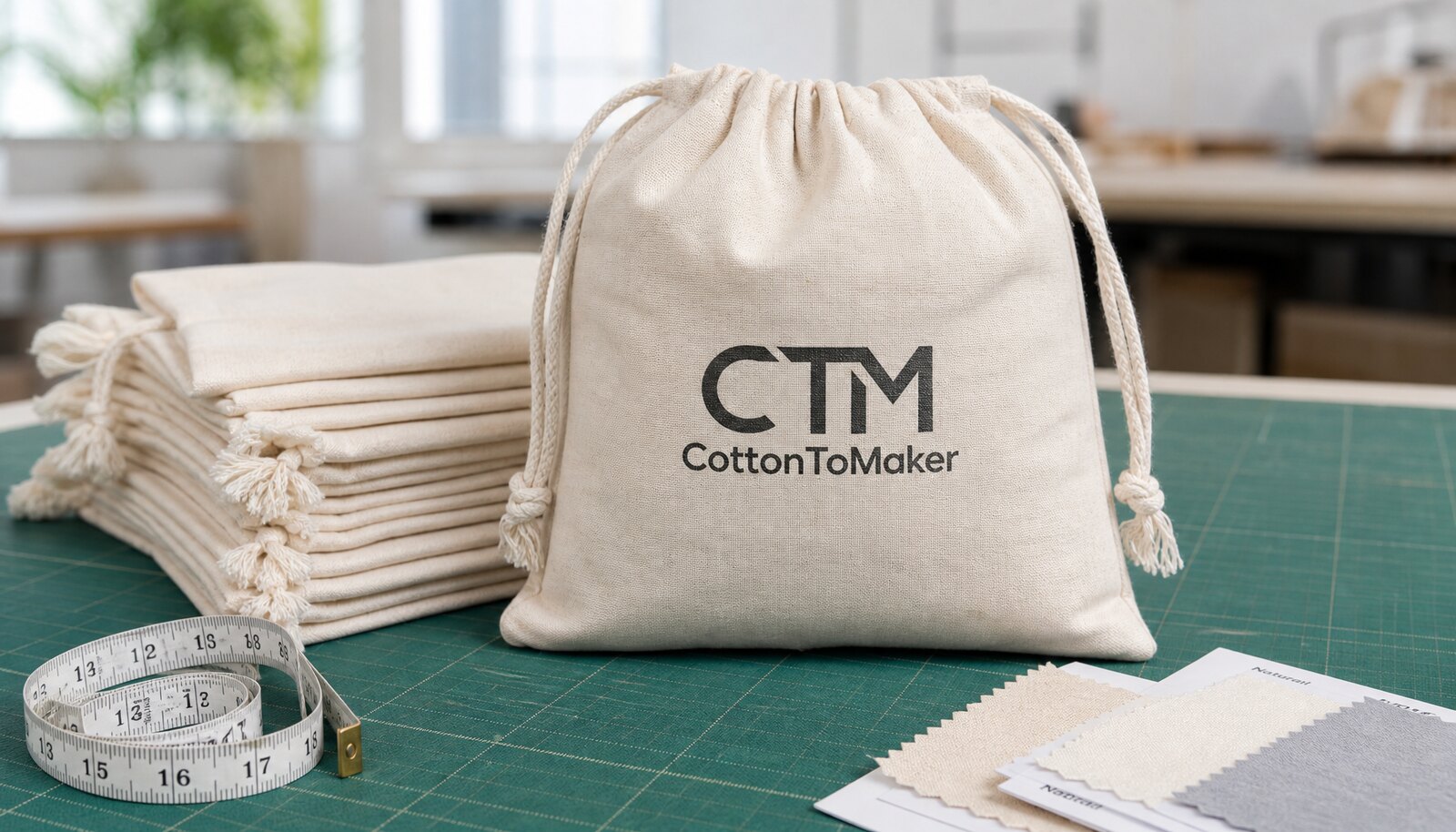
Why logo placement matters more than most gift-shop buyers expect
For gift shops, cotton drawstring pouches do more than protect the product. They affect shelf visibility, the perceived value of the item inside, and the unboxing moment that customers remember. That makes logo placement a commercial decision, not a decorative one. A mark that is easy to read on a flat art board can become unreadable once the pouch is sewn, tied, and filled.
The main risk is simple: the logo is specified against the wrong reference point. Buyers sometimes approve artwork from the cut panel, then discover that the finished pouch loses usable space to the seam allowance, the top channel, and the way the bag folds when pulled closed. For cotton drawstring pouches for gift shops, the best approach is to design the placement around the sewn pouch, then confirm the result in a filled sample.
- Keep the logo visible when the pouch is tied, not only when it is empty.
- Approve artwork against the finished sewn panel, not the raw cut fabric.
- Treat front-panel placement as part of merchandising, because that is where the customer actually sees it.
Start with the contents and the retail use case, not the bag size alone
The right pouch spec depends on what goes inside it. A jewelry card, candle, soap bar, tea sampler, ornament, or gift set all create different fill profiles, and that changes how the pouch stands, folds, and reads on a shelf. A size that feels generous on paper can look underfilled in store, while a tighter size can distort the print window or strain the channel.
Fabric weight should be selected as a procurement tradeoff, not a universal rule. For many retail programs, buyers compare lighter cotton for low-cost inserts, mid-weight cotton for general gift-shop resale, and heavier cloth when the pouch is part of the premium presentation or expected to be reused. The exact GSM is only meaningful when the supplier also identifies the weave, finish, origin, and whether the cloth has been pre-shrunk.
- Match the pouch to the real contents, including the filled shape and closure tension.
- Ask for measured fabric data, not just a brochure weight range.
- If the pouch is meant to be kept by the customer, prioritize hand feel and closure repeatability over the absolute lowest unit cost.
Draw a placement map before the artwork is finalized
The safest logo zone is usually the front center of the pouch, but the exact placement should be based on the finished construction. The usable print field may be smaller than expected once the factory adds the top channel, trims the seam allowance, and folds the pouch when the cords are pulled. For that reason, a placement map should show the top seam, the side seams, the cord channel, and the actual logo boundary in millimeters.
For many small retail pouches, a front-center mark placed with a clear buffer from the top seam keeps the art readable after tying. That is a practical starting point, not a universal rule. Smaller pouches, wider logos, and multi-line taglines all change the margin. The buyer should approve one size-specific template for each pouch format, then hold the supplier to that template on every reorder.
- Measure from the finished top seam and finished side seams.
- Keep the logo and any tagline clear of the tie line and channel fold.
- Use one placement template per size so the factory does not improvise between orders.
Choose the print method by artwork complexity and reorder plan
Screen print is usually the most stable option when the logo is simple, one color, and expected to repeat across future orders. It tends to be the best fit for buyers who want predictable placement and good unit economics on reorders. The tradeoff is that fine text, thin strokes, and intricate details can soften or fill in on textured cotton, especially if the fabric weave is open or the ink deposit is too heavy.
Heat transfer is more flexible for complex art or short-run launches, but it changes the risk profile. The print may sit more like a layer on top of the fabric, which can look less integrated and may wear differently under repeated handling. Embroidery can look premium, but it adds stiffness and can distort small pouches if the stitch density is too high. In sourcing terms, the best method is the one that fits the logo shape, retail handling pattern, and reorder volume, not the one the supplier happens to use most often.
- Use screen print when the artwork is simple and the order is likely to repeat.
- Use transfer only when the artwork or timing makes it the least risky launch method.
- Reserve embroidery for cases where texture and premium appearance matter more than softness and low cost.
Compare supplier scenarios before you compare unit price
A quote for the same pouch can mean very different things depending on the supplier type. A factory-direct supplier may give the most control over sewing, print, and packing, but expects a cleaner spec from the buyer. A trading company or sourcing office may be useful when the program includes multiple products or when the buyer needs help coordinating different factories. A local decorator or printer may be the fastest option for a small launch, but the landed cost can be higher and the fabric choices may be narrower.
That is why procurement teams should compare the total program, not just the listed piece price. Ask whether the supplier owns the sewing line, outsources printing, or subcontracts packing. If different parts of the process happen in different places, quality drift becomes more likely unless the buyer has strong sample control. For cotton drawstring pouches for gift shops, the lowest unit price is not useful if the supplier cannot repeat the same logo position or shade on the next run.
- Factory-direct fits stable repeat programs with clear specs and planned reorders.
- Sourcing partners help when the order includes mixed items or the team lacks in-house factory management.
- Local decorating can be appropriate for tight lead times, but it should be compared on landed cost and repeatability, not convenience alone.
Make the RFQ specific enough to compare apples to apples
A useful RFQ does not just say "cotton pouch with logo." It states the finished size, fabric construction, print method, placement window, cord type, packing format, and inspection expectation. Without that detail, two quotes can look similar while actually describing very different products. One supplier may be pricing a lighter cloth with bulk packing, while another is including a heavier body fabric, better cord finish, and carton labeling.
The buyer should also ask for alternative pricing scenarios. For example, request the base spec, a lower-cost version, and a premium version so the team can see where the price moves when GSM, packing, or print complexity changes. That gives the merchandising team and the procurement team a shared view of tradeoffs instead of forcing a yes-or-no decision on a vague quote.
- Specify size, fabric, print method, and packing in the RFQ body, not in a side note.
- Ask for at least one lower-cost and one premium scenario so tradeoffs are visible.
- Require the supplier to identify what is included and what is extra, especially setup, packing, and labels.
Sample approval should test the pouch in the way it will actually be used
A good sample is not just a clean-looking pouch. It is proof that the finished bag closes properly, displays well when tied, and still looks balanced when the intended product is inside. The buyer should evaluate the sample under the same conditions the retail customer will see: filled, tied, handled, and viewed under store lighting. If the sample only passes when it lies flat on a table, it is not enough.
The sample should also represent the real production method. If the proof sample was touched up by hand or made on a different machine, it may look better than the regular line can repeat. The buyer should ask whether the sample came from the same sewing setup, same fabric lot, and same print method that will be used for production. Keep one sealed reference sample and one marked spec sheet, because reorders are only as good as the comparison standard.
- Test the sample with the actual product or a weight equivalent.
- Check the pouch while tied, open, and re-tied to see whether the logo still reads cleanly.
- Retain one sealed reference sample for future reorder comparison and inspection.
QC needs concrete test methods, not just a visual thumbs-up
Retail buyers should define the test method before they define the pass/fail result. For print durability, a controlled dry rub test is the most practical starting point: use a white cotton cloth or equivalent surface, apply repeated strokes with consistent pressure, and check for transfer, flaking, or tackiness. If the pouch may face moisture, add a damp-rub check. The goal is not a lab report for its own sake; it is to know whether the logo will survive normal warehouse handling and customer use.
Seam strength also needs a real-world check. Fill the pouch with the intended product or a weight-equivalent sample, close it, shake it, and inspect the side seam, bottom corners, and top channel for stitch opening or distortion. If the pouch is meant to be reused or washed, set a shrinkage or size-stability rule before ordering and confirm the fabric does not move outside that limit after conditioning or washing. For shade control, compare the production lot to the sealed reference under the same light used for receiving, not just under office daylight.
- Dry rub: no visible flaking and no meaningful color transfer after controlled strokes on white cloth.
- Damp rub: no bleeding or smearing if the pouch is likely to encounter moisture.
- Seam strength: no popped stitches, open corners, or channel failure when the pouch is filled and handled as intended.
- Size stability: define the allowable change before production if the pouch is expected to be washed or reused often.
- Shade control: compare production against the sealed reference sample under receiving light.
Use a documented inspection plan so defects are judged consistently
An AQL plan is more useful than a vague quality promise because it forces the supplier and buyer to agree on what a defect actually is. For cotton drawstring pouches, the most common major issues are crooked logos, visible stains, incorrect size, and weak seam finish. Critical issues are the ones that make the pouch unusable or unsafe for retail release, such as a missing cord, open seam, or severe print failure. Minor issues are the small visual imperfections that should still be controlled but may not block shipment if they stay within the agreed limit.
The inspection record should include count verification, measurement checks, visual review, and carton audit. If the first article approval set a specific placement window and the shipment no longer matches it, the lot should be judged by the same rule. That consistency matters because gift-shop programs often reorder seasonally, and a supplier who shifts standards between runs will create avoidable disputes.
- Major defects: crooked logo, wrong size, visible stain, or poor seam finish.
- Minor defects: loose thread, light marking, or small shade variation within the agreed tolerance.
- Critical defects: missing cord, open seam, severe print failure, or a pouch that cannot be used as intended.
Packing and carton rules matter because pouches are easy to miscount
Cotton drawstring pouches are light, compressible, and easy to miscount, which makes packing more important than it looks on a quote sheet. If the order goes to a retail warehouse, the cartons need clear style codes, size labels, and barcode labels so receiving can process the shipment without opening every box. If the pouch is part of a gift set, the packing spec may need to define fold direction, inner pack size, or whether the pouch should arrive in a retail-ready orientation.
Mixed-size cartons can save a little space but often create receiving friction. Unless the retailer asks for assortments, one SKU per carton is usually easier to audit and less likely to trigger count disputes. The carton marking should match the purchase order exactly, including color, size, pack count, and destination code. For procurement teams, the goal is not just safer shipping; it is fewer surprises at the warehouse dock.
- Use clean carton labels that match the PO line items and style codes.
- Avoid mixed SKUs unless the receiving process is designed for assortments.
- Define whether the order is bulk-packed, retail-packed, or set-ready before production starts.
Specification comparison for buyers
| Spec decision | Best default | When it fits | Buyer risk to check |
|---|---|---|---|
| Logo placement zone | Front center with a buyer-approved safe margin from the finished top seam and side seams | When the pouch is tied on shelf and the logo must stay readable from the front | A placement rule copied from cut-size artwork can hide the logo after sewing and tying |
| Print method | One-color screen print for simple marks; heat transfer only when art or launch timing makes it necessary | Screen print suits repeat orders and flat logos; transfer suits short runs or detailed art | Fine text can fill in on textured cotton; some transfers crack or wear faster under handling |
| Fabric weight | Use the lightest GSM that still supports the contents, handling, and shelf look you need | Heavier cotton helps premium gift sets and reuse; lighter cotton may work for small inserts or low-cost packaging | A quoted GSM range without fabric source, weave, or pre-shrink status is not enough to compare suppliers |
| Pouch construction | Clean top channel, even cord pull, and seam allowance that leaves enough printable front panel | When the pouch is part of the product presentation, not just an outer bag | A narrow print window or uneven channel can force the logo too high, too low, or off-center |
| Supplier model | Use the most direct route that still gives you control over print, sewing, and packing | Factory-direct works for stable repeats; a local decorator or sourcing partner may help with smaller or more fragmented programs | Different supplier types may quote different assumptions, so the cheapest line item may not be the cheapest landed result |
| Quantity strategy | Quote the pilot order, the expected reorder size, and one higher breakpoint | When you need to control setup cost without locking into a premature volume promise | A quote that only covers one quantity can hide setup, packing, or color-change penalties |
| Packing format | Bulk pack unless retail receiving or set assembly requires more detail | When the pouch is a secondary packaging item or a gift-set component | Retail-ready packing can add labor, carton complexity, and count error risk |
| Artwork setup | One locked vector file, one placement template, one approved reference sample | When you expect reorders or multiple retail accounts using the same pouch spec | Late art changes and non-vector files create avoidable delays and print drift |
Buyer checklist before sampling
- Define the use case first: product packaging, retail resale, gift wrap, mailer insert, or event giveaway. The right fabric feel, print durability, and closure behavior change with the use case.
- Approve the finished pouch size and the printable front panel together. Measure from the sewn seam and the finished channel, not from the cut fabric panel.
- Ask the supplier to state the actual fabric construction, weave, finish, and measured GSM. A brochure range is not enough if you are comparing suppliers across regions or mills.
- Lock the logo size and placement window before artwork is finalized. Keep every critical element out of the top channel, the side seams, and any area that folds when the pouch is tied.
- Confirm whether the pouch will be printed, embroidered, or labeled, and require the supplier to show the artwork on the exact production method, not a generic mockup.
- Request a filled sample or a weight-equivalent sample. A flat pouch can look acceptable and still fail once the real product goes inside and the drawstring is pulled.
- Ask for the packing structure in writing: bulk, inner packs, retail polybags, size labels, barcode labels, carton marks, and whether mixed sizes are allowed.
- Get quote breaks at your pilot quantity, your expected reorder quantity, and a higher production breakpoint. That makes setup cost, print cost, and packing cost easier to compare.
- State the acceptable tolerance for logo position, seam appearance, shade variation, and trim quality. If you do not define it, the factory will use its own standard.
- Keep one approved sample, one approved spec sheet, and one artwork file version number for reorders. That prevents drift when the next purchase order is raised.
Factory quote questions to send
- What is the finished pouch size, seam allowance, and printable front-panel width after sewing and channel formation?
- What cotton fabric are you quoting, including weave, finish, GSM, and whether the cloth is pre-shrunk or prewashed?
- Where exactly is the logo placed, what is the maximum print size in millimeters, and what placement tolerance do you hold during production?
- Which print method is included, how many colors are covered, and are screens, plates, or setup charges included in the unit price?
- What price breaks can you offer at the pilot order, the first reorder, and a larger repeat run?
- Are the cords cotton, cotton-poly blend, or synthetic, and how are the ends finished to prevent fraying or uneven closure?
- What packing is included by default, and what extra cost applies for inner bags, retail labels, barcode labels, carton marks, or master cartons?
- Can you quote the same pouch in at least two construction options, such as standard retail and premium retail, so we can compare tradeoffs instead of only unit price?
- What inspection method do you use for print placement, seam strength, rub resistance, and shade variation between lots?
- What is your sample timeline, production lead time, and the revision impact if the logo, pouch size, or packing spec changes after sampling?
Quality-control points to confirm
- Logo position should match the approved template and stay within the buyer-agreed placement window for that pouch size.
- The printed area should be readable at normal retail viewing distance, with no smearing, ghosting, broken edges, or heavy fill-in on the cotton weave.
- Dry rub testing should use a white cotton cloth or equivalent test surface with repeated controlled strokes; accept no visible flaking and no meaningful color transfer beyond light haze.
- If the pouch may face moisture or handling near beverages, use a damp-rub check as well; accept no bleeding, smearing, or sticky ink after the agreed test.
- If the fabric is meant to be reusable or washable, define an allowable size change before production and confirm the pouch does not distort beyond that limit after conditioning or the agreed wash test.
- Seams should hold under normal fill and handling, with no popped stitches, open corners, broken top-channel stitching, or needle damage that weakens the pouch.
- Cord movement should be smooth and balanced on both sides, with no slipping knots, twisted channel, or uneven closure when the pouch is tied and reopened.
- Loose threads should be trimmed cleanly, not just tucked in, and there should be no oil marks, fabric snags, or visible needle runs on the retail-facing surface.
- Shade variation should be checked against the sealed reference sample under the lighting you use for receiving and merchandising, not only under warehouse daylight.
- Use a documented AQL or buyer inspection standard with clear major, minor, and critical defect definitions so rejections are consistent across lots and suppliers.