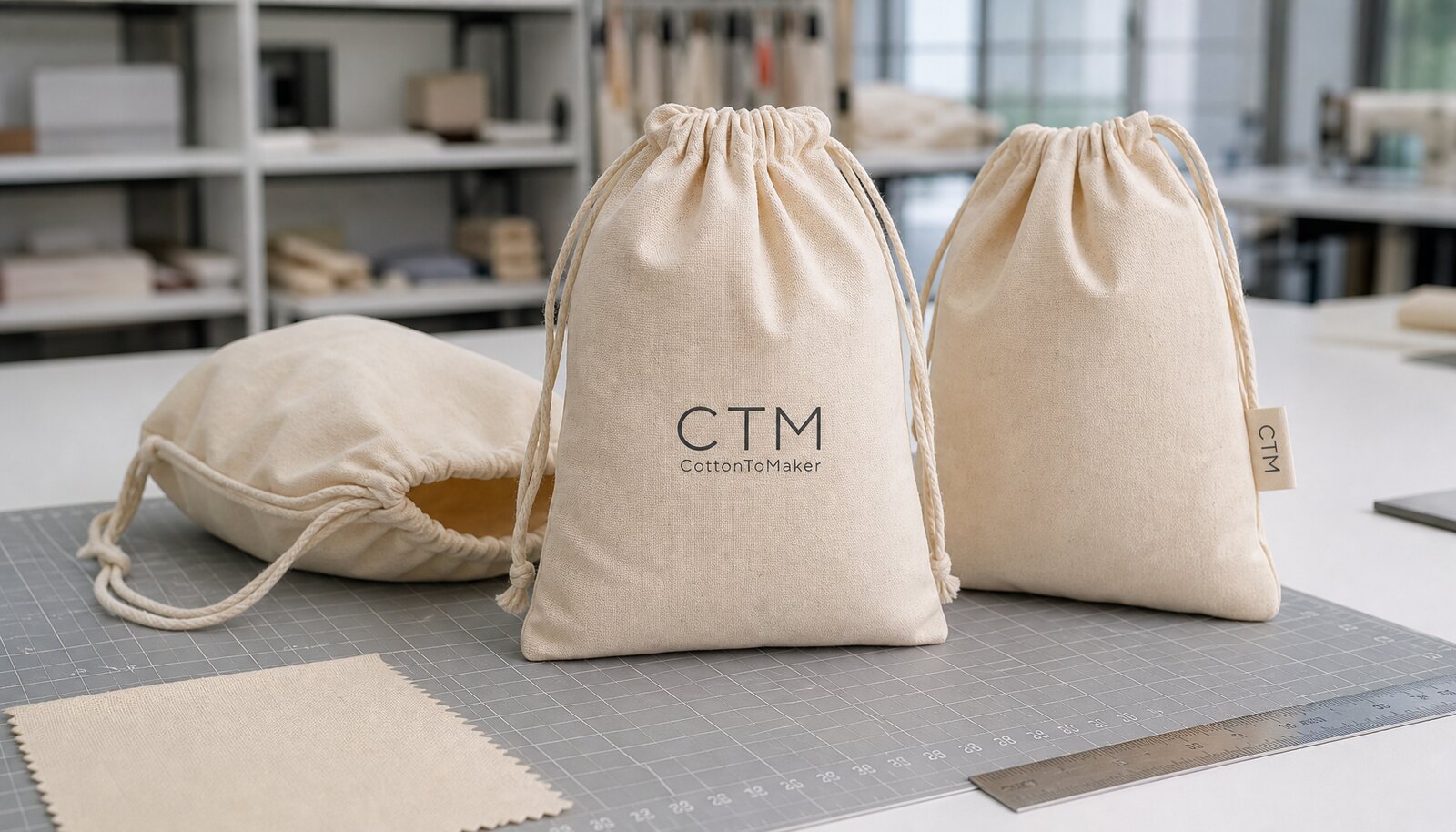
Why print proofing matters on a small pouch
For gift shops, a cotton drawstring pouch is not just packaging. It is part of the product story, the shelf look, and the first thing a customer touches. If the logo lands too high, the print looks faint, or the pouch closes badly once it is filled, the item feels cheap even when the artwork itself is strong. That is why print proofing on this product is not a design formality. It is the point where fabric, print method, and sewing line reality have to match the buyer's retail intent.
A good proof protects three things at once: brand appearance, production repeatability, and landed cost. If you approve a pouch from a screen image alone, you may miss fabric color drift, print opacity problems, or a logo that clashes with the seam line. For gift shop buyers, the right question is not whether the art looks good. It is whether the approved proof can be made at scale without changing the hand feel, the retail look, or the unit cost structure.
- Treat the proof as a production instruction, not just a visual approval.
- Lock the pouch use case first: gift wrap, retail pouch, or reusable carry bag.
- Approve the print only after the fabric, size, and closure style are fixed.
Start with fabric weight, size, and closure details
The fastest way to create a bad quote comparison is to compare pouches that are not built the same way. A 120 GSM pouch can be fine for jewelry tags or small trinkets, but it will not hold shape the same way as a 160-180 GSM pouch. For gift shop use, that difference affects perceived value, print clarity, and how the pouch sits on a counter or in a basket. If the bag is too light, the logo may show show-through or wrinkle around the print area. If it is too heavy, the finished pouch may feel more like a utility bag than gift packaging.
Size and closure design matter just as much. A pouch that narrows sharply toward the top can cut into the print field, and a drawcord channel that is too wide can steal visible space from the brand mark. Buyers should define the finished size, opening width, cord length, and whether the pouch needs a single drawcord or a double drawcord finish. If the pouch will sit beside premium candles, ornaments, or jewelry, the buyer should also decide whether the edge stitching and cord color must match the product range.
- Use 120-140 GSM only when the product inside is light and the pouch is not expected to hold shape.
- Use 160-180 GSM for most gift shop assortments where the pouch must look substantial on shelf.
- Move above 180 GSM when the pouch carries heavier items, needs a premium hand feel, or must survive repeated reuse.
- Define finished dimensions, not just flat fabric size, so the factory quotes the real sewing result.
- Specify cord style, cord diameter, and top channel construction before asking for print placement.
Choose the print method by order size and artwork
For most cotton drawstring pouches, screen print is the best balance of price, clarity, and repeatability when the art is one or two solid colors. It handles simple logos well and usually gives the cleanest result on natural cotton. The catch is that setup cost only makes sense when the run is large enough to spread the screen or plate charge across the quantity. If the logo has fine type, thin lines, or multiple colors, the buyer has to decide whether the final print can still read cleanly after the fabric flexes and the pouch is cinched.
Heat transfer, digital print, embroidery, and woven labels each solve a different problem. Heat transfer can work for short runs or complex color art, but buyers should inspect the hand feel and durability because the print can sit on the surface instead of becoming part of the textile. Embroidery looks premium but may distort small text and can pucker on lighter cotton. A woven label sewn into the side seam is often the best choice when the brand wants a durable mark without covering the front panel. The right method is the one that matches the volume, the artwork detail, and the retail expectation, not the one that looks best in a presentation mockup.
For a seasonal gift shop launch, many buyers use one simple front screen print and a small side label, because that combination gives a clear brand read without overcomplicating the sewing line. If the artwork is still changing, it is usually better to test on a small run first than to commit to a multi-color setup that locks you into high reprint risk.
- Screen print fits simple logos, low color counts, and repeat replenishment.
- Heat transfer fits short runs and complex color art, but test the finish for cracking and gloss.
- Embroidery fits premium branding, but it is not ideal for tiny text or very soft fabric.
- Woven labels work when the brand needs durability more than a large front graphic.
- The more colors and placements you add, the more your setup cost and proof risk increase.
Read the artwork proof like a production drawing
A usable proof should answer more than the question of whether the logo is centered. It should show the exact pouch dimensions, the print size, the distance from the top edge, and the amount of clear space around the artwork. It should also identify the fabric color, the print method, and the Pantone or visual color reference used for approval. If the pouch has a seam, a label, or a cord channel near the print zone, those features need to be shown on the proof because they can change the readable area more than the buyer expects.
A digital image alone is not enough when color and placement matter. The buyer should ask for an annotated layout and, where possible, a physical strike-off or pre-production sample that uses the actual fabric and ink. That is the only reliable way to see whether the print is too close to a seam, whether the logo has been scaled incorrectly, or whether the natural cotton base makes the chosen ink look weaker than expected. If the proof does not show the front, back, and side view, it is still a concept, not an approved production document.
- Require finished dimensions and print area dimensions on the proof.
- Mark the exact location of the logo relative to the top seam and side seams.
- State the color reference method, such as Pantone, lab dip, or approved sample.
- Show side label location if the pouch carries a woven label or care label.
- Do not approve based on a file that hides important details behind a clean mockup.
Build the RFQ so quotes can be compared cleanly
The biggest buyer error on these pouches is asking for a price without locking the production inputs. If one supplier quotes a 140 GSM bag with a one-color print and another quotes a 160 GSM bag with the same artwork, the prices are not comparable. The RFQ should split the job into fabric, cutting, sewing, print, packing, sampling, and cartonization. That gives procurement a real way to see where one supplier is cheaper because of process efficiency and where another is cheaper because they quietly changed the spec.
Good quotes also show the hidden drivers. Ask whether the factory owns the printing line or outsources it, whether the setup charge is per color or per design, and whether the price changes when you move from bulk packing to retail packing. If your order includes multiple SKUs, a direct factory can often give better control over one pouch design, while a trading company may be useful if you need mixed products in one shipment. For a first bulk order, the better quote is the one that explains the structure clearly, not the one with the lowest headline number.
- Separate unit price from tooling, sample, packing, and carton charges.
- Ask for price breaks by quantity tier so you can see where the setup cost is absorbed.
- State whether the quote is EXW, FOB, or another incoterm.
- Request overrun and underrun tolerance in writing.
- Ask who handles printing, sewing, and packing if the supplier is not a direct factory.
Set sample approval rules before bulk production starts
A pre-production sample should use the actual fabric, actual print method, and the actual cord or label that will go into bulk production. A paper proof or a print-on-white test swatch can be useful, but it does not show how the logo behaves on the final pouch surface. Buyers should measure the sample, compare the print position against the approved drawing, and inspect the pouch after it has been filled and cinched. That reveals whether the print area disappears into folds, whether the cord pulls evenly, and whether the pouch still looks straight when it is closed.
Set clear acceptance limits before the factory starts. Many buyers use a small placement tolerance, such as a few millimeters, because handmade sewing will never be perfectly rigid. The key is to define what matters most: logo centerline, color match, seam strength, or retail presentation. If your gift shop program depends on a very precise brand look, keep one signed sample in the file and use it as the master reference for repeat orders. That makes later reorders much easier to compare and reduces arguments over whether a batch is really the same as the approved one.
- Approve size, print position, and color on the actual production material.
- Pull the drawcord several times to see if the channel and knots hold.
- Inspect the pouch after folding, because some logos look fine flat but fail when cinched.
- Keep a signed master sample with the order record for future reorders.
- If the color is critical, approve under both daylight and store lighting.
Packing details affect shelf readiness and shipping cost
Packing is often treated as a last-step detail, but for gift shop pouches it can change both cost and presentation. Bulk packing is usually cheaper and better for warehouse handling, while individual polybags, barcode stickers, and retail-ready folding add labor and material cost. If the pouches will be distributed to shops, kitting centers, or online fulfillment teams, ask the factory to quote the exact inner pack count and carton count. A small mistake in folding or count labels can create extra receiving work and make the first shipment look less professional than the unit price suggests.
Print quality can also be affected by the packing method. A pouch folded too tightly can crease the logo, especially if the print sits near the center of the bag. Cotton absorbs moisture more than synthetic fabrics, so cartons should stay dry and clean, and the buyer should decide whether a simple protective sleeve or tissue wrap is needed. If the order is moving into retail distribution, barcode placement, carton marks, and carton size should be part of the quote, because freight cost is often driven by volume as much as by weight.
- Confirm whether the quote includes bulk pack, retail pack, or both.
- Specify carton count and inner pack count so receiving teams can reconcile shipments quickly.
- Ask for carton dimensions and gross weight before shipment booking.
- Use fold direction that protects the print face from creasing.
- If the market requires it, add barcode labels and any warning labels to the packing spec.
Plan lead time from artwork approval, not from the first inquiry
Lead time on a custom pouch order is usually lost in small steps, not one big delay. Artwork revisions, sample corrections, fabric sourcing, and print plate approval can each add days. For a typical custom cotton drawstring pouch, a buyer may see a short proof cycle first, then a pre-production sample, then bulk production, then packing and dispatch. The real schedule should start from the point when the artwork and spec are frozen, not from the date the first inquiry was sent. That matters most in gift retail, where seasonal windows can close quickly around holidays, fairs, or store resets.
The buyer should also understand where time is at risk. Multiple print colors take longer to register, new fabric colors can extend dyeing time, and a factory that outsources printing can lose days between process steps. If the order is for a gift shop launch, keep a buffer for approval loops and transit, because even a small change in logo size may require a new strike-off. Buyers who work backward from the in-store date usually get better control than buyers who trust a single promised ship date without asking what happened to the sample stage.
- Count lead time from final artwork approval and deposit, not from the first email.
- Add extra buffer for new fabric colors, multi-color printing, or peak-season orders.
- Separate sample time, production time, packing time, and transit time in the schedule.
- Ask the factory what part of the schedule is under its control and what part is subcontracted.
- If the pouch launches with a holiday range, freeze the spec early and keep revisions minimal.
Compare landed cost, not just the factory unit price
A low unit price can still be the expensive option if the quote hides setup, packing, freight, or rework risk. For small cotton drawstring pouches, the landed cost should include the pouch itself, print setup, packing labor, export cartons, inland freight, inspection time, and the transport mode you actually plan to use. A direct factory may look cheaper at the unit level, but a trading company may reduce coordination cost if you are sourcing other gift items in the same shipment. A local decorator can turn around an emergency reorder quickly, but the unit cost is usually higher and the fabric choices may be narrower.
The best comparison method is to reduce every quote to a sellable unit. That means the cost per pouch after packing, not just the ex-works price on the invoice. If the pouch is part of a gift shop bundle, a small mistake in print placement or carton count can create more margin loss than a small difference in quoted price. Buyers should compare route by route: direct factory for repeat orders, trading company for mixed sourcing, and local print finishing for urgent replenishment. The right route depends on how stable the artwork is and how much control the buyer wants over the process.
- Compare total landed cost per sellable pouch, not just the printed unit price.
- Include sample charges, setup charges, packing labor, and carton cost in the math.
- Treat a faster route as valuable only if it does not weaken print control or color match.
- Use a different sourcing route for emergency replenishment than for planned seasonal buys.
- When the artwork is stable, repeat orders are where direct factory sourcing usually pays back.
Avoid the mistakes that create rework and write-offs
Most pouch failures are predictable. The logo is too close to the seam, the print is approved on a screen but not on cotton, the bag is too thin for the product inside, or the buyer forgets to define packing and gets a retail carton that is not shelf ready. Another common mistake is approving a beautiful mockup while ignoring how the pouch closes when filled. Once the cord pulls the fabric into pleats, the artwork can distort and the brand mark may no longer sit where the buyer expected.
The safest order is the simplest one: one size, one fabric weight, one print method, one placement, one packing format, and one signed sample. That does not mean the product has to be plain. It means the buyer removes variables before scale-up. For gift shop programs, that discipline matters because these pouches are often repeated across seasons and product lines. A stable spec gives procurement a cleaner quote, a factory a clearer production target, and the retail team a product that looks the same when it is reordered months later.
- Do not approve a proof without the final fabric color and fabric weight.
- Do not add extra print colors unless the margin supports the added setup cost.
- Do not ignore how the pouch looks after it is cinched shut with product inside.
- Do not leave carton counts, barcode labels, and retail pack rules out of the RFQ.
- Do not let a revised artwork file enter production without a fresh proof round.
Specification comparison for buyers
| Spec decision | Recommended option | When it fits | Buyer risk to check |
|---|---|---|---|
| Supplier route | Direct factory with in-house cutting, sewing, and printing | Repeat orders, one or two print locations, and a buyer who needs control over fabric and placement | Confirm who actually prints the bags and whether any step is outsourced |
| Supplier route | Trading company that consolidates pouch, print, and packing work | Mixed-SKU orders or buyers who need one shipment from multiple factories | Watch for hidden margin, weak technical control, and proof delays between subcontractors |
| Fabric weight | 160-180 GSM cotton for standard gift shop use | Most retail pouches for jewelry, candles, soaps, ornaments, or small promo items | Check shrinkage, weave density, and whether the bag still looks crisp after handling |
| Fabric weight | 120-140 GSM cotton for lighter seasonal items | Low-cost gift wrap, sachet-style use, or very light products | Risk of a thin hand feel, show-through, or poor shape once the pouch is filled |
| Print method | 1-2 color screen print | Simple logo, repeat orders, and tight unit-cost control | Verify registration tolerance, ink opacity, and cure quality so the logo does not crack or wash off |
| Print method | Woven label or sewn side label | Premium natural look, minimalist branding, or when the print area is small | Check label placement, stitch quality, and whether the label affects the retail finish |
| MOQ structure | Single size, single fabric color, single print position | Best way to reduce setup cost on custom pouches | If you change size, color, or artwork, ask how the MOQ and setup charges move |
| Packing format | Bulk packed with count labels, then retail packing only if required | Wholesale shipments to warehouses, distributors, or kitting centers | Confirm carton count accuracy, inner pack method, and whether folding damages the print |
| Approval route | Physical pre-production sample plus signed artwork proof | Any order where print color, placement, or hand feel matters | Do not rely on a PDF alone if the final sale depends on exact color and logo positioning |
Buyer checklist before sampling
- Final vector artwork with Pantone references or clear color instructions
- Finished pouch size, seam allowance, and acceptable measurement tolerance
- Fabric weight, fabric color, and whether the cotton is bleached, natural, or dyed
- Print method, print size, print location, and the minimum clear margin from seams or cords
- MOQ by size and color, plus any price changes for extra print positions or extra colors
- Sample type required for approval: digital proof, strike-off, or physical pre-production sample
- Packing spec, carton count, retail labeling, and barcode requirements
- Lead time start point, overrun and underrun tolerance, and the agreed incoterm
Factory quote questions to send
- What fabric GSM and weave are you quoting, and is that based on approved stock or new dyeing?
- Is the price based on one print color, one print position, and one pouch size only?
- What is the MOQ if we change the pouch size, fabric color, or logo placement?
- What setup charges apply for screen plates, color matching, or woven labels?
- Can you send a pre-production sample made with the actual fabric and actual print method?
- What packing is included in the quote, and what is charged separately for polybags, hangtags, or barcodes?
- What overrun or underrun tolerance do you work to, and is it the same for custom print orders?
- What lead time do you count from: artwork approval, sample approval, or deposit receipt?
Quality-control points to confirm
- Confirm finished size against the approved spec and allow only the agreed tolerance on width and height.
- Inspect print placement so the logo stays centered and clear of seams, cord channels, and folding lines.
- Match print color to the approved reference under daylight and retail lighting, not only on a monitor.
- Check ink coverage for pinholes, fading at the edges, cracking after flexing, or bleed-through on thin fabric.
- Pull-test the drawcord and inspect the channel stitching, bartacks, and top seam for loose threads or puckering.
- Measure fabric weight from the approved lot and flag any material change before bulk production continues.
- Verify carton counts, inner pack counts, barcode labels, and carton marks before shipment release.
- Keep one signed sample from the approved run for claim handling, reorders, and color reference.