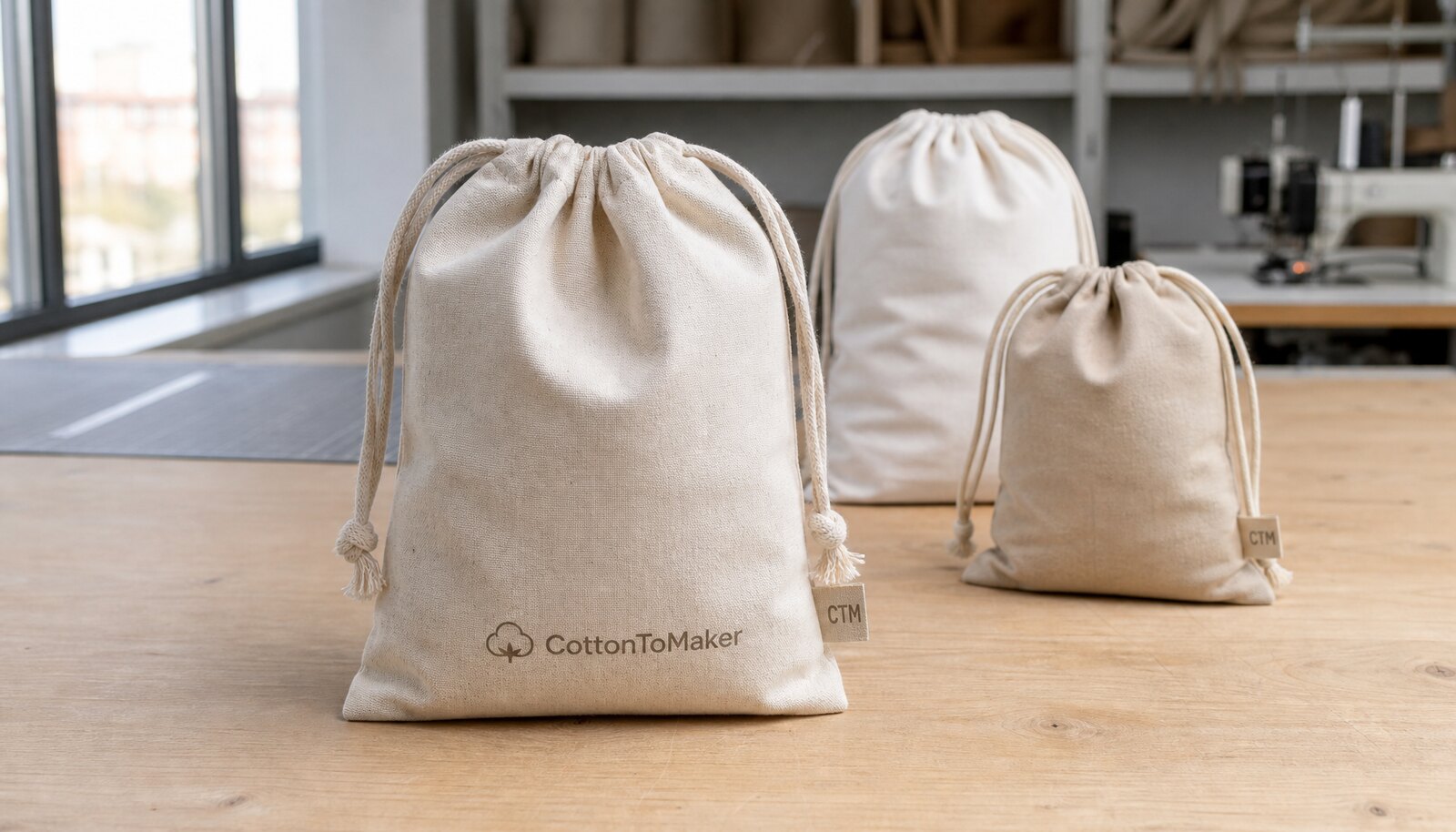
What gift-shop buyers are really paying for
When buyers search for cotton drawstring pouches for gift shops bulk pricing plan, they usually want one thing: a practical way to protect margin without buying a pouch that cheapens the gift. In a gift-shop assortment, the pouch is not just packaging. It can be part of the product presentation, a reusable keepsake, or a small but visible carrier that changes how the customer judges the whole set. That means the buying decision needs to start with retail function, not only with factory unit price.
The right spec depends on how the pouch will be used. If the pouch is hidden inside a larger box or used only as transit packaging, lighter fabric and simpler sewing can be acceptable. If the pouch sits on a shelf next to candles, soap, tea, jewelry, or souvenirs, buyers usually need a cleaner hand-feel, better print clarity, and more consistent stitching. In other words, the same pouch can be either a cost line or a value signal, and that difference should show up in the quote plan.
For procurement teams, the first question is whether the pouch must support resale value. If yes, the buying brief should include touchpoints the consumer can notice: how the drawstring moves, how the seams lie, whether the print folds cleanly, and whether the pouch stands up to repeated opening. If no, the spec can be simpler. That distinction is the foundation of the pricing plan because it determines whether you should optimize for absolute unit cost or for a balance of cost, appearance, and defect risk.
- Use lighter construction when the pouch is only an inner packaging layer.
- Use cleaner seams and better fabric when the pouch is part of the retail presentation.
- Define the buyer job first: carrier, display item, reusable gift bag, or storage pouch.
Choose a fabric weight that matches the sales job, not a marketing claim
The most common GSM mistake is assuming heavier is always better. In gift retail, that is not always true. A pouch that is too light can feel thin and arrive with more wrinkles, while a pouch that is heavier than necessary can raise fabric cost, increase carton weight, and reduce the number of units per carton. The useful range for cotton drawstring pouches is usually governed by use case rather than by a single universal target.
For procurement planning, 80 to 100 GSM is best viewed as an entry spec. It can work for sample packs, low-cost inserts, and lightweight gift items. Around 120 GSM is often the practical retail baseline because it gives a more dependable hand-feel and better shape recovery without pushing freight too hard. At 140 GSM, the pouch becomes more premium, but you should expect not only a material cost increase; the added weight can also change carton utilization and shipping cost. A buyer comparing quotes should ask the supplier to hold the same size and construction while showing the price difference between those GSM steps.
Construction details matter just as much as GSM. A neat top hem, stable side seams, and a properly formed drawstring channel often make a medium-weight pouch look better than a heavier pouch with poor finishing. If you add extras such as lining, embroidery, woven labels, metal tips, or specialty dyeing, those should be priced separately. Otherwise, you will not know whether the quote is actually comparing like with like. For a gift-shop program, the safest approach is to lock the base construction first, then add decoration only where the retail value supports it.
- 80–100 GSM: entry-level, light-use, or inner packaging.
- 120 GSM: common retail sweet spot for many gift-shop programs.
- 140 GSM: premium feel, stronger presentation, higher freight impact.
Use a real pricing ladder instead of a single quote number
A bulk pricing plan is only useful if it shows how cost changes as volume changes. One flat quote hides the economics. Procurement buyers need to know what the supplier can do at 500 pcs, 1,000 pcs, 3,000 pcs, and 10,000 pcs because the real savings often arrive in steps. Those steps come from faster cutting, lower setup cost per pouch, better fabric utilization, and lower packaging labor per unit. If the quote does not show the breakpoint logic, the buyer cannot tell whether a slightly larger order will save real money or just create excess inventory.
A workable way to request pricing is to ask for three bands at minimum: test order, standard replenishment, and scale order. For example, a blank 10x15 cm cotton pouch at 120 GSM may land around $0.22–$0.38 at 1,000 pcs, $0.17–$0.28 at 3,000 pcs, and $0.12–$0.20 at 10,000 pcs depending on fabric source, sewing efficiency, and packing style. Once you add one-color screen printing, the same pouch may move to roughly $0.30–$0.55 at 1,000 pcs, $0.24–$0.40 at 3,000 pcs, and $0.18–$0.32 at 10,000 pcs. These are planning bands, not universal market prices, but they are useful because they show the shape of the cost curve and why a larger order can produce a real step-down.
The practical lesson is simple: compare supplier quotes using the same size, GSM, print method, and pack count. If one supplier quotes a lower number but includes only blank sewing while another includes printing and carton packing, the cheaper quote is not cheaper. Ask for a line-by-line cost build and then compare total landed cost. Gift-shop buyers often get better decisions from a cost ladder than from a single headline price.
- Request at least three volume bands: test, standard, and scale.
- Compare quotes only after separating pouch cost, print cost, and pack cost.
- Use the 120 GSM / 10x15 cm / one-color print combination as your reference scenario.
Know which supplier route fits the order size and risk level
A direct factory quote, a trading-company quote, and a stockist quote can all look similar until you examine the operational details. A direct factory generally gives the clearest cost structure and more control over fabric, sewing, and print quality. That route is usually best when the pouch will repeat across multiple seasons or when you need better control over the production standard. The tradeoff is that factories often prefer more volume, tighter artwork discipline, and firmer approval timing.
A trading company can help when you need a small test order, mixed SKUs, or more handholding on sampling and communication. The price may be higher because an additional layer is involved, but the service can be useful if your team is short on sourcing bandwidth. A stocked importer or warehouse supplier is different again: you are buying speed and convenience, not customization. That can be the right answer for seasonal replenishment, but only if the stock fabric, size, and color actually meet your spec.
For a gift-shop buyer, the route should match the business problem. If the pouch is a repeat retail item with a stable logo, the factory route usually wins over time. If you are testing a new gift concept and need to limit risk, a trading company can be acceptable for the first order. If you need a rush fill-in before a holiday, stock may be the fastest option, but you should treat it as a temporary bridge, not a baseline for long-term cost planning. The key procurement step is to know what part of the quote is factory price and what part is service margin.
- Direct factory: best for repeatable SKU programs and clearer cost control.
- Trading company: useful for smaller test orders, but verify the real factory source.
- Stockist/importer: fastest, but least flexible on exact spec and branding.
Write the RFQ so the supplier prices the same bag you intend to buy
Most pricing confusion begins with a loose RFQ. If you ask for cotton drawstring pouches without specifying dimensions, fabric weight, print method, cord style, and packing, the supplier fills in the blanks. That is how you get quotes that are cheap for one assumption set and expensive for another. A procurement-grade RFQ should reduce guessing to almost zero.
A strong RFQ for gift-shop bulk pricing should include the finished size in centimeters, target GSM, fabric color, print placement, number of colors, whether the design appears on one side or both, and how the pouch will be packed. If the pouch must fit inside another gift box, include the internal carton or box dimensions. If you need retail-ready labeling, state whether you want a woven side label, hang tag, barcode sticker, or both. If there are multiple sizes or artwork versions, list each SKU separately so the supplier cannot blend the pricing.
A simple example helps. If you say “10x15 cm, 120 GSM natural cotton, one-color screen print front only, drawcord to match, bulk packed 200 pcs per carton,” you will get a much more comparable price than if you say “small printed cotton bag.” The second version invites assumptions about cord type, channel depth, and print size. The first version gives the factory enough detail to price the actual work. For procurement teams, that difference often determines whether a quote survives internal review.
- State finished size, not a loose size description.
- Specify print method, print sides, and number of colors.
- Include packing and labeling rules in the RFQ, not after award.
Build MOQ logic around setup cost and reuse, not around a supplier slogan
MOQ is not just a sales number. It usually reflects setup work, fabric consumption planning, and line efficiency. A screen-printed pouch requires screen preparation and registration checks. A sewn pouch requires cutting markers and line balancing. If the order is too small, setup cost gets spread across too few units, and the unit price climbs. If the supplier says the MOQ is very low, ask what is being absorbed in the price and what is being charged separately.
For buyers, the useful question is not simply what is your MOQ. It is what order size gives the best cost per usable pouch once setup, packing, and reject allowance are included. Often there are real breakpoints around 1,000, 3,000, and 10,000 pieces. At the lower end, you are paying more per unit for flexibility and setup. At the higher end, the supplier can usually reduce the price because cutting waste and labor per piece fall. If your gift-shop program includes multiple sizes or colors, ask whether the factory can run them in one fabric lot or one print window. That can reduce cost more than squeezing the quoted price by a few cents.
A practical procurement rule is to compare the MOQs for the base pouch, the print version, and any label or packaging version separately. A supplier may quote a low MOQ for blank stock but require a much higher number once decoration is added. That is not necessarily a problem if the volume logic is clear. It becomes a problem only when the buyer assumes the lower MOQ applies to the finished retail item.
- Ask for price breaks at realistic reorder quantities, not only at first order quantities.
- Separate base pouch MOQ from decoration MOQ.
- Treat unusually low MOQ quotes as likely to carry higher unit cost elsewhere.
Use sample approval to test handling, not just appearance
A sample is a decision tool, not a souvenir. For cotton drawstring pouches, the sample should prove that the bag opens smoothly, closes evenly, and keeps its shape after handling. The approved sample should also show whether the print sits correctly on the finished bag, not only on a flat lay image. For gift-shop items, the customer experience often starts with touch, so the sample needs to be evaluated in hand.
The best practice is to keep a golden sample or signed reference sample. That reference should include the approved fabric shade, print position, label placement, finished dimensions, and folding method. If you do not lock those details, later disputes turn subjective very quickly. A factory may believe the bulk run is acceptable because it is close to the original sample, while the buyer may reject the same run because the pouch no longer feels retail-ready. A signed reference reduces that argument.
During sample review, check the cord pull, stitch behavior, and print durability. Fold the pouch several times, pull the drawcord repeatedly, and examine the seams after bending. If the print is screen printed, look for ink cracking at fold lines and edge ragging after handling. If the pouch will be used in gift sets or point-of-sale displays, simulate real warehouse and retail handling rather than only visual inspection on a table. A pouch that passes a visual check but fails simple handling tests will often become a returns or rework problem later.
- Approve the exact reference sample before bulk production starts.
- Test opening, closing, and repeated folding, not just flat appearance.
- Measure the sample and record the approved dimensions in writing.
Land the cost before you choose the cheapest quote
The cheapest ex-factory price is not always the cheapest landed cost. For cotton drawstring pouches, freight and handling can change the final economics in ways that are easy to miss. A heavier GSM pouch may add only a small amount to the unit price but can reduce carton efficiency and raise shipping cost. A low-cost supplier that packs poorly may also create warehouse labor, relabeling work, or damage loss that offsets the apparent savings.
A useful landed-cost worksheet should include the pouch price, any print setup fee, packing materials, carton cost, freight, duty or tax where applicable, receiving labor, and a reasonable defect allowance. For example, if a 3,000-piece order of blank 120 GSM pouches is quoted at $0.20 per pouch ex-factory, the product cost is $600 before freight. If freight, cartons, and import handling add $180, the landed cost becomes $780, or $0.26 per pouch. If a slightly higher-quality pouch costs $0.23 ex-factory but reduces defects and packs more efficiently, the landed cost may end up close to the same or even lower. That is why buyers should compare total cost per sellable pouch, not simply the quote on the page.
This is also where freight behavior matters. Cotton is often light enough that carton volume becomes more important than weight alone. If the pouch is folded too loosely or the carton count is too conservative, you may ship air. If it is packed too tightly, you may receive creased goods or distorted cord channels. Ask the supplier to show the pack density and the carton dimensions on the quote. Those numbers are more useful than a generic promise that freight will be low.
- Calculate landed cost on the exact pack plan, not on a guess.
- Include defect allowance and warehouse handling in the comparison.
- Use carton dimensions and pack density to judge freight efficiency.
Check quality with measurable criteria, not broad language
Procurement value comes from measurable quality control. A gift-shop buyer should not have to decide whether the pouches are “good enough” using only photos and general language. The order should define specific acceptance criteria before production starts. That includes GSM tolerance, size tolerance, seam behavior, print placement, defect limits, and pack accuracy. Once those are written, the supplier knows what to produce and the buyer knows what to inspect.
For fabric, a practical control point is to confirm that the lot stays within the agreed GSM range and does not show thin spots or visible transparency in the body panel. For stitching, check that seams are straight, secure, and free of skipped stitches, with no open seams on random inspection. For dimensions, a common working tolerance is ±0.5 cm for small pouches and ±1.0 cm for larger pouches unless the program needs tighter control. For print placement, ask for a measured tolerance, such as ±3 mm for small logos or ±5 mm for larger layouts. These are not universal standards, but they are much more useful than saying the print should look centered.
A useful acceptance rule is to classify defects. Critical defects include wrong artwork, holes, missing cords, or open seams; these should be zero tolerance for a retail gift-shop order. Minor defects can include small loose threads or tiny ink specks, but the allowable limit should be written into the quality plan. For an important retail program, ask the factory to inspect a first article, then provide in-line photos, and finally document carton counts and lot traceability before shipment. That gives procurement buyers evidence, not just reassurance.
- Write measured tolerances for size, print placement, and GSM.
- Set zero tolerance for critical defects like holes, wrong art, or missing cords.
- Ask for lot traceability, carton counts, and measured inspection photos.
Use a comparison framework that helps decide, not just compare
A supplier table is only useful if it helps the buyer choose between options. The comparison should show more than price and MOQ. It should show what kind of buyer problem each route solves and what can go wrong. For example, a direct factory may be the best answer for a repeat gift-shop program, but only if you can wait for sampling and keep artwork stable. A trading company may be useful for a first order, but you need to know whether the margin is justified by the coordination support. A stocked supplier may save time, but it may also limit color, size, or branding control.
When comparing quotes, use the same reference product across all suppliers: same size, same GSM, same cord, same print side, same packing count. Then note where the price differs because of actual manufacturing choices and where it differs because of the supplier route. The question is not which number is smallest. The question is which quote is the lowest-risk path to a sellable pouch that meets your shelf, margin, and replenishment needs.
If the buyer’s real goal is a stable program, the best supplier is often the one that can repeat the same fabric lot, keep the print consistent, and offer a clear cost ladder for reorders. That is more valuable than a one-time low quote. Gift-shop programs live or die on repeatability because the assortment often needs the same pouch across multiple seasons, locations, or product families.
- Compare like for like: same size, GSM, print, and packing.
- Score each supplier on price, repeatability, speed, and QC control.
- Prefer the route that supports reorders, not only the first shipment.
Specification comparison for buyers
| Supplier route | Typical MOQ / volume fit | What the quote usually includes | Indicative unit price band (blank pouch only) | Best for |
|---|---|---|---|---|
| Direct factory, blank cotton pouch | 1,000–10,000 pcs per SKU; strongest at 3,000+ | Fabric, cutting, sewing, basic packing; sometimes carton only | $0.22–$0.38 at 1,000 pcs; $0.17–$0.28 at 3,000 pcs; $0.12–$0.20 at 10,000 pcs | Repeat gift-shop SKUs with stable sizing and color |
| Direct factory, printed 1-color logo | 1,000–5,000 pcs per SKU | Blank pouch plus screen print setup, ink, and basic QC | $0.30–$0.55 at 1,000 pcs; $0.24–$0.40 at 3,000 pcs; $0.18–$0.32 at 10,000 pcs | Simple retail branding on reusable pouches |
| Direct factory, printed 2-color logo | 2,000–8,000 pcs per SKU | Blank pouch plus two screens, registration, and print labor | $0.38–$0.68 at 2,000 pcs; $0.30–$0.50 at 5,000 pcs; $0.22–$0.40 at 10,000 pcs | Gift shops with clear, limited-color artwork |
| Trading company / sourcing agent | 500–5,000 pcs per SKU | Consolidated buying, sample handling, production coordination | $0.35–$0.70 at 1,000 pcs; $0.28–$0.55 at 3,000 pcs | Smaller test orders or mixed programs |
| Stocked importer / warehouse supplier | 100–2,000 pcs per SKU | Blank stock, limited branding, fast dispatch | $0.40–$0.85 depending on decoration and pack | Urgent replenishment or in-season gaps |
| Premium 120–140 GSM pouch | 1,000–10,000 pcs per SKU | Heavier fabric, stronger seams, sometimes better cord and finishing | Add roughly $0.05–$0.18 per pouch versus 80–100 GSM | Pouches sold as part of the gift item, not just outer packaging |
| Small size 8x10 cm / jewelry pouch | 3,000+ pcs most efficient | Small cut size, lower fabric consumption, simple construction | Often 10–25% below a 10x15 cm pouch at the same GSM | Jewelry, samples, stones, or tiny keepsakes |
| Medium size 10x15 cm / general gift-shop pouch | 1,000–10,000 pcs | Most standard size for retail resale and gift sets | Baseline reference size for comparison | Candles, soap, tea, cosmetics, souvenirs |
| Large size 15x20 cm or above | 1,000–5,000 pcs | More fabric, more sewing time, higher carton volume | Add roughly $0.06–$0.20 per pouch over a 10x15 cm baseline | Bulkier gifts or bundled sets |
Buyer checklist before sampling
- Finished size by SKU, with acceptable tolerance in length, width, and drawstring channel depth.
- Fabric target GSM, weave type, and whether the quote assumes natural cotton, bleached cotton, or dyed cotton.
- Decoration scope: one-side or two-side print, number of colors, and approved artwork format.
- Cord spec: cord material, diameter, color, knot style, and whether ends are heat-sealed, tied, or tipped.
- Quantity split by size, color, logo version, and any mix rules the supplier will accept.
- Packing plan: bulk pack count, inner bundle count, polybag requirement, barcode placement, and carton strength.
- Pre-production sample requirement, golden sample reference, and approval deadline before bulk start.
- Acceptance criteria for defects, including stitch defects, print defects, dimension limits, and packing errors.
Factory quote questions to send
- What GSM, weave density, and shrinkage allowance are included in your quote, and what production tolerance will you hold?
- Is the quoted unit price for a blank pouch, one-color print, or two-color print, and what setup charges are separate?
- What is the exact MOQ by size, color, and artwork, and can similar SKUs share one production run?
- What fabric lot policy do you use for repeat orders, and how do you handle shade variation between lots?
- What print method are you pricing, what is the registration tolerance, and how many reprints or rejects are allowed before chargeback?
- What is included in the packing spec: folding method, inner bundle count, polybag, barcode, and carton marks?
- What are the sample charge, sample lead time, and whether the sample fee is credited back on bulk order?
- What overrun or underrun percentage do you allow, and how will short shipments be handled against the purchase order?
- What carton dimensions and gross weight do you expect at the quoted pack count, and can you change pack density to reduce freight?
- What production milestones do you assume after artwork approval, and which step is most likely to delay shipment?
Quality-control points to confirm
- Fabric weight should remain within the agreed GSM range, ideally within ±5% of the target, and the hand-feel should be consistent across the lot without thin, translucent, or slubby areas that affect retail appearance.
- Finished dimensions should be checked on a measured sample of at least 10 pcs per color or SKU, with a practical tolerance of ±0.5 cm for small pouches and ±1.0 cm for larger sizes unless the buyer specifies tighter limits.
- Seam quality should be assessed by stitch line straightness, secure end backstitching, and no skipped stitches; a practical acceptance rule is zero open seams and no more than 2 minor loose threads per pouch after trimming.
- Top channel and drawcord construction should allow smooth opening and closing across 10 repeated pull cycles without snagging, pulling through, or uneven gathering; the channel should remain flat and not twist excessively.
- Drawcord strength should be checked by a hand-pull test and, for important programs, a simple pull-load check; the cord or knot should not slip or fail under normal retail handling, and the stopper or knot should stay seated.
- Print placement should stay within the approved artwork location, typically within ±3 mm for small logos and ±5 mm for larger graphics, with no major misregistration, haloing, bleeding, or cracked edges on fold lines.
- Color control should be reviewed against the signed-off sample under standard light; reject any lot with obvious shade drift, uneven dyeing, or patchy print density that would be visible at retail distance.
- Packing should be counted against the purchase order with zero tolerance for mixed SKUs in the same carton unless preapproved, and carton labels should match SKU, color, quantity, and lot code exactly.
- A practical defect limit for gift-shop pouches is zero critical defects such as holes, missing cords, or wrong artwork; for minor defects such as stray threads or small ink smudges, set a written AQL or lot reject threshold before production starts.
- For final inspection, ask the factory for measured photos, carton count confirmation, and a lot traceability sheet showing production date, line, and packing date; do not accept a photo-only inspection report without measurements.