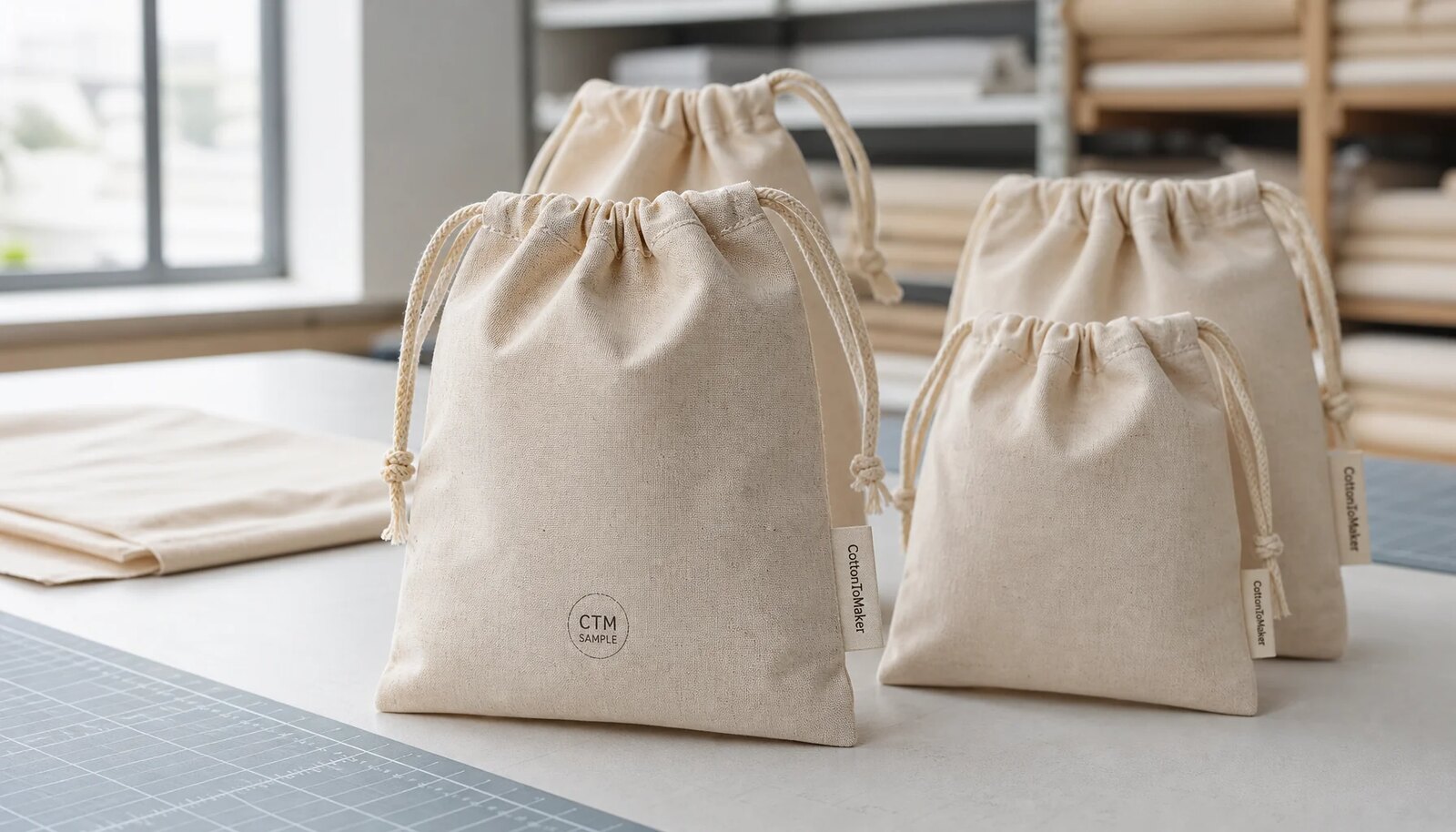
Why Farmers Market Pouches Need A Procurement Spec
Cotton drawstring pouches for farmers market vendors look simple, but they create real sourcing risk for wholesale buyers. These pouches are used for soap bars, seed packets, tea sachets, herb blends, jewelry, candles, honey accessories, and gift kits. They are opened, refilled, stacked, shipped, and sometimes reused by the end customer. If the pouch is even slightly undersized, difficult to close, or printed too close to the channel, the issue shows up at receiving, at the market stall, or in customer feedback. The product may be inexpensive, but the operational cost of a bad pouch is not.
The procurement job is to turn a soft textile item into a repeatable SKU. That means the buying spec has to cover finished size, fabric weight, construction, cord behavior, decoration, packing, and inspection in measurable terms. A generic request for natural cotton bags encourages suppliers to quote different cloth weights, cut sizes, cord styles, and packing methods. The unit price may look comparable, but the products behind the numbers are not the same.
Start with the operating environment. A farmers market pouch is often part packaging, part presentation, and part convenience item. For a giveaway or sample pack, low weight and bulk packing may be the priority. For a retail set, cleaner sewing, tighter print placement, and more controlled packing usually matter more. The RFQ should state the pouch’s role before price requests go out. Otherwise every supplier will optimize for a different use case.
- Treat the pouch as a functional packaging component, not only a branding item.
- Define the contents, sales channel, reuse expectation, and receiving method before asking for price.
- Use one written spec sheet so every supplier quotes the same finished product.
- Separate acceptable variation from reject conditions before bulk production starts.
Build The Size Around The Product Inside
Finished pouch size should be chosen around the largest item or kit that will go inside, not around a convenient catalog dimension. Common references include 100 x 150 mm for small samples, 120 x 180 mm for seed packets or soap bars with inserts, 150 x 200 mm for small gift kits, and 200 x 300 mm for larger retail bundles. Those are only reference points. A rigid candle tin, a stack of flat seed packets, and a soft herb sachet can all need different clearance even if their outside dimensions look similar.
Ask suppliers to quote finished flat size after sewing. Cut size is larger because it includes seam allowance and the folded drawstring channel. If one supplier quotes cut size and another quotes finished size, the comparison is broken from the start. For smaller pouches, a commercial tolerance around +/-5 mm is often the right starting point; for larger pouches, +/-8 mm may be more realistic. The exact tolerance should be written into the PO or spec so the factory knows what it must hold and the inspector knows what to measure.
Fit also depends on the channel and the way the top gathers. The usable loading height is not the same as the total pouch height because the channel consumes space. If artwork sits too high, it will disappear into the tied area. If the pouch is too tight, the product will press against the seams and distort the logo. Send suppliers the product dimensions, product weight, and a photo or simple sketch of how the item will be packed. That gives the factory a chance to flag sizing issues before sampling.
- State dimensions as finished flat width x finished flat height after sewing.
- Identify the product's maximum length, width, thickness, and packed weight.
- Allow clearance for fingers, insert cards, hang tags, and the gathered top channel.
- Set a written size tolerance and measure samples using the same method planned for bulk QC.
- Ask the supplier to confirm whether the pouch can fit the product with one hand or whether two-step loading is expected.
Fabric GSM, Finish, And Shrinkage
Most cotton drawstring pouches in this category fall in the 120-180 gsm range. A 120-140 gsm plain-weave cotton is usually enough for light contents such as seed packets, tea sachets, soap samples, jewelry cards, and low-weight giveaways. It keeps the pouch flexible, lowers carton weight, and often supports more efficient bulk packing. A 150-180 gsm fabric gives more body, better opacity, and a more substantial handfeel for reusable pouches or premium kits, but it also increases fabric consumption, sewing effort, carton volume, and freight cost.
GSM should be quoted with tolerance. A supplier stating cotton 140 gsm is not enough by itself. Ask whether bulk production may run within a range such as +/-5 percent or within another agreed standard. Without that range, the buyer has little basis to reject a noticeably lighter lot. Weave matters too. A loose weave can make print edges softer and the pouch feel limp after handling. A tighter weave generally supports cleaner printing and a more stable opening, although the result also depends on yarn, finishing, and sewing.
Natural unbleached cotton is common for farmers market branding because it gives a warm base color and pairs well with simple one-color logos. The tradeoff is shade variation. Cream, oatmeal, and lightly speckled natural cotton can differ between lots. Bleached or white cotton gives stronger print contrast but shows handling marks, oil, and dust more easily. If the pouch may be washed or steamed, ask whether the cloth is raw, washed, or pre-shrunk and request an expected shrinkage range. A pouch meant to be reused should not be approved on dry appearance alone if wash performance matters.
- Use 120-140 gsm for light contents and cost-sensitive vendor programs.
- Use 150-180 gsm for heavier contents, reusable positioning, or a more premium handfeel.
- Require target GSM plus tolerance and keep an approved fabric swatch.
- Define the fabric finish as natural, bleached, dyed, washed, or pre-shrunk.
- Ask for shrinkage expectations if the pouch may be washed, steamed, or exposed to damp market handling.
- Check whether the cloth is lint-heavy or low-lint if the pouch will sit near food, candles, or other clean retail goods.
Construction Details That Affect Daily Use
The most common construction is a flat cotton pouch with side seams, a bottom seam or folded bottom, a folded top channel, and a single or double drawstring. For farmers market use, double drawstring closure is often preferred because it closes evenly from both sides and feels familiar to customers. A single cord can work for lower-cost applications, but it should be tested with the actual product weight and fill method. The closure should be judged by function: can staff fill it quickly, pull it shut without snagging, and hand it over without the top reopening?
Specify the cord instead of accepting whatever is standard. The spec should name the material, diameter, color, length, knot style, and whether the ends are raw, knotted, tipped, heat sealed, or taped. Cotton cord supports a natural look but can fray if poorly finished. Polyester or blended cord may be stronger and more consistent, though it changes the material story. Cord diameter must match the top-channel height. If the cord is too thick, the pouch binds. If it is too thin, it can feel weak or sloppy.
Sewing details should be visible in the spec sheet. Ask for seam allowance, stitch density, thread color, inside finish, and thread trimming. A pouch can look acceptable in a quick photo and still have loose tails, skipped stitches, or uneven channel stitching that show up when the first carton is opened. For heavier contents, ask whether the channel exits or side seams need reinforcement. The goal is not luxury sewing. It is repeatable, clean construction at the grade the order requires.
- Specify single or double drawstring, top-channel height, cord diameter, and cord length.
- Check that the pouch closes evenly with the real product inside.
- Require clean trimming of loose threads before packing.
- Confirm seam allowance and stitch density with the approved sample.
- Inspect channel exits because tearing and uneven closure often start there.
- Ask whether the cord is attached as one continuous loop or as two independent cords, since that changes closing feel and repairability.
Print, Label, And Artwork Specifications
For many farmers market brands, one-color or two-color screen printing is the practical default. It is cost-efficient at wholesale quantity, works well for simple logos, and can be repeated if the artwork, screen, ink, and placement are controlled. The limitations matter. Cotton weave can soften thin lines, small type, and detailed illustrations. Ink can spread slightly into the fabric, especially when the cloth is loose or the ink load is heavy. Artwork that looks clean on a screen may not survive contact with woven cotton in the same way.
Before sampling, define print size, print location, ink color reference, print method, and minimum distance from seams and the drawstring channel. A logo placed too high may gather into the closure. A logo too close to the bottom can distort when the pouch is filled. For small pouches, a 5-8 mm placement shift can be visible. Use a dimensioned artwork drawing rather than instructions like centered on front. Centered should still have a reference point, such as centered horizontally and positioned 45 mm from the bottom edge to the bottom of the artwork.
Woven labels, cotton labels, and sewn patches are useful when the brand mark is small or when print durability matters more than a large graphic. They also add variables: label material, label size, fold type, edge finish, stitch color, and placement tolerance. For either print or label, require a strike-off or decorated pre-production sample on the actual fabric. Add a simple rub check to approval. Dry rubbing should not smear, and if the pouch may meet moisture, the buyer should ask for a damp rub discussion before launch. Do not assume washable print unless wash testing is explicitly part of the spec.
- Keep fine text and thin lines out of artwork unless the factory proves they reproduce cleanly.
- Use dimensioned placement from a seam, bottom edge, or center line.
- Require a strike-off or decorated sample on the actual cotton, not only a PDF proof.
- Set print placement tolerance and inspect it in bulk.
- For labels, specify size, fold, material, stitch color, orientation, and placement.
- Approve the artwork against the real pouch shape, not just a flat digital mockup.
MOQ, Quote Breakdown, And Landed Cost
MOQ is rarely one simple number. It can be driven by fabric roll availability, dye lot, cutting efficiency, print setup, label production, carton packing, or the sewing line minimum. Blank stock pouches may be available at lower MOQ because the supplier already has fabric and patterns. Custom finished size, custom fabric color, multi-color screen print, woven labels, or individual retail packaging can raise MOQ quickly. Ask the supplier to state MOQ by finished size, fabric color, artwork, print color count, and packaging method.
A usable B2B quote should be itemized. At minimum, separate blank pouch unit price, decoration cost, setup or screen charge, sample charge, label or tag cost, inner packing, carton packing, and delivery term. If the quote includes FOB pricing, request carton dimensions, carton quantity, net weight, and gross weight so freight can be estimated. A cheaper pouch with fewer units per carton may cost more landed than a slightly higher unit price packed efficiently.
Also separate first-order cost from reorder cost. The first order may include sample fees, screen fees, artwork handling, and extra review time. Repeat orders should use the approved spec and may avoid some setup charges, but only if the supplier confirms that screens, labels, artwork, and material references remain valid. Procurement should compare suppliers by cost per usable approved pouch in the receiving warehouse, not by the lowest unit price in an email.
- Ask what changes trigger a new MOQ: size, color, fabric, print, label, or packing.
- Require itemized pricing so hidden setup and packing costs are visible.
- Request carton data before comparing freight or landed cost.
- Clarify which setup charges repeat and which are one-time.
- Compare first-order and reorder economics separately.
- Push the supplier to quote the same spec on both sample and bulk pricing so the numbers are comparable.
Supplier Route And Evidence
A direct factory can be the right route for repeat cotton pouch programs because it gives the buyer clearer control over fabric, sewing, print, and packing. That control only matters if the supplier actually performs or directly manages those steps. Some suppliers describe themselves as factories but subcontract sewing or printing. Subcontracting is not automatically a problem, but hidden subcontracting makes QC responsibility unclear. Ask which processes are in-house and which are outsourced, then require one accountable party for final quality.
Trading companies can be useful for buyers with mixed-SKU programs, smaller trial runs, or several accessory items under one PO. They may coordinate multiple factories and simplify communication. The risk is loss of direct visibility into material substitutions, line changes, and inspection decisions. A trading company should be able to name who owns inspection, who approves pre-production samples, who signs off on carton packing, and how nonconforming goods are handled before shipment.
Evidence should be current and product-specific. Catalog images prove little. Ask for recent production photos of similar cotton drawstring pouches, physical samples if possible, and a sample room or line photo that shows comparable construction. For higher-volume programs, request a written QC checklist or a sample inspection report format with sensitive customer details removed. The aim is not to audit every supplier like a large enterprise program. It is to avoid approving a quote from a seller who cannot prove control over the product being ordered.
- Confirm who cuts, sews, prints, inspects, and packs the pouches.
- Ask for recent similar production photos or physical samples.
- Require one party to own final QC even when steps are subcontracted.
- Check whether the supplier can repeat the same fabric, cord, print, and packing on reorders.
- Treat missing process detail as a procurement risk, not just a communication gap.
- Ask whether the factory keeps approved material records tied to a PO or batch number.
Sampling And Golden Sample Approval
A strong approval process starts with a blank fit sample. The blank sample confirms finished size, fabric handfeel, seam construction, top-channel behavior, cord movement, and product fit before decoration adds cost and distraction. Measure it flat, load it with the real item, pull the drawstring several times, and check whether the product distorts the seams or print area. If the pouch does not work blank, it will not become reliable after printing.
After the blank is approved, request a decorated pre-production sample on the actual production fabric or the closest approved fabric if bulk cloth has not yet been purchased. This sample should confirm print color, ink coverage, artwork size, artwork position, label placement, and how the logo looks when the pouch is filled and tied. Approving a digital mockup is not enough for cotton because weave, shade, ink absorption, and sewing variation all affect the final appearance.
Keep one signed golden sample and a matching spec sheet. The spec should list finished size, tolerance, fabric GSM and finish, cord details, seam construction, artwork dimensions, print position, label details, packing count, carton count, and inspection requirements. Photos are helpful, but a physical sample remains the strongest reference for handfeel, shade, and construction. For reorders, require the supplier to notify procurement before changing fabric source, cord type, print ink, label material, or packing method.
- Approve blank fit before decorated appearance.
- Measure samples against the same points that will be checked in bulk inspection.
- Sign and date the golden sample or keep a buyer-approved reference tag with it.
- Keep approved artwork files, placement drawings, and packing photos together with the spec.
- Require a new pre-production sample after any material, size, print, label, or packing change.
- Test the pouch with the actual contents and not just with an empty hand fit.
Packing, Cartons, And Warehouse Receiving
Packing must match the destination workflow. If the pouches are going to a distributor, market vendor program, or kitting center, bulk bundles in clean inner bags or paper bands may be the most efficient. If the pouches are sold as retail units, individual polybags, hang tags, barcode labels, or paper inserts may be required. These choices affect labor, carton count, freight volume, receiving speed, and waste. They should be quoted and approved, not left to the factory’s default.
Cotton attracts dust and can pick up marks from dirty surfaces, damp cartons, and rough handling. Natural and white cotton show this quickly. Require clean inner packing and dry export cartons. If avoiding individual plastic is a buyer priority, specify the alternative packing method clearly, such as bundled by 50 pieces in a master polybag or paper banded in units of 25. The supplier should confirm whether the chosen method protects the pouches during freight and warehouse storage.
Carton labels should support receiving without opening every box. Include PO number, item code, finished size, color, decoration version, quantity, carton number, and total cartons. For mixed-size shipments, require a carton map or packing list that makes sorting easy. Before freight booking, get carton dimensions, gross weight, net weight, and units per carton. A small difference in carton cube can outweigh a small unit-price saving, especially when shipping bulky low-value textile packaging.
- Define bulk, bundled, individual, retail, or barcode packing before quote approval.
- Require inner pack count and carton quantity on the proforma invoice or PO confirmation.
- Use clean, dry cartons and protect natural cotton from dust and moisture.
- Confirm carton labels before shipment, especially for mixed sizes or multiple artworks.
- Compare freight using carton cube and gross weight, not unit price alone.
- Ask the factory to state whether the cartons are single-wall or double-wall if the shipment is long-haul or export bound.
QC Plan, Defect Classes, And Inspection Method
Quality control should be written before production, not improvised when goods are finished. For larger wholesale orders, many buyers use an AQL-based final inspection plan, with the sampling level and acceptable quality limits agreed in advance. The exact AQL standard depends on the buyer’s risk tolerance and order value, but the important step is to define critical, major, and minor defects. Critical defects may include contamination, wrong product, severe mold, or a cord hazard if relevant to the sales channel. Major defects may include wrong size beyond tolerance, open seams, unreadable print, incorrect artwork, mixed sizes, or carton shortages. Minor defects may include small thread tails or slight cosmetic variation within the approved grade.
Inspection should include measurement, function, appearance, decoration, and packing. Measure a sample set for finished width, finished height, top-channel height, cord length, and print placement. Open and close the drawstring several times. Check the pouch with the intended contents if possible. Inspect print by comparing to the strike-off under consistent lighting and performing a simple rub check. Review labels for orientation and stitch security. Open cartons from different positions in the stack so the sample is not biased toward the easiest cartons.
QC records matter for repeat orders. Ask the supplier to record measured results, defect counts, carton counts, and photos of bulk goods before shipment. If a third-party inspection is used, send the inspector the spec sheet, golden sample photos, artwork placement drawing, and packing requirements. A generic inspection without the correct product spec may only confirm that bags exist; it may miss the problems that make them unusable for procurement.
- Classify defects as critical, major, and minor before inspection.
- Measure finished size, channel height, cord length, and print placement in the sampled goods.
- Run closure function checks with the intended product or a representative substitute.
- Check print rub, label security, shade, stains, loose threads, and carton count.
- Open cartons from multiple stack positions and verify the packing list against the PO.
- Hold back shipment if the supplier cannot show the approved spec and golden sample used for production control.
Specification comparison for buyers
| Spec decision | Recommended option | When it fits | Buyer risk to check |
|---|---|---|---|
| Finished size | Quote as finished flat size after sewing, such as 100 x 150 mm or 150 x 200 mm | Any custom or stock-style pouch where the packed product must fit reliably | Confirm whether the supplier measures flat, empty, and after sewing; set a written tolerance such as +/-5 mm for small pouches and +/-8 mm for larger pouches |
| Product clearance | Add clearance for thickness, fingers, insert cards, and the gathered top channel | Soap bars, candle tins, seed packets, tea sachets, jewelry cards, and mixed gift kits | A flat dimension can look right while the real item binds at the opening; require a fit check with the actual contents |
| Fabric weight | 120-140 gsm plain-weave cotton | Light retail kits, seed packets, tea sachets, soap samples, jewelry, and low-weight giveaways | Can feel thin on dark print areas; require a GSM tolerance and an opacity check against the intended contents |
| Fabric weight | 150-180 gsm cotton | Reusable pouches, heavier handmade goods, candles, premium sets, or resale packaging | Higher fabric weight increases unit cost, carton weight, and carton volume; check landed cost, not only unit price |
| Fabric finish | Natural unbleached cotton | Brands that want a warm, low-processed look and simple one-color artwork | Natural shade can vary between fabric lots; approve a shade range or require lot-to-lot shade confirmation |
| Fabric finish | Bleached or white cotton | Artwork needing stronger contrast, brighter ink appearance, or color-critical branding | Marks, oil spots, and storage stains show more easily; require clean handling and carton liner or inner bag as needed |
| Construction | Double drawstring with folded top channel | Most wholesale vendor pouches where customers open and close the bag repeatedly | Cord must slide without binding; check channel height, cord diameter, and balanced cord length on both sides |
| Decoration | 1-2 color screen print on actual cotton fabric | Simple logos, farm names, market stall branding, and repeat orders with stable artwork | Fine type can fill in on woven fabric; require strike-off and minimum line thickness approval before bulk |
| Decoration | Woven label, cotton label, or sewn patch | Premium presentation, small brand mark, or cases where print durability is more important than print area | Adds sewing labor and placement risk; specify label size, fold type, stitch color, and distance from seam or bottom edge |
Buyer checklist before sampling
- Define the product going inside the pouch, including maximum length, width, thickness, weight, insert cards, and tags.
- Quote the pouch by finished flat size after sewing, not fabric cut size, and state the measuring method.
- Set size tolerance in writing, for example +/-5 mm on small pouches and +/-8 mm on larger pouches unless the supplier proposes a tighter realistic standard.
- Specify fabric composition, weave, GSM target, GSM tolerance, fabric finish, and whether the cloth is natural, bleached, dyed, washed, or pre-shrunk.
- Ask for the expected shrinkage range after washing or steaming if the pouch may be washed, pressed, or exposed to humid handling.
- Define top channel height, cord material, cord diameter, cord length, cord color, knotting, and cord exit style.
- State seam allowance, stitch density target, thread color, inside finish, and whether loose thread trimming is included before packing.
- Lock artwork size, print method, ink color reference, print location, minimum distance from seams, and acceptable print position tolerance.
- Request a blank fit sample before approving decoration, then approve a decorated pre-production sample on the actual bulk fabric.
- Ask suppliers to separate blank pouch cost, decoration cost, setup charges, sample charges, labels, hang tags, inner packing, cartons, and freight term.
Factory quote questions to send
- What exact finished size are you quoting, and is it measured flat after sewing or before sewing?
- What size tolerance do you run in bulk production for width, height, top opening, and print placement?
- What is the fabric composition, weave, target GSM, and GSM tolerance? Can you provide a fabric swatch from the lot intended for production?
- Is the fabric natural, bleached, dyed, washed, or pre-shrunk? What shrinkage range should we expect if washed or steamed?
- What cord material, cord diameter, cord length, cord color, and cord-end finish are included in the price?
- What is the top channel height, seam allowance, stitch density, and thread specification for this pouch?
- Is your quoted price for a blank pouch only, or does it include print, label, hang tag, inner packing, carton, and export packing?
- What MOQ applies by pouch size, fabric color, print color count, label type, and packaging method?
- What setup charges apply for screens, labels, cutting dies, artwork handling, barcode labels, or packing changes?
- Can you produce a blank fit sample first and then a decorated pre-production sample on the actual production fabric?
Quality-control points to confirm
- Finished flat width and height should match the approved spec within the written tolerance, with measurement taken after sewing and before packing.
- Top channel height should be even across the pouch and large enough for the specified cord diameter to move smoothly without twisting or binding.
- Opening width should allow the intended product to load without forcing the seams, especially for rigid soap bars, candle tins, jars, or boxed goods.
- Cord length should match the spec on both sides, close evenly, and leave enough tail for tying without excessive waste or uneven hanging.
- Cord ends should be knotted, heat sealed, taped, or otherwise finished according to spec, with no loose unraveling unless raw ends are explicitly approved.
- Side seams and bottom seams should be straight, secure, and free from skipped stitches, broken thread, loose ends, seam puckering, and open seams.
- Stitch density should be consistent with the approved sample; sudden changes can indicate machine setting drift or rushed sewing.
- Fabric GSM, shade, handfeel, and weave appearance should match the approved swatch or golden sample within the agreed range.
- The face panel should be free from visible oil marks, dirt, stains, yarn slubs beyond the approved grade, needle holes, lint buildup, and contamination.
- Print color, opacity, edge sharpness, and position should match the approved strike-off or decorated sample under consistent lighting.