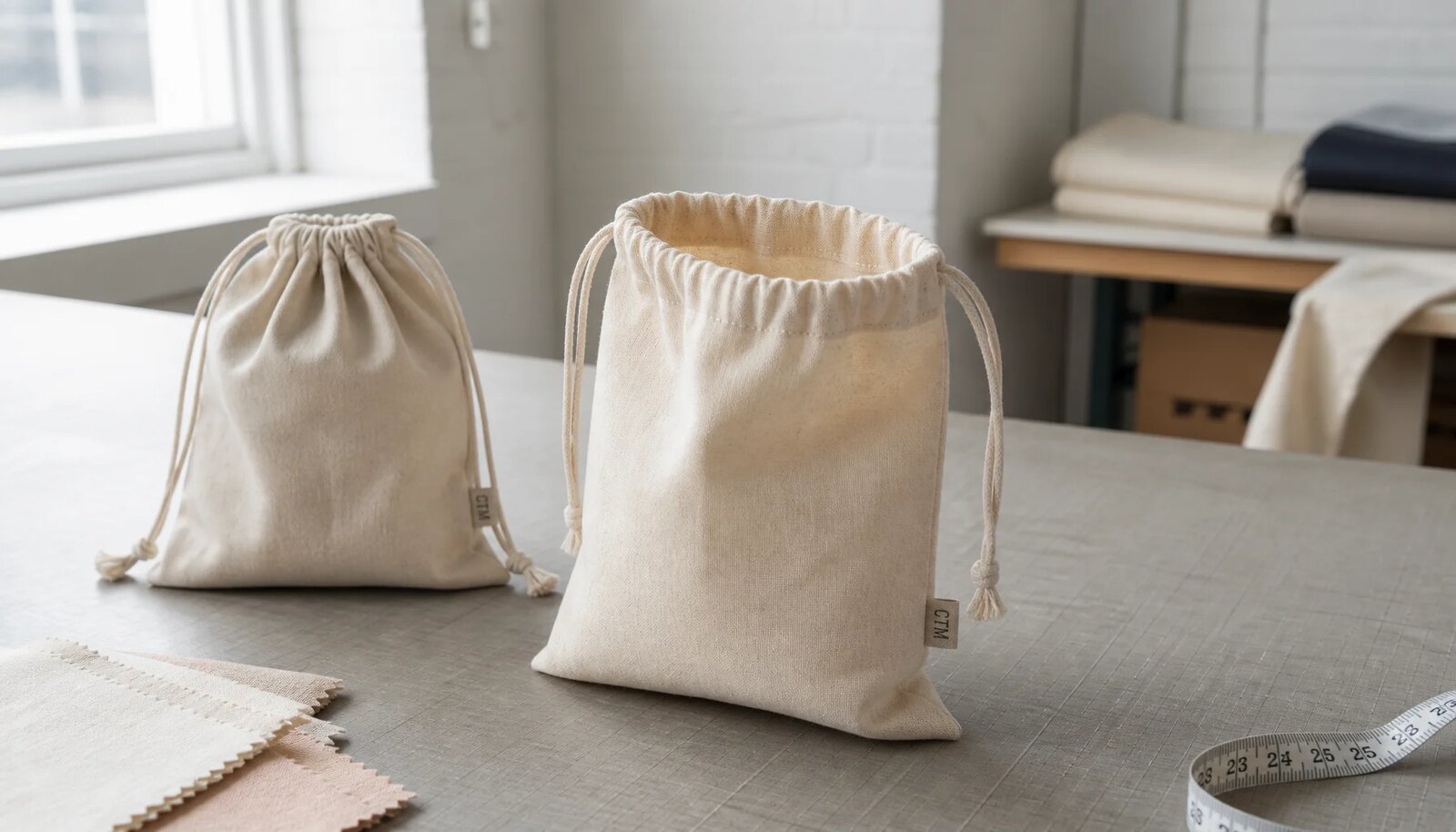
Start With the Job the Pouch Has to Do
Farmers market vendors use cotton drawstring pouches in different ways, and the intended use changes the spec more than most buyers expect. A pouch that holds soap samples for a stall, one that carries spice blends for resale, and one that sits inside a gift set do not need the same fabric weight, print method, or closure detail. If you start with the look before the use case, the quote will be hard to compare and the first sample often misses the real requirement.
A useful buying brief begins with what the pouch must survive between packing and final customer use. If the pouch is handled every weekend, opened repeatedly, or reused as a carry bag, durability matters more than a soft hand feel. If it is only a retail insert or a branded giveaway, the buyer can trade some strength for lower cost and better print clarity. That is why the first decision is not color or logo placement, but the actual handling profile.
- Retail resale needs better seam control and cleaner branding than a one-time handout.
- Reusable pouches should survive repeated drawcord pulls without fraying at the channel.
- Food-adjacent uses often need a cleaner, lower-odor cotton finish than promotional packaging.
Choose Fabric Weight by Fill Weight, Not by Habit
For cotton drawstring pouches, fabric weight is the first commercial decision that changes both cost and performance. As a practical starting point, 110 to 130 GSM works for lightweight samples, seed packets, and low-cost giveaway packs. 140 to 160 GSM is usually the balance point for standard retail pouches because it holds shape better without becoming bulky. 180 to 220 GSM makes sense when the pouch carries heavier items, needs a more premium hand, or has to survive repeated use.
Plain weave cotton is the most common construction because it is predictable, easy to sew, and usually the most economical to source. Tighter weave helps print sharpness and reduces fiber shedding, while looser cloth can look casual but may show uneven texture, particularly on pale colors. Buyers should ask whether the quoted weight is the fabric weight before wash or the finished weight after finishing, because shrink and finishing loss can change the real hand feel and the final size.
- 110 to 130 GSM: light fills, lowest cost, best when the pouch is not expected to take abuse.
- 140 to 160 GSM: the standard range for most market retail pouches.
- 180 to 220 GSM: premium feel, better structure, and more tolerance for repeated handling.
Set the Color and Finish Before Comparing Quotes
Color choice changes more than appearance. Natural unbleached cotton gives a simple, handmade look and often works well for market brands, but it can vary in shade and may carry visible flecks. Bleached white gives the best print contrast and looks cleaner on shelf, but it shows dirt sooner and can feel less rustic. Dyed cotton can be strong visually, but then the buyer needs a tighter shade standard and a clearer approval process for each lot.
Finish matters as much as the base color. If the pouch is likely to be washed or reused by the end customer, the buyer should ask about shrink control, colorfastness, and whether any softener or coating affects odor, feel, or print hold. For food, tea, soap, or herb use, many buyers prefer a minimal finish because extra chemical treatment can create unnecessary compliance questions. The right finish is the one that matches how the pouch will be handled, not the one that sounds most polished in a sales email.
- Natural cotton: lower contrast, lower visual uniformity, stronger handmade positioning.
- White cotton: better logo visibility, but more visible soil and warehouse marks.
- Dyed cotton: stronger brand look, but requires shade control and tighter lot approval.
Pick the Branding Method That Matches Order Size
The branding method should follow order size, artwork complexity, and the expected life of the pouch. Screen printing is usually the best value for one to three spot colors and a repeatable logo. It gives strong color density on cotton and is easy to price when the artwork is simple. Embroidery works better on heavier cloth and gives a premium retail feel, but it raises unit cost and can distort a soft pouch if the design is too large or too dense.
Heat transfer and DTF are worth considering for short runs, multicolor graphics, or seasonal programs where artwork changes often. They can be useful for market testing, but buyers should not assume they behave like a screen print over time. Ask for the actual decoration on the same cotton body, then inspect edge sharpness, feel, and abrasion. If the logo sits near the drawcord channel, check it while the pouch is closed and while it is packed so the print does not disappear in real use.
- Screen print: best for flat artwork, repeat runs, and low decoration cost per unit.
- Embroidery: better for premium positioning and thicker fabric bodies.
- Heat transfer or DTF: useful for short runs, but needs wash and rub testing on the actual cloth.
Specify Construction Details That Prevent Returns
A cotton drawstring pouch can look fine at first glance and still fail in use if the construction details are loose. The buyer should define seam style, top hem width, drawcord channel, and the treatment of the cord entry points. A good production spec says how the seam is finished, whether the side seams are overlocked or double-stitched, and how the channel is reinforced so the cord does not chew through the fabric after repeated opening.
The drawcord itself matters more than many quotes suggest. Cotton cord fits the natural look of the pouch, but a polyester cord may slide better and hold up longer if the pouch will be opened frequently. For smaller retail pouches, a 3 to 4 mm cord is often sufficient; thicker cord improves grip but can look bulky on a small body. The exact choice should match the product weight and how the customer will actually use the pouch, not just the brand style board.
- Define whether the pouch uses overlock, double-stitch, or both at the main seams.
- Specify how the top hem and cord channel are reinforced so the opening does not tear.
- State whether cord ends are knotted, heat-finished, tipped, or left natural.
Size the Assortment Around Merchant Behavior
Farmers market vendors rarely need only one size. They usually need a small pouch for samples, a medium pouch for soaps or candles, and sometimes a larger pouch for gift bundles or textile items. A good assortment is usually two or three sizes that share the same fabric and decoration method. That keeps sourcing simpler, reduces development time, and makes reorders easier to manage. If the buyer tries to cover too many use cases with one size, the pouch will be too small for some items and too expensive for others.
From a procurement angle, the safest approach is to keep the base spec constant and vary only the dimensions and print placement. That makes the quotes comparable and helps the factory keep fabric usage predictable. Ask the supplier to price each size band separately and to explain whether the MOQ applies per size, per color, or per print file. Even a small dimension change can alter cutting efficiency, carton cube, and the true landed cost of the order.
- Small size: sample packs, seed packets, small soaps, and token gifts.
- Medium size: candles, herbs, jars, and bundled retail items.
- Large size: textile goods, market bundles, and premium multi-item sets.
Compare Supplier Evidence Before Unit Price
A low unit price means little if the supplier cannot show how the pouch is actually built. Ask for evidence that matches the exact product: photos of the same size, the same fabric weight, the same print method, and the same drawcord construction. If the order involves a sustainability claim, the factory should also show where the cotton came from, how it was processed, and whether the finished goods trail matches the paperwork. Buyers do not need a long presentation; they need enough proof to know the quote is based on real production capability, not a generic template.
Good supplier evidence also includes a measured spec sheet, not just pictures. The factory should show finished dimensions, stitch style, packing assumption, and any tolerance they intend to use in mass production. If the seller refuses to separate the base fabric, decoration, and packing assumptions, the quote is not ready for comparison. In practice, buyers pay for vague evidence later through delayed samples, spec drift, or a second round of corrections.
- Ask for a photo of the exact fabric and the exact printed pouch, not a similar item.
- Request a measured spec sheet with size, GSM, cord type, and packing count.
- If claims matter, request documentation that follows the finished goods chain, not just one stage of the supply chain.
Approve Samples With a Real Use Test
Sample approval should go beyond a visual check on a table. Fill the pouch with the real product, close it, open it again, and see whether the cord slides smoothly and whether the body stays balanced. If the pouch is washable, run at least a basic wash and dry test or a damp rub test before bulk approval. The goal is not to simulate every possible abuse case. The goal is to catch the obvious failures before the order enters mass production.
A strong sample process also protects the next reorder. Keep a signed reference sample, and note the approved fabric lot, print file version, and trim details so the production line can repeat the same result. A useful approval record gives the factory a clear target and reduces arguments later about whether a shade change or a slightly shifted print was acceptable. For planning purposes, sample lead time often runs about 7 to 15 days, while bulk production commonly sits in the 25 to 45 day range after approval, depending on fabric booking, decoration complexity, and packing requirements.
- Measure the pouch after sewing and compare it with the approved reference sample.
- Test logo placement, rub resistance, and cord function under real load.
- Record the approved sample version so the next order can be matched exactly.
Package for Retail, Transit, and Inventory Counting
Packing changes landed cost more than many buyers expect. Drawstring pouches compress well, but they still need a packing plan that matches the selling channel. If the pouch is a retail item, the buyer should decide whether it ships flat, in inner packs, or pre-filled with a sample product. If it is a warehouse stock item, mixed packing can slow down receiving and make counts unreliable. The cheapest unit price can disappear quickly if the destination team needs to sort and repack every carton.
Ask the supplier to quote the pack count, carton dimensions, gross weight, and any label requirement. For export orders, those details matter because freight is often charged by volume as much as by weight. A carton that is too large wastes cube, while a carton that is too dense can crush the pouches and distort the print. If the buyer needs retail-ready cartons, the supplier should also state whether polybags, moisture control, barcode labels, and carton marks are included in the offer or added later.
- Use fixed inner pack counts so receiving can count quickly and accurately.
- Keep mixed sizes out of the same carton unless the buyer wants manual sorting.
- Confirm whether the quoted price includes carton printing, labels, and export marks.
Use an RFQ That Forces Comparable Answers
The best RFQ is short, specific, and measurable. It should state the finished size, fabric GSM, weave, color, print method, cord type, packing method, and target schedule. If the factory cannot quote against those fields, the price is not yet reliable. Buyers often lose time because one supplier quotes a natural pouch, another quotes pre-shrunk cloth, and a third assumes different carton counts. Those are not price differences; they are different products.
A good RFQ also defines what may change and what must stay fixed. For example, a supplier may propose an alternative cord fiber, but the fabric weight should remain fixed. A supplier may adjust stitch density for production efficiency, but the print size and placement should stay locked. That balance keeps the buyer open to practical factory advice without letting the spec drift. When the quote comes back, compare the line items, not just the total. A clean quote separates material, labor, decoration, packing, sample charge, and any extra setup cost so the buyer can see where the real value sits.
- State what is fixed: fabric weight, pouch size, print placement, and packing count.
- State what is flexible: cord material, stitch style, and carton layout if the buyer allows substitution.
- Require the supplier to separate tooling, sampling, decoration, and packing in the quote.
Specification comparison for buyers
| Spec decision | Recommended option | When it fits | Buyer risk to check |
|---|---|---|---|
| Direct cut-and-sew factory for blank pouches | Use one factory for fabric sourcing, cutting, and sewing | Best when the buyer wants a simple natural pouch and needs tight control over fabric weight and seams | Confirm finished GSM, shrink allowance, and whether the factory buys greige or finished fabric |
| Direct factory with in-house screen printing | Choose for one to three spot colors on a repeat order | Works well when the logo is simple and the buyer wants durable branding with stable repeat quality | Check ink curing, registration tolerance, and rub resistance on the actual cotton body |
| Factory plus outside embroidery or patch supplier | Use only when the pouch is a premium retail item | Fits gift sets, boutique merchandising, and higher price points where tactile branding matters | Extra handoffs can add delay and create shade or placement variation |
| Trading company bundling fabric and trims | Source through one contact when multiple pouch sizes or colors are needed | Good for buyers who want simplified purchasing and one consolidated order flow | Spec detail can become vague, so insist on fabric source, trim source, and measured tolerances |
| Local decorator on imported blanks | Keep blank pouch sourcing separate and decorate domestically | Useful for short runs, test launches, and fast artwork changes | Blank quality may vary between replenishment orders unless the blank spec is locked |
| Organic cotton supply chain with supporting documents | Use when sustainability claims matter on shelf or in retailer compliance reviews | Best for brands that need traceability from yarn or fabric to finished pouch | Paperwork must match the actual material flow, not just a certificate at one stage |
| Recycled cotton blend route | Allow a blend when the buyer can accept natural color variation and a slightly rougher hand feel | Works for value-driven or sustainability-led programs where texture is not the primary selling point | Expect more lot-to-lot variation in shade, shrink behavior, and surface appearance |
| Digital or DTF print route | Use for short runs, seasonal artwork, or full-color graphics | Good for test-market inventory and designs that change often | Verify wash durability, hand feel, and edge wear before approving bulk production |
Buyer checklist before sampling
- Confirm finished pouch size, seam allowance, and whether the size is stated before or after sewing
- Lock the fabric weight in GSM and the weave type, then define whether the cloth is pre-shrunk or will be washed later
- Choose the body color standard, including natural unbleached, bleached white, or dyed color reference
- Select the branding method and provide the final artwork file, color count, and placement dimensions
- Specify drawcord material, cord diameter, cord length, and whether knots, tips, or ends are finished in a special way
- Define the pack count per inner bag and per master carton, plus any retail barcode or label requirement
- Set the sample approval standard, including acceptable size tolerance, print placement tolerance, and seam quality
- Ask for a production timeline that separates sampling, material booking, sewing, inspection, and export packing
Factory quote questions to send
- Is your price based on finished size or cut size, and what tolerance do you use after sewing?
- What fabric weight, weave, and color are included in the quote, and is the cloth pre-shrunk?
- Which print method is included, how many colors are covered, and what setup fees apply for extra colors?
- What is the MOQ per size, per color, and per artwork, and can mixed sizes share the same fabric order?
- Are labels, inner packs, master cartons, and carton marks included or quoted separately?
- What stitch standard do you use at the side seams and drawcord channel, and what defect rate do you allow before rework?
- What are the sample charge, sample lead time, and the number of revision rounds included before bulk approval?
- What lead time starts after deposit, after sample approval, or after fabric arrival, and what can delay shipment?
Quality-control points to confirm
- Finished dimensions should match the approved sample within the buyer's stated tolerance and should be measured after sewing, not by cut cloth
- Fabric weight should stay within the agreed GSM range and should not feel thin, overly loose, or visibly inconsistent across the order
- Seams should be straight, fully closed, and free of skipped stitches, open ends, needle damage, or weak corners
- The drawcord channel should run smoothly, hold tension evenly, and not tear, pucker, or narrow the opening too much
- Printed graphics should be centered, legible, and resistant to rub-off, bleeding, and obvious misregistration
- If the pouch is washable, shrinkage and color change after wash testing should stay within the approved limit
- Inner packs and cartons should count accurately and should not crush the pouches, crease the print, or trap excess moisture
- Labels, barcodes, and side marks should be placed exactly where the buyer requested so warehouse receiving does not slow down