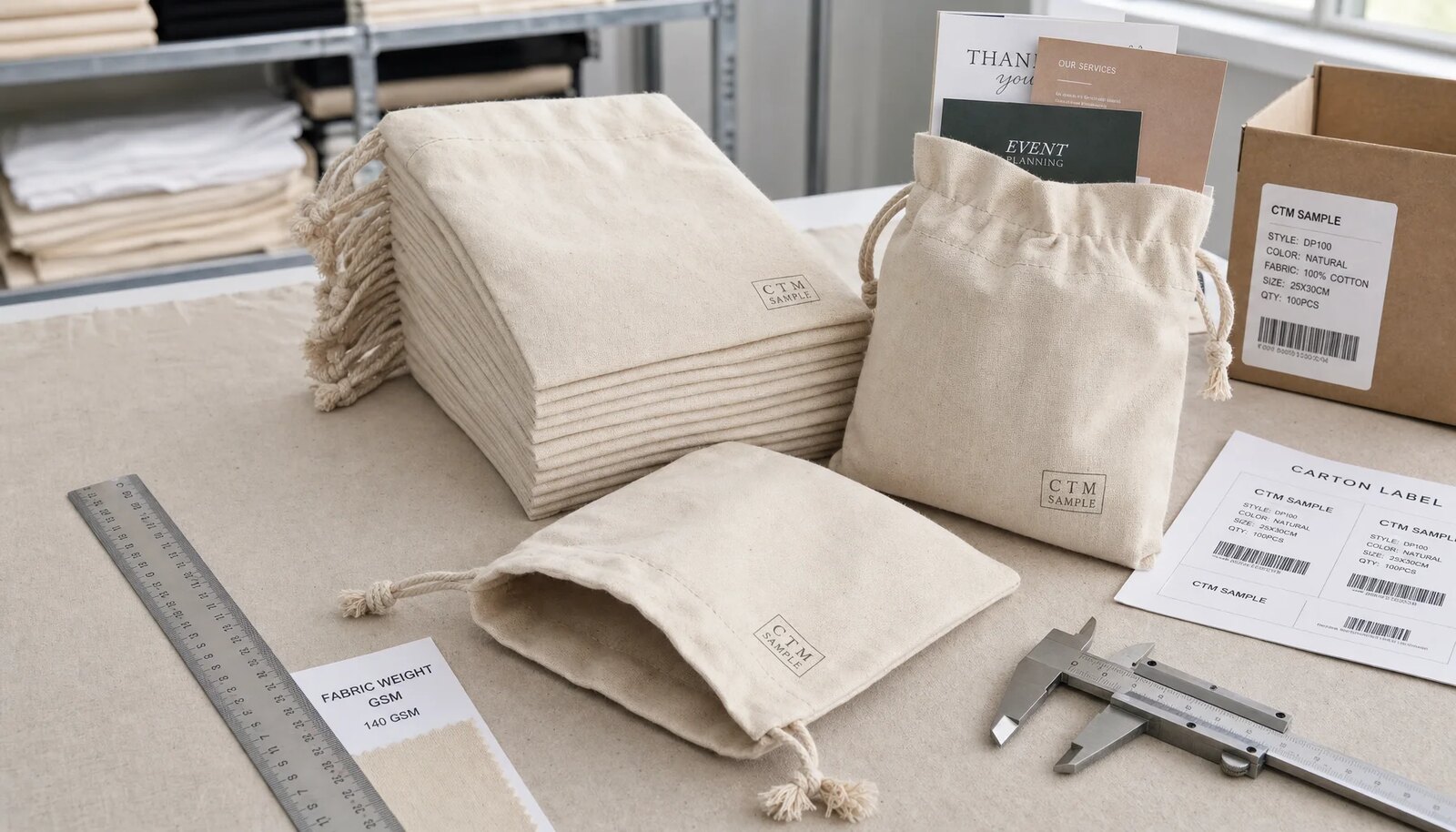
Start with the event job, not the pouch
For event planners and procurement teams, cotton drawstring pouches are rarely just small fabric bags. One pouch may be the first branded item an attendee receives at registration. Another may wrap a sponsor gift, hold hotel amenities, protect a showroom sample, or organize a press kit. Each use asks for a different balance of cost, handfeel, print clarity, packing efficiency, and strength.
The best RFQs begin with the job the pouch has to do. A badge, agenda card, and pen do not need the same fabric or seam strength as a pouch holding a candle, bottle, folded T-shirt, power bank, or several sponsor samples. A press event pouch may need tighter logo placement because it will be photographed. A hotel amenity pouch may need softer fabric and cleaner thread trimming because guests handle it in a premium setting.
Treat the phrase cotton drawstring pouches for event planners quality inspection checklist as a working procurement framework, not just a search term. It reminds the buying team to remove assumptions before suppliers quote. Once the use is clear, a factory can recommend a realistic GSM, finished size, cord, print process, carton quantity, and lead time. When the brief stays vague, each supplier fills in the blanks differently, and procurement ends up comparing prices for different products.
- Name the event use: registration kit, sponsor giveaway, VIP gift, room drop, press mailer, product sample pouch, retail insert, or employee welcome kit.
- Group contents by type: paper inserts, cosmetics, apparel, packaged food, tech accessories, wellness products, or mixed sponsor gifts.
- Estimate the filled weight before choosing fabric and seam construction.
- Decide the presentation tier: cost-efficient, natural rustic, premium hospitality, retail-style, or executive gifting.
- Clarify how the pouch will move: direct attendee pickup, warehouse kitting, hotel delivery, mailer insert, or multi-city distribution.
Turn fabric into a measurable spec
Fabric is one of the quickest ways for two quotes to drift apart. A request for a “cotton drawstring pouch” can be answered with thin muslin, midweight plain-weave cotton, canvas-like cotton, bleached cotton, dyed cotton, or a cotton-poly blend. A lower price may simply mean lighter GSM, smaller usable size, simpler cord, or looser inspection expectations.
For many event orders, 140-180 GSM is the practical middle range. It usually gives enough opacity and handfeel for branded programs without making cartons bulky. A 120-140 GSM pouch can work for light paper inserts or budget giveaways. A 180-220 GSM pouch suits premium kits, heavier contents, or reuse, but the buyer should check freight weight, carton dimensions, and drawcord function before approving it for a large run.
Finish also changes risk. Natural unbleached cotton has warmth and texture, but shade and flecks can vary by lot. Bleached cotton gives a cleaner base for high-contrast logos. Dyed cotton can support a brand palette, but it may require lab dip approval, colorfastness discussion, higher MOQ, and extra calendar time. If color matters, ask whether the supplier is quoting stock dyed fabric or custom dyeing.
- Quote fabric as a target GSM with tolerance, such as 160 GSM +/-5%, if the supplier can support that control.
- Confirm whether the material is 100% cotton or a blend, especially if labeling, sustainability language, or client approvals depend on it.
- Approve natural cotton shade from a physical swatch or sample, not only a photo on screen.
- Ask whether the fabric is stock, made-to-order, bleached, dyed, pigment dyed, reactive dyed, washed, or unfinished.
- Check opacity by placing the actual event inserts inside the sample under normal room light.
Size around the real contents
Finished size matters more than the name of the pouch. Some suppliers quote cut size before sewing. Others quote approximate size, finished flat size, or even a standard size that varies by factory. For procurement, kitting, and inspection, finished width and height measured flat are the numbers that matter. The usable internal height is slightly less than total height because the drawcord channel takes space at the top.
Flat measurements can still mislead buyers when contents have thickness. A pouch that looks large enough for a sample may become tight once a brochure, card, tissue wrap, or accessory is added. Tight pouches slow packing, wrinkle paper, strain bottom seams, and distort the logo after filling. Oversized pouches create the opposite problem: the item looks lost, fabric collapses around the contents, and shipping cartons fill with air.
The sizing process should be tactile. Put every event item on the table. Measure the largest footprint. Add allowance for thickness and ease of packing. Then test a sample with the actual contents. Common event starting points include 10 x 14 in. and 12 x 16 in., but smaller formats may be better for badges, jewelry, cards, tea, cosmetics, amenity items, or small product samples. For high-volume kitting, the opening width should be tested for packing speed as well as final appearance.
- Ask suppliers to quote finished size and measurement method: flat, unstretched, seam to seam.
- Use agreed tolerances, such as +/-5 mm for small pouches and +/-10 mm for larger pouches, unless the design requires tighter control.
- Confirm usable internal height below the drawcord channel, not only total height.
- Fill the sample and check whether the logo remains visible, centered, and reasonably flat when closed.
- Time a small packing test if thousands of kits must be assembled by a warehouse or event crew.
Specify construction before it becomes a failure point
Most pouch failures come from details that were never discussed. Side seams, bottom corners, seam allowance, stitch density, top channel width, cord material, cord thickness, and cord exit points all affect performance. On an empty sample, weak construction can look acceptable. Under real contents, the same pouch may gap, twist, snag, or close poorly.
A standard double drawcord works for most event programs because it closes from both sides and feels familiar. Cotton cord supports a natural look. Polyester cord can be smoother and more consistent in some applications. Flat tape creates a different presentation but usually needs a wider channel. If the pouch will hold heavier items, ask about reinforced stress points instead of relying on a default sewing line.
Construction is also part of perceived quality. Straight seams, even cord lengths, clean thread trimming, and a smooth draw all matter when the pouch is used for VIP gifts, hospitality, or retail-style activations. For a one-time registration insert, the tolerance may be more practical. For a premium room drop, the same loose threads may feel careless.
- Specify single or double drawcord, cord material, cord color, and approximate cord diameter or tape width.
- Ask for seam allowance and stitch density expectations when contents are heavy or the pouch is intended for reuse.
- Check bottom corners because they carry stress when the pouch is filled.
- Pull the drawcords several times during sample review to catch snagging, tearing, rough movement, or uneven closure.
- Set a cord length tolerance so bulk goods do not arrive with visibly uneven or too-short cords.
Approve artwork for cotton, not for a mockup
Printing is where many event pouch orders become fragile. A logo can look perfect in a digital mockup and still reproduce poorly on textured cotton. Fine lines may break. Small letters may fill in. Gradients can lose smoothness. Brand color can shift because cotton absorbs ink differently from coated paper, plastic, or digital screens.
Screen printing is usually the strongest value for simple one-color logos and bold sponsor marks. Multi-color screen printing can work, but every color adds setup and registration control. Heat transfer may help with complex artwork or smaller runs, though buyers should inspect edge feel, adhesion, flexibility, and appearance after folding. Digital print can support full-color graphics, but physical approval matters because sharpness and color vary by fabric and process.
The artwork sheet should be inspection-ready. Include print size, placement from top and side edges, color reference, orientation, and any minimum legibility requirements. “Centered logo” leaves too much room for argument. A better instruction states that the logo centerline aligns to the pouch center, the top of print sits a set distance below the channel, and placement may vary only within the agreed tolerance. For sponsor layouts, simplify early. Cotton is not kind to tiny marks squeezed into a crowded print area.
- Provide vector artwork for screen print and confirm minimum line weight before sampling.
- Avoid functional QR codes, legal copy, and very small sponsor logos unless the supplier confirms readability and the buyer approves a scan or legibility test.
- Set print placement tolerance in millimeters, such as +/-5 mm or +/-10 mm depending on pouch size and factory capability.
- Approve color from a physical sample when brand color matters; exact screen-to-fabric matching is not realistic on textured cotton.
- For heat transfer, flex and fold the sample to check lifting, cracking, stiffness, or a heavy edge feel.
Write an RFQ that makes quotes comparable
A strong RFQ protects the buyer from false savings. When a request only says “cotton drawstring pouch with logo,” suppliers choose their own fabric weight, size basis, cord, construction, print process, setup assumptions, carton count, and sample route. The cheapest quote may simply exclude details another supplier included.
The RFQ should state finished dimensions, GSM, fabric finish, drawcord type, print method preference, artwork size, order quantity, packing format, carton labeling, destination, delivery requirement, and sample expectations. If the budget is not final, ask for structured options: a cost-efficient version, a standard event version, and a premium version. This gives procurement and marketing real tradeoffs instead of a pile of unrelated prices.
Separate unit cost from one-time and conditional charges. Screen fees, sample cost, sample freight, custom dyeing, artwork cleanup, labeling, individual polybags, barcodes, special cartons, inland trucking, and inspection support can change landed cost. For repeat events, ask which charges repeat and which are one-time. For multi-city programs, include destination marks and carton sorting requirements at the quoting stage. Warehouse rework can erase a small unit-price advantage very quickly.
- Require suppliers to restate the exact quoted specification in their offer.
- Ask for price breaks by quantity and by specification, not only one blended price.
- Identify excluded costs: setup, samples, special packing, testing, inspection, duties, freight, and destination handling.
- Request lead time assumptions in writing, including when the production clock starts.
- Ask suppliers to flag substitution risks before production, such as alternate fabric lots, cord changes, or different print equipment.
Use sample approval as the production reference
A pre-production sample should prove that the supplier can make the pouch you intend to buy. It should confirm fabric handfeel, shade, finished size, drawcord movement, stitching, logo position, print opacity, and filled appearance. If the sample uses substitute fabric or a different print method, document the difference. For high-risk events, ask for a production-style sample before releasing bulk production.
Sample review should be simple and disciplined. Measure the pouch flat without stretching. Check width, height, channel depth, cord length, and print placement. Open and close the drawcord repeatedly. Pull the side and bottom seams lightly to see whether gaps appear. Fold the printed area once and rub it lightly to see whether ink cracks, sheds, or transfers. Then fill the pouch with actual event contents and confirm that it closes naturally.
Physical approval is preferred because photos do not reliably show handfeel, opacity, stitching strength, drawcord smoothness, or print texture. If timing forces photo approval first, request closeups of the fabric, seams, channel, cord ends, print area, carton label, and a filled pouch. Keep one approved sample as the inspection reference. Without it, final QC becomes a debate over what “acceptable” was supposed to mean.
- Record sample status as approved, approved with changes, or rejected for resample.
- Attach written comments for every change: size, fabric, cord, stitch, print, or packing.
- Confirm whether bulk production will use the same fabric lot or only the same specification.
- Do not release mass production until artwork, print placement, carton labels, and packing method are locked.
- Keep the approved sample available for pre-shipment inspection and warehouse receiving comparison.
Set inspection rules before sewing begins
Inspection standards should be agreed before goods are produced. For event orders, the biggest risks are visible defects, functional failures, and problems that slow kitting. Crooked logos, wrong artwork, weak channels, open seams, severe shade variation, wrong size, mixed cartons, and inaccurate counts are not small cosmetic annoyances when the event date is fixed.
Many B2B buyers use an AQL-style random inspection even when they do not commission a formal third-party audit. The practical version is to inspect units from multiple cartons and classify defects as critical, major, or minor. Critical defects include contamination, mold, sharp foreign objects, unsafe materials, or wrong artwork that cannot be used. Major defects include failures that affect function, presentation, or receiving. Minor defects are small issues that do not materially affect event use.
Write examples into the purchase order, approval sheet, or inspection checklist. A visible oil stain on the logo side is not the same as a tiny natural cotton fleck. A 3 mm print shift may be acceptable on a large pouch but unacceptable on a small centered logo if the agreed tolerance is tighter. Objective rules reduce disputes when goods are packed and everyone is watching the calendar.
- Critical defects: mold, contamination, sharp objects, strong chemical odor, unsafe trim, wrong logo, or wrong event artwork.
- Major defects: open seams, broken stitches, wrong size outside tolerance, unusable drawcord, visibly tilted print, unreadable logo, wrong fabric, or incorrect carton quantity.
- Minor defects: short thread tails, slight approved natural flecks, small cosmetic marks away from the logo area, or minor shade variation within the approved range.
- Inspect across multiple cartons and production bundles, not only the top layer of one carton.
- Separate inspection by SKU, size, color, artwork version, and destination when the order is mixed.
- Require rework photos or re-inspection for major defect corrections before shipment release.
Inspect the pouch as one connected product
A useful cotton drawstring pouch quality inspection checklist follows the way the product will be used. Fabric affects appearance and strength. Stitching affects durability. Drawcords affect opening and closing. Print affects brand presentation. Packing affects receiving, kitting, and event execution. Checking only the logo or only the carton count leaves too much risk.
Start with fabric and shade. Compare production units to the approved sample for GSM, finish, handfeel, and general color. Natural cotton may show flecks or seed particles, but the sample should define the acceptable level. Look for holes, stains, oil marks, severe slubs, uneven dye, panel mismatch, and odor. Then move to construction: side seams, bottom seam, channel width, cord exits, stitch consistency, loose threads, and drawcord movement.
Print QC should compare bulk goods to both the approved sample and the artwork sheet. Check artwork version, print size, position, orientation, color appearance, ink coverage, edge quality, curing, registration, and legibility. On cotton, a slightly textured edge may be normal. Obvious bleeding, ghosting, pinholes, cracking, smearing, or tilt should be classified by severity. Packing QC then confirms carton count, inner bundle count, carton label, SKU separation, destination code, and packing list accuracy.
- Fabric checks: GSM, shade, finish, odor, stains, holes, severe slubs, and approved natural flecks.
- Stitching checks: seam closure, stitch consistency, bottom corners, channel width, skipped stitches, loose tails, and unraveling.
- Drawcord checks: material, color, length, smooth pull, closure function, fraying, and cord exit strength.
- Print checks: correct artwork, size, placement, orientation, color, opacity, edge quality, curing, and legibility.
- Packing checks: carton count, carton marks, SKU separation, inner bundles, gross weight reasonableness, and packing list accuracy.
Plan packing, MOQ, and lead time around the event date
Packing is part of the specification, not an afterthought. Event pouches may move from a factory to a forwarder, then to a warehouse, kitting center, hotel, venue, office, or regional team. If cartons are mixed, mislabeled, weak, or inconsistent in count, the problem appears when the team has the least time to fix it.
Bulk packing is usually efficient when pouches will be inserted into kits, but it still needs clear rules. Keep one SKU, size, color, artwork version, and destination per carton whenever possible. Use consistent carton quantities. If inner bundles are needed for counting or protection, define the bundle count and label style. If individual polybags, hangtags, barcodes, retail labels, or dust protection are required, specify them before quoting because they affect cost, labor, sustainability goals, and carton volume.
Build the schedule backward from the required delivery date. Include sample development, sample freight, internal approval, production, inspection, balance payment, export handling, freight, customs clearance, warehouse receiving, and kitting. Standard sample development may take 7-15 days. Standard bulk production may take 25-45 days after final approval, depending on quantity, print complexity, fabric availability, factory capacity, and season. Custom dyeing, special trim, multiple artwork versions, or a failed sample can add more time.
MOQ is tied to custom variables. Stock fabric, standard sizes, and one-color print usually give the most flexible ordering route. Custom fabric weight, custom dye, special cord, non-standard construction, or multiple print methods may increase MOQ because materials and setups cannot always be purchased in tiny quantities. For recurring programs, standardizing one or two pouch sizes reduces sourcing risk across the year. For one-time events, staying close to stock specifications often protects both schedule and landed cost.
- Use carton labels with PO number, SKU, item description, color, size, artwork version, quantity, carton number, total cartons, and destination code when relevant.
- Request packing photos before shipment for first-time suppliers, multi-destination orders, or multiple artwork versions.
- Leave time for one sample correction when the size, fabric, or print method is new.
- Ask whether holidays, peak season, fabric stock, or print capacity could affect the quoted lead time.
- Reserve time for inspection and rework before goods leave the factory.
- Do not treat the shortest quoted production time as the full project schedule; freight, customs, receiving, and kitting still need calendar days.
Specification comparison for buyers
| Spec decision | Recommended option | When it fits | Buyer risk to check |
|---|---|---|---|
| Fabric weight | 140-180 GSM cotton for most event programs; 120-140 GSM for light inserts; 180-220 GSM for premium or heavier kits | Conference registration kits, sponsor giveaways, hotel amenities, press mailers, showroom samples, employee welcome packs | Light fabric may show contents and feel thin; heavy fabric raises carton volume, freight weight, and sometimes makes closure less smooth |
| Fabric finish | Natural unbleached cotton for a warm rustic look; bleached cotton for brighter logo contrast; dyed cotton for brand-color programs | Wellness events, retreats, trade shows, product launches, hotel gifting, retail-style activations | Natural shade varies by lot; dyed fabric needs lab dip or shade approval, colorfastness discussion, higher MOQ, and more lead time |
| Weave and handfeel | Plain-weave cotton or muslin for soft pouches; canvas-like cotton for structure and durability | Light giveaways, amenity bags, apparel wraps, bottle pouches, tech accessory pouches | Coarse weave can reduce small-logo sharpness; very soft fabric may wrinkle, twist, or distort print placement when filled |
| Finished size | Quote finished size, not cut size; allow +/-5 mm for small pouches and +/-10 mm for larger event pouches unless tighter tolerance is agreed | Registration contents, brochures, samples, cosmetics, apparel, press kits, VIP gifts | Undersized pouches slow kitting and strain seams; oversized pouches waste fabric, create a loose presentation, and increase shipping space |
| Construction | Double drawcord with stitched top channel; reinforced stress points or heavier seam allowance for weightier contents | Repeated attendee use, hotel room drops, heavier samples, bottles, candles, or multi-item kits | Weak channel stitching, narrow seam allowance, uneven cord lengths, or rough cord movement can create closure complaints and rework |
| Print method | 1-color screen print for simple logos; multi-color screen, transfer, or digital print only after artwork review and physical approval | Brand marks, sponsor logos, QR-like graphics, multi-color campaigns, premium gifts | Fine lines can fill in on cotton; color matching is approximate unless controlled with samples, references, and tolerances |
| MOQ route | Stock fabric + standard size + one-color print for lower MOQ; custom dye, custom size, or custom cord for repeat programs | One-time events, short timelines, recurring campaigns, annual conference kits | Custom variables can increase MOQ and leave surplus inventory; changing one detail can reset sample and production timing |
| Packing method | Bulk pack one SKU per carton; use inner bundles only when counting, kitting, or warehouse process requires it | Kitting centers, convention shipments, hotel drops, regional distribution, agency warehouses | Mixed cartons, unclear counts, missing destination marks, or weak cartons create receiving delays close to the event |
| Lead time plan | Allow 7-15 days for sample development and 25-45 days for standard bulk production after approval; add time for custom dye, resample, inspection, and freight | Orders with fixed event dates, sponsor approvals, multiple artwork versions, or overseas shipping | Late artwork, sample revisions, peak season, holidays, customs clearance, or failed inspection can force expensive air freight |
Buyer checklist before sampling
- Define the exact event use: registration kit, sponsor giveaway, VIP gift pouch, hotel amenity bag, press mailer, product sample pouch, retail insert, employee welcome kit, or post-event reuse item.
- List every item going inside the pouch with approximate length, width, thickness, and weight so the supplier can recommend finished size, GSM, seam strength, and carton packing accurately.
- Specify target fabric in GSM, finish, color, and weave. Avoid vague terms such as “good cotton” or “standard natural cotton.”
- State finished pouch width and height, channel depth if important, acceptable measurement tolerance, and whether dimensions are measured flat without stretching.
- Define construction: single or double drawcord, drawcord material, cord diameter or tape width, cord color, seam allowance expectation, top channel style, and any reinforced stress points.
- Choose the print method after artwork review. Confirm print size, print placement from top and side edges, color reference, and tolerance for placement and color variation.
- Provide vector artwork, Pantone or brand references when relevant, minimum text size expectations, sponsor logo rules, and any restricted areas near seams or the drawcord channel.
- Request a pre-production sample made with the actual fabric, cord, construction, and print method planned for mass production whenever timing allows.
- Approve the sample only after measuring finished size, checking drawcord movement, filling it with real contents, folding the print area, and reviewing stitching closeups.
- Set inspection tolerances for finished dimensions, print placement, print defects, shade variation, stitching defects, thread trimming, drawcord length, and carton quantity before production starts.
Factory quote questions to send
- What exact fabric are you quoting: GSM, weave, finish, color, and whether it is 100% cotton or a cotton blend?
- Is the fabric natural unbleached, bleached, reactive dyed, pigment dyed, canvas, muslin, or another construction?
- What finished pouch size are you quoting, and what size tolerance will you hold in bulk production?
- What is the usable internal height below the drawcord channel, and how deep is the top channel?
- What seam allowance and stitch density are included? Can you state the expected stitches per inch or centimeter?
- Which drawcord material, thickness, color, and end finish are included? Is it cotton cord, polyester cord, braided cord, flat tape, or another trim?
- How is the top channel constructed, and are the cord exit points reinforced for repeated opening and closing?
- Which print method is included, and what are the setup charges per color, screen, artwork version, or print location?
- What maximum print area is included in the unit price, and what is the price impact if the artwork becomes larger?
- Can you review our artwork before quoting and flag thin lines, small text, gradients, QR codes, or sponsor marks that may not reproduce cleanly on cotton?
Quality-control points to confirm
- Fabric weight should match the agreed GSM within the supplier’s stated tolerance, commonly within about +/-5% when measured by the mill or test lab method agreed by both parties.
- Finished width and height should be measured flat without stretching and stay within the approved tolerance, such as +/-5 mm for small pouches and +/-10 mm for larger event pouches unless the buyer requires tighter control.
- Fabric should be free from holes, cuts, mold, oil marks, heavy stains, severe slubs, strong odor, unacceptable shade panels, or visible weave defects under normal inspection light.
- Side seams, bottom seams, and the top channel should be straight, secure, and free from open seams, skipped stitches, broken stitches, unraveling, or loose thread tails that affect appearance or use.
- Drawcords should match approved material, color, thickness, and length tolerance. They should pull smoothly through the channel and close the pouch without snagging, tearing, or excessive fraying.
- The opening should close properly when cords are pulled from both sides, without fabric bunching so severely that contents cannot be inserted or removed normally.
- Print artwork, size, position, and orientation should match the approved sample and artwork sheet, with placement tolerance agreed in millimeters before production.
- Print defects such as obvious tilt, bleeding, cracking, ghosting, smearing, pinholes, poor curing, or uneven ink density should be classified by severity and reworked when they affect brand presentation.
- Print color should be judged against the approved physical sample or agreed color reference, allowing realistic variation for cotton texture, natural fabric shade, ink absorption, and lighting.
- Small text, sponsor marks, and fine lines should remain legible at normal viewing distance if they were approved for production. QR codes should be scan-tested if they are functional, not decorative.