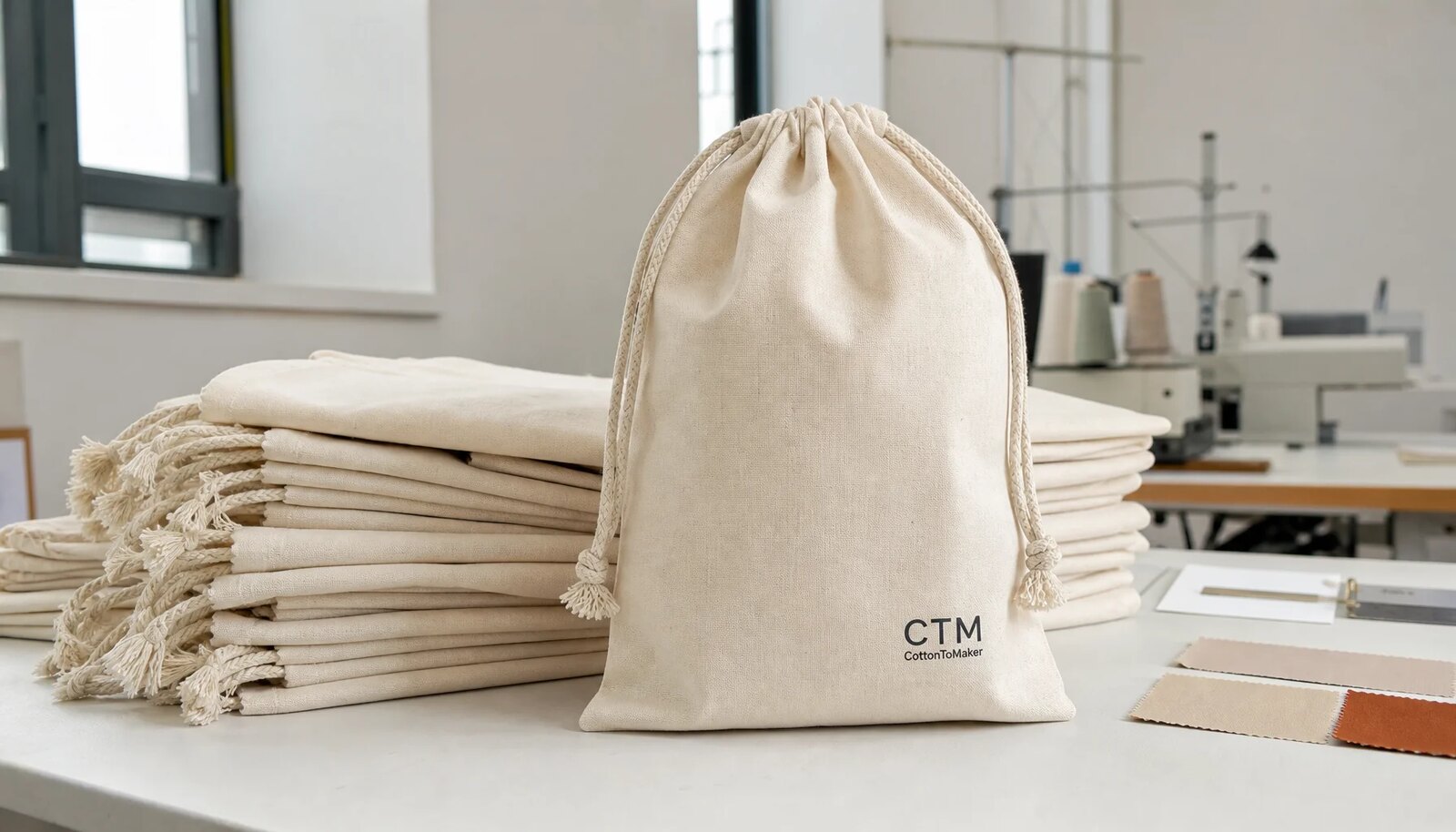
Why logo placement affects procurement risk
For cotton drawstring pouches, logo placement is a sourcing decision, not just a design preference. The position of the mark affects print setup, defect tolerance, visible branding, fold direction, packing labor, and how the pouch presents when it is filled and tied. Event planners often approve artwork on a flat digital mockup, then discover that the real pouch has a drawstring channel, seam allowance, cord bulk, fabric movement, and a smaller usable panel than expected.
A B2B buyer should treat placement as part of the technical specification. The RFQ should define where the logo sits on the finished pouch, not only where it looks good on a rendered image. A centered logo may be ideal for sponsor recognition, while a lower-front logo may be safer when the top channel is wide or the pouch will be cinched before distribution. If the pouch will be displayed on registration tables, included in attendee kits, or photographed with other event materials, the placement must support that use case.
The main risk is repeatable error. If the first approved sample has the logo too close to the cord channel, bulk production will usually repeat the same issue hundreds or thousands of times. A clear logo placement guide prevents the factory from guessing, gives the buyer measurable approval criteria, and helps competing suppliers quote the same work.
- Define placement with millimeter measurements, not only terms like centered, small, or near the top.
- Approve the logo on a physical pouch in the condition attendees will receive it: flat, filled, tied, folded, or packed.
- Leave clearance around drawstring channels and seams because fabric movement can shift the printed panel during cutting, sewing, and handling.
- Treat logo placement as a cost and quality factor when comparing cotton drawstring pouches for event planners logo placement guide requirements.
Build the pouch specification before artwork approval
A strong logo result starts with the pouch itself. Before requesting price, procurement should define the finished size, fabric weight, fabric construction, cotton color, drawcord type, seam style, and packing method. A supplier cannot accurately quote print placement if the pouch size is still flexible or the fabric weight is only described as standard. A 100 GSM pouch, 140 GSM pouch, and 180 GSM pouch may all be called cotton drawstring pouches, but they behave differently under ink, embroidery, filling, and folding.
For event use, many buyers evaluate cotton between roughly 120 and 180 GSM first. Lighter cotton can work for small samples, seed packets, low-weight gifts, or disposable event contents. Midweight cotton gives better structure, stronger perceived quality, and a more stable print surface. Heavier fabric can feel more premium, but it increases unit cost, carton weight, and sometimes the minimum order if the material is not already available. The right choice depends on what the pouch must hold and how long it needs to look presentable.
Procurement teams should also separate natural cotton, bleached cotton, and dyed cotton. Natural cotton has visible texture and shade variation, which many event programs accept, but it should be approved as a range. Dyed cotton requires tighter color control and may involve higher MOQ or longer fabric lead time. The drawcord matters too: cotton cord, polyester cord, braided cord, flat tape, and waxed cord each change the look and the closure performance.
- Finished size: state width and height in millimeters, plus acceptable tolerance after sewing.
- Fabric: specify GSM, weave or construction, natural, bleached, or dyed color target, and whether shade variation is acceptable.
- Cord: confirm material, color, thickness, pull direction, knot, end finish, and whether the cord must match or contrast with the pouch.
- Construction: define top channel width, seam finish, bottom shape, and whether the pouch must stand neatly when filled.
- Use load testing with intended event items before approving a smaller size or lighter GSM.
Map the safe logo zone on the pouch
The safe logo zone is the area where decoration can be applied without colliding with functional construction. On cotton drawstring pouches, the most important boundaries are the top edge, the drawstring channel, the side seams, and the bottom seam. The decoration should not be placed so high that the cord hides it, so wide that it crosses seam bulk, or so low that it wrinkles against the base when the pouch is filled.
A useful placement proof should show the finished pouch outline, channel line, seam allowance, logo size, and measurement from the top edge or channel to the logo. Buyers should ask for actual dimensions: for example, logo width 60 mm, logo height 25 mm, centered horizontally, top of logo 45 mm below finished top edge, with at least 15 mm clearance from the channel stitching and 20 mm from each side seam. The exact values depend on pouch size, but the principle is the same: give the factory a measurable target.
Avoid letting the artwork file become the only control document. A logo supplied at high resolution does not tell the production team where to print it. If the factory prints panels before sewing, placement must account for cut tolerance and seam allowance. If the factory decorates finished pouches, placement must account for the available flat area under the print frame or embroidery hoop. Both routes can work, but each needs a clear safe zone.
- Top clearance: keep the mark below the drawstring channel so it remains visible when the pouch is closed.
- Side clearance: avoid printing into seam bulk where ink coverage, registration, or embroidery tension may become uneven.
- Bottom clearance: leave room for the pouch to expand when filled so the logo does not fold under the base.
- Centerline control: specify whether the logo is centered to the finished pouch, the front panel, or an offset presentation layout.
- Production method: ask whether the pouch is printed before sewing or decorated after sewing, because placement tolerance may differ.
Choose placement by event use case
The best placement is the one that matches how the pouch will be used at the event. A pouch placed flat inside a welcome kit has different visibility needs than a pouch handed out tied at a registration desk. A pouch used for sponsor gifting may need a prominent front-center mark, while a pouch used as protective packaging may need a smaller, more discreet brand mark that does not overpower the contents.
Front-center placement is the default for visibility. It works well when the logo is the main message and the pouch will be photographed, stacked, or handed to attendees as a branded item. Lower-front placement is often safer for drawstring pouches because it gives the cord channel room and keeps the logo visible after the pouch is tied. A small corner or side placement can feel more premium, but it may not deliver enough sponsor exposure for event programs where brand recognition is the purpose.
Back printing can be useful when the front carries a sponsor logo and the back needs event dates, a QR code, or a small compliance mark. However, two-sided decoration adds setup cost and inspection complexity. If the pouch will be included in a kit with a hang tag, card, or sticker, the buyer should check whether those materials cover part of the front logo during packing.
- Front-center: strongest option for brand visibility, sponsor recognition, and attendee-facing giveaways.
- Lower-front: good when the pouch is tied shut, when the channel is wide, or when the logo is taller than expected.
- Small corner mark: useful for premium restraint, but weaker for crowded event environments.
- Back print: practical for secondary information, QR codes, or event details when the front carries the main brand.
- Two-position print: only approve after confirming extra setup cost, MOQ impact, curing time, and inspection criteria.
Match decoration method to artwork and fabric
Decoration method affects both the look and the procurement risk. Screen printing is often the practical default for cotton drawstring pouches because it suits solid artwork, repeat orders, and predictable unit costs. It is usually best for one- or two-color logos with clear shapes. Buyers should still confirm ink opacity, curing time, registration tolerance, and whether the ink will feel too heavy on lighter cotton.
Digital printing can support more colors, gradients, or event-specific graphics, but cotton texture can reduce sharpness compared with a smooth synthetic surface. It may be useful for shorter runs or more complex designs, provided the supplier explains color limits and durability expectations. Embroidery can create a premium tactile mark, but it needs the right fabric weight and logo structure. Dense stitching on small pouches may pucker the fabric or limit the clean printable area near the drawstring channel.
Heat transfer can be appropriate for short-deadline event runs or artwork that is difficult to screen print, but buyers should inspect hand feel, edge lift, and surface durability. The wrong method often fails quietly at the quote stage: a supplier may provide a low unit price using a method that is not suitable for the artwork. A stronger RFQ asks the factory to recommend the method, explain the tradeoff, and provide a sample or proof before bulk approval.
- Screen print: best for solid logos, repeat programs, simple sponsor marks, and cost control at scale.
- Digital print: useful for multi-color artwork, gradients, or smaller batches, but check sharpness and rub resistance.
- Embroidery: suitable for thicker cotton and premium kits, but verify stitch density, backing, and fabric puckering.
- Heat transfer: workable for speed and complex graphics, but inspect edge adhesion and hand feel.
- For small text, ask the supplier to confirm the minimum readable height before sample production.
Control MOQ, pricing, and quote comparability
MOQ is often misunderstood as a single number. For cotton drawstring pouch sourcing, there may be separate minimums for fabric purchase, cutting, sewing, dyeing, screen setup, embroidery setup, cord color, labeling, and packing. A supplier advertising a low minimum may be using stock fabric and a standard pouch size, while a supplier quoting a higher minimum may be including custom dyeing, production sampling, or special packing. Procurement should ask what the MOQ is tied to before deciding whether a quote is expensive.
The cleanest comparison starts with a normalized specification. Ask each supplier to quote the same finished size, same GSM, same fabric color, same logo size, same placement, same decoration method, and same packing. Then request line items or clear inclusions for setup fees, sample charges, plate or screen charges, packing labor, labels, carton marks, and freight assumptions. Without that structure, a low unit price may simply exclude work that another quote includes.
Low MOQ can still be the right choice for regional events, pilot programs, or sponsor tests. To keep the cost realistic, use a standard natural cotton fabric, one standard pouch size, one logo position, and simple packing. Custom color, custom cord, woven labels, inserted cards, and two-sided printing can be added later once the event program repeats or volume increases.
- Ask for MOQ by pouch size, fabric color, logo color count, print position, and packing type.
- Separate sample cost, setup cost, production unit cost, packing cost, and freight assumptions in the quote review.
- Do not compare a loose bulk-packed pouch with an individually folded, labeled, and polybagged pouch as if they are the same product.
- Check whether the quoted price is from an integrated factory, a trading company, or a supplier coordinating separate sewing and print vendors.
- For repeat programs, ask whether future reorders can use the same screens, artwork files, or placement standards.
Approve samples with real-use inspection
Sample approval is where procurement can prevent most bulk problems. A blank sample can confirm size and sewing, but it does not prove logo placement, print registration, ink behavior, or artwork readability. For branded event pouches, the pre-production sample should use actual or production-equivalent fabric, the final cord style, the final closure construction, and the real logo method. If the final order will be dyed, printed, folded, labeled, or packed with inserts, those elements should be represented or clearly approved before bulk production.
Inspect the pouch in the same way attendees will see it. Fill it with the intended items, pull the cord closed, place it on a table, and view the logo from normal handout distance. If the pouch will be stacked, check whether the logo is visible when folded. If it will be placed in a welcome kit, check whether the logo faces outward and whether any insert card, tag, or label covers the artwork. Small shifts that look acceptable flat may become obvious when the pouch is filled.
Approval notes should be written and measurable. Instead of saying the logo looks good, state that the sample is approved with logo size, position, color, fabric, cord, and packing as shown. If the logo is too high, too low, too small, or too close to a seam, reject the placement before bulk production and request a revised proof or sample.
- Measure logo distance from top edge, drawstring channel, side seams, and bottom seam.
- Check the pouch flat, filled, tied, folded, and packed if those states apply to the event.
- Look for ink bleed, fuzzy edges, poor opacity, print-through on the reverse side, and color mismatch.
- Pull the cord several times to confirm the channel moves freely and the print or embroidery has not stiffened the top area.
- Photograph the approved sample and keep it as the reference for bulk inspection.
Set quality-control tolerances before production
A quality-control plan should translate the approved sample into inspection criteria. Cotton drawstring pouches have several common defect points: logo shift, crooked print, uneven ink, stains, loose threads, skipped stitches, distorted channels, fraying cord ends, size variation, and mixed packing. If these are not defined before production, the buyer and supplier may disagree about what counts as a reject.
For logo placement, buyers should set a tolerance that reflects the product size and event visibility. A small pouch with a small logo may need tighter alignment than a large pouch with a generous print area. The tolerance should cover vertical shift, horizontal shift, rotation, and whether critical text remains readable. For sewing, check the channel stitching and side seams because distortion there changes how the pouch closes and how the logo sits when the pouch is filled.
Inspection should include both cosmetic and functional checks. Cosmetic checks cover stains, shade variation, print defects, and visible thread quality. Functional checks cover cord pull, seam strength, pouch size, and whether the pouch can hold the intended event items. Packing inspection matters because even well-made pouches can arrive poorly if counts, labels, or carton marks are wrong.
- Logo alignment: define acceptable vertical and horizontal shift from the approved sample or placement proof.
- Print quality: reject obvious blur, cracking, pinholes, poor opacity, ink transfer, and unreadable fine text.
- Fabric and sewing: inspect GSM tolerance, shade range, seam strength, skipped stitches, puckering, and open seams.
- Cord function: confirm both sides pull smoothly, knots are secure, and ends do not fray excessively.
- Packing accuracy: verify unit count, inner pack count, carton count, SKU separation, labels, inserts, and carton marks.
Plan packing for event operations
Packing is part of the product experience and the event workflow. A pouch that is loose bulk-packed may be cheaper, but the event team may need extra labor to count, fold, label, or kit units on site. Individually packed pouches cost more but can reduce handling time and protect the printed surface. The right choice depends on whether the pouches will be handed out empty, filled before shipment, assembled at the venue, or included in a larger sponsor kit.
Fold direction should be specified when the logo matters. If the pouch is folded across fresh print or packed under pressure before curing, the logo can scuff, transfer, or develop surface marks. If the logo needs to be visible through a polybag or on a registration table, the factory should fold consistently with the mark facing the intended direction. Insert cards, hang tags, barcode labels, and sponsor stickers also need placement rules so they do not cover the logo.
Carton planning is important for procurement and event logistics. Ask for master carton dimensions, gross weight, carton quantity, and whether cartons contain mixed SKUs. For multi-city events, fixed carton counts can help allocate inventory. For one large venue, bulk packing by handout station may be more efficient. These details should be quoted before sample approval, not discovered after production.
- Loose bulk packing: lower cost and faster factory packing, but more destination labor and greater scuff risk.
- Bundle packing: useful when teams need fixed counts for tables, rooms, or sponsor groups.
- Individual polybagging: protects the pouch and supports barcode control, but adds cost and may not fit all sustainability requirements.
- Insert card or tag: confirm placement, material, attachment method, and whether it changes carton count.
- Carton marks: include event name, SKU, quantity, size, color, PO number, destination, and any required barcode.
Manage lead time around the event date
Event-driven orders have fixed consequences. The production timeline is not only the number of days needed to sew pouches. It includes artwork preparation, quote confirmation, sample production, sample transit, revision time, material allocation, cutting, decoration, curing or drying, sewing if printed before assembly, inspection, packing, freight, customs where applicable, and final delivery. A tight timeline can still work, but only if the buyer knows which steps can overlap and which cannot.
The biggest schedule risk is late approval. If artwork files are incomplete, logo placement is not dimensioned, or the sample is approved without real inspection, delays move into production when they are harder to correct. For larger programs, ask the supplier to identify the critical path: fabric availability, print setup, sewing capacity, packing labor, or freight. That tells procurement where to add buffer and what decisions must be locked first.
A practical event schedule includes one sample round and one correction buffer. If there is no time for a physical sample, the risk should be acknowledged and reduced with a dimensioned proof, material reference, previous production sample, or smaller pilot run. For high-visibility sponsor programs, skipping the sample can cost more than the time it saves.
- Lock artwork, logo size, logo placement, fabric, cord, and packing before issuing the bulk PO.
- Separate sample lead time, bulk production lead time, packing time, freight time, and destination handling time.
- Ask when print curing occurs and whether rush packing increases transfer or scuff risk.
- Build a buffer for sample revision if the first logo placement is too high, too low, too large, or too close to the channel.
- Confirm holiday closures, peak season constraints, and freight cutoff dates before promising the event delivery schedule.
Specification comparison for buyers
| Spec decision | Recommended option | When it fits | Buyer risk to check |
|---|---|---|---|
| Front-center logo | Use a centered print window below the drawstring channel | Best for sponsor visibility, attendee handouts, and event photography | Confirm the logo remains visible when the pouch is filled and tied, not only when flat |
| Lower-front logo | Place the mark in the lower half of the front panel | Good for taller logos, tied pouches, and cleaner clearance from the cord channel | Check that the logo does not sit too close to the bottom seam after filling |
| One-color screen print | Quote one solid color on natural or dyed cotton | Best for repeat programs, simple brand marks, and predictable unit cost | Confirm ink opacity, curing time, and tolerance for fine lines or small type |
| Digital print | Use when artwork includes gradients, multiple colors, or variable event graphics | Useful for smaller batches or complex graphics where screen setup becomes inefficient | Ask for rub resistance, edge sharpness, and color matching limits on cotton texture |
| Embroidery | Use on heavier cotton when a premium tactile mark is required | Fits VIP kits, sponsor pouches, and lower-volume premium event packaging | Check puckering, stitch density, backing visibility, and whether the pouch size can support the logo |
| Natural cotton fabric | Specify unbleached or natural cotton with an approved shade range | Good for sustainability-positioned events and neutral brand palettes | Natural shade can vary by lot; approve a shade band instead of expecting exact white |
| Dyed cotton fabric | Specify dyed fabric with a color target or reference standard | Best when the pouch must match an event, sponsor, or campaign color | Confirm dye-lot MOQ, shade tolerance, and whether the print color remains visible |
| Individual packing | Fold, polybag, label, or insert each pouch according to event distribution needs | Useful for VIP kits, retail-style event packs, barcode control, or sponsor bundles | Packing labor, fold direction, and inserted materials can change unit cost and carton count |
| Bulk packing | Pack loose or bundled by fixed count inside master cartons | Best for fast handout stations, on-site assembly, and lower packaging cost | Check whether the logo can scuff or transfer if pouches are packed before ink fully cures |
Buyer checklist before sampling
- Define finished pouch size in millimeters, including expected size tolerance and whether measurements are taken flat before or after washing or pressing.
- Specify fabric weight in GSM, fabric construction, cotton color, and whether natural cotton shade variation is acceptable within an approved range.
- Confirm drawcord material, cord color, cord diameter, knot or end finish, and whether both cords pull evenly after the pouch is filled.
- Mark the logo position on a dimensioned artwork layout, including distance from top edge, drawstring channel, side seams, and bottom seam.
- State logo size in millimeters, number of print colors, Pantone or color references where needed, and minimum readable text size.
- Choose the decoration method before comparing quotes, or ask suppliers to quote separate options for screen print, digital print, embroidery, or transfer with tradeoffs.
- Request a pre-production sample made with actual or production-equivalent fabric, final cord, final closure style, and the real logo artwork.
- Inspect the sample flat, filled, tied, and grouped with other event kit items to confirm the logo is visible in the real handout condition.
- Require print and sewing tolerances for logo shift, size variance, seam skew, loose threads, stains, cord binding, and misaligned channel stitching.
- Clarify packing method, fold direction, units per inner pack, carton quantity, carton marks, barcode labels, insert cards, and whether mixed-size cartons are allowed.
Factory quote questions to send
- What finished size, GSM, weave, cotton type, and fabric color are you quoting, and what tolerance applies to size and GSM in bulk?
- Where exactly will the logo sit on the finished pouch, what is the maximum safe print area, and how much clearance is kept from the drawstring channel, side seams, and bottom seam?
- Which decoration method are you using for this artwork, and what limitations should we expect for fine text, thin lines, color matching, ink hand feel, or embroidery puckering?
- Can you provide a dimensioned placement proof showing logo size, logo centerline, top-edge distance, and clearances before sampling?
- What is the MOQ by pouch size, fabric color, logo color count, print position, packing type, and custom cord or label requirement?
- Will the pre-production sample use actual production fabric, production cord, and the final logo method, or only similar materials?
- How many sample revision rounds are included or available, and how long does each round take including production and shipment?
- What packing is included in the unit price, how many units are packed per inner pack and master carton, and can you apply barcode labels, insert cards, or carton marks?
- What inspection standard do you use for logo alignment, print defects, seam quality, stains, size variance, and cord performance?
- How are rejected units handled before shipment, and do you produce extra units to cover defects or event overage?
Quality-control points to confirm
- Logo placement should stay within the approved print window, with measured tolerance for vertical and horizontal shift from the signed sample or placement proof.
- Critical artwork should not cross the drawstring channel, side seam, bottom seam, fold line, or any area that becomes hidden when the pouch is tied.
- Print registration should be clean, with no obvious blur, double image, pinholes, cracking, uneven ink density, or unacceptable color shift across the bulk lot.
- Fine text should remain readable at normal event-handout distance, and small legal marks or sponsor names should be checked before approving mass production.
- Fabric GSM should match the approved tolerance, because very light cotton can distort during printing or show ink through the reverse side.
- Fabric shade should match the approved sample or shade band, especially when natural cotton pouches are reordered across multiple event waves.
- Seams should be straight and secure, with no skipped stitches, open seams, excessive puckering, loose threads, or distortion around the cord channel.
- The drawstring channel should allow smooth pulling, and cord ends should be trimmed and secured so they do not fray during packing, transit, or handout.
- The pouch should be checked both flat and filled, because logo position, seam skew, and cord tension often look different once the pouch contains event items.
- Packing should match the approved method, count, fold direction, inner pack, labels, inserts, and carton marks, with no mixed SKUs unless the PO allows it.