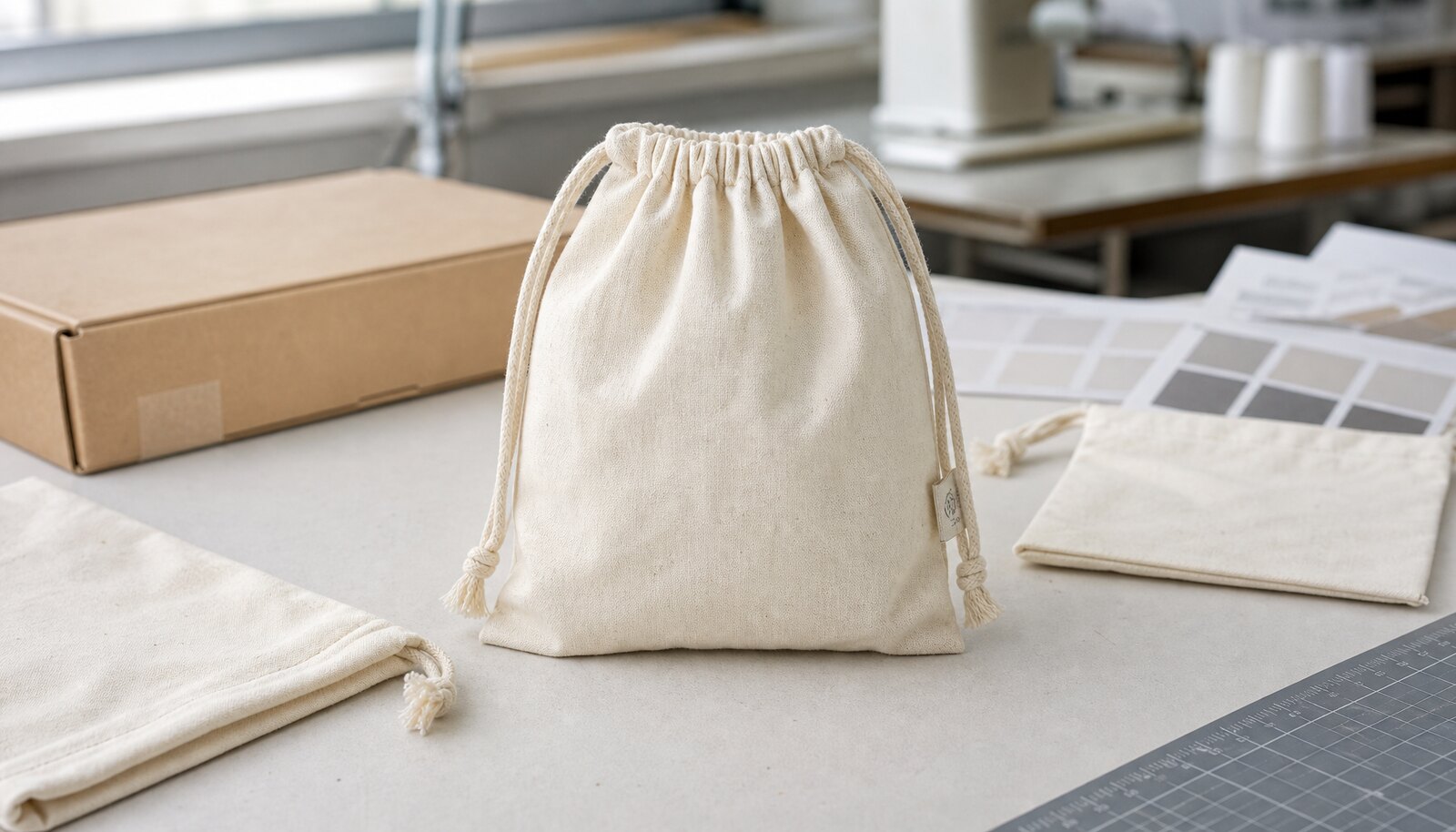
Why the pouch matters in a corporate gift program
Cotton drawstring pouches for corporate gifts look like a small accessory, but they are often the first physical item a recipient touches. That makes the pouch part of the gift experience, not just packaging. If the fabric feels thin, the seam line is uneven, or the logo sits crooked, the entire set reads as less considered than the budget suggests. In buyer terms, the pouch is not a throwaway line item. It is part of the brand presentation and should be specified with the same discipline as the gift itself.
The key procurement decision is use case. A pouch used only to protect the contents during transit can be lighter and simpler. A pouch that will be reused as storage or kept as a branded item needs better fabric opacity, cleaner construction, and more durable decoration. The right spec starts with that distinction. Without it, the quote process turns vague and suppliers fill in the blanks with their own assumptions, which is where avoidable rework begins.
- Define whether the pouch is packaging, reusable storage, or a keepable brand item.
- Treat first-touch quality as part of the gift program, not an afterthought.
- Match the spec to the recipient experience, not just to the lowest unit cost.
Start with the item inside the pouch
The pouch should be sized from the real gift, not from a rough drawing. Measure the finished item, including sleeves, cables, inserts, cards, or accessory bundles that will go inside. Then add enough clearance for easy insertion and a clean drawstring closure. If the pouch is too tight, packing slows down and the channel can distort. If it is too loose, the gift shifts inside and the pouch looks oversized or unfinished once it is cinched.
For RFQ purposes, state finished size and allowable tolerance rather than a loose description like small, medium, or large. Ask the supplier how they convert finished size into cut size, because that is where hidden quote differences often sit. If the product has hard edges or a rigid shape, ask for internal clearance around the item, not just the nominal width and height. That gives procurement a spec that can be checked, compared, and enforced instead of a design intent that can be interpreted three different ways.
- Measure the real packed item, not only the product drawing.
- State finished dimensions and tolerance in the RFQ.
- Ask for internal clearance if the gift has rigid edges or accessories.
Choose fabric, weave, and cord as a set
Cotton is not one fixed material choice. A lighter cloth in the 140-180 GSM range behaves very differently from a denser 200-250 GSM cloth, even before branding is added. Lighter fabric is easier to fold, cheaper to ship, and acceptable for basic packaging, but it can show the shape of the contents and lose structure on display. Heavier fabric usually gives better opacity and a more premium hand feel, but it also changes material use, sewing behavior, and freight weight. Those tradeoffs are real, but they are case-specific, so compare the exact construction rather than assuming one GSM band is always cheaper or better.
Weave and cord should be specified with the same care. Plain weave is usually the simplest route for cost control and straightforward print work. Twill or a denser canvas-style weave tends to look richer and feel more substantial, which matters when the pouch will be reused after the event. For the cord, state the material and diameter, not just the color. A braided cord in the 3-5 mm range usually moves more cleanly through the channel than a thin string, but the right choice depends on the pouch size and how much visual weight the closure should carry. The goal is a closure that looks deliberate, moves smoothly, and does not fray or pinch at the opening.
- Use lighter fabric for insert-style packaging and heavier fabric for reusable or premium pouches.
- Ask for a physical swatch when comparing plain weave with twill or denser canvas-style cloth.
- Specify cord diameter and cord material, not just the cord color.
Match the decoration method to the artwork
Screen print remains the most common option for cotton drawstring pouches for corporate gifts because it is efficient and works well for simple logos. It fits clean vector art, limited colors, and a defined print area away from seams and the drawstring tunnel. The main issue is not whether the logo can be printed on the sample; it is whether the production run can hold the same placement, opacity, and edge sharpness. A logo that is technically present but too faint, too low, or too close to the channel still counts as a poor result for a buyer.
Woven labels and sewn side labels are better when the pouch is meant to feel more permanent or premium. They shift the brand signal from ink coverage to construction detail and usually age better under handling. Small embroidery can also work, but it can pucker lighter cotton if the logo is dense or the fabric is too soft. Heat transfer is usually the least forgiving on textured cotton because it can look good on day one and then age unevenly. For any artwork with fine type, thin lines, or a large solid fill, ask for a strike-off or pre-production decoration sample before you approve the run.
- Use screen print for simple, repeatable artwork with stable placement.
- Use labels or small embroidery when the pouch should feel premium or reusable.
- Keep logos clear of seams, corners, and the drawstring opening.
- Ask for a strike-off when artwork has fine lines, small type, or large solid areas.
Compare sourcing routes by control, not just price
A direct cut-and-sew factory is usually the strongest option when you need control over fabric, stitching, and decoration. It is easier to manage repeat orders when one factory owns the core steps and can reproduce the approved sample with fewer handoffs. A trading company or sourcing office can still be useful when the program includes several gift items or consolidated freight, but the buyer should know exactly who controls production decisions and who pays for rework if the result misses the agreed sample. A reseller can be fast, but speed is not the same as visibility.
For buyer comparison, the quote has to reflect the same production path. A headline price does not tell you whether the supplier changed fabric weight, reduced print area, simplified packing, removed a label, or shifted the shipping term. Ask for the quote to separate base pouch price, decoration, packing, sample cost, and freight wherever possible. That structure makes it easier to compare landed cost and spot where one supplier is cheaper because the item is actually different. If the spec is not aligned, the lowest number is usually the least useful number.
- Use a direct factory when repeatability and process control matter most.
- Use a trading company when coordination across multiple SKUs is the real problem.
- Compare landed cost on the same spec, not just the lowest ex-factory number.
Write an RFQ that produces usable quotes
A useful RFQ should behave like a production brief. Include finished size, fabric type, target GSM, weave, cord construction, color reference, logo file format, print method, print area, quantity by SKU, packing method, carton marks, destination, and target lead time. If the buyer gives only a broad description, each supplier fills the gaps differently. One factory quotes a lightweight promotional pouch, another quotes a heavier retail-style pouch, and the two prices look comparable even though the products are not.
The cleaner way to manage it is to separate the variables that change cost. Show the base pouch on one line, then list decoration, packing, labels, and freight as separate items when the program allows it. If there are acceptable alternatives, state them directly. For example, a buyer may allow either screen print or a sewn label, but those options should be compared as alternatives, not blended into one vague number. This is especially important when the team is buying cotton drawstring pouches for corporate gifts at scale, because small substitutions compound quickly across a large order.
- State quantity by size and artwork version.
- Separate base pouch price from print, label, packing, and freight when possible.
- Tell suppliers which substitutions are acceptable and which are not.
Use samples to validate production, not just appearance
A photo sample is not enough for this product. The pre-production sample should use the actual bulk fabric, the actual cord, the actual label method, and the final print or embroidery process. That sample has to prove the pouch closes cleanly, holds the intended gift, and still looks balanced when cinched. If the bag only looks good when empty, the spec is not ready. It is also worth checking the sample in daylight and indoor light, because fabric tone and print contrast can shift depending on viewing conditions.
Sample approval should be treated as a control point, not a formality. Keep one signed reference sample with the order file and note every accepted deviation in writing. If the project includes several pouch sizes or artwork variants, each one should have its own approved reference or an explicit written exception. That matters later if the factory says a change was minor. If it was not in the signed sample set, it should be treated as a change request and priced or approved accordingly.
- Approve a sample made from actual bulk materials, not a mockup.
- Test fit with the real gift item inside the pouch.
- Keep a signed reference sample and record any approved deviations in writing.
Plan packing and labeling before the PO is issued
Packing affects both presentation and damage risk. Bulk flat-packing is usually the best cost choice, but the factory still needs to control fold lines, dust, and print rub. Inner polybags can protect the surface, but they add handling and waste, and they can trap moisture if the pouch is not dry before sealing. Some programs need tissue, a card insert, or a branded hangtag, but those items should be deliberate because they change labor and carton volume. The right pack-out depends on whether the pouch is shipping alone, being inserted into a kit, or being handed over as a finished gift set.
Carton specification should be simple enough for warehouse staff and 3PL teams to use without rework. State inner pack count, outer carton quantity, carton strength, and carton mark format. If there are multiple SKUs, the carton labels should map to procurement or warehouse codes, not only to the factory’s internal system. For international shipments, ask how the supplier protects the goods from moisture, compression, and rough handling. A low-cost pouch can still become a cost problem if the cartons arrive crushed, damp, or mislabeled.
- Choose flat-pack, folded, or tissue-packed based on the final unboxing experience.
- Specify carton marks and SKU labels that match your warehouse system.
- Ask for moisture and compression protection if the shipment will travel far.
Set QC thresholds before production starts
Quality control needs to be written in terms the factory can inspect without guessing. Define critical defects, major defects, and minor defects before the purchase order is issued. Critical defects should have zero tolerance because they affect usability or branding, such as the wrong logo, wrong size, a broken drawstring, holes, stains, or mixed artwork in the same carton. For visual defects, an AQL-based plan is usually the practical route, but only if the defect categories are written clearly and the buyer has a signed standard to enforce. Otherwise, the factory uses its own judgment and the buyer gets the dispute later.
The inspection checklist should be practical and repetitive. Measure size on a defined sample plan, verify the fabric against the approved swatch, inspect seam quality at the bottom corners and top channel, and pull the cord several times to make sure the opening moves smoothly. Check print placement, edge sharpness, and color density against the approved artwork. Do a simple dry white cloth rub check on the printed area to confirm the ink does not transfer under normal handling. Then open random cartons and confirm the count, packing pattern, and carton marks match the shipping docs. The aim is not perfection in every unit; it is predictable quality with no surprises on receipt.
- Use zero tolerance for critical defects such as wrong artwork, holes, or broken cords.
- Tie major and minor defects to a written inspection plan before production begins.
- Keep the approved sample, artwork file, and packing spec together as one control package.
Lock the PO and control changes on reorder
The final step is to compare quotes line by line and then lock the order terms. Build a matrix that includes material spec, decoration method, sample cost, setup cost, pack-out, carton marks, lead time, incoterm, and payment terms. If one quote is lower but the fabric is lighter, the print area is smaller, or the packing is weaker, it is not truly a better price. For procurement, the useful metric is cost per acceptable unit, not the lowest printed unit price. Rework, inspection failures, and freight corrections erase false savings quickly.
The purchase order should also make change control explicit. No substitution in fabric, cord, print method, label construction, or packing should happen without written approval. If the factory wants to alter anything after sample sign-off, request a revised sample or a written deviation note with a named approver. That discipline matters on repeat orders because small spec drift is easy to miss when the pouch looks similar at first glance. A clean reorder process starts with a locked spec, a signed sample, and a quote that leaves no ambiguity about what was included.
- Compare quotes using the same spec, the same incoterm, and the same pack-out.
- Judge the order on cost per acceptable unit, not just unit price.
- Require written approval for any substitution after sample sign-off.
Specification comparison for buyers
| Spec decision | Recommended option | When it fits | Buyer risk to check |
|---|---|---|---|
| Sourcing route | Direct cut-and-sew factory with in-house decoration control | Best when you need repeat orders, stable construction, and one accountable owner for sewing plus print or label application | Ask whether the factory actually controls sewing and decoration in-house or only coordinates them; subcontracted steps can create timeline gaps and weak defect ownership |
| Sourcing route | Trading company or sourcing office coordinating multiple processes | Useful when the gift program includes several SKUs, mixed decoration methods, or consolidated freight planning | Check who approves fabric, who owns rework, and whether the quote includes subcontracted print, repack, and carton relabeling |
| Fabric weight | 140-180 GSM cotton | Suitable for light inserts, sample kits, and lower-cost packaging where the pouch is secondary to the gift | Lighter cloth can show contents, collapse when displayed, and look less substantial than the brand may want |
| Fabric weight | 200-250 GSM cotton | Better for premium corporate gifts, reusable storage, and pouches that are meant to be kept after the event | Verify the quote is based on actual GSM and not just a descriptive label; heavier fabric changes material use, sewing behavior, and freight weight |
| Weave | Plain weave | Good for cost-sensitive programs, simple logos, and straightforward production planning | Flat appearance and lower opacity can be a problem if the pouch is meant to feel premium or conceal the item inside |
| Weave | Twill or denser canvas-style weave | Better when presentation matters, the pouch will be reused, or a more tactile finish is part of the brand message | Ask for a physical swatch because density, drape, and opacity are difficult to judge from a spec sheet alone |
| Branding method | 1-color or 2-color screen print | Best for clean logos, repeatable placement, and medium-to-high volume orders | Check ink density, curing, rub resistance, and how close the art can sit to seams or the drawstring channel |
| Branding method | Woven label, sewn side label, or small embroidery | Fits premium programs and reusable pouches where the decoration should survive handling after the gift is removed | Confirm label size and stitch density so the decoration does not distort the pouch body or interfere with cord movement |
| Packing format | Bulk flat-packed with protection only where needed | Best when unit cost matters and the pouch is mainly an insert or giveaway component | Confirm the factory can prevent wrinkling, dust, and print rub while still keeping carton volume under control |
Buyer checklist before sampling
- Finished pouch width and height, plus allowed tolerance in writing
- Cotton type, weave, target GSM, and whether the fabric is pre-shrunk or treated
- Cord style, cord diameter, cord color, and whether the channel is self-fabric or bound
- Logo file format, print method, print area, and minimum clearance from seams and the drawstring opening
- Exact color reference for fabric and artwork, including Pantone, lab dip, or approved physical swatch
- Quantity by SKU, by size, and by artwork version
- Packing format, inner pack count, carton count, and carton marking instructions
- Sample type required before approval, including bulk-material pre-production sample and strike-off if needed
- Lead time after sample sign-off and the date the factory considers production day 1
- Incoterm, destination, freight responsibility, and whether the quote includes customs, duty, or local delivery
Factory quote questions to send
- What exact cotton fabric, weave, and GSM will you use, and what tolerance do you hold on GSM for incoming inspection and bulk production?
- Is your quote inclusive of cutting, sewing, print, label, packing, and carton marking, or are any of those items quoted separately?
- What is the MOQ by size, color, and artwork version, and what changes that MOQ the most?
- Can you provide a pre-production sample made from actual bulk materials, not only a photo sample or a digital mockup?
- What print method do you recommend for this logo, what is the maximum print area you can hold consistently, and what is the minimum line thickness you can reproduce cleanly?
- What seam allowance, stitch density, and drawstring channel construction will you use, and what tolerance do you apply to the finished dimensions?
- How are the pouches packed inside the carton, and what protection is used to avoid rubbing, dust, or creasing?
- What is the lead time after sample approval, and which steps can add delay if the artwork, packing, or carton mark changes?
- If you outsource any step, who owns rework responsibility and who pays if the final product misses the approved sample?
- Can you share a recent production photo set or process flow that shows the actual sewing and decoration setup for this item?
Quality-control points to confirm
- Measure finished width and height on a defined sample plan and reject any pouch outside the agreed tolerance
- Verify the fabric against the approved swatch for color, weight, weave density, and surface consistency
- Check seam quality at the side seams, bottom corners, and the top channel where the cord runs; do not accept open seams, skipped stitches, or obvious puckering
- Pull the cord repeatedly to confirm the channel opens and closes smoothly without binding, tearing, or uneven tension
- Inspect print placement, color density, registration, and edge sharpness against the approved artwork and gold sample
- Use a dry white cloth rub check on the printed area to confirm the ink does not transfer under normal handling
- Verify label placement, spelling, orientation, and whether the label sits flat without curling or distorting the pouch body
- Open cartons at random and confirm pack count, inner protection, carton marks, and label consistency with the shipping docs
- Apply an inspection plan such as AQL 2.5 for major defects and 4.0 for minor defects unless the program requires a tighter threshold
- Treat critical defects as zero tolerance, including wrong size, wrong logo, broken drawstring, holes, heavy stains, or mixed artwork in the same carton