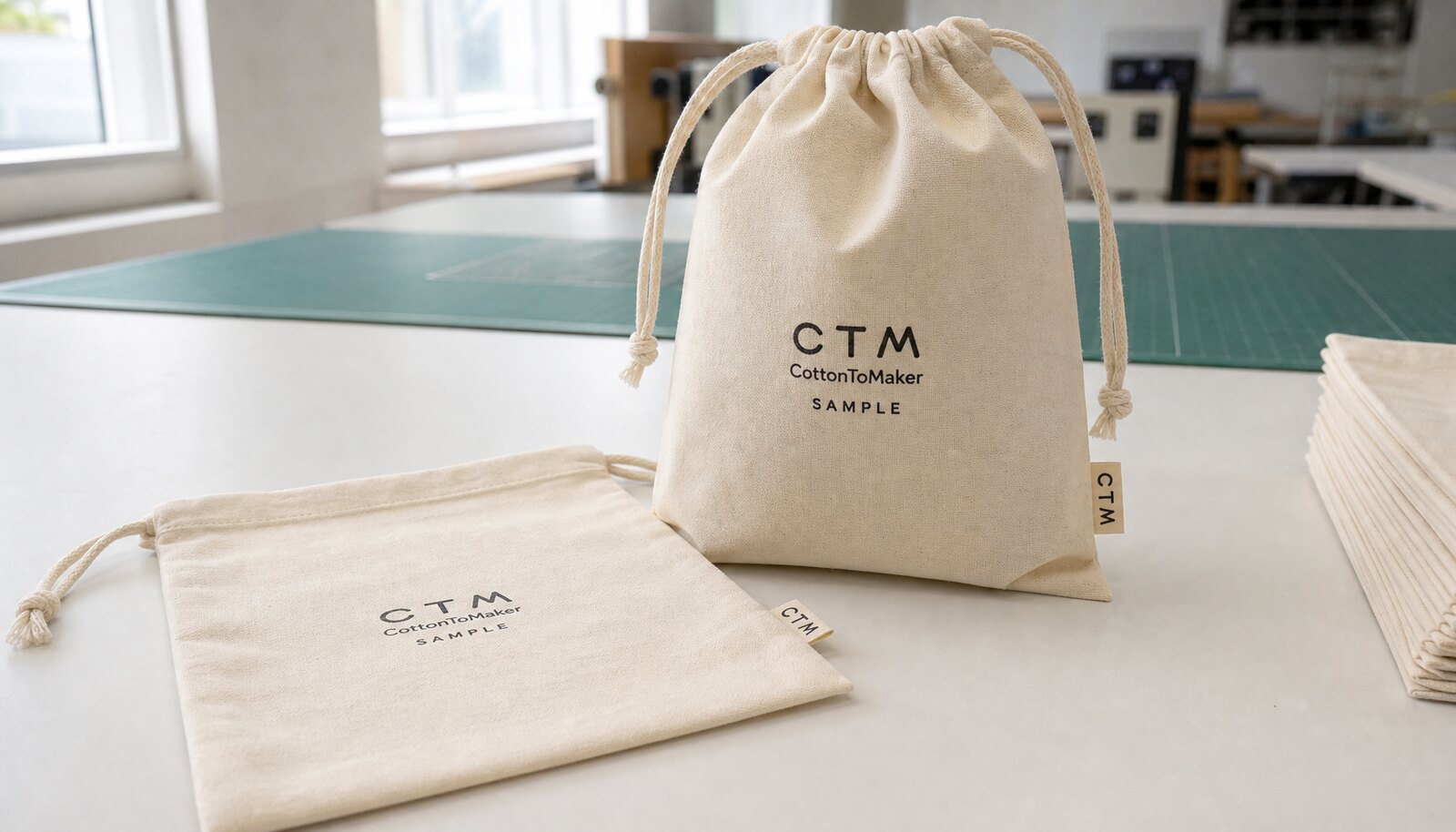
Choose the pouch for the gift, not the catalog
A cotton drawstring pouch for corporate gifting should be selected around the item it will carry, the brand it represents, and how the recipient will use it after the event. A pouch for a small beauty kit does not need the same body weight or closure detail as a pouch for a premium accessory set. Buyers often start with a generic size and then try to force the product into it. That is where problems begin: artwork gets crowded, the cord channel distorts, and the pouch looks thin once filled.
The better approach is to define the gift set first. List the heaviest item, the sharpest edge, the largest dimension, and whether the pouch is meant to be reused. That gives you the minimum fabric weight, the opening width, and the seam allowance that will hold shape. For corporate gifting, the pouch often carries the first brand impression, so the material needs to support presentation, not just containment.
- Match pouch size to the actual gift set, not to a standard showroom sample.
- Use heavier fabric when the contents are dense, angular, or intended for reuse.
- Leave room for a clean print area so the logo does not sit on a seam or channel.
Pick the cotton fabric by weight and surface, not by name
The phrase cotton drawstring pouch covers a wide range of fabrics. Muslin, plain weave cotton, twill, and light canvas all behave differently. For low-cost corporate giveaways, 90 to 120 GSM cotton can work if the contents are light and the pouch is not expected to hold structure. For better drape and more reliable print coverage, many buyers move into the 120 to 150 GSM range. When the pouch is part of a premium set or must sit upright in a gift box, 180 to 260 GSM cotton twill or canvas usually gives a better result.
Surface matters as much as weight. A loose weave may feel softer but can show print through on the reverse side and can look uneven after cutting. A tighter weave gives a cleaner print face and reduces the chance of distortion when the cord is pulled. If the supplier says 'cotton' without specifying weave, yarn count, and GSM, you do not yet have a real production spec. Ask for a measured swatch, not a marketing description.
- 90 to 120 GSM: light promotional use, small items, lower cost.
- 120 to 150 GSM: balanced option for most corporate gifting pouches.
- 180 to 260 GSM: premium feel, stronger shape, better for repeated use.
Construction details that change the feel and the quote
The body fabric is only one part of the spec. A drawstring pouch can be single-layer or double-layer, sewn with a side gusset or flat panel, finished with cotton cord, polyester cord, or a blended cord. Each choice changes hand feel, durability, and price. Single-layer pouches are lighter and cheaper, but thin fabric may show the contents. Double-layer versions feel more premium and hide the contents better, yet they require more labor and often a wider fabric panel to cut efficiently.
The closure detail also matters. A simple cotton cord works well for a natural, soft presentation, while a waxed or polyester cord may slide better and hold up under frequent reuse. Some buyers add a woven side label, a small care label, or a stitched logo tab to elevate the pouch without increasing print complexity. These details sound minor, but they change sewing time, fabric consumption, and packing volume. If you do not define them early, the factory will quote the wrong build.
- Single-layer reduces cost but may be translucent with lighter cotton.
- Double-layer improves presentation and content concealment.
- Cord material, channel width, and label placement should be fixed before sampling.
Decoration methods should match the fabric
The best print method depends on the fabric surface, the number of colors, and how the pouch will be handled after delivery. Screen print is usually the most practical option for cotton drawstring pouches for corporate gifting when the logo is simple and the run is large enough to absorb setup cost. It gives strong color coverage and a clean look on flat cotton panels. If the art has many colors or fine gradients, the buyer should expect higher setup risk and more room for color variation between lots.
Heat transfer can work for short runs or complex graphics, but it is more sensitive to fabric texture and wash wear. Embroidery looks premium, yet it adds stiffness and can distort lighter fabrics if the stitch density is too heavy. Woven labels and sewn patches are often better for understated branding, especially when the pouch itself should stay soft and natural. The rule is simple: the decoration should fit the fabric, not fight it.
- Screen print: best for simple logos, larger quantities, and stable flat cotton.
- Heat transfer: useful for short runs, but verify adhesion on the actual fabric.
- Embroidery or woven labels: better for premium presentation, with added cost and hand-feel impact.
Compare sourcing routes before comparing unit price
A low unit price can hide a weak sourcing route. A direct factory that controls fabric, cutting, stitching, and print will usually give the cleanest spec control, but it may need a higher MOQ and longer lead time. A trading company can simplify communication, especially if the buyer is managing several items in one gift program, yet the real production responsibility may be spread across multiple parties. Local decorators are fast for simple overprints, but they usually work from pre-made blanks that limit fabric choice and exact sizing.
The right route depends on what the buyer is trying to protect. If the pouch is part of a recurring brand program, control over fabric and color is usually worth more than the cheapest first quote. If the order is a one-off event pack, speed and readiness may matter more. The table above is meant to show how each route changes risk, not just cost. A proper RFQ should ask suppliers which process they own, which process they outsource, and what proof they can show for the step that matters most.
- Use direct factory sourcing when spec control and repeatability matter.
- Use local decoration only when the blank pouch already matches the required quality.
- Do not compare quotes unless you know who owns fabric, print, stitching, and packing.
Lock the sample before bulk production starts
Sampling should not be treated as a courtesy stage. It is where you decide whether the fabric, sewing method, print, and packing can all work together at scale. For a cotton drawstring pouch, the sample set should include at least one physical reference that shows the actual fabric weight, the cord behavior, the logo placement, and the finished opening. If you only approve a digital mockup, you are not approving the real product. The hand feel, the opacity, and the print edge are all still unknown.
Ask for the sample type that matches the risk you are trying to reduce. A white sample helps lock construction and size. A printed pre-production sample confirms logo placement and ink behavior. A golden sample, signed off and retained by both sides, is the safest control point before bulk cut. Acceptance should be based on measurable items: finished size, print position, seam quality, and packing format. If the factory needs to change the fabric lot, the cord type, or the decoration method after approval, the sample should be reopened.
- Approve a physical sample, not only artwork files.
- Keep one signed reference sample on both the buyer and factory side.
- Reapprove if the factory changes fabric lot, print method, or packing format.
Packing and labeling decide how premium the gift feels
Many corporate gifting buyers focus on the pouch body and forget the packing. That is a mistake, because packing affects presentation, labor cost, and the way the item arrives at the recipient's desk. A pouch packed loose in bulk carton may be acceptable for event giveaways, but a client gift set usually needs controlled inner packing so the fabric stays clean and the cords do not tangle. If the order will be distributed through retail or dealer channels, barcode labels, inner counts, and carton marks become part of the product, not just shipping paperwork.
Packing also affects damage risk. Cotton fabric can pick up dust and moisture if the packing is too open or the warehouse is not controlled. Polybags can protect the pouch, but they add cost and plastic content. Tissue, belly bands, or card inserts may improve unboxing for premium programs, yet they also change carton density and freight cost. The packing instruction should state what the buyer wants to see on arrival: flat-folded or stuffed, bagged or unbagged, and how the cartons should be sealed and marked.
- Define inner pack count and carton count before the factory prices shipping cartons.
- Use bagging only when it supports cleanliness, presentation, or retail handling.
- Check that barcode labels and outer carton marks match the receiving system.
MOQ and lead time depend on fabric control
MOQ is not just a factory preference. It is usually tied to fabric width, print setup, cutting efficiency, and how many color changes the job needs. A simple single-color print on stock cotton can often be built at a lower MOQ than a custom-dyed pouch with a woven label and special cord. As a practical buying guide, low-complexity stock-fabric orders are often easier to start around 1,000 to 3,000 pieces, while custom fabric, multiple print colors, or premium finishing can push the viable MOQ much higher. The actual number matters less than whether the factory has explained why that number exists.
Lead time follows the same logic. A stock-fabric pouch with approved artwork might move from sample to bulk within a few weeks after sign-off, while custom fabric, color matching, or added trims will stretch the schedule. The safest way to manage timing is to separate sample lead time, bulk production time, and freight time. A factory that gives only one total timeline is hiding where the risk sits. For holiday gifting, build in correction time for print adjustment and carton rework, because that is where schedules usually slip.
- Lower MOQ usually means simpler fabric, fewer colors, and standard packing.
- Custom fabric and premium finishing increase both MOQ and schedule risk.
- Ask for separate dates for sample approval, bulk production, and dispatch.
Build the RFQ around landed cost and acceptance criteria
A useful RFQ for cotton drawstring pouches for corporate gifting should force the supplier to price each cost driver separately. If the supplier gives only a single unit price, you cannot compare fabric grade, print setup, packing labor, and carton cost against another quote. Ask for a breakdown that shows fabric, cutting, stitching, print, cord, labels, inner packing, export carton, and any special handling. That makes it easier to see where one supplier is cheaper because they are using a lower GSM cloth, a different cord, or a lighter packing spec.
Landed cost is the number the procurement team actually lives with. Freight, duties, local handling, inspection cost, and the rejection buffer should be part of the buying decision, not an afterthought. If a lower-priced supplier has a higher defect rate or a slower lead time, the real cost may be worse. The best RFQ is one that lets the factory quote the same construction, the same packing, and the same acceptance standard across all bidders. That is the only way to get a clean comparison and avoid production surprises later.
- Request a line-by-line quote instead of one blended price.
- Compare landed cost, not just ex-factory unit cost.
- Write the acceptance criteria into the RFQ so all bidders quote the same spec.
Specification comparison for buyers
| Spec decision | Recommended option | When it fits | Buyer risk to check |
|---|---|---|---|
| Direct factory with custom fabric | Best when the pouch must match a brand standard for GSM, shade, and cord finish | Repeat programs, retail assortments, and gift sets that will be reordered | Longer lead time and more approval steps; ask for lab dips, shrinkage data, and fabric source details |
| Direct factory using stock cotton fabric | Best when you need faster turnaround and a stable base cloth | Seasonal campaigns, event gifting, and orders with moderate volume | Shade and width options may be limited; confirm what is actually in stock before you price the job |
| Trading company managing the order | Best when you want one point of contact across multiple processes | Buyers who value coordination more than plant-level control | Margin opacity and less visibility into the real factory; insist on named process ownership and sample accountability |
| Local decorator on imported blanks | Best when the print deadline is tight and the pouch spec is simple | Small promotional runs or last-mile customization near the delivery market | Blank quality may be inconsistent and print area can be restricted by existing seams and channels |
| Stock pouch with overprint | Best when speed matters more than exact fabric specification | Giveaways, conferences, and short-life campaigns | Pre-existing seams, dust, and fabric finish can hurt print clarity and brand presentation |
| Nearshore small-batch supplier | Best when low MOQ and frequent replenishment matter more than lowest unit cost | Distributed teams, ongoing kit programs, and short reorder cycles | Unit price is usually higher; verify fabric availability and whether repeat shades can be matched |
| Dual-source route: pouch factory plus separate print finisher | Best when you need strong fabric control and specialized decoration | Programs where the pouch body and decoration have different technical needs | Handoff risk between vendors; define which party owns defects, spoilage, and color matching |
| Recycled or organic cotton specialist | Best when the claim itself is part of the gift value proposition | Sustainability-led corporate gifting and retail programs with content claims | Require proof of material composition and avoid vague eco language that cannot be supported on the quote or label |
Buyer checklist before sampling
- Final pouch size stated in finished dimensions, not just flat fabric cut size, with the intended gift item dimension included.
- Fabric type and GSM confirmed, along with any shrinkage allowance after washing or pressing.
- Cord material, cord diameter, stopper or knot style, and the expected opening/closing feel defined in writing.
- Decoration method fixed by artwork complexity, including number of print colors, print side, and placement reference.
- Packaging spec defined: individual polybag or no polybag, inner pack count, carton count, barcode, and label position.
- Sample approval path set: white sample, pre-production sample, or signed golden sample before bulk cut.
- MOQ and reorder logic written into the RFQ so the factory quotes the right fabric and setup costs.
- Delivery window, shipping term, and reserve time for correction or reprint already built into the schedule.
Factory quote questions to send
- What fabric construction and GSM are you pricing, and what is the expected finished shrinkage after production?
- Is the quote based on custom fabric, stock fabric, or stock blanks, and what changes if we switch sourcing routes?
- How many print colors, how many print sides, and what setup or screen charges are included in the unit price?
- Does the quoted price include cord, stitching, side label, inner packing, carton pack, and export carton marks?
- What is the MOQ by fabric color, print design, and packaging format?
- What is your sample timeline, and what sample type will you provide before bulk production starts?
- What measurement tolerance, stitch standard, and print defect threshold do you use for acceptance?
- Can you show recent in-process photos or an inspection summary for a similar cotton pouch order?
Quality-control points to confirm
- Fabric GSM matches the approved swatch or signed spec within the factory's stated tolerance.
- Finished size, opening width, and cord length stay within the agreed measurement tolerance after pressing.
- Drawcord slides smoothly, knots hold securely, and cut cord ends do not fray in normal handling.
- Print alignment is correct on the front panel, with no bleed-through, cracking, or muddy edges on the pouch body.
- Top channel stitching, side seams, and bottom seams are straight, secure, and free of skipped stitches or puckering.
- No oil stains, odor, dust contamination, broken needles, or loose thread bundles remain in packed goods.
- Carton counts, inner packs, and barcode labels match the packing instruction exactly.
- Shade variation stays controlled across cartons, especially for dyed cotton, natural cotton, and colored cords.