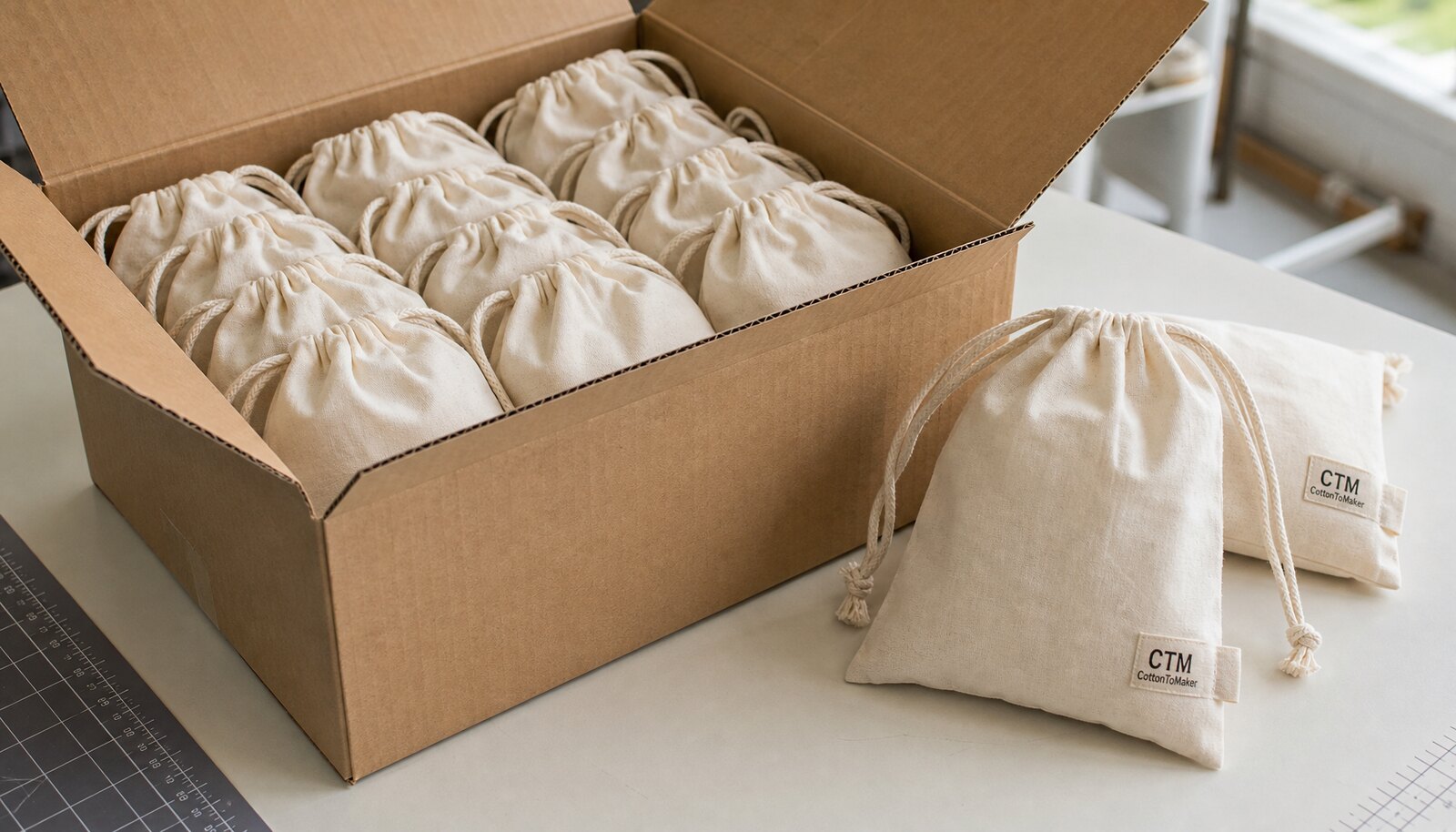
Why carton planning matters for drawstring pouches
For cotton drawstring pouches used in corporate gifting, the carton is not a storage afterthought. It affects freight cost, warehouse handling, damage rates, and how quickly your team can count and distribute the goods on arrival. A pouch that looks inexpensive in a unit quote can become expensive once the factory packs it in oversized cartons or builds a carton count that creates unstable pallets.
Buyers often focus first on print and fabric, then discover that carton planning drives the final landed cost. If the pouch is going into a gift program, the packing method also affects presentation. A flat-packed pouch, a lightly folded pouch, and a pouch bundled with an insert all need different carton layouts, and those choices change both labor and freight.
- Treat carton planning as part of the product spec, not as logistics detail after approval.
- Ask the factory to quote the pouch and the packing method together so the landed cost stays visible.
- Use one carton plan per SKU wherever possible to reduce receiving mistakes.
Start with the pouch spec, not the carton size
The right carton starts with the right pouch construction. A 140 GSM cotton pouch is usually enough for a light promotional item or a simple gift set. If the pouch carries a heavier product, or if the buyer wants a firmer handfeel and fewer crease marks, 180-200 GSM is more practical. That extra fabric weight increases bulk slightly, so carton count must be tested rather than guessed.
Finished dimensions matter more than cut size. A factory may quote a 15 x 20 cm pouch, but the useful packed footprint depends on seam allowance, hem depth, drawcord channel construction, and whether the pouch is folded before cartonizing. If those details are not locked, the first carton plan will drift when production starts.
- Specify finished size, fabric GSM, and drawcord type together.
- Confirm whether the pouch is meant to hold an insert, product sample, or just collateral.
- Use the approved sample to measure the actual folded thickness, not the flat fabric width.
How carton count changes freight and receiving cost
Carton count is where small errors become real money. If you pack too few pouches per carton, you pay more in carton material, pallet space, and handling. If you pack too many, the carton becomes heavy, the corners crush, and the inner pouches arrive wrinkled or damaged. The practical target is a carton that stays easy to lift, easy to stack, and consistent across the full order.
For export shipments, buyers should ask for carton gross weight and carton dimensions before approving the packing plan. A carton that looks efficient at the factory may create trouble at destination if it exceeds the warehouse lifting limit or pallet height standard. If the order is split across air and sea, keep the carton plan compatible with both modes or define separate pack plans for each mode.
- Keep master carton gross weight in a range your warehouse can lift safely.
- Avoid mixed carton counts across the same SKU unless the order is very small.
- Compare the cost of extra carton material against the freight saved by tighter packing.
Compare sourcing routes before you compare unit price
A direct factory quote is not automatically the lowest-risk route. Some suppliers quote a clean unit price but leave carton dimensions, packing labor, or inner bundles undefined. Others can supply a full packed sample and exact carton spec, which usually gives a more dependable landed cost. For corporate gifting, dependable packing is often worth more than a slight unit discount.
If your program includes multiple destinations, retail distribution, or staged release, compare three sourcing routes: factory bulk pack, factory pre-pack, and third-party cartonization. Each route has a different labor footprint and different risk points. The cheapest quote is often the one with the most missing details, not the best total cost.
- Request unit price, packing cost, and carton cost separately.
- Compare factory pack capability, not only the pouch decoration capability.
- Use a packed sample carton to confirm the route before release.
Print method and packing method have to work together
The print method affects how the pouch survives folding and stacking. Screen print is usually the most stable choice for a simple logo because it sits well on cotton and tolerates repeat production. If the artwork is complex or the run is short, heat transfer may be acceptable, but the buyer should watch for cracking at fold lines and abrasion in transit. Embroidery can add value, but it also increases thickness and may affect carton density.
Logo placement should be chosen with the fold pattern in mind. If the print sits too close to the drawcord channel or is buried under the fold, the first impression is weak even when the print itself is accurate. The better RFQ language is not just where the logo goes, but how it should appear after the pouch is packed and opened by the recipient.
- Specify logo placement based on the packed and opened view.
- Test the chosen print method on the approved GSM, not only on a generic fabric swatch.
- If the pouch is embroidered, ask the factory to show how it stacks inside the carton.
Use MOQ logic to avoid carton waste
MOQ for cotton drawstring pouches is rarely a single number with no context. It changes with fabric width, print colors, drawcord type, and carton configuration. A factory may accept a low MOQ for a blank pouch, but once you add multiple logo colors or custom packing, the minimum run increases because setup time and spoilage become part of the economics.
For corporate gifting, buyers should think in terms of pack logic rather than only piece MOQ. If the carton plan requires 500 pieces per size but the artwork split creates 300 units in one color and 200 in another, the factory may need to break the line and repack. That adds labor and can create leftover cartons that do not match the purchase order. The cleaner the carton logic, the cleaner the quote.
- Ask whether MOQ changes by print color, packing format, or pouch size.
- Avoid mixing too many logo versions in one run unless the carton plan is fixed first.
- Use one carton configuration for the bulk of the order whenever possible.
What a useful packed sample should prove
A sample pouch alone is not enough. For this product, the sample should include the pouch, the folding method, the bundle count, the inner packing, and the outer carton label. That is the only way to see whether the unit actually survives real packing. A good packed sample shows the finished product exactly as it will leave the factory, including drawcord position, print orientation, and carton fill density.
When reviewing a sample carton, measure more than the appearance. Check the carton dimensions, gross weight, how much air is left inside, and whether the pouches slide or crush when the carton is moved. If the buyer plans a gift assembly step after import, make sure the sample carton leaves enough room for the downstream process without forcing a repack.
- Approve a physical sample, not only photos.
- Record the final folded pouch dimensions and the carton gross weight.
- Keep one signed sample carton as the production reference.
Packing details that prevent claims later
Packing is where many low-priced quotes fail. The factory may use thin outer cartons, inconsistent tape, weak inner bundles, or poor label placement because none of those issues show up in a simple unit quote. For export, the carton must be strong enough for stacking and transit, and the marks must stay readable after handling. Buyers should specify whether the pouches ship flat, lightly folded, or pre-bundled in sets.
Labeling matters as much as carton strength. Each carton should show the PO number, pouch size, quantity, color, carton number, and destination mark. If the goods are split across multiple SKUs, use clear carton sequencing. That makes warehouse receiving faster and reduces the chance that partial deliveries are lost or mixed during inbound sorting.
- Use a carton label format that your warehouse can scan or read at a glance.
- Specify carton tape, inner bundle type, and any polybag requirement.
- For retail or premium gifting, decide whether individual pouches need tissue, belly bands, or no extra packaging.
Lead time, inspection, and landed-cost control
Lead time is not only sewing time. It includes fabric availability, print screen preparation, sample approval, carton sourcing, packing, inspection, and export booking. A buyer who only asks for a production lead time often gets an incomplete answer. The better question is how long each stage takes after art approval and sample sign-off. That exposes schedule risk early, especially when the order is tied to a campaign date.
To control landed cost, compare the supplier quote against the real shipment plan. A slightly higher unit price can still win if the factory packs efficiently, keeps carton weight in range, and reduces damage claims. Buyers should ask for the quote in a way that separates decoration, pouch construction, packing labor, and carton cost. That structure makes it easier to compare apples to apples across suppliers and avoid hidden charges.
- Build the schedule around sample approval, not around the first sales promise.
- Ask for separate line items for pouch, print, packing, and carton.
- Use a pre-shipment inspection focused on count accuracy, print quality, and carton integrity.
Specification comparison for buyers
| Spec decision | Recommended option | When it fits | Buyer risk to check |
|---|---|---|---|
| Pouch fabric weight | 140-180 GSM cotton for standard gifting; 200 GSM if the pouch carries heavier inserts or needs a firmer handfeel | Most corporate gifting sets that need a clean look without overbuilding the bag | Too-light fabric can show product outlines; too-heavy fabric raises freight and unit cost |
| Print method | 1-2 color screen print for simple logos; heat transfer only for short runs or complex art | When the logo is bold, flat, and repeatable across a large order | Heat transfer may crack in folding and stuffing; screen print can look uneven if fabric is too textured |
| Packing style | Flat-packed pouches in master cartons unless the pouch is part of a pre-packed gift set | When the buyer wants the lowest freight cost and simplest warehouse handling | Overstuffing cartons causes creasing, seam stress, and carton bulging |
| Carton count per size | Set carton counts by tested gross weight, not by guesswork; use one carton spec per pouch size if possible | When orders need stable palletization and easy receiving counts | Mixed pack counts lead to inconsistent carton weights and mis-ships |
| Supplier route | Direct factory with carton trial and packing mock-up | When the order has custom print, controlled QC, and export shipment | If the factory cannot show a packed sample carton, the first production run may be wrong |
| Outer carton strength | 5-ply corrugated for export or long transit; 3-ply only for short domestic moves | When cartons will be stacked, palletized, or transshipped | Weak cartons crush at corners and damage drawcord ends or printed faces |
| Labeling method | Barcode plus carton mark with size, color, quantity, PO, and carton number | When the buyer needs warehouse receiving and partial release | Missing carton numbers make claims and counts difficult after transit |
| Pre-pack vs bulk pack | Pre-pack only if the gifting kit is final and the insert dimensions are stable | When the pouch is going directly to end recipients or event kits | Any later change to inserts can invalidate the carton layout and add rework |
Buyer checklist before sampling
- Lock the finished pouch size, fabric GSM, drawcord type, and logo method before asking for carton quotes.
- Request a packed sample carton with actual gross weight, not just an empty carton spec.
- Confirm how many pieces fit per inner bag, inner bundle, and master carton.
- Ask for the carton dimensions, carton grade, and the target carton gross weight.
- Verify whether pouches ship flat, lightly folded, or pre-filled with inserts.
- Align the print placement with the fold line so the logo is visible after packing.
- Get one quote showing FOB unit price, carton cost, and any packing labor separately.
- Approve a production sample that includes both the pouch and the shipping carton label.
- Set an inbound QC standard for stitching, print placement, and carton compression before production starts.
Factory quote questions to send
- What fabric GSM is being quoted, and what tolerance will you hold on final production rolls?
- What is the exact finished pouch size after stitching, and what allowance is included for shrinkage or seam loss?
- How many pieces per inner pack and per master carton are included in the quote?
- What are the carton dimensions, carton grade, and estimated gross weight per carton?
- Is the price based on bulk-packed pouches, pre-folded pouches, or pre-packed gift sets?
- Which print method is included, and how many colors or print positions are covered?
- What is the MOQ by color, print version, and carton configuration?
- Can you provide a packed sample carton photo and one physical pre-production sample?
- What is the lead time after sample approval, and does it change if we request carton labeling or palletization?
Quality-control points to confirm
- Fabric GSM should match the approved sample within the agreed tolerance, usually within a practical commercial band rather than a wide factory estimate.
- Drawcord length should be consistent enough that the pouch closes evenly and the knot or stopper does not sit off-center.
- Print registration should keep the logo centered on the finished pouch after folding and packing.
- Stitching should be straight, with no loose threads at stress points or drawcord channel openings.
- Carton gross weight should stay within the approved packing plan so pallet stacking remains stable.
- Cartons should pass a drop and compression review appropriate to the route, especially for export moves.
- Carton labels should show PO number, size, quantity, carton number, and destination mark in a legible format.
- A packed sample should be retained and signed off before bulk production starts.