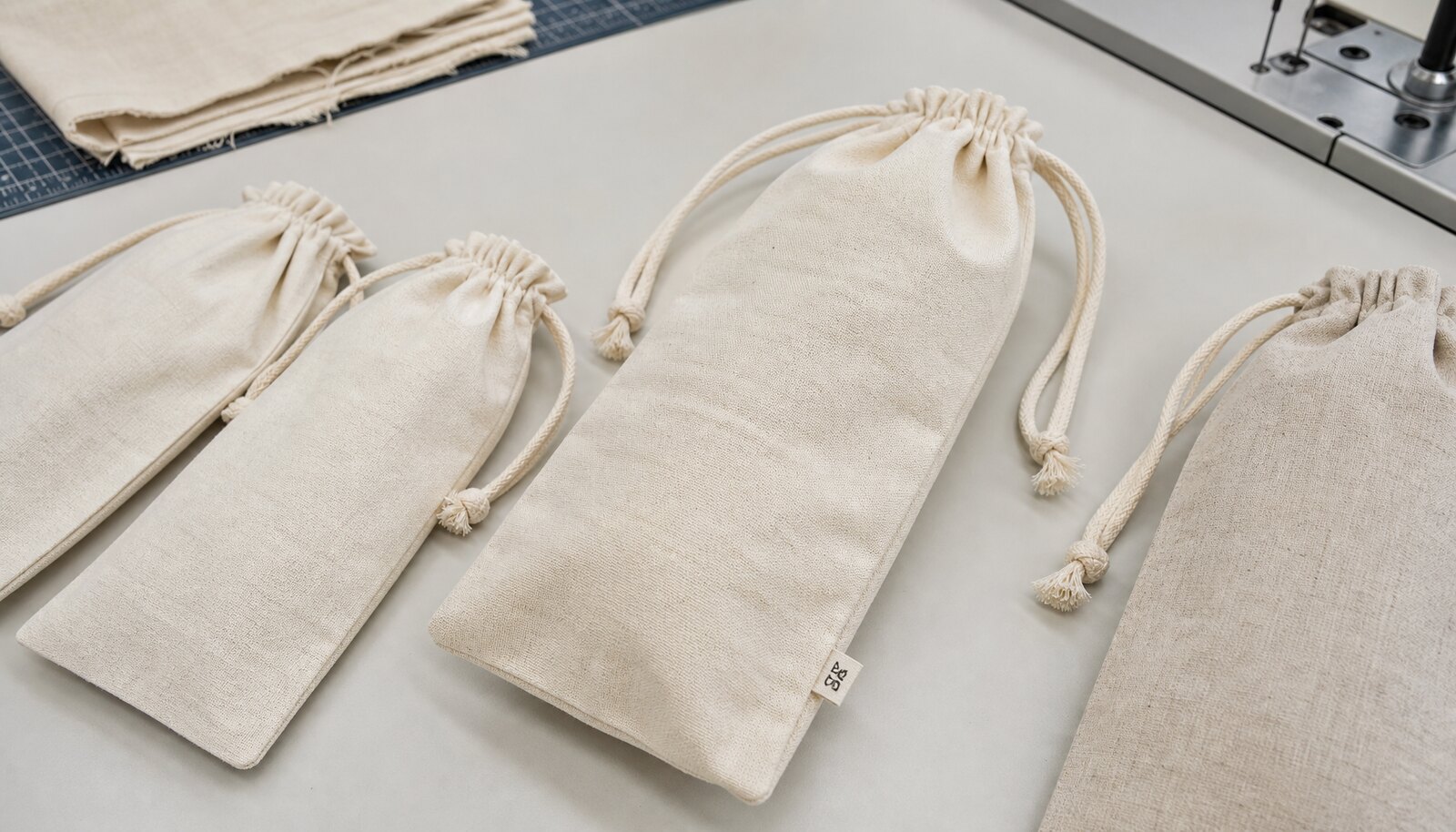
Why Fabric Weight Belongs in the Buying Spec
For boutique wineries, cotton drawstring pouches are rarely just a soft wrapper. They may sit on a tasting-room shelf, travel inside a wine club shipment, frame a limited-release bottle, or become a small reusable item that customers keep. Before anyone reads the logo, the fabric has already made an impression. Too light, and the pouch can cling to the bottle, show glass color or label artwork underneath, and make the print look weak. Too heavy, and it may feel substantial but gather badly at the neck, bulk up at the drawcord channel, or reduce carton efficiency.
That is why B2B buyers should avoid buying a generic 'cotton drawstring bag.' The phrase can cover thin muslin, tight plain-weave cotton, or light canvas. Two suppliers may both quote natural cotton while one is pricing 120 GSM and another is pricing 180 GSM. Those are not equivalent products. They differ in opacity, hand feel, print behavior, shrinkage risk, sewing performance, and landed cost. If the RFQ does not define GSM and fabric construction, the lowest quote may simply be the lightest fabric.
A better sourcing process treats GSM as a functional requirement. Start with the pouch job, the bottle profile, the closure point, the decoration method, and the level of consumer handling. Then choose a fabric weight that supports that job. This cotton drawstring pouches for boutique wineries fabric weight guide is written for procurement teams that need clearer RFQs, cleaner quote comparison, and fewer surprises between sample approval and bulk delivery.
- GSM affects opacity, drape, logo clarity, seam stability, channel strength, shrinkage management, carton weight, and freight cube.
- A lower unit price is not a saving if the pouch fails fit testing, looks transparent, or needs rework after sample approval.
- Heavier fabric is not automatically better; it still has to close cleanly, sew cleanly, fold efficiently, and fit the bottle profile.
- The practical buying sequence is use case, bottle fit, fabric spec, decoration method, tolerances, packing, then price comparison.
GSM Ranges That Work for Winery Pouch Programs
Most cotton winery pouch programs fall between 140 and 220 GSM. That range usually gives enough structure for bottle presentation without moving into stiff tote-bag canvas. A tight 140-160 GSM plain weave can be a sensible starting point for standard tasting-room pouches, simple club inserts, or promotional bottle wraps. The word 'tight' matters. A loose 160 GSM fabric may print and drape worse than a better-constructed cloth at the same weight.
The 160-180 GSM range is a useful middle ground when the winery wants more opacity and a firmer hand but does not want the stiffness, cost, or packing bulk of heavier canvas. It often fits branded retail pouches, seasonal releases, and wine club gifts that customers are expected to handle and keep. It also gives screen printing a more stable surface when the weave is controlled and the artwork is not overly fine.
The 180-220 GSM range suits premium bottle gifts, reusable pouches, limited-release packaging, and programs using woven labels or side tags. The extra weight can reduce the clingy look around glass shoulders and improve perceived substance. There is a tradeoff: heavier fabric may need a wider opening, more careful channel construction, stronger cord control, more carton space, and tighter shrinkage management. Above 220 GSM, test carefully. The pouch can become too stiff for standard bottles unless the size, cord, and channel are designed around the cloth.
- 120-140 GSM: suitable mainly for low-cost inserts, lightweight accessories, or minimal branding; use cautiously for bottles.
- 140-160 GSM: common for standard winery retail pouches when the weave is tight and the logo is simple.
- 160-180 GSM: a stronger choice for improved opacity, cleaner drape, and more reliable customer-facing presentation.
- 180-220 GSM: appropriate for premium gifts, reusable pouches, woven labels, and heavier handling expectations.
- 220+ GSM: possible for substantial retail packaging, but test gathering at the neck, sewing bulk, folding, freight weight, and unit economics.
Write GSM as a Number, Not a Mood
Terms like 'medium cotton' and 'heavy cotton' create room for misunderstanding. A procurement-ready specification should state a target GSM or a controlled range. For example: 'natural cotton plain weave, target 160 GSM, acceptable 152-168 GSM' or 'light cotton canvas, 180-200 GSM.' The exact tolerance should be agreed with the supplier because mills, finishing routes, and measurement methods vary. A common commercial approach is plus or minus 5%, but it still needs to be written into the RFQ and purchase order.
GSM should be checked before cutting. Once fabric has been cut, printed, and sewn, a substitution becomes expensive to correct. Ask the supplier how they verify fabric weight. Do they use a GSM cutter and scale? Do they rely on mill paperwork? Do they inspect incoming rolls before production? Mill documentation can be useful, but it should not replace a physical approval standard for a customer-facing winery program. Keep an approved swatch and, where possible, an approved production sample pouch for comparison during final inspection.
Also ask whether the quoted GSM applies before or after finishing. Washing, softening, calendaring, steaming, dyeing, and pressing can change the hand feel, relaxation, and finished size. If the sample is made from stock finished fabric but bulk is cut from fabric finished later, shade and shrinkage risk increase. The buyer does not need to control every mill process, but the route should be visible enough to know whether the approval sample is truly representative.
- Write a numeric GSM target or range in the RFQ and PO.
- State that substitutions to a different weight or weave require written approval before cutting.
- Ask when and how GSM is checked: incoming fabric, before cutting, during production, or final inspection.
- Keep an approved fabric swatch and production sample as inspection references.
- Clarify whether GSM is measured on finished fabric and whether washing, softening, dyeing, or pressing is included.
Fit the Fabric to the Bottle Shape, Not Just the Volume
A 750 ml bottle is not one universal shape. Bordeaux, Burgundy, Rhône, sparkling, ice wine, dessert wine, and custom winery bottles can vary in height, shoulder width, diameter, and neck profile. A pouch that slips neatly over one bottle may pull across the shoulder of another or fail to close above the cork. Fabric weight changes that fit. Lighter cloth follows the bottle closely and can reveal contours. Heavier cloth needs more room to drape and gather.
Flat pouch size is not the same as usable capacity. Seam allowance, bottom construction, channel fold, fabric thickness, and shrinkage all reduce internal space. If the pouch must close above the cork or capsule, the usable internal height below the drawcord channel matters more than total flat height. For sparkling bottles or broad-shoulder formats, finished width and mouth opening can decide whether the pouch works at all.
A strong RFQ gives the supplier the actual bottle information. Include bottle height, maximum body diameter, shoulder width if relevant, neck height, and desired closure point. If the pouch holds a corkscrew, tasting card, stopper, gift note, or small food item with the bottle, state the loaded contents and approximate weight. This lets the factory recommend whether a gusset, boxed bottom, stronger seam, wider opening, or different GSM is needed.
- Single 750 ml tasting-room pouch: prioritize clean fit, logo visibility, moderate opacity, and efficient packing.
- Premium bottle gift: prioritize stronger drape, better opacity, reinforced channel, and a more substantial hand feel.
- Sparkling or wide-shoulder bottle: prioritize finished width, mouth opening, and closure testing with the real bottle.
- Gift set pouch: prioritize width, bottom seam strength, possible gusseting, and resistance to stress from accessory corners.
- Reusable consumer pouch: prioritize higher fabric weight, stronger seams, smoother cord action, and lower visible defect rates.
Weave, Finish, and Color Can Change the Same GSM
GSM tells you weight per square meter. It does not, by itself, tell you quality. A tight 160 GSM plain weave can print better and feel more controlled than a loose 180 GSM muslin. A coarse natural fabric may support a rustic winery look, but it can blur small logo details and show irregular slubs. Light cotton canvas improves structure and opacity, but it may feel stiff on a narrow pouch unless the channel and cord are adjusted.
Color route is a sourcing decision as much as a design decision. Natural unbleached cotton works well for many winery brands because it has a warm, understated appearance. Still, natural shade variation is normal and should be controlled with an approved reference. Bleached cotton gives a cleaner base for certain print colors, but it can show dirt and handling marks more easily. Dyed cotton can align with a brand palette, though it usually adds shade approval, dye-lot risk, and possibly higher minimums.
Finishing affects size and hand feel. Fabric may be used as stock finished fabric, dyed to order, washed for softness, steamed, pressed, or packed without washing after sewing. Each route can affect shrinkage and final dimensions. If the buyer approves a soft, pressed sample, bulk should follow the same finishing route or the comparison will not be reliable. Ask the supplier to describe the finish in plain production terms, not just the fiber content.
- Ask for weave type and finish along with GSM: tight plain weave, muslin, canvas, washed, softened, dyed, bleached, or natural.
- Use tighter construction when print clarity, opacity, and repeatability matter more than a loose handmade texture.
- Set a shade standard for natural cotton, bleached cotton, or dyed cotton using an approved swatch or sample pouch.
- For dyed fabric, ask whether the color is stock or custom dyed and what shade tolerance and MOQ apply.
- Do not approve bulk based only on photos; fabric hand, transparency, and texture need physical review.
Decoration: Match the Branding Method to the Cloth
Winery artwork often contains fine serif type, estate illustrations, vintage years, appellation names, and small certification marks. Those details may look perfect on a paper label and still fail on cotton. Lower GSM and loose-weave fabrics can absorb ink unevenly, causing tiny letters to fill in or edges to feather. A tighter mid-weight cotton gives screen printing a better surface, but artwork still needs enough line weight and spacing for production.
Screen printing is practical for bold one-color or two-color logos, event marks, and simple brand graphics. Heat transfer can reproduce more detail, but it may change the hand feel and should be tested for flexibility, adhesion, and appearance on textured cotton. Woven labels and side tags often work well for premium winery programs because they keep branding crisp even when the pouch fabric is textured. Embroidery can look high value, but it belongs on heavier cloth with simplified artwork; dense stitching can pucker thin fabric.
Placement needs numbers. A soft pouch can shift during printing, and the logo can appear to move once the bottle is inserted. Specify print width and height, distance from the top edge or bottom seam, side-to-side centering, and whether placement is measured before or after sewing. For labels, define seam location, fold style, finished label size, orientation, and acceptable tilt. A tolerance of plus or minus 3-5 mm is practical for many pouch programs, but the factory should confirm what it can hold consistently.
- Use screen print for bold logos, simple marks, event names, and controlled unit cost.
- Use woven labels or side tags when small detail, premium finish, or long-term branding durability matters.
- Use embroidery only on heavier cloth with simplified artwork and a tested backing or stitch plan.
- Avoid tiny type, thin lines, and complex multi-color registration on low GSM or loose-weave cotton.
- Approve decoration on a real pouch made from the intended fabric, ideally with the bottle inserted for presentation review.
MOQ and Cost: Make Every Quote Answer the Same Question
MOQ is not only about sewing capacity. It may be driven by fabric availability, fabric width, dye-lot minimums, cutting yield, cord color, label production, print setup, packing format, and carton marking. A stock natural cotton at 160 GSM may support a lower MOQ and shorter schedule than a custom dyed 200 GSM canvas. Change the GSM, color, or decoration method, and the material source behind the product may change too.
Price comparison only works when suppliers are quoting the same pouch. A plain natural pouch with stock cord and one-color screen print is not comparable to a dyed pouch with woven side label, hang tag, inner packs, barcode labels, and export carton marks. Ask each supplier to state what is included and what is excluded. Screen setup, artwork adjustment, sampling, label tooling, special cartons, and local freight can all change the real landed cost.
For cleaner comparison, send one RFQ table to every bidder. Include finished size, GSM range, weave, color, drawcord, decoration, label details, packing count, carton requirements, inspection requirements, and trade terms. If one price is much lower than the others, do not assume efficiency. Ask what assumption is different. The supplier may be pricing lighter fabric, smaller dimensions, fewer stitches, wider tolerances, no setup charge, no carton detail, or a different packing method.
- Stock fabric usually lowers MOQ risk and shortens the schedule.
- Custom dyed fabric can raise MOQ, add lab dip or strike-off approval, and increase shade variation risk.
- Multiple artwork versions may create separate setup charges or minimums even when pouch size is identical.
- Woven labels, hang tags, barcodes, individual packing, and special carton marks should be priced explicitly.
- Compare unit price together with setup fees, sample costs, defect risk, freight weight, carton cube, and warehouse receiving efficiency.
Sample Approval: Measure the Pouch Like a Buyer, Not a Photographer
A sample is valuable only if it represents production. A catalog pouch can show general sewing ability, but it should not approve GSM, bottle fit, print clarity, shrinkage, shade, or carton packing. For purchase approval, request a pre-production sample made from approved production fabric or the same fabric route, with final cord, final thread, final decoration, and intended seam construction. If any component is substituted, the supplier should list it clearly.
Inspect the sample the way the customer will use it. Insert the actual bottle. Close the cord. Stand the pouch upright if that is part of the display. Check whether the shoulders distort the fabric, whether the logo remains visible, whether the bottom seam is stressed, and whether the pouch feels too transparent or too bulky. Then lay it flat and measure finished width, finished height, channel depth, mouth opening, cord length, print placement, and label placement.
Approval comments should be numeric. Instead of 'make it a little bigger,' write 'increase finished width from 155 mm to 165 mm.' Instead of 'better cord,' specify cord diameter, color, material, or an approved sample reference. Keep the approved physical sample for final inspection. If bulk arrives with a different fabric hand, size, or decoration position, that sample becomes the practical comparison standard.
- Approve a production-relevant sample, not only a showroom sample or photo.
- Measure finished width, finished height, usable internal height, channel depth, mouth opening, cord length, print placement, and label placement.
- Test with the actual bottle or loaded gift set, including closure, lifting, handling, and shelf presentation.
- Check opacity under realistic retail or tasting-room lighting with the bottle inside.
- Perform a simple dry rub check on the print after curing and look for smudging, cracking, or poor adhesion.
- Document every approved change with dated notes and keep the physical sample for bulk comparison.
Quality Control Details to Put in the Purchase Order
QC should focus on defects that affect customer-facing presentation and function. Fabric stains, shade variation, crooked logos, weak seams, poor cord channels, and wrong carton counts matter more than tiny internal cosmetic issues. Define critical, major, and minor defects before production. For a premium winery release, a visibly crooked logo or mismatched fabric shade may be a major defect because the pouch is part of the retail experience.
A practical inspection plan can use an agreed AQL method, such as general inspection level II with buyer-defined AQL values, if that matches the order size and risk level. The exact AQL should be agreed between buyer and supplier. Critical defects are typically not acceptable. Major defects may include wrong fabric weight, wrong size outside tolerance, wrong artwork, severe print defects, open seams, broken cord channel, stains on the front panel, or incorrect carton assortment. Minor defects may include small loose threads or slight internal irregularities that do not affect presentation or function.
QC works best when it happens in stages. Before cutting, verify GSM, shade, construction, and obvious fabric defects. During sewing, check stitch density, seam allowance, channel width, reinforcement, and loose threads. During decoration, check print placement, registration, curing, color, and legibility. During final inspection, insert the bottle or a dimensionally accurate equivalent, close the cord, review the finished look, verify carton counts, and confirm carton marks.
- Agree on GSM tolerance, finished-size tolerance, print-placement tolerance, and label-placement tolerance before production.
- Check fabric before cutting for weight, shade, weave, stains, holes, odor, and contamination.
- Inspect sewing for stitch consistency, seam allowance, skipped stitches, channel symmetry, back-tacks, loose threads, and raw edges.
- Check drawcord action, cord length, cord thickness, exit points, fraying, and closure appearance.
- Verify print curing, color, registration, edge sharpness, rub resistance, and readability of fine details.
- Perform bottle-fit testing on finished goods before packing, not only during sample approval.
- Confirm carton count, SKU separation, folding method, carton dimensions, net weight, gross weight, and carton marks before shipment.
Packing, Cartons, and Warehouse Receiving
Packing affects cost, appearance, and receiving accuracy. Flat packing is usually the most efficient route for cotton pouches because it reduces carton cube and makes counting easier. The fold should not create a hard crease across the printed logo or crush the drawcord channel. Heavier GSM pouches, woven labels, embroidery, or thick transfers may need more carton space to avoid pressure marks.
SKU separation matters when a winery has multiple releases, club tiers, events, or private-label versions. Natural cotton standard bottle pouches, dyed premium pouches, event artwork, and retailer-specific versions should not be mixed unless the purchase order calls for a defined assortment. Mixed cartons can support direct distribution, but they create receiving errors if the warehouse expects single-SKU cartons.
Ask for carton data in the quote, not after production. Units per inner pack, units per carton, carton dimensions, net weight, gross weight, and carton marks affect landed cost and warehouse planning. Also define whether individual polybags are required, discouraged, or prohibited. Some buyers avoid individual polybags for sustainability and faster unpacking; others need inner protection for moisture, dust, or inventory control. Cotton should be packed dry and clean to avoid odor, mildew, or staining during transit and storage.
- Use flat packing for most import and warehouse programs unless retail hanging or individual presentation is required.
- Separate size, color, artwork version, and label version by carton unless assortments are intentionally specified.
- Approve a folding method that protects the printed panel, cord channel, woven labels, and hang tags.
- Confirm units per inner pack, units per export carton, carton dimensions, net weight, gross weight, and carton marks.
- Specify whether individual polybags, belly bands, recycled cartons, desiccants, or moisture protection are required.
- Avoid overfilled cartons, especially for 180 GSM and heavier fabrics or raised decoration.
Specification comparison for buyers
| Spec decision | Recommended option | When it fits | Buyer risk to check |
|---|---|---|---|
| Fabric GSM | 140-160 GSM for standard retail; 160-180 GSM for better opacity; 180-220 GSM for premium gift programs | Tasting-room bottle pouches, club shipment inserts, seasonal gift packs, event merchandise, and e-commerce accessories | Too light can show bottle color and collapse around shoulders; too heavy can add sewing bulk, shrinkage management, carton cube, and freight weight |
| GSM tolerance | State target GSM with agreed tolerance, commonly +/-5% or a quoted range such as 150-160 GSM | When comparing supplier quotes or approving fabric before cutting | A quote saying only 'cotton' or 'canvas' can hide substitution to a lighter cloth or looser construction |
| Fabric construction | Tight plain weave cotton or light cotton canvas; avoid very loose muslin for detailed branding | Programs needing clean print edges, better opacity, repeatable hand feel, and retail-ready presentation | Loose weave can distort artwork, stretch at the channel, shed lint, and make bottle shoulders visible |
| Finished size tolerance | Use finished flat measurements with tolerance, commonly +/-5 mm for small pouches and +/-10 mm for larger bottle pouches, unless factory advises otherwise | Single 750 ml bottles, sparkling bottles, dessert bottles, magnums, and multi-item sets | Nominal cut size is not the same as usable internal space after seams, channel folding, and shrinkage |
| Bottle-fit test | Test with the actual bottle profile and desired closure position | When the pouch must close above cork, around neck, or hold accessories with the bottle | A pouch that fits a straight-sided bottle may fail on Burgundy shoulders, sparkling bottles, or tall dessert bottles |
| Sourcing route | Direct sewing factory with documented fabric sourcing and controlled decoration, or a supplier that discloses subcontracted print/label steps | Repeat programs where repeatable GSM, shade, placement, and corrective action matter | Layered trading chains can obscure fabric substitution, print curing issues, and responsibility for rejects |
| Print method | Screen print for bold logos; woven label or side tag for premium detail; embroidery only on heavier cloth and simplified marks | When artwork, fabric texture, budget, and retail finish are aligned | Fine serif type and vintage details can fill in; embroidery can pucker thin cloth; label placement needs a measurable tolerance |
| Closure detail | Cotton cord or braided cord with even channel stitching, back-tacks, and controlled cord length | Bottle gifts, tasting kits, wine club packs, and repeated consumer handling | Weak channel stitching causes fraying, cord pull-out, twisting, uneven gathering, and poor user experience |
| Pre-production sample | Sample made from approved production fabric, final cord, final stitch construction, and final decoration | Before approving bulk production, carton count, artwork placement, and purchase-order tolerances | Generic sales samples hide real opacity, shrinkage, logo placement, drawcord action, and shade variation risks |
Buyer checklist before sampling
- Define the pouch job first: tasting-room bottle wrap, club shipment insert, limited-release gift pack, event giveaway, POS retail item, e-commerce accessory, or reusable consumer pouch.
- Identify the exact item going inside: bottle type, bottle height, maximum diameter, shoulder profile, neck height, closure type, and whether accessories are included.
- Specify finished flat size, not only approximate capacity. Include finished width, finished height, usable internal height below the drawcord channel, channel depth, seam allowance expectation, and whether a gusset or boxed bottom is required.
- Lock a target fabric weight before pricing, such as 150 GSM, 160 GSM, 180 GSM, or a narrow range. State that GSM substitutions require written approval before cutting.
- Name the fabric construction: tight plain weave cotton, cotton canvas, recycled cotton blend if applicable, natural unbleached cotton, bleached cotton, or dyed cotton. Do not rely on 'cotton bag' as the complete material spec.
- Set practical tolerances in the RFQ: GSM tolerance, finished-size tolerance, shade tolerance, print-placement tolerance, label-placement tolerance, and carton-count tolerance.
- Provide artwork in vector format where possible. State print size, number of colors, Pantone or brand color reference if required, placement from top edge or bottom seam, and minimum acceptable legibility for small text.
- Choose the branding method before quoting: screen print, heat transfer, woven label, side tag, embroidery, hang tag, barcode label, or a combined method.
- Ask for a pre-production sample made with production fabric, final cord, final thread, final decoration, and intended sewing construction. If substitute material is used, require the supplier to list every difference.
- Define QC checks before purchase order release: fabric weight verification, shade approval, stitch quality, seam strength, cord pull-out resistance, print rub/cure check, carton count, and defect classification.
Factory quote questions to send
- What exact fabric composition, weave, yarn construction if known, finish, and target GSM are you quoting? What GSM tolerance will you guarantee before cutting?
- Is the fabric stock finished fabric, greige fabric finished to order, or custom dyed fabric? What MOQ applies by color, GSM, and fabric width?
- Can you provide a fabric swatch and a pre-production pouch made from the same fabric lot or approved production fabric intended for bulk?
- What finished-size tolerance do you recommend for this pouch size? Please quote width, height, channel depth, mouth opening, cord length, and print placement tolerance.
- How do you account for shrinkage from fabric finishing, washing, steaming, pressing, or relaxation after cutting? Will bulk be cut from pre-shrunk or finished fabric?
- What is the MOQ by pouch size, fabric color, artwork version, label version, cord color, and packing assortment?
- What is included in the unit price: fabric, cutting, sewing, drawcord, printing, print setup, woven label, side tag, hang tag, inner pack, export carton, carton marks, and inspection support?
- Can you provide a measurement sheet or line drawing showing finished flat width, finished height, usable internal height, seam allowance, channel fold, drawcord exit, cord length, label position, and print placement?
- How do you control artwork placement on a soft pouch before and after sewing? Do you use printing jigs, alignment marks, or in-line measurement checks?
- What decoration method do you recommend for our artwork and fabric weight? What minimum line width or minimum text height do you advise for reliable production?
Quality-control points to confirm
- Fabric weight must match the approved target or range. Agree on a tolerance, commonly +/-5% or a specific quoted range, and verify fabric before cutting rather than only after sewing.
- Fabric construction must match the approved reference swatch: same weave, finish, color, opacity, and hand feel, with no visible substitution to a weaker or looser cloth.
- Fabric surface should be free from unacceptable stains, oil marks, holes, heavy slubs, shade bands, odor, mildew, or contamination that would affect retail presentation.
- Finished dimensions must stay within the approved tolerance for body width, finished height, mouth opening, usable internal height, and drawcord channel depth.
- Cord channels must be even, securely stitched, and properly back-tacked or reinforced at stress points. Reject skipped stitches, loose ends, fraying, twisting, and narrow channels that restrict cord movement.
- Drawcord length, cord diameter, color, and material must match the approved sample so the pouch closes smoothly and looks consistent across cartons.
- Stitch quality should be consistent, with agreed stitch density, straight seams, no burst stitches, no exposed raw edges beyond the approved construction, and no seam slippage under normal handling.
- Print must be centered within the agreed placement tolerance, properly cured, legible, and aligned with the approved sample. Check for smudging, cracking, ink bleed, heavy show-through, and unacceptable color shift.
- Fine text, vintage years, appellation names, certification marks, and small estate logos must remain readable at the agreed viewing distance on the approved fabric, not only on digital artwork.
- Woven labels, side tags, hang tags, barcode labels, or neck tags must be fixed in the approved position, orientation, fold style, and distance from seam or edge.