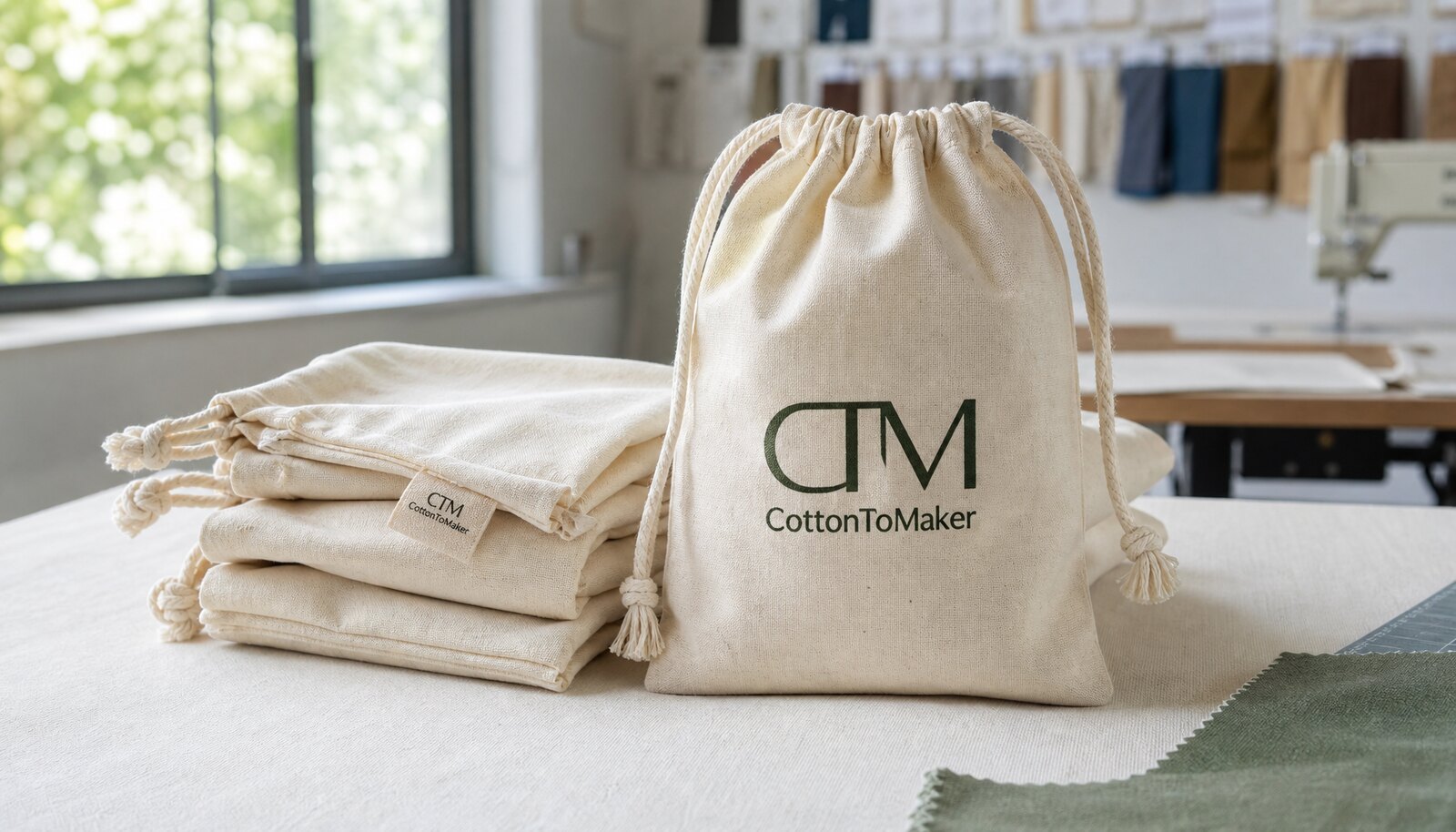
Start With the Winery Use Case
Boutique wineries buy cotton drawstring pouches for more than one job. The same pouch may go into a tasting-room retail bundle, a wine club shipment, a gift-with-purchase promotion, or a seasonal holiday set. That matters because the pouch is not just a decorative bag. It has to fit a bottle cleanly, hold up during handling, and still look good when a buyer opens the carton or photographs the set for retail use.
The first mistake is quoting a pouch by unit price before the use case is clear. A pouch that only carries a lightweight bottle and a card insert can be built differently from one that needs to protect a heavier bottle, a corkscrew, or a hanging tag. If you want clean bulk pricing, consolidate the order around one finished size, one print position, and one cord type. Every extra variant adds setup time and raises the chance of mix-ups during sewing and packing.
- Define the bottle size, closure style, and any insert items before you ask for a quote.
- Treat repeatability as a cost lever: one spec across several winery SKUs usually prices better than many small variations.
- Ask whether the pouch must look premium on shelf or only perform as a simple protective sleeve.
Choose Fabric Weight for the Bottle Weight
Most cotton drawstring pouches for winery programs land between 135 and 200 GSM. A 135-145 GSM fabric can work for light promotional use, but it can feel thin once the bottle is inside and the cord is pulled tight. For a retail-facing set, 170-190 GSM is usually the more practical band because it improves opacity, reduces seam distortion, and gives the print a flatter surface.
Unbleached cotton is common because it reads natural and works well with dark inks, but the label on the quote is less important than the actual cloth structure. Ask for the weave type, the finished hand feel, and the shrinkage observed on production cloth. If the pouch is meant to be reused or sold as part of a premium gift pack, a slightly heavier cloth often lowers complaint risk even if the unit cost is higher.
- 135-145 GSM: light promotional use, low-cost add-on, less premium hand feel.
- 170-190 GSM: the best general-purpose range for boutique wine retail and gift packaging.
- 200 GSM plus: stronger retail presence and better shape retention, but higher fabric and freight cost.
Decoration Method Drives Real Cost
Screen print is still the default option for many winery pouches because it gives a clean result on cotton and scales well once the setup is done. If the logo is simple and the order is large enough, a one-color screen print usually gives the best balance of unit cost and durability. Keep the print to one side when possible. A second print position adds labor, registration risk, and more room for inconsistency between cartons.
Woven labels, side tags, embroidery, and digital transfer each have a place, but none of them is automatically better. A woven label can improve retail presentation, yet it needs a clean attachment point and tight stitching. Embroidery looks premium, but it can distort lighter fabric. Digital transfer helps when artwork is complex or the order is small, but the finish should be tested for cracking and edge lift after repeated folding and handling.
- For logo simplicity, one-color screen print is usually the strongest value choice.
- For premium shelf presentation, a woven side label or small side tag can be better than a large front print.
- For detailed art or short runs, request a real sample of the transfer finish, not only a photo.
How Bulk Pricing Is Usually Built
A useful bulk quote should separate the real cost drivers. At minimum, it needs fabric, cutting and sewing, decoration setup, packing, and cartonization. If a supplier gives one all-in number without showing the structure, you cannot compare it fairly against another quote. The cheapest price often hides a softer cloth, a lighter cord, or a print setup charge that appears later when the purchase order is placed.
MOQ logic should follow the production bottleneck, not a sales target. With custom-size pouches and a single screen print, many factories price best at 3,000 to 5,000 pcs because the cutting and printing setup cost is spread over more units. If the size is stock and the artwork is simple, 1,000 to 2,000 pcs can still be workable. A steep price drop between 1,000 and 3,000 pcs usually means the factory is crossing from a less efficient manual process to a more stable line, which is normal and useful to see.
- Ask for price breaks at 1,000, 3,000, and 5,000 pcs using the same exact spec.
- Separate setup charges from unit price so you can compare reorders correctly.
- Watch for hidden cost shifts in cloth weight, cord quality, print method, or packing count.
Compare Sourcing Routes Before You Compare Price
Direct factory sourcing is usually the cleanest route when the factory owns the sewing and printing steps. That gives you better visibility on fabric weight, stitch quality, and carton count, and it usually gives the best repeatability once the spec is locked. For a boutique winery line that will be reordered, direct sourcing is often the most practical route because the same pouch can be reproduced with less interpretation by middlemen.
Trading companies, sourcing agents, and local decorators can still make sense, especially when the order is small or when the buyer needs several products under one purchase order. The tradeoff is control. You need to know who is actually printing, who is sewing, and who is packing. Stock blank pouches with local decoration can launch fast, but buyers should expect more variation in cloth feel, print placement, and shade. The table below is the fastest way to narrow the route before you spend time on samples.
- Choose direct factory sourcing when repeatability and lower reorder cost matter most.
- Use a trading company only when the consolidation value is real and the production chain is transparent.
- Use stock blanks only for pilot runs, seasonal programs, or urgent replenishment with limited design complexity.
Approve the Sample Like a Production Buyer
Do not approve a pouch from a front-facing photo or a hand-cut prototype. Ask for a pre-production sample made with the final cotton, the final cord, and the final decoration process. On the sample, pull the cord several times, check the way the top hem closes, and confirm the pouch still sits properly around a bottle. This is where you catch the small failures that create returns later, such as weak cord tunnels, off-center print, or a size that fits on paper but not on the line.
The sample approval note should be specific enough that the factory can build to it without guessing. Record the approved size, GSM, print location, thread color, cord finish, and any acceptable shade range. If you are buying more than one SKU, approve each style separately. A common production mistake is mixing a label position or a print version across cartons because the buyer approved the family of products instead of the exact item.
- Check print alignment, opacity, and edge sharpness under normal retail lighting.
- Test the pouch with a real bottle and any insert card or accessory you plan to ship with it.
- Keep the approved sample reference tied to the PO so the factory cannot substitute materials later.
Packing Choices Change Freight and Damage Rates
For cotton drawstring pouches, packing is not a minor detail. The goods need protection from dust, rubbing, and carton compression, but they also need to stay efficient in the box. A common setup is 25 or 50 pcs per inner polybag, then master cartons sized to avoid wasted space and excessive gross weight. If the pouch is going into a retail kit, define whether the pouch ships empty, with inserts, or already pre-packed with the bottle and accessories.
Carton marks are part of the product spec, not an afterthought. Ask for outer carton dimensions, net and gross weight, carton counts, and the ability to print SKU or barcode information on the master carton. Those details affect warehouse receiving time and freight calculations. A small change in carton size can change the number of cartons per pallet or the volume charge on an air shipment, so packing should be quoted as carefully as the pouch itself.
- Use an inner pack count that protects the print from abrasion but still keeps labor efficient.
- Ask for carton dimensions before you compare freight, because cube drives landed cost.
- Confirm whether the factory can apply shipping marks, SKU labels, or barcode labels at packing.
Lead Time Risk Is Usually a Sample and Material Problem
A real production timeline includes cloth sourcing, sample approval, cutting, sewing, printing, inspection, and packing. If the fabric is in stock and the artwork is final, the schedule can be fairly tight. If you change the size after the sample, the timeline extends because both the cutting pattern and the print placement have to be adjusted. That is why many late orders fail on paperwork rather than on machine capacity.
For boutique wineries, calendar risk is often tied to harvest season, holiday gifting, or a launch date that cannot move. Build a buffer around the date the artwork is approved, not just the date the order is placed. The more complete the RFQ, the less back-and-forth the factory needs to clarify size, packing, and artwork. A complete spec sheet is one of the cheapest ways to shorten lead time without paying for expedite fees.
- Expect the schedule to slip if cloth has to be dyed, printed, or sourced after the order is confirmed.
- Leave extra time when the pouch is tied to a wine club drop or holiday retail window.
- Keep one repeat-order spec file unchanged so reorders do not restart the approval cycle.
Write the RFQ So the Quote Can Be Compared
The RFQ should let two suppliers quote the same item without guessing. Include finished size, fabric GSM, color, print method, artwork count, cord type, packaging count, and the destination port or warehouse. Also state whether you want EXW, FOB, or delivered pricing. Ask for tiered prices at 1,000, 3,000, and 5,000 pcs so you can see where setup cost flattens out and where the factory can actually offer a better rate.
When you compare landed cost, do not stop at the unit price. Add setup charges, domestic transport to port, export cartons, freight, duty, and receiving cost. The strongest supplier is not always the lowest ex-factory quote. It is the one that gives you the cleanest total cost, the least ambiguity on materials, and the smallest chance of rework after sample approval. If the quote does not spell out those elements, you will spend more time cleaning up the order than saving money on it.
- Use the same artwork file, size, and packing spec across every supplier quote.
- Request separate lines for setup charge, sample charge, and reorder price.
- Compare total landed cost by order size, not only the first carton or first PO.
Specification comparison for buyers
| Spec decision | Recommended option | When it fits | Buyer risk to check |
|---|---|---|---|
| Direct factory with in-house screen print | Best repeat cost and best control over fabric, print placement, and carton packing | 3,000+ pcs, one or two print colors, stable artwork, repeat wine club or retail orders | Verify the factory actually prints on site and not through a subcontractor |
| Direct factory with woven side label | Strong premium finish with durable branding and a cleaner retail look | Gift sets, cellar-door retail, and buyers who want subtle branding instead of a large logo | Check label width, stitching quality, and whether the label edge frays after handling |
| Trading company bundling sewing and print | Useful when you need one contact for several product types or mixed order lines | Small procurement teams, multi-item baskets, or buyers with limited sourcing time | Confirm who owns QC, who packs the goods, and which plant does the real production |
| Stock blank pouch with local decoration | Fast launch path with low development effort | Pilot programs, event merchandise, short seasonal campaigns, or urgent replenishment | Risk of shade mismatch, double handling, and less control over fabric hand feel |
| Low-MOQ digital transfer specialist | Works for complex art, many colors, or test-market orders | 500-1,500 pcs when the logo is detailed and screen setup cost would be inefficient | Check fold cracking, edge lift, and whether the finish feels plastic on cotton |
| Organic or traceable cotton route | Best for premium eco positioning and higher-value winery gift boxes | Brands that need sourcing traceability or a documented material story | Ask for the document trail early and expect longer material lead time |
| High-volume sea freight program | Lowest landed cost when demand is stable and cartons ship efficiently | Reorders above 5,000 pcs with predictable monthly or quarterly pull | Check carton cube, production calendar, and whether the factory has enough raw cloth on hand |
| Split sourcing: body from one factory, decoration from another | Flexible when one supplier cannot meet every spec in one plant | Launches with tight timelines, partial stock, or separate packaging requirements | Risk of mismatched shade, inconsistent sizing, and schedule drift between vendors |
Buyer checklist before sampling
- Confirm finished pouch size in millimeters, not just nominal size, and include seam allowance in the spec.
- Choose fabric weight first: 135-145 GSM for light promo use, 170-190 GSM for retail, and 200 GSM plus for premium handling.
- Lock the decoration method before quoting: one-color screen print, two-color screen print, woven side label, or digital transfer.
- Specify cord type, cord length, knot finish, and whether the pouch needs a reinforced top hem or bartack at the tunnel.
- Request tiered pricing at 1,000, 3,000, and 5,000 pcs so fixed setup costs are visible.
- Ask for packing details: pcs per polybag, inner pack count, master carton dimensions, and gross weight per carton.
- Approve a pre-production sample made with the final cloth, final cord, and final print method, not a hand sample.
- Compare total landed cost, not only ex-factory price, by adding setup, domestic trucking, freight, duty, and receiving cost.
Factory quote questions to send
- What is your FOB or EXW price at 1,000, 3,000, and 5,000 pcs for the exact size and print method I specify?
- Is the cotton fabric plain weave, and what is the actual GSM tolerance you can hold on production?
- Do you screen print in-house, or do you send printing to another workshop?
- What is the setup charge for screens, plates, or digital files, and is it charged again on repeat orders?
- What finished size tolerance can you guarantee after cutting and sewing?
- How many pcs go into one inner polybag and one master carton, and what are the carton dimensions?
- Can you send a physical pre-production sample and confirm the approved sample will be the production reference?
- What is the standard lead time after sample approval, and what steps can delay it?
- What inspection standard do you use for defect sorting, carton marking, and packing accuracy?
- If I reorder the same spec, what parts of the quote stay fixed and what can change?
Quality-control points to confirm
- Finished size must stay within the agreed tolerance on width and height, with no obvious channel shrinkage or distortion.
- Fabric GSM must match the approved spec band, with no thin spots, loose weave, or visible variation between cartons.
- Print placement must stay within the approved position, with clean edges, solid ink coverage, and no smudging or ghosting.
- Cord length, knot finish, and draw tension must match the approved sample, and the cord must move freely through the tunnel.
- Side seams and top hem must show no skipped stitches, open bartacks, broken thread, or loose trimming.
- The pouch must hold a typical wine bottle without seam strain, twisting, or top opening collapse.
- Inner pack and carton counts must match the packing list exactly, with correct SKU labels and outer marks.
- Use your normal AQL or carton inspection standard before release, and keep photos of the first packed cartons for reference.