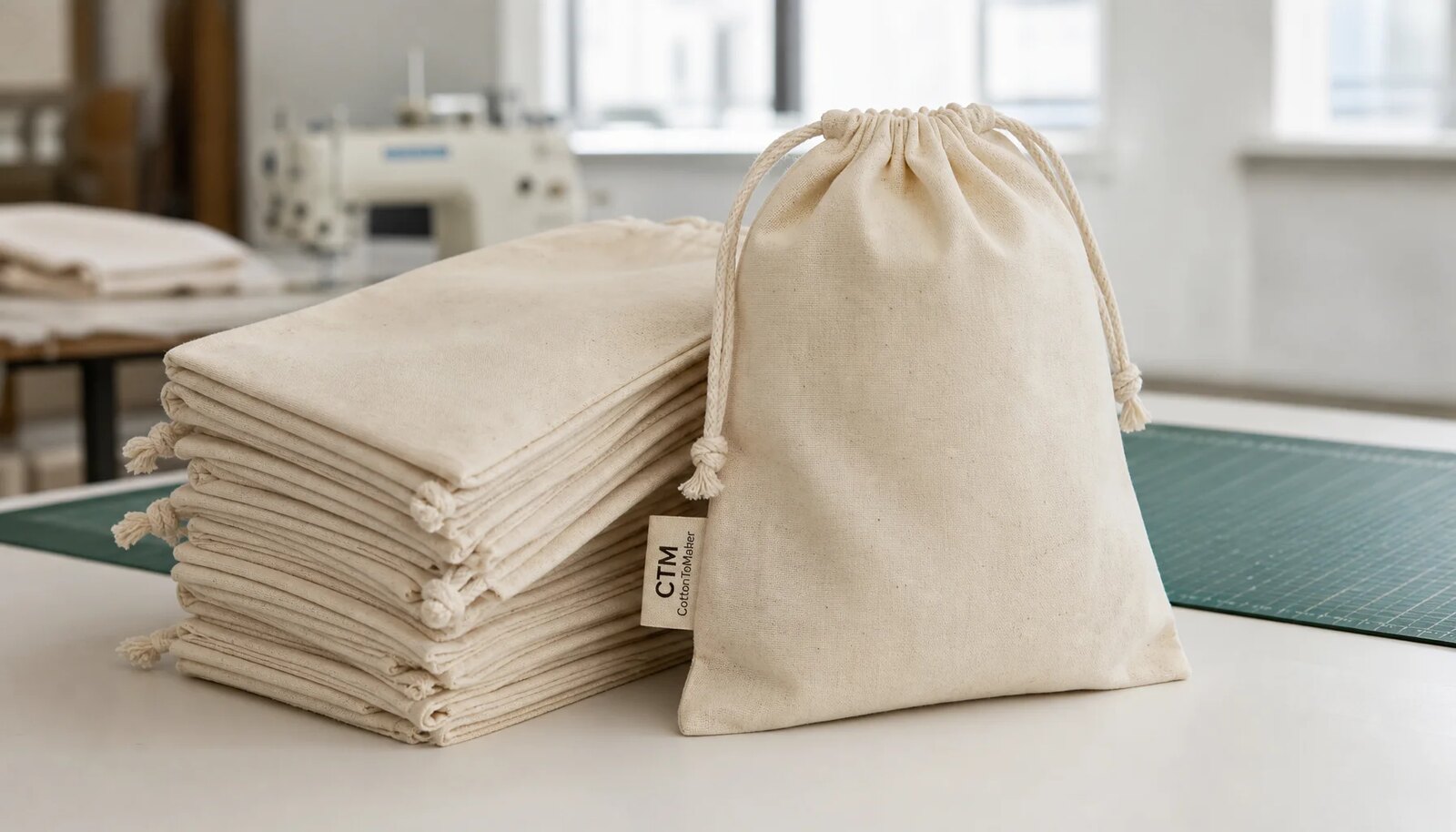
1. Why Farmers Market Lead Times Slip on a Simple Cotton Pouch
Cotton drawstring pouches for farmers market vendors look easy to buy, but the schedule usually slips before sewing even starts. The problem is rarely the pouch itself. It is the missing detail around how the pouch will be used at market. A vendor packaging soap, dried herbs, candles, preserves, or gift sets needs a different fit, different presentation, and sometimes different packing than a buyer sourcing a generic promo pouch. If those use cases are not defined early, the supplier has to pause for clarifications, revise the sample, or rework the packout.
That is why procurement should treat the pouch as a working retail item, not a low-value accessory. Farmers market sales are calendar-driven. If the pouches are meant for a weekend launch, a seasonal market, a holiday stall, or a regional craft fair, the order has to absorb sampling, artwork approval, packing decisions, freight booking, and a small buffer for correction. The supplier lead time on paper is only one part of the total schedule; the buyer-side response time is the other part, and it is often the hidden delay.
- Define the market date first, then build the pouch schedule backward.
- Treat sample review, label approval, and carton setup as lead-time items, not admin tasks.
- If the pouch must support product resale, specify the actual item it will hold instead of describing it as general packaging.
2. Start With the Use Case, Not the Unit Price
The fastest way to buy the wrong pouch is to ask for price before the use case is clear. A cotton drawstring pouch for a farmers market seller may need to protect a candle, present a herb sample, bundle a soap bar, or act as a small resale gift bag. Each use case changes the right fabric weight, size, closure feel, and branding method. A pouch that only holds a few dried sachets does not need the same structure as one that carries glass jars or heavier handmade goods.
Size decisions should be tied to the product that will go inside. A quoted 6 x 9 inch pouch is not enough if the buyer actually needs room for a wrapped soap, an insert card, and a branded hangtag. Ask the supplier for finished internal size, not only cut size, and define the acceptable tolerance in advance. For most small cotton pouches, a practical starting point is a tolerance of about plus or minus 0.25 inch, or roughly plus or minus 6 mm, unless the product fit is tighter. If the pouch must hold a fixed item, give the supplier the item dimensions and the closure allowance, not just a rough size name.
- State the product the pouch must hold, not only the pouch size.
- Ask for finished internal dimensions and the tolerance after sewing.
- If the pouch will be reused by customers, check whether the bag should stand, flatten, or keep shape when partially filled.
- Give the supplier the end-use: sample pack, resale packaging, or market giveaway.
3. Build the Lead Time Backward From the First Market Date
A useful lead-time plan starts with the market date and works backward. For a simple cotton drawstring pouch with one color of screen print and standard packing, the factory may need around 20-35 production days after sample approval. That is not a promise; it is a planning window that depends on order size, fabric availability, and whether the artwork is already final. If the pouch needs custom labels, special packing, or a fabric that is not in stock, the calendar grows quickly.
A practical backward plan is easier to control. First freeze the spec and artwork. Then allow time for a pre-production sample and internal signoff. After that, reserve the factory production slot, packing labor, and freight booking. If sea freight is involved, add more margin than you think you need. If the schedule is tight, do not plan to finish on the exact market date. Build in at least one revision cycle and a buffer window of 2-3 weeks so the team can absorb a print correction, a carton label change, or a packing adjustment without missing the event.
- Spec freeze and artwork approval: 1-3 days if internal reviewers are ready.
- Sample production and review: often 3-7 factory days, plus buyer response time.
- Bulk production after approval: commonly 20-35 days for simple runs, longer for complex packs.
- Packing, booking, and transit: plan separately instead of assuming they are included in sewing time.
4. Compare Sourcing Routes Before You Send the RFQ
The sourcing route matters as much as the spec. A direct factory with sewing and printing under one roof usually gives the best control over timing because one production owner can manage fabric booking, print setup, sewing, and packing. That is the safest path when the market date is fixed and the order needs a clean handoff. A trading company can be useful if you need one contact point for several product lines, but it adds a layer between you and the line schedule, so the buyer has to ask more questions about who actually owns each step.
Local decorators working on imported blanks can be fast for very simple branding, but they often give up control on finished size consistency, fabric sourcing, and lead-time certainty. That can still be the right route if the pouch is small volume, unbranded, or needed on a short local turnaround. For a farmers market vendor who needs a repeatable seasonal program, the best route is usually the one that keeps the fewest steps outside the factory's direct control. If more than one supplier is involved, the buyer should ask for a dated handoff plan for each transfer point.
- Use one production owner when the calendar is tight.
- Ask which steps are in-house and which steps are subcontracted.
- Prefer a route that keeps print, sewing, and packing in one workflow when possible.
- If multiple vendors are involved, require a schedule for every handoff.
5. Choose Fabric and Construction for Market Use, Not Catalog Language
Fabric weight affects both the feel and the lead time. For many cotton drawstring pouches, 140-160 GSM natural cotton is a practical middle ground because it gives enough body for reusable packaging without making the bag heavy or slow to sew. If the pouch will carry a product with more weight, sit on display, or serve as a premium resale package, moving up to 180 GSM or higher can be sensible. The tradeoff is that a heavier cloth can change print behavior, sewing speed, and unit cost. The buyer should choose the fabric for the item in the pouch, not for a generic idea of quality.
Construction should be simple enough to repeat and strong enough to survive market use. A double-threaded drawcord channel, clean top hem, and bar-tacks at stress points improve durability without adding much complexity. Ask where the cord exits, how the end is finished, and whether the seam allowance is stable across sizes. If the pouch will be reused by customers, ask for pre-shrunk cotton or a clear shrink expectation. If the pouch is strictly for one-time packing, structure can be lighter, but the bag still needs to close cleanly and look consistent when handled at a stall.
- Use heavier fabric only when the product or presentation needs more body or opacity.
- Ask for pre-shrunk treatment if size stability matters after storage or handling.
- Require reinforcement stitches where the cord enters and exits.
- Do not over-specify construction if the pouch is meant for low-cost giveaway use.
6. Match Branding Method to Artwork Complexity and Schedule
For most farmers market pouch programs, the fastest and most reliable branding route is simple screen print. One or two colors usually give the best balance of setup effort, durability, and unit cost. If the logo is detailed, tiny, or likely to be handled repeatedly, a woven side label or sewn patch can be a better choice than forcing a complicated print. The point is not to chase the fanciest method; the point is to pick the method that will actually survive production and still look clean at the market table.
Artwork is where many lead times get burned. Thin type, tight spacing, metallic inks, and multicolor art create more setup work because the factory must control screens, ink thickness, and curing conditions before bulk production starts. Buyers who need speed should simplify the mark early, confirm acceptable placement in millimeters, and approve the design on the actual pouch material rather than on a generic mockup. If the pouch is retail-facing, define acceptable variation in logo position and print density before bulk starts so there is no argument later about what counts as a pass.
- Use screen print for simple marks and stable volume.
- Use a woven label or sewn patch when the logo is small or highly detailed.
- Ask the factory how it controls cure temperature, print density, and placement tolerance.
- Keep artwork final before sample approval if the market date is fixed.
7. Read Quotes Like a Procurement Document
A unit price alone does not tell you whether a pouch quote is workable. Buyers need to compare the assumptions behind the number. Ask what fabric weight is being used, whether the cotton is pre-shrunk, what print method is included, what the MOQ is by size or color, and whether the packing format is bulk, polybagged, or retail-ready. If two suppliers quote different numbers but one is missing those details, the lower number is not a real comparison.
The fastest way to expose a weak quote is to ask about the hidden steps. Are screens, setup, and sample charges included? Is the sample charge credited back against the bulk order? Does the quote include barcode stickers, carton marks, insert cards, or export documents? Buyers often discover too late that the quote excludes exactly the items that drive schedule and receiving issues. If the answer is vague, assume the supplier has not fully costed the job yet, which usually means the schedule is also still fluid.
- Compare the same GSM, same print method, same packing, and same carton assumptions across suppliers.
- Ask whether screens, plates, sample fees, and packing labor are included or separate.
- Treat schedule reliability as part of landed cost when the launch date is fixed.
- If the supplier cannot describe the production steps, expect delays later.
8. Use a Farmers Market-Specific Sample Standard
Sample approval should test the pouch in the same way a vendor will use it at the market. A flat sample on a table is not enough if the bag must hold soap, candle jars, herbs, or a gift set with an insert card. The buyer should check closure behavior when the pouch is loaded, not only when it is empty. The pouch should pull closed smoothly, hold its shape if needed, and keep the product secure when it is moved around in a stall or packed into a tote.
The sample should also be reviewed against a clear defect standard. Reject open seams, loose threads that create a bad retail impression, poor centering, weak bar-tacks, and any logo bleed or smearing that would look unacceptable at point of sale. For dimensions, use the approved sample as the baseline and ask the supplier to hold the same tolerance on the bulk run. If the pouch is part of a branded farmers market assortment, keep one signed sample with procurement and one with the factory so both sides are working from the same reference.
- Test the sample with the real product or a weighted substitute, not only when empty.
- Agree on the acceptable print shift, seam tolerance, and cord finish before bulk approval.
- If the pouch is retail-facing, approve the packaging presentation at the same time as the product sample.
- Keep a signed sample at both buyer and supplier sites.
9. Treat Packing, Labels, and Cartons as Part of the Order, Not an Add-On
Packing decisions can change both cost and lead time. Bulk pack is usually the fastest option for importers or vendors who will sort locally, while individual polybags, insert cards, or retail labels add handling steps and more opportunities for delay. If each pouch needs a barcode sticker, size label, or branded insert, those requirements should be in the quote from the start. Asking for them after production begins is one of the fastest ways to blow up a schedule.
Carton planning matters because the receiving team needs to know what is coming and how it will be handled. Ask for master carton dimensions, inner pack count, outer carton marks, and whether the pouches will ship sorted by size or mixed by assortment. If the order goes into a warehouse or fulfillment center, carton labeling and packing list format should be written into the spec so receiving does not need to repack or hand-sort the order on arrival. For small farmers market operations, that same discipline helps the vendor unpack faster and get inventory onto the stall without rework.
- Specify whether unit polybags are required or excluded from the quote.
- Confirm carton count, inner count, barcode format, and outer carton marks before production starts.
- If the order is mixed, require a packing list by SKU so receiving does not have to sort by hand.
- Ask for carton dimensions if shelf space, tote space, or parcel thresholds matter.
10. Close the Plan With a Simple Procurement Checklist
Before the purchase order goes out, the buyer should have a spec that a factory can actually build without guesswork. The checklist is not paperwork for its own sake. It is the minimum information needed to keep a farmers market pouch order from slipping because of avoidable clarification loops. A clear brief also makes it easier to compare vendors on the same basis, which matters when you are deciding whether to use a local decorator, a direct factory, or a trading company.
The most useful final test is simple: if a supplier can quote the pouch without asking follow-up questions, the brief is probably strong enough for procurement. If the supplier still has to ask about size, use case, print method, packing, or timing, the buyer should expect a longer schedule. That does not mean the project is off track. It means the buyer has found the missing detail before it turned into a production delay. For seasonal farmers market programs, that is usually where the real savings are made.
- Finished size, product fit, and tolerance are locked.
- Fabric weight, color, and shrink expectation are stated.
- Artwork, print method, and placement are final.
- Packing format, carton marks, and barcode needs are written down.
- Target ship date and backup buffer are built into the schedule.
Specification comparison for buyers
| Spec decision | Recommended option | When it fits | Buyer risk to check |
|---|---|---|---|
| Sourcing route | Direct factory with sewing and print under one roof | Repeat seasonal programs, launch dates with little slack, and orders that need one production owner | Confirm whether print is in-house or sent to a subcontractor that adds hidden days |
| Fabric weight | 140-160 GSM natural cotton | Farmers market resale, gift packaging, and reusable product pouches | Heavier fabric improves body but can slow sewing and change print coverage |
| Bag size strategy | Standardize 3 sizes around the products you actually pack | Soap sets, candle bundles, herb kits, and mixed vendor assortments | Check finished internal size, not only cut size, before approving samples |
| Closure construction | Double-threaded drawcord channel with bar-tacks at stress points | Frequent open-close use and retail-facing packaging | Loose cord tension or weak reinforcement can create early failures |
| Branding method | 1-2 color screen print or woven side label | Simple logos, stable brand marks, and moderate volume | Ask for placement tolerance, cure method, and rub resistance evidence |
| MOQ structure | Group by fabric and print setup, not by every color or size variation | Orders with several SKUs but shared production parts | Separate changeovers can erase the quoted unit price advantage |
| Packing method | Bulk pack with inner count labels and master carton marks | Import shipments or small warehouse receiving | Verify unit count, carton size, and whether individual polybags are included |
| Quality control | Pre-production sample plus in-line and final inspection checkpoints | Orders with fixed market dates or retail-facing branding | Confirm defect limits, any AQL target, and who signs off each stage |
| Lead time buffer | Build 2-3 weeks of float before the sales date | Seasonal launches, holiday markets, and promo calendars | Transit time, rework, and sample revisions can consume the margin quickly |
Buyer checklist before sampling
- Final artwork file in vector format, with logo placement, color count, and any text size limits clearly marked
- Finished size target, seam allowance tolerance, and whether the pouch must fit a specific product or gift set
- Fabric weight target in GSM, weave expectation, color standard, and whether the cotton must be pre-shrunk
- Print method preference, ink color target, and acceptable placement tolerance in millimeters
- MOQ by size and color, plus whether mixed sizes can share one fabric booking and one print screen set
- Packing requirement: individual polybag, bulk pack, or retail-ready inner pack with barcode label
- Target market date, ship date, and whether air, sea, or split shipment is acceptable
- QC standard for stitching, cord strength, print clarity, odor, and carton count accuracy
- Sample approval owner and response deadline so the supplier does not wait on internal signoff
- Delivery location terms, freight responsibility, and whether the quote must include export documents
Factory quote questions to send
- What fabric weight, weave, and pre-shrink treatment are you quoting for the pouch body?
- Is printing done in-house, and how many days are needed for screens, sampling, and color approval?
- What is the MOQ by size, color, and print setup, and where does the price break happen?
- What is the finished size after sewing, and what seam allowance do you use on this style?
- What packing is included in the quote: bulk pack, polybag, barcode sticker, carton mark, or retail insert?
- What inspection standard do you use for stitching, cord reinforcement, and print defects?
- How many production days do you need after sample approval, and what can delay the schedule?
- What freight terms are included in the quote, and what charges stay outside the unit price?
- Can one fabric booking support multiple sizes or assortments, or does each variation reset the schedule?
- What is the sample charge, and is it credited back if the bulk order is placed?
Quality-control points to confirm
- Finished dimensions match the approved sample within the agreed tolerance, especially if the pouch must hold a fixed gift set or retail SKU
- Fabric weight is within the quoted GSM band and the hand feel is consistent across cartons
- Seam lines are straight, thread tension is even, and no open seams appear at the side or bottom gusset
- Cord channels are reinforced, the cord slides smoothly, and the ends are finished so they do not fray quickly
- Print is centered, color density is even, and there is no obvious bleeding, cracking, or smearing after curing
- Bar-tacks or reinforcement stitches are present at stress points where the cord enters and exits
- Carton count, inner pack count, and label data match the packing list exactly
- No strong odor, oil marks, loose threads, or fabric contamination is present in the bulk lot
- Polybag or retail insert count matches the PO, with barcode and size labels readable at receiving
- Sample signoff, production approval, and final inspection records are dated and traceable