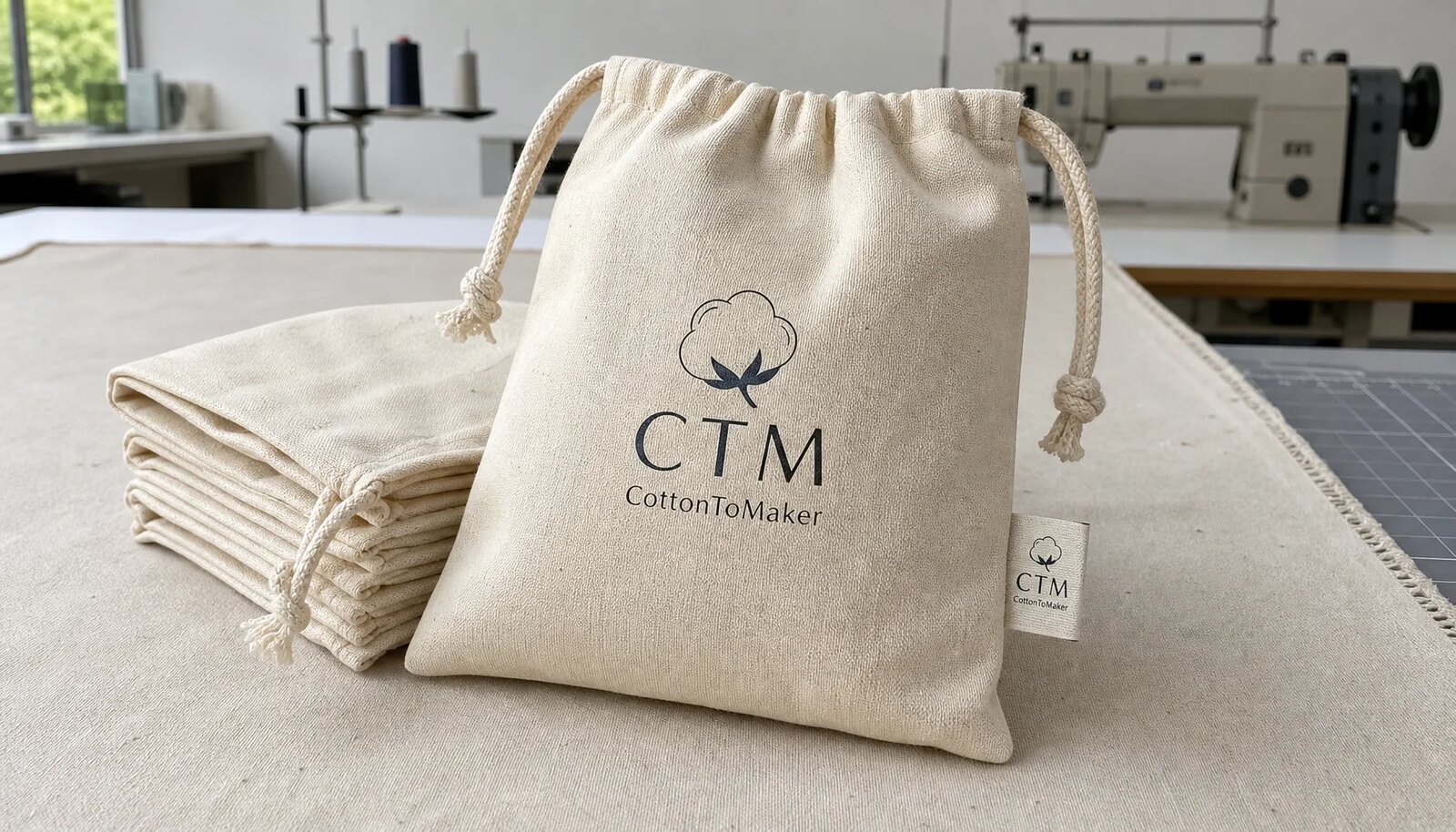
1. Define the Commercial Job Before You Ask for Bulk Pricing
A useful cotton drawstring pouches for farmers market vendors bulk pricing plan starts with the job the pouch must perform, not with a generic request for a cheap cotton bag. Farmers market programs use pouches for different reasons: protecting soap bars, grouping herb bundles, packaging seed packets, presenting farm shop gift sets, holding wax melts, covering small jars, or giving customers a reusable checkout bag for lightweight goods. Each use changes the right size, fabric, seam, drawcord, branding method, and packing plan.
Procurement should describe the contents in practical terms. A pouch for two seed packets may only need a light natural cotton body and simple single cord. A pouch for a handmade soap bar may need better opacity, a smoother print face, and a size that allows easy insertion without bending the product label. A pouch for a small produce assortment may need more capacity, stronger seams, and a cord that can be opened quickly at checkout. If the pouch is part of the product value, it should be specified like packaging. If it is only a convenience bag, it can be specified more economically.
The most common sourcing mistake is letting every supplier interpret the product differently. One quote may include 100 GSM muslin-style cotton, another may include 150 GSM cotton, and a third may include 227 GSM canvas. All can be described as cotton drawstring pouches, but the material cost, durability, opacity, and customer impression are very different. Buyers should define the primary job, expected fill weight, and customer-facing role before asking for MOQ and price breaks.
- State the primary pouch job: seed pouch, soap pouch, herb pouch, sample pouch, gift pouch, produce pouch, or branded checkout pouch.
- List the intended contents, approximate fill weight, product dimensions, and whether corners, fragrance, oil, moisture, or dirt may contact the fabric.
- Define whether the pouch should feel low-cost, reusable, retail-ready, premium, or strictly functional.
- Explain how pouches will be displayed, filled, shipped, redistributed, stored, or sold.
2. Turn the Use Case Into a Quote-Ready Specification
A quote-ready specification removes guesswork from the supplier's cost calculation. The minimum spec should include finished flat width, finished height, usable height below the drawcord channel, gusset or no gusset, fabric weight, fabric color, drawcord type, seam type, branding method, print location, packing format, and carton requirement. A drawing is helpful, but procurement should still write the spec in words because drawings often omit material weight, tolerance, packing, and inspection details.
Finished size needs more precision than many buyers expect. A 4 x 6 inch pouch and a 100 x 150 mm pouch are close but not identical. A top drawcord channel can reduce usable height by 15-25 mm depending on construction. A gusset can improve capacity but increases fabric consumption and labor. If the pouch must fit a box, jar, soap sleeve, or retail card, the buyer should share the actual packed product dimensions with the supplier and test the fit on the sample before approving bulk production.
Tolerances should be realistic for sewn cotton goods. Small pouches cannot be held to the same precision as injection-molded packaging. For many simple cotton pouches, a tolerance such as +/-5 mm on small finished dimensions and +/-10 mm on larger pouches may be commercially workable, but the exact tolerance should be agreed before production. Print placement also needs a tolerance, especially on soft fabric that can shift during loading and sewing. Without written tolerances, inspection becomes an argument instead of a decision.
- Specify finished flat width, finished height, usable height below channel, gusset depth, seam allowance assumption, and opening width.
- Define fabric as GSM or oz/sq yd, not vague terms such as light, medium, thick, or premium.
- Identify drawcord material, color, diameter or tape width, single-cord or double-cord construction, and knot or end finish.
- Add print placement details such as centered front panel, distance below channel, maximum print area, and acceptable placement tolerance.
3. Fabric Weight, Cotton Type, and Finishing Drive the Real Cost
Fabric is usually the biggest cost driver in a cotton pouch, so procurement should be specific. Lightweight cotton around 90-120 GSM may be appropriate for dry samples, seed packets, small promotional inserts, or short-term use. Midweight cotton around 130-180 GSM often fits farmers market soaps, herbs, small gifts, and reusable vendor packaging because it gives better opacity and a more substantial hand feel. Heavier cotton or canvas-like fabric from about 200 GSM upward can feel more premium and durable, but it raises unit cost, freight weight, and carton volume.
The GSM number alone does not tell the full story. A loose weave can feel thin even when the stated weight sounds acceptable. A tight weave may print more cleanly and feel better in the hand. Natural unbleached cotton may include slubs and shade variation; that can suit rustic farm branding, but it should still be controlled so stains, oil marks, dirt, and heavy defects are not accepted as normal texture. Bleached and dyed cotton add process cost and require shade approval. Dyed cords, custom fabric colors, and washed finishes may also change MOQ and lead time.
Claims need discipline. If the pouch is marketed as organic cotton, recycled cotton, or certified material, procurement should request documentation and confirm the claim is suitable for the intended market and label language. If the buyer cannot verify the claim, a safer specification is conventional natural cotton. Strong sourcing files separate material fact from marketing preference, which protects both the brand and the supplier relationship.
- Use 90-120 GSM cotton for lightweight dry samples, seed packs, or cost-sensitive promotional programs.
- Use 130-180 GSM cotton for many retail-ready farmers market pouches, soap pouches, herb packs, and reusable vendor packaging.
- Use 200 GSM or heavier cotton only when structure, opacity, durability, or premium hand feel justifies the added cost.
- Ask whether the quoted fabric is greige, finished, washed, dyed, bleached, organic, recycled-content, or conventional.
4. Construction Choices Affect Durability, Appearance, and Labor
Small construction decisions can change how the pouch performs in the field. A basic side-seam pouch with overlocked internal edges may be enough for a low-cost insert bag. A cleaner French seam or better internal finishing can reduce loose threads and improve perceived quality, especially if customers will reuse the pouch. A boxed bottom or gusset helps bulky contents sit better, but it increases cutting complexity and labor. Reinforced or cleanly finished cord exits reduce tearing at the channel, which is important when pouches are opened and closed repeatedly at a market stall.
Drawcord selection also matters. Cotton cord supports a natural product story, but it may fray or absorb dye differently depending on construction. Polyester cord can be smooth and strong, but it may not match a natural cotton positioning. Flat cotton tape can look more premium, while thin cord keeps cost down. Single-cord construction is economical and simple; double-drawcord construction gives better closing action and customer feel but adds cord length and handling time.
Procurement should not overbuild every pouch. A seed packet pouch does not need the same construction as a gift pouch sold at a farm shop counter. The right approach is to link construction upgrades to commercial value: cleaner seams for retail presentation, gussets for bulky items, stronger channels for repeated use, and better cords for premium feel. Suppliers can quote these options accurately only when each detail is named in the request.
- Ask the supplier to state side seam type, bottom seam type, channel fold, stitch density, and reinforcement method.
- Use gussets or boxed bottoms only when the product shape or display method needs extra volume or stability.
- Confirm cord material, cord length, cord color, and whether ends are knotted, heat-cut, tipped, or left plain.
- Inspect inside seams and channel openings on samples; these hidden areas often reveal the true construction level.
5. Choose Supplier Route and Accountability Before Comparing Prices
The same pouch can be purchased from a direct cut-and-sew factory, a factory using a subcontracted printer, a trading company, a local decorator using imported blanks, a stock pouch distributor, or a small workshop. Each route can work, but it changes accountability. A direct factory with controlled sewing, printing, packing, and inspection is often stronger for repeat custom programs. A stock distributor is faster for pilots, rush events, and plain pouches, but control over exact fabric, measurements, carton count, and reorder matching is usually weaker.
Trading companies and sourcing agents can be useful when buyers need language support, supplier comparison, consolidation, or lower internal sourcing workload. The buyer should still ask who makes the goods, who prints the artwork, who performs inspection, and who handles corrective action. If print placement drifts or cartons arrive with mixed SKUs, procurement needs one accountable party, not a chain of explanations.
For B2B programs serving farmers market vendors, accountability is part of the price. A slightly cheaper quote may not be cheaper after rework, repacking, delayed launch, short-count disputes, or customer service time. Quotes should identify the production route clearly enough that quality ownership is visible. If the sewing factory and print shop are separate, the purchase file should specify who approves blank pouches, who approves printed pouches, and who signs off before packing.
- Ask who buys fabric, cuts panels, sews pouches, prints or labels them, packs cartons, and performs final inspection.
- Use stock distributors when speed and low complexity matter more than exact repeatability.
- Use custom factories when the program needs controlled dimensions, branding, packing, and seasonal reorders.
- Require the quote to name whether inspection is performed by the factory, agent, buyer representative, or third party.
6. Build MOQ Tiers Around the Supplier's Setup Logic
MOQ is not just a number to negotiate down. It reflects fabric ordering, cutting markers, sewing line setup, print setup, label production, cord procurement, packing labor, and carton preparation. A natural cotton blank pouch may have a lower MOQ than a dyed pouch, custom cord color, multi-color print, woven label, or barcode-packed retail unit. Buyers should ask whether MOQ applies to the total order or separately by size, fabric color, artwork, print color, label, and packing format.
A practical bulk pricing plan should include at least three quantities: the minimum viable order, a working production tier, and a scale or reorder tier. For many B2B programs, requesting 1,000, 3,000, 5,000, and 10,000 piece tiers reveals how much cost is fixed setup versus variable production. If price drops sharply after a certain quantity, procurement can decide whether inventory carrying cost is justified. If price barely changes, a smaller order may be better for testing vendor demand.
SKU discipline protects the first order. Splitting the first purchase across many sizes, colors, and artworks increases sampling time, setup charges, inspection complexity, and receiving risk. A clean first run might use one fabric color, one pouch size, one print color, and one packing method. Once sales data is available from farmers market vendors, the next run can add seasonal colors, different sizes, or category-specific artwork with less guesswork.
- Request MOQ by total order, size, fabric color, drawcord color, artwork, print color, label, and packing format.
- Ask for price tiers that match your forecast rather than arbitrary round numbers only.
- Separate one-time setup charges from recurring unit costs so reorders can be modeled accurately.
- Limit first-order variants unless each SKU has a sales forecast and a reason to exist.
7. Compare Landed Cost, Not Just Factory Unit Price
A strong quote shows the cost stack. Procurement should know whether the price includes fabric, cutting, sewing, drawcords, printing, labels, inner packing, master cartons, barcode labels, carton marks, samples, inspection, and freight. A supplier offering a single low unit price may be quoting loose packed goods at the factory door. Another supplier may look higher because counted bundles, barcode labels, export cartons, and carton marks are already included. These are not equal offers.
For farmers market vendor programs, packing can create or remove labor. Loose bulk pouches may be acceptable if the buyer will repack in its own warehouse. Counted bundles of 25, 50, or 100 pieces can make distribution to vendors faster. Inner cartons can protect SKU separation. Individual polybags may be required for resale or cleanliness, but they add cost, handling, and packaging waste. Procurement should decide the receiving and redistribution process before approving the cheapest packing method.
Freight terms must also be normalized. EXW, FOB, CIF, DAP, DDP, and domestic delivered pricing place different responsibilities on the buyer and supplier. A factory quote under EXW can look attractive until pickup, export handling, freight, duty, customs clearance, delivery, and warehouse receiving are added. The fair comparison uses the same product spec, packing spec, inspection level, delivery point, and Incoterm.
- Ask suppliers to itemize sewing, print, label, packing, carton, sample, setup, inspection, and freight assumptions where practical.
- Confirm whether print screens, artwork handling, barcode application, carton marks, and custom labels are included or excluded.
- Compare landed cost per usable pouch after freight, duty, receiving labor, repacking, and expected defect allowance.
- Keep quote exclusions in the purchase file so later charges do not surprise the team.
8. Engineer Branding for Cotton, Not for a Digital Mockup
Branding changes cost, lead time, and customer perception. One-color screen print is often the most efficient option for bulk cotton pouches used by farmers market vendors. It works well for simple farm logos, market names, product categories, and short brand messages. It becomes less efficient when artwork has tiny text, many colors, fine registration, gradients, or frequent SKU-level artwork changes. On textured natural cotton, very fine lines may fill in or break, and light ink may not look as bright as it does on a digital proof.
Woven labels and sewn side tags are useful when the buyer wants subtle branding or a cleaner retail presentation. They can avoid large ink areas and may hold up well during folding and reuse, but they add their own MOQ, setup, placement tolerance, and sewing inspection. Embroidery can look substantial on heavier fabric, but it may distort lightweight cotton or make the pouch feel stiff. Heat transfers can support more complex artwork, yet the buyer should test edge adhesion, hand feel, and folding durability on the actual cotton.
Artwork should be sized for the pouch panel. A logo that works on a website header may be too detailed for a 100 x 150 mm pouch. Print should stay away from side seams, bottom seams, and the drawcord channel. A placement diagram should show centerline, maximum print area, distance from the channel, and acceptable tolerance. Approving the artwork on actual fabric is especially important for natural cotton because the base color affects ink appearance.
- Use one-color screen print for simple artwork, strong visibility, and efficient bulk pricing.
- Use woven labels or sewn tags when subtle branding, durability, or premium presentation matters more than a large front print.
- Avoid tiny type, thin lines, dense copy, large solid ink blocks, and artwork placed too close to seams or the drawcord channel.
- Approve a strike-off or pre-production sample using final fabric, final artwork size, final ink color, and final placement.
9. Make Sample Approval and QC Measurable
Sample approval should be a measurable gate, not a quick visual check. The pre-production sample should use final fabric, final size, final drawcord, final construction, final branding, and final packing method whenever possible. If substitute fabric or a temporary print method is used, that exception should be written into the sample record. Otherwise, a buyer may approve a sample that the factory cannot repeat in production.
The sample review should include measurements and functional checks. Measure flat width, height, usable opening, gusset, drawcord length, and print placement. Open and close the pouch repeatedly to check cord movement and channel stress. Turn it inside out to inspect seam finishing, loose thread tails, skipped stitches, label attachment, and raw edges. If the pouch will hold scented, oily, rough, or slightly damp goods, test the actual product inside the sample. Empty pouches can look acceptable and still fail in real use.
Final QC should be defined before bulk production starts. Inspection should pull random units from multiple cartons and compare them with the approved sample and written tolerances. Major defects should include wrong size outside tolerance, wrong fabric, missing cord, broken seam, open channel, wrong print, severe print misplacement, undercured ink, stains, mildew odor, mixed SKUs, and short counts. Minor defects can include small thread tails or slight natural slub within the agreed standard. The point is not to make inspection complicated; it is to make acceptance criteria clear.
- Record sample measurements, artwork version, fabric reference, approval date, supplier name, and purchase order reference.
- Set written tolerances for dimensions, gusset, drawcord length, print placement, label placement, shade range, and carton count.
- Request in-line photos of cut panels, first sewn units, first printed units, seam closeups, and packing setup.
- Inspect random finished cartons before shipment and compare production units against the approved sample, not only against email descriptions.
10. Control Packing, Lead Time, and Reorder Files
Packing is part of the product for B2B procurement. A low-cost loose carton may be fine for internal repacking, but it can create extra labor for distributors, farm shops, and multi-vendor programs. Counted bundles make it easier to ship pouches to many farmers market vendors. Inner cartons improve SKU separation. Barcode labels support warehouse receiving and retail resale. Individual polybags may protect cleanliness but add material, labor, and sustainability concerns. The packing method should be quoted, sampled, and inspected like the pouch itself.
Lead time should be planned backward from the selling calendar. Farmers market programs often depend on spring openings, harvest events, holiday gift sets, local food festivals, and recurring vendor replenishment. A sourcing schedule should separate artwork preparation, sample making, sample shipping, sample review, sample revision, bulk production, in-line checks, final inspection, packing, freight, customs clearance, delivery, and receiving. A quote that states only production days can hide weeks of sampling and logistics time.
The reorder file protects future cost and consistency. It should contain the final quote, approved spec, approved sample photos, measured dimensions, fabric reference, drawcord reference, artwork file, ink or label details, packing instructions, carton marks, inspection report, shipment photos, and any corrective notes. Without that file, the next order becomes a new sourcing project, and small changes can enter unnoticed. With it, procurement can negotiate reorders from a stable baseline and keep the pouch consistent from season to season.
- Approve inner pack quantity, master carton quantity, carton dimensions estimate, SKU label format, barcode placement, and carton marks before production packing begins.
- Ask for estimated units per carton, gross carton weight, and carton size so freight and warehouse handling can be modeled.
- Build the schedule from launch date backward and include sample revision, inspection, freight, customs, and receiving time.
- Maintain a reorder file so the next purchase order repeats the accepted construction, branding, packing, and QC standard.
Specification comparison for buyers
| Spec decision | Recommended option | When it fits | Buyer risk to check |
|---|---|---|---|
| Use case and fill profile | Define one primary pouch job and expected contents: seed packs, soaps, herbs, samples, small produce, gift sets, or checkout packaging | Best first step for any cotton drawstring pouches for farmers market vendors bulk pricing plan | If fill weight, shape, or moisture exposure is vague, suppliers may quote different fabric, seam, and sizing assumptions |
| Finished size and usable height | Specify flat width, finished height, usable height below the drawcord channel, and gusset depth if required | Fits buyers comparing factory quotes on the same commercial item | A 150 mm tall pouch may not provide 150 mm of usable product height once the channel and seam allowance are included |
| Fabric weight | Quote by GSM or oz/sq yd; common light cotton starts around 90-120 GSM, midweight around 130-180 GSM, and heavier canvas-like cotton from about 200 GSM upward | Useful for matching pouch strength, opacity, and hand feel to product value | Confirm whether weight is measured before finishing, after finishing, or after washing; do not compare unspecified light, medium, or heavy fabric |
| Fabric type and claim control | Use conventional natural cotton unless organic, recycled-content, dyed, or bleached material is commercially required and documented | Fits farm shops and vendor programs that need a natural look without unsupported sustainability claims | Any organic or recycled claim should be supported by supplier documentation and aligned with the buyer's labeling obligations |
| Seam and channel construction | Use neat overlock or French seams, a folded drawcord channel, and reinforced or cleanly finished cord exits for reusable pouches | Best for market handling, repeated opening, and customer-facing packaging | Low-cost seams may be acceptable for samples but can create loose threads, fraying, weak corners, or poor drawcord movement |
| Single vs. double drawcord | Single drawcord for economy; double drawcord for easier closing and better customer feel | Single cord fits giveaways and cost-sensitive bulk programs; double cord fits retail-ready or reusable pouches | MOQ and cost can change because double-cord construction adds cord length, handling, and sewing complexity |
| One-color screen print | Use for simple farm logos, market marks, category labels, and high-volume repeat programs | Usually the most cost-efficient branding method when artwork is simple and print size is moderate | Check ink cure, rub resistance, print placement tolerance, registration, opacity, setup charges, and whether screens are reused on reorder |
| Woven label or sewn side tag | Use when branding should be subtle, durable, or more retail-oriented than a large front print | Fits soap pouches, gift sets, farm shop retail, private label, and premium natural packaging | Confirm label MOQ, placement tolerance, softness, seam security, and whether the label edge creates an internal snag point |
| Packing format | Approve loose bulk, counted bundles, inner cartons, individual polybags, barcode labels, or retail packs before quoting | Critical for distributors, multi-location markets, and buyers shipping pouches to many vendors | Undefined packing can create receiving labor, short-count disputes, mixed SKUs, carton mark errors, and avoidable repacking cost |
Buyer checklist before sampling
- Define the pouch use case, expected contents, approximate fill weight, display method, and reuse expectation before requesting pricing.
- Lock finished flat width, finished height, usable height below channel, gusset depth, drawcord type, fabric GSM, color, print area, and packing format.
- State whether fabric is natural, bleached, dyed, organic, recycled-content, or conventional; request documentation for any claim used in marketing or labeling.
- Require suppliers to quote the same specification and the same Incoterm so unit prices can be compared fairly.
- Ask whether MOQ applies by total order, pouch size, fabric color, drawcord color, artwork, print color, label type, or packing style.
- Request price breaks at the true MOQ, a practical mid-tier, and a reorder or scale tier, such as 1,000, 3,000, 5,000, and 10,000 pieces when relevant.
- Separate recurring unit cost from one-time charges for screens, artwork, sampling, woven labels, dyeing, carton marks, barcodes, or custom packing.
- Approve a pre-production sample made with final fabric, final construction, final drawcord, final print or label, and final packing method whenever possible.
- Set written tolerances for finished size, gusset, drawcord length, print placement, label placement, seam quality, shade variation, and carton count.
- Require a production file containing artwork version, Pantone or ink references, print placement diagram, fabric reference, approved sample photos, carton marks, and packing instructions.
Factory quote questions to send
- What finished pouch size are you quoting, and what tolerance do you hold for flat width, finished height, gusset depth, usable height below the channel, and drawcord length?
- What cotton fabric weight are you quoting in GSM or oz/sq yd, and is the weight measured before finishing, after finishing, or after washing?
- Is the fabric conventional natural cotton, bleached cotton, dyed cotton, organic cotton, recycled-content cotton, cotton canvas, or a cotton blend, and what documentation can you provide for any claim?
- What construction is included: simple side seam, overlock seam, French seam, boxed bottom, bottom gusset, folded channel, reinforced cord exits, single drawcord, or double drawcord?
- What drawcord material and size are included: cotton cord, cotton tape, polyester cord, braided cord, round rope, flat tape, or dyed-to-match cord?
- Is printing done in-house or subcontracted, and which method are you quoting: screen print, heat transfer, embroidery, woven label, sewn tag, hangtag, or another process?
- What print placement tolerance do you hold from the pouch centerline and from the top channel, and how do you control registration on soft cotton fabric?
- What is the MOQ by total quantity, size, fabric color, drawcord color, artwork, print color, woven label, and packing format?
- Can you quote price breaks at the MOQ, a mid-tier production quantity, and a reorder tier using the same specification and packing method?
- Which setup charges apply for screens, artwork separation, label development, dyeing, sampling, barcode labels, carton marks, or packing changes, and are they repeated on reorders?
Quality-control points to confirm
- Finished size should be checked against written tolerances on random production units from multiple cartons, not only on the approved sample or first output.
- Typical procurement tolerances should be agreed in writing, such as +/-5 mm for small pouch width and height, +/-10 mm for larger pouches, and a defined tolerance for drawcord length and print placement.
- Fabric GSM, color, hand feel, weave density, opacity, and shrinkage behavior should match the approved reference within the agreed tolerance.
- Natural cotton should be inspected for unacceptable oil marks, dark stains, mildew odor, embedded dirt, heavy shade variation, excessive loose lint, and large weaving faults.
- Side seams, bottom seams, and channel stitching should have even stitch density, no skipped stitches, no broken threads, no seam holes, no open seams, and trimmed thread tails.
- Drawcords should pull smoothly and close evenly; double-drawcord pouches should function from both sides without twisting, fraying, or binding in the channel.
- Channel openings should be reinforced or cleanly finished so repeated opening and closing does not tear the top edge or expose raw fabric.
- Print should match approved artwork scale, placement, ink color, registration, opacity, and cure level, with no smearing, cracking, ghosting, pinholes, or heavy ink buildup.
- Printed pouches should be checked after folding and light rub testing to confirm reasonable adhesion and cure on the actual cotton fabric.
- Woven labels, side tags, hangtags, and barcode labels should be positioned correctly, securely attached, readable, and free from rough edges that affect product use.