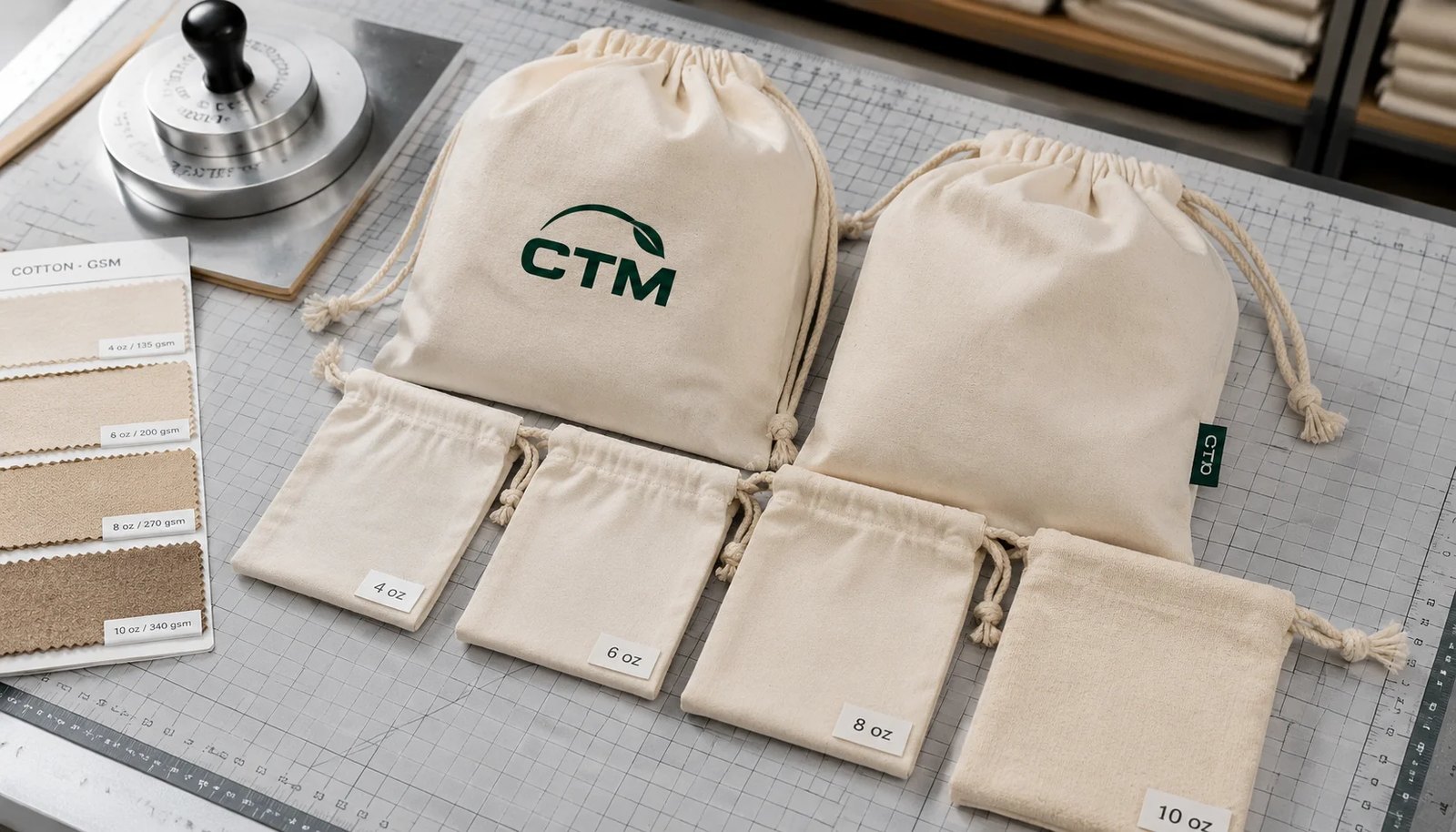
Why fabric weight is the main buying decision for natural grocer pouches
For cotton drawstring pouches, fabric weight drives more than durability. It affects print quality, shelf appearance, pouch shape, drawstring function, packing density, and landed cost. In natural grocer channels, the pouch often sells both the product and the store image. A lightweight pouch may feel right for tea, herbs, soap, or loose wellness items, but the same pouch can look underbuilt if it holds nuts, granola, refill packs, or a mixed gift set. Buyers who start with size and artwork but leave GSM open usually get quotes that are hard to compare because each supplier fills in a different fabric assumption.
The practical way to buy is to define the pouch by use case and fill weight. A 10 x 15 cm herb pouch and a 25 x 30 cm bulk refill pouch should not be sourced from the same GSM target by default. Natural grocers also care about tactile feel and material story. A softer 130 GSM cotton may suit minimalist merchandising, while a 210 GSM canvas pouch gives a more premium reusable feel. The mistake is treating those as branding choices only; they are also production and cost choices that will change sewing speed, print method, carton quantity, and defect rates.
- Low fill weight, low retail price, high carton efficiency: usually 120-140 GSM
- General-purpose retail pouch with better body: usually 150-180 GSM
- Reusable, heavier fill, gift set, or premium pantry use: usually 200-220 GSM
- Larger pouch size often needs higher GSM even when product weight is moderate, because panel sag becomes visible on shelf
Best GSM ranges by pouch use in natural grocery retail
A useful sourcing shortcut is to tie GSM to both product category and pouch dimensions. For small formats used for tea sachet bundles, dried herbs, soap bars, seed packs, or point-of-sale gift items, 120-140 GSM is usually enough. It keeps cost and freight controlled, and it gathers cleanly at the top when cinched. The tradeoff is that thin natural cotton wrinkles easily and can look uneven if the print area is large or dark. If the pouch hangs on peg display or sits in bins, that softness may be acceptable. If it stands in a gift box or open tray, the same softness can read as low-end.
For broad grocery use, 150-180 GSM is the safest middle band. It gives a better hand feel, reduces transparency, and handles medium product weight with less seam distortion. When buyers want a reusable produce or refill pouch, especially above 20 cm width, 200-220 GSM canvas becomes easier to merchandise because the pouch keeps a cleaner front panel and takes logo print more evenly. Above that level, the pouch can become too stiff for some cinch-top formats and may need a wider channel or softer cord to close properly.
- 120-140 GSM: small tea, herb, soap, sample, sachet, accessory pouches
- 150-180 GSM: nuts, dried fruit, bath items, small refill packs, checkout gift bundles
- 200-220 GSM: produce kits, pantry refill systems, larger wellness kits, premium reusable programs
- Very light GSM on large pouches often creates bottom corner stress and a distorted front print area
How fabric weight changes print results and logo readability
Natural grocer buyers often focus on eco styling and simple graphics, which makes print defects more visible, not less. A one-color logo on natural cotton sounds straightforward, but the wrong fabric weight can blur edges, show pinholes, or wrinkle the print block. On lighter 120-140 GSM fabric, silkscreen printing works well for bold marks and minimal copy, but small text and fine line art become risky because the cloth texture moves more under print pressure. If the pouch uses a dark solid fill area, lightweight cotton can also show more strike-through or uneven ink deposit.
Midweight and light canvas fabrics usually improve logo definition because the surface is more stable. For premium visual presentation or multiple SKUs with complex artwork, digital methods can make sense, but buyers should not assume digital is automatically better. Digital and transfer routes can change hand feel and may react differently after washing or repeated rubbing. For pouches used as reusable food-adjacent packaging, the print should be tested for rub resistance and odor, particularly if the pouch sits near unpackaged produce or dry goods.
- Silkscreen is usually the most cost-efficient for 1-2 color logos at scale
- Keep minimum line thickness and small text size in the RFQ to avoid unreadable art
- Large dark prints on low GSM fabric need strike-off approval before production
- Panel printing before sewing usually gives better registration than printing on finished pouches
- Natural cotton absorbs ink differently lot to lot; define acceptable shade variation for logo color
Cost drivers beyond GSM: what actually moves the quote
Fabric weight matters, but buyers often overestimate its share of total pouch cost. In many programs, the bigger quote swings come from print setup, pouch size, drawstring type, sewing complexity, and packing labor. Moving from 140 GSM to 160 GSM may add less cost than switching from a small centered logo to a full-panel print. A double drawstring, a reinforced channel, or a dyed matching cord can also change labor time more than expected. If you want comparable supplier quotes, the RFQ needs to lock these variables down before negotiation starts.
Another common gap is quote basis. Some factories quote ex-works with very basic packing; others include polybags, export cartons, carton marks, and even pre-shipment inspection support. If the buyer is ordering several sizes for one natural grocer program, MOQ logic becomes a major cost issue. A supplier may price each size as a separate run, while another may combine fabric cutting and print setup if artwork and fabric are shared. That is why one low unit price can still become the expensive option after setup charges and inefficient packing are included.
- Main cost levers: pouch size, GSM, print colors and area, drawstring type, sewing steps, packing style
- Dyed fabric or dyed cords add lead time and often increase MOQ
- Small MOQ with many SKUs usually raises print and handling cost sharply
- Low quoted price can hide light GSM substitution, looser tolerances, or mixed packing
How to write an RFQ that gets comparable pouch quotes
A vague RFQ invites vague quotes. For cotton drawstring pouches, the buyer should specify the finished pouch dimensions, target GSM range, fabric construction, logo method, drawstring material, and packing format in one sheet. If the program includes multiple sizes, use a matrix so suppliers can quote all SKUs against the same assumptions. This prevents a factory from quoting 130 GSM on small pouches and 170 GSM on large ones without highlighting the change. It also stops hidden substitutions such as polyester cord in place of cotton cord.
The better RFQ also identifies how the pouch will be used. A natural grocer refill system, a produce bag set, and a wellness gift pouch have different acceptance standards. If the buyer expects the pouch to carry a 1 kg fill repeatedly, include that in the document. If the pouch is mainly for shelf presentation, state that appearance and print cleanout are higher priority than load performance. Factories price more accurately when the end use is clear, and the buyer gets fewer disputes over what 'good quality' was supposed to mean.
- Include finished size, not cut size
- State GSM with tolerance, for example 150-160 GSM instead of only 155 GSM nominal
- Specify natural, bleached, or dyed fabric color
- Define print artwork size and Pantone references if color match matters
- State single or double drawstring and expected cord diameter or tape width
- List packing by inner bundle and carton, plus carton gross weight limit if your warehouse needs it
Sample approval: what to inspect before bulk production starts
A pouch sample should be used to approve function, not only style. Many buyers sign off once the logo placement looks right, then discover during bulk use that the cord drags, the opening is too narrow, or the pouch distorts when filled. For natural grocer programs, sample approval should include a real fill test with the intended product weight or a close substitute. This quickly shows whether the selected GSM is too soft, whether the bottom seam pulls at the corners, and whether the pouch still looks retail-ready once filled.
The second sample risk is approving an unprinted or hand-made development sample and assuming mass production will match it. Bulk output depends on machine sewing consistency, repeat print registration, and actual fabric lot weight. If the order is meaningful, the buyer should approve at least a pre-production sample made with bulk fabric, actual print process, and final drawstring. That is the version that will expose logo edge spread, natural fabric shade differences, and channel stitching quality.
- Measure flat width and height after sewing, not before
- Pull the drawstring 10-20 times to see cord fray and channel drag
- Fill the pouch to intended product weight and inspect front-panel shape
- Rub printed area with dry white cloth to spot loose pigment issues
- Inspect seam ends and channel openings for skipped stitches or weak bartack area
- Compare natural fabric shade under consistent light if multiple lots are involved
Quality thresholds that prevent the most common production claims
Most pouch claims come from basic execution problems rather than major material failure. The repeat offenders are underspec fabric weight, inconsistent size, crooked print, twisted drawstrings, open seams, and mixed packing by size. These defects are simple to catch if the buyer defines tolerances before production. A factory cannot control to an unstated standard. If your QC document says only 'good quality,' the final inspection turns subjective and every claim becomes harder to settle.
For retail programs, classify what is critical, major, and minor. A broken seam, missing cord, oil stain, or wrong SKU pack count should be major or critical depending on use. Slight natural slub variation may be acceptable because cotton is not perfectly uniform, especially on unbleached fabric. The smart buyer distinguishes acceptable natural variation from avoidable workmanship defects. That keeps quality expectations realistic while still protecting the brand.
- Critical: wrong SKU, missing print, severe contamination, dangerous foreign object if applicable
- Major: open seam, major size out of tolerance, heavy print misplacement, cord missing or trapped
- Minor: small thread tail, slight natural slub, small shade drift within approved range
- Use AQL only after defect definitions are written clearly; otherwise inspection arguments continue
Packing choices that affect warehouse labor and landed cost
Packing looks secondary until the goods reach a distributor or retailer DC. Cotton drawstring pouches are often ordered in several sizes and artwork versions, which creates receiving risk if the factory packs loosely or mixes bundles. For natural grocer channels, buyers usually gain more from accurate SKU segregation than from shaving a small amount of packing labor. A clear inner pack by size and SKU reduces count errors, speeds put-away, and avoids repacking costs that do not show on the supplier invoice.
Carton efficiency still matters because heavier canvas pouches and cotton cords add cube and gross weight quickly. If the buyer shifts from 140 GSM to 210 GSM, carton quantity may need to drop to stay within safe handling limits. This can increase freight cost per piece. Packing should therefore be discussed as part of the GSM decision, not after production is booked. A pouch that saves a few cents in unit cost can lose that advantage if carton count falls sharply or if destination staff spend extra time sorting mixed sizes.
- Mark cartons with PO, SKU, size, color, quantity, and carton number sequence
- Set carton gross weight limit if your DC uses manual handling rules
- Use consistent inner bundle counts for easier inbound counting
- Protect printed surfaces from ink offset during humid transit if dense print areas are used
- If pouches are sold in retail sets, specify whether set assembly happens at factory or destination
Lead time planning and where pouch schedules usually slip
Cotton drawstring pouches are not technically complex, but their lead times can still slip when buyers underestimate artwork approval, fabric readiness, or mixed-SKU handling. The fastest route is usually natural cotton from stock, standard cord, simple screen print, and one or two sizes. Lead time stretches when the order adds dyed fabric, custom cord color, many sizes, many SKUs, or high print registration expectations. If a natural grocer launch is date-sensitive, buyers should separate must-have specs from nice-to-have details before placing the order.
Another common delay point is sample iteration. If the initial RFQ does not define GSM range, drawstring material, and print location clearly, the first sample often becomes only a discussion piece, not an approval sample. Then bulk booking starts later than planned. Procurement teams should build the schedule backward from in-store date, allowing time for strike-off approval, pre-production sample, production, inspection, and ocean or air transit. A low unit price does not help if the goods miss a seasonal reset or gift program.
- Stock natural cotton usually shortens sourcing time compared with custom-dyed fabric
- Artwork with fine registration detail increases approval cycles
- Multiple pouch sizes can share material, but cutting and counting complexity still adds time
- Pre-production sample approval should happen before bulk cutting, not after fabric is consumed
Comparing quotes on landed value, not just unit price
For natural grocer buyers, the best quote is the one that lands with the right balance of appearance, reusability, and operational simplicity. A cheaper 130 GSM pouch may look attractive on paper, but if it causes more rejects, weaker print, lower carton efficiency due to repacking, or customer complaints about flimsiness, the true cost is higher. Likewise, a heavy 220 GSM pouch may feel premium but can overshoot the use case and raise freight enough to hurt margin. Buyers should compare quote scenarios against actual end use and total delivered cost.
A practical comparison sheet should include at least: ex-works unit price, setup charges, sample charges, estimated carton quantity, estimated gross weight, print method, MOQ structure, and expected defect exposure. This makes it easier to compare a midweight pouch from one supplier against a heavier pouch from another. In many grocery-adjacent programs, the winning spec is not the thickest fabric. It is the fabric weight that supports the product, prints cleanly, packs efficiently, and survives normal consumer reuse without making the program too expensive.
- Compare cost per usable delivered piece, not only cost per ordered piece
- Add sample, setup, inspection, and repacking risk into the decision
- Consider freight effect of higher GSM and lower carton count
- Use one approved benchmark sample when comparing multiple factories
Specification comparison for buyers
| Spec decision | Recommended option | When it fits | Buyer risk to check |
|---|---|---|---|
| Fabric weight for tea, herbs, soap bars, or small wellness items | 120-140 GSM cotton | Best when low product weight, low freight cost, and soft hand feel matter more than structure | Thin cloth can wrinkle heavily and show drawstring stress marks; reject if fabric looks too transparent for shelf display |
| Fabric weight for nuts, grains, gift assortments, or refill packs | 150-180 GSM cotton | Balanced choice for most natural grocer pouch programs needing better body and moderate cost control | Suppliers may quote 140 GSM as 150 GSM tolerance; require tested finished GSM range on bulk fabric |
| Fabric weight for reusable produce kits or heavier pantry refill items | 200-220 GSM cotton canvas | Useful when pouch must hold shape, survive repeated use, and support larger print areas | Heavier fabric raises freight, sewing time, and drawstring channel bulk; confirm carton count and packed weight |
| Print method for simple 1-2 color logo on natural fabric | Silkscreen printing | Most cost-effective route for medium and large runs with bold artwork | Fine lines can fill in on textured cotton; define minimum line thickness and allowable print offset |
| Print method for premium retail graphics or many SKUs | Digital printing on cut panels or heat transfer only where artwork requires it | Fits short to medium runs with multi-color branding and changing artwork | Color fastness and hand feel vary by process; request rub test and wash reaction sample before approval |
| Drawstring material choice | Cotton cord or cotton tape drawstring matched to pouch weight | Better fit for natural grocer positioning than synthetic cord, especially for organic-style shelf presentation | Very soft cords can slip or fray; require knot security and cord length tolerance |
| MOQ strategy by size and print | Use one base fabric and one print color across 2-4 sizes | Reduces dye lot variation, lowers setup costs, and makes MOQ workable for a broader SKU range | Different factories count MOQ by size, print, or total order value; clarify how overruns and split quantities are handled |
| Packing for retail-ready replenishment | Inner poly by size bundle with carton marks showing PO, SKU, color, and quantity | Best when distributors or store DCs need fast receiving and low counting errors | Loose mixed packing saves labor but creates receiving claims and hidden repacking cost at destination |
Buyer checklist before sampling
- Define pouch use first: produce, dry goods, tea, wellness kits, checkout add-on, or seasonal gift pack
- Set target filled weight per pouch so fabric GSM and seam construction match actual use
- Specify finished size with tolerance, measured flat before packing
- State fabric type clearly: cotton plain weave, cotton canvas, organic cotton if required, natural or dyed
- Give acceptable GSM range, not only a nominal GSM number
- Note whether logos print on finished pouch or on cut panels before sewing
- List print colors, print area, artwork line thickness, and whether color matching to Pantone is required
- Choose drawstring material, color, knot style, and whether single or double drawstring is needed
- Confirm seam construction: side seam allowance, top hem width, and reinforcement at drawstring opening
- Approve sample against actual filling test, not appearance only
Factory quote questions to send
- What is the quoted finished fabric weight range after washing and printing, and how is it tested?
- Is the pouch fabric plain weave cotton or canvas, and what yarn count is normally used for this GSM?
- Does the print price assume printing on cut panels or on finished bags, and what registration tolerance applies?
- What MOQ applies by size, artwork, and print color, and can mixed sizes share one MOQ if fabric is the same?
- What drawstring material is included in the quote: cotton cord, polyester cord, or cotton tape?
- Are seam reinforcement stitches included at the channel openings, or quoted as an extra?
- What sample stages are chargeable: blank sample, printed sample, pre-production sample, and courier cost?
- How many pieces per inner pack and per export carton are included in the quote, and what is carton gross weight?
- What overrun or underrun tolerance does the factory apply to bulk production?
- What lead time is based on greige fabric stock and what lead time assumes custom dyed or certified fabric?
Quality-control points to confirm
- Finished size tolerance should be stated by width and height, typically tighter for small gift pouches and slightly wider for large produce pouches
- Bulk fabric GSM should be tested on finished fabric, not only from mill declaration
- Shade consistency on natural cotton should be reviewed under the same lighting standard because natural fabric can vary by lot
- Print placement tolerance should be defined in millimeters from top hem and side seam
- Print adhesion or rub resistance should be tested on actual printed fabric, especially for dark inks on natural cotton
- Drawstring channel must feed smoothly without twisting or trapping the cord
- Cord ends should be secured consistently by knot, heat cut where approved, or folded stitch method depending on material
- Side seams and bottom seam need clean lockstitch or chain stitch with no skipped stitches or loose thread tails
- Needle holes, oil marks, mildew odor, and fabric contamination should be treated as major defects for retail-ready programs
- Carton count accuracy and SKU segregation should be inspected before shipment because mixed-size pouch orders are often packed incorrectly