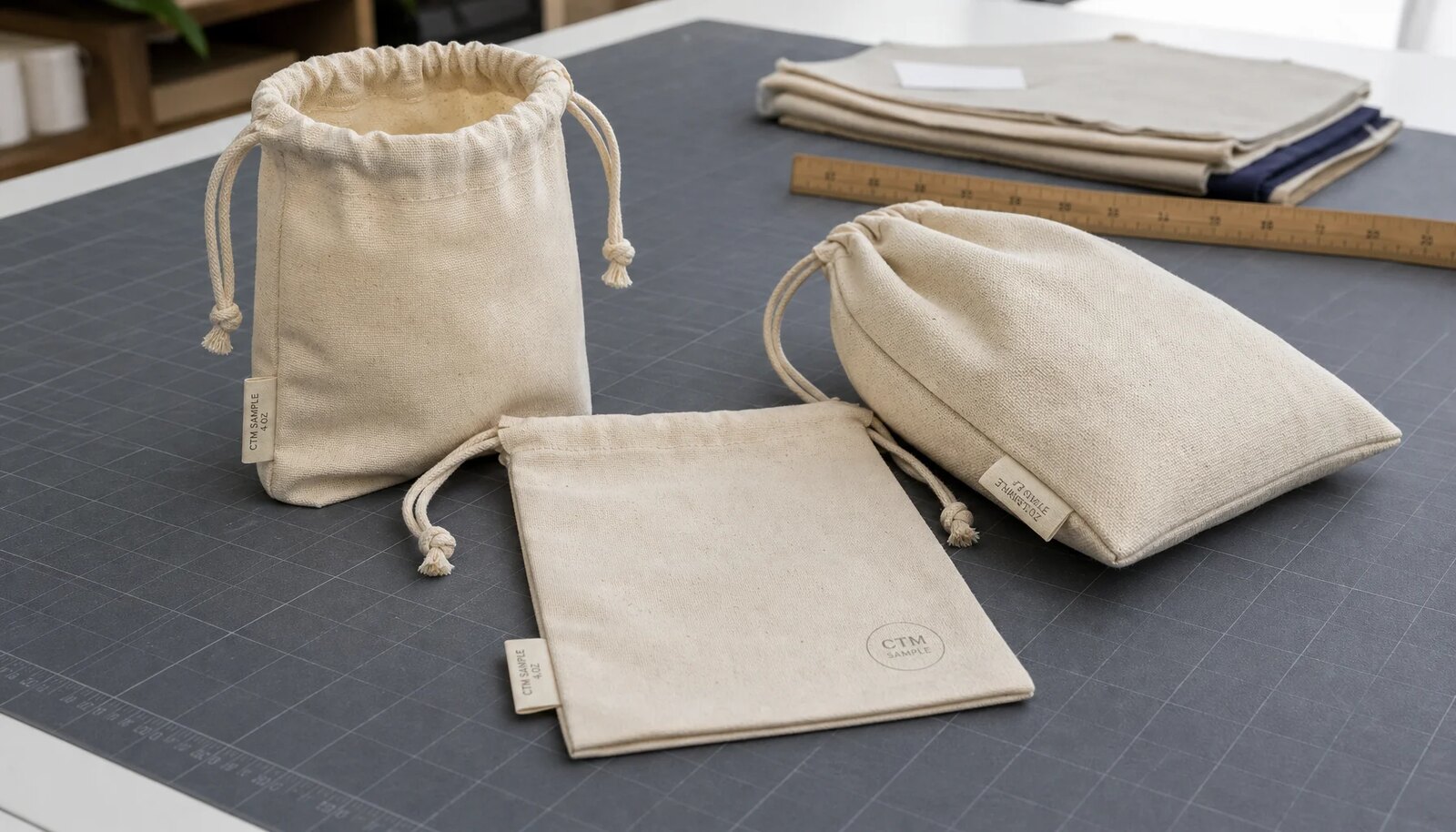
Why Fabric Weight Decides the Buying Result
For cotton drawstring pouches used at craft fairs, fabric weight is not a cosmetic detail. It controls how the pouch hangs on a display hook, how much the product shape shows through, how the logo prints, how well the drawcord closes, and how much the shipment costs. A buyer who only writes “cotton pouch, natural color, logo printed” will receive quotes that look similar on price but may represent very different products.
The practical range for most craft fair pouches is 4 oz to 8 oz cotton, roughly 135-280 GSM. Below that range, the pouch may feel like a dust bag and may not support retail presentation. Above that range, the pouch can become expensive, bulky, and hard to cinch for small handmade items. The best specification depends on the item inside, the selling price, and whether the pouch is disposable packaging or part of the product value.
- Use 4 oz cotton for low-cost inserts, seed packets, tea samples, or very light giveaways.
- Use 5 oz cotton when the pouch must look retail-ready but still stay within a controlled unit cost.
- Use 6 oz cotton when reuse, stronger print feel, and better opacity matter more than the lowest price.
- Use 7-8 oz cotton canvas only when contents are dense, sharp-edged, or positioned as a premium kit.
Translate Oz and GSM Before Comparing Quotes
Many pouch quotations use ounces because cotton bags are often traded by oz, while fabric mills and inspectors often work in GSM. The two figures are related but not perfectly interchangeable because weave density, yarn count, finishing, and washing can change the hand feel. As a working reference, 4 oz cotton is usually around 135-150 GSM, 5 oz around 160-180 GSM, 6 oz around 200-220 GSM, and 8 oz around 270 GSM.
Procurement teams should write both values in the RFQ and allow a tolerance. A realistic line is “5 oz cotton, target 170 GSM, acceptable production range 160-180 GSM.” Without that range, one supplier may quote 150 GSM fabric and another may quote 180 GSM fabric, then the lower price looks attractive for the wrong reason. If the buyer needs a premium pouch, the RFQ should also mention weave tightness and surface smoothness, not only GSM.
- State target GSM and allowed tolerance in the RFQ.
- Request a fabric swatch from the production mill, not only a catalog sample.
- Clarify whether the GSM is measured before dyeing, after finishing, or after pre-shrinking.
- Keep one approved swatch sealed for comparison during bulk inspection.
Match Fabric Weight to Craft Fair Products
Craft fair packaging is different from general promotional packaging because buyers handle products directly. A pouch used for handmade jewelry has to feel neat and soft. A pouch for small ceramics must resist abrasion. A pouch for candles or cosmetics must avoid oil marks and support a clean brand impression. The fabric weight should be selected around the product’s pressure points, not around a supplier’s standard stock size.
For small flat goods, 4 oz or 5 oz can be enough. For boxed items, candle tins, reusable craft kits, or products that customers may store at home, 5 oz or 6 oz is safer. For pottery accessories, tools, bottles, or hardware-style gift sets, heavier cotton canvas may be necessary, but the buyer should test whether the drawstring still closes cleanly. Heavy fabric can look premium on a table but awkward when cinched around a small object.
- Jewelry and accessories: 5 oz cotton is usually the safest balance of softness, opacity, and cost.
- Soap and bath products: 5-6 oz cotton helps reduce a cheap translucent look, but inner wrapping may still be needed.
- Candles and jars: 6 oz cotton gives better body, while sharp lid edges may need reinforced seams.
- Ceramics and tools: 7-8 oz canvas can work, but seam strength and drawcord channel stress must be tested.
Cost Drivers Hidden Behind Fabric Weight
The fabric itself is usually the largest cost difference between a 4 oz pouch and a 6 oz pouch, but it is not the only cost driver. Heavier fabric affects cutting efficiency, sewing speed, needle choice, carton quantity, and shipping volume. It can also increase the reject risk if the factory uses equipment set up for lighter promotional pouches. A quote that looks only slightly higher at the unit price may become more expensive after freight and carton volume are calculated.
Buyers should compare each quote by landed cost per usable pouch. That means including unit price, print setup, sample fee, packing method, carton dimensions, expected inspection rejects, import duty basis, and freight method. For a distributor ordering several pouch sizes, one shared fabric weight can reduce waste and simplify production even if one SKU could technically use a lighter fabric.
- Fabric cost rises with GSM, but carton volume and gross weight also change the landed cost.
- Small pouches can have a high labor share because cutting, sewing, and cord insertion still take time.
- Multi-size programs may be cheaper when one base fabric is used across all sizes.
- Dyed cotton increases lead time and MOQ compared with natural cotton if the color is not in stock.
Print Method Changes the Right Fabric Choice
Screen printing works well on most cotton drawstring pouches when the logo uses solid colors and moderate detail. On 4 oz loose-weave cotton, large ink areas can feel stiff and may distort the fabric. On 5 oz and 6 oz cotton, the print surface is usually more stable, making logo edges cleaner. For craft fair brands using small text, care icons, or QR codes, a smoother 5-6 oz fabric is often more important than simply increasing weight.
Heat transfer can handle multi-color artwork and smaller runs, but it may not match the natural hand feel expected from cotton packaging. Embroidery is possible, but it is usually better on 6 oz or heavier cotton, and it can pucker small pouches if the backing and stitch density are not controlled. Digital printing may fit complex artwork, but the buyer should test color absorption and wash/rub resistance on the actual cotton.
- Screen print: best for solid logos, larger orders, and cost-controlled craft fair programs.
- Heat transfer: useful for multi-color artwork or lower MOQ, but test edge durability and hand feel.
- Embroidery: suitable only when the pouch size and fabric weight can support stitch tension.
- Woven side label: good for premium branding when the pouch face must stay clean or unprinted.
MOQ Logic Buyers Should Clarify Early
MOQ for cotton drawstring pouches is not only a total order quantity. It may apply by fabric weight, fabric color, pouch size, drawcord color, print design, and packing style. A buyer may request 5,000 pouches across five craft fair brands and assume the MOQ is reached, while the factory sees five small runs with separate screens, separate cutting markers, and separate packing lists.
The cleanest RFQ groups similar items. If the buyer can use natural 5 oz cotton across multiple pouch sizes, the factory may combine fabric purchasing and cutting preparation. If each SKU needs a different dyed fabric or different drawcord color, the MOQ and lead time will rise. For test programs, it can be better to reduce customization variables first and add more colors after the first selling season.
- Clarify MOQ by total order, size, fabric color, logo artwork, print color, and packing unit.
- Ask whether several pouch sizes can share one fabric lot to reduce fabric waste.
- Separate one-time print screen charges from repeat-order unit prices.
- For launch orders, keep fabric and cord standard while testing logo and size demand.
Sample Approval Should Simulate Real Use
A pouch sample is not approved just because the logo is centered. The sample should hold the actual product, close with the intended drawcord, stand or lay correctly for display, and survive normal handling. Craft fair buyers often need fast setup and repeated customer handling, so the pouch must not wrinkle badly, shed lint, or jam at the drawcord channel after a few pulls.
A strong sample process usually includes a fabric swatch, print strike-off, fit sample, and pre-production sample. For repeat orders, the approved pre-production sample becomes the inspection reference. Buyers should label it with fabric weight, finished size, cord type, logo size, print color, date, and supplier name. This avoids arguments when bulk pouches arrive slightly thinner, yellower, or smaller than expected.
- Put the real product inside and measure whether the drawcord can close without strain.
- Rub the printed logo with a dry white cloth to screen for weak ink adhesion.
- Pull each cord end repeatedly and watch for twisting, loose stitching, or channel tearing.
- Compare natural cotton shade against the approved swatch under consistent light.
- Weigh and measure several samples, not only the best-looking piece.
Packing Choices Affect Retail Handling and Freight
Packing for cotton drawstring pouches should match the buyer’s distribution route. Bulk bundles are lower cost and reduce plastic use, but they require the receiving team to count, sort, and possibly steam or flatten pouches before craft fair setup. Individual polybags protect printed pouches from dirt and moisture, but they add labor, material cost, and waste. Retail buyers may also need barcode labels or size identification if pouches are shipped to multiple booth locations.
Heavy fabric weights reduce the number of pouches per carton and can push up volumetric freight cost. A 6 oz pouch may not look much thicker than a 5 oz pouch on the table, but across thousands of pieces it changes carton count. The RFQ should request carton dimensions, gross weight, net weight, carton quantity, and packing method. Without this data, procurement cannot compare air freight, sea freight, courier, or warehouse handling accurately.
- Bulk bundle packing works for internal event teams that can count and prepare pouches before use.
- Individual packing fits retail distribution, mixed SKU cartons, or dusty warehouse environments.
- Inner labels help when several sizes look similar after folding.
- Carton moisture protection matters for natural cotton because stains and mildew are hard to rework.
Inspection Criteria for Bulk Pouch Orders
Quality control should be written as measurable acceptance criteria. For craft fair packaging, common defects include stains, oil marks, loose threads, skipped stitches, uneven drawcord length, poor logo placement, ink smudges, and size variation. Natural cotton also has normal cottonseed specks and shade variation, so the buyer must define what is acceptable before production. Otherwise, the inspection becomes subjective and slow.
For size, many buyers accept a tolerance around plus or minus 5 mm for small pouches and plus or minus 10 mm for larger pouches, depending on construction. For logo placement, a practical tolerance may be plus or minus 3-5 mm from the approved position. Seam strength can be checked by moderate manual pulling at side seams, bottom corners, and drawcord channel openings. If the pouch carries heavier products, the supplier should perform a load test using a weight higher than the actual product.
- Fabric: no major stains, holes, weaving defects, strong odor, or unacceptable shade deviation.
- Size: finished flat dimensions within agreed tolerance after drawcord insertion.
- Sewing: no open seams, skipped stitches, loose bartacks, or fraying at channel openings.
- Print: correct color, position, opacity, edge quality, and adhesion on actual cotton fabric.
- Function: drawcord pulls smoothly, closes evenly, and does not detach under normal force.
Lead Time Risks and Quote Data to Require
Lead time depends on more than sewing capacity. Natural cotton in standard weights may be available faster, while dyed fabric, custom cord, embroidery, special labels, or pre-shrunk finishing add time. Print approval can also delay production if artwork is not production-ready. A realistic schedule includes sample making, sample shipping, buyer approval, fabric preparation, cutting, printing, sewing, trimming, final inspection, packing, and export booking.
A useful quote should give enough data for procurement to compare suppliers without guessing. The buyer needs unit price by quantity break, fabric specification, print method, setup charges, sample terms, lead time assumptions, packing data, carton size, payment terms, and quote validity. If the supplier only sends a short unit price, the buyer still carries the risk of hidden charges and changed specifications later.
- Request separate timelines for sample, bulk production, final inspection, and export handover.
- Ask whether lead time starts after deposit, artwork approval, sample approval, or material arrival.
- Require carton dimensions and gross weight before choosing freight method.
- Keep artwork files, logo size, Pantone references, and pouch dimensions locked before production starts.
Specification comparison for buyers
| Spec decision | Recommended option | When it fits | Buyer risk to check |
|---|---|---|---|
| Lightweight pouch for low-value giveaways | 4 oz cotton, about 135-150 GSM, plain weave | Tea samples, small soaps, stickers, seed packets, or craft fair inserts where low freight cost matters | Fabric may show product shape through the pouch; dark printing can feel too heavy if the artwork has large ink coverage |
| Standard craft fair retail pouch | 5 oz cotton, about 160-180 GSM, plain weave | Jewelry, candles, small ceramics, cosmetic minis, and handmade goods needing a clean retail feel without high unit cost | Confirm shrinkage allowance and finished size tolerance because this weight is often quoted by different mills with small GSM variance |
| Premium reusable pouch | 6 oz cotton, about 200-220 GSM, tighter weave | Gift sets, brand merchandise, refill packaging, or pouches expected to be reused after the fair | Higher fabric cost and bulkier packing; verify carton quantity and shipping volume before approving the quote |
| Heavy pouch for sharp or dense contents | 7-8 oz cotton canvas, about 240-280 GSM | Hardware kits, pottery accessories, glass jars, or products with corners that may stress seams | Drawcord closing becomes stiffer; test whether the pouch cinches cleanly after printing and washing |
| Fine logo or small text printing | 5-6 oz cotton with smooth surface, screen print or heat transfer depending on color count | Brand names, QR codes, small care icons, and craft fair pricing information printed on one face | Loose weave or slub fabric can break fine lines; approve a strike-off using the real fabric, not only a digital proof |
| Natural eco-look presentation | Unbleached natural cotton, 5 oz or 6 oz, cotton cord | Handmade brands, organic product ranges, craft kits, and rustic gift packaging | Natural cotton has shade variation and cottonseed specks; define acceptable shade range before bulk production |
| Low shrinkage size-critical pouch | Pre-shrunk or controlled-shrink cotton, usually 5-6 oz | Products where internal fit is tight, such as boxed jewelry, small bottles, tarot cards, or candle tins | Supplier must state shrinkage test method; finished pouch should be measured after stitching and drawcord insertion |
| Best landed-cost balance for mixed SKU programs | One shared 5 oz base fabric with size and print variations | Distributors and retail buyers consolidating several craft fair pouch sizes under one purchase order | MOQ may be counted by size, fabric color, and print design; clarify whether supplier can combine cutting or dye lots |
Buyer checklist before sampling
- Define the product going inside the pouch, including weight, sharp edges, oil risk, and required internal fit.
- Specify fabric weight in both oz and GSM, and state whether GSM is before or after washing if pre-shrunk fabric is required.
- Request finished pouch size tolerance, drawcord length tolerance, and seam allowance instead of quoting only flat fabric dimensions.
- Match print method to artwork: screen print for solid logos, heat transfer for multi-color small runs, embroidery only on heavier cotton.
- Approve a physical pre-production sample with real fabric, real cord, real logo size, and real packing method.
- Check whether MOQ applies by fabric color, pouch size, logo design, print color, or total order quantity.
- Confirm inner packing, carton quantity, carton dimensions, gross weight, and whether pouches are bundled, folded, or individually packed.
- Add inspection criteria for seam strength, drawcord function, print adhesion, fabric stains, size tolerance, and needle damage.
- Build the schedule around fabric procurement, sample approval, printing, sewing, final inspection, and export packing rather than only sewing time.
- Compare quotes by landed cost per usable pouch, including rejects, carton volume, duty basis, and rework risk.
Factory quote questions to send
- Which cotton fabric weight are you quoting in oz and GSM, and what is the acceptable GSM tolerance from the mill?
- Is the fabric natural, bleached, dyed, pre-shrunk, organic, recycled, or conventional cotton, and is documentation available if claimed?
- What finished pouch size tolerance can you hold after sewing and drawcord insertion?
- What drawcord material, diameter, color, and end finish are included in the unit price?
- Which print method is included, what maximum logo size is allowed, and how many print colors are included?
- Can you provide a strike-off on the same cotton fabric before the pre-production sample?
- What is the MOQ by pouch size, fabric color, print design, and total purchase order?
- What sample cost, sample lead time, bulk lead time, and production calendar assumptions are included?
- How many pouches are packed per polybag or bundle, how many per export carton, and what are the carton dimensions and gross weight?
- What inline and final inspection standards do you use for stains, loose threads, broken stitches, print defects, and drawcord function?
Quality-control points to confirm
- Fabric GSM should be checked from production fabric, not only from the supplier's swatch card.
- Finished pouch size should be measured flat after sewing, pressing, and drawcord insertion.
- Side seams and bottom seams should show no skipped stitches, open seams, needle holes, or fraying at stress points.
- Drawcords should pull smoothly from both sides without twisting, jamming, or cutting into the channel.
- Printed logos should pass dry rub and tape pull checks suitable for the chosen print method.
- Natural cotton shade variation should stay within the approved sample range, especially for repeat orders.
- Loose threads should be trimmed before packing, not hidden inside folded bundles.
- Cartons should protect pouches from moisture, compression marks, and contamination during export transit.