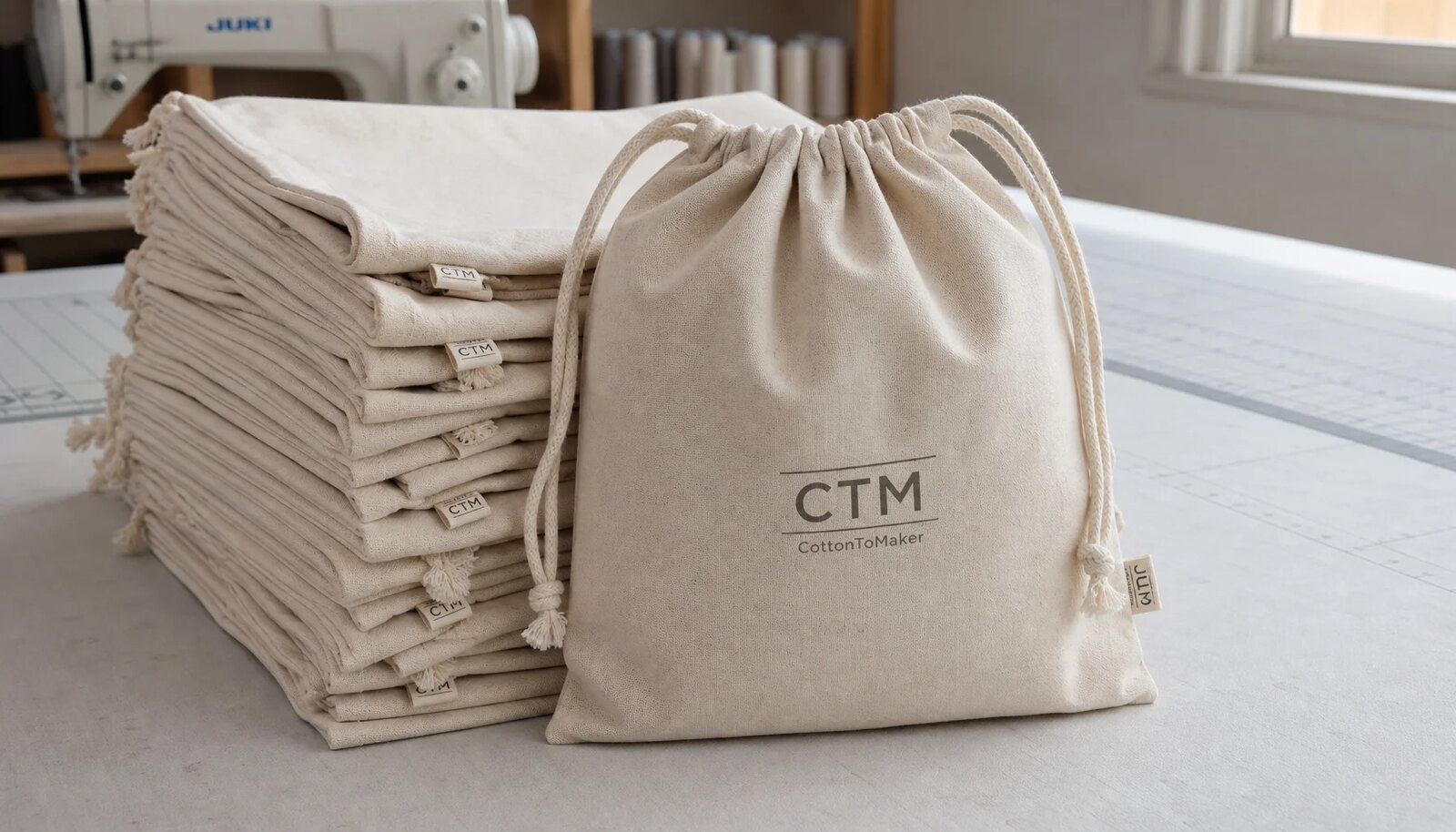
Start With the Event Risk
Cotton drawstring pouches are simple products, but event orders can fail for very practical reasons: the pouch is too light for the kit, the logo rubs, cartons are mixed, documents are too generic, or the packing does not match the warehouse plan. A useful supplier compliance checklist starts with the actual event use, not with a logo file and a target unit price.
Define whether the pouch is a low-cost giveaway, a welcome-kit container, a hospitality amenity, a merchandise pouch, or packaging for a product that will be sold. A pouch holding a badge and folded agenda can use a lighter construction than one holding candles, cosmetics, drinkware, tech accessories, or retail goods. The expected fill weight affects fabric GSM, seam strength, drawcord diameter, carton packing, and inspection checks.
The destination market matters too. A pouch distributed at a private conference may need a lighter document package than a pouch sold in a retail channel or included with a children’s product. Tell the supplier the country of distribution, whether the pouch is sold or given away, and whether it touches regulated goods such as cosmetics, toys, or children’s items. That context helps decide whether declarations, test reports, labels, or buyer-specific RSL evidence are needed.
- Classify the use: giveaway, event kit, hospitality amenity, product packaging, retail resale, or dry non-food pouch.
- State fill weight, item type, handling route, and storage time before selecting GSM or construction.
- Separate low-risk promotional use from retail, children’s product, cosmetics-adjacent, or brand-audited programs.
- Put the destination country and sales channel in the RFQ, not only in internal notes.
Build a Spec Suppliers Can Quote
A quote is only comparable when every supplier prices the same pouch. The minimum RFQ should include finished size, fabric GSM, weave, color, drawcord material, cord diameter, construction, decoration method, logo position, tolerance, packing, destination market, and incoterm. If those details are missing, suppliers will make different assumptions and the cheapest price may simply be a lighter or less controlled product.
Use finished dimensions, measured flat after sewing and drawcord insertion. State whether the pouch is flat, gusseted, lined, boxed-bottom, or shaped. For many small event pouches, +/-0.5 cm can be a workable finished-size tolerance when agreed in advance; larger or heavier bags may need a different tolerance. The point is to define the limit before the sample, not after the cartons arrive.
Construction details should be written clearly. The drawstring channel must be wide enough for smooth cord movement. Cord length should allow easy opening without tangling during kitting. Bottom corners, side seams, or channel ends may need reinforcement when the pouch carries heavier fills. Label placement, hang tags, barcode stickers, and care labels should be shown on a diagram where possible.
- Specify finished size, tolerance, GSM, weave, color, cord, construction, decoration, packing, and incoterm.
- Confirm whether measurements are taken before or after washing if shrinkage is relevant.
- Attach vector artwork, Pantone references, print size, label position, and carton mark requirements.
- Ask the supplier to list any assumptions or exclusions in the quote response.
Match GSM to Use Case
Fabric GSM affects cost, opacity, print result, durability, and carton cube. It should be selected for the program, not treated as a generic quality badge. Natural cotton around 100 to 120 gsm may be enough for flat paper inserts or short-term giveaways. A 140 to 160 gsm pouch usually gives a more dependable handfeel for attendee kits and brand activations. Premium packaging, heavier gifts, or reusable pouches often move toward 180 to 220 gsm or higher, depending on size and sewing quality.
GSM alone is not the whole story. A cleanly sewn 160 gsm pouch can perform better than a poorly finished 200 gsm pouch. Weave, shrinkage, fabric finishing, cutting accuracy, thread, and seam construction all affect bulk quality. Natural unbleached cotton can show flecks and shade variation; bleached or dyed cotton looks cleaner but needs shade and colorfastness control.
Ask whether the fabric is stock, custom dyed, bleached, washed, or pre-shrunk. Stock fabric can reduce lead time and MOQ, but the supplier should confirm enough material from one lot. If the supplier claims organic cotton, recycled cotton, or another sustainability attribute, request documentation tied to the actual fabric lot or certified supply chain claim. Do not let marketing language replace material evidence.
- 100-120 gsm: light paper inserts, low-fill giveaways, short-term handouts.
- 140-160 gsm: common event kits, better opacity, practical logo presentation, moderate reuse.
- 180-220 gsm: premium gifts, heavier contents, retail packaging, repeated handling.
- 220+ gsm: heavier-duty programs where carton cube, cost, and sewing method are also reviewed.
Define Decoration and Claims
Decoration is a major source of cost and compliance variation. A one-color screen print, two-side print, woven label, sewn patch, embroidery, and heat transfer are not equivalent offers. Lock the preferred method before comparing suppliers, or ask every supplier to price the same options with the same artwork size and placement.
Screen printing is often the most efficient method for cotton drawstring pouches used in events. It works well for simple logos, solid colors, and larger quantities. Approve a strike-off on the actual fabric color because natural cotton, dyed cotton, and heavier canvas can change print opacity and edge sharpness. Include print placement tolerance, color reference, and whether the logo must avoid drawcord channels or seams.
Labels, embroidery, and transfers need extra checks. Woven labels have their own MOQ, lead time, material composition, and attachment standard. Embroidery can pucker lightweight cotton or distort small lettering. Transfers can reproduce detail, but the buyer should approve handfeel, adhesion, edge finish, and rub resistance. For compliance review, include inks, transfer films, label materials, thread, and adhesives where they affect the destination market or brand RSL.
- Screen print: practical for simple event logos and larger quantities.
- Woven label or patch: useful for premium brand programs or retail presentation.
- Embroidery: durable, but test on the selected GSM before approval.
- Heat transfer: useful for detail, but check adhesion, handfeel, and rub performance.
Request Market-Specific Evidence
Supplier compliance should be tied to the actual order. A generic certificate folder is not enough. Useful evidence identifies the legal supplier, production site, materials, decoration process, packing materials, inspection method, and shipment documents connected to the pouch being purchased.
For EU distribution, buyers may ask about REACH declarations and, for consumer goods, GPSR-related traceability expectations. For California distribution, Prop 65 review may be relevant depending on materials and exposure. If the pouch is part of a children’s product program in the United States, CPSIA considerations may apply. Textile fiber labeling can matter when the pouch is sold as a textile product or must carry composition information. Many brands also operate their own restricted substance list, known as a brand RSL, which can be stricter or more specific than general supplier paperwork.
The right package depends on end use and market, so do not request documents blindly. Ask for evidence by component: fabric, cord, thread, labels, ink, transfer film, adhesive, and packaging where relevant. Check report dates, material scope, article description, issuing lab, and whether the document applies to the final pouch or only to an unrelated material. If the supplier cannot explain the link between the document and the pouch, treat the evidence as incomplete.
- Name the destination market and end use in the RFQ.
- Ask for CPSIA, REACH, Prop 65, GPSR, fiber labeling, or brand RSL evidence only where relevant.
- Check that documents match the exact fabric, cord, print, label, transfer, or trim used.
- Record document review status before deposit or before bulk material purchase.
Use a Cleaner RFQ Matrix
A strong RFQ matrix keeps the conversation commercial and specific. It should show the product spec, quantity, version breakdown, decoration, packing, compliance evidence, inspection standard, incoterm, delivery date, and payment milestone. This prevents hidden differences between quotes and helps event planners protect a fixed delivery window.
Ask suppliers to break out costs. Separate base pouch cost, decoration setup, decoration run charge, sample fee, label cost, packing cost, testing cost, carton cost, and freight assumption. A supplier with a higher unit price may still be better if the quote includes packing, carton marks, inspection support, and realistic freight cube. A low unit price can become expensive if the warehouse must recount, relabel, or repack the pouches.
Include non-price fields in the matrix: MOQ by version, sample time, bulk time after approval, latest approval date, inspection timing, carton dimensions, pieces per carton, gross weight, shipment port, and document availability. Event planners usually have a hard deadline, so the quote should make the critical path visible.
- Use one RFQ file for all suppliers so assumptions are controlled.
- Separate price lines for pouch, decoration, label, packing, testing, sample, carton, and freight.
- Ask for MOQ by size, color, print version, label version, and packing method.
- Require carton cube, inspection standard, and document list before PO approval.
Approve Samples With Measurements
A sample approval should prove size, fabric, handfeel, color, drawcord function, stitching, print placement, print cure, label position, and packing method. Photos are useful for speed, but they cannot verify GSM, odor, cord drag, seam strength, or print feel. For custom orders, approve a physical pre-production sample made with actual bulk materials whenever the timeline allows.
Keep one signed golden sample with the buyer and one matching sample at the factory. Link the sample to the final spec, artwork, quote, and PO. If the logo moves, cord color changes, GSM increases, packing changes, or a label is added, update the approval record. Otherwise the factory may produce against an older version.
Use measurable checks during approval. Measure finished size, channel width, cord length, print location, and label position. Open and close the drawcord repeatedly. Load the pouch with the expected contents. Rub the decoration with a dry cloth and, where appropriate, a damp cloth to screen for poor cure or ink transfer. Reject samples with open seams, strong odor, stains, obvious skew, snagging cords, uncured print, or incorrect packing.
- Approve decoration on the actual fabric color and GSM.
- Measure placement from agreed edges or center lines.
- Keep signed sample, final spec, artwork, and quote together for inspection.
- Do not release bulk production until deviations are closed in writing.
Set QC Limits Before Production
Quality control should be agreed before the factory cuts fabric. For medium or higher-risk programs, buyers often use ANSI/ASQ Z1.4 or ISO 2859-1 sampling with an agreed AQL. A common starting point for consumer soft goods is AQL 2.5 for major defects and 4.0 for minor defects, with critical defects not accepted, but the final level should match buyer policy, order risk, and inspection provider guidance.
Define defect categories. Critical defects can include unsafe foreign material, severe contamination, wrong product, wrong logo, or missing required warning or compliance label. Major defects can include open seams, broken drawcords, wrong fabric GSM, severe print misplacement, wrong SKU, incorrect carton count, or decoration failure. Minor defects can include small loose threads, slight shade variation within the approved limit, or tiny print specks that do not affect normal use.
Inspection timing matters. Check incoming fabric and trims before cutting when the material is custom. Review first-piece production after printing and sewing begin. Use in-line inspection for large orders or complex branding. Conduct final random inspection after packing but before shipment release. For event goods, packing and counts deserve the same attention as sewing because warehouse delays can damage the program even when the pouch itself is acceptable.
- Agree sampling plan, AQL, defect definitions, and rework rules before production.
- Use first-piece approval for custom size, custom print, labels, or special packing.
- Check dimensions, GSM, seams, cord function, print, labels, stains, odor, packing, and carton count.
- Hold shipment release until final inspection, photos, or third-party report is accepted for higher-risk orders.
Control Packing and Cartons
Packing is part of supplier compliance because it affects cleanliness, receiving accuracy, freight cost, and event execution. Cotton pouches can pick up dust, moisture, lint, and compression marks if packed poorly. A loose bulk pack may work for a low-cost handout. Retail-ready programs may need individual bags, fold control, barcode labels, SKU separation, or stricter carton marks.
Ask for inner pack count, master carton count, carton dimensions, gross weight, net weight, and carton labels before production. Overfilled cartons can crush pouches and make counting difficult. Underfilled cartons waste freight cube. Carton marks should show PO number, SKU, size, color, logo version, quantity, destination, and carton sequence when multiple versions are involved.
Moisture control is important for cotton, especially white or natural pouches shipped by sea, stored for long periods, or routed through humid climates. Confirm that goods are dry before packing and that cartons are strong enough for the freight method. If plastic reduction is a buyer goal, state whether individual polybags are allowed, banned, or replaced with paper bands, bundles, or master-bag protection. Sustainability goals should be balanced against cleanliness and receiving requirements.
- Choose loose bulk, bundled, individual bag, retail bag, or kitting-ready pack before quote approval.
- Confirm fold direction, inner quantity, master quantity, carton label, and SKU separation.
- Add moisture protection for white cotton, sea freight, humid routes, or long storage.
- Check carton count and packing list before balance payment or shipment release.
Manage MOQ, Lead Time, and Changes
MOQ is usually driven by fabric stock, dyeing minimums, cutting efficiency, print setup, label MOQ, packing labor, and test-document requirements. A natural cotton pouch with a simple print may support a lower MOQ when stock fabric is available. Custom dyed fabric, unusual sizes, multiple logos, woven labels, embroidery, individual packing, or market-specific testing can increase the minimum.
Lead time should be broken into stages: artwork approval, sample, pre-production sample, material sourcing, cutting, printing, curing, sewing, trimming, inspection, packing, and dispatch. A quote that says 30 days is incomplete unless it states when the clock starts. For events, ask for the latest safe sample approval date and the date when changes will begin to affect delivery.
Change control protects both buyer and supplier. Freeze the spec after sample approval. Require written approval for fabric substitutions, cord changes, print color adjustments, label changes, packing changes, or document substitutions. If a change is accepted, update the PO, sample record, QC checklist, and carton requirements so every team works from the same version.
- Ask for MOQ by component and version, not only total order quantity.
- Build schedule around approval dates, public holidays, testing, peak season, and freight booking.
- Freeze material, artwork, decoration, and packing before bulk production.
- Record who can approve deviations and how they affect cost, timing, compliance, and inspection.
Specification comparison for buyers
| Supplier option | What to verify | Commercial advantage | Buyer risk to control |
|---|---|---|---|
| Direct sewing factory | cord material proof, reinforcement close-ups, load-test photos, approved sample tag, and bulk-line first-piece record | Better sample-to-bulk control and faster production feedback | May be weaker on export paperwork or branded packing unless checked early |
| Trading company | Factory name, production photos, trim-source proof, and who owns QC decisions | Can coordinate small mixed orders and extra services | Markup can hide real factory capability and slow defect decisions |
| Specialized bag workshop | cord diameter, eyelet or reinforced channel, bottom corner reinforcement, seam allowance, bar-tack position, and load target | More practical for detailed construction, trims, and repeat programs | Capacity may be limited during peak seasons |
| Low-price general supplier | 6-10 oz cotton canvas, 210D polyester, rPET, or blended cotton with shrinkage and colorfastness expectations set before sampling | Useful for simple promotional runs with loose specs | Material downgrades, weak packing, and vague inspection scope can erase savings |
| Retail-ready supplier | fold direction, cord protection, bundle count, carton compression, moisture bag, and retail label position | Can handle labels, SKU separation, carton marks, and receiving rules | Higher unit cost must be compared against reduced warehouse work |
| Compliance-focused supplier | Fabric records, labeling review, test plan, and production traceability | Safer for retail programs and repeat brand orders | Documentation claims need evidence, not only sales language |
| Local sample room plus bulk factory | Signed sample, bulk factory handoff, first-piece photos, and deviation owner | Good for complex branding before large production | Sample room quality may not match bulk line unless handoff is controlled |
Buyer checklist before sampling
- Define the pouch use: event giveaway, attendee kit, hospitality amenity, merchandise packaging, cosmetic set, jewelry pouch, retail resale, or dry non-food outer packaging.
- Record the expected fill weight, product dimensions, handling route, reuse expectation, and whether guests, warehouse teams, store staff, or end customers will handle the pouch.
- Specify finished size, fabric GSM, weave, color, pre-shrunk or raw fabric, drawcord material, cord diameter, construction, and tolerance before requesting prices.
- Choose the decoration method before comparing quotes: screen print, transfer, embroidery, woven label, sewn patch, hang tag, or blank pouch.
- State the destination market and end use so the supplier can provide relevant evidence for CPSIA, REACH, Prop 65, GPSR, fiber labeling, brand RSL, or buyer-specific requirements when applicable.
- Ask for MOQ by size, fabric color, print version, label version, packing style, and test-document requirement instead of accepting one general minimum.
- Request a physical sample and, for custom orders, a pre-production sample made with actual bulk fabric, cord, decoration, and packing method.
- Set measurable QC limits for dimensions, GSM, seams, load, drawcord movement, print placement, rub resistance, stains, odor, carton count, and SKU separation.
- Use an agreed inspection approach, such as ANSI/ASQ Z1.4 or ISO 2859-1 sampling with a stated AQL, for medium or higher-risk orders.
- Confirm packing before production: inner quantity, master carton quantity, fold direction, bundle or individual bag, carton label, moisture control, pallet rule, and warehouse receiving needs.
Factory quote questions to send
- What finished size, fabric GSM, weave, yarn or fabric construction, and tolerance are included in your quote?
- Is the cotton natural, bleached, dyed, organic-certified, recycled-content, or blended, and what document supports that claim for this material?
- Is the fabric stock or custom sourced, and can you reserve one lot for the full order quantity plus allowance?
- What drawcord material, diameter, length, color, knot style, end finish, channel width, and reinforcement are included?
- Does the unit price include blank pouch only, one-side print, two-side print, woven label, sewn patch, embroidery, heat transfer, hang tag, or retail label?
- What are the MOQ and lead time by size, fabric color, print color count, label version, and packing method?
- What is included in the quote: cutting, sewing, printing, setup, thread, cord, labels, hang tags, individual bags, master cartons, carton marks, testing, and export packing?
- Can you provide current material declarations, restricted-substance declarations, test reports, or labeling support for our destination market and end use?
- Are the documents tied to the exact fabric, cord, ink, transfer, thread, label, and packaging materials used for this order?
- Which market frameworks have you supported before, such as CPSIA, REACH, Prop 65, GPSR, fiber labeling, or brand RSL requirements?
Quality-control points to confirm
- Use finished-size measurement after sewing and drawcord insertion. For small pouches, an example tolerance may be +/-0.5 cm; for larger pouches, agree a wider tolerance before production.
- Check fabric GSM against the approved specification. A common tolerance may be +/-5% if agreed, but tighter limits may be needed for retail or repeat programs.
- Confirm fabric handfeel, weave, opacity, shade, shrinkage expectation, and lot consistency against the approved swatch and signed sample.
- Inspect seams for skipped stitches, open seams, needle cuts, loose thread nests, uneven seam allowance, and weak bottom corners.
- Run a practical load check using the expected fill weight plus a reasonable handling margin. For heavier event kits, define a pouch-specific target such as holding the packed weight for a fixed lift period without seam opening.
- Open and close the drawcord repeatedly. The cord should move smoothly, knots or tips should not slip, and channel stitching should not tear or pucker excessively.
- Check reinforcement at drawstring channel ends, side seams, corners, eyelets, and bar-tacks against the approved construction.
- Measure print placement from agreed edges or center lines. Define placement tolerance, such as +/-3 mm for small pouches or another agreed limit based on artwork size.
- Use dry and damp rub checks on prints or transfers to catch poor cure, ink transfer, flaking, or weak adhesion. Agree whether the buyer requires an internal check or a laboratory colorfastness method.
- Review print color, opacity, registration, edge sharpness, pinholes, scorch marks, and ink handfeel against the approved strike-off.