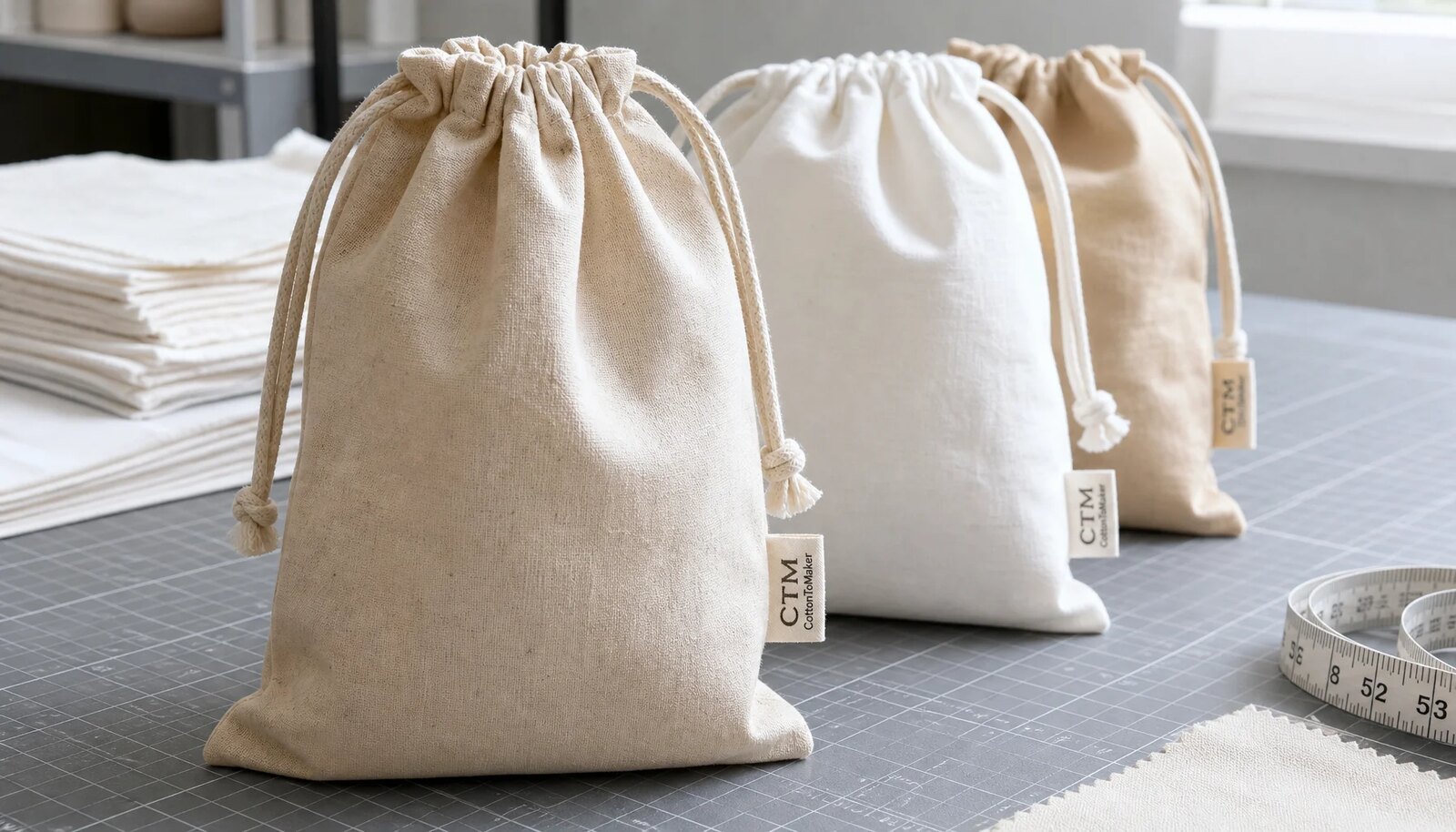
Start With the Event Workflow
Cotton drawstring pouches look simple until they become part of an event schedule. They may hold sponsor samples, jewelry, candles, badges, hotel amenities, table gifts, product launch items, or registration accessories. The pouch must fit the contents, show the logo cleanly, survive packing, arrive in countable cartons, and be ready when the event team needs it. A polished sample is not enough if the bulk order is slow to fill or hard to sort on-site.
For B2B buyers, the first job is to turn the pouch into a measurable product. A useful quote for cotton drawstring pouches for event planners bulk pricing plan should include finished size, usable opening, fabric GSM, color route, drawcord build, logo method, packing format, inspection standard, delivery term, and required in-hand date. Without those details, two suppliers can quote very different products under the same item name.
The deadline is the real risk. If pouches arrive too small, misprinted, damp, stained, or sorted into the wrong cartons, there may be no time to remake them. The practical safeguard is a clear RFQ, physical samples, written tolerances, and a final inspection plan tied to the approved sample.
- Treat the pouch as a finished sewn product, not a generic promotional bag.
- Connect every specification to packing speed, presentation, receiving, sorting, or guest handling.
- Use written specs and approved samples as the basis for supplier accountability.
Size the Pouch Around Real Contents
Finished size is the most common sourcing mistake. A buyer may request a 10 x 15 cm pouch because the item appears to fit inside that rectangle, but usable space is reduced by side seams, bottom seam, fabric thickness, drawcord channel depth, shrinkage, and closure behavior. A rigid box, candle tin, cosmetic bottle, or set of inserts needs more clearance than a flat card.
Ask what the quoted size means. Pouches are often measured flat and empty after sewing, but some catalog sizes are approximate. The internal usable space can be smaller than the outside measurement. The opening may also be narrower than the body if the drawcord channel is tight, thick, or heavily stitched. If the pouch must close fully, the contents should sit below the channel with enough fabric left to cinch.
Tolerance belongs in the purchase order. For small pouches, +/- 5 mm on finished width or height is often workable, but the right tolerance depends on size, fabric, and construction. Buyers should also define where dimensions are measured: top, middle, bottom, before pressing, after pressing, flat, empty, and across how many samples.
The best test is physical. Send actual contents or dimensioned samples and approve a blank fit sample before decoration. If contents cannot be sent, provide exact packed dimensions, weight, photos, and the full packing condition, including tissue, insert cards, wraps, lids, or ribbons.
- Measure the packed content width, height, depth, and weight, not only the main item.
- Add clearance for fast hand insertion, especially when temporary staff will pack the pouches.
- Confirm finished flat size, opening width, channel depth, and closure behavior before bulk production.
Choose GSM and Color With Limits
GSM is useful, but it does not describe the whole fabric. Cotton performance also depends on weave density, yarn, finishing, shrinkage, and color treatment. A tightly woven 160 gsm cotton can feel more stable than a looser fabric at the same weight. Still, GSM ranges help buyers compare quotes and avoid vague descriptions such as lightweight, thick, or premium.
For light favors, seed packets, tea sachets, jewelry cards, flat inserts, or small guest tokens, 140-160 gsm is often enough. It keeps unit cost and carton weight efficient while retaining a cotton texture. For boxed accessories, cosmetic sets, small candles, premium gifts, or reusable attendee kits, 180-220 gsm usually gives better opacity, handfeel, and print stability. Fabric above 240 gsm can create a more structured pouch, but it adds material cost, freight weight, and sometimes sewing complexity.
Color affects both cost and consistency. Natural cotton is efficient and popular for event packaging, but shade can vary by fabric lot. Bleached white gives stronger contrast for many prints but shows marks more easily. Stock dyed colors can work when the shade is acceptable. Custom dyed cotton needs lab dips, bulk shade tolerance, and more time. Pantone references are useful targets, not guarantees of an exact textile match.
Ask whether the quoted GSM and dimensions refer to fabric before or after washing, dyeing, or finishing. If the pouch may face steam, moisture, long transit, or repeated handling during kitting, check shrinkage, color rub, and odor on a physical swatch.
- Use 140-160 gsm for light, low-stress event favors and flat inserts.
- Use 180-220 gsm for premium handfeel, reusable kits, heavier contents, and better opacity.
- Request swatches for GSM, weave, color, opacity, odor, and handfeel before locking the quote.
Specify Drawcords and Stitching
The closure system affects both perceived quality and packing speed. Event staff may open and close each pouch several times while inserting contents, checking counts, and staging kits. If the cord is short, the channel is tight, knots slip, or stitching is uneven, the pouch feels cheap and slows the line.
Common cord options include cotton, polyester, or blended cord. Cotton cord supports a natural look; polyester can be smoother and more consistent in some colors. Cord diameter should match pouch size. Thin cord can look underspecified on larger pouches, while thick cord may bunch inside a small channel. Ask for cord material, diameter, color, cord length, knot style, and end treatment.
Stitching should be specified by function. Cover side seams, bottom seams, channel seams, stitch density, seam allowance, backstitching, reinforcement at stress points, and loose thread trimming. For heavier contents, bottom corners and channel exits need special attention because they take the most stress when the pouch is filled and pulled closed.
Include a simple pull and cycle test in QC. Open and close the pouch repeatedly, pull both cords with normal handling force, and check whether the knots move, cord frays, channel puckers, or seams open.
- Specify cord material, color, diameter, length, knot style, and end treatment.
- Check channel height and stitch evenness so the pouch opens and closes smoothly.
- Inspect side seams, bottom corners, and channel exits before shipment release.
Match Branding to Artwork
Screen printing is the standard choice for many cotton drawstring pouches because it is cost-effective, repeatable, and suitable for simple event marks. One-color printing works well for names, dates, venue marks, sponsor logos, and simple icons. Two-color printing can also work, but registration tolerance needs to be controlled.
Cotton texture matters. Fine lines, tiny sponsor names, gradients, complex crests, and small reversed text may not print cleanly. Ink can spread into the weave, and uneven fabric texture can soften edges. Before sampling, ask the supplier to review minimum line width and minimum text height for the selected fabric and method.
Woven labels are useful when the buyer wants fine logo clarity, a repeatable brand detail, or a premium retail-style look. A single label can sometimes serve several event versions, reducing artwork changes. The tradeoff is label MOQ, label lead time, sewing alignment, and added cost. Embroidery can work on heavier pouches, but it can pucker thin cotton and is often poor for small lettering.
A decorated strikeoff is more useful than a digital proof. The proof confirms scale and placement, but the strikeoff shows ink absorption, color density, edge sharpness, curing, and fabric distortion. For labels or embroidery, it confirms placement tolerance and stitching quality.
- Provide vector artwork, print dimensions, placement rules, color references, and clear-space requirements.
- Ask the supplier to flag small text, thin strokes, gradients, and registration risks before sampling.
- Test rub resistance, curing, edge sharpness, color density, and cracking after cinching.
Build a Useful Bulk Pricing Plan
Bulk pricing is shaped by fabric, cutting, sewing, drawcords, decoration, setup, labels, packing materials, inspection, cartons, and freight. A low unit price may exclude charges that appear later. For clean comparison, ask suppliers to price the base pouch and each add-on separately.
Request tiers even when the final quantity is still moving. Pricing at 500, 1,000, 3,000, and 5,000 pcs shows how setup charges, material buying, and production efficiency affect cost. A screen setup has less impact at 5,000 pcs than at 500 pcs. A woven label may have its own MOQ. Dyed fabric may require a minimum dye lot. Sorted cartons can add labor even if the pouch construction is unchanged.
Clarify whether MOQ applies to the total purchase order or to each version. An event order can split into natural cotton for general attendees, dyed pouches for VIPs, one logo for sponsors, another for staff, and separate carton marks by city. A 5,000-piece order split across many versions may price like several smaller runs.
Standardization is the simplest cost control. If stakeholders can share one size, one fabric color, one print size, and one bulk packing format across events, the supplier has fewer setups and less sorting risk. When customization is necessary, ask for each split as a visible line item.
- Request tiered unit pricing plus separate setup, decoration, label, packing, carton, inspection, and freight costs.
- Ask whether MOQ is per order, size, color, artwork, label, dyed lot, or packing version.
- Compare landed cost only after confirming delivery term, carton volume, packing method, and included services.
Send an RFQ Suppliers Can Price Cleanly
A strong RFQ removes guesswork. It should include finished pouch size, quantity tiers, fabric composition, GSM target, color route, drawcord details, logo method, artwork files, print dimensions, placement, packing method, delivery term, required in-hand date, and sample expectations. If a detail is undecided, request priced options instead of letting the supplier choose silently.
Include the use case in plain language. A pouch for boxed candles at a gala needs different clearance and seam strength from a pouch for flat drink tokens. A hotel amenity pouch may need cleaner presentation than a backstage credential pouch. Suppliers can make better recommendations when they know whether the priority is low cost, fast packing, premium appearance, reusability, or brand color control.
Ask for deviation notes. If a supplier quotes 160 gsm instead of 200 gsm, stock natural cotton instead of dyed fabric, or bulk packing instead of individual polybags, that may be acceptable if it is visible. Hidden substitutions make quote comparisons unreliable.
Delivery terms are part of price. EXW, FOB, CIF, DDP, and courier pricing include different responsibilities. Ask for carton count, carton dimensions, gross weight, net weight, and estimated CBM early enough to estimate freight, storage, and venue receiving needs.
- Attach artwork and a placement rule, such as centered and 60 mm below the top edge.
- Ask suppliers to state assumptions, exclusions, tolerances, sample fees, setup fees, and lead time.
- Request carton data early if storage space, venue receiving, or freight budget matters.
Approve Samples in the Right Order
Sampling should move from fit to decoration to final confirmation. The blank fit sample checks finished size, fabric weight, opening, channel, cord, closure, and the packing workflow. Measure it with a ruler or caliper and test the actual contents. Photo approval alone can miss tight openings, thin fabric, or poor closure.
The decorated strikeoff confirms print size, placement, readability, color density, and behavior on the selected cotton. Natural fabric shade can affect perceived print color. Small sponsor logos should be checked at normal viewing distance and in photos, not only close up. If the pouch will appear in event photography, review the sample under realistic lighting.
The pre-production sample should use final fabric, final cord, final color, final stitching, final decoration, and final packing if packing is custom. It becomes the reference for bulk production and inspection. If a sample uses substitute material or hand-made construction, document the differences clearly before approval.
After pre-production approval, changes should be controlled. A late sponsor logo update, size change, cord color change, or carton sorting revision can affect material purchase, production schedule, inspection time, and cost.
- Approve blank fit sample, decorated strikeoff, and pre-production sample as separate checkpoints.
- Measure sample dimensions, print placement, channel depth, cord length, and opening width.
- Keep one approved sample with the buyer and one with the factory for final inspection comparison.
Control Packing and Inspection
Packing affects labor, carton count, freight, inspection, and event-day distribution. For many event orders, bulk inner packs of 50 or 100 are efficient. They make counting easier and allow teams to stage pouches by table, room, registration lane, kit line, or venue. If multiple versions ship together, inner packs should be labeled clearly.
Individual polybags, barcode labels, hangtags, inserts, and retail-ready packaging should be used when there is a downstream reason, such as resale, fulfillment, inventory scanning, guest-room delivery, or sponsor tracking. They add material, labor, carton volume, inspection steps, and sometimes longer pack-out time. Approve these details before sewing is complete.
Carton marks should identify item name, purchase order, SKU or version, color, artwork version, quantity, carton number, total cartons, gross weight, and destination when shipments are split. For multi-location events, a correct pouch in the wrong carton can still fail the job.
Final inspection should happen before goods leave the factory. Inspect against the approved pre-production sample, written dimensions, tolerances, artwork placement guide, and packing list. If using AQL, agree on inspection level and defect classification before production finishes. Product checks should cover measurement, seams, fabric, odor, drawcords, decoration, count, carton marks, and split-shipment accuracy.
- Use bulk inner packs for fast counting and kitting unless individual packaging is operationally required.
- Classify defects as critical, major, or minor, with examples for size, print, sewing, stains, odor, and packing errors.
- Release shipment only after product count, carton marks, packing list, and QC results match the purchase order.
Specification comparison for buyers
| Buying choice | Cost and lead-time effect | Best fit | Buyer control to confirm |
|---|---|---|---|
| Stock natural cotton pouch with 1-color print | Usually the fastest custom route; lower setup complexity; price depends on print size, quantity, and packing | Tight event deadlines, simple sponsor marks, welcome gifts, flat favors, registration add-ons | Confirm finished size, actual stock fabric GSM, print placement, and whether stock quantity is available before deposit |
| Custom size with stock fabric | Moderate cost; lead time increases for cutting, sewing, and sample approval, but avoids poor fit | Boxed candles, cosmetic sets, badges, jewelry boxes, amenity kits, product launch samples | Approve a blank fit sample using real contents before logo strikeoff or bulk cutting |
| Dyed cotton or nonstandard color | Higher MOQ risk and longer approval path because lab dips, dye lots, and shade tolerance are involved | VIP tiers, brand-color programs, multi-city events with color coding | Request lab dips, define acceptable shade range, and ask whether MOQ applies per color |
| Woven label instead of print | Adds label MOQ, label lead time, and sewing labor; can reduce print risk on detailed marks | Fine logos, repeat programs, premium gifting, multi-version events using one shared brand label | Confirm label artwork, label MOQ, placement tolerance, sewing quality, and whether labels are made before pouch production |
| Individual polybag or barcode packing | Raises material, labor, carton volume, and inspection time; can simplify downstream fulfillment | Retail resale, e-commerce kits, hotel room drops, inventory scanning, sponsor-specific distribution | Price packing separately and approve barcode, insert, carton mark, and inner-pack rules before production |
| Direct factory order | Can improve control over sewing, decoration, packing, and inspection when capabilities are verified | Repeat events, larger custom runs, controlled specifications, consistent reorder programs | Verify which processes are in-house and which are outsourced; ask who owns final inspection and defect sorting |
| Trading or consolidation partner | May cost more per pouch but can reduce coordination when many unrelated event items ship together | Complex kits with pouches, lanyards, printed cards, badges, stationery, or multiple suppliers | Check whether the partner consolidates inspection data, carton marks, and shipment routing without hiding factory-level details |
Buyer checklist before sampling
- Measure the actual packed contents, including tissue, inserts, boxes, lids, ribbons, cards, or protective wrap, before choosing pouch size.
- Specify flat finished width and height, usable opening width, channel depth, cord length, seam tolerance, fabric GSM, decoration, and packing method.
- Choose a fabric weight by use: 140-160 gsm for light favors, 180-220 gsm for premium or reusable kits, and 240 gsm+ only when structure or heavier contents justify it.
- Define color as natural, bleached white, stock dyed, or custom dyed. For dyed cotton, request lab dips and written bulk shade tolerance.
- Send vector artwork with print size, placement from fixed edges, color references, minimum text concerns, and sponsor logo clear-space requirements.
- Ask whether MOQ and price apply per total order, size, fabric color, logo version, label version, packing version, or shipment destination.
- Request price tiers at 500, 1,000, 3,000, and 5,000 pcs, with setup, decoration, labels, packing, cartons, inspection, and freight separated.
- Approve samples in sequence: blank fit sample, decorated strikeoff, and pre-production sample made with final fabric, cord, stitching, decoration, and packing.
- Write carton and receiving rules before bulk packing: inner pack quantity, carton marks, version labels, destination splits, pallet needs, and packing list format.
- Use the approved pre-production sample, written tolerance, artwork placement guide, and packing list as the final inspection standard.
Factory quote questions to send
- What is the unit price at 500, 1,000, 3,000, and 5,000 pcs for each size, fabric color, decoration version, and packing version?
- Does MOQ apply to the total order or separately to each pouch size, fabric color, logo, woven label, dyed lot, or packing configuration?
- What fabric composition, weave, GSM, finish, opacity level, shrinkage expectation, and color approval process are included?
- Is the quoted dimension flat finished sewn size, cut panel size, internal usable size, or catalog nominal size?
- What finished-size tolerance will you guarantee, and how will width, height, opening, and channel depth be measured during inspection?
- What drawcord material, diameter, color, cord length, knot style, cord-end treatment, and channel construction are included?
- Which decoration method do you recommend for this artwork, and what setup fees, screen charges, label fees, embroidery charges, or color-matching fees apply?
- Can you provide a printed strikeoff on actual production fabric using the intended ink, screen mesh, print size, curing process, and placement guide?
- What minimum line width and minimum readable text height do you recommend for this cotton fabric and logo method?
- What default packing is included, and what is the added cost for inner bags, individual polybags, barcode labels, inserts, sorted cartons, or palletizing?
Quality-control points to confirm
- Measure finished width, height, usable opening width, drawcord channel height, seam allowance, and cord length against the approved tolerance.
- Confirm the pouch holds the actual contents, inserts quickly, closes cleanly, and does not expose, crush, or distort the packed item.
- Verify fabric GSM, handfeel, opacity, weave consistency, surface finish, color, odor, and visible shade variation against the approved swatch or sample.
- Inspect side seams, bottom seams, channel seams, stitch density, seam straightness, backstitching, skipped stitches, broken thread, and trimming.
- Pull-test drawcords, knots, cord ends, and channel exits so cords do not slip, fray, snap, bunch unevenly, or tear the fabric.
- Check print placement, size, color density, edge sharpness, registration, ink coverage, curing, rub resistance, and cracking after flexing or cinching.
- Inspect woven labels, side tabs, patches, or embroidery for alignment, placement tolerance, puckering, trimming, loose threads, and secure stitching.
- Reject pieces with stains, oil marks, dust, holes, needle damage, warped panels, harsh odor, wrong cord color, distorted shape, or missing decoration.
- Count inner packs, individual bags, inserts, labels, barcodes, and master carton quantities against the approved packing list.
- Confirm carton marks, carton size, gross weight, net weight, moisture protection, carton strength, pallet instructions, delivery routing, and split-shipment details.