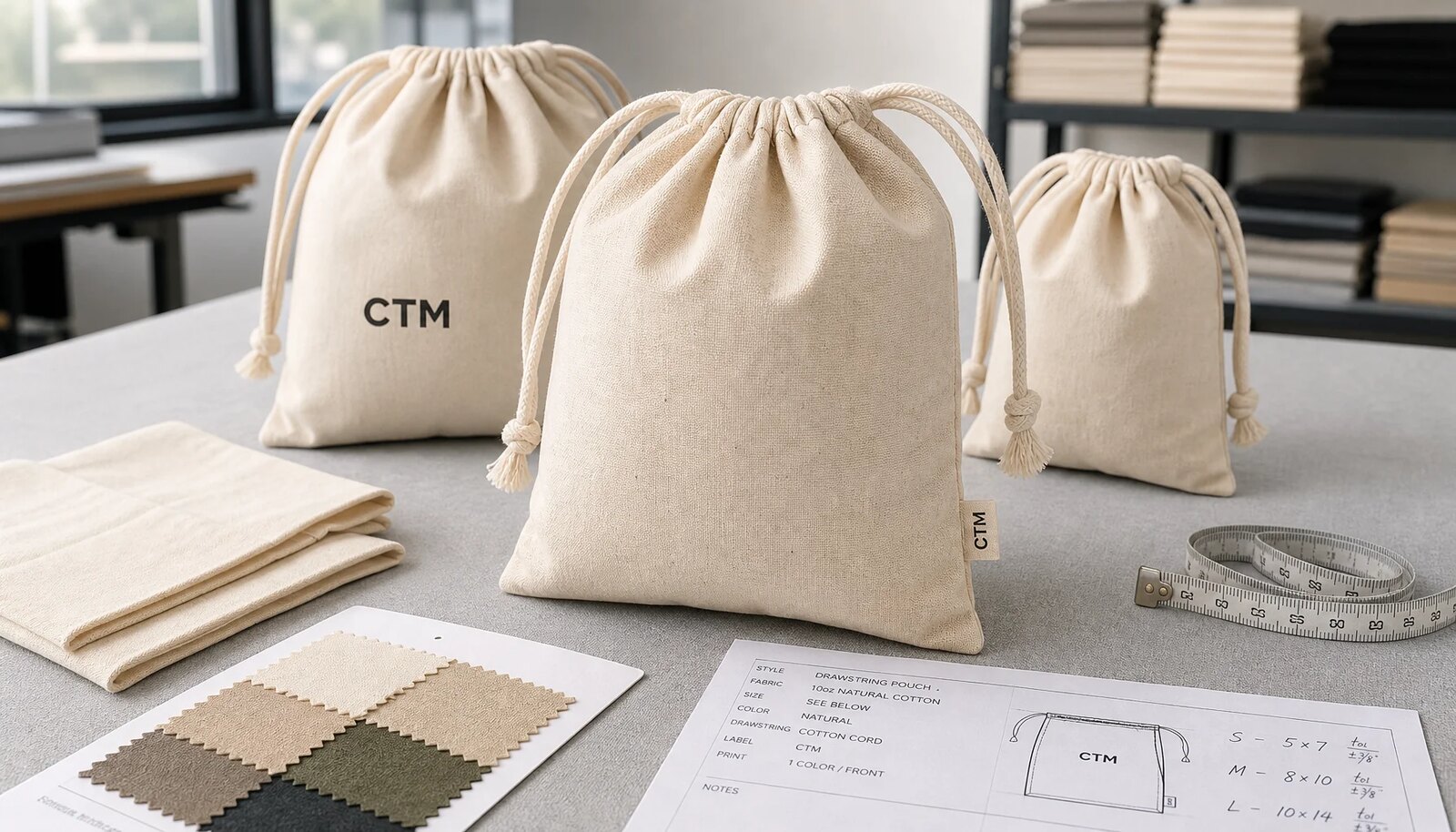
Why compliance is the real sourcing issue on cotton drawstring pouches
Cotton drawstring pouches look simple, which is why procurement teams often under-specify them. The commercial risk is not whether the pouch can be sewn. The risk is whether the pouch matches the exact use case, the exact claim language, and the exact receiving rules attached to the order. A pouch used as apparel dust packaging has a different duty than a pouch sold as a reusable product or used as retail presentation. If the RFQ only says cotton drawstring pouch, suppliers can quote different fabrics, different closures, and different packing methods under the same name, and those quotes are not comparable.
For eco apparel brands, the pouch often sits inside a bigger sustainability story. It may support natural-fiber packaging, reduced plastic, reuse, or a low-impact brand position. That makes the pouch a procurement item and a brand-risk item at the same time. Buyers need more than a sample that looks good on a table. They need evidence for the fabric, construction, and documentation behind the quote, plus a clear link between what the brand says and what the supplier can actually prove.
The most reliable way to reduce risk is to treat the pouch as a technical purchase. Write the specification, define the evidence, and make sure each supplier quotes the same scope. That keeps the process grounded in something procurement can manage: a repeatable spec, a comparable quote, and a sample path that tracks bulk production instead of a showroom version of the product.
- Main risk: buyers compare unit price without comparing fabric, packing, inspection, and evidence scope.
- Common failure mode: re-sampling, relabeling, late document requests, shipment holds, or warehouse rework.
- Best fix: define end use, claim level, sample sequence, and QC thresholds before award.
- Procurement rule: a low price only matters when the quoted scope is the same as everyone else’s scope.
Start with end use before you write the RFQ
The first spec decision is not fabric weight or print method. It is end use. A pouch that sits inside a garment box does not need the same structure as a pouch sold at retail. A pouch used for warehouse kitting may care more about count accuracy and clean packing than visual polish. A pouch used by the consumer as a reusable item may need better shape retention, better closure function, and a print method that does not feel heavy or crack under use. If the use case is missing, suppliers fill the gap with assumptions, and those assumptions rarely match the brand’s real expectation.
End use also determines what the pouch must survive. If the pouch holds folded apparel, the priority is appearance and stable closure. If it holds cosmetics, accessories, or boxed items, the seam and channel take more load. If it will be opened repeatedly, cord movement matters more than a one-time gift presentation. Buyers should describe the fill scenario in the RFQ, not just the dimensions. That makes the quote more accurate and the sample more meaningful.
A strong RFQ states the contents, approximate fill weight, whether the pouch is reusable, and whether the pouch will be seen empty or filled in the final customer journey. It also states if the pouch is packaging, a merchandising item, or a resale product. That language is simple, but it removes a large amount of ambiguity before the supplier quotes the order.
- State whether the pouch is for dust protection, gift packaging, resale, in-store presentation, e-commerce kitting, or internal logistics.
- List the expected contents, approximate fill weight, and whether sharp corners, zippers, bottles, or folded apparel may stress the fabric.
- Clarify whether the consumer will repeatedly open and close the pouch or only receive it once as packaging.
- Identify whether the pouch needs legal, fiber, country-of-origin, care, warning, barcode, or sustainability messaging.
- Tell suppliers if the pouch must pass a retailer receiving guide, brand packaging manual, or internal compliance review before shipment.
Turn the pouch into a measurable technical spec
A useful pouch spec is short, but it is not vague. At minimum, it should define finished width and height, fabric composition, target weight, color, cord details, logo method, label position, packing format, and tolerance. Finished size should be measured flat, empty, and from the same reference points every time. If the buyer changes the measurement method between sample approval and bulk inspection, the dispute is almost guaranteed, even when the pouch is functionally correct.
Fabric weight is one of the biggest cost and quality levers. A lighter cotton in the 140 to 170 GSM range can work for simple packaging or low-load accessories. A standard branded pouch often sits around 180 to 220 GSM for better opacity and a more substantial hand-feel. Heavier cotton around 240 to 270 GSM can create more structure, but it also increases cost, freight weight, and fold bulk. Heavier is not automatically better; it should match the use case, the visual standard, and the distribution path.
Composition has to be explicit. Some suppliers use cotton loosely to mean 100% cotton, cotton blend, recycled cotton blend, or a cotton-like fabric. If the brand needs 100% cotton, say so. If the order needs organic cotton, recycled content, or no special claim at all, that should also be written. If the buyer leaves the material claim open, the quote can drift long before production starts.
- Finished size tolerance: commonly around +/-5 mm for small styles and +/-10 mm for larger styles, unless the construction calls for tighter control.
- Fabric weight: use a target GSM and ask the supplier to state the actual tolerance they can hold in bulk.
- Composition: write the exact requirement, such as 100% cotton, cotton blend, recycled content, or organic cotton.
- Color: specify natural, bleached, dyed, or custom color, and attach an approved swatch or Pantone reference if applicable.
- Measurement: define whether size is taken from seam to seam, edge to edge, or from the visible body only.
Match sustainability claims to evidence before you price the order
Eco apparel brands often want the pouch to reinforce the packaging story, but the claim language has to be controlled. Cotton, organic cotton, recycled cotton, reusable, plastic-free packaging, and lower-impact packaging do not mean the same thing. Each claim can require a different level of support, and the support has to match the exact product, site, and production period. Procurement should not let the supplier choose the claim wording casually. The claim belongs to the brand brief, not to the sales quote.
The right approach is to start with the exact claim the brand will use, then ask what evidence supports it. If the claim appears on the pouch itself, the review bar is higher than an internal purchasing note. If it appears on a retail hangtag, a wholesale line sheet, or a product page, the brand may need marketing, legal, or retailer approval. If no claim will be made, keep the scope clean and do not pay for extra documentation that has no business value.
It is also important to separate product capability from document capability. A sewing factory may be able to make the pouch but not own the fabric proof. A trader may collect documents but not control the sewing line. That is workable if the chain is transparent. Problems start when a supplier says compliant without identifying what the document is, what lot it covers, and whether it matches the actual production site. Evidence should be requested before order approval, not after goods are packed.
- Write the exact claim wording before asking suppliers for documents.
- Confirm where the claim appears: pouch print, side label, hangtag, carton, product page, invoice, or internal specification.
- Ask whether evidence comes from the sewing factory, fabric mill, yarn supplier, printer, trader, or certification holder.
- Check document validity dates and whether they cover the fabric, production period, and supplier site used for the order.
- Avoid broad document requests when the brand will not use a claim; unnecessary requirements increase cost and delay.
Use quote questions that expose real supplier capability
A competitive quote is only useful if all suppliers are quoting the same thing. That means the RFQ needs to force line-item clarity. Ask the supplier to split fabric, cutting, sewing, cord, printing, labels, inspection, packing, cartons, and documents. If the quote only gives one price per piece, the buyer cannot tell whether the supplier is underpricing the construction, using lighter fabric, or excluding packing labor that will show up later as a surcharge.
The same logic applies to MOQ and setup costs. MOQ is rarely one number. There may be separate minimums for pouch size, custom color, print artwork, print color, cord color, label type, and packing format. A supplier with a low headline MOQ may still require a large order once the buyer adds multiple SKUs or special packing. The only way to compare suppliers fairly is to ask what changes at each price break and what gets charged once the order leaves the simple base case.
The best quote questions also reveal process control. Ask who actually sews the pouch, who prints it, who approves the first piece, who signs off on defects, and who owns corrective action. Ask for a pre-production sample in the exact quoted fabric and packing method. If the supplier cannot answer those questions clearly, the quote is not ready for award, even if the unit price looks attractive.
- Ask for base pouch price plus separate line items for print, label, packing, testing, inspection, and cartons.
- Ask what changes at each MOQ or price break so you can compare real scope, not just headline unit price.
- Ask who owns each process: fabric sourcing, dyeing, cutting, sewing, printing, trimming, inspection, and export packing.
- Ask for a pre-production sample in the exact fabric, cord, logo method, and packing method quoted for bulk.
- Ask what the supplier considers a major defect versus a minor defect before the order is placed.
Compare supplier types by control, not by sales language
Different supplier types can all make a cotton drawstring pouch, but they do not offer the same level of control. A direct sewing factory usually gives the best visibility into cutting, sewing, first-piece approval, and corrective action. A trading company can help coordinate mixed orders or extra services, but the buyer needs to know who actually owns QC decisions. A specialist pouch maker often handles construction details better than a generalist, especially when seam allowance, cord channel, or reinforcement matter.
The right choice depends on the order shape. If the order is simple, repeated, and price-sensitive, a capable factory may be the cleanest route. If the order has multiple sizes, label variations, or packing instructions, a supplier with stronger coordination can save time. If the order is claim-sensitive or retailer-facing, supplier transparency becomes more important than the lowest price. In every case, the buyer should verify the real manufacturing site, not only the company name on the quote.
The easiest way to compare suppliers is to force the same evidence. Ask all bidders for the same sample, the same line-item quote, the same document list, and the same packing rules. If one supplier quotes stock natural cotton and another quotes custom dyed fabric with extra packing, the prices should not be compared directly. Procurement only gets a useful answer when the scope is identical.
- Direct factory: best when construction control and bulk repeatability matter most.
- Trading company: best when you need coordination across multiple SKUs or packing formats, but verify who owns the factory and QC.
- Specialist pouch maker: best when seam detail, cord function, and repeat orders are central to the program.
- Retail-ready supplier: best when barcode labels, bundle counts, and carton routing are part of the requirement.
- Low-cost generalist: only use when the spec is loose and the buyer is ready to inspect tightly.
Lock down logo, labels, and artwork tolerances early
Logo execution is one of the most visible failure points on cotton drawstring pouches. Most eco apparel brands use one-color or two-color artwork, and screen print is often the cleanest option for simple logos on cotton. It is usually easier to control on textured fabric than a highly detailed print. Digital print can support more complex artwork, but the buyer needs a strike-off on the actual fabric because the result on cotton often differs from the PDF. Heat transfer can produce sharp detail, but some buyers reject the film-like hand-feel on a reusable pouch.
Labels need the same level of discipline. If the pouch uses a side label, care label, or brand tab, the supplier should confirm the size, fold, stitch position, and orientation. The buyer should not assume the factory will place the label where the artwork mockup shows it. The seam allowance, drawstring channel, and fold direction can shift the label position by enough to matter visually. For that reason, label placement should be measured from a fixed reference point in the tech pack.
Artwork files should be production-ready. The RFQ should include logo dimensions, placement from the top edge or centerline, print color reference, and whether the print must align after the pouch is filled. For small logos, a placement tolerance around +/-3 mm is often practical; for larger front prints, +/-5 mm is a more realistic starting point. If you do not define this before sampling, every later inspection becomes subjective.
- Screen print: best for simple solid logos, limited colors, and repeatable production.
- Digital print: useful for detailed artwork, but approve color on the actual cotton base.
- Heat transfer: good for crisp detail, but test hand-feel, adhesion, and surface compatibility.
- Woven label or embroidery: suitable for premium programs, but confirm MOQ, placement, and seam impact.
- Approve a strike-off on production fabric and write logo placement tolerance into the PO.
Build a sample path that proves bulk repeatability
A good sample process proves more than appearance. It should confirm that the supplier can repeat the quoted fabric, size, cord, print method, seam construction, label placement, and packing method in bulk. Many sourcing problems happen when the buyer approves a sample made from substitute fabric or made in a sample room that will not actually run the bulk order. The sample looks right, but it is not a production reference, and that gap shows up only when the first cartons arrive.
The sample path should move in stages. Start with a fabric swatch when color, weight, or hand-feel are still open. Then approve a print strike-off on the actual fabric. Next, request a pre-production sample in the exact construction that will be used in bulk. If the order includes SKU separation, barcode labels, or retailer receiving rules, add a packing sample before release. Keep one signed retention sample with the date, measurements, and key notes so there is a shared reference if the bulk result changes.
Do not leave critical notes in scattered emails. The approved sample should be tied to the purchase order or technical file. Record the acceptable natural-cotton appearance, the exact size method, the print position, the cord details, and the accepted label placement. That record is what the buyer uses when a bulk carton arrives and the factory says the result is within normal variation. If the standard is not written down, the dispute has no anchor.
- Swatch approval: fabric color, GSM, hand-feel, weave, and natural character.
- Print strike-off: ink type, color, opacity, hand-feel, artwork size, and placement reference.
- Pre-production sample: exact pouch size, seam style, cord, pull direction, label, and logo method.
- Packing sample: fold method, inner pack quantity, carton mark, barcode label, and SKU separation.
- Retention sample: signed and dated sample held for inspection and dispute resolution.
Set QC thresholds before production starts
Cotton drawstring pouches fail in predictable ways: size variation after sewing, uneven channels, weak seams, cord fray, logo drift, loose threads, stains, odor, and carton count errors. These are all preventable or at least controllable if the inspection standard is written before production. Vague language like good quality gives the supplier too much room to interpret the finish after the goods are already made. In a low-value soft good, that is where problems become expensive.
A practical QC plan separates critical, major, and minor defects. Critical issues include wrong material against the approved spec, mold, restricted substance concerns, or labeling that creates legal or retailer risk. Major issues include open seams, nonfunctional drawstrings, obvious logo misplacement, severe stains, incorrect size outside tolerance, missing labels, or carton counts that do not match the PO. Minor issues may include loose threads that can be trimmed or small slubs that are within the approved natural-cotton standard. The purpose is not to make every order perfect. It is to keep the inspection logic consistent.
If your team already uses AQL, state it in the PO and make sure the supplier knows the acceptance logic before shipment. If your team does not use AQL, a simple defect checklist is still better than no rule at all. For low unit-value pouches, the real risk is not only rework cost. It is shipment delay. A small defect in a pouch can stop an apparel launch if the pouch is part of the retail packing program.
- Measure finished size flat using the agreed reference points and tolerance.
- Check seam strength, channel opening, cord movement, and closure after repeated pulls.
- Verify logo placement from the same reference point used in the approved artwork.
- Inspect for oil marks, needle stains, mildew odor, ink transfer, carton dust, and foreign fibers.
- Check carton count, SKU split, label accuracy, and packing list match before shipment release.
- Ask the supplier to do a simple filled-function test if the pouch will hold product or be reused by consumers.
Write packing, freight, and release rules into the PO
Packing changes landed cost, receiving speed, and perceived quality. Cotton pouches are soft, so buyers sometimes assume packing is straightforward. In practice, soft goods are easy to miscount, mix by SKU, compress unevenly, or contaminate with carton dust. If the pouches support an apparel launch, a carton count mistake can disrupt kitting or distribution even when every pouch is sewn correctly. The risk is operational, not cosmetic, and it often shows up late.
The right packing method depends on downstream handling. Bulk packing may work when the pouches go to a warehouse for local kitting. Inner bundles can improve count control without adding individual polybags. Individual bags can protect cleanliness and simplify unit handling, but they add material and labor that may conflict with an eco packaging position. Some brands prefer paper bands, recyclable sleeves, or direct carton packing by SKU. Whatever the route, it should be quoted and sampled so the team can compare the true landed cost.
Carton details matter as much as the pouch itself. Ask for units per inner pack, units per export carton, carton dimensions, gross weight, net weight, carton board grade, and whether moisture control is needed for ocean freight. If the goods ship by air, carton cube and weight affect freight cost. If the goods ship to a retailer distribution center, carton marks and barcode labels may matter more than the pouch style. The PO should name the packing plan, not leave it to factory habit.
- Define bulk pack, bundle pack, individual bag, paper band, or retail-ready packing before final quote.
- State units per inner pack and export carton, plus carton dimensions and gross weight.
- Clarify whether individual plastic packaging is allowed, restricted, or banned by the brand.
- Use carton assortment lists for mixed sizes, colorways, or purchase orders.
- Require carton marks, barcode labels, and SKU separation to match the receiving guide.
Specification comparison for buyers
| Supplier option | What to verify | Commercial advantage | Buyer risk to control |
|---|---|---|---|
| Direct sewing factory | cord material proof, reinforcement close-ups, load-test photos, approved sample tag, and bulk-line first-piece record | Better sample-to-bulk control and faster production feedback | May be weaker on export paperwork or branded packing unless checked early |
| Trading company | Factory name, production photos, trim-source proof, and who owns QC decisions | Can coordinate small mixed orders and extra services | Markup can hide real factory capability and slow defect decisions |
| Specialized bag workshop | cord diameter, eyelet or reinforced channel, bottom corner reinforcement, seam allowance, bar-tack position, and load target | More practical for detailed construction, trims, and repeat programs | Capacity may be limited during peak seasons |
| Low-price general supplier | 6-10 oz cotton canvas, 210D polyester, rPET, or blended cotton with shrinkage and colorfastness expectations set before sampling | Useful for simple promotional runs with loose specs | Material downgrades, weak packing, and vague inspection scope can erase savings |
| Retail-ready supplier | fold direction, cord protection, bundle count, carton compression, moisture bag, and retail label position | Can handle labels, SKU separation, carton marks, and receiving rules | Higher unit cost must be compared against reduced warehouse work |
| Compliance-focused supplier | Fabric records, labeling review, test plan, and production traceability | Safer for retail programs and repeat brand orders | Documentation claims need evidence, not only sales language |
| Local sample room plus bulk factory | Signed sample, bulk factory handoff, first-piece photos, and deviation owner | Good for complex branding before large production | Sample room quality may not match bulk line unless handoff is controlled |
Buyer checklist before sampling
- Define the end use first: inner apparel packaging, dust bag, gift bag, e-commerce insert, retail display item, or a resale product.
- State finished size in millimeters with tolerance and specify whether the measurement is flat, empty, before filling, and taken from seam to seam or edge to edge.
- Specify fabric composition, target GSM or ounce weight, weave type, color, and whether the order must be 100% cotton, organic cotton, recycled content, or simply natural cotton with no claim.
- Confirm whether the pouch will carry sustainability wording on the pouch, hangtag, carton, product page, or wholesale document, and make the supplier price that scope separately.
- Ask for a line-item quote that separates fabric, cutting, sewing, cord, print, labels, packing, testing, inspection, and export carton costs.
- Choose the logo method based on artwork and use: screen print for simple solid logos, digital print for detailed art, woven label or embroidery for premium presentation, and heat transfer only if the hand-feel is acceptable.
- Set cord requirements in writing: material, diameter, color, end finish, and whether plastic or metal tips are allowed by the brand or retailer.
- Request a sample sequence that includes a fabric swatch, a print strike-off on actual fabric, a pre-production sample, and a packing sample when SKU separation, barcode labels, or retailer receiving rules matter.
- Ask the supplier to identify which processes are in-house and which are outsourced: fabric sourcing, dyeing, cutting, sewing, printing, trimming, inspection, and final packing.
- Request carton dimensions, units per inner pack, units per export carton, estimated gross weight, carton board grade, and whether moisture control or desiccant is needed for ocean freight.
Factory quote questions to send
- Is sewing done in your own factory or by subcontractors, and can you identify the site that will produce this order?
- Which processes are in-house and which are outsourced: fabric sourcing, dyeing, cutting, sewing, printing, trimming, inspection, and export packing?
- What cotton fabric weights do you run regularly for drawstring pouches, and which are stock greige fabric versus special purchase?
- What GSM tolerance can you control in bulk production, and how do you verify it before cutting?
- Can you quote the pouch with fabric weight, cord material, logo method, packing method, and compliance documents listed as separate line items?
- Can you provide a pre-production sample in the exact fabric, cord, size, print method, and packing method quoted for bulk?
- For our logo, what print method do you recommend and why: screen print, digital print, heat transfer, embroidery, or woven label?
- What print-placement tolerance can you hold in bulk, and from which reference point should it be measured?
- What MOQ applies to the pouch body, each size, custom fabric color, each print artwork, each cord color, and each packing format?
- How do you pack different sizes or SKUs by carton, and can you follow a carton assortment plan by PO, SKU, or barcode label?
Quality-control points to confirm
- Finished size should be measured flat and empty using the same reference points as the approved sample; many buyers use about +/-5 mm for small pouches and +/-10 mm for larger pouches, unless the construction requires a different allowance.
- Fabric should match the approved hand-feel, target weight, weave, and color; set a clear tolerance for natural cotton variation so mild slubs or tone differences are not treated as defects unless they exceed the approved standard.
- The supplier should verify fabric weight before cutting by weighing a measured fabric area or by another documented method agreed before production.
- Drawstring channels must be even, open, and functional, with no missed stitching, trapped cords, twisted cord insertion, or blocked pull action.
- Cord material, color, diameter, pull direction, knot finish, and any cord tip must match the approved sample and allow repeated opening and closing without fray or snagging.
- Print placement should follow the approved artwork position with a visible tolerance in the PO; many buyers use about +/-3 mm for small logos and +/-5 mm for larger front prints.
- Print quality should be checked for smearing, pinholes, cracking, poor opacity, heavy hand-feel, ink migration, and color mismatch against the approved strike-off.
- Seams should be secure with no open seams, skipped stitches in stress areas, loose threads that affect appearance, or puckering that prevents smooth closure.
- Units must be clean and dry: no oil marks, needle stains, mildew odor, ink transfer, carton dust embedded in the fabric, or foreign fibers.
- Packing quantity by inner pack, outer carton, SKU, colorway, and purchase order must match the packing list; count errors are a shipment defect even when the pouch itself is acceptable.