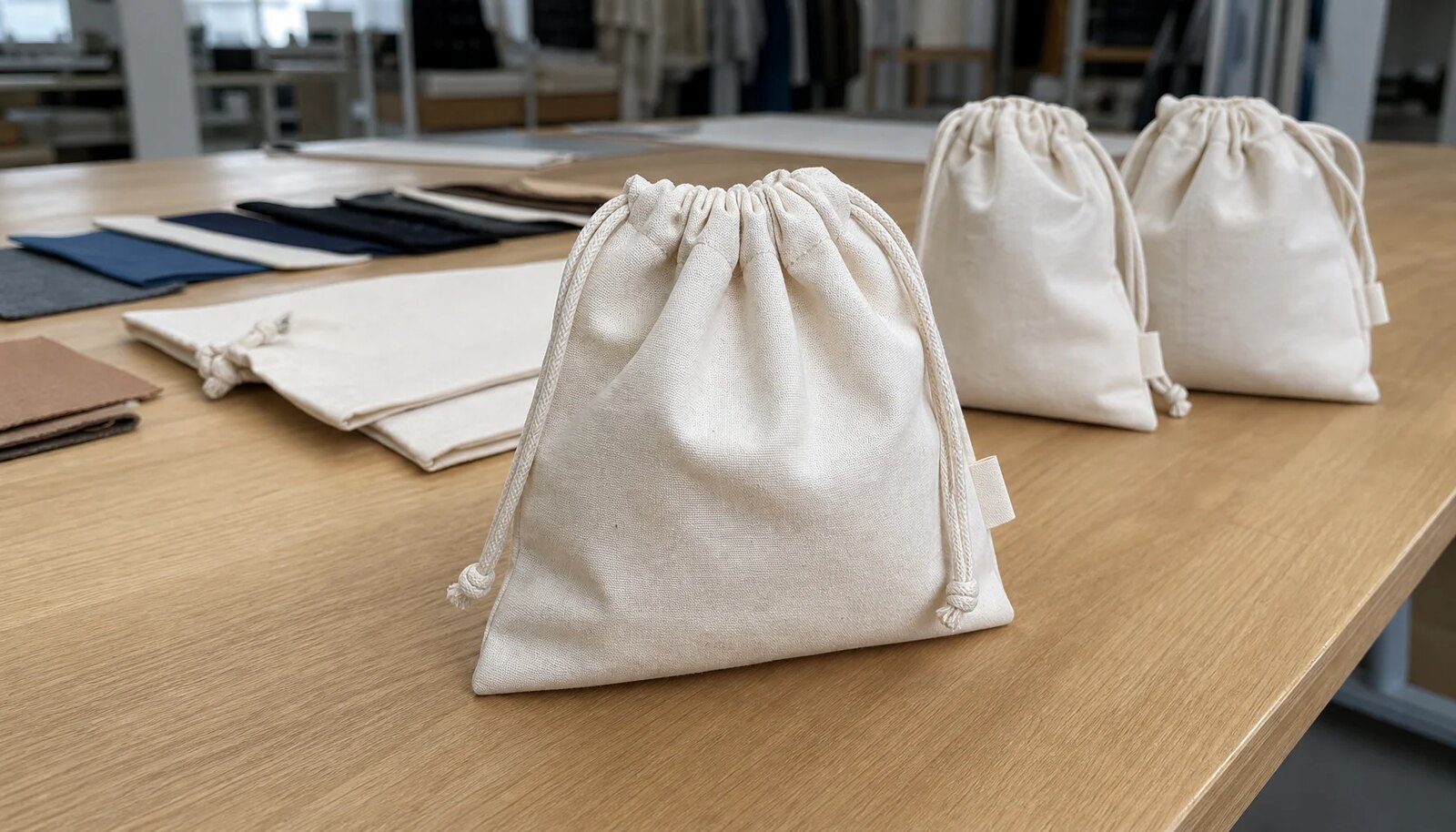
Start with the pouch job
Cotton drawstring pouches for eco apparel brands should be specified from the job they need to perform, not from a product photo. A pouch used as a sock insert can be light, simple, and bulk packed. A pouch holding a premium hoodie gift set needs better opacity, smoother cord movement, cleaner seams, and more careful print control. A pouch shipped beside a light-colored garment also needs tighter odor, crocking, and dye-transfer checks.
The buying brief should separate three ideas that often get mixed together: presentation, protection, and sustainability claim. Natural cotton may give the right visual signal, but it does not automatically support an organic, recycled, plastic-free, or certified claim. If the pouch is customer-facing or retailer-facing, the claim language must match the material documents available through the supplier route.
This first decision also keeps the RFQ from becoming vague. When suppliers know the channel, packed product, target hand feel, claim level, artwork, and packing method, they can price the same pouch instead of guessing different versions.
- Write the channel into the RFQ: DTC, retail, wholesale, gift set, subscription box, sample kit, or internal kitting.
- Confirm what the pouch must protect: garment surface, trims, care cards, metal accessories, hangtags, or only presentation value.
- State whether the pouch is customer-facing, retailer-facing, or operational packaging only.
- Define the sustainability claim separately from the fabric appearance.
Choose GSM by use, not habit
GSM is one of the largest cost and performance levers, but heavier is not always better. A tight 130 GSM plain weave may print cleaner than a loose 160 GSM fabric. A 180 GSM pouch can feel more reusable, yet it may increase freight weight, reduce carton efficiency, slow sewing, and create bulk at the drawcord tunnel. The useful target is the lightest fabric that meets the brand, handling, and packing requirement.
For many apparel programs, 120-140 GSM is the practical starting point. It works for T-shirts, socks, underwear, accessories, care kits, and e-commerce inserts when the weave is stable. A 150-160 GSM fabric gives better opacity and a more substantial hand feel for premium unboxing or gift programs. Above 180 GSM, the pouch behaves more like a small canvas bag and should be justified by reuse, heavier contents, or a specific retail presentation standard.
The PO should say how GSM will be controlled. Suppliers may quote from a sales swatch, mill estimate, or stock fabric. For bulk approval, ask for measured GSM from production fabric rolls and state the tolerance. Plus or minus 5 percent is a common buyer-specified example for standard cotton pouch programs, but it is not a universal rule; stricter brand or retailer requirements should override it.
- 110-120 GSM: light promotional inserts or short-life packaging where cost and low weight matter most.
- 120-140 GSM: standard apparel pouch range when print detail and opacity are not extreme.
- 150-160 GSM: stronger hand feel, better opacity, and more premium presentation.
- 180 GSM and above: reusable kits, heavier accessories, or structured gift sets where freight impact is acceptable.
- Always approve GSM together with weave, opacity, print result, and finished pouch feel.
Match cotton claim to documents
Eco apparel buyers can choose conventional cotton, unbleached natural cotton, organic cotton, OCS cotton, GOTS-certified cotton, or recycled cotton blend. These choices are not interchangeable once the brand publishes a claim. A natural unbleached pouch may support a lower-plastic packaging story, but it does not support an organic claim without chain-of-custody documentation.
For OCS or GOTS programs, request the supplier's valid scope certificate and transaction certificate where required for the shipment. Check whether the certificate covers the finished pouch supplier, not only the fabric mill. If only the fabric is certified and the sewing or printing route is outside the certified scope, the finished-product wording may need to be narrower.
Recycled cotton blends need the same discipline. They may create a useful waste-reduction story, but buyers should expect more texture variation, shorter fibers, neps, and possible shade inconsistency. That can work well for a natural pouch, but it should be approved intentionally. Ask for composition documentation and define whether slubs and shade variation are acceptable or defects.
For basic unbleached cotton with no certified claim, a composition statement and restricted substances declaration may be enough for some channels. Retailers, destination markets, and brand legal teams may require more, so documentation should be matched to the actual selling route.
- Use conventional cotton when no certified material claim will be made and cost is the main driver.
- Use natural unbleached cotton for a visual eco cue, while controlling shade, stains, and odor.
- Use OCS or GOTS only when certificates and shipment-linked documents support the claim being used.
- Use recycled cotton blends when texture variation is acceptable and recycled-content documents are available.
- Ask suppliers what exact claim words their documents can support.
Control weave, finish, and color
Weave changes print quality, hand feel, and durability. Plain woven cotton is the safest default for most drawstring pouches because it balances cost, sewing stability, and decoration performance. A tighter weave supports sharper logo edges and better opacity. Canvas adds structure, but it can feel bulky on small pouches. Muslin-style fabrics can reduce cost, yet may look too transparent or informal for premium apparel packaging.
Finish and color route add risk. Bleached white fabric gives a cleaner background for brand colors but may need stronger chemical documentation. Natural cotton gives the expected eco look, but shade can vary by lot. Dyed and pigment-dyed pouches can match seasonal brand palettes, yet they require colorfastness, crocking, restricted-substance, and shade-control checks. Washed cotton can feel soft and reusable, but shrinkage must be known before final dimensions are approved.
Color approval should be physical. For dyed pouches, request a lab dip or production fabric swatch and set an acceptable Delta E where practical. For natural cotton, approve a shade band rather than pretending every lot will match exactly. For printed artwork, approve ink on the final fabric because the same logo color can shift between bleached, raw, and dyed cotton.
- Choose tighter fabric for fine logos, small text, or QR codes.
- Approve a master shade and limit shade for natural cotton programs.
- Require crocking checks when dark dye, dark cord, or heavy ink may contact light garments.
- Approve finished dimensions after wash testing when a washed finish is used.
Select print method around artwork
Screen printing is usually the commercial default for cotton drawstring pouches with bold logos and one-to-three spot colors. It works well for repeat orders because setup cost is spread across volume, and opacity can be strong when the ink is cured correctly. It is less suitable for very fine reversed text, gradients, photographic artwork, or many small seasonal design changes.
Digital printing or transfer can be better for low MOQs, multiple color artwork, gradients, or frequent collection changes. The tradeoffs are hand feel, surface shine, edge softness, durability, and sometimes a less natural packaging impression. Eco apparel brands should approve not only the visual result but also whether the decoration feels aligned with the product story.
Placement needs numeric control. A centered logo should be measured from fixed pouch points such as side seams, bottom edge, or drawcord tunnel. Artwork should avoid bulky seam areas and cord exits. For inspection, buyer-specified examples include plus or minus 3 mm placement tolerance for small logos and plus or minus 5 mm for larger artwork, adjusted for pouch size and retail visibility.
- Use screen print for repeat orders, bold marks, and limited spot colors.
- Use digital or transfer for low MOQ, gradients, many colors, or frequent artwork changes.
- Approve print on final fabric, not on a generic panel.
- Define color reference, placement, registration, curing, rub resistance, odor, and acceptable hand feel.
- Keep SEO phrasing natural; the keyword belongs in metadata and useful editorial context, not forced wording.
Engineer construction details
A drawstring pouch is a small sewn product, so small construction choices matter. The top hem must be deep enough for a smooth cord tunnel. Seam allowance must be consistent enough that the usable internal size still fits the garment. Drawcord exits need reinforcement or clean finishing so they do not tear during packing or customer use.
Single drawcord pouches are economical and suitable for lightweight inserts. Double drawcord pouches close more evenly and feel better for reusable storage or gift sets. Cotton cord supports a stronger fiber story, while polyester cord may offer brighter colors, cleaner surface, and better fray resistance. If the brand says cotton pouch, clarify whether that statement includes the cord.
Stitch density should be specified as a range rather than left to habit. Many cotton pouches fall around 6-10 stitches per inch, depending on GSM, thread, and seam type. Too few stitches can weaken seams; too many can perforate light fabric or cause puckering. Reinforcement at cord exits and seam ends usually matters more than simply increasing stitch density everywhere.
Finished size should be based on the folded product. Measure the actual garment, add clearance for warehouse packing, and define both outside flat size and usable internal size. A pouch that is too tight slows packing and strains seams; one that is too large weakens presentation and may increase carton volume.
- Specify single or double drawcord, cord material, diameter, length, knotting, and end finish.
- Define top hem depth, tunnel width, seam allowance, reinforcement, and loose-thread limits.
- Clarify whether size means cut panel, flat finished size, or usable internal size.
- Test the approved size with the actual folded garment before bulk release.
Compare supplier routes clearly
Supplier route affects quality as much as unit price. A direct pouch factory can be efficient for repeat programs with stable specifications. An integrated sewing and printing supplier can reduce schedule risk when artwork consistency matters. A trading company can help consolidate low-volume mixed packaging orders, but buyers should understand which factory is actually cutting, sewing, printing, and packing.
Ask which processes are in-house and which are subcontracted. In-house production is not automatically better, and specialist subcontractors may be the right choice for certain print methods or certified materials. The important control is disclosure. If printing or sewing moves after sample approval without notice, the golden sample loses much of its value.
Traceability and audit access should match order risk. A simple natural cotton pouch may only need basic composition and chemical declarations for some channels. A certified organic, recycled-content, or retailer-facing pouch may require facility information, certificate checks, material lot records, and third-party inspection access. Refusal to identify the production location is a warning sign for quality and claim control.
- Use direct factories for repeat programs with stable specs and ongoing inspection needs.
- Use integrated sewing and printing suppliers when artwork control and speed matter.
- Use traders when consolidation is valuable, but require factory disclosure.
- Confirm audit access, subcontracting rules, lot traceability, and inspection access before deposit.
- Match documentation depth to destination market, retailer rules, and published brand claims.
Build a comparable landed-cost quote
The lowest ex-factory price is rarely the full sourcing answer. Cotton pouch quotes may include or exclude screen setup, sample fees, label sewing, inner packing, export cartons, barcode labels, inland transport, documentation, and inspection. If those costs are hidden, a cheap quote may simply be an incomplete quote.
Use one RFQ format for every supplier. Include finished size, GSM, weave, cotton claim, cord spec, artwork, print method, quantity, SKU split, packing format, Incoterm, destination, document requirements, sample requirements, and QC plan. Then ask for separated price lines. This makes it easier to see whether a supplier is expensive because the fabric is better, because setup is included, or because packing assumptions are stricter.
Landed cost also changes with weight and carton efficiency. Moving from 130 GSM to 180 GSM may look minor at unit-price level but increase freight and reduce carton quantity. Individual retail packing adds labor and volume. Multiple artwork versions increase setup cost and inspection complexity. Compare cost per acceptable pouch delivered to the warehouse, not just cost per piece at the factory gate.
- Request price lines for base pouch, decoration, setup, samples, labels, packing, cartons, inland handling, documents, inspection, freight, duty, and contingency.
- Quote first-order and repeat-order pricing separately.
- Do not mix EXW, FOB, CIF, and DDP quotes without normalizing the cost basis.
- For small orders, setup and sample charges may matter more than minor unit-price differences.
- For large orders, material yield, defect rate, and carton efficiency become more important.
Approve samples and inspect bulk
Sampling should remove uncertainty before bulk cutting. A development sample can confirm concept, size, and general hand feel, but it should not release production if it uses substitute fabric, substitute cord, mock artwork, or a different sewing route. The pre-production sample should use final fabric, cord, construction, decoration, and packing assumptions.
Seal a golden sample with PO number, SKU, approved fabric or lot reference, artwork version, approval date, and buyer sign-off. Keep one with the buyer or inspector and one with the factory. This physical reference is especially useful for cotton because hand feel, natural shade, print opacity, seam neatness, and cord movement are hard to capture in words.
For higher-risk programs, add top-of-production approval. Review the first finished pieces before thousands are completed, especially when using a new supplier, dyed fabric, certified cotton, new artwork, or strict retailer rules. Early checks can catch print shift, blocked tunnels, seam puckering, shade drift, and cord issues while correction is still practical.
Inspection must be measurable. State the AQL plan, defect classes, measurement method, and tolerances in the PO. Buyer-specified examples include ANSI/ASQ Z1.4 general inspection level II, AQL 2.5 for major defects, AQL 4.0 for minor defects, plus or minus 5 mm for many small to medium pouch dimensions, plus or minus 5 percent GSM, plus or minus 3 mm small-logo placement, and Delta E 2.0-3.0 for strict brand colors where suitable. These are commercial examples, not universal standards, so the buyer's quality manual should lead.
- Approve bulk only from a pre-production sample made with final materials and process.
- Label and seal golden samples for buyer, inspector, and factory reference.
- Use top-of-production checks for new suppliers, dyed goods, certified claims, or strict artwork.
- Inspect dimensions, GSM, stitch density, cord function, print placement, rub resistance, odor, stains, carton count, and packing marks.
- Classify serious appearance, contamination, seam, cord, and dye-transfer issues before inspection begins.
Specification comparison for buyers
| Material decision | Buyer-specified example range | Best-fit apparel use | Approval check |
|---|---|---|---|
| Fabric weight | 110-120 GSM for light inserts; 120-140 GSM for standard apparel packaging; 150-180 GSM for premium or reusable pouches | Socks, underwear, T-shirts, accessories, gift sets, sample kits | Measure GSM from bulk fabric lots and state the allowed tolerance, such as plus or minus 5 percent when suitable for the program |
| Cotton claim | Conventional, unbleached natural cotton, organic cotton, OCS, GOTS, or recycled cotton blend | Brands matching packaging to sustainability copy, retailer files, or product positioning | Confirm which exact claim is printed or published and request supporting documents before PO release |
| Weave and surface | Plain weave for most pouches; tighter weave for cleaner print; canvas for heavier reusable packs | Logo pouches, e-commerce packing, premium apparel presentation | Check opacity, slubs, hairiness, shade band, print edge quality, and whether natural variation is acceptable |
| Color route | Natural unbleached, bleached white, fabric dyed, pigment dyed, or washed finish | Natural packaging stories, seasonal brand colors, retail gift packs | Approve lab dip or shade band and define Delta E or visual tolerance before cutting bulk fabric |
| Cord specification | Cotton cord 3-5 mm for fiber alignment; polyester cord when strength or bright color matching is prioritized | Single drawcord for economy; double drawcord for smoother closure | Verify cord material, diameter, length tolerance, knot or end finish, pull resistance, and claim consistency |
| Decoration method | Screen print for bold 1-3 color artwork; digital or transfer for gradients, many colors, or lower MOQ designs | Brand logos, QR marks, collection graphics, care messaging | Approve print on final fabric and set placement, registration, color, curing, rub, and odor checks |
| Construction | Double-fold top hem, clear cord tunnel, locked seams, reinforced exits, often 6-10 SPI depending on fabric | Pouches handled in packing lines, retail displays, and customer reuse | Measure finished size, usable internal size, stitch density, seam security, cord tunnel function, and loose threads |
| Packing format | Bulk by SKU, inner counts, barcode cartons, or retail-ready packs when required | Warehouse receiving, DTC fulfillment, wholesale replenishment | Confirm carton quantity, carton marks, inner pack count, moisture control, and plastic-free packing rules |
Buyer checklist before sampling
- Define the pouch job: primary apparel packaging, protective storage, retail gift bag, e-commerce insert, sample kit, or reusable accessory pouch.
- Measure the folded garment or accessory and specify finished outside size, usable internal size, seam allowance, top hem depth, and drawcord tunnel width.
- Select cotton type and claim level: conventional, natural unbleached, organic, OCS, GOTS, recycled-content blend, or no certified claim.
- List required documents for the claim, such as scope certificate, transaction certificate where relevant, composition statement, restricted substances declaration, dye or finish statement, and lot traceability.
- Choose GSM, weave, color route, and finish, then require the supplier to confirm whether bulk material comes from one lot or multiple lots.
- Specify cord material, diameter, color, length, end finish, knot method, and whether the cord must match the pouch fiber claim.
- Approve artwork size, color reference, placement from fixed pouch points, print method, print hand feel, and acceptable registration shift.
- Ask which processes are in-house and which are subcontracted: fabric sourcing, cutting, sewing, printing, washing, pressing, packing, and carton marking.
- Set measurable QC requirements, including AQL, finished-size tolerance, GSM tolerance, stitch density, print placement tolerance, Delta E or shade band, cord pull check, shrinkage if relevant, and carton count verification.
- Approve a pre-production sample made from final fabric, cord, construction, and print method, then seal a golden sample with PO, SKU, fabric lot, artwork version, and date.
Factory quote questions to send
- What exact fabric composition, GSM, weave, finish, and color route are included in the quoted price?
- What GSM tolerance will you hold in bulk, and will you measure from production fabric rolls or only from supplier swatches?
- Is the cotton conventional, organic, OCS, GOTS, recycled-content blend, or uncertified natural cotton, and which documents support that claim?
- Can you provide mill information, lot traceability, valid scope certificates, transaction certificates where required, and restricted substances declarations for the destination market?
- What finished-size tolerance do you apply, and will you inspect width, height, usable internal size, top hem depth, and tunnel width?
- What cord material, diameter, length tolerance, color, and end finish are included, and what cord pull or repeated-use check can you perform?
- Which processes are in-house, and which may be subcontracted for this order?
- If a subcontractor is used for printing, washing, sewing, or certified material handling, will you disclose it before sampling and allow inspection access or records review?
- What print method, number of colors, setup charge, repeat setup charge, and artwork limitations are included in the quote?
- What inspection plan, AQL levels, defect classifications, and measurement tools will you use for bulk approval?
Quality-control points to confirm
- Use an agreed inspection plan such as ANSI/ASQ Z1.4 general inspection level II with AQL 2.5 for major defects and AQL 4.0 for minor defects, unless the buyer's manual or retailer requirement is stricter.
- State finished-size tolerance in the PO. Buyer-specified examples are plus or minus 5 mm for many small to medium pouches and plus or minus 8 mm for larger apparel pouches, adjusted for fit and retail box requirements.
- Verify fabric GSM from bulk rolls. A buyer may specify plus or minus 5 percent for standard programs, but tighter or wider tolerance should be written when the fabric, claim, or price point requires it.
- Check stitch density against the approved construction. Many cotton pouches use roughly 6-10 stitches per inch, but the final target should match fabric weight, thread, and seam performance.
- Classify open seams, skipped stitches, broken threads at drawcord exits, seam slippage, blocked tunnels, severe puckering, stains, mildew, sharp contamination, and strong chemical odor as major or critical defects depending on risk.
- Test cord function by repeated opening and closing and by a buyer-defined pull check, such as 20 N for 10 seconds per side when appropriate for the pouch size and cord type.
- Check print placement with a ruler or template. Buyer-specified examples are plus or minus 3 mm for small logos and plus or minus 5 mm for larger artwork, with tighter control for retail-facing packs.
- Use approved color standards. For strict brand color, agree a Delta E limit such as 2.0-3.0 where suitable for the substrate; for natural cotton, use approved shade bands when instrument limits are unrealistic.
- Run dry and wet rubbing or crocking checks when dark print, pigment dye, or dark cord may contact light apparel. Visible transfer to the garment-facing surface should be rejected.
- For washed, dyed, or reusable pouches, require shrinkage testing by a buyer-specified method. Example acceptance may be within 3-5 percent, but it must be confirmed before final sizing approval.