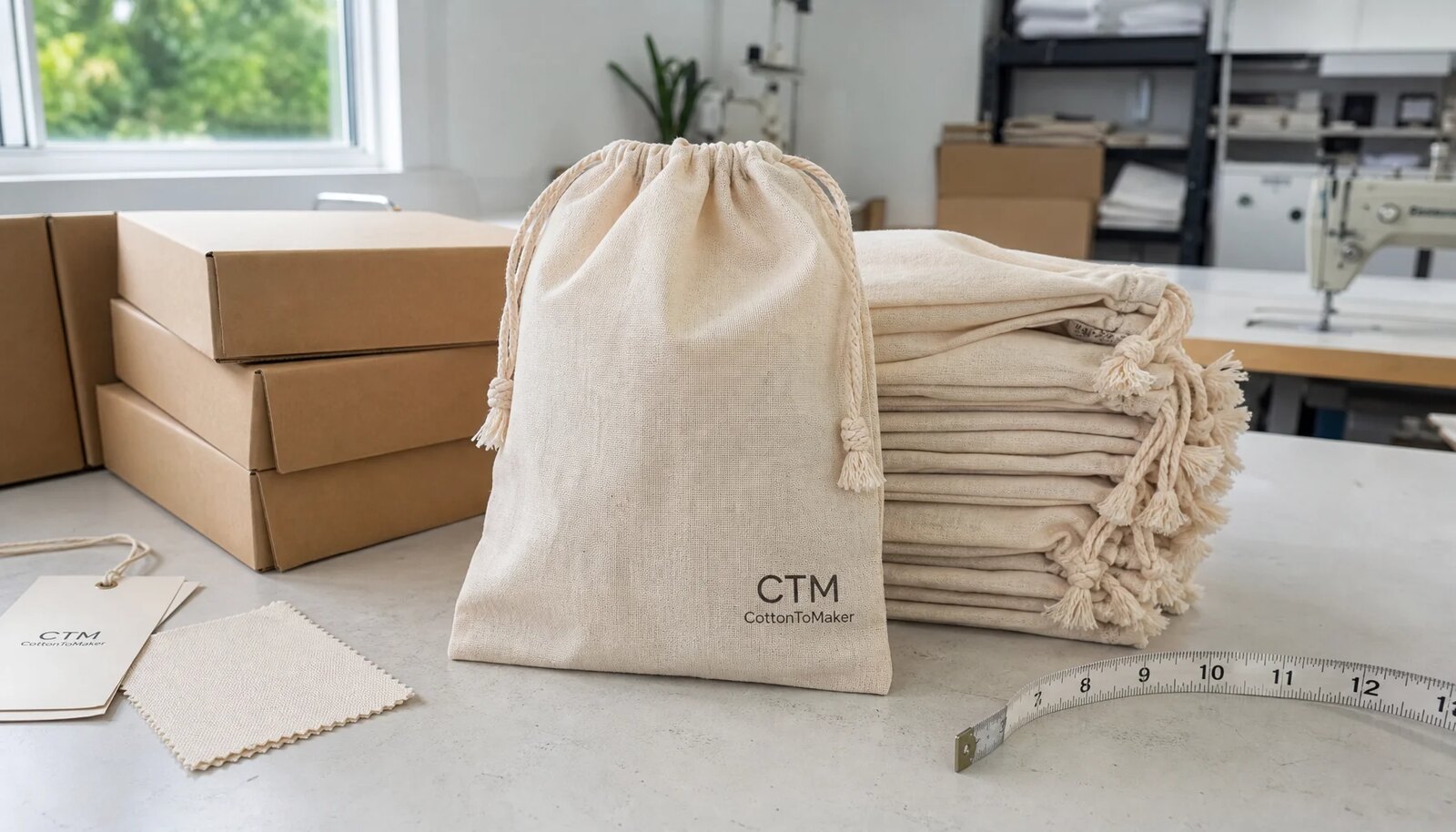
Start carton planning before the pouch is priced
Cotton drawstring pouches for eco apparel brands look easy to buy until freight, receiving, and kitting teams get involved. The sample may be soft, neatly printed, and inexpensive. Then the carton data arrives late, or worse, it arrives as a guess: 300 to 500 pieces per carton, dimensions to be confirmed, gross weight pending. That is not enough for a procurement file. Carton planning belongs in the first RFQ because packing density affects landed cost, shipment timing, warehouse labor, and the condition of the pouch when it reaches the apparel line.
A pouch is light and flexible, so suppliers may compress it tightly or leave it loose depending on the fold, cord bulk, print protection, and carton strength. Two factories can quote the same 140 GSM natural cotton pouch at nearly the same FOB price and still create different landed costs. One may pack 500 pieces per carton but crease the print or overload a weak carton. Another may pack 300 pieces neatly, with a higher carton count but fewer handling issues. Neither approach is automatically right. The buyer needs the numbers and the reasoning.
For freight planning, ask for pieces per carton, carton length, width, height, net weight, gross weight, carton board type, inner packing method, and carton marks. Early values can be labeled estimated, but they should not be missing. Before production release or final freight booking, the supplier should confirm them with a packed sample or a recent production reference using the same pouch size, GSM, cord, and fold method. This turns shipping carton planning from a late scramble into a controlled buying decision.
- Request carton quantity, carton dimensions, net weight, gross weight, and carton board type in the first RFQ.
- Compare suppliers on unit price plus carton efficiency, packing quality, and receiving requirements.
- Mark carton data as estimated, historical, or packed-sample verified in the sourcing file.
- Include fold method, inner packing, carton marks, and carton count in the PO.
- Avoid final freight bookings based only on unverified carton dimensions when timing allows confirmation.
Size the pouch from the real apparel pack
The right pouch size starts with the garment as it will ship, not with a flat product spec. A folded tee, sock set, scarf, intimates pack, sleepwear item, or accessory kit has thickness, rounded fold edges, tags, tissue, and sometimes an added card or small component. Those details change the pouch fit. If the pouch is designed from a neat two-dimensional measurement, it may look fine empty and fail on the packing table.
A filled pouch tells the truth quickly. If it is too short, the product pushes into the drawstring channel and the top will not close cleanly. If it is too narrow, the side seams take stress and the logo panel can distort. If it is too large, the garment slides around and the presentation feels unfinished. The finished size should allow a worker to insert the product without forcing it, pull the cord smoothly, stack the pouch, remove it from the carton, and repeat the process at production speed.
Standardization usually helps procurement more than making a custom size for every SKU. Many apparel programs can work with two or three finished pouch sizes if the largest and thickest product in each group is tested properly. That reduces MOQ pressure, carton label complexity, leftover seasonal inventory, and inspection variation. The merchandising team may care most about how the pouch looks on a table. The warehouse cares about pack speed and count accuracy. Both views matter before the size is frozen.
- Measure folded length, folded width, and folded thickness in the final shipping fold.
- Include tissue, tags, care cards, accessory bundles, and hangtag placement in the fit test.
- Use finished sewn dimensions in the PO, measured flat and empty after sewing and finishing.
- Add clearance for insertion and drawcord closure instead of designing the tightest possible fit.
- Test the pouch filled, closed, stacked, carton-packed, and unpacked before bulk approval.
Lock finished GSM and fabric behavior
For many standard apparel packaging programs, 120-140 GSM finished cotton is a practical starting range. It gives the pouch a natural hand feel, enough body for simple logo printing, and reasonable carton density. Lighter fabric can reduce cost and weight, but it may become too transparent, limp, or prone to distortion after printing. Heavier cotton, often around 160-180 GSM, can suit premium kits, heavier folded garments, resale pouches, or stronger reuse positioning. It also adds fabric cost, packed weight, and sometimes carton cube.
The word finished matters. Some supplier quotes use greige GSM, which refers to fabric before washing, bleaching, dyeing, softening, shrinkage, or other finishing. A buyer expecting 140 GSM finished cotton may be disappointed if the bulk pouch feels thinner after processing. Ask the supplier to state finished GSM, tolerance, and test method. Also ask whether the pouch fabric is pre-shrunk, washed, softened, bleached, or dyed, because those steps can affect final dimensions and hand feel.
Natural cotton has visible character. Seed flecks, small slubs, and shade variation may be acceptable, especially for eco-oriented apparel packaging, but they need an approved range. Bleached cotton usually gives stronger logo contrast and a cleaner retail look. Dyed cotton can support brand color programs, but it adds lab dip approval, dye lot control, possible minimum yardage, and reorder shade risk. Sustainability language should stay tied to documents. If a claim such as organic, recycled, or carbon-neutral is required, certificates and chain-of-custody evidence should be part of the order file.
- Use 120-140 GSM finished cotton for many standard apparel insert and presentation programs.
- Consider 160-180 GSM for heavier products, kits, resale use, or stronger reuse positioning.
- Ask whether the quoted GSM is finished GSM or greige GSM before processing.
- Approve shade range, seed flecks, slubs, transparency, and hand feel before bulk production.
- Confirm how each fabric option changes pieces per carton, gross weight, and carton dimensions.
Choose print methods with cotton limits in mind
A one-color screen print is often the most efficient logo method for cotton drawstring pouches. It works well for repeat packaging programs, simple brand marks, and cost-sensitive apparel orders. Still, cotton is not paper. The weave absorbs ink. Fine edges soften. Tiny reversed text may fill in. Before a supplier prices printing as a generic add-on, procurement should check the artwork for line thickness, text height, ink coverage, logo size, and placement.
More complex artwork may require multi-color screen printing, transfer, or digital printing. Those methods can support more colors, gradients, short seasonal runs, or frequent artwork changes, but they may bring different setup costs, hand feel, registration limits, and durability expectations. If Pantone matching is requested, approve the color on the actual cotton fabric, not only on a PDF or coated paper reference. Natural fabric color will influence the printed result.
The strike-off is the control sample for print quality. It should show the selected or approved production fabric, real print method, print size, color, opacity, edge sharpness, and placement. For repeat orders, keep the approved strike-off reference with the PO and reorder file. During production, the first printed pieces should be checked before the full run continues. This step is small compared with the cost of discovering off-color, off-center, or unreadable logos after sewing and packing.
- Use screen print for stable one-color logos and repeat pouch programs.
- Confirm minimum line width, reversed text height, registration tolerance, and ink coverage limits.
- Set print placement tolerance from pouch edges, seams, channel, or bottom fold.
- Approve color and opacity on the selected cotton fabric, not only in a digital mockup.
- Require strike-off approval and first-article print approval before bulk printing continues.
Specify drawcord and sewing details plainly
The drawcord is easy to overlook because it is a small component, but buyers notice it every time the pouch is opened. A cord that is too thin can look weak and cut into the channel. A cord that is too thick can make closure difficult, especially when the garment fills the upper part of the pouch. Cotton cord, polyester cord, braided cord, and flat tape each bring different hand feel, price, color control, and supply availability. The quote should name the material, diameter or width, color, length, and end finish.
The channel should be treated as a functional construction detail, not just a folded top edge. It needs the right width for the selected cord, straight stitching, consistent seam allowance, and reinforcement at stress points if the pouch is meant for repeated use. If the channel is narrow, the cord may snag. If it is uneven, the pouch mouth may twist. If the cord exits are weak, the fabric can tear or fray during use.
Sewing standards should be written before production. Open side seams, missing cords, wrong cord color, broken channel stitching, and wrong artwork are typically critical defects for branded packaging. Puckering, skipped stitches, crooked channels, poor closure, stains, and off-center logos are usually major issues. Short thread tails may be minor if they can be trimmed without affecting appearance. Clear defect categories help the supplier price the construction correctly and train the line before bulk sewing starts.
- State drawcord material, diameter or width, color, length, end finish, and single or double drawcord construction.
- Define channel width, seam allowance, stitch density, thread type, and reinforcement method.
- Check that a filled pouch closes fully without forcing the cord or distorting the print.
- Reject missing cords, snagging channels, open seams, weak cord exits, and wrong cord color.
- Ask how many pieces are checked during in-line sewing QC and final inspection.
Break MOQ into the variables that create cost
MOQ for cotton drawstring pouches is rarely one clean number. A sewing factory may accept a low run quantity, while the fabric mill, dye house, screen printer, cord supplier, or label supplier has a separate minimum. A quote that says MOQ 1,000 pieces may still carry short-run surcharges, screen charges, dyeing charges, sampling charges, or forced consolidation across versions. Procurement should ask what quantity is required per specification, not only per order.
The main MOQ drivers are pouch size, fabric color, drawcord color, print version, label version, and packing format. A 6,000-piece order split across three sizes, two fabric colors, and three artwork versions may behave like several small jobs. That affects cutting efficiency, print setup, carton labeling, inspection sampling, and production scheduling. Even when the supplier agrees to combine quantities, the price may reflect the added handling.
Cost control often comes from removing unnecessary variation. One natural cotton base across several pouch sizes can simplify fabric buying. One cord color can reduce trim minimums. One logo size or one print method can make print approval cleaner. Standard carton marks and single-SKU cartons can reduce receiving errors. These choices are not flashy, but they make the pouch program easier to reorder, easier to inspect, and less likely to leave dead stock after a season.
- Request MOQ by size, fabric color, drawcord color, print version, label version, and packing format.
- Ask whether price breaks apply to total order quantity or quantity per version.
- Separate unit price from setup charges for screens, plates, dyeing, labels, samples, and carton marks.
- Reduce variation where brand rules allow, especially fabric color, cord color, and print method.
- Use clear item codes and carton labels for each size, color, and artwork version.
Build cartons for freight, pallets, and receiving
A good carton plan is specific. It includes pieces per carton, carton dimensions, net weight, gross weight, carton board type, inner packing method, carton marks, and whether the figures are estimated or verified. Cotton pouches are compressible, which makes estimates risky. Fabric GSM, fold method, cord bulk, ink protection, and worker packing pressure can all change carton size and condition. A packed sample carton or pilot carton is the best way to confirm the plan before final shipment release.
Buyers should look at both sea freight cube and airfreight chargeable weight. A large light carton can be expensive by volume. A dense carton may look efficient but create crushed pouches, permanent fold marks, print rubbing, weak corners, or awkward manual handling. The best carton is not simply the one with the highest piece count. It is the one that protects the product, uses cube reasonably, stays within practical handling weight, and works with the destination warehouse process.
Carton marks need the same discipline as the product label. Receiving teams usually need item code, pouch size, fabric color, print version, quantity, carton number, PO number, gross weight, net weight, and warehouse or destination reference. If a shipment includes several pouch sizes or logo versions, single-SKU cartons are often cleaner. Mixed cartons should only be used with an approved carton map and clear outer labels. Otherwise, the savings at origin can turn into counting and sorting costs at destination.
- Request carton data for each pouch size instead of one average across the order.
- Confirm whether carton figures are based on a packed sample, recent production, or an estimate.
- Avoid overfilled cartons that crush printing, distort folds, or weaken carton corners.
- Avoid underfilled cartons that waste cube and increase carton count unnecessarily.
- Match carton marks to the PO, item master, warehouse receiving rules, and freight documents.
Decide inner packing with intent
Bulk flat packing is common for cotton drawstring pouches, but there are several ways to do it. Some suppliers place loose stacks directly into the master carton. Others use fixed-count bundles, paper bands, paper wraps, inner polybags, or individual protection. The right format depends on cleanliness, print protection, count control, unpacking speed, carton cube, and the apparel brand's packaging reduction goals.
For eco apparel brands, inner packing should be chosen deliberately. Individual polybags may protect white pouches or delicate prints from dust and rubbing, but they add material, labor, disposal work, and sometimes carton volume. Paper banding can make receiving counts easier, though bands may loosen during long transit. Loose bulk packing uses less material and may save cube, but only if the pouches remain dry, clean, accurately counted, and free from permanent creasing.
Inner packing also affects inspection. Fixed-count bundles make quantity checks faster. Loose packing requires stronger count control and carton weight verification. Individually protected pouches still need opened samples for odor, stains, print quality, seam quality, and drawcord function. Ask suppliers to quote different packing formats separately, including any effect on carton dimensions and gross weight. A hidden default is not a specification.
- Define bulk pack, fixed-count bundle, paper band, inner bag, paper wrap, or individual protection in the PO.
- Request separate pricing and carton data for different inner packing options.
- Use fixed bundle counts when receiving accuracy is more important than the smallest carton cube.
- Avoid unnecessary individual packaging when it conflicts with packaging reduction goals.
- Require packing photos showing bundle method, inner protection, carton marks, and master carton condition.
Use samples to approve both product and pack-out
Samples should do more than make the pouch look attractive in a meeting. A first prototype can confirm size direction, fabric hand feel, construction, cord style, and rough artwork placement. It may use available fabric if speed is the priority, but it should be labeled as a prototype. A pre-production sample is different. It should use the approved bulk fabric, approved drawcord, approved print method, approved label if any, and intended packing method.
Sample review should copy real handling. Insert the folded garment or kit, close and reopen the pouch several times, stack filled pouches, place them in a carton, remove them again, and check whether the logo still presents correctly. Look for channel twisting, seam stress, print rubbing, odor, lint, shade mismatch, and uneven closure. If a 3PL or warehouse team will pack the pouches, send them a sample before final approval. A pouch that works on a desk can still be slow on a live packing line.
Samples should also validate shipping carton planning. Ask the supplier to pack a measured number of pouches into the proposed carton and provide dimensions, net weight, gross weight, and photos. For larger or repeat programs, a pilot carton is more reliable than a calculation. Once carton details are approved, place them in the PO, inspection checklist, and freight file. That keeps the product spec and logistics spec tied together.
- Label each sample stage as prototype, strike-off, pre-production sample, or shipping sample.
- Require the pre-production sample to use bulk fabric, bulk cord, approved print, and intended packing.
- Test with real folded apparel or kits, not only an empty pouch.
- Use sample approval to confirm fold method, carton count, packed dimensions, and gross weight.
- Record the approved sample reference in the PO, inspection checklist, and reorder file.
Write QC thresholds into the PO
Cotton drawstring pouches are sewn textile items, so small variation is normal. The buyer's job is to decide which variation is acceptable for the use case. A pouch used as a simple apparel insert may tolerate more natural shade variation than a retail kit pouch. A natural unbleached pouch may show seed flecks. A bleached pouch for premium presentation may need a cleaner surface. These preferences should become written quality thresholds before production starts.
Useful QC language covers finished size tolerance, measurement method, fabric GSM range, shade standard, print placement tolerance, print approval reference, stitch defects, drawcord function, odor, stain limits, label placement, carton count accuracy, and carton marking. For example, a buyer may allow limited natural flecks but reject oil marks, mold marks, holes, strong odor, incorrect artwork, missing cords, or open seams. Print should be judged against the approved strike-off, not against a digital rendering.
Inspection should happen in stages. Incoming fabric should be checked against the swatch and GSM requirement. First printed pieces should be approved before the full print run continues. In-line sewing checks should catch channel, seam, and cord problems while they can still be corrected. Final inspection should verify product quality and packing. Photos should show front and back views, print close-up, channel detail, seam detail, filled pouch closure, inner packing, carton marks, and loaded carton condition.
- Set finished size tolerance, measurement method, GSM range, and print placement tolerance in writing.
- Define critical, major, and minor defects before bulk production begins.
- Reject wrong artwork, missing drawcords, open seams, holes, oil stains, mold marks, and strong odor.
- Require first-article print approval and in-line sewing checks, not only final inspection.
- Ask for final inspection photos covering product details, filled-pouch function, packing, carton marks, and carton loading.
Specification comparison for buyers
| Spec decision | Recommended option | When it fits | Buyer risk to check |
|---|---|---|---|
| Fabric weight | 120-140 GSM finished cotton for standard apparel packaging; 160-180 GSM for heavier garments, kits, or stronger reuse positioning | Best when the pouch needs a natural hand feel, reliable sewing, and enough body for screen printing without excessive carton cube | Some quotes state greige GSM before washing, bleaching, dyeing, or finishing. Require finished GSM tolerance, such as target GSM with acceptable variance, and confirm packed gross weight by size. |
| Fabric type | Plain-weave cotton, muslin-style cotton, or light canvas depending on hand feel and strength target | Plain weave and muslin suit tees, intimates, socks, scarves, and lightweight accessories; canvas-like cotton suits heavier kits or retail reuse | Do not approve only the word cotton. Ask for weave, yarn feel, transparency, shrinkage expectation, and whether fabric is pre-shrunk, washed, or softened. |
| Fabric finish | Natural unbleached for a low-impact look; bleached for higher logo contrast; dyed only when brand color control is important | Useful when balancing sustainability positioning, print clarity, shade expectations, and reorder consistency | Natural cotton normally has seed flecks and shade variation. Dyed cotton adds dye lot risk, minimum yardage, color approval time, and possible shade difference between reorders. |
| Finished size tolerance | Common commercial tolerance is about +/-0.5 cm for small and medium pouches; tighter tolerances should be justified by product fit | Appropriate for apparel inserts where the pouch must close cleanly and logo placement must look consistent | Factories may quote nominal cut size instead of finished sewn size. Specify finished measurement method: flat, empty pouch, edge to edge, after sewing and finishing. |
| Print method | 1-color screen print for repeat logo programs; multi-color screen, transfer, or digital only when artwork complexity requires it | Screen print fits stable brand marks, reorder programs, and cost-sensitive packaging runs | Cotton weave can soften edges and absorb ink. Require artwork limits for minimum line width, text height, registration, opacity, and a strike-off on approved fabric. |
| Drawcord construction | Single cotton or polyester cord for basic apparel packs; double drawcord or heavier cord for reuse, kits, or heavier contents | Works for tees, socks, scarves, intimates, accessories, welcome kits, and gift-with-purchase programs | Cord diameter, channel width, end finish, and reinforcement are often underspecified. Require pull function testing and check that the pouch closes fully when filled. |
| Pouch size strategy | Standardize two or three finished sizes based on folded product dimensions and warehouse handling, not only brand presentation | Good for brands with multiple apparel SKUs, 3PL kitting, seasonal programs, or repeat replenishment | Too many sizes increase MOQ pressure, carton labels, picking errors, inspection complexity, and leftover inventory after the season. |
| Carton quantity | Set pieces per carton by pouch size, GSM, fold, cord bulk, print protection, carton strength, and handling weight | Useful for freight quotes, DC receiving, pallet planning, and consolidated apparel shipments | A range such as 200-500 pcs/carton may be normal, but it must be validated by a packed sample. Overfilled cartons crease pouches; underfilled cartons waste cube. |
| Inner packing | Bulk flat pack by SKU for efficiency; paper banding or inner bags only when cleanliness, count control, or presentation protection requires it | Best when balancing eco goals with receiving accuracy and product cleanliness | Individual inner packaging adds material, labor, cube, and disposal burden. If used, include it in the quote, carton measurements, and inspection checklist. |
Buyer checklist before sampling
- Define the pouch use case: apparel insert, retail presentation pouch, accessory kit, gift-with-purchase, resale item, reusable care bag, or e-commerce packing component.
- Measure the actual folded product as shipped, including length, width, thickness, rounded fold edges, tissue wrap, hangtag position, and any accessory bundle height.
- Set the finished pouch size, measurement method, seam allowance expectation, channel position, and dimension tolerance before approving artwork placement.
- Specify finished fabric GSM, acceptable GSM variance, weave type, hand feel, natural/bleached/dyed finish, and whether seed flecks or shade variation are acceptable.
- Confirm cotton type only where it is verifiable through documentation; avoid unsupported claims such as organic, recycled, or carbon-neutral unless certificates and chain-of-custody documents are part of the order.
- Name the drawcord material, diameter or width, color, end finish, channel width, stitch density, and reinforcement method at cord exits and stress points.
- Choose print method based on line thickness, text height, number of colors, logo size, ink coverage, reorder volume, and acceptable color variation on cotton fabric.
- Provide vector artwork, Pantone or approved color reference where relevant, print dimensions, placement tolerance from pouch edges, and orientation rules for front and back panels.
- Request MOQ and price breaks by size, fabric color, drawcord color, print version, label version, and packing format, plus screens, plates, dyeing, sampling, and carton setup charges.
- Ask for pieces per inner pack, pieces per master carton, carton dimensions, gross weight, net weight, carton board type, and whether figures are estimated or based on a packed sample.
Factory quote questions to send
- Is the quoted GSM finished GSM after fabric processing, or greige GSM before washing, bleaching, dyeing, softening, or shrinkage?
- What cotton construction are you quoting: plain weave, muslin-style cotton, light canvas, brushed cotton, or another specification?
- What finished GSM tolerance can you hold, and how do you verify GSM during incoming fabric inspection?
- What shrinkage, shade variation, and seed-fleck variation should we expect for natural, bleached, or dyed cotton in bulk and on reorders?
- What finished size tolerance can you hold for each pouch size, and how many pieces do you measure during in-line and final QC?
- Do you measure the pouch flat and empty after sewing, and are dimensions taken from outer edge to outer edge or inside usable area?
- What seam allowance, stitch density, thread type, channel width, and reinforcement method are included in the quoted construction?
- What drawcord material, diameter or width, color, and end finish are included, and what alternatives change the unit price or MOQ?
- Which print method do you recommend for our artwork, and what minimum line width, reversed text height, registration tolerance, and color tolerance can you hold on this fabric?
- Will the strike-off and pre-production sample use the same fabric quality, drawcord, ink, sewing construction, and finishing planned for bulk production?
Quality-control points to confirm
- Finished pouch size must stay within the agreed tolerance, commonly around +/-0.5 cm for smaller and medium pouches unless the product fit requires a tighter standard.
- Measurement method must match the PO: flat, empty, finished pouch measured after sewing and finishing, with clear rules for width, height, channel location, and usable opening.
- Fabric weight should match the approved finished GSM range and should not look overly transparent, limp, rough, or materially different from the approved swatch under normal lighting.
- Fabric color and surface should match the approved reference, with acceptable seed flecks, slubs, shade range, and natural cotton variation defined before production.
- Side seams should be straight, secure, and free from skipped stitches, open seams, needle holes, seam slippage, puckering, broken thread, or long untrimmed thread tails.
- Drawstring channel should be evenly folded, properly stitched, wide enough for the cord to move, and reinforced at cord exits or other stress points as approved.
- Drawcord should match approved material, diameter or width, color, length, and end finish; it should pull smoothly, exit evenly, and close the filled pouch without snagging.
- Print should match the approved strike-off for size, placement, color, opacity, edge sharpness, registration, and resistance to obvious cracking, peeling, or rub-off during normal handling.
- Logo placement should remain within the written tolerance from pouch edges and should not drift noticeably across production lots, cartons, or print positions.
- Pouches should be free from oil stains, dirt, mold marks, mildew odor, strong chemical odor, holes, fiber contamination, water damage, and visible handling damage.