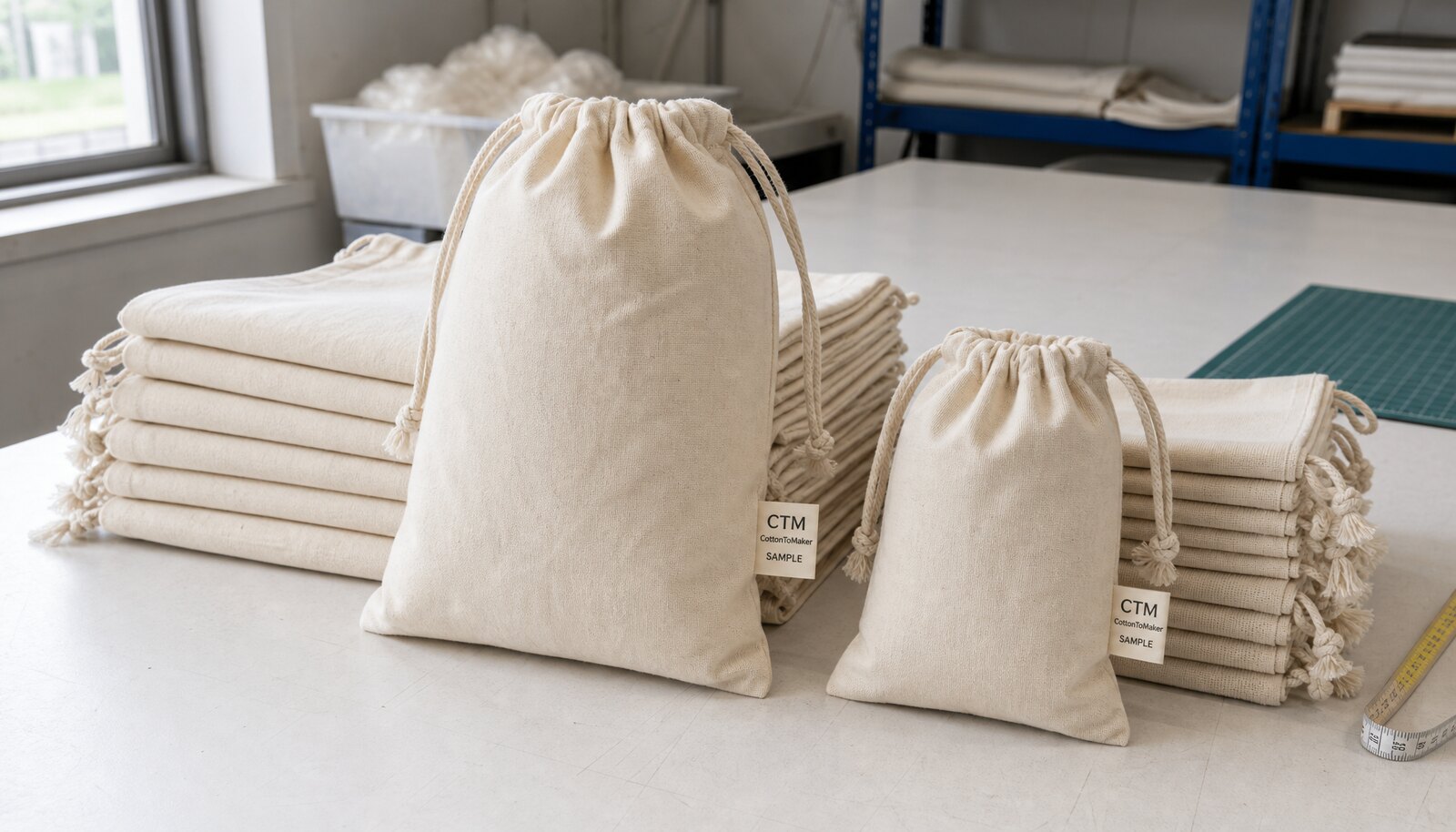
Why gift-shop pouches fail in real use
Gift shops buy cotton drawstring pouches for presentation, but the pouch often gets used more aggressively than a buyer expects. Staff fill it, re-tie it, move it between display trays and cartons, and then hand it to a customer who may open and reopen it at home. That makes durability a procurement issue, not just a packaging detail. The common failure modes are predictable: seam opening at the top corners, tunnel tearing where the cord enters, print cracking at the fold line, and fabric that looks thin or dull after a few days of handling.
The strongest sourcing decisions start with use case, not with color. A pouch for a jewelry set has a different duty cycle than a pouch for a boxed candle or bath item. Fill weight, item shape, and customer handling frequency all change the test standard. If the pouch will be reused as storage after purchase, the buyer should treat shrinkage, cord friction, and re-closure behavior as part of the spec. If it is only an insert inside another package, the bar can be lower, but the bag still has to survive the warehouse and the shop floor.
The practical goal is simple: avoid buying a pouch that passes a photo approval and fails after 20 customer touches. That is why the right checklist combines material, construction, print wear, packing, and final inspection. A supplier who can only quote the bag in generic terms is not giving you enough information to compare options reliably.
- Typical failure pattern: the pouch looks fine on arrival, then the cord tunnel tears where people pull hardest.
- Hidden cost: a low-price pouch can become expensive if you need relabeling, repacking, or replacement stock before peak season.
- Buyer rule: define the actual contents and handling pattern before you ask for pricing.
Start with fabric weight, weave, and finish
For most gift-shop programs, cotton drawstring pouches work well in a practical range of about 140–250 GSM, but the right number depends on the contents. Lightweight pouches around 140–180 GSM are usually enough for jewelry, small soaps, sample items, or seasonal inserts where softness and low cost matter more than structure. Once the pouch needs to hold a boxed item, a candle, or repeated customer use, 200–250 GSM gives a more stable body, better seam support, and a more premium feel when the customer lifts it.
Do not let GSM become the only decision. Two pouches with the same GSM can behave differently if one has a tighter weave or a stronger yarn construction. A tighter weave usually improves print sharpness and reduces snagging at the tunnel or side seam. If the pouch will carry a logo, the weave also affects ink holdout and edge clarity. A soft, open weave can make the print look slightly washed out even when the artwork file is correct.
Finish matters too. Some buyers want a raw cotton look; others need pre-shrunk fabric or an enzyme-washed finish because the pouch will be reused or sold as a retail item. Ask the supplier to state whether the fabric is pre-shrunk and what shrinkage was observed in testing, instead of accepting the vague phrase 'no big shrinkage.' Natural cotton can also show lot-to-lot shade variation, so a seasonal program should include a shade-control plan if consistency matters across reorders.
- 140–160 GSM: economical and soft for lightweight inserts and short-term seasonal use.
- 180–220 GSM: balanced option for most retail gift shops and repeat handling.
- 220–250 GSM: better structure for premium sets, heavier contents, and reusable packaging.
Choose construction details that prevent seam and tunnel failure
For a cotton pouch, construction details usually matter more than one-point price differences. A clean side seam is important, but the seam still needs enough reinforcement to survive filling and customer handling. Double-needle seams generally hold up better than a single simple line of stitching, especially when the pouch carries items with corners. At the cord entry, the bag needs a stitched tunnel or reinforced channel, because that is where force concentrates every time the user opens and closes the pouch.
Ask the factory how the tunnel is made. If the entry point is cut cleanly and then stitched, the edge should not fray into the cord path. If the cord is self-fabric or round cotton cord, confirm the diameter and end finish. Loose cord ends can become a retail complaint even if the pouch itself is intact. For premium gift programs, a bar-tack or equivalent reinforcement at stress points is worth the added cost because it reduces the risk of early failure during repeated use.
There is also a visual side to construction. A pouch that is structurally sound but puckered at the seams or twisted at the top opening will still be rejected by store buyers. Ask for the location of all stitching lines and the exact seam allowance in the sample so that the bulk run can be checked against something measurable, not just against an opinion.
- Use double-needle or reinforced side seams for medium and premium programs.
- Make the cord tunnel a designed feature, not a leftover fold in the fabric.
- Request seam allowance, stitch density, and reinforcement method in writing.
Pick the print method based on handling risk, not just setup cost
The lowest print cost is not always the best procurement choice. Screen printing is usually the strongest value for simple logos because it gives solid color, repeatable setup, and acceptable wear resistance when curing is done properly. It is often the most practical option for gift-shop branding where the logo is bold and the artwork is not too detailed. Heat transfer can be useful for short runs, more colors, or faster artwork changes, but it needs good adhesive control and should be tested for peeling along the edges after folding and rubbing.
If the pouch is likely to be kept and reused, consider a sewn label, woven label, or patch. These methods cost more, but they stand up better to friction and repeated handling than surface ink alone. That does not mean every pouch needs a label; it means the buyer should match the decoration method to the expected life of the pouch. A label can be the right answer for premium retail packaging, while screen print is often enough for standard gift presentation.
Always approve the artwork on the same fabric and the same pouch construction that will be used in production. A logo that looks crisp on a flat swatch can shift, sink, or spread once it is printed on a sewn bag with seams and folds. Ask the supplier to confirm curing method, print thickness, and the area that will be checked for rub resistance. Those details are more useful than a general promise that the print is 'durable.'
- Screen print: strong for simple logos and repeat programs.
- Heat transfer: workable for short runs or multi-color art, but test edge lift.
- Sewn or woven label: stronger for premium retail and repeated handling.
Use a sourcing comparison that forces like-for-like quotes
Supplier comparisons often go wrong because the quotes are not actually for the same product. One supplier may quote a lighter fabric, another may omit reinforcement, and a third may include individual polybags or a better carton spec. The unit price looks close enough to compare, but the products are not equivalent. Procurement teams should force a quote structure that includes fabric weight, construction method, decoration method, cord type, packing, and sample timing. Without that, price comparisons are only directional.
A second issue is supplier route. Direct factory sourcing often gives better control over sewing, printing, and packing because the decision maker is closer to the production line. Trading companies can still be useful when you need mixed products, a very low MOQ, or help coordinating multiple categories. The right question is not which route is always cheaper. It is which route gives you the clearest accountability for the spec and the fastest corrective action if the bulk lot misses target.
When comparing offers, separate the base pouch from optional add-ons such as woven labels, hangtags, retail inserts, or special retail packing. That lets buyers see where the cost is really coming from and prevents a low quote from hiding future extras. A clean quote is one that can be re-priced later without changing the meaning of the product.
- Compare the same GSM, seam method, print method, cord type, and packing format across suppliers.
- Ask who actually cuts, sews, prints, and packs the pouch.
- Separate base price from labels, retail tags, and special packaging.
Make sample approval a mini production audit
A sample should prove more than color match. It should confirm that the pouch behaves the way the bulk order will behave. Ask for a pre-production sample in final fabric, final cord, final decoration method, and final packing. If the supplier sends a hand-selected sample with better fabric or cleaner stitching than the production line will use, the approval loses value. The sample is only useful if it reflects the same materials and the same operations that will appear in bulk.
During approval, handle the sample the way the shop will handle the finished item. Put the actual retail contents inside, close it, open it again, and repeat. Check whether the cord slides smoothly, whether the tunnel collapses under finger pressure, and whether the pouch still sits flat after a few cycles of use. If the pouch will be displayed folded, stack it the same way the store will stack it and see whether the fold marks are acceptable. If the pouch will be sold as a premium item, inspect the corners, stitches, and print edges from normal shelf distance and close-up distance.
It helps to record the sample with measurements. Note pouch width, height, top opening, cord length, logo placement, and any visible tolerance issues. Keep one signed-off master sample and one photo record. When the reorder comes, that reference will save time and reduce arguments over what was originally approved.
- Test the pouch with the actual contents, not a generic filler.
- Inspect cord movement, fold behavior, and seam stability during approval.
- Keep a measured master sample and photo record for reorders.
Durability testing checklist for cotton drawstring pouches
This is the part many RFQs mention but do not operationalize. A useful durability program does not need a full laboratory, but it does need repeatable methods and pass/fail standards. The tests below are practical for gift-shop procurement because they reflect how the pouch is actually used: opening, closing, handling, rubbing against shelves or hands, and carrying a modest load. The test intensity should match the product category. A jewelry pouch can be tested more lightly than a pouch that carries a boxed candle or heavier gift set.
Set the test conditions before you approve the sample. Define the fill weight, the number of open-close cycles, the drop height, the number of rub strokes, and the shrinkage tolerance if reuse matters. If you skip those numbers, the factory will decide its own definition of 'durable,' which makes the approval hard to defend later. The following checklist gives buyers a workable starting point.
| Test item | Method | Suggested cycles / condition | What to look for | Pass / fail guide | |---|---|---:|---|---| | Seam pull | Apply steady hand tension or a simple force gauge to the side seam and top opening | 1 controlled pull per sample area | Stitch opening, slippage, broken thread | Pass if seam remains intact and no visible opening occurs under the agreed force | | Cord-cycle test | Open and close the pouch repeatedly using normal hand motion | 30 cycles for standard use; 50+ if reuse is important | Fray, snagging, tunnel collapse, cord breakage | Pass if cord still slides smoothly and no functional damage appears | | Dry rub test | Rub the printed area with clean white cotton cloth | 10 strokes in one direction + 10 cross-direction | Color transfer, cracking, blur, edge lift | Pass if no visible transfer or customer-noticeable damage appears | | Light wet rub test | Repeat the rub with slightly damp cloth only if the pouch may see moisture or handling near cosmetics/soaps | 10 light strokes | Smear, bleed, tackiness, print lift | Pass if there is no obvious smearing or tacky lift | | Fill / drop test | Fill with actual contents or matched weight block and drop from table height | 3 drops, flat and corner orientations | Seam opening, distortion, cord pull-through | Pass if the pouch stays closed and structurally sound | | Dimension check | Measure width, height, opening, and cord length at defined points | 3 samples per lot or per size | Variance beyond tolerance | Pass if measurements stay within the agreed dimensional tolerance | | Shrinkage test | Wash or steam one sample by the approved method if reuse matters | 1 cycle minimum, then remeasure | Pulling, distortion, size loss | Pass if shrinkage remains within the agreed tolerance and print stays aligned |
- Match test severity to the product: lighter for inserts, stricter for reusable retail pouches.
- Define the fill weight in grams and the test cycles in the PO or quality sheet.
- Reject a lot if the pouch looks okay at first glance but fails at the tunnel, seam, or print edge under normal handling.
Treat packing and carton design as part of product quality
A good pouch can be damaged by bad packing before it reaches the store. Cotton fabric marks easily, especially when cartons are overfilled or folded too tightly. Flat-folded packing saves freight volume, but it can leave sharp fold lines that are unattractive on shelf if the pouch is sold retail-ready. Bulk carton packing is often the better option for wholesale replenishment, while individual retail packing is only worth the extra labor when the customer sees the pouch as a standalone product.
Ask for the carton pack count, carton dimensions, gross weight, and folding method. These details affect receiving labor and storage efficiency just as much as unit price does. If the cartons will be stacked in transit or warehousing, ask the supplier how they prevent compression damage. For pouches with printed surfaces, the packing method should also protect the decoration from friction. A print that survives use may still scuff if the inner packing is poor.
It is also worth asking for a carton-marking example. If store teams or distribution centers will receive mixed size runs, clear outer markings save labor and reduce sorting mistakes. For procurement buyers, that matters because a cheaper unit price is not actually cheaper if the cartons are slow to process or if damaged packs need to be reworked on arrival.
- Flat-folded packing is efficient, but it can create visible crease lines.
- Bulk cartons usually work best for wholesale and replenishment.
- Ask for carton count, dimensions, gross weight, and outer marking format before final quote approval.
MOQ, lead time, and the real cost drivers behind the quote
MOQ on cotton drawstring pouches is usually driven by fabric sourcing, print setup, sewing efficiency, and packing labor. Buyers can often reduce MOQ pressure by simplifying the first order: one size, one fabric weight, one print position, and one cord type. Every extra variant adds complexity and can move the quote more than expected. That is why a supplier may look inexpensive on a single SKU but become expensive once you add a second color or a separate label.
Lead time is just as sensitive. A quote can look attractive until the buyer realizes the fabric is not stocked, the artwork is not final, or the carton markings still need approval. For seasonal gift-shop programs, the practical lead time is not only sewing time; it is sample approval time, print plate or screen setup, packing approval, and export planning. If your sales window is tight, ask the supplier to break lead time into steps rather than giving one broad promise.
This is where procurement nuance matters. The cheapest price can become the highest total cost if it triggers air freight, missed retail timing, or rework on arrival. Ask the supplier which part of the spec is actually driving cost. Sometimes the answer is the print method, sometimes it is the dye lot, and sometimes it is simply the requested packing format. Knowing the driver helps you adjust the spec instead of guessing.
- Lower MOQ is easier with stock fabric and one-color decoration.
- Complex prints, special labels, and retail packing often raise cost more than buyers expect.
- Ask for a step-by-step lead time: sample, approval, production, packing, and dispatch.
What to put in the RFQ so quotes stay comparable
A good RFQ for gift-shop pouches should be short enough to read, but specific enough that two suppliers cannot interpret it differently. Include size, GSM, weave or finish, cord material, print method, seam reinforcement, packing format, and target use. Then state the durability expectations in plain language: seam integrity, cord movement, rub resistance, and whether the pouch will be reused. You are not asking the factory to guess what 'premium' means.
The RFQ should also separate required items from optional upgrades. For example, woven label, side label, hangtag, barcode sticker, or individual polybag can be priced as add-ons. That gives procurement a clean base quote and prevents a supplier from bundling extras into the unit price without making them visible. If the vendor cannot quote the base product clearly, the quote will be hard to manage later when revisions appear.
A useful RFQ often includes one line on inspection. You do not need a long legal paragraph. You do need a shared expectation: what test will be run, what defect rate is tolerable, and which flaws are not acceptable at all. The more you define up front, the less likely you are to receive a shipment that looks fine in aggregate but fails on the retail shelf.
- Required fields: size, GSM, finish, cord type, print method, seam reinforcement, packing format.
- Optional fields: woven label, hangtag, barcode sticker, retail polybag.
- Commercial fields: MOQ, sample fee, lead time, price validity, and inspection standard.
Specification comparison for buyers
| Spec decision | Recommended option | When it fits | Buyer risk to check | Practical test / acceptance guide |
|---|---|---|---|---|
| Fabric weight | 140–180 GSM for light presentation pouches; 200–250 GSM for repeated reuse or heavier fills | Gift shops that need a softer hand feel, better shelf appearance, and fewer seam failures | Too-light fabric can distort, show contents, or tear near the tunnel; too-heavy fabric can increase freight and folding bulk | Weigh 10 cut panels or pouch blanks; target the approved GSM within ±5% on the fabric spec. Reject lots that feel loose, show visible unevenness, or vary sharply from the approved sample. |
| Fabric type and weave | Plain woven cotton for standard gift programs; tighter weave if print clarity or snag resistance matters; pre-shrunk or enzyme-washed only if the finish is part of the spec | When pouches are handled often, reused, or filled with items that have corners | Loose weave can print poorly and pill faster; untreated cotton may shrink and distort after steam, storage humidity, or light wash | Check weave consistency by visual inspection under strong light, then verify shrinkage after the agreed test. Ask the supplier to state whether the fabric is pre-shrunk and which side, if any, is intended as the face side. |
| Print method | Screen print for simple logos; heat transfer only for short runs or multi-color artwork; woven label or sewn patch for the highest abrasion resistance | Gift shops needing brand visibility without fast cracking or peeling | Fine detail may blur on low-cost screen work; heat transfer can lift if adhesion is weak; labels can add cost and sewing time | Rub the printed area for 10 dry strokes and 10 light wet strokes with white cotton cloth. Accept no visible smearing, edge lift, or cracking that is obvious from a normal retail viewing distance. |
| Cord construction | Round cotton cord or self-fabric cord with reinforced entry points, stitched tunnel, and neat cord ends | Pouches that will be opened and closed repeatedly or that carry heavier contents | Cheap cord can fray, knot, or become hard to pull; unreinforced tunnels can tear at the opening | Pull the cord 30 times through the tunnel using full hand motion. The cord should run smoothly, not snag, and not show visible fray at the exit points. Measure left/right cord length at rest; keep variation within ±1.0 cm for most retail pouches unless otherwise agreed. |
| Seam construction | Double-needle side seams plus bar-tack or reinforcement at stress points | Medium and premium pouches, especially for boxed gifts, candles, or hard-edged items | Single-needle seams can look neat but fail under repeated filling and retrieval | Perform a seam pull test on one sample per size and lot: apply steady manual tension or a simple force gauge at the seam area. The seam should not open, skip, or show stitch slippage. Set your pass/fail force in the PO if the pouch will carry heavier items. |
| Supplier route | Direct factory for repeat programs; trading company only when assortment breadth or very low MOQs matter more than process control | Buyers who need tighter QC, stable reorders, and fast corrective action | A brokered quote can hide the actual mill or sewing line, making corrective actions slower and less transparent | Ask who owns cutting, sewing, printing, packing, and final inspection. Request factory name, not only the sales company name, and confirm who signs off on corrective actions and replacement stock. |
| MOQ strategy | Start with one size, one fabric weight, one print position, and one cord type | Seasonal gift programs, new retail launches, and first-time supplier trials | Variant creep pushes MOQ up and weakens price comparison | Ask the supplier to quote the base pouch separately from labels, hangtags, and special packing. If MOQ jumps sharply, identify which process step is driving it—fabric dye lot, print screen setup, or sewing efficiency. |
| Packing format | Bulk carton packing with flat-folding for wholesale; individual retail packing only when the pouch is sold as a standalone SKU | Wholesale replenishment, private label, or store systems with clear receiving workflows | Overpacking inflates freight; underpacking creates fold marks, dirt pickup, or print abrasion | Specify carton pack count, carton dimensions, gross weight, and internal protection. Ask for a drop-test style packing check or at least a carton compression review if cartons will be stacked in transit. |
| Shrinkage and reuse | Pre-shrunk fabric or an explicit shrinkage allowance when pouches may be reused by consumers | Programs where the pouch becomes part of the customer experience, not just an insert | Uncontrolled shrinkage can pull seams, misalign print, or shorten the cord tunnel after humidity or light washing | Wash or steam one sample using the agreed method, then measure length and width at the same points. Keep shrinkage within the tolerance you set in the RFQ, commonly a few percent rather than a loose statement like 'minimal.' |
Buyer checklist before sampling
- Define the exact end use before sourcing: insert pouch, gift bag, jewelry pouch, candle pouch, or reusable retail item, because fill weight and durability requirements are not the same.
- Lock the fabric spec in writing: GSM, weave type, finish, and any pre-shrink treatment. Allow only a narrow tolerance, such as ±5% on GSM unless your category requires tighter control.
- State the intended fill weight or sample contents in grams and list the hardest item in the set, not only the average item. Sharp corners and rigid cartons stress seams differently.
- Require at least one pre-production sample in the final fabric, final print method, final cord, and final packing format. A paper proof is not enough.
- Ask for measurement tolerances at key points: pouch width, pouch height, cord length, top opening, and logo placement. If the product is printed, request the exact placement tolerance in millimeters.
- Include a durability test requirement in the PO: rub test, seam pull, cord-cycle test, fill/drop test, and shrinkage test if reuse matters. Define pass/fail conditions before production starts.
- Request a sample inspection using actual gift items or weight blocks, not generic filler, so the pouch is tested in the way shoppers will use it.
- Set an acceptable defect rate and inspection plan in the quality agreement. If you do not specify AQL or a comparable inspection rule, the factory will use its own standard.
- Confirm packing details before approving the order: carton counts, carton dimensions, gross weight, fold method, and whether an inner polybag is used.
- Ask for shade-lot control if the pouch is dyed or if you plan to reorder seasonally. Natural cotton can vary visibly if lot control is weak.
Factory quote questions to send
- What exact fabric weight, weave density, and finish are you quoting, and what tolerance do you allow by batch?
- Is this a direct factory quote or a trading/intermediary quote, and who is the actual sewing and printing source?
- Which print method is included in the price, how many colors are covered, and what setup or screen charges apply?
- What is the MOQ by size, print color, and packing format, and which of those three is driving the MOQ the most?
- Can you provide sample lead time for the pre-production sample and bulk lead time after sample approval?
- What seam reinforcement is used at the side seams and cord tunnel, and is bar-tacking included or charged separately?
- What is the cord material, cord diameter, and cord-end finish, and how do you prevent fray during repeated use?
- How are pouches packed for export, what is the carton loading count, and what are the carton dimensions and gross weight?
- What inspection standard do you use before shipment, and can you share the AQL level or inspection checklist?
- What is your policy for shade variation, minor print misalignment, loose threads, and cord-length variation within a bulk order?
Quality-control points to confirm
- Fabric GSM should match the approved target within the agreed tolerance. If you do not have lab equipment, compare cut-panel weight from the same measured area and check against the approved sample, not against memory.
- Inspect weave tightness, visible slubs, stains, oil spots, broken yarns, and edge fray before sewing. A pouch can fail shelf presentation even if its seam is sound.
- Side seams should remain flat after filling. Reject pouches with skipped stitches, stitch runout, loose thread tails, or seam slippage that is visible after light hand pressure.
- Cord tunnels must remain intact after repeated opening and closing. The tunnel edge should not cut into the cord, and the cord should not bunch or jam at the exit.
- Perform a cord-cycle test: open and close the pouch 30 times for standard retail use, or more if the pouch is expected to be reused often. The cord should still move smoothly and retain usable length.
- Run a dry rub test on the logo area using a white cotton cloth for 10 strokes in one direction and 10 in the cross direction. If wet handling is relevant, repeat with light moisture. Reject visible color transfer, cracking, peeling, or blurred edges that customers will notice.
- Check print placement against a measured reference point on the pouch body. For simple front logos, hold placement to within about 5 mm unless the artwork is intentionally loose or oversized.
- If the pouch is marketed as reusable, test shrinkage after the agreed wash or steam condition. Measure width and height at the same points before and after the test and compare against the agreed tolerance.
- Conduct a fill/drop test using the actual retail contents or a matched weight block. Drop from a low handling height, such as table height, and inspect for seam opening, cord pull-through, or fabric distortion.
- Review the cord end finish. Loose ends, uneven knotting, or unsealed synthetic components can become a customer complaint even when the bag is structurally intact.