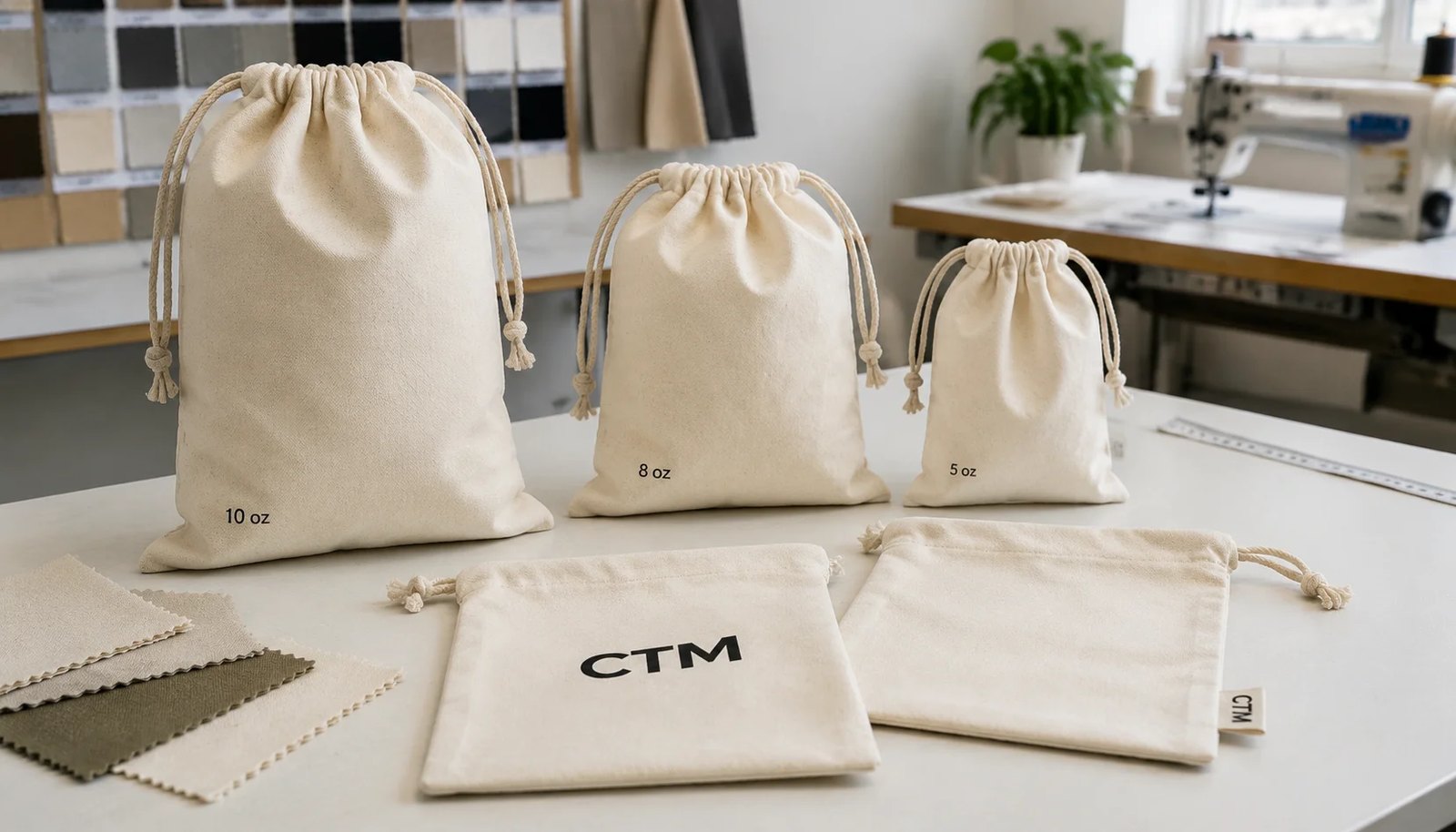
Why durability fails first on cotton drawstring pouches
For natural grocers, the main durability problem is usually not the fabric tearing in the center panel. Failures usually start at the stress points: the cord exit, top channel seam, side seam near the upper opening, or print area after rubbing against boxed or bottled contents. Buyers often approve a nice-looking sample without matching it to the actual packed weight and how the pouch will be opened, closed, stocked, and handled in stores. That is how a pouch that feels acceptable in hand becomes a returns issue after a few weeks.
The buying problem is simple: many quotes look comparable on paper, but the real durability result depends on construction details hidden behind the unit price. A 150 GSM pouch with reinforced exits and a proper seam finish can outlast a cheaper 170 GSM pouch with weak stitching and poor cord quality. Procurement teams need a checklist that ties durability to measurable acceptance criteria, not just broad claims like reusable, premium, or eco-friendly.
- Most common failure points: cord pull-through, seam opening, print cracking, shrinkage, and frayed seam allowance
- Retail handling matters: shelf restocking, customer squeezing, repeated opening, and mixed-item gift packing all add stress
- A sample approved empty is not enough; review filled-weight performance and transit handling
Match fabric GSM to the product load, not just the target price
Cotton drawstring pouches for natural grocers are often quoted in lightweight 4 oz to 6 oz fabric equivalents, roughly around 135-170 GSM, because the price is attractive and the natural hand feel works well for herbs, tea accessories, soap bars, and small wellness kits. That range can be fine, but only when the packed item is light, edges are soft, and the pouch is not expected to survive repeated opening over a long retail life. Once the pouch holds denser items like glass droppers, refill accessories, clustered small jars, or heavy sample assortments, the fabric should move toward 180-240 GSM with stronger seam construction.
The point is not to over-specify every order. Heavier fabric raises unit cost, cutting waste, and carton weight. It may also reduce print softness on water-based logos. The better approach is to write the RFQ around the actual use case. If the pouch is part of a refill program or is sold as a reusable accessory, stronger cotton often pays back through lower complaint rates. If it is a one-time promotional pack for soft, dry items, midweight cotton may be the smarter buy.
- Typical light retail range: 140-170 GSM
- Typical medium-duty reusable range: 180-220 GSM
- Typical heavier-duty range for repeated use or denser contents: 220-240 GSM
- State packed item weight and edge profile in the RFQ so the factory can recommend a realistic GSM
Construction details that matter more than buyers expect
Seam and channel construction usually decide whether a pouch survives use. On smaller pouches, a simple side seam may be enough, but once dimensions or contents increase, the top channel and side seam need more attention. A folded channel with reinforced back-tack at both exits helps stop the seam from opening where the cord repeatedly rubs. For medium and large pouches, overlock plus lockstitch or a French seam can control fraying much better than a basic raw seam finish.
Drawstring selection also affects service life. Many procurement teams focus on body fabric and logo print, then leave cord details vague. A thin, loosely braided cord may save a little cost, but it cuts into the channel, frays earlier, and can pull through if the knot is too small. For natural grocers, cotton cord supports the branding story, but diameter and finish still need to be specified. A 4-6 mm cord is usually safer than a thin decorative string on medium sizes.
- Preferred top detail: folded channel with reinforcement at both cord exits
- Preferred seam options for stronger use: overlock plus lockstitch or French seam
- Cord spec should include material, diameter, color, end finish, and knot type
- Request inside-out sample photos so seam finish is visible before approving bulk
Print durability is often the hidden cause of complaints
Natural grocer packaging usually uses simple branding, so buyers may assume printing is low risk. In practice, print durability creates many avoidable issues. Water-based screen print is usually the best balance for cotton pouches with one or two logo colors. It penetrates fabric better, keeps a softer hand feel, and is more repeatable on reorder programs. Heat transfer can work for short runs or multi-color artwork, but on textured cotton it may show edge lift, a less natural feel, or faster wear at fold lines.
A durability-focused RFQ should state the print method and include acceptance limits for rub and placement. If pouches are packed tightly after printing without proper curing or interleaving, logos may offset or scuff during export. This becomes a receiving problem rather than a visible factory defect. That is why print review must include not only color and artwork, but also curing, rub resistance, and packing protection.
- Most commercial option for repeat orders: water-based screen print
- Use print placement tolerance in millimeters, not only visual approval
- Add dry rub and light damp rub criteria if the product may contact other fabrics or paper sleeves
- Ask how long printed goods rest before packing to reduce offset risk
How MOQ, customization, and quote structure affect durability choices
MOQ logic matters because buyers often try to combine low trial quantities with multiple custom details. If the order uses stock natural cotton, standard cotton cord, and a one-color screen print, many factories can quote a lower MOQ. Once you add custom dyed fabric, special woven labels, multiple sizes, individual barcode stickers, or unusual cord colors, the factory may switch to smaller cutting runs, extra setup, and more manual sorting. That does not only affect price. It can also affect consistency and lead time.
From a durability standpoint, low MOQ programs can tempt suppliers to use whatever fabric is available rather than the most suitable one. Quote comparison should separate the base pouch cost from adders for heavier GSM, reinforced seam construction, print colors, labels, and special packing. This makes it easier to see whether a cheap quote is truly efficient or simply underbuilt.
- Lowest MOQ route: stock natural cotton + standard cord + one-color screen print
- Cost adders usually come from higher GSM, custom dyeing, extra labels, heavier packing, and more SKU splits
- Request quote lines by fabric weight and seam option so you can compare durability versus unit cost
- A realistic RFQ should note whether the order is a launch test or a reorder program
Sample approval should simulate real use, not just approve appearance
A pre-production sample is the buyer’s best chance to prevent preventable defects, but many approvals still focus on logo look, size, and general hand feel. For pouches, that is incomplete. The sample should be loaded with the actual product or a weight equivalent, opened and closed repeatedly, and reviewed for seam distortion, channel puckering, cord friction, and print stress. If the end consumer may wash the pouch, the sample should also be washed according to a defined method before final signoff.
The sample stage is also where dimension and shrinkage expectations should be fixed. Natural cotton can shift after sewing and after washing. If the pouch must fit a boxed soap set or a refill accessory kit closely, write an actual size tolerance and decide whether dimensions are approved before wash only or after wash as well. Otherwise, a factory may meet the nominal size but still deliver a pouch that becomes too tight in use.
- Approve using actual materials: bulk fabric, real cord, real print process
- Perform repeated open-close handling on the sample, not just visual inspection
- If washability matters, define wash method and acceptable shrinkage percentage
- Record measured width, height, channel depth, and cord length on the approved sample sheet
Practical durability tests and acceptance thresholds for bulk orders
Most pouch programs do not need laboratory overkill, but they do need a consistent factory or third-party test routine. The most useful practical tests are seam pull at side seam and channel area, repeated drawstring cycling, dry rub on printed area, wash shrinkage where relevant, and a simple packed-drop simulation if the pouch holds heavier retail items. These tests should be linked to pass or fail observations, not just carried out informally.
The right threshold depends on the end use, but the acceptance language should be concrete. For example, after repeated opening and closing, there should be no seam break, no cord pull-through, and no major fray at exit points. After dry rub, the print should show no visible transfer beyond the approved standard. After one wash, size reduction should remain within the agreed shrinkage range. This creates an objective basis for shipment approval and reduces disputes later.
- Seam pull: no seam opening or visible stitch failure at approved test load
- Cord cycle test: no pull-through, channel split, or severe fray after repeated use simulation
- Dry rub on print: no unacceptable color transfer onto white fabric or paper
- Wash test if applicable: shrinkage and skew remain within approved tolerance
- Packed-drop simulation for heavier contents: no seam burst or product corner breakthrough
Packing method can preserve or damage durability before goods even arrive
Packing is often treated as a warehouse issue, but it directly affects delivered quality. If printed pouches are compressed too soon after printing, logos can offset. If sizes are mixed loosely inside export cartons, receiving teams spend more time sorting and count errors rise. If master cartons are oversized or overweight, more compression and handling damage can occur in transit. For natural grocer programs with multiple SKUs, flat packing by size and style with clear carton marking is the most stable route.
Inner packing should also suit the fabric and print. A reasonable method is 25 or 50 pieces per polybag by size, with the bags aligned rather than stuffed. For some importers, individual polybags are unnecessary and may conflict with packaging reduction goals; in that case, carton liner protection and dry packing conditions become more important. The RFQ should balance sustainability, warehouse efficiency, and print protection rather than default to one method.
- Group by exact SKU and size; avoid mixed-size loose bulk packing unless expressly approved
- Use master carton gross weight limits that fit your receiving operation
- Request carton marks with item code, size, quantity, PO number, and country of origin if required
- For printed goods, note whether interleaving or resting time before packing is needed
Lead time risk usually comes from revisions, not sewing speed
Simple cotton drawstring pouches are not slow to sew, but lead time still slips when buyers revise size, fabric weight, or artwork after sample approval. Another common delay comes from unclear durability expectations. The factory makes a sample in one GSM, the buyer later upgrades to a heavier fabric after handling it, then the print setup and packing dimensions change as well. Procurement teams can reduce schedule risk by locking the performance requirement early and comparing quote alternatives before sampling begins.
Peak season also affects trim and print capacity. The pouch body may be easy to produce, but custom cords, labels, or multiple print color setups can extend the schedule. A strong quote should break out sample lead time, material booking time, print preparation time, and bulk production window from approval date. That way, a buyer can see whether the risk sits in fabric sourcing, sample revision, or final production booking.
- Approve durability spec before approving artwork placement if both affect fabric and construction choice
- Get separate timelines for sample, material booking, bulk production, and final inspection
- Allow extra time for custom dyed fabric, woven labels, and multi-SKU packing plans
- Late packing changes can force carton recalculation and delay shipment booking
Use landed-cost thinking instead of unit-price thinking
The lowest pouch quote is often not the lowest landed cost. A cheaper 140 GSM pouch with weak seams may look fine on the PO but create hidden cost in re-sorting, claims, customer complaints, and emergency reorders. On the other hand, overbuilding every pouch in 240 GSM cotton can waste money if the item is only a soft accessory sleeve for lightweight goods. The right comparison looks at durability fit for purpose, carton efficiency, receiving labor, and complaint risk together.
When reviewing quotes, ask suppliers to price at least two practical constructions for the same size and print. For example, compare 150 GSM with standard seam construction against 200 GSM with reinforced exits and better seam finish. Then review not only unit cost, but also carton quantity, carton weight, expected complaint exposure, and reorder repeatability. This gives procurement and merchandising teams a stronger business case than arguing only over cents per piece.
- Compare quote scenarios by total delivered program value, not only ex-factory unit cost
- Include expected packing efficiency and warehouse handling cost in the decision
- Higher GSM may increase freight cost through carton weight, so compare packed CBM and gross weight
- Durability-related claims can erase small unit-price savings very quickly
Specification comparison for buyers
| Spec decision | Recommended option | When it fits | Buyer risk to check |
|---|---|---|---|
| Fabric weight | 140-170 GSM for light retail packs; 200-240 GSM for repeated reuse | Use lighter fabric for dry herbs, soap bars, tea accessories, and giveaway kits; use heavier fabric for refill programs and denser items | Low GSM can fail at side seams and cord channel after repeated opening; high GSM raises unit cost and carton weight |
| Cotton yarn and weave | Plain weave, combed or standard cotton with even yarn count | Best for stable print registration and consistent pouch shape across sizes | Loose weave can skew after washing and can show pinholes around seam stress points |
| Drawstring type | Cotton cord 4-6 mm with knotted ends or heat-cut braided cord where allowed | Cotton cord suits natural grocer branding; thicker cord improves grip on medium and large pouches | Thin cord cuts into channel seam and frays faster; poor knotting causes pull-through in transit |
| Top construction | Folded cord channel with reinforced back-tack at both exits | Recommended for any pouch expected to open and close many times in store or at home | Single-stitch channel without reinforcement often splits first, especially on 140 GSM cotton |
| Bottom seam style | French seam or overlock plus lockstitch on medium and large sizes | Fits pouches carrying jars, bath items, refill accessories, or mixed gift sets | Raw seam allowance can fray during rub testing and after wash; quote may hide weaker seam finish |
| Print method | Water-based screen print for simple 1-2 color logos; heat transfer only for short runs or multi-color artwork | Screen print gives stronger adhesion and lower unit cost on repeat orders | Cheap print can crack after wash or rub off onto product; transfer edges can lift on textured cotton |
| Pre-shrinking or wash allowance | Specify fabric shrinkage tolerance and sample wash result before order approval | Important if the pouch may be washed by end users or if exact fit matters for boxed items | Uncontrolled shrinkage changes pouch dimensions and can make packed items too tight after first wash |
| Packing method | Flat packed by size, 25-50 pcs per polybag, master carton lined and marked with size/code | Suitable for mixed-SKU grocery programs and easier receiving at distributor warehouses | Bulk mixed packing increases count errors, print rubbing, and receiving labor |
| MOQ route | Use stock fabric and standard cord for lower MOQ; custom dyed fabric or woven labels only on larger runs | Best when launching a new natural grocer line and testing multiple sizes | Trying to combine low MOQ with many custom details usually increases lead time and sample revisions |
Buyer checklist before sampling
- Define actual end use: dry food accessory, soap pouch, refill kit, gift-with-purchase, or repeated retail reuse
- Set pouch filled weight range in grams and note whether corners of the packed product are sharp or rounded
- Specify finished size tolerance in millimeters for width and height after sewing
- State fabric target in GSM with tolerance, for example 150 GSM plus or minus 5 percent
- Choose seam finish: plain seam, overlock plus lockstitch, or French seam based on load and price target
- Specify cord material, diameter, color, knot finish, and whether a single or double drawstring is required
- State print method, print position, maximum print size, and acceptable color variation standard
- Request pre-production sample with actual fabric, actual cord, and actual print method rather than digital mock approval only
- Include durability tests in the RFQ: seam pull, repeated open-close cycle, dry rub, wash shrinkage if relevant, and drop simulation for packed goods
- Define AQL or shipment acceptance standard for stitch defects, wrong size, print defects, and count accuracy
Factory quote questions to send
- What cotton fabric options can you offer for this pouch size, and what is the tested GSM range lot to lot?
- Which seam construction do you recommend for the target packed weight, and can you share photos of inside seam finish?
- What is your standard drawstring cord diameter and material, and how do you prevent cord fray and pull-through at the channel exit?
- Can you run a pre-production sample using the exact bulk fabric, cord, and print process rather than substitute materials?
- What durability tests do you perform in-house for seam strength, cord cycling, print rub, and wash shrinkage?
- What shrinkage result should we expect after one wash and after three washes under normal care conditions?
- What is your MOQ by size, by print color count, and by packaging variation?
- How does the quote change between 140 GSM, 170 GSM, and 220 GSM fabric on the same pouch size?
- Is your print quoted as water-based screen print, plastisol, pigment print, or heat transfer, and what are the expected rub and wash results?
- How are goods packed to prevent print offset, moisture exposure, and size mixing during export transit?
Quality-control points to confirm
- Fabric GSM within approved tolerance and visually even across the roll
- Finished width and height within agreed tolerance after sewing
- Cord channel stitched straight with no skipped stitches at exit points
- Back-tack reinforcement present at both drawstring exit ends
- Cord length consistent and knots secure with no pull-through risk
- Inside seam finish matches approved construction and shows no raw fraying where not allowed
- Print position centered within approved tolerance and color shade aligned to sample
- Dry rub and light damp rub show no unacceptable ink transfer on adjacent fabric
- Seam pull test on random samples shows no opening at side seam or channel seam
- Wash test, if required, stays within approved shrinkage and twist tolerance