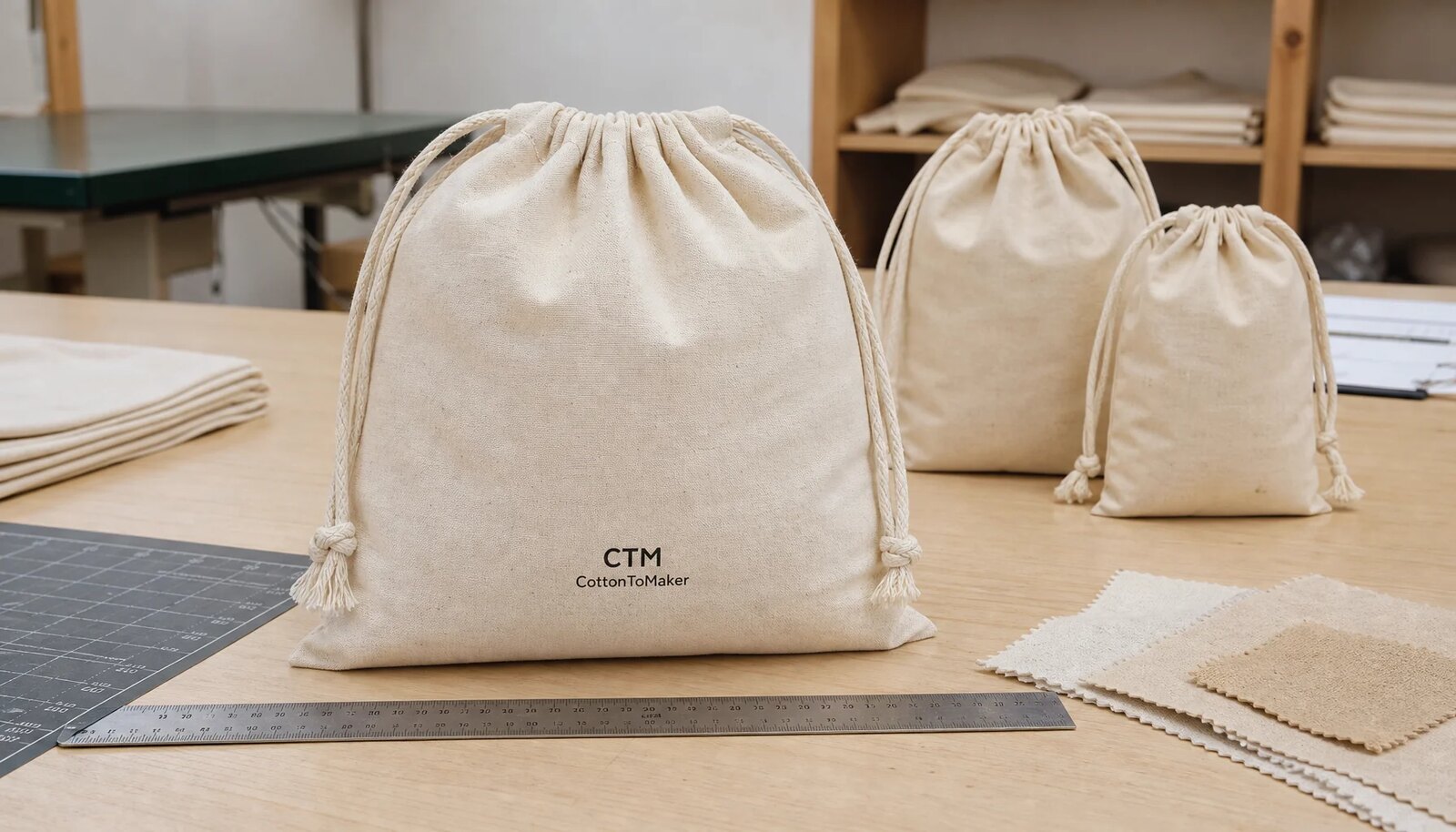
Map the selling workflow first
The right pouch depends on how it will be used, not only on how it looks. A pouch for a handmade soap bar has different risks than a pouch for a candle tin, boxed necklace, ceramic ornament, refill sachet, or vendor starter kit. Some pouches are filled once and handed to a customer. Others move through a warehouse, ship to an event site, sit on a craft fair table, and are opened by multiple shoppers before sale.
Before asking for a quote, write the handling path in plain terms: who fills the pouch, whether the product must close fully, how it will be displayed, whether it is customer-facing packaging or an internal kit component, and whether it will be reused. This prevents the supplier from guessing on GSM, size, cord strength, print method, packing, and QC level.
For multi-seller or distributor programs, separate the shared base pouch from variable elements such as logo, size, inner pack count, destination, and barcode label. That makes price comparison cleaner and reduces late changes after sampling.
- Define the product inside the pouch: dimensions, depth, weight, fragrance, oil risk, sharp corners, dust sensitivity, and label protection needs.
- Classify the use: booth packaging, retail resale, gift bundle, vendor kit, event giveaway, or warehouse allocation item.
- Identify repeated handling points: packing table, carton loading, event setup, shopper inspection, checkout, and customer reuse.
- Separate core SKUs from seasonal or vendor-specific artwork so MOQ and inventory risk are visible.
- Record the required final presentation: flat, filled, closed, partially closed, tagged, barcoded, or individually packed.
Specify cotton the factory can measure
GSM is the starting point for cotton drawstring pouch sourcing, but it is not the only fabric decision. A tight 140 GSM weave can feel more stable than a loose 140 GSM fabric with heavy slubs. For most craft fair packaging, 120-140 GSM is a practical middle range because it balances cost, foldability, printability, and perceived quality. Light 100-120 GSM cotton can work for seed packets, sachets, and low-cost samples. Reusable or premium retail pouches often need 160-180 GSM.
Do not approve fabric from close-up photos. Natural cotton can look thick online and still feel thin around a boxed product. Heavier fabric can also create problems on small pouches because the drawstring channel becomes bulky and harder to close. The goal is the lightest fabric that supports the product, brand position, decoration, and handling requirement.
Fabric shade belongs in the specification. Natural unbleached cotton suits rustic, handmade, refill, and farmers market positioning, but lot variation is normal. Bleached white improves print contrast and gives a cleaner retail look, but it shows dirt more easily. Dyed cotton needs lab dip approval, shade tolerance, colorfastness checks, and MOQ confirmation per color.
- 100-120 GSM: suitable for light samples, seed packets, sachets, and very low-weight products.
- 120-140 GSM: common standard for soaps, wax melts, jewelry cards, small ornaments, and vendor packs.
- 160-180 GSM: better for reusable pouches, premium bundles, heavier contents, and shelf presentation.
- Above 200 GSM: sample carefully because channel bulk and closure stiffness can become issues.
- Natural cotton: approve an acceptable range for flecks, slubs, seed marks, and shade variation.
- Dyed or bleached cotton: confirm shade standard, dirt visibility, colorfastness, and MOQ per color.
Size by filled fit, not catalogue size
Cotton drawstring pouches are usually quoted as finished flat width by finished flat height. That measurement is useful for costing and inspection, but it does not show true usable capacity. Product depth consumes width and height, and the drawstring channel reduces the usable top area. If the pouch is too tight, booth packing slows down and the product looks poorly planned.
Start with the real item or retail box. Measure width, height, depth, and weight. Add allowance for insertion, fabric thickness, and closure. Flat items may need only 10-15 mm extra. Boxed soaps, candle tins, jars, ornaments, and rigid gift sets often need 15-25 mm or more. Round or irregular products should be tested with a physical size set because a flat formula can mislead.
Artwork placement should be checked after filled-fit testing. A logo centered on an empty pouch may sit too low once the product bulges the lower panel or too high after the top gathers. On small pouches, even a 3-5 mm shift can be obvious, so define print position tolerance by size.
- State whether quoted dimensions are cutting size, finished flat size, or usable internal size.
- Confirm whether the pouch must close fully, close partially, or only cover the item for presentation.
- Ask how much height is lost to the channel seam and gathered top.
- Keep artwork away from the channel, side seams, bottom seam, and expected product bulge.
- Test thick, round, or rigid products with actual samples instead of relying only on dimensions.
- Keep photos and measurements of the approved filled and closed appearance for production reference.
Control drawstring and stitching details
Construction choices affect both defect rate and customer experience. A single drawstring lowers cost and may be acceptable for one-time packaging. A double drawstring usually closes more evenly and feels better for retail handling, customer reuse, and vendor programs. Cotton cord supports a natural look, while polyester or blended cord may slide more consistently depending on the supplier's materials.
The channel must be sized for the cord and fabric weight. If it is too narrow, the cord drags or jams near the side seam. If it is too wide, the gathered top looks loose. Heavier cotton needs more channel allowance, especially in small sizes where fabric gathers quickly.
Write sewing expectations into the PO instead of assuming them. Define lockstitch seams, seam allowance, back-tacking, stitch density if required, channel opening, thread color, and trimming standard. For heavier contents, check bottom corners and channel stress points with the actual product or a weight-equivalent sample.
- Choose double drawstring for repeat opening, gift bundles, retail presentation, and customer reuse.
- Use single drawstring only when low cost matters more than closure feel.
- Specify cord material, diameter, color, length, knot style, and fray-control method.
- Run repeated open-close checks on the approved sample to catch jamming, twisting, and blocked channels.
- Define seam allowance, back-tacking, thread color, stitch density, and thread trimming before sampling.
- Inspect bottom corners, side seams, and channel seams under realistic product weight.
Choose decoration by risk and run size
Screen printing is usually the best option for simple one- to three-color logos on cotton drawstring pouches. It offers repeatable results and strong unit economics at medium or high quantity. The main cost driver is setup per screen or color, which matters when an event program has many small vendor logo runs.
Heat transfer can work well for gradients, complex artwork, full-color logos, or low quantities per design. The risks are transfer edge visibility, hand feel, cracking, lifting, and adhesion after the pouch wrinkles during closure. Digital printing depends heavily on fabric and equipment, so it must be sampled on the exact cotton. Embroidery is usually reserved for heavier pouches because needle density can distort lightweight fabric.
Supply artwork as vector files whenever possible. Include Pantone or brand color references, print size, safe area, and placement from edges. Avoid very fine reverse text, thin strokes, and large solid ink blocks on rough natural cotton unless the supplier proves the result on a strike-off or pre-production sample.
- Screen print: best for solid logos, repeat orders, and medium to high wholesale quantities.
- Heat transfer: useful for detailed, multi-color, gradient, or small split artwork.
- Woven label: efficient when one brand mark appears across several sizes or fabric colors.
- Embroidery: sample on the selected GSM to check distortion and backing visibility.
- Rub checks: require dry rub and light damp rub where moisture, oils, or outdoor handling may occur.
- Placement approval: review decoration on a filled and closed pouch, not only an empty flat sample.
Unpack MOQ before price comparison
MOQ is rarely one simple number. It may be driven by fabric roll quantity, dye lot, cord color, cutting size, print setup, label production, or packing labor. A supplier may advertise 1,000 pieces, but that can mean 1,000 pieces per size, per color, per artwork, or per print method.
Craft fair programs often create more variation than standard packaging orders. A distributor may need one natural cotton construction across several sizes with many vendor logos. A brand may need one logo for soap, candle, jewelry, and refill products. An event organizer may need seasonal artwork with a short selling window. Each structure changes the best sourcing approach.
Build a SKU matrix before requesting prices. List size, fabric color, cord color, artwork, print method, quantity, packing method, barcode needs, and destination. Ask the factory to confirm MOQ and price for each line, plus all setup charges. Also ask whether any quantities can be combined for fabric purchase, cutting, printing, or sewing.
- Quote by size because each size may need separate cutting, sewing, inspection, and carton planning.
- Quote by artwork because each logo, color count, screen, transfer, or label may create setup cost.
- Quote by fabric color because dyed cotton usually has higher MOQ and stricter lot control.
- Quote by cord color because custom cord may require separate sourcing or minimum purchase.
- Quote by packing style because individual bags, barcodes, and vendor kit sorting add labor.
- Confirm overrun or underrun allowance for custom printed or dyed pouches before issuing the PO.
Compare quotes as landed cost
A low unit price can hide costs in screens, samples, packing, inland freight, carton volume, receiving time, and rework. Cotton pouches are low unit-value items, so carton density and SKU organization matter. A small unit saving disappears quickly if the warehouse must sort mixed cartons or repack goods before vendor allocation.
A complete quote should identify fabric type, GSM, finished size, construction, cord, decoration method, artwork count, MOQ, unit price, sample charge, setup charge, packing method, carton quantity, carton dimensions, gross weight, net weight, CBM, Incoterm, payment terms, lead time, shipment port, and quote validity. EXW, FOB, CIF, DAP, and DDP prices are not interchangeable.
Clarify what triggers a price change after sampling. Moving from natural to bleached cotton, adding a second print color, using individual polybags, or changing to custom dyed cord can affect MOQ, lead time, setup cost, and carton volume. For repeat buying, request price tiers by SKU and by total program volume.
- Compare unit price together with screen charges, transfer charges, label charges, sample fees, and packing fees.
- Review carton quantity, carton dimensions, gross weight, net weight, and CBM before approving landed cost.
- Separate EXW, FOB, CIF, DAP, and DDP quotes so freight responsibility is clear.
- Calculate cost per sellable packed unit, including receiving, repacking, labeling, and allocation labor.
- Ask for price tiers such as 1,000, 3,000, 5,000, and 10,000 pieces per SKU when relevant.
- Confirm currency, quote validity, payment terms, lead time trigger, and production start requirements.
Use samples to prove production reality
Photos can show general appearance, but they do not prove fabric hand feel, odor, closure behavior, seam strength, print adhesion, or true filled capacity. A physical sample is important when the pouch is branded, resold, distributed to vendors, or required to fit a specific product.
The pre-production sample should use the final GSM, fabric shade, cord, stitching, decoration method, size, and packing approach. Substitute-fabric samples can help early development, but they should not become the bulk approval standard. Put the real product inside, close the pouch, pull the cords repeatedly, and check whether the channel twists, binds, or traps the cord.
Measure the sample rather than only reviewing it visually. Check finished width, finished height, channel height, seam alignment, print position, cord length, and closure appearance. For multi-SKU programs, approve each size, each fabric type, and at least one final execution of each decoration method. Retain one approved sample with the buyer and one with the factory.
- Approve shade, GSM, weave, hand feel, and odor against a retained reference sample.
- Measure finished width, finished height, channel width, seam alignment, print position, and cord length.
- Test closure with the real product or a weight-equivalent dummy product.
- Review print adhesion, rub resistance, edge sharpness, coverage, and hand feel after closure testing.
- Sample risky artwork such as fine text, large solid ink areas, or multi-color registration.
- Request a packed sample or packing photo when inner count, carton sorting, or barcode placement matters.
Set tolerances and defect classes
Bulk defects multiply quickly on simple sewn items. Common issues include size variation, skewed seams, loose threads, uneven channels, blocked cord movement, stains, odor, print misalignment, ink smearing, and mixed packing. Some flaws may be acceptable for a low-cost giveaway but not for a customer-facing craft fair product.
Use measurable tolerances and confirm that they fit the supplier's normal process. Example tolerances may include +/-5 mm for small pouch dimensions, +/-10 mm for larger pouch dimensions, +/-3-5 mm for small logo placement, and +/-5-8 percent for GSM. These should be treated as examples to agree with the supplier, not automatic standards. For natural cotton, define acceptable flecks and slubs separately from stains, oil marks, weaving holes, and mildew odor.
If using AQL, define critical, major, and minor defects before production. The retained sample should be the inspection reference. Measure pieces across cartons or inspection lots instead of checking only the top sample.
- Critical defects: wrong logo, wrong size, unusable drawstring, broken seam, mold odor, severe stain, or unsafe contamination.
- Major defects: visible print flaw, skipped stitch, blocked channel, poor cord movement, large size deviation, or mixed SKU packing.
- Minor defects: small loose thread, slight natural cotton fleck, minor shade variation, or cosmetic issue within tolerance.
- Check seam strength at bottom corners, side seams, and drawstring channel stress points.
- Inspect fabric stains, oil marks, mildew odor, weaving holes, excessive slubs, and contamination.
- Verify inner counts, carton counts, carton marks, SKU separation, and PO quantity before shipment.
Design packing for receiving speed
Packing affects warehouse labor, shortage claims, and event readiness. If pouches ship to a central warehouse and are split among vendors, the packing plan must support fast receiving, counting, storage, and allocation. A practical structure is 50 or 100 pieces per inner bag, one SKU per carton where possible, and clear carton marks.
Bulk flat packing is usually best for simple cotton pouches because it saves cost and carton space. Inner bags by SKU keep items clean and organized without the cost of individual retail packing. Individual polybags may be needed when pouches are sold as standalone retail items, require barcode scanning, must remain clean through multiple handling points, or ship directly to consumers.
Carton design should match the logistics route. Sea freight and pallet storage need consistent export cartons. Courier or parcel distribution may need stronger cartons and lower gross weight. Many receiving teams prefer cartons under about 15-18 kg when practical, but the buyer's warehouse rule should control. Approve carton quantity, dimensions, marks, and SKU segregation before production is complete.
- Use bulk flat packing for low-cost packaging pouches and high-volume distributor orders.
- Use inner bags by SKU to prevent mixed designs and speed receiving, counting, and allocation.
- Use individual packing only for retail sale, barcode scanning, direct-to-consumer handling, or strict cleanliness needs.
- Mark cartons with SKU, size, color, artwork, quantity, PO number, carton number, and destination.
- Keep carton gross weight practical for warehouse handling, using buyer rules where available.
- Ask for carton dimensions, gross weight, net weight, and CBM before final quote approval.
Specification comparison for buyers
| Buying decision | Procurement recommendation | Typical craft fair use | Quote or QC risk to control |
|---|---|---|---|
| Fabric weight | 100-120 GSM for light packaging; 120-140 GSM for standard craft fair wholesale pouches; 160-180 GSM for reusable or retail-quality programs | Soap sleeves, jewelry cards, wax melts, seed packets, ornaments, vendor kits, and gift bundles | Confirm the supplier's measured GSM tolerance, for example +/-5-8 percent if acceptable; do not approve fabric from photos only |
| Fabric type and shade | Natural cotton for rustic artisan positioning; bleached white for stronger logo contrast; dyed cotton only with shade standard and MOQ confirmed | Handmade goods, farmers markets, cosmetics, stationery, seasonal assortments, and premium bundles | Natural cotton varies by lot; dyed cotton needs lab dip, approved shade reference, and agreed color tolerance |
| Finished pouch size | Quote finished flat width x finished flat height, then test with the real product filled and closed | Soap bars, candle tins, jewelry boxes, jars, ornaments, mini craft kits, and refill packs | Catalogue size is not usable capacity; product depth and drawstring channel reduce closure height |
| Drawstring design | Double cotton cord for repeat handling; single cord only for budget or one-time packaging | Retail packaging, booth handling, customer reuse, event merchandise, and gift sets | Cord can jam, fray, shed fibers, or feel too thin; test repeated opening and closing on the approved sample |
| Construction | Require lockstitch side seams, secure back-tacking, clean channel stitching, trimmed threads, and defined seam allowance | Orders that are packed, shipped, unpacked, filled, displayed, and handled by end customers | Skipped stitches, weak bottom corners, narrow seam allowance, and blocked channels cause field failures |
| Decoration method | Use screen print for 1-3 solid colors; heat transfer for complex artwork or small logo splits; woven label for repeat brand programs | Logo pouches for artisan brands, event organizers, distributors, gift box suppliers, and retail bundles | Heavy ink can stiffen thin cotton; require rub check, adhesion review, and print placement tolerance |
| MOQ structure | Separate MOQ by size, fabric color, cord color, artwork, print color count, label, and packing method | Multi-vendor programs, seasonal designs, mixed sizes, and replenishment orders | A low advertised MOQ may become MOQ per SKU, per artwork, per dye lot, or per cutting size |
| Packing plan | Flat pack by SKU, often 50 or 100 pieces per inner bag, with export cartons marked by PO, SKU, quantity, and carton number | Central receiving, vendor allocation, event kits, and wholesale distribution | Mixed cartons slow receiving and create shortage claims; define carton quantity and SKU segregation before production |
| Sample approval | Approve bulk-equivalent fabric, cord, stitching, print, size, closure function, odor, and packing before mass production | Branded resale, retail packaging, vendor programs, and exact product-fit orders | Photo approval misses hand feel, true capacity, shrinkage, print feel, carton packing, and drawstring performance |
Buyer checklist before sampling
- List every product going into the pouch, including width, height, depth, weight, sharp edges, fragrance, oil, moisture, dust, and whether the pouch must close fully.
- Select GSM by use case: 100-120 GSM for light packaging, 120-140 GSM for standard craft fair wholesale use, and 160-180 GSM for reusable retail pouches.
- Choose natural, bleached, dyed, recycled, or organic cotton before artwork approval because fabric shade and texture affect print contrast.
- Specify finished flat size, usable filled fit, channel height, and closure expectation; do not rely only on cutting size or catalogue size.
- Define single or double drawstring, cord material, cord diameter, cord color, channel opening, seam allowance, stitch density, back-tacking, and thread color.
- Build a SKU matrix covering size, fabric color, cord color, artwork, print method, quantity, packing method, barcode needs, and destination.
- Separate MOQ and price by pouch size, fabric color, cord color, artwork, print color count, label type, and packing style.
- Provide vector artwork with Pantone or brand color references, print dimensions, safe area, placement from pouch edges, and acceptable position tolerance.
- Choose decoration by artwork, quantity, fabric texture, setup charge, durability, and SKU complexity, not quoted unit price alone.
- Approve a physical pre-production sample for GSM, shade, odor, stitching, cord pull, real product fit, print adhesion, print placement, and packed-carton plan.
Factory quote questions to send
- What cotton options can you quote by GSM, weave, color, and certification status, and what measured GSM tolerance will apply to this order?
- Is the MOQ based on total order quantity, or separately by pouch size, fabric color, cord color, artwork, print color count, label, and packing method?
- What finished flat size do you recommend for our product dimensions and product depth, and how much height is lost to the drawstring channel?
- Does the quoted size mean cutting size, finished flat size, or usable internal size after sewing and closure?
- What cord material, diameter, color, and end finish do you recommend for repeated opening at craft fair booths?
- Which decoration method do you recommend for our artwork and quantity, and what screen charge, transfer charge, label charge, color limit, or setup fee applies?
- Can you provide a pre-production sample using bulk fabric, bulk cord, final stitching, final decoration method, final size, and final packing?
- What size tolerance, print position tolerance, GSM tolerance, shade tolerance, and seam tolerance do you use for cotton drawstring pouches?
- How do you inspect fabric stains, oil marks, mildew odor, excessive slubs, weaving holes, loose threads, skipped stitches, broken cords, and blocked channels?
- What AQL level or internal inspection plan do you use, and how do you classify critical, major, and minor defects?
Quality-control points to confirm
- Fabric GSM should match the approved sample within the agreed order tolerance; a common example range is +/-5-8 percent, but confirm supplier capability before approval.
- Finished flat pouch dimensions should stay within agreed tolerance, such as +/-5 mm for small pouches or +/-10 mm for larger pouches when suitable for the product fit.
- Fabric shade should match the approved reference range; natural flecks may be acceptable, but oil marks, mildew odor, and severe contamination should be rejected.
- Drawstring channel must be straight, evenly stitched, wide enough for the specified cord, and free from trapped thread, blocked side openings, or side-seam obstruction.
- Cord material, diameter, color, length, pull feel, and end finish should match the approved sample; cord ends should not fray or detach during normal handling.
- Side seams, bottom corners, and drawstring channel stress points should not open under reasonable hand pull or product-weight handling tests.
- Print should match approved artwork, color reference, coverage, and placement tolerance without obvious smearing, pinholes, ghosting, cracking, bleeding, misregistration, or transfer edge defects.
- Printed areas should pass agreed dry rub and, when relevant, light damp rub checks using a white cloth or other agreed inspection method.
- Loose threads should be trimmed to the agreed level, especially around the channel, side seams, bottom corners, and printed front panel.
- Inner pack counts, carton counts, SKU separation, carton marks, and purchase order quantities must match the approved packing plan; unauthorized mixed SKUs should be treated as a major defect.