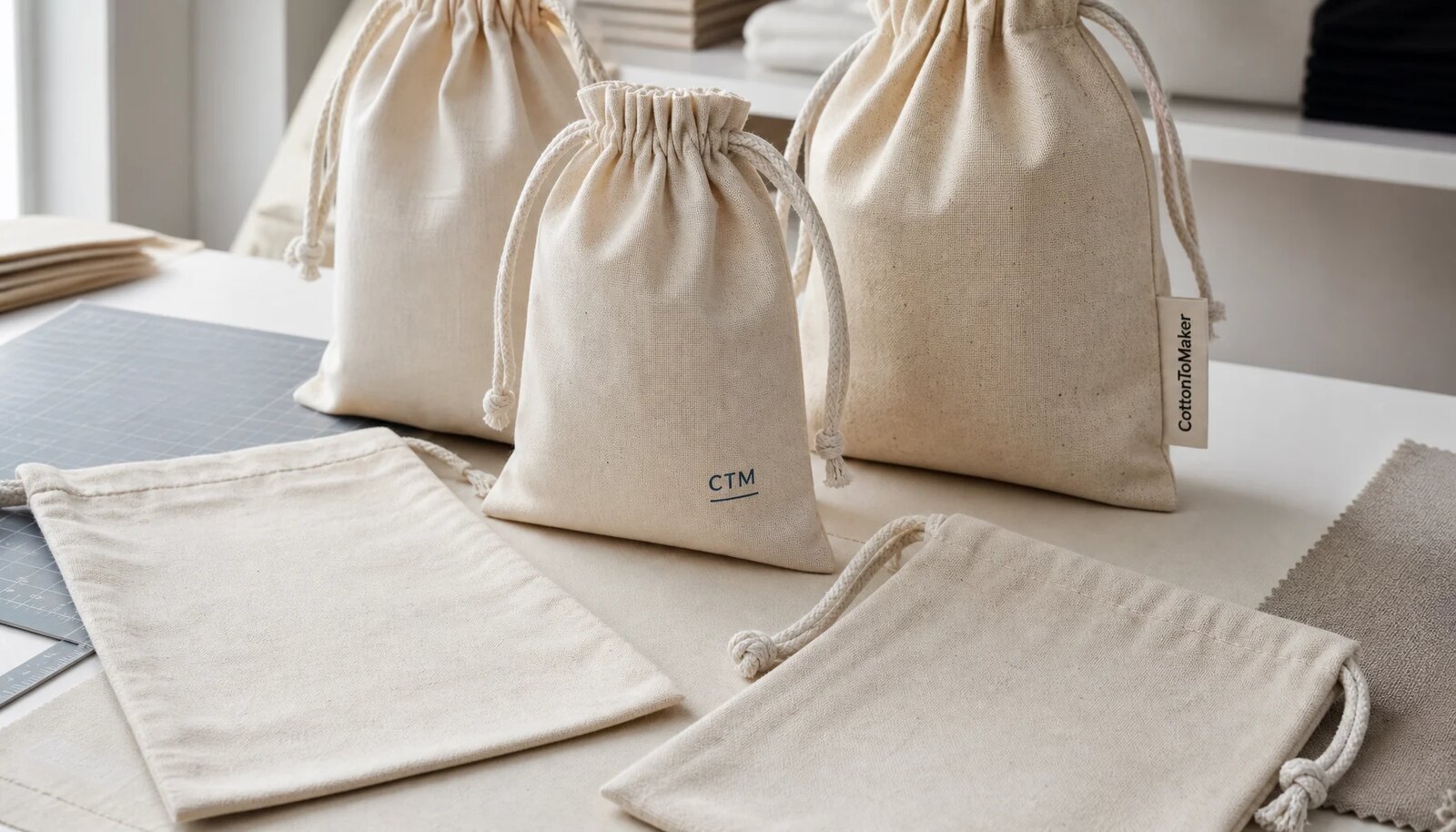
Start With the Actual Use Case
Cotton drawstring pouches for craft fairs look simple in a catalog. In production, they are not all the same product. A pouch used only as checkout gift packaging can be lighter, packed in bulk, and cost-controlled. A pouch sold with a candle, ceramic ornament, skincare sample set, or handmade jewelry box needs better fabric strength, more reliable sizing, cleaner logo work, and smoother closure. The common sourcing mistake is treating every option as a generic cotton drawstring pouch and letting each supplier fill in the missing details differently.
Before you request prices, define the pouch’s commercial job. At a craft fair, the pouch may sit open on a booth table, be handled by shoppers, go into tote bags, be reused at home, or appear in product photos after the event. If it will be opened once, neat sewing and acceptable print appearance may be enough. If customers will reuse it, specify seam durability, cord pull, print rub resistance, shrinkage behavior, and packing protection. If the pouch is part of a kit or resale item, barcode labels, inner packs, and SKU separation may matter as much as the fabric.
Give the factory context, not just a size. A useful RFQ includes product dimensions, product weight, shape, surface sensitivity, expected reuse, display method, and delivery deadline. A flat jewelry card needs different allowances than a round candle tin. A glass ornament needs smoother internal seams and more clearance than a sachet. A pouch under bright booth lights may need better opacity than one used only at checkout. When the supplier understands the use case, the quote becomes a production recommendation instead of a loose price list.
- For single-use gift packing, prioritize unit cost, neat sewing, acceptable print appearance, and accurate bundle counts.
- For reusable packaging, prioritize GSM, seam strength, drawcord durability, print rub resistance, and shrinkage control.
- For resale merchandise, prioritize handfeel, shade consistency, retail folding, barcode handling, and carton separation by SKU.
- For fragile or rigid products, prioritize usable internal dimensions, seam slippage, abrasion risk, and pressure points at corners or knots.
- For distributor programs, prioritize repeatable specifications, carton data, reorder consistency, and quote comparability across sizes.
Use GSM Instead of Loose Fabric Names
Fabric weight is the first major cost and performance lever. Suppliers may use terms such as muslin, calico, plain cotton, canvas, thin cotton, or 5 oz cotton. Those names help with general positioning, but they are too vague for bulk purchasing. Ounce descriptions are often approximate and can vary by market. Ask for measured GSM, write the GSM range into the RFQ, and make the approved sample the production standard.
A practical starting range is 110-130 GSM for very light promotional cotton, 140-170 GSM for most craft fair packaging, 200-230 GSM for a more substantial reusable pouch, and 260-300 GSM for heavier canvas-style use. The right choice depends on load, opacity, and handfeel. Load is not only product weight. Edges, corners, and thickness also create stress. A flat stationery insert may sit cleanly in light cotton. A tin, jar, ornament, or small tool can push against seams, distort the pouch face, or make a thin fabric look stretched.
Heavier cotton is not automatically better. It raises material cost, increases carton weight, may slow sewing around the draw channel, and can make small pouches feel bulky. A thick pouch with a narrow channel may close worse than a lighter pouch with a properly sized cord path. For a new program, request samples in two GSM levels and test them with the actual product inside. Choose based on fit, closure, opacity, seam behavior, print result, and landed cost, not only first touch.
- 110-130 GSM fits flat inserts, seed packets, sachets, very light samples, and short-term event giveaways.
- 140-170 GSM fits most soap, jewelry, stationery, hair accessory, small candle tin, and craft fair gift packaging programs.
- 200-230 GSM fits premium reusable pouches, heavier products, stronger opacity needs, and boutique presentation.
- 260-300 GSM fits durable merchandise pouches or tool-style kits, but is often unnecessary for small retail packaging.
- Specify measured GSM and tolerance, commonly plus or minus 5 percent, instead of relying only on terms such as muslin or canvas.
- For heavier or rigid products, test seam slippage and corner pressure rather than solving every issue by increasing GSM.
Match Cotton Finish to Retail Positioning
Cotton finish changes the pouch’s look, feel, process risk, and documentation burden. Natural unbleached cotton is popular for craft fairs because it supports handmade, artisan, apothecary, low-waste, and organic-style branding. It is also commonly available from stock. The tradeoff is variation. Natural cotton may show slubs, neps, seed marks, darker flecks, and cream-to-beige shade movement between lots. These features are not automatically defects, but they must be defined before production.
Bleached cotton gives cosmetics, stationery, candles, and gift programs a cleaner retail background. Color prints often look clearer on it. At the same time, white or bright fabric shows dirt, scuffs, and handling marks more easily. Dyed cotton supports seasonal colors and brand systems, but it adds lab dips, shade control, higher minimums, and rubbing-fastness checks. Washed cotton can feel softer and more relaxed, yet washing can affect finished dimensions if shrinkage is not managed before cutting.
Be careful with sustainability language. If the brand wants to claim organic cotton, recycled cotton, undyed cotton, or certified material, the RFQ should state exactly what document is required and what it covers. Does the claim apply to fabric only, finished goods, a transaction certificate, or chain of custody? If the sales channel does not require documentation, avoid paying for claims that cannot be verified. Material selection should align finish, budget, documentation, and replenishment needs before sampling begins.
- Natural cotton offers an artisan look, lower process complexity, wider shade tolerance, and visible flecks to manage.
- Bleached cotton offers a cleaner print background but needs stronger handling and carton cleanliness controls.
- Dyed cotton offers brand-color value but requires lab dips, lot control, and dry/wet rub review.
- Washed cotton offers softer handfeel but needs shrinkage and finished-size tolerance confirmed before bulk cutting.
- Organic cotton is useful only when documentation scope and chain-of-custody requirements are clear.
- Recycled cotton blends should be checked for strength, handfeel, shade consistency, and verified claim documentation.
Size for Usable Fit, Not Flat Appearance
Many pouch problems start with size language. A buyer asks for 10 x 15 cm and assumes a product close to that height will fit. In production, finished flat dimensions are not the same as usable internal dimensions. The drawstring channel consumes height. Side seams reduce internal width. The gathered mouth needs empty space above the product. A pouch can look correct when flat and still be too short once closed around a soap bar, candle tin, folded textile, ornament, or small rigid box.
A stronger specification separates finished flat size from usable fit after closure. Most buyers do not need to control cut size unless they are auditing fabric consumption, but they should control finished dimensions and product fit. Send product width, height, thickness, weight, and packing orientation. If workers must insert products quickly, leave enough clearance so they do not scrape the print, stretch seams, or deform the bag. If the product has corners, test whether the corners push into side seams or distort the printed face.
Pouch shape also affects cost and presentation. A flat pouch is efficient and works for many craft fair products. A gusset or boxed bottom improves display for jars, tins, bulky kits, or products that should sit upright, but it adds fabric use, cutting complexity, sewing operations, and extra tolerance points. If upright display is required, discuss structure early. Thicker fabric may improve body, but construction determines how the pouch stands, closes, and packs in a carton.
- Finished flat width should include product width, product thickness, seam allowance, and easy insertion clearance.
- Finished height should include product height, channel allowance, and closure space above the product.
- Usable internal height should be tested with the drawstring closed around the actual product.
- Small pouches need tighter control because a 5 mm variance can affect fit, closure, and logo position.
- Gusseted or boxed-bottom pouches improve bulky presentation but increase labor, fabric consumption, carton volume, and MOQ.
- For sharp or rigid items, inspect abrasion, corner pressure, bottom seam stress, and whether the product distorts the pouch face.
Specify Drawcord and Channel Together
The drawcord is a functional trim, not a minor accessory. It controls opening feel, closure security, color matching, channel width, knot finishing, packing bulk, and perceived quality. Cotton cord gives a natural look and pairs well with unbleached pouches. Polyester cord usually slides more smoothly and offers stronger color consistency. Twill tape can feel premium but needs a wider channel and may look bulky on small pouches. Jute or hemp-style cord can support rustic branding, though buyers should check shedding, roughness, and odor before using it near cosmetics, candles, textiles, or paper products.
Single drawstring construction is lower cost and can work for simple gift packaging. Double drawstring construction closes more evenly, opens from two sides, and feels more retail-ready. Decide this before sample approval. Cord count changes trim consumption, labor time, channel behavior, and how the pouch mouth gathers. It can also change the visual balance of a printed logo when the pouch is filled and closed.
Cord diameter must match the channel. For many small and medium cotton pouches, 3-4 mm cord is a practical starting point. The final choice still depends on fabric thickness, pouch size, and closure expectation. If the channel is too tight, the cord may stick after pressing, print curing, or washing. If the channel is too loose, the top edge can look weak and may not close securely. Open and close the sample repeatedly. Cord problems often appear after handling, not during the first visual check.
- Specify cord material, diameter, color, length after knotting, knot style, cord-end finish, and channel width.
- Use double drawstring when the pouch is reusable, customer-facing, or opened repeatedly after purchase.
- Use single drawstring when cost control is more important than even closure and two-side opening.
- Check knots for slippage, cord ends for fraying, and channel exits for tearing after repeated pulls.
- Do not change cord material or diameter after approval without rechecking channel width, closure feel, and packing bulk.
- For dyed pouches, state whether cord color must be custom matched, stock matched, or accepted as a close commercial match.
Choose Decoration for Cotton Behavior
Logo decoration should be selected for cotton fabric, not only for the artwork file. Screen printing is usually the most practical option for solid craft fair logos, especially one to three colors. It offers clear cost control, works well on natural or bleached cotton, and is easy to inspect. Still, cotton absorbs ink differently from coated paper or synthetic fabric. Pantone targets may appear warmer, duller, or more textured on natural cotton, especially when the fabric contains slubs or flecks. A physical strike-off on actual fabric is more reliable than a digital proof.
Heat transfer can reproduce full-color artwork, gradients, and fine detail, but it may feel less natural on soft cotton. Check edge adhesion, cracking risk, odor after application, and whether the transfer film changes pouch flexibility. Embroidery can look premium on heavier cotton or canvas, yet it may distort thin fabric or small pouch faces. Woven labels, side labels, or cotton labels are strong alternatives when the logo is detailed, when the same brand mark will be used across several pouch colors, or when direct print consistency is difficult on natural cotton.
Print placement needs a measurement standard. The top edge of a drawstring pouch changes shape after gathering, so placement should not be measured from the closed mouth. Use the bottom seam, side seam, or centerline as the reference. State print size, print position, artwork format, color references, maximum placement tolerance, and whether the logo must remain visible when the pouch is filled and closed. If printed panels are folded or compressed during shipping, test for creases and ink transfer after packing pressure.
- Screen print fits solid logos, one to three colors, repeat orders, and controlled unit cost on cotton.
- Heat transfer fits full-color detail, but needs checks for handfeel, edge durability, cracking, odor, and flexibility.
- Embroidery fits heavier cotton or canvas, but can distort thin fabric and small pouch panels.
- Woven or side labels fit detailed branding, multiple pouch colors, and repeat programs using shared trims.
- Measure print placement from a fixed seam, bottom edge, or centerline rather than the gathered top edge.
- Approve color on actual cotton because shade, absorbency, weave texture, and slubs affect final logo appearance.
Break Down MOQ and Cost Drivers
MOQ for cotton drawstring pouches is driven by more than size. Fabric availability, fabric color, dye batch, cutting efficiency, print setup, cord sourcing, label sourcing, packing method, and carton sorting all affect the factory minimum. A supplier may accept a lower order when it uses stock natural cotton, one GSM, one size, one cord color, one screen print, and bulk bundle packing. The same total quantity can become inefficient when it is split across dyed colors, multiple sizes, several logos, custom labels, and individual packing.
Ask for MOQ by variable. MOQ per fabric color matters for dyed programs. MOQ per artwork matters when several craft sellers share one pouch specification but need different logos. MOQ per cord color matters when stock cord is not acceptable. MOQ per packing method matters when some SKUs require barcode stickers, hangtags, paper bands, or retail sleeves. Without this breakdown, procurement may compare a stock pouch quote with a custom program quote and misread the cost difference.
There are useful ways to reduce cost without weakening the pouch. Several brands can sometimes share the same fabric and cord while changing only the printed artwork. Several sizes can sometimes be cut from the same fabric batch. A buyer can reduce print colors, choose a standard cord, use natural cotton instead of dyed cotton, or request counted bundles instead of individual retail packing. The quote should show these tradeoffs clearly so the team avoids hidden specification changes.
- Lowest MOQ is usually stock natural cotton, standard GSM, one size, one logo, one cord color, and bulk bundle packing.
- Dyed fabric MOQ is higher when dye lots must meet minimum batch quantities and require lab dip control.
- Multiple artworks may share fabric but still add screen setup, sorting, labeling, and carton-marking costs.
- Changing cord color can create a separate trim MOQ even when fabric, size, and print remain the same.
- Retail packing, barcode labeling, hangtags, and individual bags can add significant labor and carton volume.
- For fair comparison, require every supplier to quote the same GSM, finish, size, cord, print method, packing, carton data, and lead-time trigger.
Use Samples as the Production Standard
A sample should do more than prove that the supplier can sew a pouch. It should become the physical production standard. The most useful approval sample is a pre-production sample made with actual bulk fabric, actual cord, actual print method, actual label if used, and the intended packing fold. A prototype made with substitute material can help confirm construction or size, but it should not approve color, handfeel, opacity, print result, shrinkage, or cord movement.
Review the sample with the real product, not on an empty desk only. Load the pouch, pull the cord closed, reopen it repeatedly, rub the print with a clean cloth, inspect the channel exits, check seams near the cord path, measure finished dimensions, and compare shade under consistent lighting. If the pouch will hold candles, cosmetics, paper cards, textiles, or food-adjacent gifts, check odor and transfer risk. If it will ship folded, keep the sample packed for several days and review whether creases mark the logo or knots create pressure dents.
Keep one signed approved sample with the buyer and one with the factory. Photos are useful for measurement points and carton packing, but they do not replace a physical reference for fabric handfeel, natural cotton shade, and cord movement. The sample record should also state what is approved and what remains conditional. For example, a buyer may approve size and construction while waiting for a final print strike-off. Clear records reduce reorder drift when the same pouch is purchased again for another craft fair season.
- Approve finished size, usable internal size, GSM, cotton finish, cord type, channel width, print position, and packing fold together.
- Keep one signed sample with the buyer and one with the factory as the reference for bulk production.
- Photograph measurement points so QC teams inspect the same width, height, logo, channel, cord, and seam areas.
- Record acceptable natural cotton shade range, slub level, nep visibility, and seed-mark tolerance.
- Reject samples with tight channels, weak knotting, strong odor, distorted logo edges, seam puckering, poor closure, or product-fit problems.
- If any material, cord, label, print, or packing component changes after approval, request an updated confirmation sample.
Set Practical QC Criteria
Quality control for cotton drawstring pouches should focus on the issues that affect fit, use, appearance, and reorders. Finished size is usually the first check. As a practical benchmark, small pouches are often controlled within plus or minus 5 mm and larger pouches within plus or minus 10 mm, unless the product fit requires tighter tolerance. For rigid or closely fitted products, usable space after closure matters more than the flat measurement alone.
Fabric checks should include GSM, shade, surface marks, and shrinkage risk. GSM tolerance is often managed around plus or minus 5 percent, but the buyer should confirm the supplier’s standard and apply it to the approved sample. Natural cotton should be judged against an agreed reference because slubs, seed marks, and shade movement are part of the material unless they exceed the agreed range. Dyed cotton and printed logos need dry rub and wet rub checks when they may touch light paper, cosmetics, candles, textiles, or other sensitive products.
Construction checks should include seam allowance, stitch density, backstitching, channel width, cord exits, bottom corners, and trimming. Drawcord checks should include pull smoothness, knot security, fraying, and cord length after knotting. Print checks should include placement from a fixed reference point, edge sharpness, pinholes, bleeding, curing odor, adhesion, cracking, and batch consistency. Carton QC should verify counts, SKU separation, moisture condition, carton markings, gross weight, and whether printed panels are protected from pressure marks.
- Measure finished flat size and usable fit after closure against the approved sample and written tolerance.
- Check GSM, fabric shade, slubs, neps, seed marks, and shrinkage-sensitive processes before cutting or bulk release.
- Inspect seams at the cord exit, bottom corners, and side joins because these areas receive the most stress.
- Pull the drawcord repeatedly to confirm smooth movement, secure knots, acceptable cord length, and no channel tearing.
- Check print placement from a fixed seam or centerline, not from the gathered top edge.
- Verify carton count, SKU separation, carton markings, moisture condition, carton weight, and print protection before shipment.
Plan Packing, Cartons, and Lead Time
Packing affects carton volume, warehouse handling, inbound QC, print protection, and booth replenishment. Bulk flat packing in counted bundles is efficient for importers, distributors, and brands that will pack finished products themselves. Individual bags improve cleanliness and counting but add cost, plastic use, packing labor, and carton volume. Paper bands or kraft sleeves can support a craft brand image, but they need accurate sizing and careful packing to avoid shifting during transit.
Match the packing method to the operation after arrival. A distributor may want 50 or 100 pieces per bundle, separated by SKU, with carton labels that support receiving. A craft fair team may prefer smaller inner bundles that are easy to move to a booth without opening a full export carton. A retailer may need barcode stickers, hangtags, or retail-ready packaging. These requirements should be quoted before production begins because late packing changes can create delays, repacking charges, and carton relabeling.
Lead time should be planned around approvals, not only sewing days. A complete calendar includes artwork preparation, lab dips for dyed fabric, print strike-offs, sample production, courier time, approval revisions, deposit processing, cutting, printing, sewing, trimming, QC, packing, export documents, and freight transit. Ask when bulk lead time starts. A quoted 20 production days may begin only after deposit, final artwork, material approval, and pre-production sample approval. For fixed craft fair dates, work backward from the required delivery date and set internal approval deadlines earlier than the factory’s final cutoff.
- Bulk bundles are cost-efficient but depend on accurate counting and clear bundle labeling.
- Individual bags improve cleanliness and receiving control but increase labor, packaging cost, sustainability concerns, and CBM.
- Paper bands or kraft sleeves improve presentation but require extra artwork, sizing control, and transit testing.
- Smaller inner packs help craft fair teams replenish booths without opening full export cartons.
- Request pieces per carton, carton dimensions, gross weight, net weight, estimated CBM, carton markings, and desiccant plan if applicable.
- Set approval deadlines for lab dips, strike-offs, samples, labels, and packing before committing to an event delivery date.
Specification comparison for buyers
| Spec decision | Recommended option | When it fits | Buyer risk to check |
|---|---|---|---|
| Very light craft fair inserts | 110-130 GSM plain cotton | Seed packets, flat jewelry cards, stationery samples, sachets, small giveaways, and low-load inserts under roughly 100 g | Low opacity, weak perceived value, higher wrinkling, and lower seam margin; check show-through under booth lighting |
| General craft fair packaging | 140-170 GSM cotton, often sold as 4-5 oz cotton | Soap bars, jewelry boxes, candles in tins, hair accessories, small kits, and most checkout gift packaging | Confirm finished-size tolerance, opacity, shrinkage, seam strength, and whether supplier ounce descriptions match measured GSM |
| Premium reusable pouch | 200-230 GSM cotton or light canvas | Reusable packaging, heavier inserts, boutique product presentation, gift sets, and higher perceived-value retail programs | Higher carton weight and stiffer draw channel; check cord glide, channel width, and print curing on thicker fabric |
| Heavy-duty pouch | 260-300 GSM canvas only when needed | Tool-style craft kits, dense contents, or merchandise bags sold as reusable items | Often over-specified for small pouches; may increase freight cost, sewing time, and closure bulk without improving product fit |
| Cotton finish | Natural, bleached, dyed, washed, organic-certified, or recycled-content cotton stated clearly | Natural fits artisan brands; bleached fits clean retail; dyed fits seasonal colors; certified options fit documented claims | Natural shade variation, dye-lot variation, wash shrinkage, and certification scope must be controlled before claims are made |
| Cord specification | 3-4 mm cotton or polyester cord for many small and medium pouches | Cotton cord fits natural branding; polyester cord improves smooth pull and color consistency; tape works for premium looks | Cord diameter changes channel width, pull feel, packing bulk, and knot security; test repeated opening before approval |
| Closure construction | Double drawstring for reusable or customer-facing pouches; single drawstring for lower-cost gift packing | Double draw closes evenly and feels retail-ready; single draw reduces trim and labor for simple packing | Single draw can skew the mouth; double draw increases labor, cord cost, and sorting time |
| Logo decoration | Screen print for solid logos; heat transfer for full-color detail; woven label for repeat branding across colors | Screen print works for most one- to three-color craft fair logos; labels work when direct print consistency is difficult | Approve a strike-off on actual cotton; digital proofs do not show cotton absorbency, slubs, shade warmth, or handfeel |
| Size control | Finished flat size plus usable internal size after closure | Rigid boxes, soap, tins, ornaments, and kits where closure space matters | A 10 x 15 cm flat pouch does not provide 10 x 15 cm usable space; channel, seams, and gathered top reduce capacity |
Buyer checklist before sampling
- Define the pouch role: disposable gift packaging, reusable retail packaging, resale merchandise, sample kit bag, protective sleeve, or distributor stock item.
- Specify finished flat dimensions, usable internal dimensions after closure, product orientation, and clearance needed for fast manual packing.
- Share product width, height, thickness, weight, surface sensitivity, corners, and whether the pouch touches paper cards, candles, cosmetics, textiles, or food-adjacent goods.
- Select fabric weight using measured GSM: 110-130 GSM for very light inserts, 140-170 GSM for general packaging, 200-230 GSM for premium reusable use, and 260 GSM plus only for heavy-duty applications.
- State cotton finish and documentation needs: natural, bleached, dyed, washed, organic-certified, recycled-content, or uncertified cotton with no sustainability claim.
- Define fabric tolerances: GSM tolerance, shrinkage allowance, shade range, acceptable slubs/neps/seed marks, and whether shade approval is visual or based on a physical reference sample.
- Send vector artwork, print size, placement reference point, Pantone or brand color target, maximum placement tolerance, and note that natural cotton can make colors appear warmer or less saturated.
- Specify drawcord material, diameter, color, length after knotting, knot style, cord-end finish, channel width, and single or double drawstring construction.
- Request a pre-production sample using actual bulk fabric, actual cord, actual print method, actual label if any, and the intended packing fold or bundle method.
- Separate quote lines for fabric, dyeing, printing, cords, labels, hangtags, barcode stickers, individual bags, paper bands, export cartons, sample charges, courier cost, and inspection charges.
Factory quote questions to send
- What cotton GSM options are available from stock, and are they greige, natural, bleached, dyed, washed, pre-shrunk, or finished fabric?
- Is your ounce description approximate or based on measured GSM, and what GSM tolerance do you apply for this fabric batch?
- Is the quoted size the finished flat size after sewing and shrinkage, and what tolerance applies by pouch size, for example plus or minus 5 mm on small pouches or plus or minus 10 mm on larger pouches?
- Can you recommend pouch dimensions based on our product width, height, thickness, weight, closure space, and packing method rather than only quoting our rough size?
- What MOQ applies per size, GSM, fabric color, cord color, artwork, print color count, label type, and packing method?
- Can multiple artworks share the same fabric batch, and what additional setup, sorting, or carton-labeling charges apply for each artwork?
- Which decoration method do you recommend for our artwork on the selected cotton, and what limits apply to fine lines, small text, halftones, gradients, or Pantone matching?
- Can you provide a physical print strike-off on the actual cotton before bulk production, and is the strike-off fee credited after order placement?
- What cord type, cord diameter, cord length after knotting, knot finish, channel width, and single or double drawstring construction are included in the quote?
- Are woven labels, side labels, hangtags, barcode stickers, individual bags, paper bands, tissue inserts, inner bundles, and retail-ready packing included or quoted separately?
Quality-control points to confirm
- Finished flat size should normally stay within plus or minus 5 mm for small pouches and plus or minus 10 mm for larger pouches unless the product fit, print position, or retail display requires tighter control.
- Usable internal height must be checked after the drawstring is pulled closed because the top channel and gathered mouth reduce the space available for the product.
- Fabric weight should be checked against the approved GSM with a defined tolerance, commonly plus or minus 5 percent, because handfeel, opacity, and durability change noticeably on light cotton.
- Shrinkage should be reviewed when fabric is washed, dyed, printed, heat pressed, or expected to be laundered by the end customer.
- Natural cotton shade, slubs, seed marks, and neps should be compared against an approved reference sample under consistent lighting instead of judged subjectively during final inspection.
- Seam allowance, stitch density, backstitching, side seams, bottom corners, and channel stitching should be inspected because small pouches often fail near the cord exit point.
- Drawcord pull checks should confirm the cord slides smoothly, knots do not slip, ends do not fray excessively, and the channel does not tear during repeated opening and closing.
- Cord length should be measured after knotting on open and closed pouches so the pouch can close fully without excessive dangling cord that affects retail presentation.
- Print placement should be measured from a fixed seam, bottom edge, or centerline rather than estimated by eye, especially because the top edge gathers after closure.
- Print quality should be checked for edge sharpness, pinholes, ink bleeding, fabric handfeel, curing odor, adhesion, cracking, color consistency, and unwanted transfer after packing pressure.