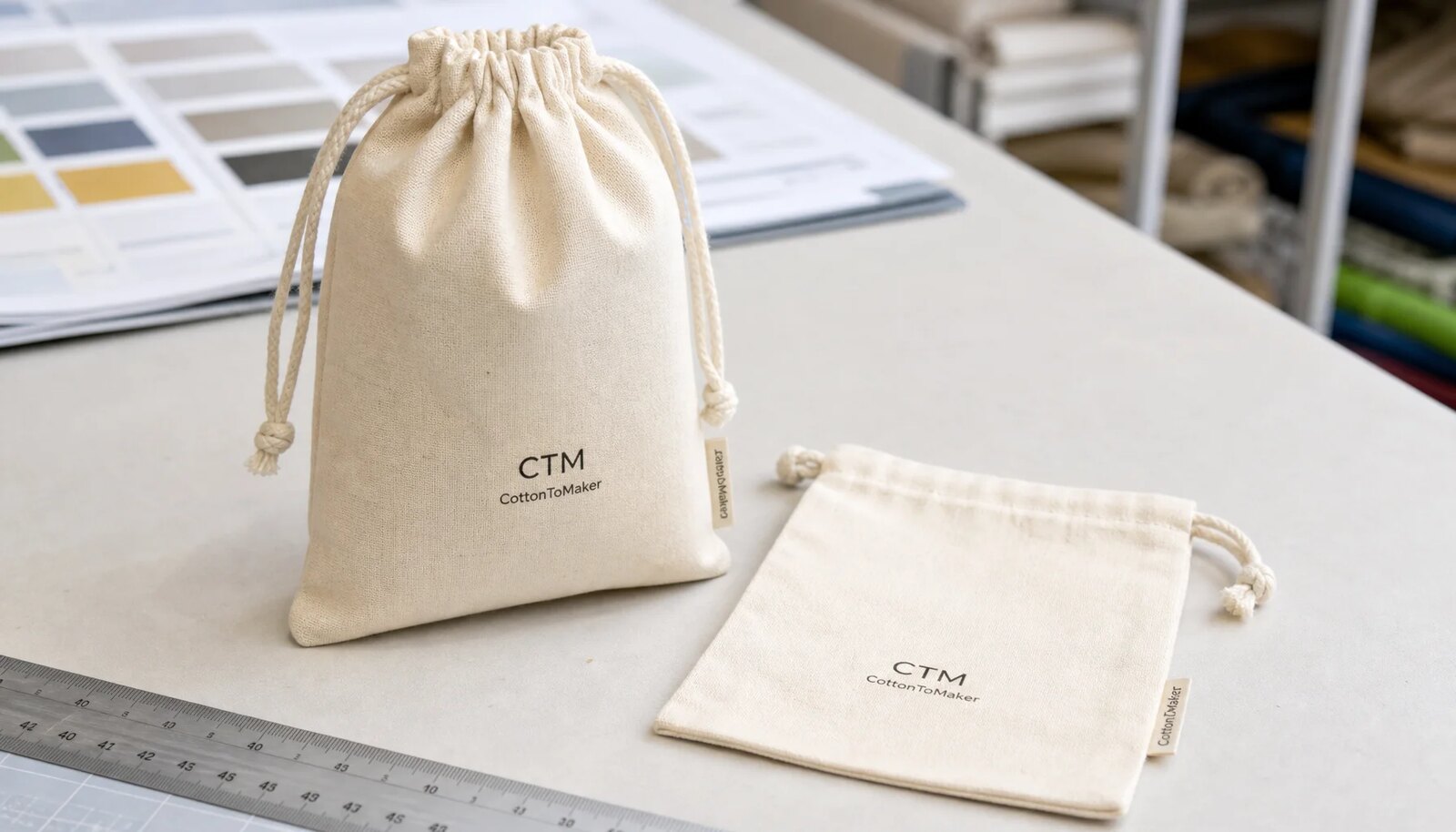
Start With Use Case and Display Method
The right logo position depends on how the pouch will be used at the craft fair. A pouch for jewelry cards lying flat on a vendor table needs a different logo zone from a pouch hanging on a peg, holding a candle, or being sold as part of a kit. If the drawstring is pulled tight, the top area gathers and can hide artwork placed too close to the channel. If the product is bulky, the front panel bows and can make a centered flat logo look higher than expected.
A strong RFQ describes the product inside, the selling environment, and the display method before asking for price. This helps the supplier quote the pouch as packaging, reusable merchandise, or a low-cost carrier. It also reduces later arguments about whether the logo was centered on the cutting panel, the finished flat pouch, or the visible area after closure.
- For table displays, keep the logo in the lower center-front area so it remains visible when the pouch is slightly open.
- For hanging displays, avoid placing the logo too low because the filled bottom may curve inward.
- For bulky products, approve logo placement on a filled sample rather than only on a flat pouch.
- For distributor programs, standardize one logo zone across similar sizes to reduce artwork and inspection errors.
Select Fabric Weight for Print and Feel
Cotton GSM affects print sharpness, opacity, closure, carton weight, and customer perception. For light craft fair packaging, many factories commonly work around 120-140 GSM cotton for jewelry, soap samples, wax melts, stationery, and small accessories. This range keeps the pouch soft and cost controlled. For a pouch that should feel reusable or premium, a typical 180-220 GSM cotton or canvas range gives more body and better opacity, but it increases material cost and shipment volume.
Treat GSM guidance as a quoting range, not a universal rule. Mills, finishing methods, dyeing, washing, and pressing can change the final hand feel. Natural cotton may also show seed flecks and slubs. Some handmade brands want that texture; others need a cleaner logo area. Put the acceptable fabric appearance in the specification so QC can judge it consistently.
- Use lighter cotton ranges for low-cost inner packaging and lightweight contents.
- Use heavier cotton or canvas ranges when the pouch contributes to the retail value.
- Avoid very thin cotton for dense black logos unless visible weave texture is acceptable.
- Define cotton color as natural, bleached white, dyed stock color, or custom dyed because each changes print contrast.
Create a Measured Logo Safe Zone
For many cotton drawstring pouches, the practical logo zone is center front below the drawstring channel with clearance from seams, cord exits, and the bottom curve. On small pouches, the safe area often starts around 25-35 mm below the channel seam. On larger pouches, 35-50 mm may be safer, especially for tall logos or tightly closed pouches. Side clearance commonly needs 15-25 mm, depending on pouch size, seam allowance, and print method.
A placement diagram is better than a written note saying centered. The supplier should know whether the measurement is from the finished top edge, the top channel seam, or the visible panel after sewing. Include logo width and height in millimeters. If the pouch will be filled at the fair, ask for one sample photo flat, one filled, and one closed; this quickly shows whether the brand mark stays readable in real use.
- Measure logo position from the finished top edge or channel seam, not from the cutting edge.
- Keep artwork away from cord exits because gathered fabric can crease the print.
- Set a logo placement tolerance, such as +/-3 mm for small pouches and +/-5 mm for larger pouches where practical.
- For gusseted pouches, approve placement on a filled sample because the front face changes shape.
Match Printing to Artwork Detail
Screen printing is usually the cleanest cost-to-quality choice for solid one-color to three-color logos on cotton drawstring pouches. It can give a soft hand feel and stable repeatability when the artwork is simple and the order quantity supports setup. Ask the factory to review small reverse text, distressed artwork, thin strokes, and tight registration before confirming price.
Heat transfer can handle gradients, detailed graphics, and smaller color runs, but the film area may feel less natural on cotton. Digital direct printing may suit full-color artwork or short runs, yet fabric texture and cotton shade can reduce brightness. Woven labels or side labels are useful when the pouch face should remain plain or when one base pouch supports several product lines.
- Use screen print for solid brand marks, repeat orders, and clear Pantone control.
- Use heat transfer only after checking film edge, hand feel, and expected durability.
- Use woven labels for subtle reusable packaging or multi-brand base-pouch programs.
- Avoid tiny legal text on coarse cotton unless the supplier confirms readable minimum line weight.
Control MOQ and Cost Drivers
MOQ is rarely based on total pieces alone. It can change by pouch size, cotton color, GSM, cord type, print color count, artwork version, and packing method. A supplier may quote a manageable minimum for a standard natural cotton pouch with one-color print, then require higher quantities or extra charges when the order is split into many SKUs.
The biggest cost drivers are fabric weight, cutting yield, sewing time, cord quality, print setup, number of colors, sample revisions, packing labor, and carton volume. Individual polybags, barcode labels, header cards, retail kits, or special carton marks can add more cost than expected. Ask suppliers to separate unit price from setup and service charges so the comparison is not distorted.
- Ask whether MOQ applies per size, fabric color, logo version, print color, or shipment.
- Keep one logo size across similar pouch sizes when brand guidelines allow it.
- Separate screen charges, sample cost, courier cost, label cost, and packing labor from unit price.
- Request carton dimensions and gross weight before choosing the lowest unit price.
Approve a Physical Pre-Production Sample
A digital mockup cannot show cotton slubs, fabric shrinkage, stitch width, cord friction, print edge quality, or how the logo looks when the pouch is pulled closed. The pre-production sample should use the intended bulk fabric, final cord, final seam construction, final logo size, final print method, and planned packing approach.
Record measurable approval details in the purchase order or sample approval sheet. Include finished size tolerance, logo placement tolerance, Pantone or color reference, drawcord movement, stitch quality, print adhesion checks, and product fit. For craft fair vendors, also test packing speed. A pouch that is technically large enough but too tight for repeated filling can slow event setup and look poorly specified.
- Approve the pouch flat, filled, half closed, and fully closed.
- Photograph the filled sample from the front to confirm logo visibility.
- Measure approved logo position and add the distance to the purchase order.
- Hold bulk production until fit, print rub, cord movement, and seam quality are acceptable.
Set QC Criteria for Event Handling
Craft fair packaging is handled many times before the end customer sees it: filled in workshops, transported in bins, arranged on tables, opened by shoppers, and reused after purchase. Inspection should cover the full pouch, not just the print. Weak top-channel stitching, rough cord movement, stains, odor, and inconsistent sizing can damage the brand impression even if the logo is placed correctly.
For larger shipments, use an agreed inspection plan and define critical defects before production. Inspect pieces from different bundles because placement drift can happen across print runs or sewing batches. Print checks should look for missing ink, blurred edges, pinholes, cracking, heavy ink, transfer marks, and color variation. Sewing checks should focus on the channel, side seams, bottom seam, and cord exits.
- Reject open seams, broken channel stitches, strong mildew odor, oil marks on the logo area, and jammed cords.
- Measure logo position across multiple bundles rather than approving only the top piece in a stack.
- Check packed pouches after sealing because damp cotton or uncured print can smell stronger inside cartons.
- Confirm that inner-bag quantity and carton count match the purchase order before shipment.
Specify Packing for Distribution
Packing affects landed cost, receiving speed, and fair setup. Bulk packing in inner bags of 50 or 100 pieces often works for distributors and craft fair vendors who will fill pouches themselves. Individual packing is useful when the pouch is sold as a retail item or included in an ecommerce kit, but it adds plastic, labor, and carton volume.
Printed pouches should be fully dry and cooled before stacking. Dense dark ink, transfer film, or heavy coverage can mark adjacent pieces if packed too quickly. Carton planning should match the distribution path: a national distributor may need SKU marks and case-pack discipline, while a small brand preparing for events may prefer cartons light enough for one person to carry.
- Use fixed-count inner bags so receiving teams can count quickly.
- Set carton gross-weight limits when cartons will be moved manually at events.
- Keep printed faces protected or aligned when ink coverage is heavy.
- Show SKU, pouch size, logo version, quantity, PO number, and destination mark on cartons.
Compare Quotes by Landed Cost
Two cotton drawstring pouch quotes can look close at unit-price level but differ after setup, packing, freight, and inspection are included. One supplier may include screen charges and carton marks; another may list them separately. One may pack compact cartons; another may increase CBM with loose packing. Compare quotes using the same Incoterms, quantity breakdown, logo placement, packing method, inspection requirement, and shipment mode.
A complete RFQ should include finished size, fabric GSM range, cotton color, drawcord specification, print method, logo size, placement diagram, quantity by SKU, packing format, carton mark needs, sample requirement, QC expectation, and delivery country. If a supplier cannot state what is included, treat the quote as incomplete rather than simply inexpensive. Missing quote data usually becomes margin loss later.
- Compare unit price with setup fees, sample charges, courier fees, packing labor, inland freight, and export handling.
- Request estimated carton count, dimensions, gross weight, and CBM before freight booking.
- Clarify whether rejected samples, revised screens, or artwork redraws are chargeable.
- Keep a quote comparison sheet so every supplier prices the same construction and logo placement.
Specification comparison for buyers
| Supplier or option to compare | Best-fit order type | What should be included in the quote | Procurement risk to verify |
|---|---|---|---|
| Standard natural cotton pouch supplier | Craft fair packaging, jewelry bags, soap bags, stationery sets, and light promotional use | Finished size, typical 120-140 GSM cotton range, one-color screen print, cotton cord, bulk inner bags, carton dimensions | Low unit price may exclude screen charge, sample courier, carton marks, or logo placement tolerance |
| Premium reusable pouch supplier | Brands using the pouch as part of the retail value or gift presentation | Typical 180-220 GSM cotton or canvas range, stronger drawcord, double-pull option, cleaner stitching, tighter print approval | Heavier fabric raises CBM and freight; top channel must be sized for the thicker cord |
| Small-run or mixed-SKU supplier | Seasonal craft fair assortments, distributor programs, and multiple brand logos | MOQ by size, fabric color, logo version, print color, and packing method; separate setup charges | Many small artwork versions can increase sampling time, screen fees, and inspection complexity |
| Print-focused supplier | Orders where logo sharpness, Pantone match, or fine artwork matters more than lowest sewing cost | Artwork review, minimum line weight, print method recommendation, color standard, pre-production print sample | Excellent print setup does not guarantee strong seams, smooth drawcords, or clean packing unless specified |
| Retail packing supplier | Pouches sold individually, included in gift kits, or shipped through ecommerce assembly | Individual bagging, barcode labels, SKU separation, case-pack rules, carton marks, and packing labor | Retail packing can add labor and carton volume; uncured ink or transfer film can mark adjacent pouches |
| Export-oriented supplier | Importers, wholesalers, and brands comparing landed cost across factories | Incoterms, export carton size, gross weight, CBM, inner-bag count, inspection support, export documents | A cheaper ex-factory price may lose value if cartons are bulky, packing counts vary, or documents are incomplete |
Buyer checklist before sampling
- State finished flat pouch size, not cutting size, and set practical tolerances such as +/-5 mm for small pouches or +/-8 mm for larger pouches where suitable.
- Specify cotton composition, color, and GSM as a target range; note whether natural seed flecks and slubs are acceptable near the logo area.
- Provide logo width, height, Pantone references, print method preference, minimum line thickness, and final artwork file format.
- Define logo placement by measurements from the finished top edge or channel seam and from side seams, not only by saying centered front.
- Confirm drawcord material, diameter, color, single-pull or double-pull construction, knot style, and whether cord ends need tipping or finishing.
- Request a pre-production sample using intended bulk fabric, final cord, final seam construction, final logo size, and final print method.
- Test the approved sample flat, filled, half closed, and fully closed to confirm product fit and logo visibility.
- Set QC checks for finished size, logo position, print defects, seam strength, cord movement, stains, odor, loose threads, and packing count.
- Clarify packing format, carton marks, inner-bag quantity, gross-weight limit, barcode needs, and whether the pouches must be fully cooled before packing.
Factory quote questions to send
- What finished size tolerance can you hold for this pouch size, fabric weight, and drawstring construction?
- Is the quoted GSM based on greige fabric, finished fabric, or fabric after dyeing, washing, printing, and pressing?
- Which print method do you recommend for our logo size, color count, line weight, and quantity, and what setup charges apply?
- What minimum distance from the drawstring channel, cord exits, side seams, and bottom seam do you recommend for this artwork?
- Can the pre-production sample use the same fabric lot, cord, stitch color, print ink, and packing method planned for bulk production?
- Does MOQ apply per shipment, per size, per cotton color, per logo version, per print color, or per packing style?
- What is the timeline for artwork checking, proof approval, sample making, sample shipping, bulk production, inspection, packing, and export handling?
- What are the inner-bag quantity, master carton dimensions, gross weight, net weight, and estimated CBM for the quoted order?
- What defects are included in your internal inspection standard, and can final QC include logo position measurements across multiple bundles?
- Does the quote include screen charges, sample cost, courier cost, label charges, carton marks, export packing, and any special handling labor?
Quality-control points to confirm
- Finished size is measured flat after pressing, with tolerance agreed by pouch size, fabric weight, and construction.
- Logo placement is measured from the finished top edge or channel seam and side seams on samples from different bundles.
- Print appearance is checked for missing ink, blurred edges, pinholes, cracking, heavy ink buildup, transfer marks, and color mismatch.
- Print adhesion is checked by dry rub, light scratch, and tape pull where suitable for the selected print method and ink system.
- Drawcord moves smoothly through the channel without jamming, twisting, excessive fabric bunching, or cord-end fraying.
- Top channel stitching is straight, secure, and wide enough for the specified cord diameter and closure style.
- Side seams and bottom seams show no open stitches, broken threads, needle holes, loose seam allowance, or weak bar tacks near cord exits.
- Cotton surface is free from unacceptable oil marks, mildew odor, large stains, dampness, and visible contamination.
- Packed pouches are dry and cooled before bagging to reduce ink transfer, odor buildup, blocking, or wrinkled print faces.
- Carton count, SKU separation, carton marks, inner-bag quantity, and packing method match the purchase order.