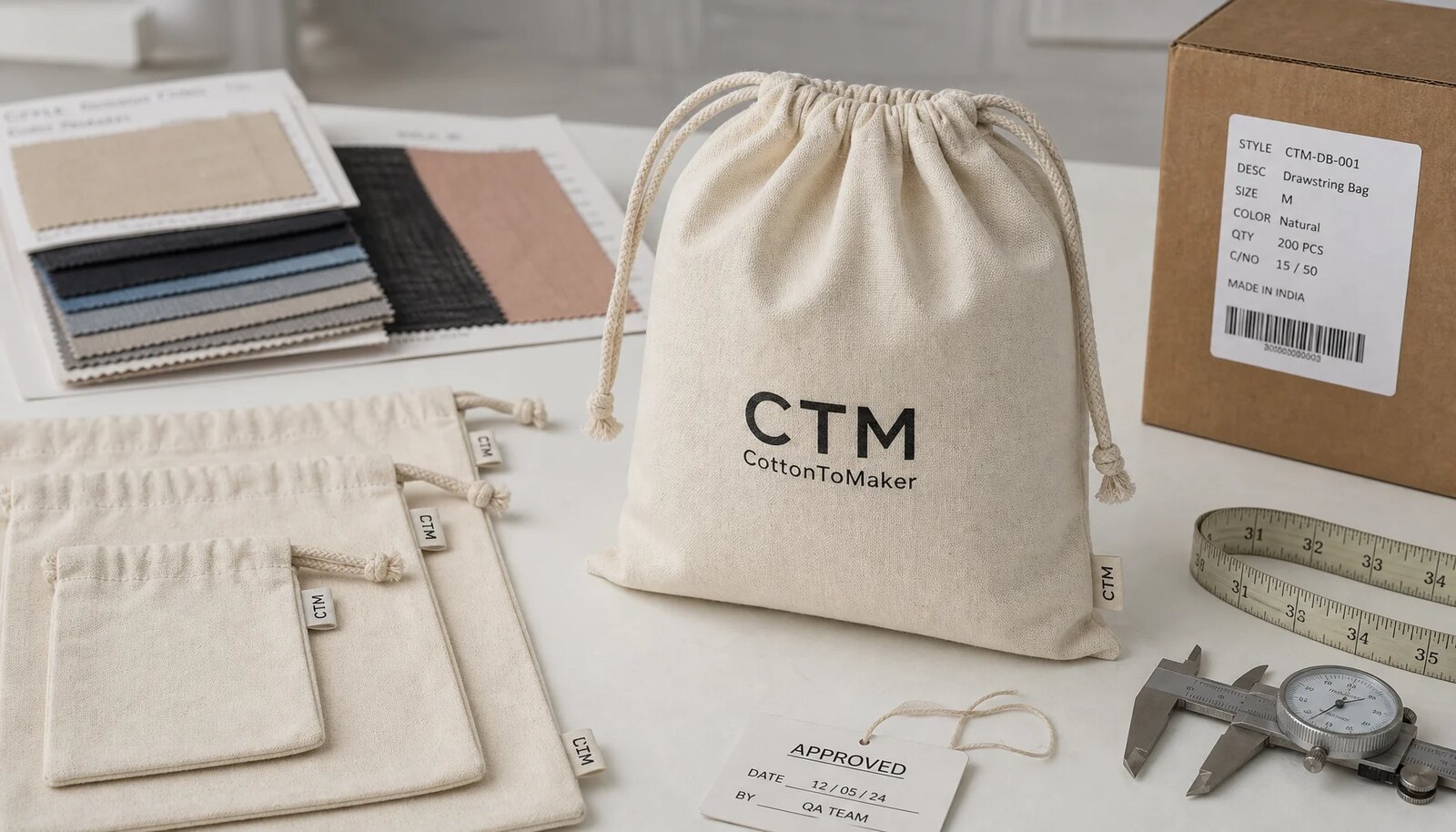
Start with the date the pouches must be usable
For cotton drawstring pouches for craft fairs, the real deadline is not the day the sewing line finishes. It is the day your team can use the pouches without extra scrambling: received, counted, released, sorted by SKU, and ready for the booth, warehouse, distributor, or event staging area. A shipment can be factory-ready on time and still fail the project if cartons arrive too late for relabeling, kitting, product packing, or transfer to the venue.
Work backward from the first operational use date. If the fair opens Friday but booth setup starts Wednesday, Wednesday is the working deadline. If your warehouse needs three working days to receive and release goods, move the delivery deadline earlier. If a distributor must pair pouches with candles, soaps, jewelry, inserts, or small gift sets, that handling time belongs in the schedule too.
Separate the time controlled by the supplier from the time controlled by the buyer. The supplier manages fabric preparation, cutting, printing, sewing, trimming, packing, inspection support, and export handover. The buyer controls artwork readiness, sample feedback, lab dip approval, deposit timing, inspection booking, freight instructions, and internal receiving decisions. Many late pouch orders are not late because sewing took too long. They are late because artwork, approvals, packing rules, or freight decisions were incomplete.
If the order is new, plan for a physical sample. Skip it only for an exact repeat using the same supplier, fabric, GSM, finished size, cord, artwork, print method, and packing. When the calendar is already tight, simplify before placing the PO. Stock natural cotton, one print color, standard cord, and bulk packing are easier to protect than dyed fabric, several artwork versions, retail labels, and individual bags.
- Use the booth-ready or warehouse-released date as day zero, then work backward through local handling, customs, freight, inspection, packing, sewing, printing, cutting, fabric preparation, and sampling.
- For new custom printed orders moving by sea, many buyers should start 60-90 days before required arrival; dyed fabric, multiple SKUs, or retail packing may require more buffer.
- For simple stock-fabric programs moving by air or courier, 30-45 days can work only if artwork, sample approval, and fabric availability are controlled early.
- Keep 7-10 days between warehouse arrival and event use for receiving, counting, product packing, booth allocation, and contingency.
- If the schedule fails on paper, change the spec, quantity split, or freight mode before deposit instead of hoping production will recover lost time.
Choose fabric GSM based on use and availability
Cotton pouch fabric is usually specified by weight and construction, such as 4 oz / 140 gsm plain-weave cotton. For lightweight craft packaging, 140 gsm is common because it keeps unit cost, carton volume, and freight weight under control. It can work well for jewelry cards, seed packets, soaps, wax melts, enamel pins, small accessories, greeting card bundles, and sample products. The tradeoff is structure. Natural 140 gsm cotton may show the outline of a dark insert or box, and the pouch may feel too light for premium gifting.
A 5 oz / 170 gsm pouch gives more body and usually a better reusable feel while remaining practical for many retail programs. It can improve logo presentation and reduce show-through. A 6 oz / 200 gsm pouch may suit candles, small ceramics, boxed ornaments, gift bundles, or products where the pouch is part of the perceived value. Heavier is not automatically better. It increases material use, carton weight, and sometimes sewing bulk around the drawcord channel and bottom corners.
Availability often matters more than the number on the spec sheet. A supplier may keep natural 140 gsm cotton in stock but need to purchase 170 gsm or 200 gsm after deposit. Dyed cotton usually requires greige fabric sourcing, dyeing, finishing, lab dip approval, bulk shade review, and possible correction if the color misses tolerance. Organic cotton or recycled cotton blends also need material sourcing and document confirmation, not just a line in the quote.
Natural cotton needs a clear appearance standard. Seed specks, slubs, and shade variation are normal in unbleached cotton unless a cleaner grade is purchased. Bleached white gives a cleaner base and different print contrast. The approved sample should capture the acceptable shade, texture, fabric hand, and level of natural variation because those details are hard to settle once bulk fabric has been cut.
- Use 4 oz / 140 gsm for lightweight packaging where cost, speed, and compact cartons are priorities.
- Use 5 oz / 170 gsm when the pouch needs better opacity, a more reusable feel, and cleaner print presentation.
- Use 6 oz / 200 gsm for heavier or premium products after checking drawcord channel bulk, carton weight, and air-freight impact.
- Ask whether the exact fabric is in stock, reserved, purchased after PO, or dependent on a mill or dye schedule.
- State accepted GSM tolerance, commonly around ±5% unless a tighter range is commercially agreed and verified.
- Approve fabric shade, hand feel, and natural cotton characteristics on a physical sample, not only a swatch photo.
Specify size, capacity, and construction clearly
A pouch RFQ should not stop at flat width and height. Finished size after sewing determines product fit, but usable capacity is reduced by the drawcord channel, seam allowance, bottom corners, and gathered closure area. A pouch listed as 15 x 20 cm does not provide 20 cm of reliable product height. If it will hold a candle jar, ceramic piece, tin, box, soap bar, bottle, or ornament, provide product length, width, depth, weight, and the closure clearance you expect.
Construction choices change both risk and lead time. A simple flat pouch with a single drawcord is usually the fastest route. A double-drawcord pouch opens from both sides and can feel more balanced, but it adds cord length, handling, knotting, and closure checks. A gusset improves depth for bulkier products, yet it adds cutting and sewing operations and creates more measurement points. Lining, French seams, contrast cords, woven labels, metal cord ends, reinforced bottoms, and special trims can improve presentation, but they should be sampled and priced before PO release.
For craft fair operations, packing speed is part of the specification. Booth staff or warehouse teams may need to insert hundreds of products quickly. A pouch that is barely large enough can slow the line if corners catch, the product stresses side seams, or the channel sits too close to the product top. Oversizing creates the opposite problem: the product looks undersized, cartons ship excess air, and the brand presentation feels weaker.
Use a fit matrix when one order covers several products. List each product, its dimensions, weight, target pouch size, required closure height, gusset need, packing location, and final destination. This prevents a common error: choosing one pouch size from a flat mockup, then discovering during kitting that a rigid box or jar does not insert smoothly.
- Quote finished size after sewing, not cut-panel size, and define whether dimensions are measured flat with or without pressing.
- Reserve usable height below the drawcord channel; the channel and gathered closure area are not reliable product space.
- Use gussets only when product depth requires them because gussets add labor, tolerance points, and inspection complexity.
- Specify single drawcord or double drawcord before quoting because cord length, channel construction, labor, and closure feel differ.
- For rigid products, approve a fit sample with the real product or a dimensional dummy before bulk cutting.
- Use ±0.5 cm for small pouches and ±1.0 cm for larger pouches as a practical baseline unless product fit requires tighter control.
Lock artwork before printing starts
Screen printing is often the most predictable choice for cotton drawstring pouches with one to three solid colors. It suits logos, maker names, icons, event branding, and simple marks that need clean edges at close viewing distance. Once screens are prepared and the first bulk pieces are approved, production can move efficiently. The buyer still needs to supply proper files: vector artwork, Pantone or target color references, print size in centimeters, placement from edges or centerline, and confirmation of one-side or two-side printing.
Heat transfer, digital print, and similar methods can help with full-color illustrations, gradients, short runs, or multiple artwork versions. They may reduce screen setup, but they introduce other variables: transfer edge feel, stiffness, cracking risk, heat marks, curing time, and rub resistance. Full color is not automatically faster. Timing depends on artwork processing, print material availability, press capacity, and how many versions need review.
Ask where printing happens in the production sequence. Printing on cut panels usually gives flatter placement and more consistent registration, but artwork must be approved before sewing starts. Printing on finished pouches can work for some designs, though seams, corners, and the drawcord channel can limit flatness and placement accuracy. This choice affects both quality and the timing of any correction.
Print approval should include hand feel and durability, not just color. Thick ink can make a small pouch stiff. Low-opacity ink can look weak on natural cotton. Artwork placed too close to a seam or channel can distort when the pouch is filled. For reusable or retail-facing pouches, include simple rub checks and tape-pull observations in the sample and final QC plan.
- Provide final vector artwork before sampling, with version names that match the PO and packing list.
- Define print size, print position, print side count, Pantone targets, and acceptable placement tolerance before production starts.
- Keep artwork away from side seams, bottom corners, and drawcord channels to reduce distortion and registration complaints.
- Approve ink opacity and color on the actual production GSM and fabric shade, not on a digital mockup.
- For print placement, specify a practical tolerance such as ±0.3-0.5 cm from the agreed reference point, depending on artwork size.
- Check first bulk print pieces before the full run continues, especially when multiple sizes or artwork versions are involved.
Break MOQ down by every variable
Craft fair buyers often need assortments: small pouches for jewelry, medium pouches for soaps, and larger pouches for candles or gift sets. From the buyer side, this feels like one packaging program. From the factory side, each size may require a separate cutting layout, sewing adjustment, cord length, print placement, and packing rule. If each size also uses a different fabric color or artwork, the order becomes several small production runs rather than one efficient run.
Clarify MOQ by variable. A quote that says MOQ 1,000 pcs is incomplete unless it states whether that means 1,000 total, 1,000 per size, 1,000 per fabric color, 1,000 per artwork, or 1,000 per packing style. Some suppliers can combine sizes when the fabric, cord, and print color are the same. Others price and schedule each size separately because setup and handling are separate.
To reduce lead time and price friction, standardize details customers will not strongly notice. Three sizes in natural cotton with the same black logo and same cord are easier to schedule than three dyed pouch colors with three logo versions and individual barcode packing. If the craft fair deadline is close, launch a simpler first program and save wider variation for a reorder.
MOQ also affects receiving. Mixed-SKU cartons may reduce freight volume but create counting errors if the warehouse expects one SKU per carton. Supplier-packed booth kits can save event labor, but only when carton marks and packing lists are exact. Align the MOQ table with the packing table so the quote supports both production efficiency and event operations.
- Ask for MOQ by order total, finished size, fabric color, cord color, artwork, print color count, and packing method.
- Use the same RFQ quantity grid for every supplier so quotes are comparable.
- Consolidate fabric and print colors when the deadline is fixed and sample time is limited.
- Confirm whether overrun or underrun tolerance applies; small custom textile runs may not finish at the exact ordered quantity unless specified.
- Create an SKU table showing size, fabric, cord, artwork, quantity, packing count, carton mark, and destination before PO release.
- Avoid late assortment changes because each new variable can reset artwork, sampling, cutting, print setup, or packing plans.
Use samples as the production standard
A pouch sample should prove function, not just appearance. For craft fair use, the sample needs to show that the product fits, closes cleanly, carries the print correctly, and can be packed quickly. If the pouch is intended for a jar, candle, ceramic piece, boxed item, soap, bottle, or gift set, send accurate dimensions and weight. When possible, provide a physical product or a dimensional dummy. Flat size alone does not prove usable fit.
The approved sample should lock measurable details: finished width and height, channel depth, usable height, gusset depth, fabric GSM, fabric shade, cord material, cord diameter, cord length, knot style, seam construction, stitch density, print method, print size, print placement, hand feel, label position, and packing format. If the buyer approves the pouch and later adds barcodes, hangtags, belly bands, or individual bags, the schedule and quote may change.
Photo samples are useful for early screening, but they do not replace physical approval when fit, opacity, fabric shade, cord function, odor, and print hand feel matter. If the calendar allows only one physical round, make the first sample request complete. Include final artwork, print size, Pantone targets, product dimensions, packing requirements, and measurement tolerances at the start.
After approval, keep a reference file. Procurement should retain sample photos with a ruler, product-in-pouch photos, final artwork files, written approval date, and any approved deviations. The supplier should retain the approved sample or a duplicate. This shared reference helps with inline inspection, final inspection, and any later dispute.
- Measure the sample flat after sewing and record width, height, channel depth, gusset depth, cord length, and print position.
- Insert the real product or dummy, close the pouch, and check whether seams, corners, and logo placement remain acceptable.
- Open and close the pouch repeatedly to check channel clearance, cord pull, knot security, and staff usability.
- Rub the print with a dry white cloth and inspect for obvious ink transfer, weak curing, cracking, or rough hand feel.
- Check whether natural cotton specks, shade variation, slubs, and fabric hand feel match the brand expectation.
- Approve the sample in writing and reference that approval in the PO, inspection checklist, and packing instructions.
Ask for quote data you can compare
A useful B2B quote defines both the product and the timing basis. At minimum, request finished size, fabric composition, weave, GSM, fabric color, drawcord type, drawcord color, print method, print colors, print area, print placement, MOQ, sample charges, setup charges, packing format, carton dimensions, gross weight, Incoterms, payment terms, and production lead time. Without these details, two suppliers may look like they quoted the same pouch while actually quoting different goods.
Lead time wording deserves close attention. One supplier may count production from deposit. Another may count from final artwork approval, lab dip approval, fabric arrival, or signed sample approval. Those start points are not equal. The PO should state exactly what starts the clock and which buyer approvals must be completed first. If artwork approval slips by five days, the supplier may not treat production as delayed.
Separate one-time charges from recurring unit costs. Screen charges, artwork separation, sample fees, lab dips, special labels, carton mark setup, inspection support, and document fees should be visible if reorders are expected. Clear pricing helps procurement compare first-order cost against reorder cost and avoids confusion when the second order is quoted differently.
Freight planning starts with carton data. Ask for pieces per inner bag, pieces per carton, carton dimensions, gross weight, net weight, and estimated carton count by SKU. This information is needed to compare courier, air, sea, and domestic trucking. Individual packing, heavier GSM, and oversized inserts can materially increase chargeable weight.
- Require quotes to include finished size, GSM, fabric route, cord specification, print method, print size, packing format, carton data, Incoterms, and lead time basis.
- Ask suppliers to identify whether the quoted ship date depends on fabric stock, sample approval, print capacity, buyer payment, or freight booking.
- Separate sample charges, screen charges, lab dips, labels, hangtags, export packing, and inspection support from the unit price.
- Request carton dimensions and gross weight early enough to estimate landed cost and freight mode feasibility.
- Put the approved sample reference, production start trigger, target ready date, packing rule, and inspection requirement directly into the PO.
- Do not compare unit prices unless all suppliers quoted the same specifications, quantity grid, packing format, and delivery terms.
Match packing to event operations
Bulk packing is usually the fastest and most economical format for cotton drawstring pouches used at craft fairs. A common approach is 50 or 100 pieces per inner bag, then export cartons by SKU. This works well when pouches will be used at a booth, packed with products in a warehouse, or distributed to vendors in bulk. It reduces labor, keeps cartons compact, and avoids unnecessary individual packaging.
Individual packing may be necessary when pouches are sold as retail items, shipped to stores, controlled by barcode, included in prebuilt kits, or processed through a fulfillment center. It can include individual polybags, barcode stickers, hangtags, belly bands, insert cards, or size labels. Each item adds material procurement, labor time, and QC points such as sticker placement, barcode readability, bag sealing, and SKU separation.
Packing affects freight cost and receiving speed. A flat bulk-packed pouch ships efficiently. The same pouch with hangtags, individual bags, or stiff inserts may require more carton volume, increasing air-freight chargeable weight. Mixed cartons can reduce carton count, but they can also create receiving errors if the warehouse expects one SKU per carton. Supplier-packed booth kits can save local labor only when the packing map is approved before production.
Carton marks are operational controls, not decoration. They should help receiving teams find the right goods quickly. At minimum, carton marks should show PO number, SKU, finished size, fabric color, print version, quantity, carton number, gross weight, net weight, and destination if needed. Poor carton labeling can turn an on-time delivery into a receiving delay.
- Use bulk packing for booth use, warehouse product packing, and internal event distribution where speed and cost are priorities.
- Use individual packing only when retail resale, barcode control, store distribution, or kit assembly requires it.
- Define pieces per inner bag, pieces per carton, carton dimensions, gross weight, SKU separation, and mixed-carton rules before production starts.
- Approve barcode labels, hangtags, inserts, belly bands, and carton marks during sampling, not after sewing.
- Check whether individual packing or inserts increase carton volume enough to affect courier or air-freight cost.
- Require SKU-level packing lists so receiving teams can verify contents before the craft fair deadline.
Set QC tolerances before cutting
The most damaging pouch defects are often practical. A slightly undersized pouch can slow product packing. A tight drawcord channel can frustrate booth staff. Uneven logo placement can make a craft brand look careless. Oil marks, severe stains, loose threads, dark slubs, broken stitches, and unreadable print may look worse under bright booth lighting than they do in a factory photo.
Define inspection criteria before bulk fabric is cut. A standard random inspection approach can be used for overall workmanship, while critical points such as product fit, finished size, print placement, and drawcord function receive specific checks. AQL can organize sampling, but it does not replace a defect classification list. Wrong artwork, wrong size, missing cords, open seams, severe stains, mold odor, and unreadable print should be unacceptable for most event-facing orders.
Measurement instructions must be repeatable. Finished width and height should be measured flat after sewing and pressing. Channel depth should be recorded because it reduces usable height. Gusset depth should be measured if specified. Print placement should be measured from a defined top edge, side edge, or centerline. If inspectors are not told exactly where to measure, disputes become likely.
Functional testing matters when the pouch holds real products. Samples should be filled with the buyer's product or an equivalent dummy. The pouch should close fully without tearing, jamming, slipping knots, or exposing too much product. For reusable pouches, open and close sampled units several times to check channel distortion and cord behavior.
- Finished size: use ±0.5 cm for small pouches and ±1.0 cm for larger pouches unless the approved fit sample requires tighter control.
- Print placement: define allowable shift, commonly ±0.3-0.5 cm from the agreed edge or centerline depending on artwork size.
- Stitching: specify seam allowance, backstitching, and a practical stitch density such as 8-10 stitches per inch for standard cotton pouches.
- Drawcord function: sampled units should open and close smoothly without missing cords, slipping knots, torn channels, or excessive puckering.
- Appearance: classify severe stains, oil marks, holes, open seams, wrong artwork, unreadable print, and mold odor as unacceptable.
- Packing: verify inner bag count, carton count, SKU separation, barcode accuracy, carton marks, and packing list alignment before shipment release.
Control schedule risks early
The visible pouch process looks simple: prepare fabric, cut panels, print, sew, trim, pack, and ship. The hidden delays usually sit around those steps. Artwork may need cleanup or color separation. Fabric may not be in stock. Dyed fabric may miss shade tolerance. Natural cotton may vary by lot. Print capacity may be booked. A fit sample may show that the pouch is too small. Carton marks may change late. Freight booking, customs, holidays, and weather can affect delivery even when sewing finishes on time.
Protect the schedule with dated milestones, not just a promised ready date. Ask the supplier to show fabric confirmation, lab dip timing if applicable, cutting start, first print approval, sewing start, inline inspection, packing start, final inspection, and ready-to-ship date. Compare that plan with freight cutoffs and internal receiving requirements. If one milestone slips, update the delivery plan immediately rather than waiting until final packing.
Craft fair orders often cluster before spring fairs, holiday markets, and end-of-year retail events. During these periods, fabric mills, sewing lines, print shops, freight forwarders, and customs channels may be busier. A factory may have sewing capacity but limited print capacity, or fabric may be available while freight space is tight. Ask about the full supply chain, not only factory sewing days.
When the event date cannot move, decide fallback options in advance. A partial air shipment can protect booth readiness while the balance ships by sea. Stock natural cotton can replace dyed cotton. One artwork version can replace several. Bulk packing can replace individual packing. These decisions are much easier before production starts than during a delivery crisis.
- Approve final vector artwork early; late art is one of the most preventable causes of missed production starts.
- Build extra buffer for dyed fabric because lab dips, bulk shade approval, dye lot variation, and redye risk affect timing.
- Check public holidays, seasonal peaks, and freight booking limits across fabric, print, sewing, export, and local delivery steps.
- Do not schedule final delivery for the same day pouches are needed at the booth; inspection failures and receiving delays need correction time.
- For critical events, consider air-shipping a smaller launch quantity and moving the balance by sea or standard freight.
- Keep a written fallback plan covering stock fabric, simpler print, reduced SKU count, bulk packing, alternate freight, and split shipment rules.
Specification comparison for buyers
| Spec decision | Recommended option | When it fits | Buyer risk to check |
|---|---|---|---|
| Planning date | Plan from booth-ready or warehouse-released date, not factory-ready date | Craft fairs, holiday markets, pop-ups, brand activations, distributor event kits | Cartons can arrive before the event and still miss use if receiving, counting, relabeling, kitting, or local transfer is left out |
| Fastest fabric route | Stock natural unbleached cotton, usually 4 oz / 140 gsm or 5 oz / 170 gsm where available | Tight timelines, neutral craft branding, simple one-color logo programs | Natural cotton has seed specks, slubs, and lot shade variation; define acceptable appearance against an approved sample |
| Premium fabric route | 5 oz / 170 gsm or 6 oz / 200 gsm cotton, natural or bleached | Reusable retail pouch, candles, ceramics, gift sets, boxed ornaments, higher perceived value | Heavier fabric may add sourcing time, increase carton weight, and require a wider drawcord channel |
| Dyed fabric route | Use only with lab dip and shade tolerance built into the calendar | Brand-color pouch programs and coordinated retail packaging | Lab dip approval, bulk dye lot variation, and redye risk can add days or weeks if color tolerance is vague |
| Finished size tolerance | ±0.5 cm for small flat pouches; ±1.0 cm for larger pouches unless product fit requires tighter control | Common 10 x 15 cm to 30 x 40 cm flat cotton pouches | Soft textile tolerance may still fail rigid jars, boxes, tins, or bottles; test with the actual product |
| Drawcord choice | Cotton cord for natural look; polyester cord for smoother pull; braided cord for stronger closure | Cotton suits handmade and eco-positioned branding; polyester suits budget or high-volume promotional use | Cord diameter, shade, knot security, shrinkage, and channel clearance must be checked on the pre-production sample |
| Print method | Screen print for 1-3 solid colors; heat transfer or digital for full-color artwork | Logo marks, maker names, simple icons, event branding, short-run illustrated designs | Ink opacity, curing, rub resistance, placement tolerance, and hand feel vary by fabric GSM and print method |
| MOQ structure | Quote MOQ by size, fabric color, cord color, artwork, print color, and packing format | Assortments with 2-4 sizes under one brand program | One total MOQ number is not enough; each variable can create a separate setup and production run |
| Packing format | Bulk pack 50-100 pcs per inner bag unless retail control is required | Booth replenishment, warehouse product packing, event kit assembly, distributor receiving | Individual polybags, barcode labels, hangtags, and inserts add labor, materials, carton volume, and inspection points |
Buyer checklist before sampling
- Lock the craft fair opening date, booth setup date, warehouse receiving deadline, local transfer date, and latest acceptable ship date before requesting quotes.
- Build a reverse schedule covering sample development, lab dips if needed, artwork proofing, fabric sourcing, cutting, printing, sewing, trimming, packing, inspection, export booking, freight, customs, and local delivery.
- Define the pouch by finished size after sewing, not cut-panel size; include usable height below the drawcord channel, gusset depth if any, and product clearance.
- Select cotton GSM based on product weight, opacity, reuse expectation, print coverage, freight impact, and fabric availability, not only unit price.
- State fabric route clearly: natural unbleached, bleached white, dyed cotton, organic cotton, recycled cotton blend, or mixed composition; ask how each route changes lead time and documentation.
- Provide vector artwork, Pantone or target color references, print dimensions in centimeters, print placement from edges or centerline, print side count, and artwork version names.
- Break quantities by pouch size, fabric color, cord color, artwork, print color, and packing method so supplier MOQ and unit price comparisons are valid.
- Require a physical pre-production sample for any new size, GSM, fabric color, construction, print method, drawcord, label, packing format, or product-fit requirement.
- Approve the sample in writing with finished measurements, fabric GSM, fabric shade, cord type and length, channel width, print size and position, packing format, carton marks, and barcode or label needs.
- Set QC criteria before bulk cutting for size tolerance, seam strength, stitch density, print placement, print durability, shade variation, stains, loose threads, drawcord function, product fit, and packing count.
Factory quote questions to send
- Is the quoted fabric in stock, reserved, purchased after deposit, or greige fabric that must be dyed, and how many calendar days apply to each route?
- What is the MOQ per finished pouch size, fabric color, cord color, artwork version, print color count, and packing format?
- What exact fabric composition, weave, GSM, accepted GSM tolerance, shrinkage expectation, and fabric finish are included in the price?
- Is the fabric natural unbleached, bleached white, dyed, organic, recycled blend, or another grade, and what visual variation is normal for the grade quoted?
- Which print method is included, how many colors are priced, what is the maximum print area, and is printing performed on cut panels before sewing or on finished pouches?
- What size tolerance, print placement tolerance, stitch density range, seam allowance, and drawcord specifications will be used for production and inspection?
- Are screen charges, artwork separation, sample charges, lab dips, carton marks, barcode labels, hangtags, export packing, compliance documents, and inspection support included or separate?
- How many days are required for artwork proof, photo sample, physical sample, revised sample, and pre-production sample after fabric and artwork are confirmed?
- What event starts the quoted production lead time: deposit received, PO confirmation, final artwork approval, lab dip approval, fabric arrival, or signed pre-production sample approval?
- Can you provide a dated schedule for fabric preparation, cutting, printing, sewing, trimming, packing, inline inspection, final inspection, and ready-to-ship date?
Quality-control points to confirm
- Finished size measured flat after sewing and pressing, with width, height, drawcord channel depth, usable height below channel, and gusset depth recorded separately where applicable.
- Fabric GSM verified through incoming fabric report, cutting-weight method, or supplier test data, using an agreed tolerance such as ±5% unless another range is approved.
- Fabric shade, specks, slubs, stains, weaving defects, and natural cotton variation checked against the approved sample under consistent light, separating normal seed flecks from unacceptable marks.
- Seam allowance, stitch density, backstitching, bottom corners, channel seams, skipped stitches, broken stitches, and loose threads checked before packing.
- Drawcord channel width, cord diameter, cord length, knot security, cord shade, pull function, and closure completeness checked on sampled units.
- Print placement measured from defined top edge, side edge, or centerline on first bulk pieces from each setup before the full print run continues.
- Print color, opacity, registration, edge sharpness, curing, rub resistance, tape pull response, and hand feel checked according to the selected print method.
- Critical defects such as wrong artwork, wrong size, missing cord, open seam, severe stain, unreadable logo, mold odor, or mixed SKU packing classified as unacceptable.
- Product fit tested using the buyer's actual jar, box, candle, soap, insert, bottle, ornament, or dimensional dummy when fit is part of the specification.
- Packing count verified by inner bag, carton, SKU, barcode, carton mark, mixed-carton rule, and packing list before shipment release.