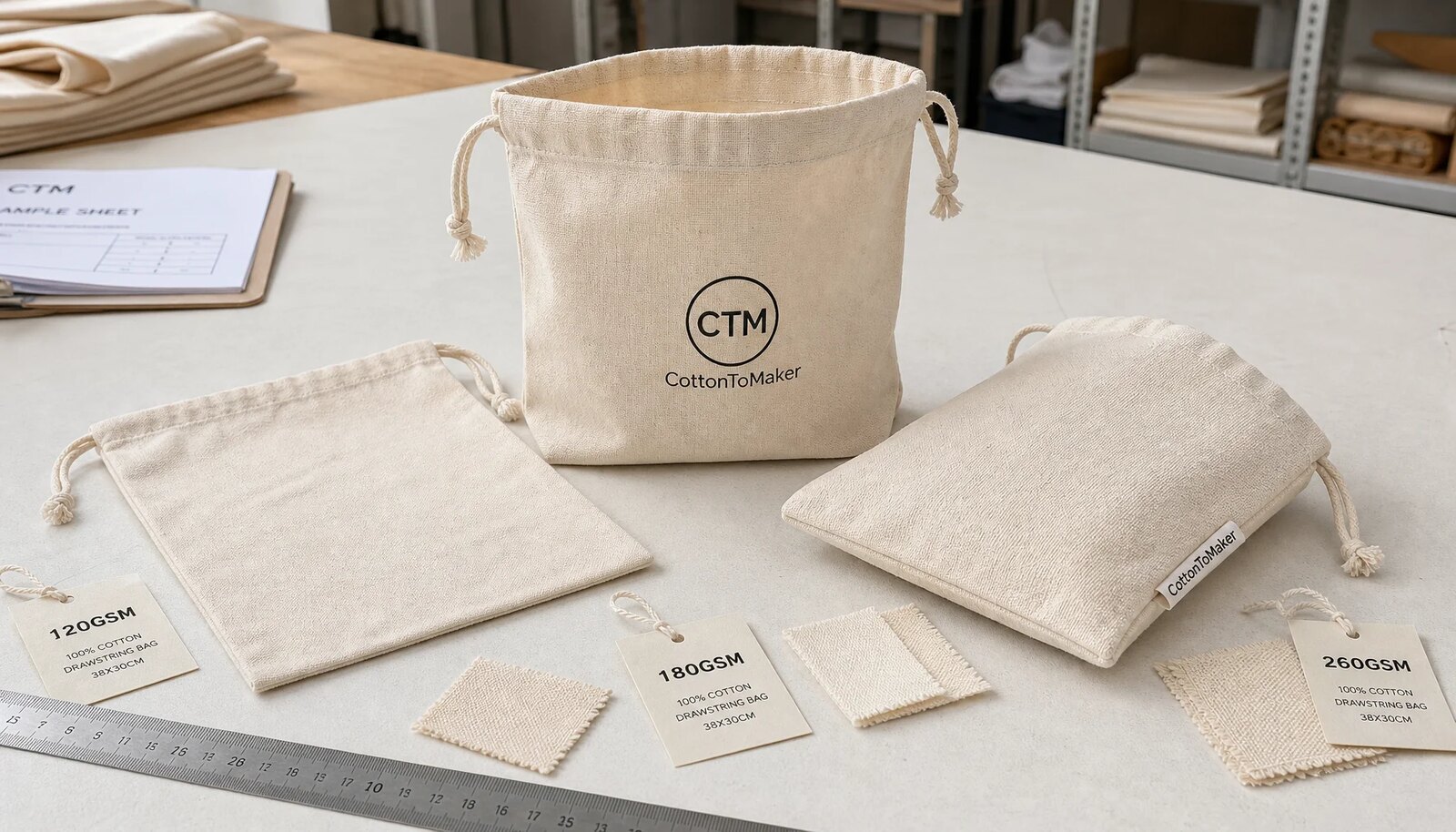
Start With the Job the Pouch Must Do
For craft fair programs, cotton drawstring pouches sit between packaging, display, and customer take-home value. A pouch used only to protect a soap bar at checkout does not need the same fabric as a pouch sold with a jewelry kit or handmade ceramic ornament. The fabric weight decision should start with the product inside, not with a catalog photo.
Procurement teams often compare quotes using only size and logo. That creates misleading price gaps because suppliers may quote different GSM, different cord quality, or different seam construction. A proper RFQ should describe the product weight, the expected retail presentation, the reuse expectation, and the acceptable feel in hand. This keeps the conversation commercial instead of cosmetic.
- Use 120-140gsm when the pouch is mainly a light packaging sleeve.
- Use 160-180gsm when the pouch needs a better retail handfeel but still folds flat.
- Use 220-260gsm when the pouch is part of the product value or likely to be reused.
- Avoid specifying heavy canvas for very small pouches unless the opening and drawstring channel have been tested.
- Leave product clearance; a pouch that fits perfectly in the sample can fail in bulk due to normal sewing tolerance.
How GSM Changes Cost, Feel, and Risk
GSM is grams per square meter, but buyers should treat it as a cost and performance indicator rather than a quality grade. A heavier cotton pouch usually costs more because it consumes more material, increases cutting bulk, slows sewing slightly, and raises carton weight. However, heavier fabric may reduce show-through, improve perceived value, and support better reuse.
The practical range for cotton drawstring pouches used at craft fairs is usually 120gsm to 260gsm. Below 120gsm, the pouch may feel too thin for retail unless it is intentionally a dust bag or low-cost event wrapper. Above 260gsm, small pouches can become bulky at the drawstring channel, and freight efficiency drops. The best value often sits around 160-180gsm for general craft fair packaging.
- 120gsm cotton: lowest cost, soft, foldable, better for light goods and short-term use.
- 140gsm cotton: still economical, slightly better opacity, common for promotional pouches.
- 180gsm cotton: strong middle option for retail feel, screen print, and moderate reuse.
- 220gsm canvas: more structured, stronger handfeel, suitable for premium small kits.
- 260gsm canvas: premium but bulkier, best for larger pouches or higher-value products.
Match Fabric Weight to Product Type
Craft fair buyers often handle mixed product ranges: candles, handmade jewelry, soap, spice packs, stationery, ornaments, sewing kits, and seasonal gifts. A single pouch specification may simplify purchasing, but it can overpay on small light goods or underperform on heavier items. Segmenting by product group usually gives a cleaner landed-cost result.
For small jewelry or charm pouches, 120-140gsm may be acceptable if the brand wants a soft natural look and the item is already protected by a card or box. For soap, candles, small jars, or ceramics, 160-180gsm is safer because corners and product weight put more pressure on the seam. For premium gift sets, 220gsm or above can make the pouch feel like a reusable component rather than disposable packaging.
- Jewelry cards: allow extra height so the drawstring closes above the card, not across it.
- Soap bars: test oil, fragrance, or moisture migration if the soap contacts cotton directly.
- Candles and jars: avoid thin cloth if glass edges or metal lids create visible pressure marks.
- Ceramics and ornaments: use stronger fabric and consider an insert box if impact protection is needed.
- Craft kits: confirm the pouch fits instruction sheets without folding them too tightly.
Construction Details That Matter More Than Buyers Expect
Two cotton pouches with the same GSM can perform differently because weave, yarn count, seam allowance, and channel construction are different. Plain weave cotton feels softer and collapses easily. Cotton canvas has a more structured surface and better retail body. If the buyer only writes “180gsm cotton pouch,” one factory may quote a soft plain cloth while another quotes canvas, and the prices will not compare fairly.
Drawstring channel design is another common source of production issues. A narrow channel saves fabric but makes the cord hard to pull, especially on heavier canvas. A weak channel opening can fray after repeated use. For reusable craft fair packaging, the channel should run smoothly, the seam ends should be locked, and the cord length should be long enough to close the pouch without disappearing into the tunnel.
- Specify plain cotton or cotton canvas, not only GSM.
- State whether the pouch needs one-sided drawcord or two-sided drawcord closure.
- Use a wider channel for heavier canvas and thicker cotton cord.
- Confirm whether the bottom corners are square, rounded, or boxed.
- Require reinforced stitching at channel openings for reusable pouches.
Logo Printing and Branding Choices
For most cotton drawstring pouches for craft fairs, screen printing is the most practical branding method. It handles simple one-color or two-color artwork well, keeps unit cost controlled, and works across light to medium fabric weights. It is less ideal for very fine gradients, tiny text, or heavily textured cloth. If the logo has small letters, the buyer should review a printed strike-off on the final fabric before bulk production.
Heat transfer, embroidery, woven labels, and cotton side labels can also work, but each changes MOQ and production flow. Embroidery adds a premium look but can pucker light fabric and may be too costly for small promotional pouches. Woven or cotton labels are useful when the pouch surface is too textured for crisp printing or when the brand wants a boutique packaging detail.
- Screen print: best for solid logos, maker names, event marks, and simple artwork.
- Heat transfer: useful for detailed artwork but should be tested for handfeel and edge durability.
- Embroidery: better on heavier fabric, not ideal for very thin cotton pouches.
- Woven label: good for premium retail presentation and repeat production consistency.
- Cotton side label: fits natural branding but requires correct seam placement before sewing.
MOQ Logic and Cost Drivers
The MOQ for cotton drawstring pouches is not only a sewing quantity. It can be driven by fabric purchase, dyeing minimums, print setup, label production, cord color, or packing requirements. A natural cotton pouch in a common size may be economical at a lower quantity because the factory can use available fabric. A custom dyed pouch with a matching cord and woven label may require a higher minimum even if the sewing line could produce fewer pieces.
Cost comparison should separate fixed costs and variable costs. Screen setup, label setup, sample development, and export documentation are fixed or semi-fixed. Fabric, cord, sewing, print labor, packing, and inland handling move with quantity. Buyers sourcing for craft fair seasons should compare at realistic breakpoints such as 500, 1,000, 3,000, and 5,000 pieces instead of forcing one quantity into every supplier conversation.
- Fabric weight increases material cost and can increase carton weight.
- Custom fabric color usually has higher MOQ than natural cotton.
- Multiple pouch sizes reduce cutting efficiency and complicate packing.
- Individual polybags, barcodes, and hangtags add labor more than buyers expect.
- Changing print colors between small batches may add setup cost and production time.
Sample Approval Before Bulk Production
A photo sample is not enough for fabric weight approval. Buyers need to feel stiffness, opacity, drawcord movement, and how the product sits inside the pouch. A complete pre-production sample should use the final GSM, final fabric construction, final cord, final logo method, and final packing style if retail presentation matters. If the factory sends a substitute fabric sample, it should be clearly marked as substitute and not used for final approval.
The most useful sample check is simple: insert the actual product, close the drawstring, hold the pouch as a customer would, and inspect how the logo looks when the top is gathered. Many logos look centered when the pouch is flat but too low once the pouch is closed. For craft fair displays, this matters because the pouch may be shown partially closed or stacked in baskets.
- Approve fabric swatch first if several GSM options are being compared.
- Approve blank pouch next to verify size, sewing, and drawcord function.
- Approve printed strike-off before bulk printing starts.
- Approve sealed pre-production sample before cutting all fabric.
- Keep the approved sample for inspection reference until the shipment is received.
QC Thresholds for Bulk Inspection
Quality control should focus on defects that affect product fit, brand appearance, and customer use. Minor natural cotton slubs may be acceptable for a handmade look, but stains, holes, loose seams, strong shade variation, and off-center logos are not acceptable for retail packaging. The buyer should define the difference before production, especially for natural unbleached cotton where small fabric character is normal.
Inspection should not be limited to the top layer of a carton. Pull samples from different cartons and bundles because cutting, printing, and sewing may happen in batches. Measure flat size, compare GSM, test drawstring operation, rub the print, and insert the actual product. If the pouch is part of a retail kit, inspect packing sequence and barcode placement as well.
- Flat size tolerance: commonly around +/-1 cm for small pouches and +/-1.5 cm for larger pouches.
- Print position tolerance: define a realistic limit such as +/-0.5 cm or +/-1 cm depending on size.
- GSM tolerance: allow practical fabric variation but reject obvious substitution.
- Seam defects: reject skipped stitches, open seams, loose channel ends, and cord trapped in stitching.
- Appearance defects: reject stains, oil marks, heavy shade panels, and visible misprints on retail-facing sides.
Packing and Carton Planning
Packing affects both landed cost and retail labor. Bulk flat packing is the cheapest and most freight-efficient, but the buyer or distributor may need to sort and tag pouches later. Individual polybags protect printed pouches from dirt and moisture, but they increase material cost, labor, and plastic use. Belly bands, hangtags, barcode stickers, and inner packs can make distribution easier if the program ships to multiple craft fair locations or retail counters.
Heavier fabric weights change carton planning. A 260gsm pouch may have a much higher carton gross weight than a 140gsm pouch of the same size, and thick drawcords can reduce the number of pieces per carton. Procurement teams should request carton dimensions, gross weight, and cubic meters before approving the final spec, not after packing. This is especially important when comparing air freight, courier shipment, or palletized warehouse delivery.
- Bulk pack: lowest cost, suitable for central repacking or simple distribution.
- Inner bags by 50 or 100 pieces: easier counting and cleaner warehouse handling.
- Individual polybag: cleaner presentation but higher cost and more packaging waste.
- Retail hangtag or barcode: useful when the pouch is sold or tracked as a SKU.
- Export carton marks: include item code, quantity, color, PO number, and destination where needed.
Lead Time and Schedule Risk
Lead time for cotton drawstring pouches depends on material availability more than sewing difficulty. Natural cotton in a common weight can usually move faster than custom dyed fabric, special cord, or woven labels. Printing also creates a production gate because artwork, screen setup, strike-off approval, drying, and curing must happen before final packing. If the buyer approves fabric late, the whole schedule shifts.
Craft fair programs are seasonal and often tied to event dates, retail launches, or market weekends. A late pouch shipment can force the buyer to use plain packaging or pay for expensive air freight. The safest schedule separates the timeline into approval gates: artwork confirmation, fabric confirmation, sample approval, bulk production, inspection, packing, and export handover. Each gate should have an owner and a latest approval date.
- Fastest route: natural stock fabric, standard cord, simple screen print, bulk packing.
- Slower route: custom dyed fabric, matched drawcord, woven label, retail packing.
- Risk point: artwork changes after the printed strike-off has been approved.
- Risk point: pouch size changed after cutting markers or fabric consumption are calculated.
- Risk point: carton labels, barcodes, or packing instructions sent after production is finished.
Specification comparison for buyers
| Spec decision | Recommended option | When it fits | Buyer risk to check |
|---|---|---|---|
| Fabric weight for low-cost giveaway pouch | 120-140gsm plain cotton | Light candles, soap samples, bead kits, small stationery, or checkout packaging where the pouch is part of the presentation but not expected to carry heavy goods | May look slightly translucent with dark contents; require sample photos with actual product inside and confirm seam allowance is not reduced to save cloth |
| Fabric weight for regular retail craft pouch | 160-180gsm cotton or cotton canvas | Most craft fair SKUs such as jewelry cards, small ceramics, handmade accessories, tea packs, and gift bundles needing better handfeel without a stiff bag | Print may show uneven ink if the cloth is very slubbed; approve pre-production print on the final fabric, not a similar swatch |
| Fabric weight for premium reusable pouch | 220-260gsm canvas | Higher-value kits, reusable packaging, seasonal gift sets, or pouches sold as part of the product rather than disposable wrap | Higher fabric cost and slower sewing; check drawstring channel bulk and carton weight before committing to large sizes |
| Fabric construction | Plain weave for soft pouch, canvas weave for structure | Plain weave works for flexible, foldable packaging; canvas weave works when buyers expect the pouch to stand better on display | Two fabrics with the same GSM can feel different; request fabric construction and shrinkage data instead of comparing GSM alone |
| Drawcord material | Cotton cord for natural positioning, polyester cord for smoother running | Cotton cord fits handmade, eco, and natural retail themes; polyester cord fits frequent opening, darker colors, or low-friction operation | Cotton cord can shed fiber and shrink; test opening and closing after steam, wash, or humidity exposure if the pouch will be reused |
| Logo method for craft fair quantities | Screen print for simple 1-2 color logos | Best balance for 300-5,000 pieces with solid logos, maker marks, event branding, and single-side artwork | Ink bleeding on light cotton or cracking on heavy ink coverage; specify Pantone, print size, and wash/rub expectation |
| Logo method for premium branding | Woven label, cotton label, or embroidery | Works when artwork is small, the pouch needs a boutique look, or the fabric texture is too uneven for fine print detail | Label MOQ and embroidery setup can affect small runs; approve label placement and seam catching before bulk sewing |
| Size and tolerance control | Flat size tolerance around +/-1 cm for small pouches, +/-1.5 cm for larger pouches | Suitable for craft fair packaging where the product must slide in easily and pouch appearance must remain consistent across cartons | If the product barely fits the sample, bulk tolerance can create rejects; allow clearance and test with the actual product, insert card, and hangtag |
Buyer checklist before sampling
- Define the product that goes inside the pouch, including dimensions, weight, corners, packaging inserts, and whether customers will reuse the pouch.
- Select a target fabric weight range, not a single GSM only, and request the supplier's available stock greige or dyed cotton options within that range.
- State whether the priority is low unit cost, retail handfeel, opacity, structure, or reusability, because one pouch cannot optimize all five at the same price.
- Provide logo artwork with print size, color reference, placement, and whether the artwork must align to the pouch center after drawstring gathering.
- Request a physical sample using the final fabric weight, final drawcord, final print method, and final pouch size before approving bulk production.
- Set acceptable tolerances for size, fabric weight, print position, color shade, seam strength, drawstring function, and carton packing quantity.
- Confirm packing format early: flat bulk pack, individual polybag, belly band, hangtag, barcode label, or retail-ready carton arrangement.
- Compare quotes using the same assumptions for fabric GSM, pouch size, print method, packing, carton quantity, sample charges, and shipment terms.
- Build lead time around artwork approval, material booking, sample approval, cutting, printing, sewing, inspection, packing, and export handover.
- Keep one approved sample at the buyer side and one sealed sample at the factory for production reference and dispute control.
Factory quote questions to send
- What exact fabric weight, construction, and shrinkage range are included in your quote: plain cotton, cotton canvas, or another blend?
- Is the quoted fabric available from stock, or does it require greige booking, dyeing, washing, or minimum fabric yardage?
- What is the MOQ for the pouch size, fabric weight, fabric color, drawcord color, and logo method separately?
- Can you quote 120gsm, 180gsm, and 260gsm versions of the same pouch size so we can compare the cost and carton weight impact?
- Which print method do you recommend for our logo size and color count, and what are the setup charges, screen charges, or minimum print quantity?
- What size tolerance, GSM tolerance, print position tolerance, and drawstring length tolerance will you use for bulk inspection?
- Will the drawstring channel be single-fold, double-fold, or separate tape construction, and how will you prevent fraying at the channel opening?
- How many pieces are packed per inner bag and export carton, and what are the estimated carton dimensions, gross weight, and cubic meters?
- What sample types are available: fabric swatch, blank pouch, printed strike-off, pre-production sample, and sealed approval sample?
- What production lead time starts after which approval point: deposit, artwork confirmation, fabric confirmation, sample approval, or packing confirmation?
Quality-control points to confirm
- Verify fabric GSM by cutting and weighing a representative swatch from bulk fabric or finished pouch area where possible, allowing for realistic production tolerance.
- Check pouch flat size, drawstring channel width, seam allowance, and bottom corner shape against the approved sample before packing begins.
- Test actual product fit by inserting the buyer's item, insert card, and hangtag into random finished pouches from different bundles.
- Open and close the drawstring at least 20 cycles on sampled pieces to identify tight channels, cord shedding, uneven cord length, or loose knots.
- Inspect print position after the pouch is pulled closed, because a centered flat print may look too low or distorted once gathered.
- Rub the printed logo with dry and slightly damp white cloth to screen for weak curing, ink transfer, or excessive lint pickup.
- Review seam security at the drawstring channel ends, side seams, and bottom corners because these are the first failure points when customers reuse the pouch.
- Check shade consistency between fabric panels, drawcords, labels, and any printed artwork, especially for natural, ecru, black, and dyed seasonal colors.
- Confirm packing quantity, barcode labels, polybag warnings if used, carton marks, and carton strength before export cartons are sealed.
- Retain failed and passed samples from inspection so the buyer and factory can agree on the defect boundary before final shipment release.