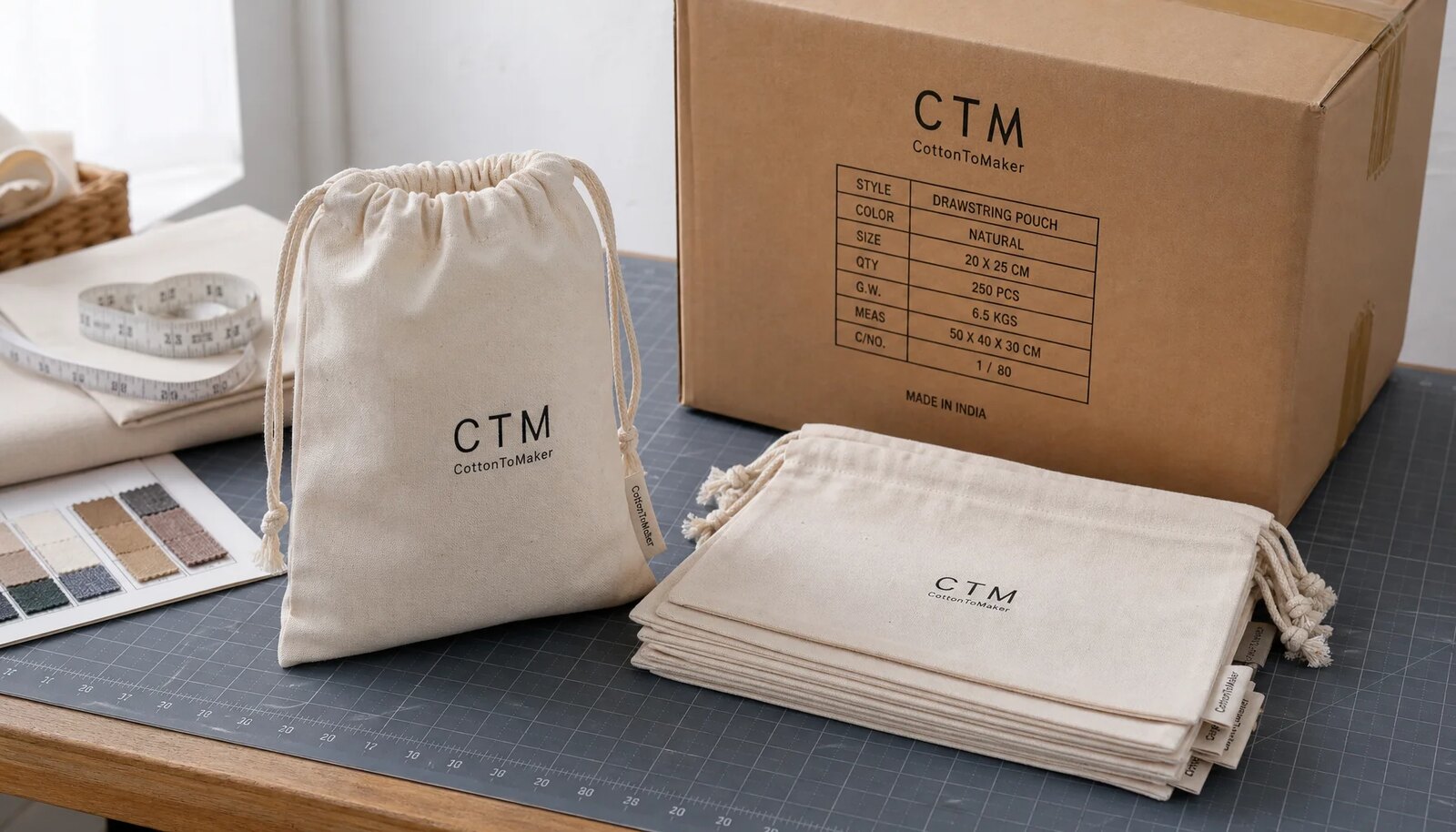
Start With the Carton Workflow
Wholesale cotton drawstring pouches for craft fairs look simple until the order lands in a warehouse. A few thousand small bags can turn into dozens of cartons, several size codes, multiple artwork versions, and rushed vendor allocations. That is why the pouch specification and the carton packing plan should be developed together. The pouch has to suit handmade goods, but the packing format decides whether the order can be received, counted, stored, issued, and replenished without extra labor before the fair.
Begin the RFQ by describing the route the pouches will take. A distributor selling blank pouches to soap makers may want single-SKU cartons with 100 pieces per inner bag. A craft fair organizer preparing vendor kits may need assortment cartons, such as 50 small natural pouches, 50 medium printed pouches, and 25 heavier canvas pouches separated by labeled inner bags. A jewelry brand may care more about small-size consistency because a carded necklace that fits too tightly slows booth packing and weakens the final presentation. These are different sourcing problems even if the product name is the same.
Map the workflow before chasing the lowest unit price. Who opens the cartons? Who counts the pieces? Will cartons be reshipped to individual vendors? Does a fulfillment partner need barcode labels, carton IDs, or an assortment sheet? A receiving team wants stable inner quantities and clear carton marks. Event staff may prefer vendor-ready bundles that do not need recounting. The supplier can quote more accurately when the packing method, count logic, and labeling expectations are known before production starts.
- Define the end use: jewelry pouch, soap pouch, candle accessory pouch, ornament pouch, gift wrap pouch, sample pouch, or reusable merchandise pouch.
- State the logistics route: import warehouse, distributor, retail store allocation, third-party fulfillment, direct vendor shipment, or event-site delivery.
- Separate product approval from packing approval because fabric, print, size, inner count, and carton marks can fail independently.
- Use finished pouch dimensions rather than cut size because seam allowance and drawcord channel height reduce usable space.
- Decide whether the priority is lowest piece cost, fastest receiving, premium presentation, or lowest landed cost per usable carton.
- Ask for the carton packing plan during quotation, not after bulk sewing is complete.
Specify Fabric GSM Without Guesswork
Cotton pouch fabric is usually quoted by GSM, or grams per square meter. GSM affects cost, opacity, handfeel, seam bulk, carton weight, and how the pouch looks after compression. A 120 GSM plain cotton pouch can be a sensible choice for stickers, beads, small jewelry, soap samples, greeting cards, sachets, and light stationery. It keeps the material cost and shipment weight under control. The tradeoff is easy to miss in photos: thinner cotton may wrinkle more, show darker product silhouettes, and feel less substantial when handled repeatedly at a booth.
For many B2B craft fair programs, 120-140 GSM is the practical volume range. Around 160 GSM gives better opacity and body without moving fully into heavy canvas. For premium reusable packaging, 180-220 GSM cotton or cotton canvas has a sturdier handfeel and stronger perceived value. That works well when the pouch is part of the product experience, such as artisan gift sets, reusable merchandise, or higher-priced handmade items. It also means higher material cost, thicker seams, more carton volume, and higher gross weight.
Do not approve fabric weight from a studio photo. Natural cotton under bright lighting can hide thin fabric, uneven yarns, and compression creases. Ask for a swatch or physical sample in the quoted GSM, then test it with the actual product. Check opacity, edge pressure, closure shape, and seam stress. If the pouch will be printed, review a printed sample because ink coverage can stiffen the panel, change the handfeel, and affect how the pouch stacks inside a carton.
- Use 120-140 GSM for lightweight goods where cost, distribution volume, and carton efficiency are key.
- Use around 160 GSM when the buyer wants better opacity and a less disposable handfeel without heavy canvas bulk.
- Use 180-220 GSM cotton or canvas for reusable, giftable, or premium branded pouches.
- Avoid 90-100 GSM cotton for rigid, dark, oily, sharp-edged, or premium products unless inner protection is used.
- Confirm whether the quoted fabric is stock natural cotton, bleached cotton, dyed cotton, twill, plain weave, or canvas.
- Keep a physical GSM reference sample for inspection so bulk fabric is not judged only by supplier wording.
Control Size and Real Capacity
Craft fair pouch programs often become overcomplicated because every product team wants a dedicated size. One pouch is requested for earrings, another for bracelets, another for soap, another for candle tins, another for ornaments, and another for gift cards. The spreadsheet looks organized, but production becomes less efficient. Each finished size adds cutting work, sewing setup, cord insertion, inspection, labeling, inner packing, carton sorting, and inventory control.
A stronger sourcing method is to build size families. A small pouch can cover jewelry, tokens, and light accessories. A medium pouch can handle soaps, stationery, and compact craft kits. A taller pouch can suit bottles, narrow ornaments, or candle accessories. Consolidation gives vendors flexibility while keeping SKUs manageable. It also improves carton planning because full cartons can be forecast by size instead of partial cartons across many near-duplicate dimensions.
Finished size is not the same as usable capacity. A pouch listed as 10 x 15 cm includes the top drawcord channel, so the product does not truly have 15 cm of interior height. For rigid goods, send the supplier the product length, width, thickness, and weight, then ask for the recommended pouch size and usable height below the channel. For many small and medium pouches, a finished-size tolerance around +/-0.5 cm is workable. If the item fits only when forced, either tighten the signed tolerance or move to a larger nominal size.
- List finished width, finished height, channel height, usable interior height, and target tolerance for each SKU.
- Group low-volume designs under common sizes when fabric, cord, artwork, and packing can be shared.
- Quote each finished size separately so MOQ, labor, and carton impact are visible before PO release.
- Flag rigid products such as candle tins, boxed ornaments, soap bars, jars, bottles, and carded jewelry.
- Avoid adding a new size unless it materially improves fit, presentation, or carton efficiency.
- Measure sample fit with the real product, not only with an empty pouch laid flat.
Match Drawcord to Handling Speed
The drawcord is small, but it affects booth speed. Cotton cord supports a natural handmade look and pairs well with undyed or lightly dyed cotton. Polyester cord usually slides more smoothly, can hold brighter colors, and may reduce moisture absorption, though it may not match a natural textile story as closely. Flat tape gives a more decorative finish. Braided cord can feel stronger on reusable pouches. The right choice depends on appearance, closure speed, product weight, and the size of the channel.
Specify the cord instead of accepting a generic drawstring description. Procurement should record cord material, color, diameter or width, cord length, knot style, and whether the pouch uses one drawcord or two. Small pouches need particular care. A thick cord can make the channel bulky and slow to close. A thin cord can slip inside the channel or create weak-looking ties. For craft fair use, staff should be able to insert the product, pull once, and close the pouch without fighting the fabric.
Cord problems are easy to miss in approval photos. During sample review and inspection, open and close the pouch several times. Check for fraying cut ends, weak knots, uneven tails, cord escape, and channel stress around the opening. If the pouch will hold heavier handmade goods, pay extra attention to the seam near the channel. A pouch can look clean on a table and still become frustrating during peak selling hours if the closure does not move smoothly.
- Specify cotton cord, polyester cord, flat tape, or braided cord instead of accepting a generic drawstring description.
- Record cord diameter or width, cord color, cord length, and knot or end treatment on the approved sample.
- Check that small pouches close smoothly without bulky channel distortion or cords disappearing inside.
- Use repeated open-close testing during sample review and final inspection.
- Ask whether custom cord colors carry separate MOQ, dye lead time, or color-matching tolerance.
- Reject fraying ends, loose knots, uneven tails, and channel openings that allow the cord to escape.
Choose Decoration by Artwork Risk
Screen printing is often the most practical decoration method for wholesale cotton drawstring pouches when the artwork is a solid logo, simple line illustration, or one to three spot colors. It can look clean on cotton and is cost-effective when the same mark repeats across a meaningful quantity. The buyer should provide print size, print side, ink color reference, placement point, and allowable placement shift. The quote should separate setup charges by color, screen, and side because a two-side, two-color print is not the same production job as a one-side, one-color logo.
Heat transfer may be better for detailed event graphics, gradients, full-color artwork, or lower-volume runs where screen setup is inefficient. The tradeoff is a different handfeel and sometimes a less natural craft aesthetic. Woven labels, cotton labels, or sewn side labels can work well for reusable premium pouches because they reduce large ink areas and create a durable branded detail. Labels also add their own MOQ, lead time, placement checks, and seam workmanship requirements.
Artwork risk rises as pouch size gets smaller. Fine reverse text can fill in. Thin lines can break. Logos printed too close to the drawcord channel can distort when the pouch is closed. Heavy ink coverage may crack, stiffen the panel, or make carton compression marks more visible. Ask the supplier for minimum line thickness, minimum readable text height, and maximum print area by pouch size and GSM. When artwork contains small text, dense ink, multiple colors, or placement near seams, approve a physical printed sample before bulk production.
- Use screen print for simple logos, repeat wholesale orders, and spot-color craft fair branding.
- Use heat transfer for detailed, short-run, gradient, or full-color artwork when handfeel is acceptable.
- Use woven or sewn labels when the pouch should feel reusable, premium, or less dependent on large print coverage.
- Provide final artwork with Pantone reference, print size, print side, placement point, and allowed shift.
- Ask for setup charges by screen, color, side, transfer film, label style, and artwork version.
- Approve a physical printed sample before bulk production for small text, fine lines, dark ink, or print near the channel.
Build the Carton Packing Matrix Early
The carton packing plan belongs in the RFQ, quotation, purchase order, and final packing instruction. Cotton drawstring pouches are soft, so suppliers may compress them tightly to reduce carton count. Some compression is normal. Too much compression can leave deep creases, flatten drawcord channels, wrinkle printed panels, and make the first carton opening feel messy. The right plan balances freight efficiency with presentation, count accuracy, and receiving speed.
A common wholesale baseline is simple: flat-packed pouches by single SKU, counted into inner polybags of 50 or 100 pieces, then packed into export cartons. Warehouses can count this quickly, store it cleanly, and issue it by bundle. If the buyer needs vendor kits or store allocation cartons, assortment packing can work, but it needs a written matrix. Each assortment carton should state exact count by size, color, artwork, and inner bag. When more than one SKU sits in one carton, inner bags should be labeled.
Carton data is also part of landed cost. Two suppliers may quote the same FOB unit price but use different carton dimensions, pieces per carton, board strength, and gross weights. Those details affect freight cost, palletization, warehouse slotting, event storage, and reshipment cost. Before choosing a supplier, request carton dimensions in centimeters, gross weight, net weight, CBM per carton, total carton count, and total shipment CBM.
- Use 50-piece or 100-piece inner bags for wholesale programs unless retail packing requires smaller units.
- Keep one SKU per carton when receiving speed, shortage control, and warehouse accuracy matter most.
- Use assortment cartons only with inner separation, inner labels, and a written count matrix.
- Request carton length, width, height, gross weight, net weight, pieces per carton, CBM, and total carton count.
- Specify carton marks on at least the side panels required by the receiving warehouse or fulfillment provider.
- Freeze inner pack quantity before the supplier prepares carton labels, inner bags, and packing labor instructions.
Separate the True Cost Drivers
The unit price of a cotton drawstring pouch is shaped by more than size. Fabric GSM, cotton type, fabric color, drawcord material, cord color, print method, print coverage, artwork count, seam construction, label type, inner packing, and carton requirements all matter. Stock natural cotton is usually more straightforward than custom dyed cotton because the material may already be available. Custom dyeing, matched cords, special labels, and exact color control can require higher minimums and longer lead time.
Small pouches are not always much cheaper than medium pouches. A 7 x 9 cm pouch uses less fabric than a 12 x 17 cm pouch, but it still needs cutting, sewing, cord insertion, trimming, inspection, counting, and packing. Very small pouches can even be slower to handle if the channel is narrow or the cord is difficult to insert. Do not assume that every size reduction creates a meaningful saving, especially when the order carries multiple prints or tight tolerances.
Packing is another hidden cost driver. Individual polybags, barcode labels, hang tags, header cards, retail sleeves, vendor-specific bundles, and assortment cartons all add labor and materials. For many craft fair programs, full retail packing is unnecessary. Buyers often need clean, countable, fast-to-distribute wholesale packing instead. Ask for base pouch cost and optional packing services as separate quote lines so procurement can decide what belongs at the factory and what can be handled downstream.
- Expect cost increases from heavier GSM, dyed fabric, matched cord color, multiple print colors, and large print coverage.
- Treat each artwork version as a possible setup cost even when size and fabric are unchanged.
- Quote retail labels, barcodes, hang tags, individual bags, and vendor bundles as separate line items.
- Do not assume very small pouches reduce labor cost enough to justify many extra size variants.
- Compare first-order cost separately from repeat-order cost when screens, labels, or samples are one-time charges.
- Reject quotes that omit carton dimensions, CBM, gross weight, and pieces per carton.
Approve Samples With Functional Tests
A pre-production sample should prove that the pouch works, not just that it photographs well. Put the actual product inside, close the drawstring, reopen it, and repeat the action several times. For small pouches, the relationship between channel width and cord thickness is critical because tight channels slow packing. For heavier craft goods, check whether the bottom seam distorts, whether product corners press sharply against the fabric, and whether the pouch still closes neatly.
Measure the sample against the written specification. Cotton can shift during cutting, sewing, pressing, and packing, so empty flat measurements are not enough. Check finished width, finished height, channel height, usable interior height, cord length, print size, and print placement. If the buyer plans to steam, iron, wash, or otherwise handle pouches before use, discuss shrinkage expectations and test the sample under that method. Do not approve a nominal 10 x 15 cm pouch if the real product only fits when forced.
Once approved, the sample should become a controlled reference. Record fabric GSM, fabric color, cord type, cord color, print method, print color, print position, seam finish, label position, inner packing method, and carton plan. Keep one sealed sample with the buyer or inspection company and ask the factory to keep a matching reference. Photos help communication, but they do not replace a physical approval sample when fit, handfeel, cord function, and print surface matter.
- Measure finished width, finished height, channel height, usable interior height, cord length, and print placement.
- Test the intended product inside the pouch instead of approving only an empty sample.
- Open and close the drawcord repeatedly to catch tight channels, weak knots, or fraying ends.
- Compare print placement to measured artwork references, not only a visual mockup.
- Check opacity, wrinkles, and product silhouette after the pouch has been packed flat.
- Seal one approved sample and use it as the buyer reference during final inspection.
Set QC Rules Before Shipment
Most quality claims on cotton drawstring pouches can be reduced with clear acceptance rules. Common defects include size variance, loose threads, skipped stitches, uneven cord lengths, open channels, print misplacement, color difference, stains, odor, wrong inner counts, and incorrect carton marks. Each problem may look minor in isolation. Across thousands of pieces, the same issue can delay distribution, create vendor complaints, or force rework right before a fair.
A practical final inspection should cover workmanship, measurements, drawcord function, print quality, cleanliness, odor, inner packing, carton count, and carton marks. An AQL-style sampling approach can be used, but the checklist must be specific to pouches. Define critical, major, and minor defects. Wrong SKU, unsafe contamination, unreadable print, severe stains, or materially wrong size should not be treated the same as a small loose thread that can be trimmed. The acceptance standard should match the sales channel: premium retail needs tighter visual control, while distributor programs may prioritize count accuracy and SKU separation.
Inspection should include basic functional checks, not only visual review. Pull the drawcord several times. Check seam strength by hand on sampled pieces. Perform a dry rub check on printed areas and use a simple tape-pull check where appropriate for the decoration method. Measure artwork placement with a ruler. Open inner bags to confirm counts. Carton marks should match the purchase order, packing list, and SKU matrix exactly because craft fair deadlines leave little time to investigate mixed labels or wrong assortment ratios after arrival.
- Size: measure sampled pouches against finished width, height, channel height, and usable height tolerance.
- Print: check color, registration, rub resistance, tape-pull response, and placement shift from agreed references.
- Drawcord: confirm smooth closure, even tails, secure knots, clean ends, and no cord escape from the channel.
- Sewing: reject open seams, broken stitches, skipped stitches, heavy thread nests, channel failures, and obvious puckering.
- Cleanliness: check stains, oil marks, odor, lint, foreign material, and contamination inside the pouch.
- Packing: verify inner bag quantity, carton quantity, SKU labels, carton numbers, gross weight marks, and packing list match.
Plan Lead Time Around Approval Gates
Lead time should start from a clear trigger, not from the first inquiry. A supplier cannot responsibly begin bulk cutting until fabric, GSM, finished size, artwork, print color, drawcord, packing matrix, carton marks, and sample approval are locked. Repeat orders using existing fabric, screens, labels, and carton instructions can move faster. New craft fair programs with several sizes, custom labels, dyed fabric, or assortment packing need more time for sampling and confirmation.
Break the schedule into sample making, buyer review, material booking, cutting, sewing, printing, trimming, inspection, carton packing, and export preparation. The most common delays are not always sewing capacity. Late artwork, unclear placement, unfinished carton marks, last-minute size changes, and slow sample feedback often cause more trouble. Assign an owner for each approval gate. If the fair date is fixed, include time for sample courier transit, inspection rework, freight booking, customs clearance, warehouse receiving, and redistribution.
Late packing changes are especially risky. Switching from 100-piece inner bags to vendor-ready 25-piece bundles after production may require new labels, more labor, and repacking. Changing assortment ratios after carton marks are printed can force relabeling or carton rework. Treat carton packing as a production input, not a shipping afterthought. The earlier it is approved, the easier it is to protect the delivery date and keep the event team ready.
- Define whether lead time starts after deposit, sample approval, fabric confirmation, final artwork, or carton mark approval.
- Treat artwork release, sample approval, packing matrix approval, and carton mark approval as separate gates.
- Freeze SKU count, size list, cord colors, and assortment ratios before bulk cutting.
- Build buffer for courier sample review, inspection rework, freight booking, and receiving before the fair date.
- Avoid changing inner pack quantity after bags, labels, and carton instructions are prepared.
- Schedule inspection before shipment release when event deadlines or retail allocations are fixed.
Specification comparison for buyers
| Spec decision | Recommended option | When it fits | Buyer risk to check |
|---|---|---|---|
| Fabric weight | 120-140 GSM plain cotton for light goods; around 160 GSM for better opacity; 180-220 GSM cotton or canvas for reusable premium pouches | Jewelry cards, soap bars, stationery, ornaments, booth giveaways, gift sets, candle accessories, artisan merchandise, and vendor kits | 90-100 GSM fabric can look thin, wrinkle after carton compression, show product silhouettes, and reveal sharp corners |
| Finished size strategy | Limit the range to 2-3 core finished sizes and quote each size as a separate SKU | Distributors, fair organizers, subscription kit packers, and retailers supporting multiple vendors | Too many near-duplicate sizes increase cutting waste, MOQ pressure, carton sorting errors, and shortage disputes |
| Size tolerance | Use a practical finished-size tolerance such as +/-0.5 cm for many small and medium pouches; agree tighter limits only when rigid products require it | Jewelry, boxed ornaments, candle tins, carded products, bottles, jars, and products with fixed dimensions | Nominal finished height includes the drawcord channel, so usable interior height may be shorter than expected |
| Drawcord material | Cotton cord for a natural look; polyester cord for smoother sliding, brighter color, or lower moisture absorption | Handmade branding, reusable gift pouches, event merchandise, and fast booth packing | Cord that is too thin may pull into the channel; cord that is too thick may slow closure and distort small pouches |
| Print method | Screen print for simple spot-color logos; heat transfer for detailed or low-volume graphics; woven or sewn labels for premium reusable pouches | Private label craft packaging, event logos, vendor kits, and retailer-branded artisan ranges | Fine reverse text, heavy ink coverage, and artwork near the channel can crack, fill in, or distort on textured cotton |
| Inner packing | Flat pack by SKU in counted inner polybags of 50 or 100 pieces unless retail prep requires smaller units | Wholesale replenishment, warehouse receiving, vendor distribution, and distributor pick-and-pack | Loose mixed pouches slow receiving, make shortages hard to prove, and create avoidable labor before the fair |
| Export carton plan | Use one SKU per export carton where possible; use assortment cartons only with a written count matrix and inner separation | Importers, regional warehouses, craft fair organizers, and buyers reshipping to vendors or stores | Mixed cartons without inner labels, carton-level SKU marks, or count sheets create mis-picks and receiving delays |
| MOQ logic | Request MOQ by size, fabric GSM, fabric color, cord color, artwork, label style, and packing method | Multi-SKU programs with seasonal colors, private branding, or vendor-specific bundles | A low total MOQ can hide separate setup charges for screens, labels, dyed fabric, cord color, or carton sorting |
| QC sampling | Use AQL-style final inspection plus pouch-specific checks for size, seam, drawcord, print, cleanliness, odor, inner count, and carton marks | Importers, retailers, fulfillment teams, event organizers, and procurement buyers needing repeatable acceptance rules | Photo approval misses actual fit, cord friction, count accuracy, shrinkage risk, carton compression, and seam strength |
Buyer checklist before sampling
- Define each SKU by finished width, finished height, drawcord channel height, usable interior height below the channel, fabric GSM, fabric color, cord type, cord color, print version, and packing method.
- Give the supplier real product dimensions and weight ranges, especially for rigid goods such as soap bars, candle tins, boxed ornaments, jars, bottles, carded jewelry, or stationery sets.
- Select GSM by presentation and load: 120-140 GSM for light craft packaging, around 160 GSM for improved opacity, and 180-220 GSM cotton or canvas for reusable or premium pouches.
- State the finished-size tolerance, commonly around +/-0.5 cm for many small and medium pouches, and identify any SKU where tighter fit control is commercially necessary.
- Provide artwork files with final print size, print side, Pantone or color reference, placement from seam or bottom edge, maximum acceptable placement shift, and warnings for small text or fine lines.
- Limit sizes, colors, cord variants, and artwork versions unless each SKU can support a practical MOQ, inner pack quantity, carton ratio, and inspection sample size.
- Confirm whether pouches ship flat stacked, bundled, individually polybagged, barcode-labeled, hang-tagged, retail packed, or packed as pre-sorted craft fair assortment cartons.
- Set inner pack quantities that match receiving and vendor distribution; 50 or 100 pieces per inner bag is usually easier to count than loose bulk packing.
- Require carton marks showing PO number, SKU, finished size, fabric color, artwork code, quantity, carton number, gross weight, net weight, destination, and country of origin if required by the market.
- Ask for carton dimensions in centimeters, pieces per carton, gross weight, net weight, CBM per carton, total carton count, and any maximum recommended stacking limit.
Factory quote questions to send
- What finished pouch size tolerance can you hold after cutting, sewing, pressing, and packing, and does this change for pouches under 10 cm wide or under 12 cm high?
- What is the drawcord channel height and usable interior height below the channel for each proposed finished size?
- Which cotton options are available from current stock: natural, bleached, dyed, plain weave, twill, or canvas, and what GSM tolerance do you normally control?
- Can you quote 120 GSM, 140 GSM, 160 GSM, and 180 GSM versions separately using the same size list, artwork, quantity, and carton plan?
- What MOQ applies separately to fabric color, custom dyed fabric, cord color, woven label, printed label, print artwork, and each finished size?
- What drawcord options can you offer, including cotton cord, polyester cord, flat tape, braided cord, and cord diameter or width for each option?
- What print method do you recommend for our artwork, and what are the setup charges by color, screen, print side, transfer film, label mold, or label style?
- What minimum line thickness, minimum text height, and maximum print area do you recommend for each pouch size and GSM?
- How many pieces will be packed per inner bag and per export carton for each SKU, and will inner bags be labeled with SKU, size, color, artwork, and quantity?
- What are the estimated carton dimensions, gross weight, net weight, CBM per carton, total carton count, and total shipment CBM for the quoted quantity?
Quality-control points to confirm
- Finished size should be measured after sewing and pressing, not estimated from cut panels; many small and medium pouches can use a practical tolerance around +/-0.5 cm unless product fit requires a tighter signed standard.
- Usable interior height must be checked below the drawcord channel because the nominal finished height includes the top channel area and may not represent product capacity.
- Fabric GSM should be verified against the approved sample or test record because 120 GSM, 140 GSM, and 180 GSM cotton can look similar in photos but differ in opacity, stiffness, and carton compression.
- Fabric condition should be clean and free from oil marks, dye stains, weaving holes, heavy contamination, unacceptable slubs, strong odor, loose lint, and visible dirt inside the pouch.
- Drawcords should slide smoothly, close evenly, and resist fraying at the cut end or knot after repeated opening and closing during inspection.
- Cord length should remain consistent within the approved tolerance so closed pouches do not have uneven tails, overly short ties, or cords that disappear into the channel.
- Seams should be straight and secure, without skipped stitches, open seams, broken bartacks, loose channel ends, heavy thread nests, puckering, or holes at stress points.
- Print should pass a basic dry rub check and tape-pull check appropriate to the chosen method, especially for dark ink, large solid artwork, and printing on natural cotton texture.
- Artwork placement should be measured from fixed sewing references such as center line, bottom seam, side seam, or drawcord channel edge rather than judged only by visual balance.
- Print color should be compared with the approved physical sample, Pantone reference, or agreed color standard under consistent light while allowing realistic variation from natural cotton base shade.