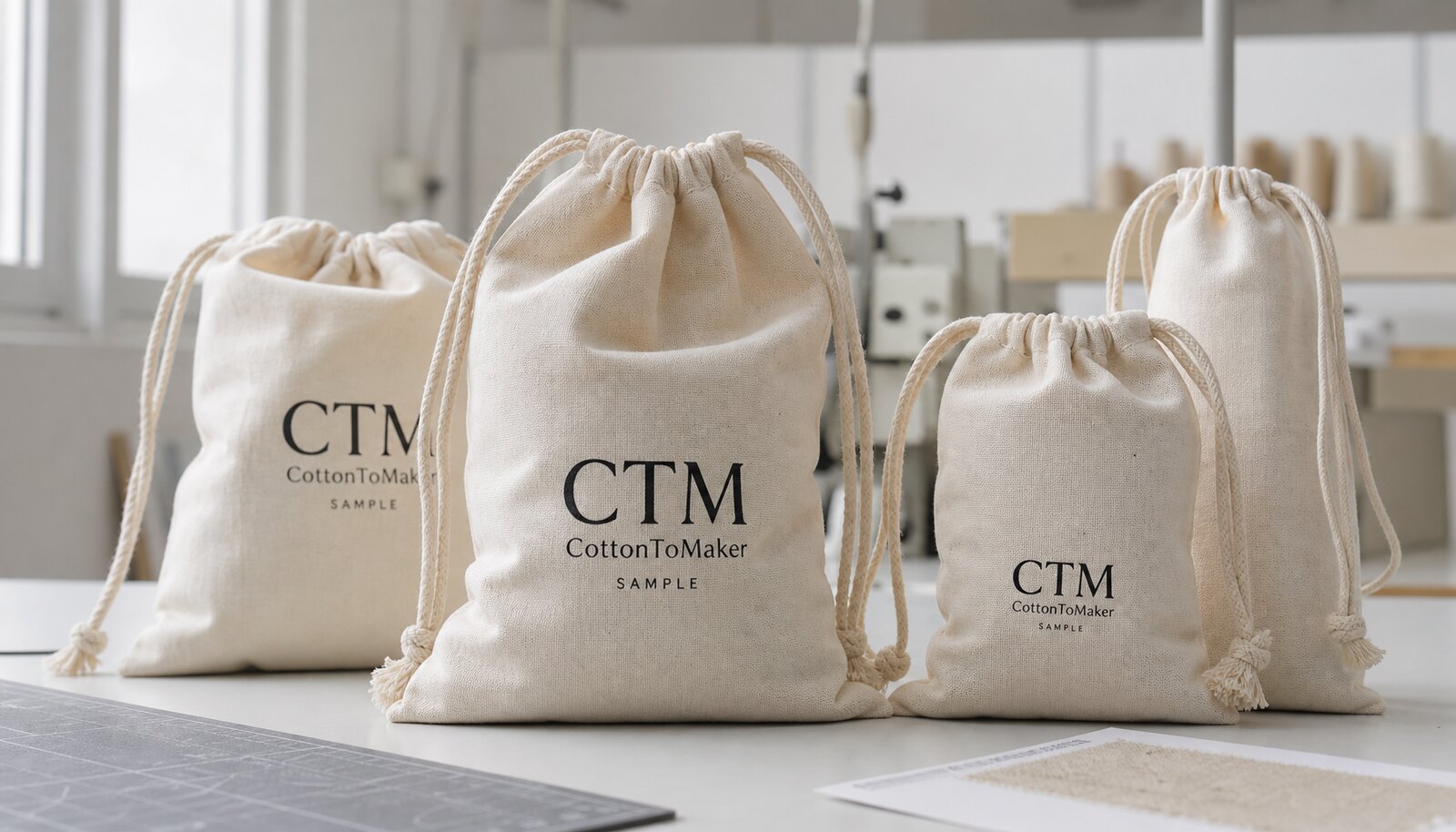
Start with the gift, not the logo file
Cotton drawstring pouches for corporate gifting look simple, but they sit at the point where brand presentation, product fit, and warehouse handling meet. A pouch for a conference badge kit does not need the same specification as a pouch for a premium client gift, a staff onboarding set, a jewelry insert, or a hotel amenity. Before discussing logo placement, define the job the pouch must do. Is it mainly a presentation piece? Does it protect the item in transit? Will it sit inside a rigid gift box? Will the recipient reuse it?
That first decision changes the branding area. A flat pouch on an event table is judged differently from a pouch filled with a candle, power bank, bottle, notebook, or rounded accessory. Once the drawstring is pulled, the top fabric gathers and becomes unreliable for branding. Once the item is inside, the front panel can curve, bulge, shorten visually, or pull the logo away from the centerline. A logo that appears balanced on a digital proof may sit too high, too low, or slightly distorted in real use.
A stronger B2B brief gives the supplier the contents, approximate item dimensions, desired presentation, order quantity, delivery deadline, and packing route. With those details, the factory can recommend the pouch size, GSM, cord style, and decoration method with fewer assumptions. Procurement also gets cleaner quote comparison and a clearer inspection standard. The logo is still important, of course, but it should be placed on a pouch that has already been designed around the gift.
- Share actual or representative gift item dimensions before approving pouch size.
- Decide whether the pouch is a presentation item, protective bag, retail insert, or event giveaway.
- Review the logo position with the pouch filled and closed, not only flat and empty.
- State whether pouches will be shipped loose, inserted into kits, or handed out directly.
- Treat logo placement as a production specification that can be measured during inspection.
Map the pouch construction before sizing the artwork
A drawstring pouch is not just a rectangle after it has been cut, stitched, filled, and closed. Side seams reduce usable width. The bottom fold or bottom seam affects how the pouch sits. The drawstring channel creates a gathered section that should usually stay outside the main logo zone. If the pouch has a bottom gusset or side gussets, fold lines can interrupt the print area or change how the logo looks once the product is inside.
For accurate sourcing, separate three dimensions in the RFQ. Finished flat size is the sewn pouch measured without contents. Usable internal size is the real space available after seams, channel height, closure behavior, and any gusset are considered. Printable area is the safe zone where decoration can be applied without running into seams, folds, gussets, or drawcord gathering. These are related, but they are not interchangeable. A 150 mm wide pouch, for example, may not support a 130 mm wide logo once side margins and placement tolerance are allowed.
Ask for a marked production sketch, even for a basic pouch. It does not have to be an engineering drawing, but it should show finished width and height, channel height, seam allowance, bottom fold or gusset, safe print area, and logo measurement references. The same drawing should guide sampling, bulk production, and inspection. If the supplier cannot show where the safe logo zone begins and ends, the buyer is approving more risk than it may appear.
- Specify finished flat size and usable internal size separately.
- Ask the supplier to mark the safe logo zone on a pouch drawing.
- Keep artwork away from side seams, bottom folds, gussets, and the cord channel.
- Define whether placement is measured from the top fabric edge, bottom of channel, or logo centerline.
- Approve separate artwork dimensions for each pouch size in a multi-size program.
Use logo placement rules that can survive production
For many corporate gifting programs, front-center placement is the safest starting point. It photographs well, gives the recipient an immediate brand cue, and makes the pouch easy for fulfillment teams to orient. The logo should sit far enough below the drawstring channel that gathered fabric does not cover it when the pouch is closed. It also needs enough side margin so ordinary sewing and printing variation does not make the artwork look off-center.
A useful placement instruction includes three things: logo size, reference point, and tolerance. For example, a buyer might specify: logo centered on front panel, logo width 70 mm, top of logo 45 mm below top edge, placement tolerance plus or minus 3 mm, final position confirmed by approved pre-production sample. The numbers will change by pouch size, but the structure should stay consistent. Avoid instructions such as large logo on front, match mockup, or place as usual. They are easy to misunderstand and hard to inspect.
The shape of the brand mark matters too. A compact icon or square logo can sit comfortably in a smaller safe zone. A long wordmark needs more side margin and may need to be reduced. A logo with a tagline, URL, event date, or legal mark may be too detailed for a small cotton pouch. Before sampling, ask the brand team what must remain and what can be removed at small scale. On fabric, a clean mark is often stronger than tiny text that fills in, breaks up, or disappears into the weave.
- Use a measured logo width and height in millimeters.
- Center the logo on the front panel unless the design brief requires another position.
- Keep the top of the logo below the drawstring channel and gathered fabric zone.
- Allow side margins large enough for sewing and print placement variation.
- Remove small secondary text when it reduces legibility on small pouch sizes.
Choose fabric by presentation, printability, and closure behavior
GSM is usually one of the first numbers buyers compare, but it is not the whole fabric story. A tightly woven 140 GSM cotton can print more sharply than a looser cotton of similar weight. A 200 GSM fabric may feel more substantial, but it can add cost, increase carton volume, and make the gathered top feel stiff. For many corporate gifting applications, 140-180 GSM is a practical range because it balances opacity, hand feel, print performance, closure, and cost.
Lighter cotton can still make sense for low-cost event packing, sample distribution, or inserts where the pouch is secondary to the main product. Buyers should expect more wrinkling, possible translucency, and less structure. Heavier cotton or cotton canvas can support a more premium hand feel, but it should be tested with the final cord and final product inside. A pouch that looks excellent flat may not close neatly once the fabric is heavier and the contents are bulky.
Fabric condition should be named clearly. Natural cotton may include flecks, seed particles, slubs, and tone variation. Those characteristics can be acceptable, even desirable, if approved in the sample. Bleached cotton gives a cleaner background but can show handling marks more easily. Dyed cotton helps match a campaign color, yet it introduces shade-lot control, colorfastness questions, and print contrast risk. If the order requires organic cotton, recycled content, OEKO-TEX, GOTS, or another material claim, request documentation that applies to the actual order material, not only a general supplier profile.
- 120-140 GSM: lighter, lower cost, with more risk of wrinkles and show-through.
- 140-180 GSM: common range for branded corporate gifting pouches.
- 180-220 GSM: more substantial hand feel, higher cost, bulkier cartons, and stiffer closure.
- Natural cotton: approve flecks, slubs, tone, and surface cleanliness by sample.
- Dyed cotton: require shade target, dye-lot control, and print contrast testing.
Match the decoration method to the artwork risk
Screen printing is often the most practical decoration method for cotton drawstring pouches. It suits one- or two-color corporate marks, solid shapes, and medium to large quantities. It can be cost-efficient and visually clean. Still, it has limits. Fine strokes, small registered marks, thin serif type, gradients, and low-contrast color combinations can lose detail on woven cotton. A strikeoff on the actual or nearest available fabric is much more useful than a perfect-looking digital mockup.
Heat transfer can reproduce more color and finer detail, but it changes the feel of the decoration area. Depending on the transfer material, the logo may feel smooth, thicker, or slightly film-like compared with direct ink. That can work well for campaign graphics, especially when color detail is important. It may be less suitable when the brief calls for a natural cotton look and feel. Check edge adhesion, flexibility, and how the transfer behaves after folding or carton compression.
Embroidery gives a tactile finish, but it must be matched to the fabric weight and logo density. Dense embroidery on light cotton can pucker the panel or make the pouch feel stiff. Woven labels and sewn patches are useful for detailed logos, multi-color branding, or a retail-style presentation, but they add component approval, sewing tolerance, and sometimes MOQ. The best method is not simply the lowest quoted decoration price. It is the method that can reproduce the artwork reliably at the required pouch size and order quantity.
- Screen print: best for simple logos, solid colors, and controlled bulk cost.
- Heat transfer: useful for full-color detail, but test hand feel and edge adhesion.
- Embroidery: premium effect, but check puckering, stitch density, and reverse-side finish.
- Woven label: good for fine detail and repeat branding across pouch colors.
- Sewn patch: visible and durable-looking, but adds thickness, labor, and component QC.
Write tolerances before the purchase order is released
Vague quality language creates avoidable disputes. A purchase order that says good quality logo pouch does not tell the factory, buyer, or inspector how much variation is acceptable. Cotton pouches involve fabric movement, cutting, sewing, printing, curing, and packing. Some variation is normal. The sourcing task is to define what variation is acceptable before bulk production begins.
Dimension tolerance should cover finished width, finished height, gusset if applicable, cord length, and channel height when those features matter. Logo placement tolerance should name the measurement reference. Is the top of the logo measured from the top fabric edge, from the bottom of the drawstring channel, or from the seam line? Is horizontal placement measured from a side seam to the logo centerline? If one party measures from the fabric edge and another from the stitch line, both may believe they are correct while reaching different conclusions.
Print tolerance should cover registration, color, ink coverage, edge definition, and defect classification. Cotton absorbs ink differently than coated paper, so production should be compared with the approved strikeoff instead of a digital screen color. Natural and dyed base fabrics will also change perceived color. A written tolerance plan protects both sides. The supplier knows the target, and the buyer has a fair basis for inspection.
- State dimensional tolerance in millimeters instead of using general wording.
- Define logo placement tolerance and the exact reference points for measurement.
- Compare print color to an approved strikeoff or physical reference.
- Classify major print defects such as wrong color, wrong orientation, missing strokes, smearing, bleeding, and severe cracking.
- Classify major sewing defects such as open seams, skipped stitches, broken channel, twisted body, and loose cord knots.
Compare quotes only when suppliers price the same pouch
Two cotton pouch quotes can look similar while covering very different products. One supplier may quote 160 GSM cotton, one-color screen print, counted inner bundles, and a pre-production sample. Another may quote an unspecified cotton pouch with logo and no packing detail. The second price may be lower because it assumes lighter fabric, a smaller logo, looser tolerances, stock cord, or fewer service items. Procurement should standardize the RFQ before comparing unit prices.
A complete quote should identify fabric GSM, fabric condition, pouch dimensions, cord specification, decoration method, number of print colors, number of print positions, logo size, setup fees, sample fees, packing format, carton quantity, Incoterms, production lead time, payment terms, and validity period. If there are multiple pouch sizes, colors, or logos, ask for MOQ and price by SKU, not only total volume. A 5,000-piece order split across five logo versions may not price like a single 5,000-piece run.
Hidden costs often appear around artwork handling, screen charges, embroidery digitizing, label development, strikeoffs, courier samples, barcode labels, individual packing, extra cartons, and inspection support. These charges are not automatically unreasonable. They simply need to be visible before supplier selection. For B2B buyers, the better comparison is landed cost per approved usable pouch, not just ex-factory unit price.
- Send the same spec sheet to every supplier.
- Require each quote to state GSM, size, print method, logo size, packing, MOQ, and Incoterms.
- Ask whether setup, screen, digitizing, sample, and strikeoff charges are included.
- Compare carton dimensions and gross weight because freight can change total cost.
- Review MOQ by SKU when there are multiple logos, colors, or sizes.
Use sampling to catch problems while changes are still cheap
A reliable sampling process moves in stages. The blank sample checks the physical pouch: size, fabric feel, opacity, seam quality, cord movement, closure, and fit with the gift item. It cannot approve print quality, but it can prevent the buyer from decorating a pouch that is too small, too thin, too stiff, or unsuitable for the contents. This is especially important when the gift is bulky, sharp-edged, heavy, or intended to sit upright inside the pouch.
The strikeoff or decorated sample checks the logo. This is where the buyer should confirm logo scale, placement, ink color, edge clarity, registration, and legibility on the selected fabric or closest available fabric. A digital mockup helps people discuss placement, but it cannot show cotton absorption, weave texture, ink density, or how folds affect visibility. If the logo includes small text, review it from the distance at which a recipient will actually see the pouch, not only in a close-up photo.
The pre-production sample should represent final production as closely as possible: final fabric, final cord, final decoration, final dimensions, and intended packing if practical. Review it flat, filled, closed, and after being packed. If changes are needed, write them as measurable corrections, such as reduce logo width from 85 mm to 75 mm or move logo 6 mm lower. Avoid approving a sample while artwork, size, or pouch contents are still changing. That is how sample approvals become unclear and production disputes start.
- Use the blank sample to approve construction, fabric, closure, and product fit.
- Use the strikeoff to approve logo size, color, placement, and print quality.
- Use the pre-production sample to approve final materials and production method.
- Photograph the approved sample with a ruler and the gift item inside.
- Record approval date, sample version, measurements, and authorized approver.
Inspect fabric, sewing, logo, and function as one product
Final inspection should compare bulk production against the approved sample and written specification. Start by selecting cartons across the shipment, especially if there are multiple shade lots, logo versions, colors, or SKUs. Checking only the top pieces from one carton can miss mixed packing, shade variation, or count errors. Larger programs may use a formal AQL plan; smaller orders still benefit from a structured checklist rather than a quick visual review.
Fabric checks should include GSM, shade, cleanliness, odor, slubs beyond the approved sample, stains, and contamination. Natural cotton should not be rejected for every tiny fleck if those flecks were part of the approved standard. Oil marks, mildew odor, strong chemical smell, heavy discoloration, and mixed shade lots are different issues and should be treated seriously. If dyed cotton is used, compare shade under consistent lighting and avoid mixing visibly different lots in the same fulfillment batch.
Sewing and function checks should cover seam security, stitch consistency, open seams, loose threads, channel construction, cord movement, knot security, and closure performance. Open and close sampled pouches several times. Fill some with a representative load. The pouch should close without tearing the channel, twisting severely, or hiding the approved logo position. Print checks should then cover placement, registration, color, ink coverage, curing, cracking, smearing, and correct artwork version.
- Measure pouch width, height, gusset, channel height, and cord length against tolerance.
- Check logo placement from the agreed reference points, not by eye only.
- Inspect print for wrong artwork, wrong orientation, smearing, pinholes, missing strokes, bleeding, and cracking.
- Open and close sampled pouches to test cord movement and channel strength.
- Check cartons across the shipment for shade consistency, count accuracy, and SKU separation.
Specify packing before the pouches reach the loading dock
Packing should be decided before bulk production is finished. Cotton pouches are light, so suppliers may compress many pieces into a carton to save space. Too much compression can crease the logo area, flatten the drawstring channel, and create a wrinkled presentation that requires sorting, steaming, or repacking before use. Too little packing density, on the other hand, increases freight cost and storage space. The quote should state units per inner bundle, units per carton, carton dimensions, gross weight, and net weight.
For many corporate gifting orders, counted inner bundles of 50 or 100 pieces are more practical than individual packing. They help with receiving counts and reduce unnecessary material. Individual polybags, barcode labels, or retail-ready packing should be used when cleanliness, e-commerce handling, warehouse scanning, retail sale, or multi-location kit assembly requires it. These services add labor, packing material, carton volume, and extra inspection points, so they should be priced separately.
Carton marks matter when the program has multiple logo versions, regions, departments, pouch sizes, or fabric colors. Labels should identify PO number, SKU, pouch size, color, logo version, quantity, carton number, and warehouse routing details if needed. Misidentified cartons can delay fulfillment even when the pouches themselves are acceptable. For event-driven gifting, carton accuracy is not an admin detail. It is part of quality.
- Request inner bundle count, units per carton, carton size, gross weight, and total carton count.
- Avoid over-compressed cartons that crease print areas or deform drawstring channels.
- Use individual bags only when the handling process justifies the extra cost and volume.
- Keep different logos, colors, and sizes separated or clearly marked.
- Include carton label requirements in the purchase order before packing starts.
Specification comparison for buyers
| Spec decision | Recommended option | When it fits | Buyer risk to check |
|---|---|---|---|
| Fabric weight | 140-180 GSM cotton for most corporate gifting programs | A useful balance of hand feel, opacity, print clarity, closure performance, carton weight, and cost for staff gifts, event kits, client mailers, hospitality gifts, and retail inserts | Below 120 GSM may look thin and show contents; above 200 GSM may increase cost, add carton bulk, and make the gathered top feel stiff |
| Fabric condition | Natural, bleached, dyed, washed, or pre-shrunk stated in the RFQ | Needed when brand color, hand feel, shrinkage, surface cleanliness, and final presentation matter | A quote that only says cotton may hide shade variation, shrinkage, dye-lot risk, or a finish different from the approved sample |
| Print method | 1-2 color screen print for most simple corporate logos | Best for bold marks, solid colors, controlled unit cost, and medium to large runs | Fine strokes, small type, gradients, and low-contrast colors can fail; request a strikeoff on the final or nearest available fabric |
| Logo placement | Front center, measured from fixed reference points with a stated tolerance | Best when the pouch is a standalone branded gift item and the logo must photograph cleanly when filled and closed | Too high can disappear into the gathered drawstring channel; too low can look unbalanced when the pouch is filled |
| Printable area | Safe print zone based on seams, bottom fold, gusset, and channel height | Required for pouches with small panels, thick contents, or multiple sizes in one program | Approving only a digital mockup can lead to artwork crossing folds, shifting near seams, or looking crooked after sewing |
| Sampling route | Blank sample, print strikeoff, and pre-production sample for new specs | Best when size, fabric, cord, logo method, packing, or supplier is new | Skipping sample stages can miss fabric translucency, logo scale, ink absorption, closure behavior, and carton creasing |
| Tolerance plan | Written tolerances for dimensions, placement, shade, registration, and cord length | Needed when multiple cartons, logos, colors, or fulfillment locations are involved | Without tolerances, inspection becomes subjective and disputes appear after production, when rework is expensive |
| MOQ logic | MOQ reviewed by SKU, not only total order quantity | Important when there are several logo versions, pouch sizes, fabric colors, inserts, or packing formats | Low MOQ may require stock fabric, higher setup cost per unit, mixed lots, or fewer packing options |
| Packing method | Counted inner bundles unless individual retail packing is required | Efficient for importers, distributors, and fulfillment teams receiving bulk promotional packaging | Loose packing causes count errors; over-compression can crease print areas, flatten cords, and deform channels |
Buyer checklist before sampling
- Confirm finished flat size, usable internal size, gusset if any, closure height, and dimensional tolerance in millimeters.
- State fabric GSM, weave or hand-feel target, fabric condition, shrinkage expectation, and whether the cotton is natural, bleached, dyed, washed, or pre-shrunk.
- Define acceptable natural cotton flecks, shade variation, slubs, odor, and surface cleanliness by approved sample or written limit.
- Specify cord material, diameter, color, length, single or double drawcord, knotting method, channel height, and whether cord ends need heat sealing, tipping, or simple knots.
- Provide vector artwork where possible, with logo width and height in millimeters, Pantone or color reference, and placement measured from fixed pouch reference points.
- Request a marked production sketch showing finished size, seam allowance, cord channel, fold lines, gusset, printable area, safe logo zone, and measurement references.
- Confirm decoration method, number of colors, number of positions, print sequence, curing method if relevant, and whether production is printed before or after sewing.
- Ask for blank sample, print strikeoff, and pre-production sample when the fabric, logo, size, supplier, or packing method is new.
- Clarify whether printing, embroidery, label sewing, or patch application is in-house or outsourced, and who is responsible for rework if defects appear.
- Request quote lines for unit price, setup charges, screen or plate fees, digitizing charges, sample fees, packing charges, carton labels, barcodes, inspection support, and Incoterms.
Factory quote questions to send
- What exact GSM cotton are you quoting, and is the fabric natural greige, bleached, dyed, washed, brushed, canvas, muslin, or pre-shrunk?
- What are the finished flat dimensions, usable internal dimensions, seam allowance, cord channel height, gusset depth if any, and normal production tolerance?
- Is the quotation based on printing before sewing or after sewing, and how does that affect placement tolerance and maximum logo size?
- What is the maximum recommended logo width and height for this pouch after allowing for side seams, bottom fold, gusset, drawstring channel, and registration tolerance?
- Is the price based on one-side printing, two-side printing, one print color, multiple colors, multiple logo positions, or separate artwork versions?
- What setup, screen, plate, digitizing, artwork adjustment, color matching, sample, and courier charges are included or excluded from the quote?
- Can you provide a blank sample, a print strikeoff on the actual or nearest available fabric, and a pre-production sample made with final components?
- What tolerance do you hold for pouch width, height, gusset, cord length, logo placement, print registration, fabric shade, and carton quantity?
- How will you check print curing, rub resistance, ink coverage, edge definition, and color consistency across batches?
- Do you print, embroider, or sew labels in-house, or is decoration outsourced? If outsourced, who controls schedule, inspection, and defect responsibility?
Quality-control points to confirm
- Fabric GSM should be checked against the agreed specification using a defined method or supplier standard, not a vague description such as light, medium, premium, or thick cotton.
- Finished pouch dimensions should be measured flat, and usable internal size should be confirmed when the gift item is close to the pouch capacity.
- Logo placement should be checked from the same reference points used in the approved drawing, such as top edge, bottom of channel, side seam, centerline, or bottom fold.
- Logo placement tolerance should be written before production, commonly a few millimeters for small pouches, with tighter or looser limits agreed based on construction and print method.
- Print must be legible at normal viewing distance, with no major bleeding, cracking, smearing, pinholes, ghosting, missing strokes, wrong orientation, or incorrect artwork version.
- Print color should be compared with the approved strikeoff or agreed color reference under a consistent light source, with realistic allowance for cotton absorption and fabric shade.
- Seams should be even and secure, with no open seams, skipped stitches, popped topstitching, loose threads, twisted body panels, or weak points near channel openings.
- Drawstrings should pull smoothly, close the pouch evenly, and show no severe fraying, broken knots, blocked channels, mismatched length, or tearing at the opening.
- Fabric should be free from unacceptable stains, oil marks, strong chemical odor, mildew odor, visible contamination, excessive slubs beyond the approved sample, and mixed shade lots within a carton.
- Packing should protect the logo area from abrasion and permanent creasing, keep carton counts accurate, separate SKUs clearly, and use dry cartons with correct marks.