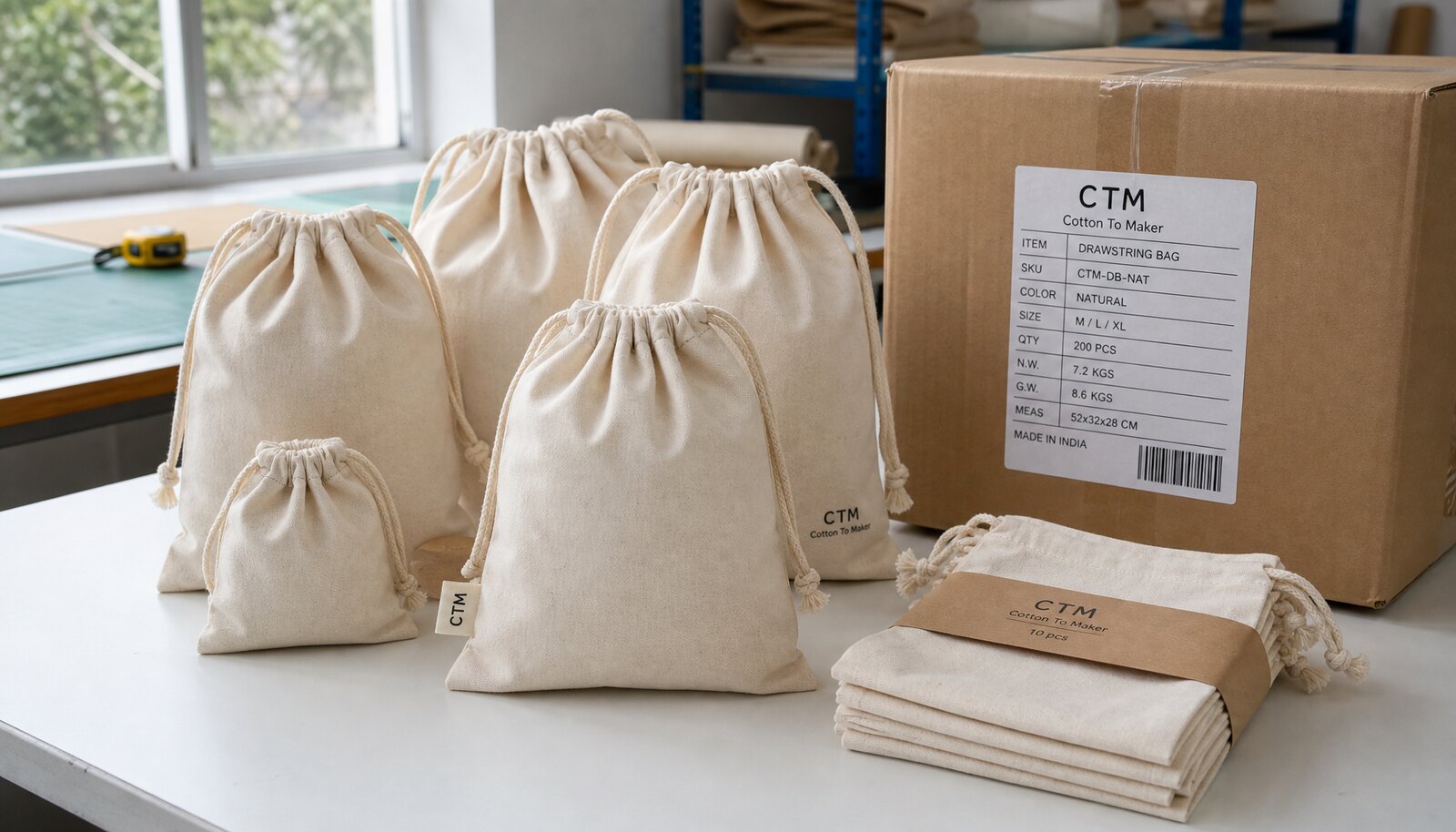
Treat packing as part of the product spec
For corporate gifting, cotton drawstring pouches are not only a soft branded item. They are also a warehouse unit, a kitting component, and often the first branded layer a recipient touches. A pouch can look acceptable in a sample photo and still create cost if cartons arrive overfilled, mixed by logo version, too heavy for manual handling, or marked by pressure from cords and folds.
A practical cotton drawstring pouches for corporate gifting carton packing plan belongs in the RFQ, quote, sample approval, and purchase order. It should state finished pouch size, fabric GSM, logo method, inner bundle count, carton count, carton dimensions, net weight, gross weight, carton strength, carton marks, and whether the shipment will be palletized.
This does not make the project complicated. It makes the order auditable. The buyer can compare suppliers on the same basis, the inspector can check against written requirements, and the receiving team can release cartons without opening every box to discover what is inside.
- Add inner packing, carton count, carton dimensions, gross weight, and carton marks to the RFQ.
- Keep each size, fabric color, and logo version in separate cartons unless mixed cartons are intentionally designed for kitting.
- Ask for a carton mock pack photo before mass packing for large, multi-SKU, or deadline-driven orders.
- Require the supplier to confirm that the proposed pack count will not create bulging, cord tangling, or print pressure marks.
Start with the gift item
The pouch should be specified from the item it will hold, not from a familiar catalog size. A boxed candle, metal bottle, notebook, jewelry card, cosmetic set, and tech accessory behave differently inside the same flat pouch. Hard corners may strain seams. A tall item may reduce closure quality. A boxy item may need a gusset even when the nominal width looks sufficient.
Give the supplier the gift item dimensions, packed weight, shape, and handling concerns. State whether the pouch must close fully, gather loosely, or simply cover the item. The drawstring channel often uses 20-35 mm of total height, so buyers should measure usable height below the channel rather than relying only on the total outside height.
For small and medium pouches, plus or minus 5 mm is often a practical finished-size tolerance, but the correct tolerance depends on fabric, construction, and finishing. Put the measuring method in writing: laid flat, after sewing and pressing, without stretching the fabric.
- Send the gift item size, weight, photos, and packaging shape with the RFQ.
- Confirm flat width, total height, usable height below channel, and gusset depth.
- Run a fit test with the real gift or a size-and-weight equivalent before bulk approval.
- For heavy or hard-edged gifts, request reinforced seams or a practical load check.
Choose cotton GSM and finish deliberately
Most corporate gifting pouches fall into a practical 140-180 GSM cotton range. Around 140-150 GSM can work for lightweight event giveaways, sample packaging, and budget-sensitive programs. Around 160-180 GSM usually gives better opacity, hand feel, and reuse value for employee welcome kits, client gifts, and retail-style inserts.
Heavier fabric is not automatically better. It increases carton bulk and gross weight, can make the drawstring channel stiffer, and may create thicker stacks that show compression lines. The best choice is the lightest fabric that still meets the buyer's requirements for opacity, seam strength, print clarity, and presentation.
Fabric finish also affects approval. Natural cotton may show seed specks and shade variation; that can be acceptable when approved physically. Bleached cotton gives a cleaner print base but shows handling marks more easily. Dyed cotton needs lab dip approval, shade tolerance, and discussion of rubbing or transfer risk, especially when touching light-colored goods.
- Specify GSM and tolerance, such as plus or minus 5% if acceptable.
- Approve shade against a signed physical fabric reference, not only a screen image.
- Ask whether fabric is pre-shrunk or whether shrinkage is included in finished-size tolerance.
- For repeat orders, keep the approved fabric reference and ask how future lots will be matched.
Control sewing and drawstring details
Drawstring problems are easy to miss in a flat sample and painful on a packing line. Uneven cords, knots that pull through, blocked channels, loose threads, and frayed ends slow kitting and create rework. Define cord material, color, diameter or tape width, exposed length, knot or end treatment, and whether the pouch uses a single or double drawstring.
Cotton cord gives a natural look and is common for eco-positioned gifting. Polyester cord can pull more smoothly and may color match more consistently, but it changes the feel. Tape drawstrings can look clean on larger pouches but need a wider channel. The channel should pull smoothly after printing, pressing, and packing, not only on the first sample.
Sewing checks should focus on stress points: channel ends, side seams, bottom corners, gusset folds, and any area pushed by the gift item. Raised seams, thick knots, and cord ridges can also create carton pressure points, so they matter for both quality and packing.
- Define cord material, diameter or width, color, knot, and end finish in the PO.
- Check cord pull after the pouch is filled, not only when empty.
- Inspect channel ends and bottom corners because these areas often fail first.
- Avoid carton orientations that press cord knots or ridges into the printed logo panel.
Specify decoration with production limits
For many cotton drawstring pouches, one-color screen print is the most efficient decoration for simple corporate logos, campaign marks, and readable text. It is not always the right choice for tiny legal copy, thin lines, gradients, halftones, QR codes, or tight multi-color registration. Cotton is a woven surface, so artwork must be tested on the actual approved fabric.
A physical strike-off is especially important when brand color matters. Ink on natural cotton may look warmer or less bright than the same reference on coated paper. Multi-color print can work, but buyers should agree registration tolerance before bulk production. Heat transfer, woven labels, sewn patches, and embroidery can be appropriate, but each has tradeoffs in hand feel, edge durability, puckering, raised thickness, and carton pressure.
Placement should be measured from fixed points: centerline, top edge, channel seam, side seam, or bottom fold. Avoid placing artwork too close to the drawstring channel, gusset fold, or side seam. A logo that looks centered on an empty sample may distort once the pouch is filled and cinched.
- Send vector artwork with logo size, color reference, and minimum line width requirements.
- Set print placement tolerance, commonly plus or minus 3-5 mm depending on pouch size and method.
- Approve a decorated sample or strike-off on the actual fabric before bulk production.
- Check curing, opacity, edge clarity, registration, cracking, tackiness, and offsetting during QC.
Use concrete carton pack scenarios
Carton count should be engineered from pouch size, GSM, construction, decoration sensitivity, destination handling, and receiving workflow. The examples below are planning references only; the supplier should confirm actual weights and dimensions from a carton mock pack before final shipment booking.
A small flat pouch, 100 x 150 mm, 140 GSM natural cotton, one-color print, may pack about 500 pieces per export carton in bundles of 100. A typical planning carton could be 45 x 35 x 35 cm, with an estimated net weight around 8-10 kg and gross weight around 9-11 kg. This works when the print is small and cartons are not bulging.
A medium flat pouch, 150 x 200 mm, 160 GSM cotton, one-color front print, may pack about 300 pieces per carton in six bundles of 50. A planning carton could be 50 x 40 x 40 cm, with net weight around 11-14 kg and gross weight around 12-15.5 kg. Reduce to 200-250 pieces if the print area is large, ink coverage is heavy, or the pouch will travel long distance under stacked load.
A larger gusseted pouch, 250 x 350 mm with 60 mm gusset, 180 GSM cotton, patch or embroidery, may pack about 100-150 pieces per carton in bundles of 25 or 50. A planning carton could be 60 x 45 x 45 cm, with net weight around 12-18 kg and gross weight around 14-20 kg. Reduce count when gussets distort, cartons bulge, or raised decoration marks neighboring pieces.
- Ask for proposed pack count, carton dimensions, net weight, gross weight, and total carton quantity before shipment booking.
- Set a maximum carton weight for manual unloading, office delivery, or event staff handling.
- Use reduced count or interleaving when large prints, heat transfers, embroidery, or patches show pressure risk.
- Reject pack counts that create bulging cartons, unstable stacking, crushed corners, or visible logo-panel compression.
Specify export cartons and moisture control
A pouch order may move through factory storage, truck loading, export handling, port or airport transfer, destination customs, warehouse receiving, and event delivery. The carton must survive that route. Ask the supplier to state carton material, flute type if available, burst or edge-crush strength if used locally, closure method, and whether cartons are suitable for stacking and export handling.
For most B2B shipments, cartons should be clean, dry, square, and strong enough to hold their shape when stacked. Overfilled cartons are a warning sign even if the goods fit. Bulging sides reduce pallet stability and increase damage risk. Underfilled cartons can collapse unless void space is controlled.
Moisture control is also practical, not decorative. Cotton can absorb odor and humidity. Cartons should not be sealed while goods are damp, ink is uncured, or the packing area is humid without controls. For ocean freight, ask whether desiccants, container moisture precautions, or pallet wrapping rules are recommended. Avoid placing cartons directly on wet floors during storage or loading.
- Confirm export carton grade or strength standard used by the factory.
- Require clean, dry cartons with no crushed edges, wet marks, strong odor, or weak sealing.
- Use moisture protection when shipping through humid seasons, ocean freight, or long storage periods.
- Ask for closed-carton photos showing carton condition, tape sealing, labels, and stacking before release.
Make receiving and palletization easy
The best packing plan matches the destination workflow. A 3PL may want barcode labels, predictable bundle counts, and single-SKU cartons. An event team may want lighter cartons that can be moved without equipment. A distributor may need cartons separated by region, language version, or client logo. These requirements should be known before production, not discovered at delivery.
Carton marks should include PO number, item code, pouch size, fabric color, logo version, quantity per carton, carton sequence, net weight, gross weight, and destination code where relevant. For multi-region campaigns, make the region visible on the outer mark and packing list. Inner bundles should carry enough information to remain identifiable after the master carton is opened.
For palletized shipments, confirm pallet size, maximum height, carton orientation, stacking pattern, stretch wrap, corner protection if needed, pallet label, and whether mixed pallets are allowed. If the destination does not accept pallets, the carton weight limit becomes more important.
- Use single-SKU cartons unless mixed cartons are intentionally built for a kitting workflow.
- Match carton labels, inner labels, and packing list descriptions exactly.
- Confirm pallet height, pallet labels, stretch wrap, and whether destination warehouses accept pallets.
- Number cartons clearly, such as Carton 1 of 40, so shortages are easier to identify.
Make quotes comparable
Unit price alone is not enough for procurement comparison. One supplier may assume 150 GSM cotton, loose bulk packing, and a light carton. Another may include 180 GSM cotton, labeled bundles, stronger cartons, a pre-production sample, and carton labels. The quotes are not comparable unless the assumptions are visible.
Ask suppliers to quote the same finished size, construction, GSM, fabric finish, drawstring detail, decoration method, logo size, inner packing, carton count, carton dimensions, carton grade, MOQ, sample cost, setup charges, bulk lead time, and defect handling process. If freight is included, confirm the Incoterm and whether the estimate uses confirmed carton dimensions or preliminary assumptions.
Controlled alternates are useful. Request a 150 GSM and 180 GSM option, bundled bulk versus individual polybag, and standard carton count versus reduced count for print protection. These options show the tradeoff among unit cost, freight cube, receiving labor, and damage risk.
- Separate unit cost, setup, sample, lab dip, packing, carton label, inspection support, and freight assumptions.
- Require MOQ by fabric color, size, logo version, and print color count.
- Count lead time from final artwork, sample, lab dip, and packing-plan approval.
- Attach the approved quote revision, artwork, sample comments, and packing plan to the PO.
Inspect product and packing before shipment
Final inspection should cover both the pouch and the carton plan. Product checks include fabric defects, finished size, stitching, cord function, seam strength, logo quality, logo placement, print curing, and general workmanship. Packing checks include bundle count, carton count, carton marks, carton condition, gross weight, SKU separation, and packing list accuracy.
If a third-party inspection is used, define sampling standard and defect classification before production finishes. Critical defects may include wrong logo, wrong size, missing drawstring, severe stains, wet cartons, wrong carton marks, or mixed SKUs. Major defects may include open seams, blocked channels, poor print registration, incorrect bundle count, or carton damage that affects handling.
Print curing needs attention. If pouches are packed before ink is dry or cured, pressure inside the carton can cause offsetting, tackiness, blocking, or marks on neighboring pieces. Inspect pieces from the top, middle, and bottom of cartons, not only fresh pieces from the production table.
- Request pre-shipment photos of representative pouches, print close-ups, stitching, bundles, carton labels, and closed cartons.
- Check carton labels against the packing list before shipment release.
- Open sample cartons during inspection to verify bundle count and SKU separation.
- Hold shipment release to the approved sample, approved quote revision, and approved carton packing plan.
Specification comparison for buyers
| Packing option | Best use | Typical pack setup | Procurement watchout |
|---|---|---|---|
| Loose bulk in master carton | Low-cost programs where the receiving team will count and sort manually | Pouches stacked flat in one carton, usually without inner count bands | Lowest packing cost but slow receiving, higher miscount risk, more cord tangling, and weaker SKU control |
| Bundled bulk pack | Most B2B gifting, 3PL receiving, event kitting, and distributor replenishment | Bundles of 25, 50, or 100 pieces with paper band or recyclable bag, then packed in export carton | Best balance for counting and warehouse flow; buyer must approve bundle count, label content, and carton count |
| Individual polybag pack | Dust-sensitive goods, retail handoff, strict unit separation, or kits where each pouch is handled alone | Each pouch packed flat or folded in a bag, then bundled or layered in master carton | Adds cost, plastic, trapped air, and carton volume; bag size must avoid print creasing and excessive bulk |
| Print-protection reduced count | Large screen prints, heat transfers, embroidery, raised patches, or long ocean transit | Lower pieces per carton, flat orientation, interleaving or print-facing rules where needed | Higher freight cube, but reduces pressure marks, offsetting, blocked ink, and raised cord marks on the logo panel |
| Mixed-carton kitting pack | Controlled regional kits or cartons built for direct event distribution | Predefined mix by size/color/logo, inner bundles clearly labeled and packing list matched carton by carton | Only safe when the mix is intentional; unclear mixed cartons cause receiving errors and slow fulfillment |
| Palletized export pack | Larger orders moving through export, cross-dock, or warehouse receiving | Single-SKU cartons stacked by carton mark, stretch-wrapped, with pallet label and packing list reference | Confirm pallet height, carton strength, moisture protection, warehouse equipment, and whether destination accepts pallets |
Buyer checklist before sampling
- Confirm finished pouch dimensions as flat width x total height, usable height below drawstring channel, and gusset depth where applicable.
- State size tolerance and measuring method: after sewing and pressing, laid flat, without stretching fabric or cord.
- Provide gift item dimensions, weight, packed shape, hard corners, retail packaging type, and whether the pouch must fully close.
- Specify cotton GSM, GSM tolerance, fabric finish, shade reference, and whether fabric is natural, bleached, stock dyed, or custom dyed.
- Confirm MOQ by size, fabric color, logo version, and print color count, not only total order quantity.
- Define construction: flat, bottom gusset, side gusset, single or double drawstring, channel width, seam type, and reinforcement points.
- List drawstring material, cord diameter or tape width, cord color, exposed length, knot or end finish, and acceptable fraying level.
- Send vector artwork with Pantone or approved color reference, logo size, print position, number of colors, and minimum line width.
- Set inner packing: loose bulk, bundles of 25/50/100, individual polybag, or print-protection reduced count.
- Approve carton count, carton dimensions, net weight, gross weight, carton grade, carton marks, and pallet requirements before shipment.
Factory quote questions to send
- What finished size are you quoting, and how do you measure flat width, total height, usable height below channel, and gusset depth?
- What size tolerance applies, and is it measured after sewing, pressing, printing, or packing?
- What GSM is included, what GSM tolerance applies, and what is the price change for one lighter and one heavier fabric option?
- Is the fabric natural, bleached, stock dyed, or custom dyed, and what physical shade approval process applies before bulk cutting?
- What MOQ applies by fabric color, pouch size, logo version, and print color count?
- What drawstring material, cord diameter or tape width, channel width, knot/end treatment, and cord color are included?
- Which decoration method is priced, what maximum print area do you recommend, and what artwork details may not reproduce cleanly?
- What is the sample lead time, bulk lead time, and production start point: deposit, artwork approval, lab dip approval, or sample approval?
- What inner packing, carton count, carton dimensions, net weight, gross weight, carton grade, and carton markings are included?
- Can you provide a carton mock pack photo before mass packing, including bundle labels, pouch orientation, closed carton, and outer marks?
Quality-control points to confirm
- Check fabric GSM from representative fabric cuts or finished goods according to the agreed method and tolerance, commonly plus or minus 5% unless the PO states otherwise.
- Inspect fabric surface for stains, oil marks, holes, broken yarns, severe slubs beyond the approved reference, color streaks, and loose contamination inside bundles.
- Match fabric color to the approved physical sample or lab dip under agreed lighting; judge natural cotton shade against a signed reference, not a screen image.
- Measure finished dimensions after sewing and normal finishing, laid flat without stretching, with width, total height, usable height, and gusset depth recorded separately.
- Check cutting alignment, panel squareness, side seam straightness, top opening consistency, and whether the pouch stacks evenly for carton packing.
- Inspect channel width and stitching for smooth cord movement, blocked sections, skipped stitches, loose thread loops, and stitch run-off at channel ends.
- Check cords for presence, symmetry, smooth pull, secure knots, balanced exposed length, acceptable end finish, and no severe fraying.
- Test side seams, bottom seams, and gusset corners with a practical pull or load check based on the intended gift weight.
- Inspect print size, color, opacity, edge clarity, curing, and placement against the approved strike-off, including pieces from different production stages.
- Verify inner bundle count, carton quantity, carton labels, carton condition, gross weight, SKU separation, moisture condition, and packing list accuracy before shipment.