Why MOQ gets confusing on cotton drawstring pouches for coffee roasters
MOQ on cotton drawstring pouches looks simple until the quote arrives with multiple thresholds. A supplier may say 1,000 pieces, but that figure often assumes stock natural fabric, one standard size, one-color print, bulk packing, and no custom labels. Coffee roasters usually need more variation than that: different pouch sizes for cupping kits, holiday gift sets, grinder accessories, or brew tools; branded printing for retail shelves; and cleaner presentation than a generic promo pouch. Each change pushes MOQ or unit price in a different way.
The buying mistake is treating MOQ as one number instead of a stack of production minimums. There can be one MOQ for fabric allocation, another for screen setup, another for custom drawcord color, and another for woven labels. If your team negotiates only the final unit price, you can still lose money through forced overbuy on custom trims or through inefficient split runs across several SKUs. The better approach is to separate what truly needs customization from what can stay standard in the first order.
- Stock natural fabric usually supports the lowest practical MOQ
- Custom dyed fabric can raise MOQ more than custom printing does
- Small pouches are not always cheaper if sewing labor is high and cutting waste increases
- Mixed sizes with the same print can sometimes be grouped, but only if the supplier's cutting plan allows it
Start the RFQ with the pouch's real job, not just its flat dimensions
For coffee roasters, a drawstring pouch may be used for a retail gift set, sample bean packs, a mug-and-bean bundle, or branded merch accessories. Those uses create different stress points. A pouch holding a small accessory only needs presentable fabric and decent print. A pouch used to contain multiple coffee items needs seam strength, thicker fabric, and a channel that still cinches when the pouch is full. Without the intended use, factories quote on assumptions and the quote becomes hard to compare.
Include the filled contents in your RFQ. Say whether the pouch will hold a 250g coffee bag, a tin, a scoop, drip bags, or an accessory kit. Provide the packed dimensions of the inserted item, not just the product dimensions before packing. This immediately improves size recommendations and reduces the common mistake of ordering a pouch that fits flat samples but not the retail-ready bundle.
- State inserted item size: length x width x depth after retail packing
- State whether the pouch must fully close at the top when filled
- Mention target feel: lightweight promo, standard retail, or premium gift
- Add expected use environment: store shelf, ecommerce shipper insert, event giveaway, or subscription program
Choose fabric weight by retail feel and load, not by lowest price per piece
Cotton pouch pricing is highly sensitive to fabric weight, but the cheapest option can create expensive presentation issues. Around 4oz cotton, roughly 135 GSM, works for lightweight promotional uses and low-value inserts, but it can look thin, wrinkle easily, and show the drawcord channel pulling under load. For coffee roaster gift packaging, 6oz to 8oz cotton, about 200-270 GSM, is the safer commercial range because it holds shape better, prints more cleanly, and gives a more reusable feel.
Heavier is not automatically better. A 10oz or 12oz canvas body can look premium, but on smaller pouches it becomes bulky at the top hem and can create uneven cinching. It also raises freight cost and slows sewing. If you need a premium result, a cleaner 8oz cotton with a good screen print and neat stitching often performs better than an unnecessarily heavy fabric.
- 4oz to 5oz: low-cost promo or lightweight accessories only
- 6oz: balanced option for most coffee-related retail pouches
- 8oz: stronger hand feel for gift sets and repeat-use packaging
- Request both oz and GSM on the quote to avoid fabric substitution confusion
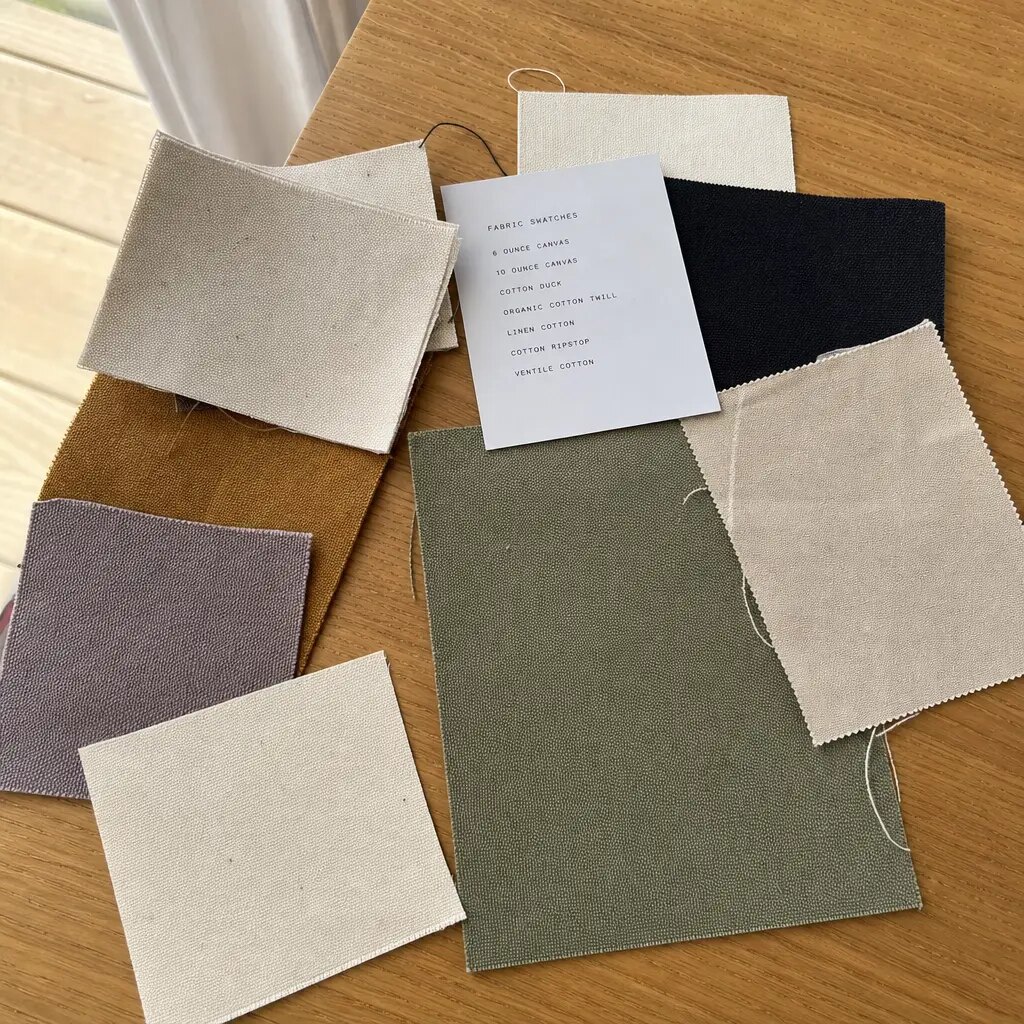
- Approve a fabric swatch under normal retail lighting because natural cotton can vary in shade and texture
Print choice affects MOQ more than many buyers expect
For most coffee roaster pouch programs, one-color silkscreen printing gives the best balance of readability, setup cost, and production stability. It handles simple logos, roast-club branding, event graphics, and message lockups well. It also keeps MOQ lower because screen setup is straightforward and print speed is high. If your brand artwork has fine gradients, distressed textures, or multiple colors, the supplier may propose heat transfer or digital methods, but those usually raise cost per piece and can reduce consistency on textured cotton.
Print area and print location matter in negotiation. A small front logo and a large wraparound graphic are not the same job even if both are one color. Bigger print area means more ink coverage, more drying attention, and a higher chance of registration or smudge issues. A buyer comparing quotes should break out the print details line by line instead of accepting 'custom logo included' as a meaningful pricing term.
- One-color screen print is usually the best first-order route
- Large solid prints can increase cost due to ink coverage and handling time
- Very fine details may not reproduce well on natural cotton texture
- Pantone reference should be listed if color accuracy matters across other packaging items
- Specify one-side or two-side print and exact print area dimensions
How to negotiate MOQ without forcing the wrong customization too early
MOQ negotiation works best when you protect the parts of the design that buyers notice most and postpone the parts that mainly increase factory complexity. For a new coffee roaster program, keep the body fabric as stock natural cotton if possible, and use custom print to carry the brand identity. This usually lets you enter at a more manageable quantity while still getting a branded result that works for retail or promotional use. Custom dyed fabric, specialty cord color, metal cord ends, and woven labels can come in later when volume is proven.
If you need several pouch sizes, negotiate mixed-size production under one fabric and print program rather than requesting separate custom runs for each size. The supplier may still price each size differently, but grouping the artwork style and body material often reduces setup duplication. Another useful tactic is to split the quote into pilot volume and repeat volume. You may accept a slightly higher first-run price if the repeat-order structure is defined in advance and does not re-trigger the same setup charges.
- Keep first order simple: stock fabric, one print color, standard cord, bulk packing
- Negotiate mixed-size production only after sharing estimated ratio by size
- Separate one-time setup costs from repeat-order unit costs
- Ask if future repeat runs can use retained screens or approved print standards
- Do not add custom trim MOQ unless it materially improves sell-through or gift value
Samples should test production reality, not only artwork approval
Many sample rounds fail because they are treated as visual sign-off only. For drawstring pouches, the sample should prove size fit, print readability, drawcord function, stitching neatness, and overall retail feel. A digitally mocked-up approval or a hand-made showroom sample is not enough if the final order depends on how a real 6oz or 8oz fabric folds, how the drawstring channel behaves, and how the print sits on natural cotton texture.
The most useful pre-production sample is made from production-intent fabric and with the intended print process. It does not need full bulk efficiency, but it should reflect the actual sewing construction and top-channel dimensions. If your coffee roaster program includes inserted products, test with actual packed items. A pouch that looks correct when empty can become too short, too narrow, or impossible to close once the fill is inside.
- Approve flat size and filled fit with actual product inserts
- Measure top opening width after sewing, not only body width
- Review print opacity, edge sharpness, and position from top hem
- Pull the drawcord several times to test channel smoothness
- Photograph approved sample with ruler and note tolerance limits on the approval form
The cost drivers buyers should separate before comparing quotes
A supplier quote that gives one total unit price without line-item logic is difficult to negotiate and easy to misread. Cotton drawstring pouches have several cost layers: fabric consumption, cutting and sewing labor, print setup and print run cost, trims such as drawcord or labels, packing method, sampling, and carton configuration. Coffee roasters often compare quotes from promotional-product vendors, trading companies, and factories. Unless those quotes are normalized, the cheapest one may simply exclude a required feature or use lighter fabric.
Request a structured quote that separates material and process assumptions. This is especially important when two prices look close. One supplier may be quoting 6oz cotton with single-color print and bulk packing; another may be quoting 5oz cotton with no individual inspection and a smaller print area. The difference will not appear in the top-line unit price alone. Your team should rebuild the comparison using equivalent specifications.
- Body fabric cost changes with GSM, width utilization, and cutting waste
- Sewing cost changes with pouch size, double drawcord, and reinforcement details
- Print cost changes with color count, print area, and method
- Packing cost changes with individual polybagging, barcode labels, and carton assortment
- Freight planning changes with carton density and gross weight
Packing decisions can quietly erase the savings you won in MOQ negotiation
Packing is often discussed late, but it changes both factory cost and landed cost. For many coffee roasters, pouches are filled locally with beans, gift items, or accessories. In that case, bulk packing by SKU is usually the most efficient route. The supplier can pack by fixed inner quantity, for example 50 or 100 pieces per polybag and a set count per export carton. This reduces labor and keeps carton cube lower.
Individual polybagging makes sense only when the pouch itself is a finished retail item or when the receiving operation needs very clean handling. Otherwise it adds labor, plastic use, and carton volume. If you skip individual polybags, be explicit about cleanliness and carton lining. Natural cotton can pick up dust or lint in transit, and buyers sometimes blame the factory for a problem that was really a packing-spec gap.
- Specify inner pack count by SKU to reduce warehouse resorting time
- Request carton dimensions and gross weight in the quote for freight planning
- Use carton marks that show size, print version, PO number, and quantity
- If no individual polybag is used, define clean packing standard and moisture protection
- Avoid mixed-size cartons unless your receiving team specifically wants them
Lead time risk usually sits in approvals, fabric availability, and print queue
Buyers often focus on the stated production days but miss the dependencies that actually control shipment timing. Cotton pouch orders for coffee roasters usually move smoothly when stock natural fabric is available, artwork is simple, and the packing spec is straightforward. Delays appear when artwork changes after sampling, when custom-dyed components are introduced, or when the supplier's print line is carrying several jobs with similar due dates. A short quoted lead time is not useful if the conditions behind it are unclear.
Build the schedule around decision gates, not just final ETD. Separate sample review, artwork sign-off, deposit receipt, raw material booking, bulk production, final inspection, and booking handover. This lets procurement identify where internal delays hurt most. In many cases, two days lost in artwork approval are more dangerous than two days lost in sewing, because printing cannot start cleanly without final approved placement and color references.
- Request lead time from each trigger: sample approval, artwork approval, deposit, and shipping mark approval
- Clarify whether fabric is in stock or to be purchased after order confirmation
- Ask which step is the bottleneck: printing, sewing, or packing
- Leave time for one final pre-production photo review if physical sample timing is tight
- Do not book promotional launch dates purely on the shortest verbal lead time
Set acceptance criteria before production so QC has measurable thresholds
The easiest pouch disputes to avoid are size, print position, and cleanliness issues. These are visible, measurable, and common. Procurement should write basic acceptance standards into the PO or approval sheet rather than relying on general language like 'good quality'. For example, define the finished size tolerance, allowable print shift from centerline, tolerance on top hem depth, and what constitutes a rejectable stain, seam skip, or cord fray. This helps the factory's inline inspection and gives your receiving team a fair reference.
For coffee roaster programs, appearance matters because the pouch is often part of the brand story, not just protective packaging. But reusable function matters too. A pouch that prints beautifully and fails to cinch smoothly is still a bad result. Good QC balances visual quality with basic mechanical performance. That means pulling random samples to test cord movement, seam integrity under a normal load, and consistency across cartons.
- Write size tolerance by finished sewn size, not cut size
- State print position tolerance from top seam and side seam reference points
- Define acceptable natural cotton variation if using undyed fabric
- Treat oil marks, mildew smell, and major lint contamination as rejectable defects
- Test drawstring operation on filled samples, not empty pouches only
Specification comparison for buyers
| Spec decision | Recommended option | When it fits | Buyer risk to check |
|---|---|---|---|
| Fabric weight | 6oz to 8oz cotton, about 200-270 GSM | Best for 250g-500g coffee gift packs, drip bag sets, accessories, or reusable retail packaging | 4oz can look thin and show drawcord stress; above 8oz raises cost and can increase sewing difficulty on small pouches |
| Fabric type | Combed cotton or clean standard cotton with low nep level | When brand presentation matters and logo print needs a cleaner surface | Open-end cotton may have more slubs and lint; approve swatch before print approval if natural fabric appearance is important |
| Size range | 15x20cm, 20x25cm, or 25x30cm based on final packed item dimensions | Standard retail gift pouch programs with repeatable insert sizes | Many MOQ disputes come from custom sizing below factory cutting efficiency; include filled dimensions and tolerance in RFQ |
| Print method | 1-color silkscreen for most logos; heat transfer only for detailed multicolor artwork | Silkscreen fits strong logo visibility at lower MOQ and lower unit cost | Heat transfer can crack or shift on textured cotton; screen print registration and Pantone tolerance should be pre-approved |
| Drawstring construction | Single drawcord with side cinch for low cost, double drawcord for premium retail feel | Single cord for promotional packs; double cord for gift sets and ecommerce resale | Double drawcord increases labor time and defect points if knotting and channel width are inconsistent |
| MOQ route | Use stock fabric plus custom print for lower MOQ; use dyed fabric or woven label only if volume supports it | Best for pilot launches, seasonal roasts, or distributor testing | Custom dye lots and custom trims often trigger higher MOQ than the pouch itself; split quotes by body, print, and accessory components |
| Packing method | Bulk pack by size and print lot in PE bag plus export carton, with optional inner count labels | Best for importers and roasters doing final insertion locally | Individual polybag packing adds labor and carton volume; if omitted, specify cleanliness standard to avoid dust complaints |
| Sampling stage | Digital layout plus one physical pre-production sample from production-like fabric | Necessary when natural cotton shade, print opacity, and cord color affect retail presentation | Handmade prototype may not reflect bulk stitching quality; approve a sample made with intended fabric weight and print process |
| Lead time structure | 7-10 days sample approval plus 20-35 days bulk after deposit and artwork sign-off | Typical for moderate-volume pouch orders with standard fabric | Lead time promises are unreliable if fabric greige stock, printing queue, or export booking are not clearly stated in quote |
Buyer checklist before sampling
- Define the actual use case: empty retail gift pouch, accessory pouch, bean bag overwrap, or merch kit component
- State filled product dimensions and target pouch size, not only flat size
- Specify fabric weight in oz and GSM range, such as 6oz about 200 GSM natural cotton
- Note whether natural cotton shade variation is acceptable or whether cleaner color consistency is required
- List print method preference and artwork details: one-side or two-side, color count, Pantone reference, print area size
- Decide single or double drawstring construction and whether knots, metal tips, or cord color matching are needed
- Clarify if side label, care label, barcode sticker, or swing tag is part of the pouch program
- Request sample made with production-intent fabric and print process, not a substitute cloth
- Define packing format by inner quantity, carton quantity, and whether individual polybagging is required
- Include acceptable size tolerance, print position tolerance, and major defect threshold in the PO or spec sheet
Factory quote questions to send
- What is the MOQ by size when using stock natural cotton fabric with one-color silkscreen print?
- How does MOQ change if we add custom dyed fabric, woven label, or double drawstring construction?
- Which fabric weight are you quoting in both oz and GSM, and what is the finished weight tolerance?
- Is the quoted size a cut size or finished sewn size, and what tolerance will be applied in bulk?
- What print method is included, what is the maximum print area, and is Pantone color matching charged separately?
- Will the pre-production sample use the same fabric, cord, and print process as mass production?
- How many pieces per carton, what are the carton dimensions, and what gross weight should we use for freight planning?
- What defects are sorted before packing: open seams, print smudges, cord fray, stains, oil marks, and wrong size?
- What lead time depends on artwork approval, fabric stock, and deposit receipt, and which step is the production bottleneck?
- Can you provide separate line items for pouch body, printing, labels, packaging upgrades, and sampling so we can compare quotes fairly?
Quality-control points to confirm
- Finished size tolerance should be written clearly, for example plus or minus 0.5cm on small pouches and plus or minus 1cm on larger sizes
- Fabric weight should stay within an agreed tolerance band; if quoted as 6oz, the bulk fabric should not drop to a noticeably lighter hand feel
- Natural cotton shade should be approved against a swatch because lot-to-lot variation is normal and often becomes a dispute later
- Print placement should follow a measured tolerance from top hem and side seam, not visual judgment only
- Print opacity should be reviewed on natural cotton because thin white or light inks can look dull on textured fabric
- Drawcord ends should be heat cut, folded, or knotted consistently to reduce fraying in transit
- Top channel stitching must be even and wide enough for smooth cinching without twisting or trapped cord
- Seams at lower corners should be back-tacked or reinforced if the pouch will hold heavier gift items
- Pouches must be clean packed with no oil marks, loose threads, mildew smell, or excessive lint inside the bag
- Carton assortment must match the approved packing list to avoid size mixing and print version confusion at receipt