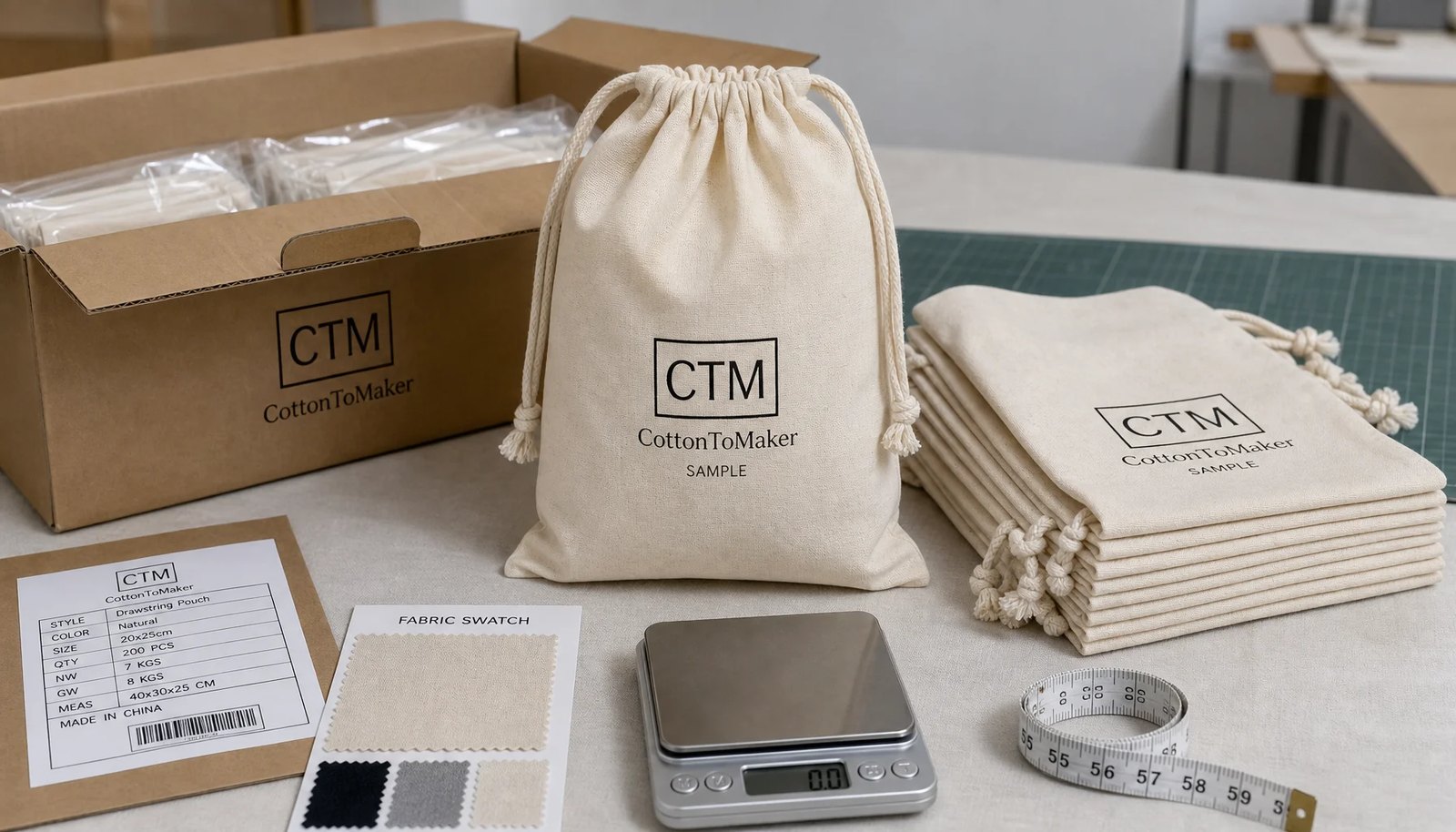
Why carton planning belongs in the pouch specification
Cotton drawstring pouches look simple at first glance: cotton fabric, two side seams, a drawcord, and a printed logo. For a university bookstore buyer, however, the largest surprises often appear after the unit price is agreed. A pouch that saves a few cents at production may need larger export cartons, extra inner packs, slower receiving, added barcode handling, or higher dimensional-weight charges. For orientation kits, graduation gifts, alumni merchandise, bookstore private-label packaging, department events, and ecommerce fulfillment, shipping carton planning belongs in the specification from day one.
Factory quotes can be prepared from a rough pouch size, but dependable carton data needs production-level detail. Fabric GSM, cord diameter, knot style, seam allowance, print method, curing time, fold style, inner bag quantity, hangtags, barcode labels, and carton strength all affect how the pouch packs. Two suppliers may quote the same finished pouch size, yet the order using 8 oz canvas will not pack like the order using 5 oz cotton.
Campus receiving adds another layer. Goods may land at a central university warehouse, move to a bookstore stockroom, be split by department, be allocated to satellite shops, or be staged for a fixed event date. Clear carton marks, SKU separation, inner pack counts, and accurate packing lists reduce handling time and make discrepancies easier to resolve. In practical terms, the carton plan protects product condition, freight accuracy, and PO reconciliation.
- Request carton data before PO confirmation: pieces per carton, carton L x W x H, gross weight, net weight, carton count, total CBM, and SKU breakdown.
- Treat a change in fabric weight, cord type, print method, hangtag, barcode label, or individual packaging as a carton-plan change, not only a product-spec change.
- Use inner packs of 25 or 50 pieces when bookstore staff need predictable counting units for transfers, events, stockroom replenishment, or kit assembly.
- Keep one SKU per carton whenever practical to reduce misallocation, receiving delays, and discrepancy disputes.
- Ask for a packed-sample photo or carton trial when ordering a new pouch size, heavier canvas, double-sided print, or retail label configuration.
Build the RFQ around the item going inside
The best pouch size is not simply the lowest-cost flat dimension. It is the size that holds the intended item, closes without strain, presents the logo cleanly, and packs efficiently. University bookstores use cotton drawstring pouches for pens, pins, stickers, gift cards, chargers, earbuds, folded apparel, dorm move-in items, graduation accessories, cosmetics, jewelry, stationery bundles, and alumni gifts. Each use case changes the priority: usable space, bottom seam strength, opacity, closure height, retail display, or fast event distribution.
Finished pouch size and usable internal space should be listed as separate requirements. The drawcord channel, top closure area, side seams, bottom seam or bottom fold, and fabric thickness all reduce available capacity. A 200 x 300 mm flat pouch does not provide 200 x 300 mm of usable closed space. If the pouch must close above a folded T-shirt, small notebook, boxed charger, or diploma item, the supplier should test the product or a rigid product-size template before the pattern is finalized.
The RFQ should describe the insert item in working terms, not only as a category name. Provide length, width, thickness, approximate weight, corner sharpness, whether factory packing is required, and whether the filled pouch must stand, fold flat, or stay presentable on a shelf. If the pouch itself is the retail item, add barcode placement, hangtag position, care information, and display method early. Those details affect labor, packing time, and carton volume.
- For pens, stickers, cards, and pins, confirm that fabric opacity and print coverage are acceptable before choosing lighter cotton.
- For chargers, earbuds, and tech accessories, check bottom seam strength, closure function, and pressure points from boxed or angular contents.
- For folded apparel, test the exact folding method because width often becomes the limiting dimension before height does.
- For gift cards or small premium items, define whether the pouch is protective packaging, retail display, or part of the gift presentation.
- For event distribution, prioritize accurate carton labels, simple inner packs, and fast counting over unnecessary individual retail packaging.
Fabric GSM, cotton state, and carton volume
Cotton pouch fabric is commonly quoted in ounces or GSM. Approximate references help: 4 oz cotton is often around 135 GSM, 5 oz around 170 GSM, 6 oz around 200 GSM, 7 oz around 240 GSM, and 8 oz canvas around 270 GSM. The exact relationship depends on weave and finishing, so a B2B quote should state both the target GSM and the acceptable tolerance. For many university bookstore pouch programs, 5 oz to 6 oz cotton, about 170-200 GSM, is a practical starting range because it balances print quality, fabric body, folded thickness, and carton efficiency.
Heavier cotton can improve structure and perceived value, but it also changes packing density. Canvas creates thicker folded edges, more drawcord-channel bulk, and higher pressure inside cartons. If cartons are packed too tightly, printed areas may crease or show pressure marks. If cartons are enlarged to avoid compression, freight CBM rises. Buyers comparing quotes should review fabric weight together with pieces per carton, total CBM, and dimensional-weight exposure.
Fabric state deserves the same attention. Natural cotton can shift from warm cream to grayish tones, and that base shade affects university colors. Bleached cotton offers a cleaner print base but changes cost and appearance. Dyed cotton can support a school-color program, yet it may require lab dip approval, fabric MOQ, and schedule buffer. If the bookstore will make organic cotton or recycled-content claims in retail copy, certification and transaction documents must be checked before production begins.
- 135-170 GSM cotton fits light giveaways but may show seams, contents, or darker inserts more easily.
- 170-200 GSM cotton is a strong default for bookstore gift packaging and 1-3 color screen printing.
- 220-240 GSM cotton adds opacity and structure but increases folded bulk and may reduce carton quantity.
- About 270 GSM canvas supports premium reuse but often increases dimensional weight for air, courier, and parcel freight.
- Natural cotton swatches should be approved before Pantone signoff because the base fabric can shift the perceived logo color.
- Custom-dyed fabric should include lab dip approval, color tolerance, fabric MOQ, and schedule buffer in the RFQ.
Print specifications that protect licensed campus artwork
Screen printing is usually the most practical option for cotton drawstring pouches with one to three solid university colors. It works well for vector logos, department marks, mascot art, and bookstore house branding when the artwork is clean and the fabric surface is consistent. The buyer should provide vector files, Pantone references, approved print size, print location, and licensing instructions. A digital proof is useful, but it is not a color approval standard; ink on natural cotton will not match a backlit monitor or a coated-paper chip exactly.
For full-color artwork, gradients, or short seasonal designs, heat transfer or DTG may be considered after supplier review. These methods can be useful, but they change the product. Transfers may have a panel-like handfeel, visible edge, or different fold behavior. DTG results may depend heavily on fabric surface, pretreatment, and curing. Before approving either method, test adhesion, folding, rubbing, and how the printed face behaves when pouches are stacked inside inner bags.
Print position needs measurable language. “Centered on front” can lead to disputes if the pouch is sewn slightly asymmetrically or the drawcord channel changes the visual center. State the print width and height, the distance from the bottom seam or top channel, the horizontal centerline, and the allowed tolerance. For many pouch sizes, plus or minus 3 mm to 5 mm is a practical starting point, though sensitive licensed marks may require closer approval.
- Specify whether printing occurs before sewing or after sewing because this affects placement accuracy, screen access, and edge limitations.
- Approve Pantone color on the actual cotton fabric, especially for navy, burgundy, gold, green, white ink, and bright mascot shades.
- Request a printed strike-off before bulk production when university licensing or bookstore brand standards require close color control.
- For double-sided printing, decide whether printed faces may touch or whether inner bags, interleaving, or alternate folding are required.
- Confirm curing and packing timing so screen-printed pouches are not packed while ink is still vulnerable to blocking or scuffing.
Drawcord, sewing, and closure details
Drawcord choices affect both user experience and carton packing. Cotton cords match the natural fabric look and are common for bookstore-style pouches. Polyester cords may slide more smoothly and can be easier to source in some colors. Cord diameter is often in the 3-5 mm range for many small and medium pouches, but the right size depends on pouch scale and channel width. Too thin, and the cord looks weak. Too thick, and it can block the channel, create bulky knots, and reduce pieces per carton.
The RFQ should define cord material, color, diameter, length, knot style, end finish, and whether the cord must match the fabric, school colors, or logo ink. If a school-color cord is required, ask whether it is stock or custom dyed. Custom cord colors can add MOQ and lead time just like custom fabric. During sample review, check whether cord ends fray, whether knots are secure, and whether cord lengths look even across paired openings.
Sewing construction should be inspected at the side seams, bottom corners, channel openings, and backtack points. These are the areas that fail first when a pouch is filled, pulled closed, or handled repeatedly. A pouch for stickers does not need the same stress performance as a pouch for chargers or folded apparel. If the pouch will be used for kit assembly, the seams must tolerate insertion and closure without tearing, twisting, or distorting the printed face.
- Ask the supplier to confirm cord diameter and channel width together, not as isolated details.
- Pull the drawcord open and closed repeatedly during sample review to detect blocked seams, tight channels, or uneven cord lengths.
- Define whether knots are inside or outside the pouch and whether loose cord ends are acceptable for retail presentation.
- Inspect channel openings and backtacks because weak stitching there can cause early drawcord failure.
- Check that the cord, knot, and folded top do not create carton bulging when inner packs are stacked.
MOQ and SKU planning for campus buyers
MOQ is shaped by more than a supplier’s sales policy. For cotton drawstring pouches, minimum order quantity can depend on fabric availability, cutting efficiency, sewing setup, print screens, ink mixing, packing labor, label preparation, and carton marking. A stock natural cotton pouch with a one-color screen print is normally easier to quote than a custom-dyed cotton pouch with several logo versions, hangtags, and individual barcoded polybags.
University programs often become complicated because several departments want similar pouches with small changes. A 3,000-piece order may look efficient, but if it is split across six logos, three fabric colors, and two sizes, the factory is managing many SKUs. Each SKU can require separate artwork approval, screen setup, packing count, carton label, inspection record, and sometimes its own production run. Buyers should ask whether price breaks apply to total order quantity or only to each SKU quantity.
SKU discipline lowers sourcing and receiving risk. If the program allows it, keep the same pouch size, fabric, cord, and packing method across departments, then vary only the print version. If multiple sizes or colors are unavoidable, assign clear SKU codes and avoid mixed cartons unless the receiving team has approved that method. A low MOQ quote is not attractive if it leads to unclear carton labels, unstable fabric sourcing, mixed-SKU disputes, or limited inspection access.
- Ask for unit price, setup cost, screen cost, sample cost, packing cost, and carton label cost as visible line items where possible.
- Confirm MOQ by total order, fabric color, pouch size, print version, and packing style.
- Ask whether stock fabric is sufficient for repeat orders or only available for the first production lot.
- Request over/under shipment tolerance, especially when exact counts are needed for kits, department allocations, or event bags.
- Compare suppliers using landed-cost inputs, not factory unit price alone.
Carton math: pieces, CBM, and dimensional weight
Carton planning should begin after the supplier folds a production-equivalent pouch. Carton dimensions are not final until fabric GSM, cord diameter, print method, inner pack quantity, and retail labeling are locked. A practical structure for many bookstore programs is 25 or 50 pieces per inner polybag, then several inner bags per export carton. This gives receiving teams reliable count units without the material and labor cost of individually bagging every pouch.
Carton data should include pieces per carton, carton length, width, height, gross weight, net weight, total cartons, and total CBM. CBM is calculated by multiplying carton dimensions in meters by the total carton count. For example, a carton measuring 0.50 m x 0.40 m x 0.30 m equals 0.060 CBM per carton; 40 cartons equal 2.40 CBM before palletization or forwarder adjustments. This calculation helps buyers compare freight modes, storage needs, and landed cost.
For air, courier, and some parcel shipments, dimensional weight may matter more than actual weight. Carriers use their own divisors, so the buyer should ask the forwarder which formula applies. The procurement point is simple: cotton pouches can be bulky without being heavy. Upgrading from 170 GSM cotton to 270 GSM canvas, adding thicker drawcords, or switching to individual polybags can increase dimensional weight even when order quantity stays the same.
- Require final carton dimensions after a folding and packing test, not only estimated dimensions from a flat pouch drawing.
- Avoid half-filled cartons because they crush, collapse, and reduce stacking stability during handling.
- Avoid overfilled cartons because they crease pouches, deform drawcords, and press printed faces too tightly together.
- Ask the supplier to show total CBM and total carton count for each SKU, not only for the full order.
- Reconfirm carton data if hangtags, barcodes, insert cards, polybags, or inner pack quantities are added after the first quote.
Packing hierarchy for bookstore and distributor receiving
Packing should follow the way the pouches will be handled after arrival. If bookstore staff will assemble gift sets, inner bags of 25 or 50 pieces may be enough. If the pouch is sold as an individual retail item, it may need a barcode label, hangtag, insert card, belly band, or individual polybag. If goods move through a distributor, routing-guide labels and carton mark formats may be mandatory. These details belong in the RFQ because they change labor, material cost, and carton volume.
Individual polybags are not automatically the better choice. They protect against dust and support barcode scanning, but they add plastic, labor, packing time, and carton bulk. They can also trap odor if pouches are packed too soon after dyeing, washing, or printing. Loose bulk packing reduces cost, yet it can slow counting and allow printed faces to rub. For many campus programs, grouped inner bags with clear labels and one SKU per carton are the better middle ground.
A complete packing specification should describe the path from folded pouch to export carton. Include fold direction, whether printed faces may touch, inner bag quantity, inner bag label, individual packaging if needed, barcode placement, hangtag attachment point, carton quantity, carton label layout, and carton numbering. If a distributor has a routing guide, provide it before quotation. Late label changes often mean rework, repacking, and shipment delays.
- Use loose bulk only when print scuffing, quantity checks, and SKU control are low-risk.
- Use 25-piece or 50-piece inner bags for efficient counting, department allocation, stock transfers, and event staging.
- Use individual polybags when retail cleanliness, online fulfillment, barcode scanning, or distributor rules require them.
- Place barcode labels where they can be scanned without covering the logo, care information, or required marks.
- Match carton labels to PO, SKU, pouch color, size, print version, destination, quantity, and carton sequence.
Sample approval and carton trial
A single loose sample does not prove the order will pack correctly. Pre-production approval should confirm fabric GSM, fabric color, finished size, usable internal space, drawcord material, cord length, thread color, stitch construction, print color, print location, fold method, inner pack quantity, and carton labeling. For first-time programs, heavier canvas, double-sided printing, or retail packaging, ask for a packed inner-bag sample or carton-trial photos.
Sample approval should be written as a controlled specification. The approval note should list approved measurements, tolerances, Pantone references, print placement, cord details, packing method, and any accepted deviations. This gives the supplier and inspector a shared reference. An email that only says “sample approved” is weak support if bulk production later arrives with wrong carton counts, shifted print, or poor closure function.
A carton trial catches issues before freight is booked. It can show whether inner bags are too tight, knots create bulges, printed faces touch, the carton closes squarely, and the label sits on the correct panel. The trial does not need to be a full production carton for every repeat order, but it is valuable whenever the pouch construction, fabric weight, print coverage, or packing method changes.
- Measure finished size after sewing and handling, not the fabric cutting size.
- Insert the intended item or a rigid template and close the drawcord to confirm usable space and logo visibility.
- Fold the pouch in the approved packing style and check whether the print creases, blocks, or rubs.
- Photograph inner bags, carton fill level, carton closure, carton label, and carton sequence for approval.
- Use carton-trial dimensions for freight estimates only after fabric, cord, print, and packing details are locked.
QC standards to put in the PO
Quality control should be specific enough that the factory, inspector, and buyer evaluate the same requirements. Cotton drawstring pouch defects commonly include size variation, fabric stains, odor, slanted print, poor curing, skipped stitches, weak bottom corners, uneven drawcords, blocked channels, and carton quantity errors. A PO that only says “good quality” does not give a bookstore buyer much leverage when goods arrive with receiving problems or brand issues.
Final inspection may follow an AQL-based sampling plan if the buyer uses third-party inspection, but defect definitions must match the use case. A missing logo, wrong school color, wrong SKU label, incorrect carton count, or unapproved mixed carton can be critical for a bookstore program. Loose threads may be minor unless they create open seams. Print color outside the approved standard may be major when the pouch carries licensed university branding.
QC should cover packed goods, not only loose pouches pulled from a table. Inspectors should verify carton dimensions, gross weight, net weight, carton count, inner pack count, SKU separation, packing list consistency, carton marks, barcode labels, and destination information. Reworking labels or recounting cartons at the factory is far cheaper than correcting receiving errors after import, distributor intake, or campus delivery.
- Set size tolerance in millimeters and define whether it applies to finished flat size, usable internal space, or both.
- Use a practical print position tolerance, often plus or minus 3 mm to 5 mm, unless the artwork requires tighter control.
- Check seam strength at side seams, bottom corners, channel openings, and backtack points.
- Open and close sample pouches repeatedly to verify drawcord movement and channel construction.
- Compare carton contents against the packing list by SKU, size, color, print version, destination, and carton number.
Specification comparison for buyers
| Spec decision | Recommended option | When it fits | Buyer risk to check |
|---|---|---|---|
| Fabric weight for light event pouches | 4 oz to 5 oz cotton, about 135-170 GSM | Orientation giveaways, sticker packs, card sets, low-weight inserts, and short-term event handouts | May look translucent, show darker contents, expose seam shadows, distort under heavy ink coverage, and feel less retail-ready |
| Fabric weight for core bookstore use | 5 oz to 6 oz cotton, about 170-200 GSM | Stationery bundles, small accessories, welcome kits, department gifts, private-label bookstore packaging, and repeat campus programs | Confirm actual GSM tolerance, opacity, shrinkage behavior, and print result on the approved fabric lot rather than relying on ounce descriptions alone |
| Fabric weight for premium reusable pouch | 7 oz to 8 oz cotton canvas, about 240-270 GSM | Alumni gifts, tech accessories, premium merchandise, reusable retail packaging, and higher perceived value programs | Reduces pieces per carton, increases folded bulk, and can raise CBM or dimensional-weight cost even when actual carton weight is acceptable |
| Sizing method | Finished size plus usable internal width and height below the drawcord channel | Pouches that must fit notebooks, folded apparel, chargers, pens, pins, cosmetics, diploma items, gift cards, or kit components | A flat size that ignores seam allowance, channel depth, fabric thickness, and closure height can pass sample review but fail during real kit assembly |
| Drawcord specification | Cotton or polyester cord, commonly 3-5 mm diameter, with defined color, length, knot, and end finish | Bookstore pouches that need smooth closure, consistent appearance, and repeatable retail handling | Cord diameter, knot bulk, fraying, uneven length, or blocked channel seams can reduce closure function and carton packing density |
| Logo print for university marks | Screen print for 1-3 solid colors with Pantone references | Campus logos, mascot art, department marks, bookstore house brands, and repeat-order designs | Pantone approval must be reviewed on the actual cotton base because natural cotton can warm, mute, or dull school colors |
| Full-color artwork method | Heat transfer or DTG only after strike-off and fold testing | Gradients, event illustrations, small seasonal runs, and artwork with more than three colors | Transfers can change handfeel, lift at edges, crack when folded, or scuff if packed too tightly before approval testing |
| Packing unit | 25 or 50 pieces per inner bag, then export carton | Campus warehouse receiving, stockroom counting, event staging, department allocation, distributor intake, and online order replenishment | Loose bulk packing slows counting; individual polybags add cost, plastic, labor, and carton volume |
| Carton data for freight | Pieces per carton, L x W x H, gross weight, net weight, total cartons, total CBM, and SKU breakdown | Ocean freight, air freight, courier, domestic truck, distributor routing, warehouse planning, and landed-cost comparison | Estimated cartons before folding tests can misstate CBM and dimensional weight; final carton data must reflect actual fabric, cord, print, labels, and packing |
Buyer checklist before sampling
- Define finished pouch size and usable internal space separately; specify seam allowance, drawcord channel depth, closure height, and the exact item dimensions that must fit inside the closed pouch.
- Select fabric weight by use case: 135-170 GSM for light giveaways, 170-200 GSM for most bookstore programs, 220-240 GSM for stronger gift packaging, and about 270 GSM canvas for premium reusable pouches.
- State the fabric condition: natural, bleached, dyed, washed, organic cotton if certified, recycled blend if documented, or custom color; do not use sustainability claims without supplier documents that match the claim wording.
- Provide vector artwork, Pantone references, print size, print location, logo orientation, licensing approval requirements, and whether approval is needed before strike-off, pre-production sample, and bulk production.
- Specify drawcord material, diameter, color, length, knot style, end finish, and whether the cord must match fabric, logo color, school color, or a standard stock shade.
- Define packing hierarchy from pouch fold to export carton: loose bulk, 25-piece inner bag, 50-piece inner bag, individual polybag, barcode label, hangtag, insert card, belly band, and distributor routing labels.
- Request pieces per carton, carton L x W x H, gross weight, net weight, total carton count, total CBM, SKU-per-carton plan, and dimensional-weight assumptions before confirming freight method.
- Approve a pre-production sample using actual fabric, actual cord, actual sewing thread, actual print method, actual fold, actual inner pack, and actual carton label whenever timing allows.
- Set QC tolerances for finished size, usable internal space, print position, Pantone shade, seam strength, drawcord function, loose threads, stains, odor, packing count, carton dimensions, and carton label accuracy.
- Include shipping marks, PO number, SKU, pouch color, size, print version, destination, carton sequence, country-of-origin marking needs, barcode rules, and any distributor routing-guide requirements in the RFQ and PO.
Factory quote questions to send
- What exact cotton fabric weight is quoted in GSM and ounce, and what tolerance do you allow for bulk fabric weight, for example plus or minus 5% or another stated range?
- Is the fabric natural greige, bleached, dyed, washed, organic cotton with certification, recycled blend with documentation, or another fabric type, and will the same fabric be available for repeat orders?
- What finished pouch size after sewing is included, and what is the usable internal width and height below the drawcord channel when the pouch is closed?
- What size tolerance can you control in bulk production for this pouch, and does the tolerance differ for small pouches, larger pouches, or washed fabric?
- Which drawcord material, diameter, color, length, knot style, and end finish are included, and how will you check that cords slide smoothly through the channel after sewing?
- Which print method is quoted, how many colors are included, which Pantone references are assumed, and what is the maximum printable area for this exact pouch size?
- Will the logo be printed before sewing or after sewing, and what print placement tolerance can you guarantee from the bottom edge, side edge, or centerline?
- Can you provide a printed strike-off on the approved cotton fabric before bulk production, and is the strike-off cost included or charged separately?
- Is the quotation based on stock fabric, new fabric procurement, custom-dyed fabric, or leftover fabric, and how many pieces can be supported from the same lot?
- What is the MOQ for this size and fabric, what is the MOQ per SKU or print version, and which quantity breaks change unit price, setup cost, screen cost, or packing cost?
Quality-control points to confirm
- Finished size tolerance should be stated in millimeters; for many cotton pouch programs, plus or minus 5 mm is practical for small pouches and plus or minus 10 mm for larger pouches, unless kit contents require tighter control.
- Usable internal space should be verified by inserting the intended product or a rigid product-size template and closing the drawcord without tearing seams, distorting the printed face, or leaving the contents exposed.
- Fabric GSM should be checked against the approved range with a measured fabric sample, not judged only by handfeel, because weave, finishing, washing, and natural cotton variation can change the perceived weight.
- Fabric color should be compared to the approved swatch under consistent lighting; natural cotton lots can range from cream to grayish, affecting navy, burgundy, gold, green, and other university colors.
- Print position should be measured from fixed pouch edges, bottom seam, or centerline, with a defined tolerance such as plus or minus 3 mm to 5 mm depending on pouch size and logo sensitivity.
- Pantone color should be reviewed on actual cotton fabric because unbleached cotton can mute bright colors and change the appearance of white ink, metallic-looking golds, navy, burgundy, and mascot shades.
- Ink or transfer adhesion should be checked after curing by light rubbing, folding in the approved packing style, and normal handling, especially when printed faces touch in inner bags or cartons.
- Drawcords must slide smoothly through the channel with no blocked seams, missing knots, broken ends, excessive fraying, uneven lengths, or fabric bunching that prevents proper closure.
- Stitching around side seams, bottom corners, channel openings, and backtack points should have no skipped stitches, open seams, raw thread nests, loose lockstitch areas, or sharp thread ends.
- Odor, stains, oil marks, mildew, dust, and fabric slubs should be classified before inspection so minor natural cotton variation is not confused with contamination or handling damage.