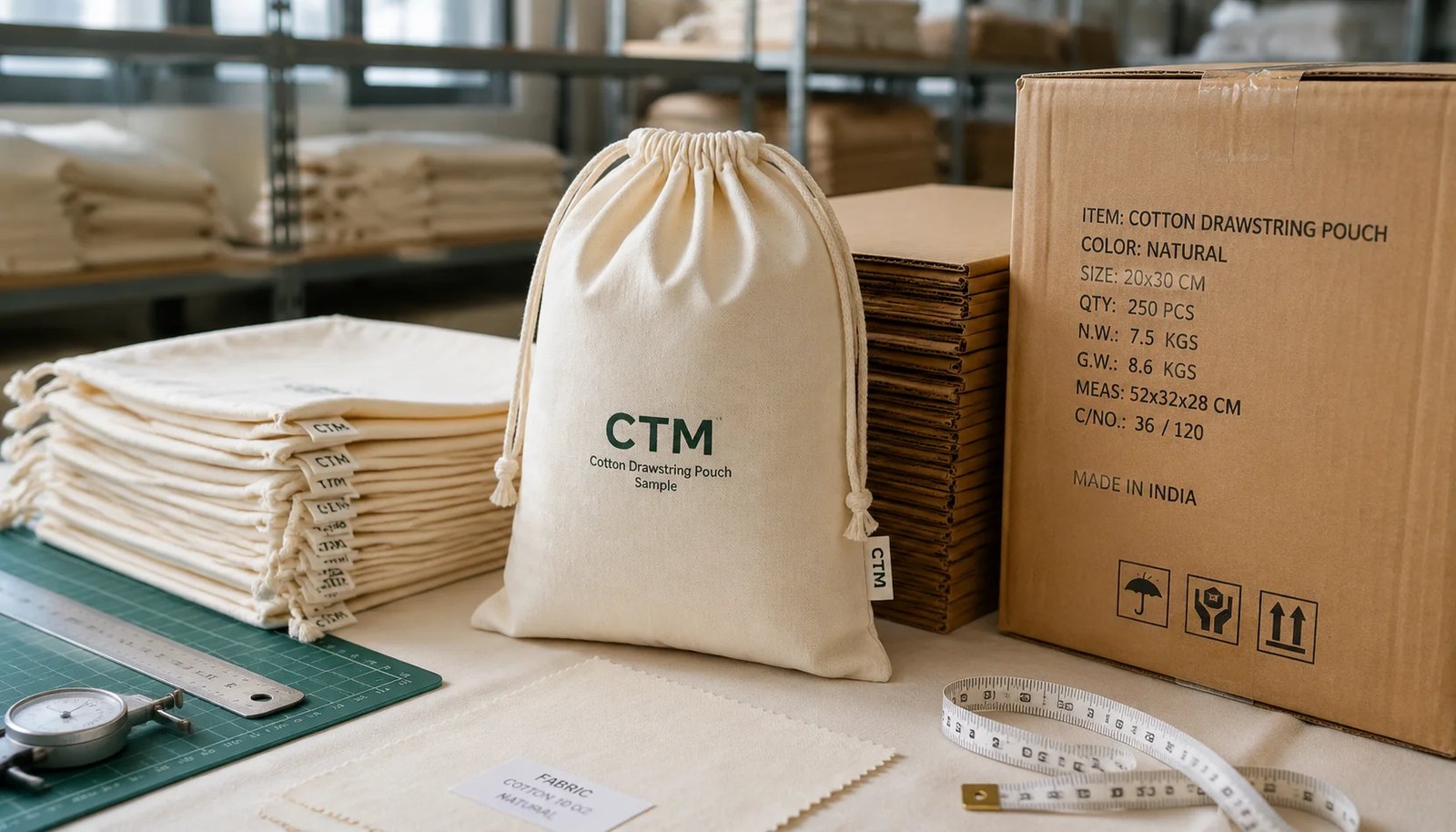
Why carton planning matters more than pouch cost for natural grocer programs
For cotton drawstring pouches, many buyers spend time comparing cents per piece and very little time on packed density, carton handling, and downstream receiving. That is backwards if the order will move through import warehousing, distributor replenishment, or store-level backroom handling. A pouch can be competitively priced at the factory and still become an expensive SKU once the cartons are oversized, too heavy, or packed in counts that do not match replenishment logic.
Natural grocer programs often run lean assortment, lower backstock space, and mixed-SKU replenishment. That means the best carton plan is not simply the maximum units per box. The right plan balances freight cube, manual handling, carton durability, and piece count convenience. If buyers define carton rules early, supplier quotes become easier to compare because fabric, print, and packing assumptions are aligned instead of hidden inside broad FOB numbers.
- A low FOB price can be offset by poor carton cube and higher freight per usable unit
- Cartons that are too heavy create receiving friction and damage risk in distributor environments
- Mixed-SKU programs benefit from standardized carton footprint and clear carton marking
- Natural cotton pouches compress well, but over-compression can flatten print and crease drawcord channels
Start with the pouch specification before you calculate cartons
Carton planning only works when the base pouch specification is stable. The same 15 x 20 cm pouch can pack very differently depending on whether it uses 140 GSM cotton with a single cord or 220 GSM cotton with double drawcord and a wide printed panel. Buyers should lock the main physical variables before requesting final shipping carton calculations.
For most natural grocer pouch programs, practical starting points are 140 to 170 GSM for lightweight utility use and 200 to 220 GSM when shelf feel matters more. Small refill accessory pouches, herb sachet outer bags, gift set pouches, and produce-related accessory programs usually do not need heavy canvas. Once fabric is too heavy for the intended use, freight efficiency drops and storage density gets worse without improving sell-through.
- Common small pouch sizes: 10 x 15 cm, 12 x 18 cm, 15 x 20 cm, 20 x 25 cm
- Typical cotton weights: 140 GSM, 160 GSM, 180 GSM, 220 GSM
- Closure choices that affect pack density: single cord, double cord, flat tape, twisted rope
- Construction details that affect thickness: French seam, overlock inside seam, folded hem depth, reinforcement stitching
Fabric weight and print method change carton efficiency
Fabric selection is not just a feel decision. It directly changes folded thickness, compression tolerance, and print behavior in packed cartons. A 140 GSM natural cotton pouch can usually be packed at a higher count per carton than a 220 GSM pouch of the same dimensions, but only if the print method and artwork coverage do not create blocking or heavy ink surfaces. Large solid prints on natural cotton need more careful interleaving or lower inner-bag counts to avoid set-off and pressure marks.
For natural grocers, one-color water-based screen print is usually the most practical method. It keeps cost reasonable, suits natural cotton aesthetics, and is less likely to create a plastic feel than heavy transfers. Digital print can work for low-volume, many-artwork projects, but on simple pouch programs it is often less efficient and can complicate color consistency across repeat orders. Heat transfer is usually not the first choice for a basic reusable cotton pouch unless detail requirements are very specific.
- 140 to 170 GSM + 1-color screen print usually gives the best freight-to-value ratio
- 220 GSM fabric is useful when the pouch is part of a premium shelf presentation or repeat reusable system
- Large flood prints increase risk of sticking, offset, and visible pressure marks after long transit
- Natural fabric can shift print tone slightly; approve artwork on actual base cloth, not white paper only
MOQ logic: why packing plans should be quoted with the product, not after production
MOQ is often discussed as if it only belongs to fabric or printing. In practice, the packing plan also has MOQ logic because unusual carton dimensions, small custom counts, special inner labels, and mixed assortments create setup time and material waste. If a buyer requests 24 pieces per inner bag, 8 inners per carton, a custom barcode sticker, and strict weight limits, that packing setup needs to be reflected in the quote from the beginning.
For cotton drawstring pouches, factories may quote a base MOQ per size and print design, then apply different costs for alternate packing methods. A buyer comparing two factories can make the wrong decision if one quote assumes 500 pieces per carton and the other assumes 100 pieces per carton with more labor-friendly inners. The landed-cost winner can easily be different from the FOB-price winner.
- State whether MOQ is per SKU, per artwork, per size, or mixed across sizes
- Request at least one alternate packing quote for freight comparison
- Small custom carton counts often increase labor cost but reduce downstream handling cost
- If order volume is low, ask whether standard carton stock can be used instead of custom carton sizes
How to plan master cartons for grocery distribution and retail receiving
The best master carton for cotton drawstring pouches is usually not the deepest carton the factory can tape shut. It is the carton that moves efficiently through container loading, unloading, 3PL storage, palletization, and retail or distributor receiving. For small pouches, many importers do better with moderate cartons in the 8 to 12 kg gross-weight range rather than very dense cartons that save a little board cost but slow down handling.
Carton dimensions should also work with pallet footprint and warehouse slotting. If the pouch program will be mixed with other soft goods, standardizing outer carton length and width can simplify pallet stack patterns. A practical RFQ should request estimated carton dimensions, carton board grade, gross weight, and piece count per carton so the buyer can calculate cubic volume and receiving efficiency before placing the PO.
- Use 5-ply export cartons for most pouch shipments; consider stronger board if distributor handling is rough
- Avoid gross weights that force two-person handling for small-value soft goods
- Standardize carton footprint where possible across multiple pouch SKUs
- If units are store-ready in fixed bundles, define inner bag counts to match replenishment logic
Sample approval should include a packed carton sample, not only the pouch
Many production mistakes happen because the pre-production sample only covers the item and ignores the packed result. A pouch can pass size, print, and sewing approval and still arrive with crushed channels, cord tangling, or print pressure marks because the packing method was never validated. For a new project, buyers should request not only the PP sample pouch but also a trial pack sample showing inner-bag count, folding method, outer carton dimensions, and carton markings.
This is especially important with natural cotton because the product appearance can change after compression during sea transit. Trial-packed samples help buyers decide whether to reduce count per inner, change folding direction, insert a tissue or slip sheet, or increase carton height slightly. A small board-cost increase can prevent visible pouch deformation that creates retail presentation issues.
- Approve actual folding direction for printed pouches
- Review whether cord knots create pressure points when stacked tightly
- Request photos of trial-packed inner bags and sealed master cartons
- For high-coverage prints, consider slip sheet or lower inner-bag count
QC thresholds that prevent freight waste and store complaints
Quality control for drawstring pouches should not stop at seam inspection. Packed goods create a second layer of quality risk: wrong counts, inconsistent folding, moisture-soft cartons, unreadable labels, and carton dimensions drifting enough to disrupt pallet planning. Buyers should define acceptance points that are practical for the factory to inspect and meaningful for the receiving team to verify.
The most useful QC thresholds are measurable. Size tolerance, GSM range, print placement tolerance, cord length tolerance, inner-bag count, and carton gross weight are all easy to inspect if the factory has a proper packing SOP. For natural grocer channels, consistency matters because products are often displayed in simple bins, baskets, or shelf trays where uneven pouch appearance is visible immediately.
- Example print placement tolerance: within ±0.5 cm from approved reference on small pouches
- Example carton weight control: within agreed gross-weight range to avoid handling surprises
- Count verification should include inner-bag recount and random carton recount
- Carton labels should include PO, SKU, quantity, carton sequence, and origin data if required
Lead time risk usually sits in fabric booking, printing queue, and carton materials
Buyers often hear one lead time number, but pouch production is really a chain of smaller timelines. Fabric greige availability, dye or wash status if applicable, cutting, printing queue, sewing line allocation, inspection, and carton procurement all sit inside the final date. Carton planning becomes a delay point when custom outer sizes, special marks, or retailer-specific labels are approved late.
For a straightforward natural cotton pouch with one-color screen print, a realistic production window after final approval may be around 25 to 40 days depending on volume and factory load. That is an example, not a promise. The useful buying move is to request a stage-by-stage schedule with the quote. If the supplier cannot break down fabric, print, sewing, and packing timing, the date is harder to trust.
- Blank sample: often fastest stage because print and final packing are not involved
- Printed PP sample: usually controls the real start of bulk because artwork and placement must be fixed
- Custom carton printing can add time if board stock is not standard
- Mixed-SKU orders often take longer in final packing than buyers expect
How to compare quote data beyond FOB piece price
A useful quote comparison for cotton drawstring pouches should separate product cost from packing cost assumptions. When suppliers bury packing inside one total line, buyers cannot tell whether a lower quote comes from lighter fabric, fewer stitches, larger cartons, weaker board, or very high pieces-per-carton compression. For a natural grocer program, these hidden differences show up later as warehouse inefficiency or retail presentation problems.
Ask suppliers to break out at least these variables: fabric GSM, pouch size, print method and color count, sample charges, MOQ basis, pieces per inner, pieces per carton, carton dimensions, gross weight, and estimated CBM. Even if you still award on total value, not line-item arithmetic, that structure exposes where one factory is economizing in ways that may not fit your channel.
- Compare estimated cubic volume per 1,000 pieces across suppliers
- Review whether lower FOB requires higher minimum carton count or less practical packing
- Check if quote includes spare pieces for defects or short shipment risk
- Treat vague wording such as standard export packing as incomplete for final comparison
A practical carton-planning workflow for your RFQ and purchase order
The cleanest workflow is to move from item specification to trial packing to final PO language. First, define pouch dimensions, GSM, print, closure, and expected use. Second, request two packing options from the factory: a cube-efficient option and a handling-efficient option. Third, review sample and trial-packed carton photos or physical samples. Fourth, choose the packing standard that best fits your freight mode and receiving environment. This sequence gives you real comparison data before production starts.
In the purchase order, the packing plan should be written with enough detail that the factory floor and the inspection team can follow the same standard. Generic language leaves too much room for substitution. If carton planning matters to landed cost, then it needs the same precision as artwork approval. A buyer who writes this clearly usually gets cleaner supplier execution and fewer disputes after shipment.
- PO should list pouch size, GSM, print spec, drawcord spec, and approved sample reference
- Include inner-bag quantity, master carton quantity, target dimensions, and gross weight cap
- Add carton marking layout and label content for distributor or 3PL receiving
- Reference approved packed sample or trial pack photos as part of shipment standard
Specification comparison for buyers
| Spec decision | Recommended option | When it fits | Buyer risk to check |
|---|---|---|---|
| Base fabric weight | 4 oz to 5 oz cotton, about 140 to 170 GSM | Best for lightweight grocery accessory pouches, herb packs, bulk refill accessories, and promo gift-with-purchase programs where carton efficiency matters | Too light a fabric can show print-through, seam grin, and poor shelf feel if pouch size exceeds about 20 x 25 cm or product load is heavy |
| Retail-grade fabric weight | 6 oz cotton, about 200 to 220 GSM | Works when the pouch is part of a reusable in-store system or must feel more substantial at shelf while still packing efficiently | Heavier GSM improves feel but lowers pieces per carton and may trigger higher freight cost per sellable unit |
| Fabric color | Natural unbleached cotton with tone range approved by lab dip or bulk swatch | Fits natural grocer positioning and small one-color branding programs | Natural cotton shade varies by lot; if you need exact shelf uniformity, define acceptable tone range in sample approval |
| Print method | 1-color water-based screen print | Most cost-effective choice for natural cotton pouches with medium or large logo coverage | Print registration drift, ink rub, and color shift on natural fabric are common if strike-off is not approved against actual fabric lot |
| Closure construction | Single cotton drawcord with channel fold and backtack at exits | Suitable for low-cost promotional or utility pouches where fast opening is fine | Single cord is cheaper but may look less premium and can distort opening if seam allowance is narrow |
| Premium closure construction | Double drawcord, one on each side, with knot consistency standard | Better for retail-ready pouches, gift sets, and private label presentation programs | Cord length variation causes uneven closure and receiving complaints; define tolerance and knot position in PP sample |
| Inner packing | 50 to 100 pieces per polybag, then packed into 5-ply export carton | Efficient for wholesale replenishment and DC receiving when stores do not need pre-bundled counts | Overpacked inner bags compress print and crease cords; if pouch face print is large, lower bag count to reduce set marks |
| Master carton size strategy | Carton dimensions matched to pallet footprint and courier handling limits, usually not exceeding about 60 cm on longest side for small pouches | Useful for importers shipping mixed SKUs to 3PL or grocery distributors that re-pick inventory | If cartons are optimized only for factory loading, they may waste pallet cube or exceed warehouse handling preference |
| Carton gross weight target | Keep gross weight near 8 to 12 kg for small pouch programs | Good for manual handling at DC, easier cycle counting, and lower damage from carton bursting | Chasing maximum pieces per carton often pushes gross weight too high, increasing seam crush, carton split risk, and receiving labor |
Buyer checklist before sampling
- Define finished pouch size in centimeters with tolerance for width, height, and drawstring channel depth
- State target fabric weight in GSM and whether fabric must be combed, carded, or recycled blend
- Specify natural cotton shade expectation and whether lot-to-lot tone variation needs pre-approval
- Choose print method and print position using actual pouch dimensions, not artwork ratio alone
- Approve drawcord material, diameter, color, knot style, and finished exposed cord length tolerance
- Set piece count per inner polybag and per master carton based on receiving workflow, not only factory packing speed
- Limit master carton gross weight and list preferred outer carton dimensions for pallet efficiency
- Request packed carton drop and compression suitability if cartons will move through distributor networks
- Require pre-production sample and packed carton sample before bulk cutting for new size or new artwork
- Add barcode, carton marking, and lot traceability requirements if inventory will be split across stores or 3PL locations
Factory quote questions to send
- What is the quoted fabric specification in GSM, weave, and yarn type, and what is the weight tolerance used in production?
- Is the pouch size based on finished measurement after stitching and washing, or cut-panel measurement before sewing?
- What print method is included in the quote, how many colors, and what print area is assumed?
- Does the MOQ apply per size, per fabric color, per print design, or per total order across mixed SKUs?
- What is included in sample charges: blank fit sample, printed pre-production sample, and packed carton sample?
- How many pieces per inner bag and per export carton are included in the quote, and what carton dimensions and gross weight will result?
- Is the carton 5-ply or 7-ply, and what bursting strength or board grade is normally used for export to grocery distribution channels?
- What lead time is needed for fabric booking, printing, sewing, inspection, and packed carton completion after approval?
- What spare quantity, overrun or underrun tolerance, and defect replacement policy are standard for this item?
- Can the factory quote an alternate packing plan that lowers cubic volume even if carton count rises, so landed cost can be compared?
Quality-control points to confirm
- Finished pouch dimensions within approved tolerance, typically ±0.5 cm for small pouches and ±1.0 cm for larger formats
- Fabric weight tested against approved GSM range with acceptable production variance stated in PO
- Print color and placement matched to signed-off strike-off on actual natural cotton fabric
- No open seams, skipped stitches, severe seam puckering, or exposed raw edges outside approved construction
- Drawcord length and knot position consistent enough for uniform retail presentation across packed lots
- Channel opening functions smoothly without excessive resistance or cord snagging
- Inner polybag count accurate and carton count accurate against packing list and carton markings
- Master carton dimensions and gross weight matched to approved packing plan within agreed tolerance
- Carton labels readable with SKU, PO, color, quantity, carton number range, and country of origin where required
- Cartons remain intact after normal handling with no crushed corners, split tape lines, or moisture-soft board on loading