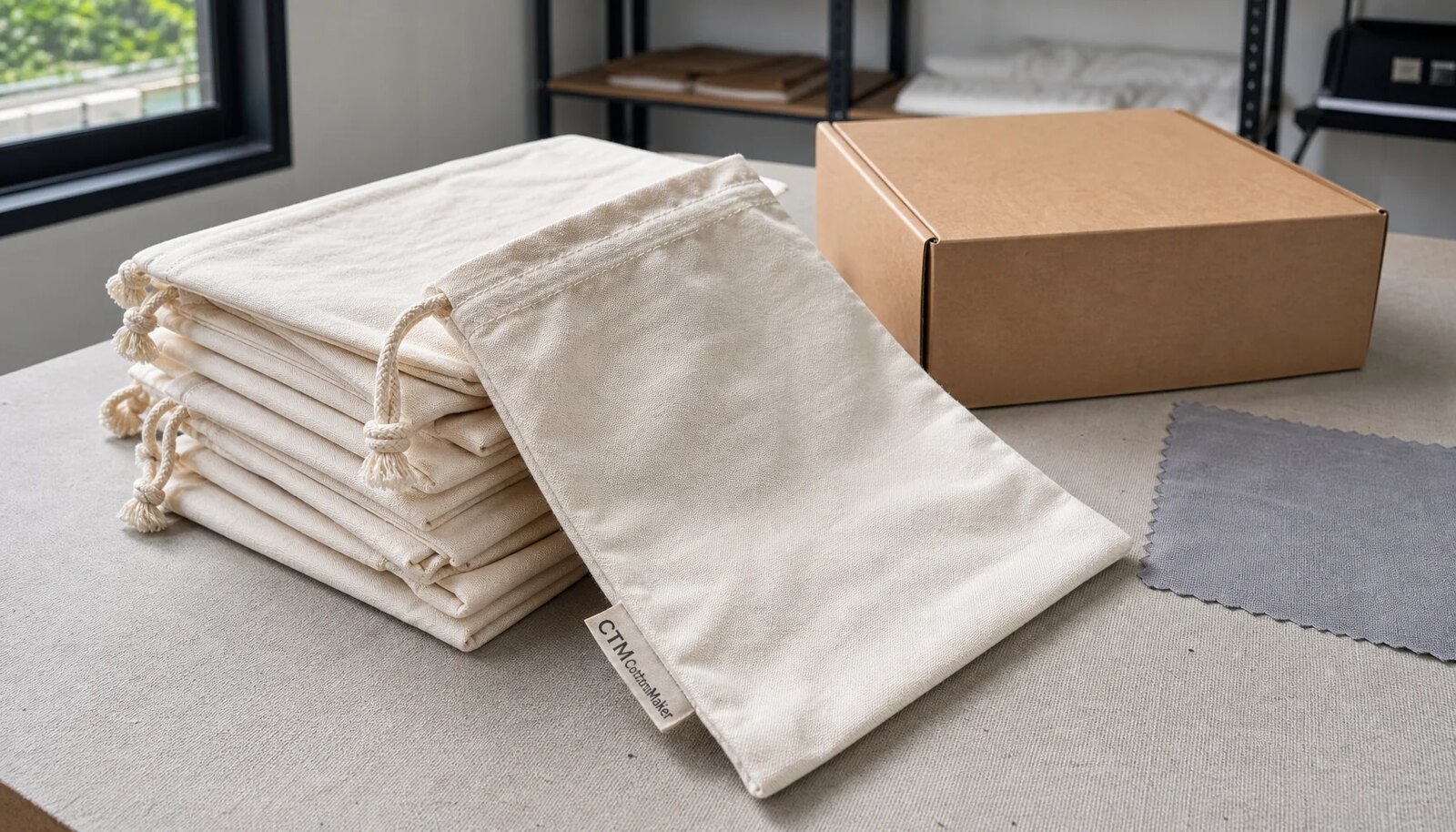
Start With the Carton Plan, Not Just the Pouch
For cotton drawstring pouches, the carton plan is not a warehouse detail you solve at the end. It decides whether the event team receives clean counts, whether the logo arrives scuff-free, and whether the freight quote stays inside budget. If the pouch is going into attendee kits, welcome packs, sponsor bundles, or booth giveaways, the packing method affects the job as much as the size or print. A good factory can sew a decent pouch and still lose the order on packing discipline if the carton spec is vague.
Write the carton logic before you approve sampling. Decide whether each carton holds one style only, whether mixed colors are allowed, whether destinations are split at the carton level, and whether the receiving team needs barcodes or simple carton marks. For buyers, the safest assumption is that the pack plan must survive handoff to a third party who did not place the order, did not see the sample, and still has to count everything correctly on arrival.
- Treat carton count, carton size, and label content as part of the product spec.
- Keep one SKU per carton whenever the event timeline is tight or the receiving team is small.
- Use mixed cartons only if the destination team can sort them immediately.
Pick the Pouch Build for the Job
The right cotton drawstring pouch depends on what it has to carry and how often the end user will reuse it. For lightweight event giveaways, 120 to 140 GSM cotton is usually enough if the sewing is clean and the cord is secure. For a more premium event or a pouch that may be reused for retail or travel, 140 to 180 GSM gives better body, less see-through, and a more stable print surface. If the pouch is too thin, it wrinkles badly in the carton and the logo looks tired before it reaches the venue.
Size and construction matter just as much as GSM. A pouch that closes well but opens too narrow can slow hand-packing at the event site, while an oversized pouch wastes freight cube. Ask for the finished size, seam allowance, cord length, and whether the top hem is single-fold or double-fold. If the event team will insert small items later, the opening needs to be easy to use without forcing the seam. For bulk orders, a slightly heavier fabric often reduces complaints later because it handles folding, stacking, and repeated opening more predictably.
- Use 120 to 140 GSM for basic giveaways when weight and cost matter most.
- Use 140 to 180 GSM for reusable, giftable, or retail-facing pouches.
- State the finished size tolerance so the supplier does not quote cut size by mistake.
- Confirm whether the cord is cotton, polyester, or blended, because hand feel changes.
Choose a Print Method That Survives Packing
Print method is not only a branding choice. It changes the way the pouch behaves in carton packing, how long it needs to cure, and how likely the logo is to scuff against adjacent units. Screen printing is usually the most practical option for simple logos and one or two spot colors because it gives a clean mark and stands up well in bulk. Heat transfer works when you need more artwork flexibility or names and variable copy, but it can add handling risk if the film is not fully cured or pressed correctly. Embroidery looks premium, but it adds bulk and can affect how tightly the pouch stacks.
The carton plan must respect the print process. Water-based and some discharge inks need enough drying time before the pouch is folded or stacked, otherwise the print can offset onto the pouch above it. If the artwork sits near the seam or cord channel, the fold line can create a pressure mark that shows up only after the carton is sealed. For event buyers, the useful test is simple: one packed carton, left under normal stacking pressure, then opened and inspected for print transfer, creases, and odor. If the print is still tacky, the packing schedule is too aggressive.
- Screen print fits most bulk event logos and has the best cost-to-durability balance.
- Heat transfer should be approved only after rub testing and packing simulation.
- Embroidery is premium but changes carton cube and unit weight.
- Require a dry, non-tacky surface before cartons are sealed.
Build the Inner Pack and Master Carton
A good carton plan uses two layers of control: the inner pack and the master carton. The inner pack keeps counts manageable on the floor, and the master carton protects the lot during transit. For cotton drawstring pouches, the best unit pack is usually flat-folded with the cords tucked in or tied so they do not snag. If the pouches are packed loosely, the carton looks full before the count is actually full, which creates hidden shortages and uneven cube. If they are compressed too tightly, the fabric creases harder and the print can rub during travel.
The right carton count depends on size, GSM, and ship mode, not on a generic factory habit. A small 8 by 10 inch pouch at 120 GSM can take a higher count than a large 12 by 16 inch pouch at 180 GSM, but the carton should still stay within a practical gross weight for handling. Many buyers target a carton weight that a warehouse worker can move safely and that still keeps freight efficient. The exact number matters less than the discipline: one SKU per carton, consistent counts, clear carton numbering, and no last-minute mixing at the packing table.
- Flat-fold the pouch consistently so every carton loads the same way.
- Keep one style, one color, and one lot per carton whenever possible.
- Target a safe gross weight that the receiving team can lift without repacking.
- Use carton numbers such as 1 of 24, 2 of 24 so missing cartons are visible.
Match MOQ to the Sourcing Route
MOQ on a pouch order is not just about sewing capacity. It comes from fabric roll usage, print setup, color change time, carton prep, and how many packing variations the factory has to manage. A quote that looks cheap at first can become expensive if the order is split into several colors, several destinations, and several label formats. If the supplier is forced to cut and print in very small batches, the unit price rises because the labor behind setup, sorting, and packing does not shrink in the same way as the order volume.
When comparing sourcing routes, direct factory supply is usually the cleanest path for repeatable carton packing because the sew room, print area, and packing line can stay aligned. A trader can still work if the order is mixed or if you need consolidation across several styles, but you should expect less visibility into the actual pack-out process. Local decorators are useful when the deadline is short and the geography matters more than factory economics, yet they often carry higher handling cost. The practical buyer question is simple: which route gives you the most predictable cartons for the event, not just the lowest unit quote.
- Separate the base bag MOQ from the print MOQ and the carton MOQ.
- Expect higher unit cost when you ask for many color splits or destination splits.
- Choose direct factory supply when count accuracy and carton repeatability matter most.
- Use a trader or consolidator only when the program has many SKUs or destinations.
Approve the Sample as a Packed Unit
A single pouch sample is not enough for this product category. You need a pre-production sample and a packed carton sample. The pouch sample confirms the fabric, print, size, seam, and cord feel. The packed sample confirms the real issues that cause claims later: whether the pouch folds cleanly, whether the print scuffs during stacking, whether the carton count matches the label, and whether the packed weight is still practical for receiving staff. For event buyers, the packed sample is the more honest one because it shows the product as it will actually land.
Use simple acceptance criteria and write them down. The logo should sit where the art proof says it should sit, the pouch should close without snagging, and the carton should arrive with the exact count written on the label. If the supplier proposes an approval photo instead of shipping a sample, ask for a photo of the actual packed carton with the carton label visible and one opened bundle shown beside it. The goal is to eliminate assumptions before mass packing starts, not after the truck is already booked.
- Approve fabric, print, size, cord, and carton label together, not separately.
- Inspect one open pouch and one packed carton before bulk release.
- Set tolerances for print position, seam quality, and count accuracy in writing.
- Require a photo of the sealed carton and the packing list from the actual batch.
Compare Quotes by Landed Cost, Not Unit Price
A quote for cotton drawstring pouches is only useful if it shows the details behind the unit price. The number should be broken into fabric GSM, size, print method, color count, setup fee, packing method, carton spec, and shipment term. If the quote gives one flat unit price with no pack description, it is hiding the costs that usually cause trouble later. The cheapest quote can become the most expensive one if the carton is weak, the count is wrong, or the bags need to be repacked at destination.
For event programs, landed cost should include not just freight but also receiving labor and contingency. A carton that saves a little on product cost but arrives too heavy, too loose, or too mixed can create extra work at the warehouse or venue. Ask the supplier to compare at least two pack-out options: a standard master carton and a smaller destination carton. That will show whether freight, handling, or pack accuracy is driving the real cost. Buyers who compare only ex-factory price often miss the actual cost of sorting and damage control.
- Ask for separate lines for product, setup, packing, carton, and freight.
- Compare carton weight and carton size as part of the landed cost exercise.
- Check whether one supplier is quoting pre-packed units and another is not.
- Use the same packing spec when you compare suppliers, or the quote is not comparable.
Write the Carton Label and Pallet Rules
Carton labels are part of the receiving process, not decoration. Every carton should carry enough data for the warehouse or event team to receive it without opening everything first. At minimum, that means PO number, style, color, size, quantity, carton number, gross and net weight, carton dimensions, and destination if the order is split. If the buyer has multiple event sites or multiple departments, add a clear destination code so the cartons can be sent onward without rework.
Pallet rules matter when the order is shipping by ocean, by warehouse transfer, or by any route where cartons will be stacked. Cotton drawstring pouches are light, so the risk is often crushing rather than breakage. A badly stacked pallet can deform the corners, press the cord into the fabric, and leave the top cartons looking dirty before they are ever opened. Keep the pallet height practical, use stretch wrap and corner support when needed, and avoid overpacking one carton just to save a few units of freight cube.
- Put the carton count and carton sequence on the outer label.
- Use destination codes when the order is split by venue or warehouse.
- Keep pallet height and stacking pressure low enough to protect soft goods.
- Ask for a final carton mark proof before production release.
Lock the Schedule Before Production Starts
Lead time for cotton drawstring pouches is usually driven by three gates: sample approval, fabric and print readiness, and carton packing release. A realistic production window often runs in the 20 to 35 day range after approval, but the exact timing depends on artwork complexity, fabric availability, and whether the cartons are standard or custom printed. If your event date is fixed, the only safe move is to freeze the design early and keep the packing spec stable. Late changes to carton count or label text are common causes of avoidable delay because they force the factory to restart sorting and relabeling.
Build a small contingency buffer into the order plan. Reserve a little extra fabric lot, a little extra cord, and a small overage for damage or event-site replacements. If the program is large, ask the factory to reserve the lot once the sample is approved so the color and hand feel do not drift between runs. A good schedule is one that can absorb a minor setback without changing the event delivery date. The right carton plan makes that possible because it reduces repacking, protects print, and keeps the batch count visible from the start.
- Freeze artwork and label copy before sample approval.
- Reserve a small overage for sampling, damage, and replacements.
- Keep carton specs stable once the packing test is signed off.
- Ask the factory to hold the fabric and cord lot after approval if the order is repeatable.
Specification comparison for buyers
| Sourcing route | Recommended pack plan | When it fits | Buyer risk to check |
|---|---|---|---|
| Direct factory, one style | Single-SKU master carton with fixed inner bundles and a clear carton count label | Large events with one pouch color, one logo, and one ship-to destination | Ask for a photo of a sealed carton and a counted packing list before release |
| Direct factory, mixed colors | Color-sorted inner packs and carton-by-color indexing | Promotions with several event colorways or audience segments | Freeze the color split before sewing starts so packing does not drift at the end |
| Factory plus trader consolidation | One purchase order split into separate cartons by venue, department, or date | Multi-location programs with several delivery points | Watch for weak traceability and mixed packing mistakes when cartons are repacked |
| Local decorator or fulfillment house | Retail-style packing with destination labels and fast rework capability | Short deadlines, domestic drop ship, or last-minute changes | Confirm fabric origin, print consistency, and the higher handling cost before approving |
| Ocean freight optimized factory | Pallet-ready cartons with cube-efficient fill and stronger outer cartons | Large volumes where freight cost matters more than a few extra labor steps | Avoid overstuffing that crushes cords or distorts the print when cartons are stacked |
| Air freight launch route | Lower carton weight and fewer units per carton for easy handling | Urgent launch samples or replacement stock for an event date that cannot move | Make sure the lighter carton spec still protects against scuffing and corner damage |
| Retail-resale route | Barcode-ready cartons, clean folding, and individual polybags only if required | Stores or online resale after the event instead of one-time giveaway use | Check presentation damage, missing labels, and whether the fold standard is repeatable |
| Venue-direct event route | Small cartons by ship-to location with easy-carry weight limits | On-site distribution to staff, guests, or booths | Confirm carton sequence and avoid overpacking beyond lift limits for venue teams |
Buyer checklist before sampling
- Lock finished pouch size, not cut size, and write the tolerance on the PO.
- State the fabric GSM and whether the cotton is pre-shrunk, brushed, or bleached.
- Define the print method, number of colors, print position, and cure requirement.
- Specify unit pack, inner pack, and master carton count in one instruction set.
- Set a maximum gross carton weight and a preferred carton size range.
- Request a pre-production sample and a packed carton sample before bulk start.
- Freeze label copy, destination marks, and PO references before packing begins.
- Agree the shortage/overage tolerance and replacement policy in writing.
- Reserve 3% to 5% extra units for damage, sampling, and event-site mishandling.
- Confirm transit mode, warehouse receiving hours, and who signs carton counts on arrival.
Factory quote questions to send
- What is the finished size, fabric GSM, and seam allowance used in the quote?
- Is the quote based on one-sided or two-sided print, and how many colors are included?
- How are screen, plate, or embroidery setup charges separated from the unit price?
- How many pieces go into an inner pack and how many inner packs go into each carton?
- What are the quoted carton dimensions, gross weight, and carton material grade?
- Are sample fees, packing fees, and carton marking fees included or listed separately?
- What is the lead time after sample approval, and what can delay packing release?
- Can you provide packing photos, carton labels, and a final packing list before shipment?
Quality-control points to confirm
- Fabric weight should stay within the agreed GSM band, not just the supplier's marketing description.
- Finished size should stay within the stated tolerance after stitching and drawcord insertion.
- Seam lines should be straight, secure, and free of broken stitches or loose thread tails.
- Drawcords should pull smoothly, lock evenly, and not fray after repeated opening and closing.
- Print position should stay centered within the agreed tolerance and show no smearing or tackiness.
- Carton counts should match the packing list exactly, with no short cartons hidden in the last pallet.
- Outer cartons should survive stacking without collapsing corners or crushing the pouch cords.
- Carton marks should match the PO, SKU, color, and destination detail on every label and master list.