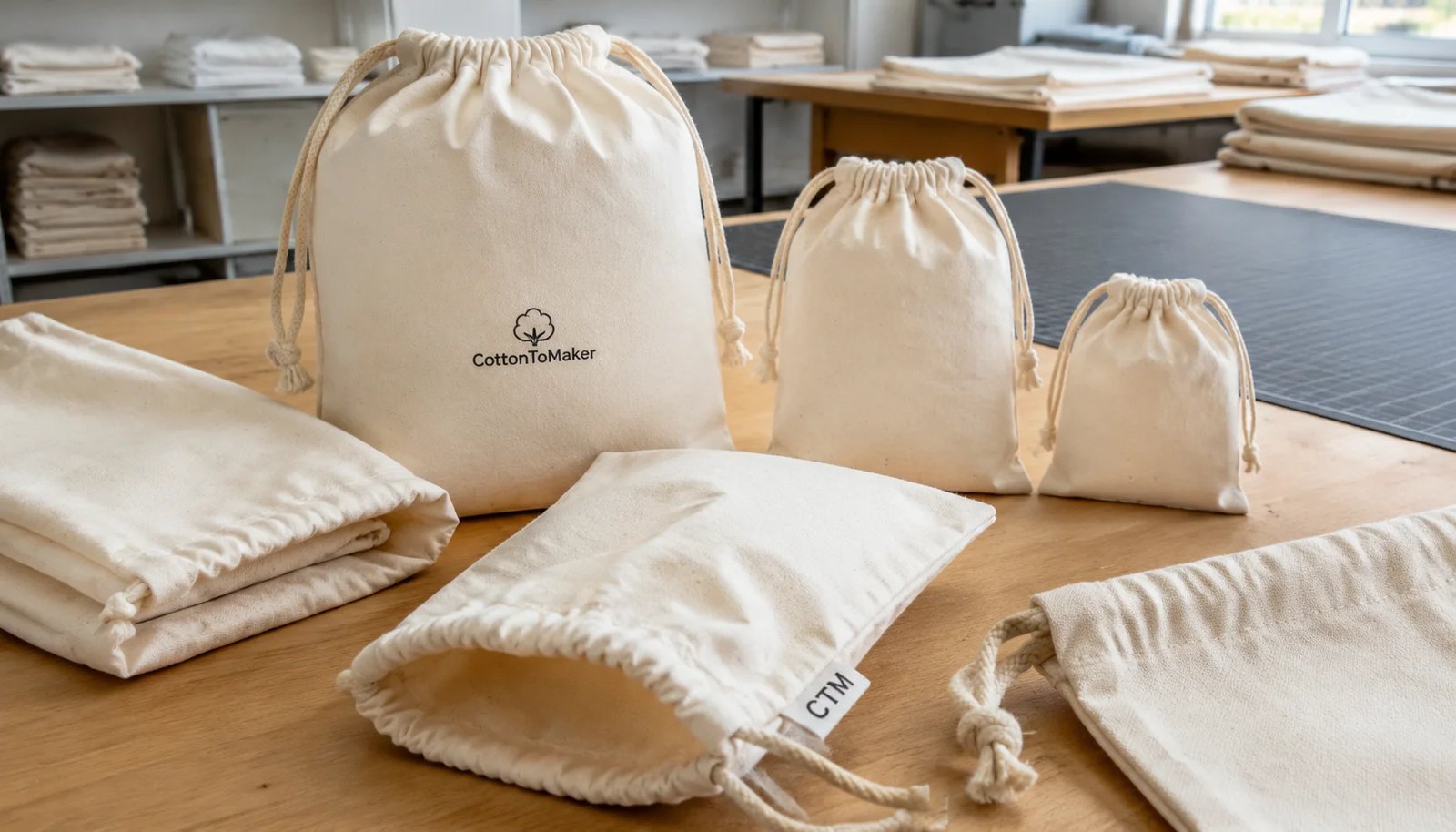
Why natural grocers need a tighter pouch RFQ than a general gift-bag buyer
Cotton drawstring pouches for natural grocers usually sit between packaging and reusable merchandise. That creates a common quoting problem: the buying team requests a simple pouch, but the stores expect it to work like branded retail packaging. The result is avoidable rework on fabric weight, print legibility, and carton packing because the first RFQ was written like a generic promo-bag inquiry. A natural grocer program often needs cleaner material messaging, a more consistent natural look, and practical shelf handling, especially if the pouch is sold with soap bars, dry goods tools, spices, tea accessories, or refill kits.
The main buying problem is not whether the factory can sew a pouch. Most can. The real issue is whether the quote reflects the actual retail use case. If the spec is vague, one supplier prices 110 GSM promotional cotton, another quotes 170 GSM, and a third quietly assumes smaller finished dimensions after sewing. Unit prices become impossible to compare. A good wholesale buying checklist should narrow the variables before sampling starts, so procurement can compare like-for-like offers and avoid approving a sample that cannot scale cleanly into bulk.
- Use-case examples that change the spec: soap set pouch, herb bundle pouch, refill accessory pouch, gift-with-purchase pouch, and checkout merchandise pouch
- Common hidden variables in quotes: GSM, finished size vs cut size, single vs double drawcord, print coverage, and inner packing method
- Why natural grocer buyers should care: shelf presentation, brand sustainability claims, and reduced receiving labor at the DC
Choose the pouch spec from product fit, not from a target price first
Start with the item that goes inside the pouch and its fill pattern. A flat tea accessory pouch, a bar soap pouch, and a mixed-item gift pouch do not behave the same in production or on shelf. For most natural grocer programs, 140-170 GSM natural cotton is the practical middle range. It gives enough body for a neater silhouette and better print holdout than very light promotional cotton, while staying well below heavy canvas cost. If the pouch will carry sharper edges or multiple heavy items, move upward carefully; if it is only a light add-on or giveaway, a lower GSM may work if the retailer accepts a softer handfeel and less opacity.
Size should be written as finished dimensions after sewing, not approximate nominal size. That sounds minor, but it changes usable volume. A pouch quoted at 10 x 15 cm can end up too small if the factory measured cut panels before seam allowance and top channel fold. Also note whether the drawstring channel is included in total height. Many disputes start there. A clear tech pack with width, usable fill height, and bottom seam type saves time later than trying to resolve sample-to-bulk differences by email.
- Typical practical GSM bands: 110-130 GSM for low-cost promotions, 140-170 GSM for most retail-ready pouches, 180-220 GSM when extra structure matters
- Write dimensions as: finished width x finished height, plus usable fill height below channel
- For small pouches, note whether seam allowance is inside the nominal size or excluded
Natural fabric choices affect both brand positioning and print consistency
Natural grocers often prefer unbleached cotton because it supports an earthy, low-processing look. That can be the right commercial choice, but procurement should understand the tradeoff. Natural cotton often has visible specks and shade variation from lot to lot. Those are not necessarily defects unless the pouch is being sold as a cleaner premium branded item where visual consistency matters more than a raw natural look. If your retail shelves need uniformity across many stores, define the acceptable shade range before bulk. Otherwise one carton may look cream and another more beige, and the supplier will still argue that both are natural cotton.
If recycled cotton or organic content is part of the positioning, add the exact claim requirement to the RFQ instead of assuming the supplier will infer it. Some mills offer blends that reduce consistency in shade or texture. That is not automatically bad, but it should be evaluated against print clarity and shelf presentation. For one-color logos, natural fabric usually prints well enough if the artwork is bold. For fine text, ingredient messaging, or stamp-like logos with small gaps, the uneven texture can soften edges. This is where a pre-production sample in actual fabric matters more than a digital proof.
- State whether natural specks are acceptable and to what visual level
- If fiber claim matters, request claim evidence format in the quotation stage
- For repeat orders, ask whether the supplier can reserve similar base fabric or mill source to reduce shade drift
Print method selection matters more than many buyers expect on small pouches
For most cotton drawstring pouches in this category, one-color screen printing is still the most practical method. It balances cost, durability, and speed, especially when artwork is simple. Screen print also handles moderate order volume better than transfer methods in many factories. But it performs best when the logo is not too fine and the print area is realistic for the pouch size. Procurement should not treat all one-color logos as equal. A bold 6 cm logo and a dense legal-information print are very different jobs, even if both are one color.
If the pouch requires photographic artwork, tonal gradients, or very small text, the buyer should test whether a different print route or a larger print area is needed. On natural cotton, registration and ink holdout are affected by weave texture and lint. A factory may quote screen print cheaply, then bulk output shows edge spread or uneven fill. Better RFQs include the actual artwork file, target print size, Pantone reference if critical, and the minimum line width that must remain open. That reduces subjective debate at sample stage.
- Best low-risk use of screen print: bold logos, reuse messages, simple brand marks
- High-risk artwork on textured cotton: thin serif fonts, reverse-out details, dense care text, and tonal fills
- Useful approval point: signed artwork showing print size, position, and acceptable color variance
MOQ logic for pouches is often misunderstood and can distort the real unit cost
Many buyers ask for the minimum order quantity and receive a number that looks workable, but the quote hides how the MOQ is built. A pouch supplier may quote 3,000 pieces total, yet require 1,000 per size and 1,000 per print design. If the natural grocer program needs three sizes for different product categories, that total MOQ may no longer fit. The same issue appears with cord color changes, woven labels, or separate barcode stickers for different store programs. Procurement should compare MOQ structure, not just MOQ headline.
From the factory side, MOQ is driven by fabric cutting efficiency, screen setup, labor handling, and packing complexity. If you want a lower entry order, simplify variables before requesting a concession. Keeping one fabric, one print color, one cord type, and one common packing standard usually has more effect than trying to negotiate unit price alone. Buyers often save more by reducing SKUs in the first run than by pressing for a few cents off while keeping a fragmented assortment that creates higher hidden handling cost.
- Request MOQ broken down by: size, artwork, print color, label type, and packing style
- If the first run is small, combine sizes only if the fabric and print setup remain identical
- Lower MOQ often means higher unit price; compare total program spend, not just piece rate
Sampling should prove retail function, not only logo appearance
A good pouch sample should answer practical questions before bulk starts: does the item fit correctly, does the drawstring slide smoothly, does the fabric look too thin under store lighting, and does the logo stay legible on natural texture? Many approvals fail because buyers focus on front print and ignore seam balance, channel depth, or actual usable opening width. A pouch can look acceptable when laid flat but become frustrating to fill if the top opening is tight or if the side seams pull inward.
For natural grocer applications, request at least one pre-production sample made with intended bulk fabric, intended print method, and intended drawcord. If there are multiple sizes, sample the highest-risk size rather than the easiest one. Usually that means either the smallest pouch with tight artwork placement or the largest pouch carrying the heaviest load. If the supplier only offers a development sample using substitute fabric, treat it as a shape sample, not a final approval. That distinction should be written clearly in the sample review record.
- Sample checks worth recording: fit test with actual product, opening width, print readability, seam appearance, and cord movement
- Measure the pouch after 24 hours in normal room conditions, not immediately after pressing
- Approve against a written sample card with dimensions, GSM target, fabric shade note, and print position reference
Packing details can change warehouse labor and landed cost more than buyers expect
Packing is often left until the end of the discussion, but for importers and distributors it should be part of the initial quote comparison. Cotton drawstring pouches are light, compressible, and easy to miscount if packed loosely. If sizes are mixed or cartons are overfilled, the distribution center spends extra labor sorting and recounting. A low ex-factory unit price can become a poor deal once receiving labor, carton relabeling, and internal split-pack handling are included.
For most wholesale pouch programs, clear packing discipline works better than fancy presentation. Inner packs of 50 or 100 pieces by single SKU, with a visible size or SKU label on the inner bag and outer carton, make receiving easier. Also set a practical maximum carton weight. Over-compressed cartons can cause wrinkling, distorted print appearance, and slower put-away. If your natural grocer channels require store-ready barcode labels, decide whether those go on each pouch, each inner bag, or each carton. That is a cost and workflow choice, not a last-minute note.
- Useful carton fields: SKU, size, quantity, gross weight, net weight, carton dimensions, and PO number
- Avoid mixed-size cartons unless the buyer specifically wants assortment packs
- If moisture risk matters in transit, note whether desiccant or liner is required
Lead time risk usually comes from material and approval gaps, not sewing time
Sewing a simple drawstring pouch is not the hard part. Delays usually happen earlier: fabric booking, print screen preparation, artwork clarification, and waiting for sample approval. Natural cotton programs can also slip when the base fabric shade or GSM from a ready stock lot does not match the approved sample, forcing a re-source or re-dye decision. Buyers who treat pouch orders as simple often leave too little time for pre-production alignment and then face rushed bulk decisions.
A practical timeline should separate development sample, pre-production sample, and bulk production. It should also identify what event starts the lead time clock. Some suppliers count from deposit; others count from approved sample and confirmed artwork. Those are not the same. To compare quotes properly, ask each supplier to state lead time from the same milestone. During peak gifting or seasonal retail periods, small accessories like pouches compete for print line capacity, so sampling and booking early often matters more than negotiating one more price revision.
- Typical timeline drivers: fabric availability, screen setup, sample courier time, and bulk packing complexity
- Define lead time start point in the PO: deposit received, artwork approved, or pre-production sample approved
- Build buffer for retail launch if there are multiple SKUs or compliance documents to collect
Quality thresholds should be written in buyer language the factory can execute
QC for cotton drawstring pouches should focus on defects that change retail saleability or fill function, not cosmetic perfection that no factory can price reasonably. Natural cotton by nature has some variation, so the acceptance standard needs to separate acceptable raw-material character from actual quality failure. For natural grocers, the practical threshold usually centers on usable size, print readability, stain control, and seam security. If those are right, the goods are commercially sound even if every pouch is not visually identical under close inspection.
Write defect language with examples. A major defect could include wrong size beyond tolerance, print upside down, missing drawstring, heavy oil mark on the front, or open side seam. A minor defect might be a small natural speck or a slight cord-end length difference within an agreed range. This kind of definition helps the factory train inspectors and reduces end-of-line arguments. It also helps procurement explain to internal stakeholders why some natural variation is acceptable while shipping defects are not.
- Major defect examples: wrong fabric, wrong print, severe print misplacement, seam opening, visible mildew, mixed SKUs in one labeled inner pack
- Minor defect examples: small natural fiber specks, slight pressing wrinkle, small stitch variation not affecting strength
- Useful measurable points: size tolerance, print position tolerance, cord length tolerance, and carton count accuracy
How to compare quotes on landed value instead of only piece price
A lower unit price is not always the better wholesale buy. For cotton drawstring pouches, quote comparison should include at least fabric GSM, size basis, print method, MOQ structure, sample policy, packing spec, and trade term. If one supplier quotes a cheaper pouch in lighter fabric with loose packing and another quotes a heavier, better-organized packout FOB, those are not comparable offers. Procurement teams should normalize the quote inputs first, then calculate the landed impact of rework, freight cube, and receiving labor.
When price gaps remain after normalization, ask what is driving them. Sometimes the answer is simple: different GSM, different cord type, or missing print setup cost. Other times the supplier is assuming a shorter quality route or less disciplined packing. A useful buying workflow is to short-list two or three technically aligned offers, then request a revised side-by-side quote sheet with every cost element broken out. That gives brand owners and distributors a cleaner basis for final negotiation than chasing a headline unit price from mixed assumptions.
- Normalize before comparing: same finished size, same GSM, same print coverage, same packing ratio, same Incoterm
- Watch hidden landed-cost items: oversized cartons, mixed-size inner packs, sample courier charges, and separate screen fees
- If repeating orders are likely, ask whether setup costs reduce on replenishment runs
Specification comparison for buyers
| Spec decision | Recommended option | When it fits | Buyer risk to check |
|---|---|---|---|
| Base fabric weight | 5 oz to 6 oz cotton, about 140-170 GSM | Best for dry grocery items, tea, herbs, soap bars, gift-with-purchase, and everyday retail handling without paying for heavy canvas | Too light below about 120 GSM can look cheap, distort after printing, and expose seam grin at fill points |
| Fabric color | Natural unbleached cotton with shade tolerance agreed before bulk | Works for natural grocer positioning and usually avoids bleaching cost | Natural cotton shade varies lot to lot; approve acceptable cream range or printed logo color may look different across batches |
| Closure style | Single drawstring for low-cost pouches; double drawstring for cleaner retail presentation | Single cord suits simple giveaway or refill use; double cord fits shelf-ready branded packaging | If channel width is narrow or cord is rough, opening and closing can snag and generate retail complaints |
| Print method | 1-color screen print on natural cotton | Most cost-effective for medium to large runs with bold logos and ingredient or reuse messaging | Fine lines, small text, or tonal artwork can fill in on textured cotton; request minimum line width and print position tolerance |
| Size tolerance | Set finished size tolerance at ±0.5 cm for small pouches and ±1 cm for larger sizes | Important where pouches must fit soap sets, loose goods jars, spice kits, or refill packs consistently | No agreed tolerance means suppliers may quote on nominal size but ship mixed usable volume |
| MOQ structure | MOQ by size and print color, not just total order quantity | Useful when natural grocers need 2-3 sizes or store-brand variations in one program | A supplier may quote a low total MOQ but hide per-size, per-artwork, or per-color minimums that raise actual spend |
| Retail packing | 50 or 100 pcs per polybag, then export carton with size label and carton count mark | Good for importers, distributors, and DC counting without repacking labor | Loose mixed packing by size creates receiving errors and carton count disputes |
| Sampling route | Pre-production sample in actual fabric and actual print before mass production | Necessary when approving handfeel, fabric specks, print holdout, cord color, and top-channel construction | Digital mockup approval alone does not show shrinkage, print opacity, or seam bulk at the drawcord area |
Buyer checklist before sampling
- Define the pouch use first: loose product packaging, gift set, refill program, or private-label retail accessory, because GSM and closure style should follow actual fill weight and shelf handling.
- State finished pouch size as width x height measured after sewing, and note whether dimensions exclude the drawstring channel.
- Specify fabric clearly: cotton type, target GSM, natural or bleached, and whether recycled or organic claims are required with evidence format listed in the RFQ.
- List print method, print size, print colors, print side count, and the smallest text or line in the artwork so suppliers quote on realistic print difficulty.
- Declare whether natural cotton shade variation is acceptable within a range, or whether bulk must match approved swatch reference.
- Set drawstring details: single or double cord, cotton rope or flat tape, cord diameter, color, knot finish, and whether cord ends need heat cut or stitched finish.
- Request MOQ split rules by size, color, logo version, and packing configuration instead of only asking for one total MOQ number.
- Ask for pre-production sample timing, sample cost policy, and whether sample uses bulk fabric and bulk print process.
- Define carton packing: units per inner pack, units per carton, maximum carton weight, export carton board grade, and whether assortments are allowed.
- Include AQL level or practical defect thresholds for print misalignment, seam opening, staining, wrong size, and missing cords before approving production.
Factory quote questions to send
- What fabric weight in GSM are you quoting, and what is the normal production tolerance for that fabric?
- Is the quoted fabric combed cotton, conventional cotton, recycled cotton blend, or another composition? Please state exact content.
- Does your MOQ apply per size, per artwork, per print color, or per total PO? Please break it down.
- What print method are you using for this artwork, and what minimum line thickness and text size can you hold on natural cotton?
- Can you provide a pre-production sample in the same fabric, same cord, and same print process as bulk? What is the sample lead time?
- What shrinkage should we expect after printing and sewing, and do you cut oversize to hit final finished dimensions?
- How do you control natural fabric shade variation across one PO and across repeat orders?
- What are your standard seam allowance, stitch density, and reinforcement points at the drawstring channel and side seams?
- How will the goods be packed by size and SKU, and what carton dimensions and gross weight do you expect?
- Which cost items are not included in your unit price: screen charge, sampling, label insertion, barcode sticker, export carton upgrade, or destination testing support?
Quality-control points to confirm
- Finished size must match approved spec within agreed tolerance, with channel measurement method stated on the tech pack.
- Fabric weight should be within agreed GSM tolerance and visually consistent across random cartons.
- Print position, color density, and artwork clarity must match approved sample, especially on textured natural cotton.
- No broken stitches, skipped stitches, raw seam exposure, or seam opening under normal hand pull at side seams and cord channel.
- Drawstring must run smoothly through the channel without snagging, with cord length and knot finish consistent.
- No major oil marks, mildew smell, water stains, rust transfer, or heavy cottonseed specks beyond approved natural standard.
- Carton count, inner pack count, SKU labeling, and assortment ratio must match packing list exactly.
- Needle control, metal detection policy if used, and final carton sealing standard should be documented for retail and distributor confidence.