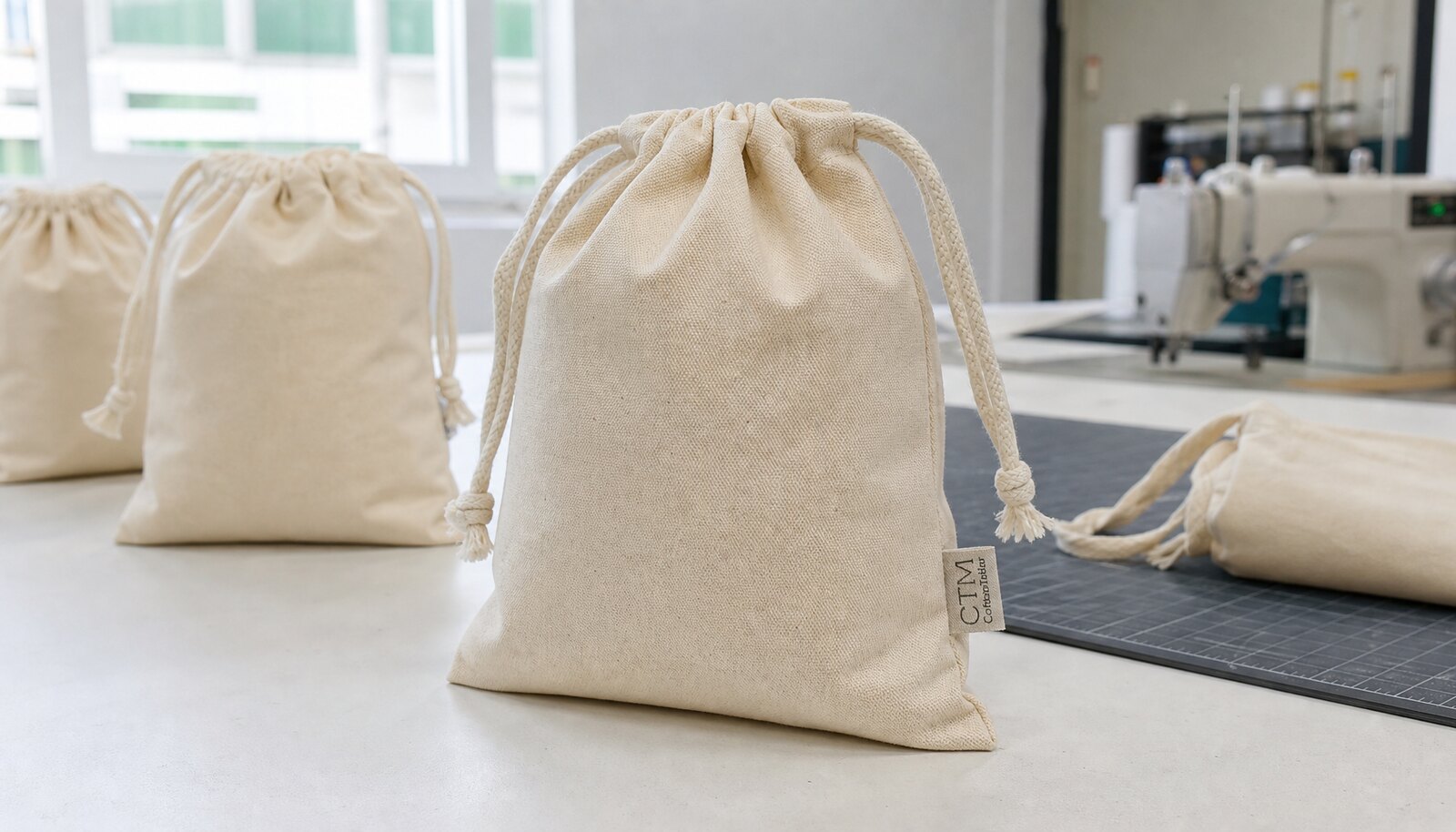
Why cotton drawstring pouches need a procurement lens, not just a product lens
Cotton drawstring pouches look uncomplicated until a buyer receives mixed quotes that cannot be compared. One supplier may quote a lighter cloth, another may include a better cord, and a third may hide the difference in packing or print fees. On paper the pouch is the same size. In practice, it can be three different products with three different outcomes in customer experience and freight cost.
For procurement teams, the real issue is that cotton drawstring pouches are often used at the intersection of packaging and merchandise. They may protect a product, carry a brand logo, support retail presentation, or serve as a reusable accessory. That means the pouch is judged on function, appearance, and repeatability. A small spec miss can show up immediately in hold-in-hand quality, closure behavior, or print alignment, so the quote has to be built around the intended use, not just a catalog name.
The most common sourcing mistake is asking for size first and everything else later. A 10 x 12 cm pouch can be soft and light, structured and premium, or too thin to present well, depending on GSM, weave, seam allowance, shape, and cord design. If those variables are not fixed early, the buyer ends up comparing unit prices across non-equivalent builds and loses visibility on landed cost.
- Size alone does not define capacity or feel; fabric weight and construction matter just as much.
- The cheapest quote often omits stronger cord, better seam control, or more reliable packing.
- A pouch can pass a photo review and still fail in use if the channel width, print placement, or seam tension is wrong.
Start from the packed item and the end use, not from the pouch template
The first sourcing question should be: what is going inside the pouch, and how often will the pouch be opened? A jewelry pouch, a cosmetic pouch, a hotel amenity pouch, and a sample-kit pouch all have different requirements. Flat objects can usually live inside a flat pouch. Bottles, jars, and boxed items usually need more structure, more depth, or a gusset so the pouch holds shape instead of ballooning at the seams.
Procurement teams should translate the use case into measurable inputs. The factory needs the product dimensions, the packed weight, whether the item has sharp edges, how often the pouch will be reused, and whether it is destined for retail, gifting, or internal distribution. A pouch intended only for promotional handout can use a simpler spec. A pouch that sits on a shelf or ships as part of a branded set often needs stronger cloth, cleaner finishing, and more controlled labeling.
It also helps to decide whether the pouch is packaging or a product in its own right. That distinction changes the commercial route. Retail-facing cotton drawstring pouches usually justify tighter QC, better label control, and a more conservative fabric spec. Pure promotional pouches can be optimized for cost and speed, but only if the buyer is comfortable with a lighter handfeel and simpler finishing.
- Flat contents: cards, jewelry, flat accessory packs, tea sachets, small sample envelopes.
- Medium contents: cosmetics, tech accessories, travel items, folded garments, gift inserts.
- Heavier or rigid contents: glass jars, small bottles, boxed accessories, premium gift kits.
Fabric, weave, and cord: the spec lines that change both price and performance
Cotton drawstring pouches are usually made from plain-weave cotton, but the perceived quality depends heavily on fabric basis weight, yarn consistency, and finishing. In buyer conversations, GSM is often used as shorthand for quality, but it should be treated as only one part of the build. A 140 GSM pouch from a tight, well-finished cloth may present better than a loosely woven 160 GSM pouch, especially after printing and stitching. That is why a physical sample is worth more than a generic description.
As a practical sourcing range, 120–140 GSM is often enough for lightweight promotional use where cost matters more than structure. 140–180 GSM is usually the safer range for retail packaging and repeat-use pouches because it gives better opacity, better shape retention, and a more stable print surface. For premium presentation or heavier contents, 200 GSM and above can be appropriate, but it raises material cost, carton weight, and sometimes the effort needed to pull the cord smoothly through the channel.
Cord design also matters more than many RFQs acknowledge. A thin cotton cord can match a natural look, but if it is too soft or too narrow, closing the pouch can feel uneven. A slightly thicker cotton cord or a polyester-cotton blend may improve pull balance and reduce customer complaints about snagging. Ask the supplier to specify cord material, cord diameter, end finish, and whether the cord is knotted, tipped, or simply cut and tied. If the pouch is used in retail settings, that small detail can affect the perceived quality almost as much as the logo print.
- 120–140 GSM: budget-oriented promo pouches and very light contents.
- 140–180 GSM: common retail and brand-packaging range with better shape and opacity.
- 200+ GSM: premium feel, heavier contents, and a higher freight footprint.
- Cord details: material, diameter, end finish, and pull behavior should be quoted explicitly.
Natural cotton, bleached cotton, dyed cotton, and recycled content are not the same commercial buy
A useful RFQ should ask for the cotton origin or content category, not just “cotton.” Natural unbleached cotton usually has a warmer, more organic look and is often favored for eco-positioning or minimalist branding. Bleached cotton gives a brighter background for logo print and may suit cosmetic or retail presentation better if the brand wants a cleaner visual base. Dyed fabric creates a more controlled brand color story, but it can introduce shade variation, dye lot management issues, and extra lead time.
If the project uses recycled cotton content or a blend that is being marketed as lower-impact, the supplier should be able to state what the fabric claim is based on and what supporting material declaration they can provide. Procurement teams do not need to overcomplicate the order, but they do need to know whether the quote assumes standard cotton cloth, recycled content, or a custom-dyed finish. These are different procurement paths with different factory setup requirements.
When fabric origin matters, ask how the cloth is sourced and whether the factory is buying greige fabric, finished fabric, or using a vertically integrated textile partner. That matters for consistency and for reorder continuity. A low quote built on opportunistic fabric sourcing can look attractive on the first order and become difficult to repeat later if the same cloth width or finish is unavailable.
- Natural cotton: simpler look, often better for eco-friendly or artisan branding.
- Bleached cotton: brighter background and cleaner print contrast.
- Dyed cotton: stronger brand color control, but more shade and lead-time risk.
- Recycled content: ask for the exact claim basis and documentation support before you promote it.
Print methods and decoration choices: choose by artwork, not by habit
Print method should follow the logo and the order profile. Screen printing is often the most stable route for solid logos, limited color counts, and medium-to-large runs. It is a strong option when repeatability matters and the artwork does not rely on fine gradients. For short runs, variable artwork, or designs with many colors, digital print or heat transfer may be more practical even if the per-unit cost is higher. The right answer is not “best method overall,” but “best method for this specific artwork and quantity.”
Buyers should compare print quotes only after the print area, color count, and placement are locked. A one-color logo on a natural pouch is a much simpler build than a two-location print with fine type and a large ink coverage area. Because cotton is textured, very fine lines and small reversed text can blur or fill in if the print screens or transfer process are not matched to the fabric. Ask the supplier to show the expected print tolerance and to confirm whether the mockup is a digital visualization or a production technique match.
Embroidery can be attractive on some pouch styles when the goal is premium gifting, but it should be evaluated carefully. It adds labor, may distort lighter cloth, and is not always ideal for small artwork or very low-MOQ programs. If the pouch is a marketing handout rather than a keepsake item, a clean one-color print usually gives a better cost-to-result ratio.
- Screen print: best for simple logos, stable repeat runs, and durable branding.
- Digital or heat transfer: better for short runs, multiple artworks, or more complex graphics.
- Embroidery: premium look, but higher labor and greater risk of fabric distortion on lighter cloth.
A sourcing-route comparison table is more useful than a spec-only table
Procurement teams often need to decide not only what to buy, but how to buy it. The commercial route affects transparency, lead time, and the amount of control you have over fabric and QC. A direct factory relationship usually gives the strongest visibility into cloth selection, stitching, and packing. A trading company can make sense when the order involves multiple packaging items and the buyer wants one commercial contact. A regional converter may be the fastest response for a small urgent run, especially if the decoration is simple.
The table below compares real sourcing routes instead of repeating material specs. That makes it easier to judge where your risk sits: in unit price, in traceability, in schedule, or in the ability to reorder the same product later.
This is also where landed cost should enter the conversation. A lower ex-factory quote can still produce a higher true cost if packing density is poor, if freight class is worse than expected, or if the supplier cannot hold a consistent build on the reorder. For cotton drawstring pouches, the route matters as much as the GSM.
How MOQ works in practice, and why one number is rarely enough
MOQ for cotton drawstring pouches is usually layered. A supplier may be willing to make a standard natural pouch at one volume, but the minimum can increase if you request custom-dyed cloth, a special cord color, a woven label, or retail individual packaging. That is not a generic sales tactic; it reflects fabric sourcing, setup cost, and line efficiency. The same can happen when the order includes multiple sizes or multiple print variants.
The more useful way to quote is to request three lanes: a lowest-cost promo build, a standard working spec, and an upgraded retail spec. Those three routes reveal where the cost jumps are coming from. If your target price only works in the promo lane, you know the premium details are carrying real cost. If the standard lane already meets your budget, the pouch can probably be built with fewer concessions and less rework risk.
MOQ should also be read together with pack format. Some factories can accept a lower piece count if the order uses stock fabric and stock cord, but the effective MOQ rises once the buyer asks for individual retail packing or multiple SKU labels. In procurement terms, the true MOQ is not just piece count; it is also the minimum efficient production bundle.
- Standard spec: stock cotton, standard cord, one-color print, bulk packing.
- Upgraded retail spec: heavier cloth, cleaner finishing, woven label, retail folding or bagging.
- Promo spec: lighter cloth, simpler print, fewer packing steps, lowest practical cost.
How to compare quotes on landed cost instead of headline unit price
A pouch quote becomes useful only when the buyer can compare it on the same basis. The best comparison is landed cost, not ex-factory price alone. For cotton drawstring pouches, freight can be disproportionately affected by carton volume because the product is light but takes up space. A supplier with a slightly higher unit price but better packing density may still be cheaper once freight, handling, and receiving labor are included.
To build a real comparison, ask each supplier for carton dimensions, carton count, net weight, gross weight, and incoterm. If you are comparing FOB, EXW, and delivered quotes side by side, make sure the finance or logistics team normalizes them. Also ask whether the supplier’s price includes screen setup, label application, insert cards, or carton marks. Hidden extras are often where quote surprises begin.
When possible, request a three-line quote sheet with the same size and artwork but different commercial assumptions: the lowest-cost route, the standard route, and the retail-ready route. That approach helps procurement and the business team decide whether the savings from a cheaper pouch are real or whether a slightly better spec is worth the added cost. It also gives you a cleaner negotiation basis because you can point to the exact line item that changes the total.
- Compare ex-factory, FOB, or DDP only after normalizing the quote basis.
- Ask for carton dimensions and packing density so freight can be estimated realistically.
- Separate one-time costs such as screens or setup fees from recurring unit cost.
Sample approval should prove fit, closure, and presentation at the same time
A sample is not only a color check. It should prove that the pouch fits the intended product, closes cleanly, and presents the logo correctly in the hand. Test the actual packed product, not an empty pouch alone. A pouch can look fine empty and fail as soon as the content adds width, height, or corner pressure. This is especially important for bottles, jars, boxed accessories, and gift kits, where closure behavior changes once the pouch is loaded.
The best practice is to keep both a golden sample and a working sample. The golden sample is the signed reference tied to the final approved spec. The working sample is the one used for internal checks and day-to-day communication. The supplier should know that any later change to fabric, cord, print position, label, or pack format is a revision, not a tolerance adjustment. That discipline prevents the common dispute where the first sample is approved but the bulk shipment reflects a cheaper build.
Your sample review should be specific. Check whether the opening is wide enough, whether the cord slides smoothly, whether the pouch stands or collapses as expected, and whether the artwork sits where the brand expects it to sit. If the pouch is for retail resale, inspect the fold consistency and the visual finish as carefully as the sewing. Those are the details that determine whether the pouch looks like a packaged product or a promotional giveaway.
- Test with the actual packed product, not only with an empty pouch.
- Approve one golden sample and one working sample tied to the same spec revision.
- Treat any later change in fabric, cord, print, label, or pack format as a formal revision.
QC checkpoints that reduce disputes, rework, and received-not-as-expected claims
Quality control for cotton drawstring pouches should be written in concrete terms. Buyers should define the finished dimensions, the tolerance window, the stitch standard, the print tolerance, and the defect categories before bulk production. Avoid language like “good quality” or “nice finish” because those phrases do not support a claim if the shipment is off-spec. The factory needs to know what is acceptable before the line runs, not after the cartons are sealed.
The most useful defect framework separates critical, major, and minor issues. A broken drawstring function, wrong artwork, wrong size, or contamination issue is critical for most use cases. Weak seams, major print shift, missing labels, or mispacked cartons are generally major issues. Small thread tails or minor fold marks may be minor if they do not affect function or presentation. You do not need a complicated quality system to manage this product, but you do need one that is written and measurable.
If your supplier can support a pre-shipment AQL inspection report, ask for the report format in advance. More important than the label itself is whether the inspection covers the exact features that matter for your project: size, closure, print, labels, packing count, carton marks, odor, and visual cleanliness. For retail-facing pouches, make sure the inspection happens after final folding and packing, because some defects only show up at that stage.
- Critical: broken closure function, wrong size, wrong artwork, contamination.
- Major: weak seams, severe print misalignment, missing or incorrect labels, mispacked cartons.
- Minor: small thread tails, slight fold marks, light color variation within the approved range.
- If labels are included, check placement, readability, and stitching security.
Specification comparison for buyers
| Sourcing route | Best fit | Commercial upside | Tradeoff to manage |
|---|---|---|---|
| Direct factory | Repeat programs, stable artwork, controlled spec, and buyers who need clear QC ownership | Usually the best route for spec control, consistent reorders, and clearer accountability on fabric, print, and packing | May require clearer RFQ detail and a more structured approval process; not ideal if you need many unrelated categories in one order |
| Trading company / sourcing agent | Mixed-category orders, buyers who want one contact for multiple SKUs, or teams with limited local sourcing capacity | Can consolidate different items, coordinate across factories, and reduce internal coordination work | Fabric grade, subcontracting, and inspection control may be less transparent unless you request document-backed traceability |
| Regional converter / local decorator | Short lead-time replenishment, small promotional runs, or urgent event orders | Faster communication, easier sample handover, and less freight complexity for some destinations | Unit cost is often higher, and material options may be narrower than a dedicated pouch factory |
| Imported stock program with decoration | Teams needing quick launch volume with limited customization | Fastest route when the pouch body is standard and only logo/labeling changes | Less flexibility on exact size, GSM, cord detail, and carton configuration; reorders may be tied to stock availability |
| Material | 6-10 oz cotton canvas, 210D polyester, rPET, or blended cotton with shrinkage and colorfastness expectations set before sampling | Before price comparison | Different cloth weights, backing, or certification claims make quotes hard to compare |
| Construction | cord diameter, eyelet or reinforced channel, bottom corner reinforcement, seam allowance, bar-tack position, and load target | Before sampling | Weak stress points create returns and failed inspections |
| Decoration | screen print, transfer, embroidery, woven label, or drawstring tag tested against folding and abrasion | Before artwork approval | The wrong method can crack, bleed, pucker, or fail on the chosen fabric |
| MOQ | Base MOQ plus change drivers | During quote review | Custom colors, trims, and packing can change minimums |
Buyer checklist before sampling
- Confirm the final pouch size using the actual packed product, not only the flat pouch measurement.
- State the fabric basis weight in GSM or oz/yd², plus whether the cotton is natural, bleached, dyed, pre-shrunk, or enzyme-washed.
- Approve the cord type, cord diameter, end finish, and draw behavior before bulk order.
- Lock the print method, print count, artwork file format, and accepted color variation before quoting.
- Specify whether the pouch needs a woven label, printed care label, origin marking, or barcode.
- Define packaging format: bulk pack, individual bag, insert card, carton marks, and case quantity.
- Ask for carton dimensions, gross weight, and packing density so freight and warehousing can be compared on a landed-cost basis.
- Request the QC documents you expect to receive: pre-production sample photo set, in-line check record, final inspection report, and packing list.
- Set clear acceptance criteria for seam strength, size tolerance, print alignment, odor, staining, and cord function.
- If the pouch is for retail or regulated use, ask whether the factory can share fabric origin information and material declaration support if needed.
Factory quote questions to send
- What is the exact cotton fabric specification you are quoting, including GSM, weave, finish, and whether the cloth is pre-shrunk or untreated?
- Is the pouch made from natural cotton, bleached cotton, dyed cotton, or reclaimed/recycled cotton content, and how will shade variation be controlled?
- What is the finished size, cut size, seam allowance, and tolerance range after sewing and pressing?
- What cord material, cord diameter, and end finish are included, and does the cord run through a single or double channel?
- Which print method is included, how many colors are priced, and what setup, plate, or screen fees apply?
- What MOQ applies by size, color, print color count, and packaging format?
- What sample charges apply, what is the sample lead time, and is the sample fee refundable after order confirmation?
- Can you quote three commercial routes: lowest-cost promo spec, standard working spec, and upgraded retail spec?
- What packing format is included, and what are the carton dimensions, case quantity, net weight, and gross weight?
- What QC documents can you provide before shipment, such as in-line checks, final AQL report, size sheet, and packing list?
Quality-control points to confirm
- Fabric weight matches the approved GSM range and does not feel materially lighter than the approved sample.
- Finished dimensions remain within the agreed tolerance after stitching, pressing, and packing.
- Top channel stitching is straight, secure, and free from skipped stitches, loose thread tails, or twisted openings.
- Cord pulls smoothly without snagging, and both sides close evenly when cinched.
- Print is centered within the agreed tolerance, with no major smearing, pinholes, or visible cracking on first inspection.
- Seam strength is adequate for the intended contents, and tug testing does not expose weak corners or opening gaps.
- No visible stains, oil marks, lint clumps, foreign fibers, mildew smell, or packaging odor are present.
- Labels, carton marks, inner pack counts, and SKU references match the approved packing list and order sheet.
- If a woven label or care label is included, stitching is secure and placement does not interfere with closure or branding.
- Bulk cartons are intact, dry, and correctly marked for receiving and warehouse scanning.