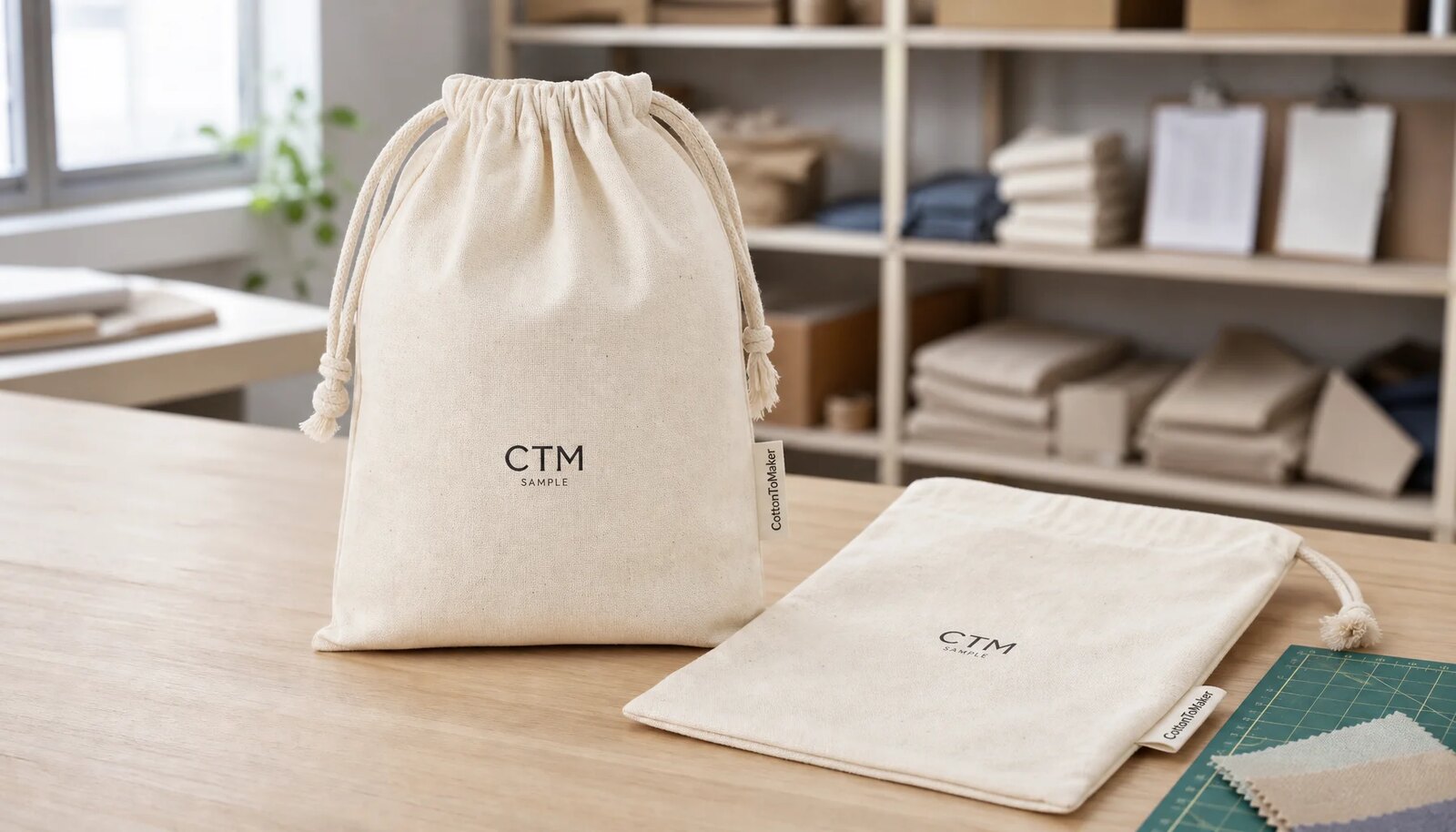
Start With the Buying Problem, Not the Pouch
Cotton drawstring pouches look simple until they sit in a hotel retail program. Then the pouch has to do several jobs at once. It must protect a product, present the brand well, close quickly for staff, fit a shelf or welcome tray, arrive easy to count, and repeat cleanly on the next order. A pouch for a 30 g soap is not the same sourcing problem as a pouch for a glass candle, a spa oil set, a jewelry counter item, or a resort shop souvenir.
That is why a cotton drawstring pouches bulk pricing plan for hotel retail should begin with the use case. If procurement asks only for “10 x 15 cm cotton pouch with logo,” suppliers will fill in the blanks differently. One may quote 120 GSM natural cotton with a thin cord. Another may quote 180 GSM cotton canvas, a larger print, and better carton packing. Both prices may be honest, but they are not comparable.
The objective is not to make sourcing bureaucratic. It is to remove the small ambiguities that become expensive later: a thin pouch under gift shop lighting, a logo that blurs into textured cotton, a cord channel that will not close around the product, or cartons so compressed that staff spend time sorting and flattening instead of stocking. Hotel buyers need a repeatable component, not a one-time sample that looks fine on a desk.
A strong RFQ tells suppliers exactly what to price and tells internal teams exactly what they are approving. Brand can review the decoration. Retail can judge presentation. Operations can check filling speed and storage. Finance can compare landed cost. The supplier can price fabric, sewing, printing, packing, and inspection with fewer assumptions.
- Classify the pouch as disposable packaging, retail presentation, or a reusable guest-facing item.
- Use one written base specification for every supplier and every quantity break.
- State the fill item, filled weight, product fragility, and whether the pouch must fully close.
- Separate pouch unit price from screens, samples, courier, labels, packing, inspection, freight, duty, and handling.
- Ask suppliers to list exclusions clearly, especially barcode work, carton marks, certification documents, and special packing.
Write a Specification Factories Can Actually Price
The base specification is the control document for the entire purchase. It should state finished flat width and height, drawcord channel height, fabric GSM, fabric construction, color, closure style, cord material, cord diameter, cord color, decoration method, print size, print location, label requirements, packing method, carton marks, inspection expectation, incoterm, and delivery market. For hotel retail, add the product being packed and the environment where guests will see it.
Finished size deserves careful wording. Say whether measurements are taken after sewing, while the pouch is lying flat, and whether the stated height includes the drawcord channel. A small pouch may need a clear absolute tolerance such as +/-5 mm. Larger pouches may work with a percentage tolerance such as +/-3%, provided product fit is not tight. If the pouch must hold a rigid tin, box, bottle, or candle, sizing tolerance matters more than it does for a soft sachet.
Avoid adjectives that sound good but price poorly. “Premium natural cotton pouch” can mean many things. “180 GSM natural cotton, plain weave, unwashed, finished size 12 x 18 cm including 2.5 cm channel, 4 mm natural cotton cord, 1-color screen print 55 mm wide centered on front, flat packed 100 pcs per inner bundle” gives a factory something concrete to cost.
This written spec also protects procurement during revisions. If marketing later asks for a heavier fabric, a side label, or individual barcode bags, the buyer can see exactly what changed and why the price changed. That makes internal approval cleaner and supplier negotiation more factual.
- State finished width, finished height, channel height, seam expectation, and gusset depth if required.
- Confirm the measurement method: flat, after sewing, before packing, and including or excluding the channel.
- List product dimensions, depth, weight, scent or oil exposure, and whether the item is boxed or loose.
- Name the fabric type: plain cotton, canvas, brushed cotton, bleached cotton, dyed cotton, washed cotton, recycled cotton, or organic cotton where relevant.
- Define packing as bulk bundles, individual polybags, barcode-ready retail units, store-allocated cartons, or mixed-SKU cartons.
Choose GSM by Function and Brand Position
Fabric GSM is one of the quickest ways a pouch changes in both cost and feel. It affects opacity, drape, print quality, sewing bulk, carton weight, and guest perception. A low GSM pouch can be perfectly acceptable for a short-use amenity, but it may feel underpowered when placed beside a premium spa product or boutique resort gift.
For lightweight hotel uses, 100-120 GSM cotton is a cost-sensitive option. It suits sachets, small soaps, event inserts, basic room giveaways, and other products where the pouch is mainly a container. Buyers should still check transparency, seam strength, wrinkling, and slubs. Under bright retail lighting, a low-GSM natural cotton pouch may reveal the product outline or look more promotional than intended.
For many hotel retail programs, 140-180 GSM is the practical middle. It normally gives better opacity, a more substantial handfeel, and a more reliable surface for simple screen printing while remaining efficient to cut, sew, and pack. This is often the first range to test for spa retail kits, small candles, jewelry pouches, minibar bundles, resort shop add-ons, and welcome gifts.
Premium reusable pouches may require 200-240 GSM cotton canvas, brushed cotton, or another heavier weave. That choice can lift perceived value, especially when the pouch is kept by the guest. The tradeoff is real: heavier fabric costs more, creates bulk at the channel, may close less smoothly on small sizes, and reduces pieces per carton.
Do not approve GSM from a catalog description alone. Ask for a swatch and a filled sample. Check opacity under the same lighting used in the spa, gift shop, suite, or welcome desk. If natural cotton is used, decide how much seed fleck or slub is acceptable. If dyed cotton is used, ask how shade variation and repeat orders will be controlled.
- Use 100-120 GSM for lightweight amenity packaging where low cost matters more than reuse.
- Use 140-180 GSM for balanced hotel retail pouches with stronger handfeel and better opacity.
- Use 200-240 GSM for premium reusable pouches or heavier products where packaging supports perceived value.
- Ask the factory for its practical GSM tolerance, often around +/-5%, and approve that range in writing.
- Test opacity, drape, lint pickup, print result, and closure performance with the actual filled product.
Size Around the Filled Product
The most common mistake is approving an empty pouch. Empty cotton pouches lie flat, photograph well, and can look generous. Filled pouches behave differently. The product pushes against seams, the top gathers, the logo shifts, and the cord channel may lose usable height. A pouch that looked right on a sample table can feel too tight in a stockroom or too limp on a retail shelf.
Start with the product, not the pouch. Provide width, height, depth, filled weight, fragility, and preferred orientation. Then decide what the finished pouch must do: close fully, gather lightly, stand upright, hang from the cord, sit in a bin, or fit inside a welcome kit. Rigid products such as boxes, tins, bottles, and glass candles need more ease than soft textiles or flat sachets.
Small size changes can shift pricing. A move from 10 x 15 cm to 13 x 18 cm changes panel area, cutting yield, cord length, print position, carton quantity, and sometimes fabric width utilization. The supplier should tell you whether the proposed size affects material efficiency. This is especially important when procurement is comparing 1,000, 3,000, 5,000, and 10,000 piece breaks.
Logo placement must be checked after filling and closing. A print that is centered on a flat pouch may sit too low once the top gathers. A logo placed too close to the channel can disappear into wrinkles. Instead of writing “front center,” specify reference points such as centered left to right and 45 mm above the bottom seam, then approve that position on a filled sample.
- Send product width, height, depth, weight, photos, and the intended fill orientation.
- Add closure allowance above the product instead of matching pouch height to product height exactly.
- Choose flat bottom, rounded bottom, bottom gusset, or boxed bottom based on shelf presentation and product shape.
- Approve logo visibility on a filled, closed sample, not only on an empty flat sample.
- Ask whether the selected size changes fabric yield, cord length, print placement, carton count, or MOQ.
Control Decoration Before Quotes Drift
Decoration is where many cotton pouch comparisons fall apart. A one-color screen print is often the best baseline for hotel retail because it is clear, familiar, and repeatable for simple logos, spa marks, resort names, and private-label graphics. To price it properly, define the number of colors, Pantone or ink reference, print dimensions, print side, placement, and whether the artwork includes fine lines, small type, or reversed details.
Cotton is not a smooth film. The weave, slubs, and fabric finish affect ink edges. Fine lines below roughly 0.3-0.5 mm may break or blur. Small reversed type can fill in. Large solid areas can look uneven or feel stiff, especially on lighter fabric. A PDF proof confirms layout only; it does not prove how ink behaves on the production cotton. For new artwork, a new fabric, or a new supplier, request a printed strike-off.
Side labels and folded tags can create a quieter boutique look. They work well when the hotel wants the pouch to feel reusable rather than logo-heavy. Still, labels are not free details. They carry separate MOQs, color limitations, lead times, artwork approvals, fold choices, and sewing placement requirements. Quote them separately from the pouch body so procurement can see the real cost.
Embroidery and digital printing have their place, but each needs testing. Embroidery can pucker lightweight cotton or feel too heavy on a small pouch. Digital printing can help with multicolor artwork or lower setup needs, but color result and unit economics vary by quantity. Choose the method based on artwork, order volume, brand tone, and handfeel, not habit.
- Use 1-color screen print as the baseline when artwork is simple and the program will repeat.
- Define print size in millimeters, print side, distance from bottom seam, and centerline tolerance.
- Confirm whether the quote includes one screen, one color, one side, and one print position.
- Require a strike-off when fabric, artwork, ink color, or supplier is new to the program.
- Quote woven labels, printed labels, embroidery, and digital print as separate options with separate MOQs.
Build MOQ Breaks Around the Hotel Program
MOQ is not just a supplier preference. It reflects fabric purchasing, cutting setup, print setup, sewing-line planning, label production, packing material, and export handling. A factory may accept a 500-piece order, but the unit price will usually be higher because the same setup work is spread over fewer pouches.
For hotel retail procurement, 1,000, 3,000, 5,000, and 10,000 piece breaks usually give a useful view of launch quantity, replenishment quantity, and annual-program economics. The key is to keep the specification identical across every break. Only quantity should change. If GSM, cord, print, packing, inspection, or incoterm changes between breaks, the pricing table becomes less useful.
Different hotel programs buy differently. A single property may launch with 1,000 pieces and reorder quarterly. A group may use the same pouch across several properties, with destination-specific carton marks. A seasonal spa kit may require one large run and no repeat. Share realistic annual forecasts as forecasts, not commitments, and ask how the price changes if production is split by property, color, or SKU.
Component MOQs can surprise buyers. The finished pouch MOQ may be 1,000 pieces, while dyed fabric, custom dyed cord, woven labels, or individual retail barcode bags may require more. If those limits appear after sample approval, timing and cost can move. A complete quote lists the MOQ for the pouch body, fabric, cord, label, decoration, barcode sticker, and packing components separately.
- Request 1,000, 3,000, 5,000, and 10,000 piece breaks using the exact same specification.
- Ask for separate MOQs for body fabric, custom dyed fabric, cord, woven label, print, barcode sticker, and individual packing.
- Confirm whether repeat orders can reuse screens, artwork, approved fabric standard, and label inventory.
- Clarify whether the quote relies on stock fabric that may not be available for replenishment.
- Do not compare one supplier’s launch MOQ price with another supplier’s annual-volume price.
Convert Unit Price Into Landed Cost
The factory unit price is only one line in the buying decision. Hotel buyers should also capture sample charges, artwork or screen charges, label development, barcode setup, special packing, inspection, freight, duty assumptions, import handling, and domestic distribution. A low EXW price may not beat a higher FOB or delivered price once export handling and packing data are included.
Incoterms must be treated carefully. EXW, FOB, CIF, DDP, and delivered warehouse pricing allocate different responsibilities and costs. They should not be compared as if they are equal. If the buyer uses its own forwarder, the supplier should provide carton dimensions, pieces per carton, net weight, gross weight, and shipment handover point before the PO is approved.
A landed-cost view also helps internal stakeholders. Brand teams need decoration and sample information. Retail teams need barcode and shelf-facing packing details. Warehouse teams need carton quantity, carton size, and labeling. Finance needs tooling, payment terms, and price validity. Compliance or import teams may need documents if organic, recycled, or other material claims are being made.
Ask what may change the price. Cotton fabric, exchange rates, dyeing, courier fees, and freight can move. The quote should state its validity period and any assumptions that support repeat pricing. For hotel groups with replenishment across multiple properties, ask whether a standing forecast, material reservation, or long-term agreement is needed to protect shade and pricing.
- Track unit price, screen fee, sample fee, courier, label setup, packing, inspection, freight, duty, and destination handling separately.
- Compare suppliers using the same incoterm, origin port, destination, packing method, and inspection expectation.
- Request carton dimensions, gross weight, net weight, and pieces per carton before confirming freight assumptions.
- Confirm whether export cartons, inner bundles, barcode labels, carton marks, and pallet requirements are included.
- Ask for payment terms, quote validity, repeat-order conditions, and triggers for price revision.
Use Sampling as a Commercial Gate
Sampling should prove the specification, not just create a nice photo. A practical sequence is fabric swatch, blank size sample, printed strike-off, and pre-production sample. The swatch confirms GSM, weave, color, and handfeel. The blank sample confirms dimensions, channel construction, cord length, and closure. The strike-off confirms how the logo prints on the chosen cotton. The pre-production sample confirms that all parts are assembled correctly before bulk work starts.
Sample feedback should be measurable. “Make it more premium” is not a production instruction. “Change from 140 GSM to 180 GSM,” “increase cord from 3 mm to 5 mm,” “move logo to 50 mm above bottom seam,” and “hold logo placement within +/-4 mm from centerline” are controllable. Photograph the sample with a ruler, record measurements, and keep a sealed approval sample. Ask the factory to keep the matching reference.
Test samples in the real hotel context. Have staff fill and close several pouches, not just one. Put the filled pouch on the spa counter, gift shop shelf, welcome table, or minibar tray. Check whether the logo remains visible, the item looks full, the cord snags, the pouch picks up lint, and staff can pack it at normal speed.
Sampling should include packing when packing affects cost, presentation, or warehouse handling. If pouches are bulk packed in bundles of 100, approve the bundle method. If they are individually polybagged with barcode labels, approve bag fit, sticker size, sticker location, and scanability. If cartons are allocated by property, approve carton-mark fields before bulk packing.
- Approve fabric swatch, blank size sample, printed strike-off, and pre-production sample when program risk justifies it.
- Measure width, height, channel height, cord length, label position, and logo position after sewing.
- Test opening and closing repeatedly with the actual product or a realistic weight substitute inside.
- Approve print quality on production cotton, not only from a PDF or paper proof.
- Keep sealed buyer and factory samples for inline checks, final inspection, and replenishment matching.
Set QC Tolerances Before Production
Quality control works best when expectations are agreed before cutting and sewing. Cotton drawstring pouches have simple construction, but defects still matter in hotel retail: uneven size, skewed print, blocked channels, weak seams, stains, odor, loose threads, mixed counts, and carton damage. Decide what is critical, major, and minor before the order starts.
Many B2B buyers use an ANSI/ASQ Z1.4-style final random inspection or a supplier-agreed sample-size plan. The exact AQL should match brand risk, order value, and how the pouch will be sold or presented. Severe contamination or safety issues are usually critical. Defects that make the pouch unsellable or visibly off-brand are major. Small cosmetic variation may be minor if it does not affect retail presentation or function.
Finished-size tolerance should be practical, not theoretical. On small pouches, an absolute tolerance such as +/-5 mm for width and height is often clearer than a percentage. On larger pouches, +/-3% may work if the product fit is not tight. Logo placement often needs a tighter range, commonly within +/-3 mm to +/-5 mm from agreed reference points, depending on pouch size and artwork.
Inspection must include function. Every inspected sample should open and close smoothly. Cords should not pull out, knots should remain secure, and channels should not be blocked near the side seams. Prints should be checked for smearing, missing ink, heavy stiffness, poor coverage, pinholes, ghosting, and edge blur. Packing checks should verify bundle count, carton quantity, carton marks, moisture condition, and SKU accuracy.
- Set critical, major, and minor defect definitions before PO approval or before bulk production starts.
- Use a stated inspection plan, such as AQL-based final inspection or an agreed random sample quantity.
- Define size, logo position, cord length, label position, and carton count tolerances in writing.
- Check functional closure with filled samples, not only empty pouch appearance.
- Require carton-level checks for quantity, marks, SKU, PO number, destination, gross weight, and moisture condition.
Engineer Packing for Warehouses and Retail Floors
Packing is easy to overlook because the pouch itself is small. Yet packing affects freight cost, receiving speed, counting accuracy, and product condition. For many cotton drawstring pouch programs, the economical baseline is flat bulk packing in counted inner bundles inside export cartons. A clear instruction might state 50 or 100 pieces per inner bundle, a clean inner polybag if needed, a defined master carton quantity, and a gross weight target that hotel staff or warehouse teams can handle safely.
Hotel retail often requires more than bulk bundles. Gift shops may need barcode labels, retail price stickers, SKU labels, or individual polybags. Hotel group distribution centers may require PO number, property code, destination, carton number, routing label, mixed-SKU restrictions, and pallet notes. These details belong in the RFQ because they add material, labor, and time.
Printed cotton pouches also need protection from avoidable damage. Over-compressed cartons can crease large logos and deform drawcord channels. Dyed cotton can transfer color if packed damp or stored in poor humidity conditions. Natural cotton can pick up odor from unsuitable storage. Ask how the supplier controls drying, bundling, storage cleanliness, carton strength, and moisture exposure before shipment.
The best packing plan supports receiving. If a property receives mixed cartons without clear marks, staff lose time sorting. If a central warehouse receives inconsistent carton quantities, inventory accuracy suffers. Use a simple carton-mark format: PO number, SKU, description, color, quantity, carton number, gross weight, net weight, and destination. It is basic, but it prevents many avoidable receiving problems.
- Define inner bundle quantity, master carton quantity, carton dimensions, and maximum gross weight before production packing.
- Confirm barcode location on the pouch, polybag, bundle, carton, or finished retail unit.
- Avoid excessive compression for large printed logos, heavy canvas, or pouches with structured cords.
- Require clean, dry packing conditions and decide whether inner polybags are needed for moisture or counting control.
- Approve carton marks with PO, SKU, item description, quantity, carton number, destination, and hotel routing details.
Specification comparison for buyers
| Procurement decision | Typical B2B specification to quote | Best fit in hotel retail | Tolerances and buyer risk to lock |
|---|---|---|---|
| Base hotel retail pouch | 140-180 GSM natural cotton, plain weave or light canvas, 1-color screen print, flat bulk packed | Spa products, amenity retail kits, small candles, soaps, jewelry, minibar gifts, resort shop add-ons | Finished size tolerance commonly needs +/-5 mm on small pouches or +/-3%; approve opacity and handfeel with the actual product inside |
| Low-cost amenity pouch | 100-120 GSM cotton, simple cord, no label, counted bulk bundles | Lightweight sachets, small soap, short-use room giveaways, event inserts | Can feel promotional rather than retail; check seam strength, transparency, wrinkling, and whether fabric slubs are acceptable |
| Premium reusable pouch | 200-240 GSM cotton canvas, brushed cotton, or heavier weave, upgraded cord or label | Higher-priced spa sets, glass candles, boutique resort merchandise, welcome gifts | Higher GSM increases fabric cost, sewing bulk, carton weight, and channel stiffness on small sizes; test closure before PO |
| Logo baseline | 1-color screen print, Pantone reference, defined print area, one side only | Repeatable hotel, resort, spa, or private-label branding | Fine lines below about 0.3-0.5 mm and small reversed text may fill on cotton texture; require printed strike-off |
| Subtle branding option | Woven side label, printed cotton label, or folded seam tag with exact placement | Boutique, natural, reusable, or private-label retail look | Label MOQ, label lead time, color count, fold type, and sewing position can change price; quote separately from pouch body |
| Drawcord choice | 3-5 mm cotton cord, natural, white, black, or dyed to match; single or double drawcord | Guest-facing pouches where soft handfeel matters | Cord diameter and length affect closure. Confirm cord length tolerance, knot security, and whether colorfastness is needed for dyed cords |
| Sizing method | Flat finished size based on product dimensions plus seam, thickness, channel, and gathering allowance | Avoids tight fill, distorted logos, slow staff packing, and weak shelf appearance | Confirm measurements are after sewing and lying flat; size changes affect fabric yield, print position, carton count, and unit price |
| Bulk pricing breaks | Quote 1,000, 3,000, 5,000, and 10,000 pcs with one locked spec, same packing, same incoterm | Separates launch quantity, replenishment, and annual-program economics | Very low MOQ pricing may rely on stock fabric or manual processes; ask how repeat pricing and shade consistency are protected |
| Packing method | Flat packed, counted inner bundles of 50-100 pcs, export cartons with gross weight target under 15-18 kg where practical | Hotel DCs, property stockrooms, spa back rooms, gift shop replenishment | Over-compression can crease prints and deform channels; define bundle count, carton size, moisture protection, and carton marks |
Buyer checklist before sampling
- Define the use case before sizing: in-room amenity, spa retail, resort gift shop item, minibar bundle, wedding block gift, conference welcome kit, front-desk jewelry pouch, candle pouch, or reusable souvenir packaging.
- Provide product dimensions, packed depth, filled weight, fragility, scent or oil exposure, and whether hotel staff or the supplier will fill the pouch.
- Specify finished flat pouch width and height, drawcord channel height, seam allowance expectation, bottom gusset or no gusset, and whether measurement tolerance is after sewing.
- Choose fabric by GSM, weave, color, finish, shrinkage expectation, and claim status: natural, bleached, dyed, washed, brushed, recycled cotton, organic cotton, or conventional cotton.
- Match fabric weight to positioning: 100-120 GSM for light-cost packaging, 140-180 GSM for balanced hotel retail, and 200-240 GSM when the pouch is part of the retained product value.
- Define drawcord material, diameter, color, length, knot style, number of cords, and whether dyed cords must pass a basic colorfastness or rub check.
- Specify logo method, artwork file format, Pantone or ink reference, print size in millimeters, print location from seams or bottom edge, number of print positions, and side-label placement if used.
- Ask suppliers to quote 1,000, 3,000, 5,000, and 10,000 pieces using the same spec, packing, sample requirement, inspection expectation, and incoterm.
- Separate pouch unit price from screen charge, sample fee, courier, label development, special packing, barcode setup, inspection, freight, duty, and destination handling.
- Request sample photos and measurements empty, filled, closed, open, inside-out, and packed in the proposed bundle or carton method.
Factory quote questions to send
- What exact fabric is quoted: GSM, weave, cotton type, fabric width, finish, color, shrinkage expectation, and whether it is stock fabric or made-to-order fabric?
- Is the cotton natural, greige, bleached, dyed, washed, brushed, recycled, or organic-certified, and what documents can be supplied if the buyer requires certification or chain-of-custody support?
- What finished-size tolerance do you quote for width, height, drawcord channel height, gusset depth if any, and logo placement, measured after sewing and flat?
- What is the MOQ for the pouch body, dyed fabric, dyed cord, woven label, printed cotton label, barcode sticker, individual retail polybag, and export packing separately?
- Which decoration method is included, what ink type is planned, how many colors and print positions are quoted, and what maximum print size is included before the price changes?
- Can you quote 1,000, 3,000, 5,000, and 10,000 pieces using the same specification, same carton packing, same incoterm, and same inspection standard?
- What sample stages are available: fabric swatch, blank size sample, print strike-off, finished printed sample, pre-production sample, and sealed approval sample?
- What are the lead times for artwork review, fabric booking, sample production, sample shipping, buyer approval, bulk cutting, printing, sewing, final inspection, and shipment handover?
- How many pieces are packed per inner bundle and export carton, and what are the estimated carton dimensions, net weight, gross weight, and carton-mark fields?
- What AQL or inspection plan do you recommend, and how will you classify critical, major, and minor defects for stains, odor, size, sewing, print, cord function, and packing quantity?
Quality-control points to confirm
- Fabric GSM should be checked against the approved swatch before bulk cutting. For many programs, an agreed GSM range of +/-5% is more practical than a single exact number.
- Finished pouch size should be measured flat after sewing, including width, height, channel height, opening width, and gusset depth if specified. Small pouches often need tighter absolute tolerances than large pouches.
- Drawstring channels must open and close smoothly without blocked seams, twisted channels, excessive friction, uneven gathering, or cord ends pulling inside the channel during normal use.
- Cord diameter, cord length, cord color, knot position, and knot security should match the approved sample. Test with the actual filled product or a weight substitute, not only an empty pouch.
- Print should be checked for ink coverage, edge clarity, pinholes, cracking, smearing, ghosting, excessive handfeel stiffness, and dry-rub resistance appropriate to cotton handling.
- Logo position should be measured from agreed reference points such as centerline, bottom seam, side seam, and drawcord channel. A typical target may be within +/-3 mm to +/-5 mm depending on pouch size and artwork.
- Stitching should be secure, straight, and locked at stress areas near the channel opening, side seams, bottom corners, label attachment, and cord exit points.
- Color difference should be controlled against the approved sample for fabric, cords, print, and labels. For dyed materials, confirm whether shade variation between dye lots is acceptable and how repeats will be matched.
- Visible defects should be classified before inspection, including stains, oil marks, holes, broken yarns, excessive slubs, odor, loose threads, skipped stitches, needle damage, and dirty packing.
- Packing should protect printed surfaces from heavy creasing, moisture, abrasion, dye transfer, carton pressure, and mixed-count errors during warehouse handling and transit.