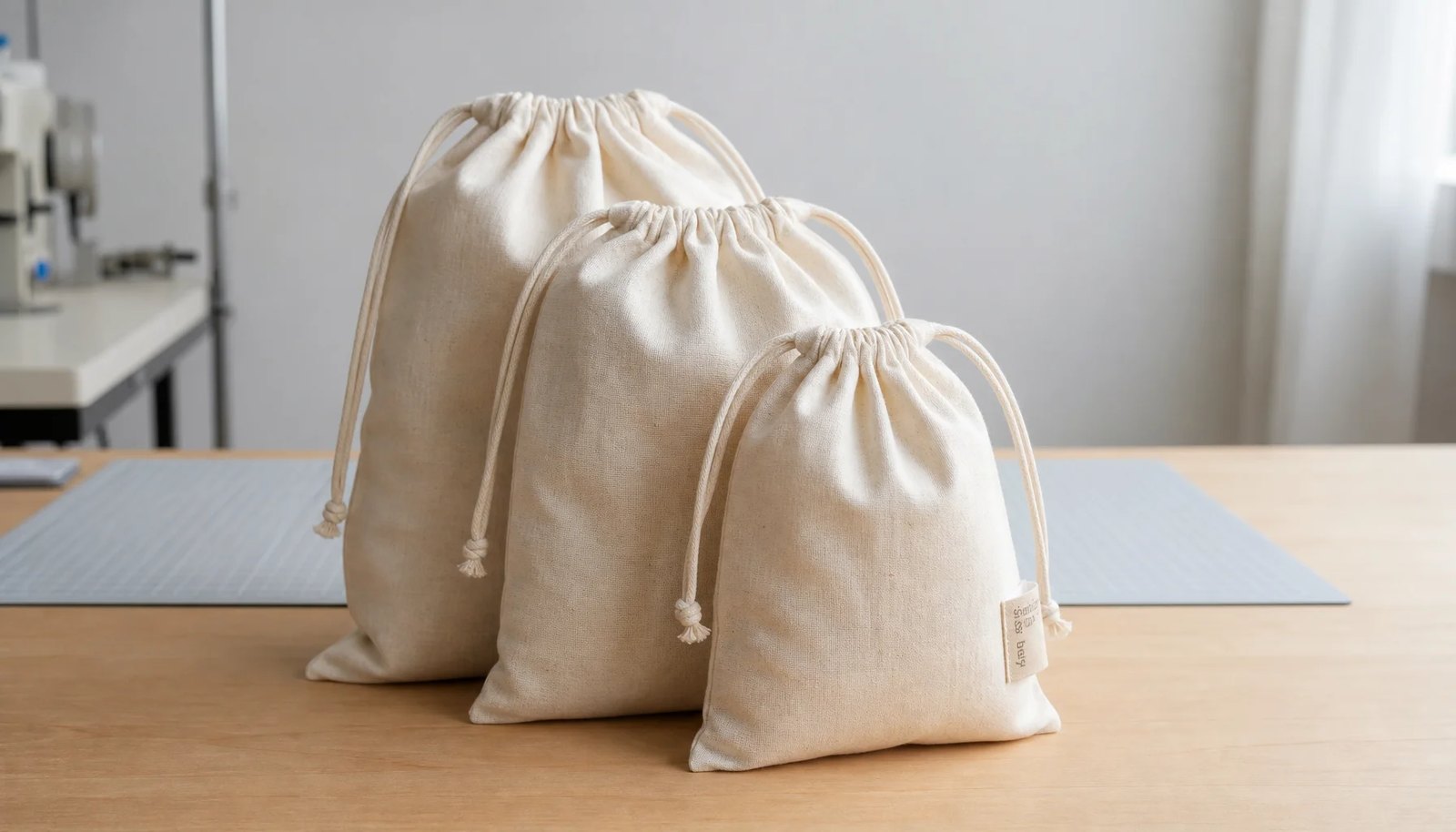
Why subscription boxes need a different pricing plan
Cotton drawstring pouches for subscription boxes are not priced like simple promotional bags. They sit at the intersection of presentation, protection, and recurring fulfillment. The pouch has to look good when the customer opens the box, survive packing and transit, and still fit within a controlled unit cost so the margin on the monthly box does not erode. That is why a pricing plan for cotton drawstring pouches bulk pricing plan for subscription boxes should start with the business role of the pouch, not with fabric cost alone.
For procurement teams, the biggest mistake is comparing supplier quotes built on different assumptions. One supplier may quote a 100 GSM cotton bag with no print and loose bulk packing, while another includes 140 GSM fabric, screen print, reinforced seams, and inner polybag packing. Those are not equivalent offers even if the headline unit price looks close. Without a common specification, the buying team can approve the wrong supplier for the wrong reason.
Subscription programs also create repeat demand patterns that differ from one-time promotional campaigns. A one-off event can absorb minor quality variation because the pouch is used briefly. A subscription box program repeats the same packaging item across many monthly cycles, so the buyer needs cost stability, re-order predictability, and a controlled approval process. Small deviations in fabric hand-feel or print consistency become more visible when the same item appears every month.
The pricing plan therefore needs three layers: the product spec, the sourcing structure, and the landed-cost model. The spec defines what the pouch must be. The sourcing structure defines how MOQ, setup, and sampling work. The landed-cost model shows the real expense after packing, freight, duties, and quality control. Buyers who skip any of these layers usually end up negotiating with a supplier on price alone, which is rarely the same thing as buying the right pouch.
The safest way to start is to define the pouch as a controlled component in the subscription box bill of materials. That means naming the pouch size, fabric, print, and packing standard before requesting quotes. It also means deciding whether the pouch is expected to be reused by the customer. Reusable pouches need stronger seams, better print durability, and a cleaner finish than a disposable insert. If the buying team does not make that decision early, the supplier will price to the vaguest version of the job and the final order will drift.
A strong sourcing plan also protects internal stakeholders. Marketing often wants a pouch that feels premium. Operations wants a pouch that packs fast and arrives flat. Finance wants a stable unit cost. The procurement team has to convert those goals into one approved spec. When that spec is clear, the supplier quote becomes useful. When it is not, the quote becomes a negotiation about assumptions instead of a comparison of real options.
- Fix the pouch role before requesting quotes: insert, gift, sample carrier, or resale item.
- Compare only like-for-like quotes with the same size, fabric, print, packing, and Incoterm.
- Treat decoration, packing, and inspection as part of the pricing plan, not as later add-ons.
- Assume recurring subscription orders need tighter repeatability than one-time promo runs.
Fabric weight, weave, and the tolerances that matter
For subscription box use, cotton drawstring pouches usually perform best in the 120-140 GSM range when the pouch carries light merchandise, samples, or small accessories. That range gives the bag enough structure to open cleanly, hold its shape in the box, and feel more substantial in the customer’s hand. If the fabric is too light, the pouch can look thin, wrinkle easily, and show the contents more than the brand wants. If it is too heavy, the unit cost, carton weight, and freight cost all rise quickly.
Fabric construction matters as much as GSM. Plain weave is usually the most economical and broadly available option, while twill often gives a denser feel and a more premium surface for printing. Twill can be especially useful if the logo needs cleaner edges or if the pouch will be handled often during fulfillment. Organic cotton can support a premium brand story, but procurement should expect tighter source control, more documentation, and a higher base price. A quote that only says “cotton pouch” leaves too much room for hidden substitution.
The right specification should name not only the GSM but also the weave, finishing, and expected color. Natural cotton often varies in shade from batch to batch, which may be acceptable for rustic branding but risky for a luxury subscription box. If the buyer expects a more uniform appearance, the supplier should clarify whether the fabric is bleached, raw, or dyed, and whether any softening or washing treatment is included. These details influence both appearance and cost.
Construction details should be written into the spec sheet because they affect lifespan and perceived quality. The cord channel should be reinforced well enough to withstand repeated opening and closing. Side seams should be even, with no twisting or puckering. If the pouch will be filled densely, buyers should ask whether the stitching allowance supports the intended load. In practice, a slightly better seam can be cheaper than a weak seam that fails in transit and triggers replacements.
A useful procurement spec also defines acceptable tolerances. For small to medium pouches, a width and height tolerance of ±5 mm is common enough to compare suppliers without making the order impossible to produce. Larger pouches can often be held to ±8 mm if the factory uses consistent cutting and sewing control. Buyers should also ask for a tolerance on the drawcord length and opening alignment, because a pouch that closes unevenly can feel cheap even if the fabric is correct.
The fabric choice should also be aligned with the product inside the pouch. A soft jewelry pouch, a sample kit, and a small textile accessory do not need the same structure. Buyers should not pay for heavy fabric where a lighter bag is enough, but they also should not under-spec the pouch just to hit an artificial unit price target. The best pricing plan is the one that matches the use case with the lowest acceptable fabric weight and the highest acceptable consistency.
- 120-140 GSM is the practical range for most subscription box pouches.
- Plain weave reduces cost; twill often improves hand-feel and print appearance.
- Specify weave, finishing, and color treatment, not just the word “cotton.”
- Set tolerances for size and opening alignment so every supplier quotes to the same standard.
Print method choices and the quote impact
Decoration is often the biggest variable after fabric. A plain pouch may be easy to source, but a branded pouch must carry the logo clearly enough to support the subscription box identity. For simple logos and repeat orders, one-color screen printing is usually the most stable and cost-efficient route. It works well on natural cotton and keeps setup relatively predictable. Buyers should still check line thickness, registration tolerance, and ink density, because coarse cotton can make small text or thin elements look uneven.
Heat transfer can be helpful for short promotional runs or artwork with multiple colors, but it adds a different risk profile. Transfers can crack, peel, or wrinkle if the pouch is folded tightly, compressed in storage, or re-handled at a fulfillment center. That means procurement needs to ask how the decoration holds up after packing, transit, and repeated opening. If the pouch is a visible part of a premium box experience, short-term savings from a fragile decoration method can backfire later.
Woven labels, sewn patches, and sewn-on branding usually cost more at the start, but they can offer a cleaner and more durable look. They are worth considering when the pouch is treated as a long-life branded accessory rather than a disposable insert. This matters in subscription programs where the customer may reuse the pouch for storage after unboxing. If the bag stays in circulation with the consumer, the branding method should be assessed for abrasion resistance, not only for first-impression appearance.
When requesting quotes, the buyer should ask for the decoration method separately from the pouch construction. That helps identify whether the supplier is pricing the pouch body correctly and whether the decoration charge changes with artwork complexity or color count. It also helps compare suppliers on a fair basis. A supplier quoting one screen print color, one setup charge, and one repeat run cost is easier to evaluate than a supplier bundling decoration into a vague all-in number.
Artwork approval should be based on actual production size. Buyers should ask for a print placement proof showing the final width, height, and distance from seam or cord channel. For subscription boxes, the logo usually needs to read clearly in a video unboxing, on social media, and in the customer’s hand. That means print placement is not just a graphic issue; it is part of the packaging performance standard.
For better quote control, ask the supplier to state the minimum line thickness they can hold, the maximum print area that stays visually clean, and whether they can keep registration within about 2-3 mm on one-color jobs. Those figures help separate a factory that routinely prints cleanly from a factory that is only quoting the artwork on paper. If the logo includes small taglines or fine lines, the buyer should request a revised art file before the order is approved.
- Use screen print for simple logos and repeat orders.
- Use heat transfer only when artwork complexity justifies the risk.
- Consider woven labels or sewn branding if the pouch is reused by the customer.
- Approve artwork at actual size and placement, not just on a flat digital mockup.
MOQ logic and how to stop the order from fragmenting
MOQ is rarely a single number. It often changes with size, fabric weight, artwork colors, packaging format, and whether the order uses a stock or custom component. A supplier may be comfortable with a low MOQ for an unprinted standard pouch, then increase the minimum once custom printing, custom cord color, or a second size is added. If the buyer does not separate these variables, the procurement process becomes opaque and the order can fragment into too many small configurations.
The simplest way to control MOQ is to standardize the first launch. Choose one primary size, one fabric spec, and one print color, then keep the initial order focused on proving sell-through and operational fit. For a subscription box program, the goal of the first order is not to cover every possible use case. It is to learn whether the pouch dimensions fit the actual products, whether the unboxing presentation works, and whether the supply chain can replenish reliably.
If the program needs more than one size, request separate quotes for each size and for the combined order. That reveals whether the supplier can nest production efficiently or whether each size triggers a separate setup and separate MOQ. Buyers should also ask whether MOQ changes when the pouch is packed with a specific count per carton, because packing format can affect production efficiency. A clean MOQ structure should make the tradeoff visible: one size at a lower unit cost, two sizes at a higher inventory burden.
For multi-month subscription programs, MOQ should also be reviewed against replenishment cadence. A low first-order MOQ might look attractive, but if the reorder minimum is much higher than the monthly burn rate, inventory will accumulate and tie up cash. Procurement should ask the supplier what repeat-order quantities are realistic after the first run. That matters just as much as launch MOQ, because the subscription box format creates recurring demand rather than a one-time shipment.
The best MOQ strategy is one that supports both launch and replenishment. Buyers should not chase the smallest possible number if it causes inconsistent supply, slower lead times, or poor carton utilization. A slightly higher MOQ on a stable, repeatable pouch spec can be easier to manage than a lower MOQ on a highly fragmented design matrix. In other words, the MOQ decision should support the operating plan, not only the initial purchase order.
A practical RFQ trick is to ask the supplier to price three scenarios: base pouch only, pouch plus print, and pouch plus print plus upgraded packing. That makes the cost jump visible and shows exactly which variable is driving the MOQ. If a factory cannot explain the difference cleanly, it is often a sign that the quote is being built from rough estimates rather than a controlled production method.
- Keep the first order simple: one size, one fabric, one logo color.
- Ask for separate pricing on each variant and on the combined order.
- Review MOQ against monthly usage, not just first-order launch volume.
- Use MOQ to test supplier discipline and repeat-order stability.
What a usable quote should include
A usable quote for cotton drawstring pouches should allow procurement to compare landed cost, not just base factory price. At minimum, the supplier should state fabric weight, weave type, pouch dimensions, print method, quantity tiers, tooling or screen charges, sample policy, packing format, and lead time. If any of those are missing, the buyer cannot tell whether a quote is genuinely competitive or merely incomplete. Missing information tends to reappear later as surprise charges or specification drift.
The quote should also identify what is included and what is excluded. For example, does the price include one print color only, or does it include artwork setup, proofing, and repeat orders? Does it include inner polybags, master cartons, carton marks, and palletization? Is the sample fee credited back on bulk order? Does the supplier quote from EXW, FOB, or DDP terms? These are not paperwork details; they decide whether the unit price holds after freight and handling are added.
A strong quote structure separates recurring cost from one-time cost. Fabric and sewing belong in the recurring unit price. Screen setup, plates, or print screens belong to setup cost. Packaging modifications, custom labels, and sample development should be shown separately. This helps buyers compare true operating cost over multiple subscription cycles instead of treating launch expenses as if they were part of every reorder.
Procurement should also request carton dimensions and gross weight in the quote itself. This is especially important for subscription box programs because freight, warehousing, and pallet efficiency can be as important as sewing cost. If one supplier uses a heavier carton or packs fewer pieces per case, the difference may not show up in the factory unit price but will show up in the landed-cost calculation. A quote that includes carton data is easier to feed into logistics planning and less likely to create surprises at booking time.
A quote becomes even more useful when the supplier states the acceptable defect rate and inspection standard. That may include the percentage of pieces that may have minor thread ends versus the zero-tolerance defects that trigger rejection. Buyers do not need a theatrical promise of perfection. They need a supplier who can quote a realistic standard and then hit it consistently. That makes the pricing plan defensible when the order is reviewed internally.
For procurement approval, the quote should also show the assumed shipping mode and payment term. A price based on EXW with no export handling is not comparable to a FOB quote that includes inland movement to port, and neither should be compared casually with DDP. If the supplier cannot define the commercial term, ask them to re-quote. The goal is to compare equal baskets, not to discover after approval that the freight, duty, or inland transport was omitted.
The most usable quotes also state production approvals in writing: approved sample reference, whether color matching is based on a physical swatch or Pantone reference, and whether any visible variation is acceptable on natural cotton. That prevents later arguments about what the buyer thought was included. For subscription box teams that reorder often, a clean quote is not administrative overhead. It is the document that prevents every future order from becoming a new negotiation.
- Require a tiered price sheet by volume, not a single unit number.
- Separate setup charges from recurring unit cost.
- Include packing count, carton size, and gross weight in the quote.
- Confirm the Incoterm so quotes can be compared on equal terms.
Supplier routes and landed-cost tradeoffs
There are usually three sourcing routes for cotton drawstring pouches: factory-direct, trading company, and domestic stock reseller. Factory-direct sourcing typically gives the best control over fabric weight, stitching, print quality, and packing. It also gives procurement a clearer view of who actually makes the pouch and which materials are being used. For a recurring subscription box program, that control is valuable because repeatability matters over many orders. The tradeoff is that the buyer must manage the RFQ more carefully and be more disciplined about sample approval and inspection.
Trading companies can be useful when the program needs multiple product types, mixed artwork, or faster coordination across different factories. They can simplify communication, but the buyer should confirm who owns production oversight, who approves the sample, and whether the factory can substitute fabric or trim without disclosure. If the intermediary cannot answer those questions clearly, the landed-cost advantage may disappear once quality risk and rework are considered.
Domestic stock resellers are usually the fastest option for urgent replenishment or temporary bridging supply. They can help a team launch a subscription box test quickly when the custom order is still in development. However, stock resellers usually offer less control over shade, weave, and pouch dimensions. That can be acceptable for a short run, but it is not ideal for a recurring branded program that needs consistent presentation. Procurement should treat stock sourcing as a contingency or bridge, not the long-term target unless the design is intentionally standardized.
Landed-cost comparison should include freight, duties, packaging, inspection, and expected reject rate, not only factory price. A factory-direct quote might appear slightly higher than a trading company quote, but if the factory-direct route reduces defect risk and rework, it may still be the better commercial decision. The reverse can also happen if a trading company consolidates shipments more efficiently. The point is to compare fully loaded costs using the same assumptions rather than assuming the lowest ex-factory price is the best value.
Route selection should also reflect the life cycle of the subscription box program. A test launch may justify a faster, less rigid sourcing path. Once the pouch becomes part of an ongoing monthly box, the procurement team should move toward the most repeatable route with the clearest control over quality and replenishment. The best sourcing route is the one that aligns with program maturity, not just the first order deadline.
If possible, ask each supplier to identify the actual factory name, production location, and primary quality contact. That does not guarantee quality, but it reduces confusion when a batch issue appears later. For buyers managing quarterly or monthly replenishment, knowing the production source is helpful for continuity, especially if the pouch needs reorders with the same fabric lot or the same print setup.
- Factory-direct is strongest when repeatability matters.
- Trading companies add flexibility but require proof of factory control.
- Stock resellers are fast, but specification drift is the main risk.
- Always compare total landed cost, not just ex-factory price.
Sample approval: where most production mistakes start
The pre-production sample is the control point for the entire order. It should show the actual fabric, actual print method, actual cord, and actual stitching construction that will be used in production. Buyers should not approve a pouch because it looks close enough in a photo. They should approve it only after touching the fabric, checking the hand-feel, verifying the seam finish, and confirming how the drawcord runs through the channel. If the sample is weak, the bulk order will usually be weak in the same way.
A strong sample review checklist should include dimensions, logo placement, stitch quality, opening width, usable depth, and cord pull behavior. Buyers should also check whether the pouch closes evenly and whether the top channel twists or buckles when the bag is lightly filled. If the pouch will hold small boxed items, samples should be tested with a representative load rather than left empty. That exposes sizing and seam issues before the full production run starts.
The approval note should be specific enough to prevent ambiguity later. For example: approve 130 GSM natural cotton twill, one-color black screen print, centered logo placement at the specified distance from the top edge, no visible ink bleed, and reinforced side seams with bar-tacks at the channel ends. If the supplier later suggests substituting fabric or print method, the buyer should treat that as a new approval event. Otherwise the initial sample loses its value as a quality benchmark.
Sample control should include a record of what was approved. Procurement teams should keep a simple approval trail showing the sample date, the supplier’s sample reference, the production spec, and any deviations that were accepted or rejected. That trail matters when the bulk lot arrives and the team needs to determine whether a defect is a factory error or an unapproved change. The goal is not paperwork for its own sake; it is to protect the order from preventable disputes.
For subscription box programs, sample approval is also about marketing fit. The pouch may look fine in isolation but fail in the context of the full box. Buyers should place the sample next to the actual box contents, printed insert, and any other packaging elements to confirm that the visual tone matches the brand. A pouch that is technically correct but visually off-brand can still create a bad customer impression, which is why sample review must include commercial context, not only technical checks.
If the supplier offers a pre-production photo set, use it as a checkpoint, not as the final approval. Photos help confirm placement and packing method, but they cannot replace a physical sample for fabric feel, stitch tension, or cord movement. The most reliable approval process is physical sample first, then written signoff, then a final production confirmation before mass sewing begins.
- Approve actual placement and stitch behavior, not just a digital proof.
- Use a written sample signoff that names the approved fabric and print method.
- Treat any material or decoration change as a new approval event.
- Test the sample with representative product load, not only empty.
Packing, carton counts, and warehouse handling
Packing has a direct effect on both freight cost and fulfillment efficiency. Cotton drawstring pouches are usually most economical when flat-packed in bulk cartons, but the buyer needs to define exactly how they are packed. That means specifying the number of pieces per inner polybag, the number of inner bags per outer carton, and the labeling format on each carton. Without those details, one supplier may ship loose and another may double-pack, creating inconsistent receiving and storage effort.
If the pouches are being used in subscription box assembly, the primary requirement is usually count accuracy and clean condition. Flat-packed cartons with controlled quantities make it easier for the fulfillment center to pick, count, and stage product. If the pouch is retail-facing or sold independently, inner packaging and retail labeling may matter more. Buyers should decide this early because the packing style affects labor, carton size, and chargeable weight.
Carton design should support stable palletization and avoid unnecessary compression. Overfilled cartons can crush the cotton, create wrinkles, and even deform printed logos. Underfilled cartons waste cube and increase freight cost. Procurement should ask the supplier to quote carton dimensions and gross weight and to indicate whether cartons are single-wall or double-wall. These details help the logistics team estimate chargeable weight and determine whether the goods can move efficiently through the warehouse.
Warehouse handling should also be considered in the packing plan. If the fulfillment center works from bulk cartons, carton counts must be easy to reconcile. If the pouch is being kitted with other items, the packing format should minimize handling damage and make replenishment simple. The more complex the packing format, the more likely it is that receiving errors or miscounts will create downstream delays. For this reason, the most efficient pouch packing is often the simplest packing that still protects the product.
Packing should be validated during sample review, not left until production. Buyers should ask the supplier to show how the pouches will be packed, whether they will be folded or stacked, and how the cartons will be sealed and labeled. This matters because cotton can pick up dirt and creases easily if it is handled carelessly. A clean packing standard is a low-cost way to protect the appearance of the pouch and reduce avoidable rejects when the shipment arrives.
For subscription box teams, it is also useful to specify how the pouches should be presented inside the carton. If the fulfillment center opens cartons frequently, the top layer should not be compressed or taped in a way that slows picking. If the pouches are intended for kitting, the carton count should be aligned with the daily assembly rate so the warehouse does not have to split cases unnecessarily. A packing plan that works in the factory but slows the warehouse is not a good commercial plan.
- Set a fixed piece count per inner and outer carton.
- Avoid over-compression that causes wrinkles or logo distortion.
- Quote carton dimensions, gross weight, and wall strength.
- Confirm packing style with the fulfillment team before approval.
Lead time, risk points, and how to protect the launch date
For most custom cotton pouch programs, the timeline has four gates: sample development, sample approval, bulk production, and inspection or release. The most common schedule failures happen between these gates, not inside the sewing line. Delayed artwork signoff, late fabric confirmation, and revised packing instructions are all common causes of launch slippage. That is why a pricing plan for cotton drawstring pouches bulk pricing plan for subscription boxes should include a realistic schedule buffer, especially when the pouches are tied to a fixed subscription ship date.
Buyers should ask the supplier to state how many days each stage actually takes, not just the total lead time. A supplier may say production takes 20 days, but that may exclude sample work, screen setup, or final packing inspection. The buyer needs the full path from order confirmation to ready-to-ship goods. If any stage is compressed to win the order, procurement should ask what was removed or shortened. The answer often reveals whether sample quality, inspection depth, or packing control is being sacrificed.
A schedule also needs a risk response plan. If the first sample fails, what is the turnaround for revision? If a print issue appears during bulk production, how much extra time is required for correction? If cartons are rejected at inspection, who pays for rework and resubmission? These are commercial questions, not just operational ones. Buyers who define the response process in advance are better able to protect the launch date without escalating to expensive freight or last-minute compromises.
Seasonal or campaign-driven subscription boxes are especially sensitive to lead time. A pouch that is meant to support a holiday box, new member welcome kit, or promotional anniversary box cannot arrive late without affecting the rest of the launch sequence. Procurement should therefore align the pouch order with the overall box schedule, including print deadlines for other packaging components. The pouch is only one part of the bundle, but its delay can hold up the complete assembly process.
The safest approach is to treat lead time as a negotiated plan, not a vendor promise. A realistic plan has milestones, sample approvals, inspection windows, and a contingency buffer. That approach often looks less aggressive on paper but performs better in practice. In bulk packaging procurement, on-time delivery with stable quality is usually more valuable than a low quote attached to an unrealistic schedule.
Ask the supplier to identify which tasks are done in-house and which are outsourced. Screen setup, sewing, packing, and final inspection may not all happen in the same facility. If the factory outsources any part of the process, add time for transport between sites and additional QC checkpoints. The more handoffs in the route, the more the buyer should insist on written status updates.
- Map the timeline in four gates: sample, approval, production, inspection.
- Protect the schedule with buffer time for print setup and carton verification.
- Ask what is excluded from the supplier’s stated lead time.
- Do not compress QC just to win a lower factory quote.
A practical cost model for bulk pricing decisions
When comparing cotton pouch quotes, break the total cost into fabric, sewing labor, decoration, packing, freight impact, and quality control. Fabric weight changes both material cost and shipping weight. Sewing complexity changes labor time. Print method changes setup charges and reject risk. Packing format changes carton efficiency. A quote that looks inexpensive at the factory can become the more expensive option once cartons, freight, and rework are included.
For procurement teams, the right comparison metric is landed cost per approved pouch, not unit price at the factory gate. That means the quote should be evaluated after allowing for the defect rate, the cost of inspection, and the freight mode that the pouch volume and weight will require. If a lighter pouch saves a few cents but causes logo show-through or seam failures, the buyer may end up paying more in replacements and customer dissatisfaction. Conversely, overbuilding the pouch can create a premium feel that the subscription box does not actually need.
A sensible model also separates launch cost from steady-state cost. Sample development, screen setup, and trial packing are launch costs that should not be confused with the recurring cost of the pouch itself. If the subscription program is expected to reorder every month or quarter, the buyer should calculate the ongoing landed unit cost at the likely reorder volume. That tells the business whether the pouch is sustainable as a recurring insert or whether the design needs to be simplified.
The cost model should also account for the customer experience. For subscription boxes, the pouch often functions as both packaging and a brand touchpoint. If the pouch is kept by the customer and reused, the visual and tactile quality can justify a slightly higher cost. If it is mainly a disposable insert, the priority may be fit and protection at the lowest acceptable specification. The point is not to buy the cheapest pouch. It is to buy the pouch that gives the right return for the box strategy.
A practical decision rule is simple: pay more when the higher-cost choice solves a real operational or brand problem. Do not pay more for details that do not affect the box outcome. That rule keeps procurement grounded and prevents the pricing plan from drifting into feature creep. In a recurring subscription business, discipline in pouch specification often protects more margin than a one-time negotiation over the headline unit price.
When the team builds the cost model, use a simple table with columns for base factory price, print/setup cost, packing cost, freight per unit, duty or tax if applicable, QC cost, and expected reject allowance. That view exposes where savings are real and where they are only shifted from one line item to another. If two suppliers are within a few cents on the factory quote but differ in reject rate or freight cube, the total economics can change quickly.
- Model cost across fabric, print, packing, freight, and reject rate.
- Use landed cost per approved pouch as the real approval number.
- Separate launch cost from repeat-order cost.
- Pay more only when the pouch visibly improves the box experience or reduces risk.
Specification comparison for buyers
| Spec decision | Recommended option | When it fits | Buyer risk to check |
|---|---|---|---|
| Fabric weight | 120-140 GSM cotton twill or plain weave | Subscription box inserts that need a better hand-feel, low show-through, and repeat logo visibility | Below 110 GSM often looks thin and can distort at the cord channel; above 150 GSM raises material cost, carton weight, and freight |
| Print method | 1-color screen print for stable artwork; woven label or sewn patch for premium reuse cases | Simple logos, repeat SKUs, and pricing plans that need low decoration cost | Small text below about 4 mm stroke width can fill in on coarse cotton; transfers can crack after repeated folding |
| MOQ route | Standardize on one size and one artwork color before adding variants | Brands testing a subscription box launch or reordering on a monthly cycle | Each added size, color, or packaging option can multiply MOQ and inventory exposure |
| Pouch closure | Cotton drawcord with reinforced channel and bar-tack stress points | Monthly box programs where customers open and reclose the pouch | Weak channel stitching can pull out after repeated handling or transit compression |
| Size strategy | One main size plus one upsized SKU only if product mix requires it | Subscription boxes with consistent product dimensions | Over-sizing adds fabric consumption and freight; under-sizing risks fit failure and crushing |
| Packing method | Flat-packed in bulk polybags with fixed carton counts and carton label control | High-volume B2B shipments and fulfillment centers that rework cartons | Loose packing causes wrinkles, count mismatches, and higher receiving labor |
| Supplier route | Factory-direct with a signed pre-production sample and carton spec | Buyers comparing landed cost across multiple replenishment cycles | Trading intermediaries can hide fabric substitution, inconsistent cord quality, or higher gross weight |
| Lead time planning | Sample approval first, then production calendar with buffer for print setup and inspection | Seasonal launches or box programs tied to ship dates | Rushed schedules can skip wash tests, reduce inspection depth, and force air freight |
Buyer checklist before sampling
- Define the pouch role first: product insert, sample carrier, membership gift, or resale item before fixing fabric weight.
- Lock one primary size and one backup size so MOQ and inventory do not drift across variants.
- Approve the artwork at actual production size, not just a digital mockup.
- Confirm GSM, weave type, finished dimensions, cord length, seam allowance, and channel reinforcement in the spec sheet.
- Set dimensional tolerances in writing: target width and height, plus an acceptable variance of ±5 mm for small pouches or ±8 mm for larger pouches unless your supplier can hold tighter.
- Request a pre-production sample with fabric hand-feel, print density, seam quality, and pull-test checks.
- State packing count per inner bag, cartons per pallet if needed, master carton markings, and barcode or label requirements.
- Compare quotes on the same Incoterm, same print method, same carton count, and same sample standard.
- Build a lead-time buffer for sample approval, print setup, and inspection rework.
- Ask the factory to confirm whether any fabric substitution, trim change, or packing change requires written buyer approval before production continues.
Factory quote questions to send
- What exact cotton fabric weight, weave, and finishing are included in this quote, and can you provide a spec sheet or sample swatch reference?
- What is the finished pouch size, and what tolerance do you hold for width, height, and cord channel opening?
- Is the quoted price based on one-color screen print, woven label, sewn patch, or heat transfer, and what is the setup charge for each?
- What is the MOQ per size and per artwork color, and how does it change if we add a second size or a second logo location?
- Can you confirm cord type, cord diameter, channel reinforcement, seam allowance, and bar-tack locations on the sample?
- What packing format is included: bulk polybags, inner packs, carton count, carton markings, and palletization if required?
- How many days are needed for pre-production sample, bulk production, and final inspection release, and what steps are excluded from that lead time?
- What defects do you reject during inspection: print misregistration, loose threads, broken cords, seam skips, oil stains, or shade variation outside the approved range?
- Can you quote the same pouch on FOB and DDP so we can compare landed cost options?
- If fabric shade or GSM varies between batches, how do you notify the buyer and what approval is required before shipping?
Quality-control points to confirm
- Inspect 10-20 pieces from the pre-production sample for print location, seam finish, stitch density, and drawcord movement.
- Measure the sample against the approved spec and record actual dimensions, especially opening width, body width, and usable depth.
- Reject visible oil stains, broken stitches, seam skips, puckering, and print misregistration that would be obvious in retail presentation.
- For print, check edge sharpness, ink bleed, and registration; for woven labels or patches, check attachment strength and edge fray.
- Test cord pull resistance on a small random sample from bulk cartons before release; the cord should not slip, and the channel should not tear or deform under normal hand pull.
- Verify that the sample and bulk lot use the same fabric hand-feel and that no unapproved substitution is present.
- Check carton labels, count marks, and packing slips against the purchase order before goods are accepted into receiving.
- Record approved sample reference, date, supplier contact, and any allowed deviations so the team can verify future reorders against the same standard.