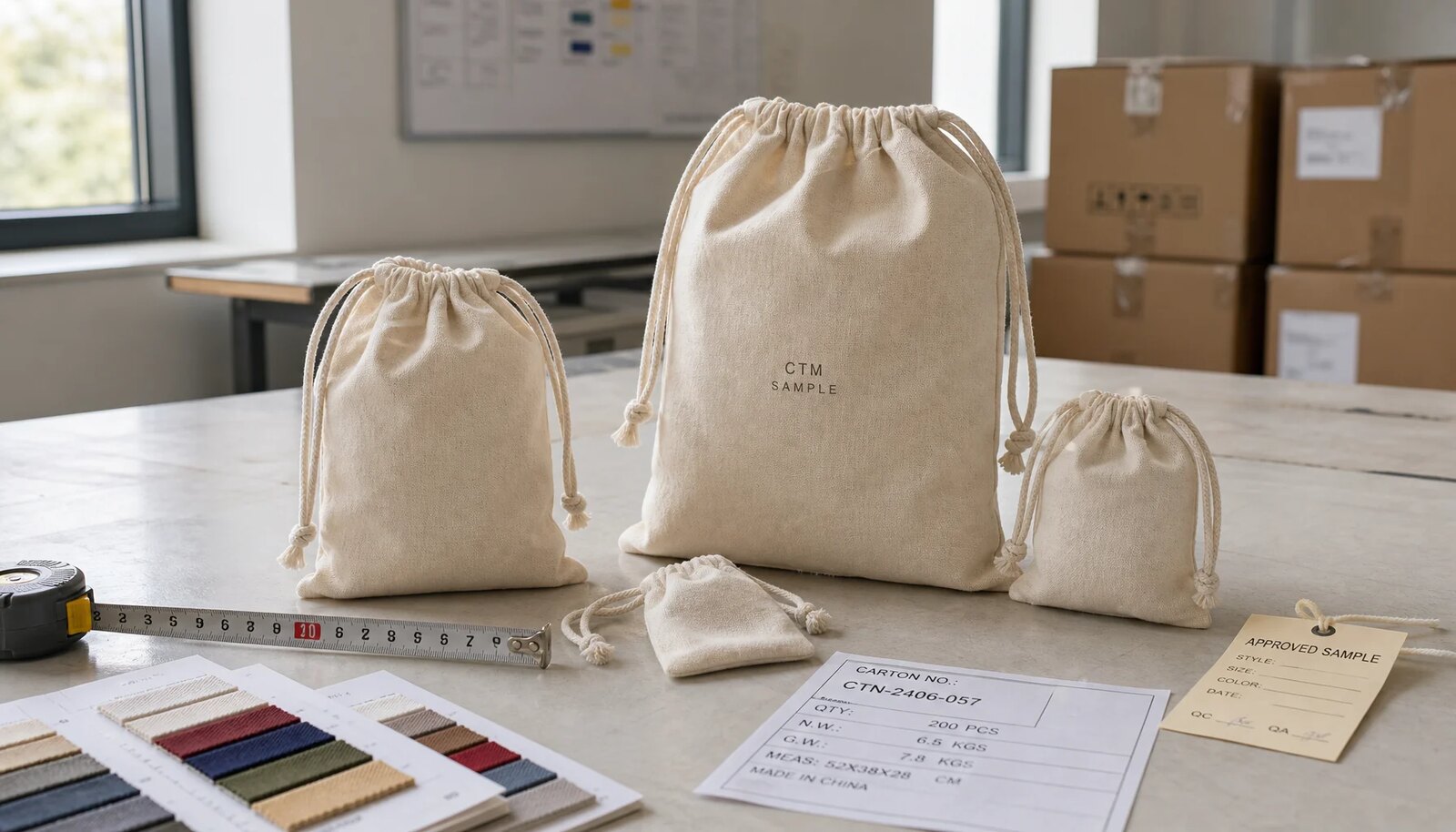
Start with the pricing plan, not the pouch sketch
A cotton drawstring pouch looks simple, which is exactly why many bulk quotes become hard to compare. One supplier prices a blank natural cotton pouch, another includes a one-color print, another assumes a lighter cloth, and a fourth hides packing and setup inside one unit price. Procurement teams need a pricing plan that forces every vendor to quote the same commercial reality: finished size, GSM, construction, decoration, packing, quantity tier, Incoterm, and sustainability claim.
For eco apparel brands, the pouch is often part of the customer experience rather than a disposable accessory. It may carry a garment, store a refill item, protect a sample kit, or replace plastic packaging. That brand role affects the acceptable cost. A promotional pouch can be lighter and simpler. A retail pouch tied to a sustainability message needs cleaner stitching, traceable material documentation, and a packing method that keeps the item presentable when it reaches the warehouse or store.
The practical plan is to build the RFQ around cost drivers. Separate fixed setup costs from variable unit costs. Ask where the price drops as quantity rises. Compare supplier routes before comparing numbers. Approve a pre-production sample against measurable tolerances. Then calculate landed cost, not just ex-factory price. This turns cotton drawstring pouches bulk pricing from a vague negotiation into a controlled buying process.
- Define the pouch use before choosing the spec: retail packaging, sample kit, event giveaway, refill pack, or storage pouch.
- Quote the same finished size, GSM, print method, and packing format with every supplier.
- Make suppliers show setup charges, variable unit cost, carton details, and freight basis separately.
- Use the exact phrase cotton drawstring pouches bulk pricing plan for eco apparel brands in internal sourcing notes only when it helps align the buying brief; the supplier still needs a technical spec sheet.
Build a tiered MOQ model buyers can actually use
MOQ should be treated as a pricing map, not a single barrier. The minimum can change by fabric availability, custom dyeing, print setup, sewing-line efficiency, carton packing, and shipment split. A natural cotton pouch in a common size may support a lower MOQ than a dyed organic cotton pouch with two-sided printing and custom retail labels. If the supplier only gives one price at one quantity, you cannot see whether the quote is expensive because of the spec or because the order sits below an efficient production tier.
A useful RFQ asks suppliers to quote several tiers even if the forecast is uncertain. Common planning tiers include 500, 1,000, 3,000, 5,000, 10,000, and 25,000 units. Smaller eco apparel brands may not buy the top tier immediately, but seeing the curve helps procurement decide whether to consolidate seasonal programs, standardize one pouch size across product lines, or split a first test from a later reorder. The goal is not always to chase the highest quantity; it is to identify the point where extra units stop producing meaningful savings.
The table below is not a price promise because fabric market, labor region, exchange rate, print method, certification, and packing format all move cost. It is a planning structure buyers can use when building a quote sheet.
- 500 units: best for proof of concept, event testing, or local blank decoration; expect higher unit cost and limited customization.
- 1,000 units: workable for simple one-color print on standard natural cotton; setup charges still matter.
- 3,000 units: often a practical first custom tier where fabric, sewing, and print setup spread more efficiently.
- 5,000 units: useful for retail packaging programs with more consistent body cost and better carton planning.
- 10,000 units: stronger for repeat apparel lines, standardized sizes, and negotiated packing or label costs.
- 25,000 units and above: strongest for annual programs, but only when demand, storage, and quality controls are mature.
Use a cost build-up instead of a one-line quote
A one-line unit price hides too much. Cotton drawstring pouch cost is usually built from fabric consumption, cutting and sewing labor, drawcord, decoration, label or tag, packing, quality control, inland handling, and export terms. Some costs are fixed, such as screen setup or sample development. Others scale with every unit, such as cotton fabric, sewing minutes, and inner packing. If these items are blended into one price, procurement cannot tell whether to simplify artwork, change GSM, increase tier quantity, or negotiate freight.
A target quote sheet should make suppliers fill in the same fields. The most useful fields are item number, finished size, fabric composition, GSM, color, drawcord type, print method, number of colors, print area, label or tag requirement, individual packing, master carton count, quantity tier, unit price, setup charge, sample charge, Incoterm, lead time, carton dimensions, gross weight, CBM, document availability, and payment terms. Add a column for supplier assumptions because hidden assumptions are where most quote disputes begin.
For planning, buyers can model cost as body cost plus decoration plus packing plus allocated setup plus logistics. If a setup charge is 180 USD and the order is 1,000 pieces, it adds 0.18 USD per pouch before freight. At 5,000 pieces, the same setup adds 0.036 USD per pouch. This is why small artwork changes can feel expensive on low quantities but almost disappear at larger tiers. The same logic applies to sample charges, custom label tooling, and color matching work.
- Body cost: fabric usage, cutting, sewing, drawcord, and basic finishing.
- Decoration cost: screen print, transfer, embroidery, woven label, patch, or side label.
- Packing cost: folding, inner bag, barcode, hang tag, carton, carton liner, desiccant, and pallet rules if needed.
- Allocated setup: screens, artwork preparation, sample development, lab dips, label tooling, and testing charges.
- Landed-cost adders: inland freight, ocean or air freight, duty, customs clearance, destination handling, inspection, and repacking labor.
Specify fabric, construction, and size with no loose language
The largest visible difference between two pouch quotes is often fabric weight. Most cotton drawstring pouches for apparel programs sit between 120 and 180 GSM, but that range covers very different brand experiences. A 120 GSM pouch may be acceptable for lightweight promotional use, while a 160 GSM pouch usually feels more credible for retail packaging. Heavier cloth can support a premium impression, but it also increases material cost, carton weight, and sometimes sewing time. The right GSM is the lightest fabric that still protects the product, supports the print, and matches the brand promise.
Construction details matter because they determine whether the pouch works after it looks good. Specify finished dimensions, not only approximate size. Confirm whether measurements are taken flat, after finishing, and with an allowed tolerance such as plus or minus 5 mm for smaller pouches or a wider tolerance for large formats. Define the drawcord channel, seam type, hem depth, cord material, cord diameter, knotting method, and whether side seams require back-tacking. If a garment must fit inside, test the actual product in the sample rather than relying on nominal dimensions.
Shrinkage is a common source of quiet failure. Cotton can shrink depending on fabric preparation, washing, dyeing, steaming, and finishing. If the supplier cuts to the finished target without considering shrinkage, the delivered pouch may be too small. The RFQ should ask whether shrinkage allowance is included and whether the approved sample represents bulk fabric. For apparel brands using the pouch as packaging, usable opening and internal fit matter as much as the outside measurement.
- 120 to 140 GSM: lighter promotional or sample use, lower perceived structure, more print show-through risk.
- 140 to 160 GSM: balanced retail range for many apparel and accessory programs.
- 160 to 180 GSM: stronger hand feel for premium packaging, heavier contents, or reusable storage.
- Plain weave: economical, flat print surface, common for standard natural cotton pouches.
- Twill or heavier weave: more texture and durability, but fine logo detail may soften.
- Cotton cord: coherent natural look, but confirm fray and knot security.
- Polyester or blended cord: stronger performance in some uses, but may conflict with material-story expectations.
Choose decoration for repeatability, not only brand mood
Decoration can make or break the economics of a pouch program. One-color screen print is usually the most predictable option for bulk cotton pouches because the setup is clear, the unit cost is efficient at scale, and placement can be controlled with proper fixtures. Water-based ink can give a softer hand feel, while plastisol or transfer methods may produce a heavier print surface. The supplier should explain the ink type, curing method, expected hand feel, and test method for rub or wash exposure if the pouch will be reused.
Multi-color artwork adds cost and risk. Every added color can require another screen, more setup time, more registration control, and more inspection attention. On soft cotton, fabric movement during printing can cause small misalignment that would not appear on rigid packaging. Procurement should ask whether the artwork can be simplified without weakening the brand presentation. Sometimes a single-color logo on a better cloth looks more premium than a complex print on a lighter pouch.
Labels and tags deserve serious consideration. A woven side label, folded seam label, cotton patch, or hang tag can reduce print complexity and make reorders easier when the base pouch stays the same but customer programs change. The trade-off is label MOQ, label lead time, sewing placement, and possible tooling cost. For eco apparel brands, the decoration choice should also match claim language. A pouch cannot imply organic, recycled, undyed, or low-impact printing unless the supplier can support the claim with appropriate documentation.
- Use one-color screen print when the logo is simple and cost control matters.
- Limit print area when possible; large solid areas use more ink and can create hand-feel or curing issues.
- Ask whether the quoted price includes one side only or both sides.
- Use woven labels for small detailed marks, repeat base pouches, or premium subtle branding.
- Request a strike-off or printed pre-production sample before approving bulk print.
- Define acceptable print placement tolerance, color reference, and rub performance in the PO.
Match the supplier route to the commercial risk
Supplier route is a procurement decision, not a sourcing footnote. A direct factory can be the best route for stable, repeatable programs because it gives the buyer clearer control over fabric, cutting, sewing, print, and packing. The strongest direct factories can explain how they buy cloth, inspect incoming fabric, control print placement, and pack cartons for export. They may require higher MOQ or more complete specs, but the trade-off can be worthwhile for repeat apparel packaging.
A trading company or sourcing office may be useful when the brand needs one contact across several accessories. That convenience can be real, especially when pouches ship with labels, trims, dust bags, or other packaging items. The buyer should still ask where production occurs and who is responsible for corrective action. If the trading company cannot separate costs or identify the inspection owner, the buyer may lose leverage when defects appear.
Local decoration and stock blank routes are often the right answer for small tests, events, influencer kits, and urgent replenishment. They reduce development time because blank inventory already exists. However, they rarely give the same control over fabric weight, construction, dye lot, or sustainability documents. This route works best when the pouch is not making a deep material claim and the brand accepts the available blank options. For eco apparel brands, the route should match the claim burden: stronger claims require stronger documentation and usually a more controlled supply chain.
- Use direct factory sourcing for recurring orders with defined specs and forecast visibility.
- Use trading companies when consolidation value is greater than the need for factory-direct cost visibility.
- Use local blank decoration for speed, tests, and small runs with simple branding.
- Use certified or traceable converters when marketing will make organic, recycled, or chain-of-custody claims.
- Require the same pre-production approval and inspection standard regardless of route.
Approve samples with procurement discipline
Sample approval should be treated like the first production control gate, not a creative preview. A sales sample can confirm general look and hand feel, but it may not use the exact production fabric, print line, or packing method. A pre-production sample should represent the final bulk spec: same fabric composition, same GSM target, same finished size, same drawcord, same decoration method, same print size, and same packing format. If any of those variables changes, approval should reopen.
The buyer should measure and record sample results. Check finished width and height, usable opening, hem depth, drawcord length, seam alignment, print placement, and logo color. Pull the drawcord repeatedly to confirm smooth movement and no tearing at the casing. Turn the pouch inside out to inspect seam finish, loose threads, back-tacking, and skipped stitches. If the pouch will hold a garment or accessory, fit the real product inside and close it. A pouch that looks correct flat may still be too tight in use.
Keep a golden sample on the buyer side and require the factory to retain one matching approved sample. Reference the approved sample number or date on the purchase order. This matters when receiving teams inspect the shipment weeks later. Without a retained standard, disputes become subjective: one person remembers the cloth as heavier, another remembers the print as warmer, and nobody has a signed reference. A modest sample log prevents expensive arguments.
- Stage 1: material swatch or blank sample for GSM, weave, and hand feel.
- Stage 2: print strike-off or label sample for artwork color, placement, and decoration quality.
- Stage 3: pre-production sample using final materials, final construction, and final decoration.
- Stage 4: packed sample or packed carton photo for folding, inner count, carton marks, and barcode review.
- Approval rule: no bulk cutting until written approval covers fabric, size, print, drawcord, label, and packing.
Set QC methods before the shipment is at risk
Quality control is strongest when the inspection method is written before production starts. For cotton drawstring pouches, the PO should name the inspection standard, sample size approach, AQL level, defect classes, measurement tolerances, and inspection timing. Many buyers use ANSI/ASQ Z1.4 or ISO 2859-1 as a framework, with general inspection level II for visual inspection unless the order risk suggests otherwise. The right AQL depends on brand tolerance and product use, but the key is that both buyer and supplier agree before the goods are packed.
Defect classification should be practical. Critical defects include contamination, mold, strong odor, unsafe debris, incorrect material claim, or anything that makes the item unusable or legally risky. Major defects include wrong size outside tolerance, broken seams, missing cords, severe print defects, stains, wrong artwork, incorrect carton count, or barcode errors that block receiving. Minor defects include small loose threads, light creasing, or slight shade variation within the agreed tolerance. Without classification, suppliers may argue that every issue is cosmetic.
Inspection should include function, measurement, appearance, and packing. Pull the drawcord repeatedly. Check seam strength at stress points. Rub the printed area with dry white cloth and, when relevant, damp cloth to screen for transfer. Measure a statistically meaningful sample, not just one pouch from the top carton. Compare fabric shade to the approved reference under consistent light. Inspect cartons for moisture, crushed corners, incorrect marks, and count errors. For export shipments, carton condition can be as important as pouch appearance because warehouse disputes often begin with packing failures.
- Measurement check: width, height, opening, hem depth, drawcord length, print position, and tolerance compliance.
- Material check: GSM, composition statement, weave, shade, odor, stains, broken yarns, and hand feel against approved sample.
- Construction check: seam security, skipped stitches, puckering, back-tacking, top channel, bottom corners, and loose threads.
- Function check: drawcord movement, knot security, casing strength, repeated opening and closing, and product fit.
- Print check: registration, color match, curing, rub transfer, bleeding, ghosting, cracking, and placement.
- Packing check: inner count, master count, carton dimensions, gross weight, carton marks, moisture control, and barcode scan.
Document sustainability claims without vague wording
Eco apparel brands should be especially careful with pouch claims because packaging claims are easy to overstate. Natural cotton, undyed cotton, organic cotton, recycled cotton, low-impact dye, water-based ink, biodegradable, compostable, and plastic-free all mean different things and require different support. A supplier saying a material is eco-friendly is not enough for procurement, compliance, or marketing review. The RFQ should ask exactly which claim the supplier can support and which documents are available for the specific order.
For organic cotton, buyers may need certificate scope for the supplier and, depending on the claim and chain, transaction certificates or equivalent chain-of-custody records. For recycled cotton, ask for recycled content declaration and any applicable certification scope rather than accepting a generic statement. For undyed natural cotton, clarify whether the cloth is unbleached, bleached, natural shade, or dyed to look natural. For inks, ask for ink type and any relevant safety or restricted substance documentation. For packaging, confirm whether inner bags, hang tags, and labels conflict with the brand's material story.
Unsupported claims create risk even when the pouch itself is well made. If the brand cannot document organic content, do not print organic claim language on the pouch or carton. If recycled content is blended, do not imply 100 percent recycled unless documents support it. If the pouch ships in individual polybags for moisture protection, do not use broad plastic-free language without explaining the actual packaging system. Strong procurement protects the marketing team by turning sustainability language into verifiable purchase requirements.
- Ask for supplier certification scope, not just a certificate logo.
- Request transaction documents or order-specific chain records when making organic or certified-content claims.
- Use material declarations for cotton composition, recycled content, dyeing, and trim components.
- Confirm whether drawcord, label, thread, and packing materials match or weaken the claim.
- Avoid broad phrases such as eco-friendly, sustainable, green, or natural unless the claim is defined and supportable.
- Put approved claim wording on the PO, artwork file, carton mark sheet, and inspection checklist.
Control packing, freight, and landed cost
Packing is a pricing variable and a quality-control variable. Cotton pouches are soft, absorbent, and easy to crease or soil when handled poorly. A low-cost quote that assumes loose bulk packing may create receiving labor, dust exposure, cord tangling, and inconsistent presentation. A stronger export spec defines folding method, inner pack count, master carton count, carton dimensions, gross weight target, carton marks, barcode labels, moisture protection, and pallet requirements if the shipment is not floor-loaded.
Landed cost is the number procurement should use for award decisions. Start with the quoted unit cost, then add setup charges allocated across the order, inland freight, international freight, duty, customs brokerage, destination handling, inspection, repacking, storage, and the expected cost of rejects. Cotton pouches are lightweight, but carton efficiency still matters. Oversized cartons can increase CBM. Weak cartons can crush and create warehouse claims. Individual packing can add material and labor cost but may reduce soiling and counting errors.
The best buying decision balances cost with repeatability. A supplier that is slightly more expensive but holds fabric shade, print placement, carton count, and documentation across reorders may be cheaper over a season than a low quote that causes receiving disputes. For eco apparel brands, the pouch often supports brand trust. Landed cost should therefore include the operational cost of mistakes, not only the factory invoice.
- Ask for carton dimensions, gross weight, net weight, and CBM at every quoted tier.
- Compare ex-factory, FOB, CIF, DDP, or delivered pricing only after making the Incoterm explicit.
- Add setup and sample charges into the per-unit model so low quantities are not understated.
- Include inspection, testing, destination handling, duty, brokerage, and repacking labor in landed cost.
- Require carton marks, barcode rules, and inner pack counts to match warehouse receiving needs.
- Use moisture protection for humid routes, long ocean transit, or absorbent natural cotton packaging.
Specification comparison for buyers
| Supplier route | Best use case | Pricing impact | Buyer risk to check |
|---|---|---|---|
| Direct factory source | Stable repeat orders with a fixed size, fabric, print method, and packing spec | Often strongest unit cost once MOQ is met because fewer margin layers sit between buyer and sewing line | Confirm the factory controls fabric purchasing, sewing, decoration, packing, and corrective action rather than subcontracting unknown steps |
| Trading company or sourcing office | Multi-item accessory programs where pouches, labels, bags, trims, and packaging need one coordination point | Can simplify vendor management but may add a margin layer that hides body, print, and packing cost details | Ask for production-site disclosure, sample origin, inspection responsibility, and who pays for remakes if defects appear |
| Stock blank importer plus local branding | Small tests, urgent drops, event packs, or simple logo runs with no custom body construction | Lower setup burden and faster start, but higher unit cost at scale and fewer size, GSM, and dye-lot choices | Check blank consistency, replenishment availability, mixed dye lots, and whether print adhesion is tested on the actual fabric |
| Local decorator using imported blanks | Regional replenishment, short lead time, or late artwork changes after blank inventory is secured | Freight exposure may be lower for finished goods, but blank cost and local print labor can raise the unit price | Confirm who owns blank quality claims, print rejects, and replacement lead time if the blank supplier changes |
| Integrated eco-certified converter | Premium retail programs where organic, recycled, or chain-of-custody claims are part of the selling proposition | Usually higher MOQ and longer approval cycle, but documentation quality can reduce brand and compliance risk | Verify certificate scope, transaction documents where applicable, claim wording, and whether the facility is certified for the process claimed |
| Regional nearshore factory | Programs where replenishment speed, time-zone communication, or lower transit risk matters more than lowest ex-factory price | Unit cost can be higher, but cash conversion and inventory risk may improve if orders can be placed closer to demand | Check available fabric range, print capability, capacity during peak season, and whether carton specs match your warehouse needs |
| Factory with in-house printing | Simple logos, one-color artwork, repeat orders, and tighter control of print placement and curing | Can lower handling cost and reduce handoff errors because the same supplier owns body and decoration | Inspect print registration, curing, crocking or rub performance, and whether print defects are classified clearly in inspection |
| Factory body plus local print | Standard pouch body with frequent artwork changes, regional campaigns, or customer-specific branding | Base pouch cost can be optimized at volume while decoration remains flexible by market | Define ownership for defects, inventory shrinkage, color matching, and rejected goods when two vendors touch the product |
Buyer checklist before sampling
- Freeze finished size, usable opening, fabric composition, GSM, weave, drawcord material, seam construction, and shrinkage allowance before requesting final pricing.
- Ask for MOQ and price breaks by total quantity, fabric color, artwork version, print location, and shipment destination so the commercial breakpoints are visible.
- Require separate quote lines for pouch body, decoration, label or tag, drawcord upgrade, individual packing, master carton, sample charge, setup charge, and freight basis.
- Compare ex-factory, FOB, and estimated landed cost in one sheet before awarding the order; do not treat the lowest unit price as the lowest total cost.
- Request one sales sample for look and feel, one pre-production sample for signoff, and a retained golden sample for receiving inspection.
- Approve measured tolerances, print placement, color reference, seam finish, drawcord performance, and packed-carton format before bulk cutting begins.
- Name the inspection standard in the PO, including sample size, acceptable quality level, defect classification, and who pays for rework or replacement.
- Confirm inner pack count, master carton count, carton dimensions, gross weight, carton marks, barcode rules, and moisture-control requirements before production starts.
- For organic, recycled, or responsible sourcing claims, request the exact certificate scope, transaction document, material declaration, and claim language the supplier can support.
- Build a reorder plan that standardizes size, GSM, print method, and packing so the next buy benefits from fewer approvals and clearer price steps.
Factory quote questions to send
- What is the exact fabric composition, weave, greige or finished GSM, and acceptable GSM tolerance by roll?
- Is the price based on finished size or cut size, and what shrinkage allowance is included for washing, steaming, or finishing?
- What quantity tiers can you quote at 500, 1,000, 3,000, 5,000, 10,000, and 25,000 units, and what changes at each tier?
- What is the MOQ by natural cotton, dyed cotton, custom fabric color, artwork version, print color, and shipment split?
- Can you separate pouch body, drawcord, print, label, hang tag, individual pack, master carton, setup, sample, and inspection costs?
- Which Incoterm is included in the quote, and can you provide estimated carton dimensions, gross weight, and CBM for landed-cost comparison?
- Which print method is quoted, how many colors and sides are included, and what is the added cost for a larger print area or second position?
- What are the sample stages, charges, lead times, and refund policy if the bulk order is placed?
- What measurement tolerance, stitch standard, print placement tolerance, and color tolerance will you accept in bulk production?
- Can you support AQL inspection, and how do you classify critical, major, and minor defects for cotton drawstring pouches?
Quality-control points to confirm
- Use an agreed inspection plan such as ANSI/ASQ Z1.4 or ISO 2859-1 with a stated general inspection level and AQL before production starts.
- Measure a sampled set for finished width, height, hem depth, drawcord channel, opening width, and print placement against the approved tolerance table.
- Check fabric GSM from production rolls or retained cuttings and compare with the approved target and allowed variation.
- Classify critical defects such as mold, strong odor, contamination, unsafe sharp objects, incorrect claim labels, or wrong material composition as shipment-blocking.
- Classify major defects such as wrong size beyond tolerance, broken seams, missing cords, severe stains, misprinted logo, poor curing, or cartons with incorrect counts.
- Classify minor defects such as loose thread ends, slight shade variation within tolerance, small removable dust, or minor crease marks that do not affect saleability.
- Run a dry and, if relevant, damp rub check on printed areas to screen for ink transfer before carton release.
- Perform a drawcord pull test by opening and closing sampled pouches repeatedly and checking for casing damage, knot slippage, fray, or cord breakage.
- Check seam strength with a firm manual pull at side seams, bottom seams, and top hem corners, especially on pouches intended for accessories or heavier garments.
- If fabric is washed or likely to be steamed, run a shrinkage check on a representative sample and confirm final usable dimensions still meet the product fit requirement.