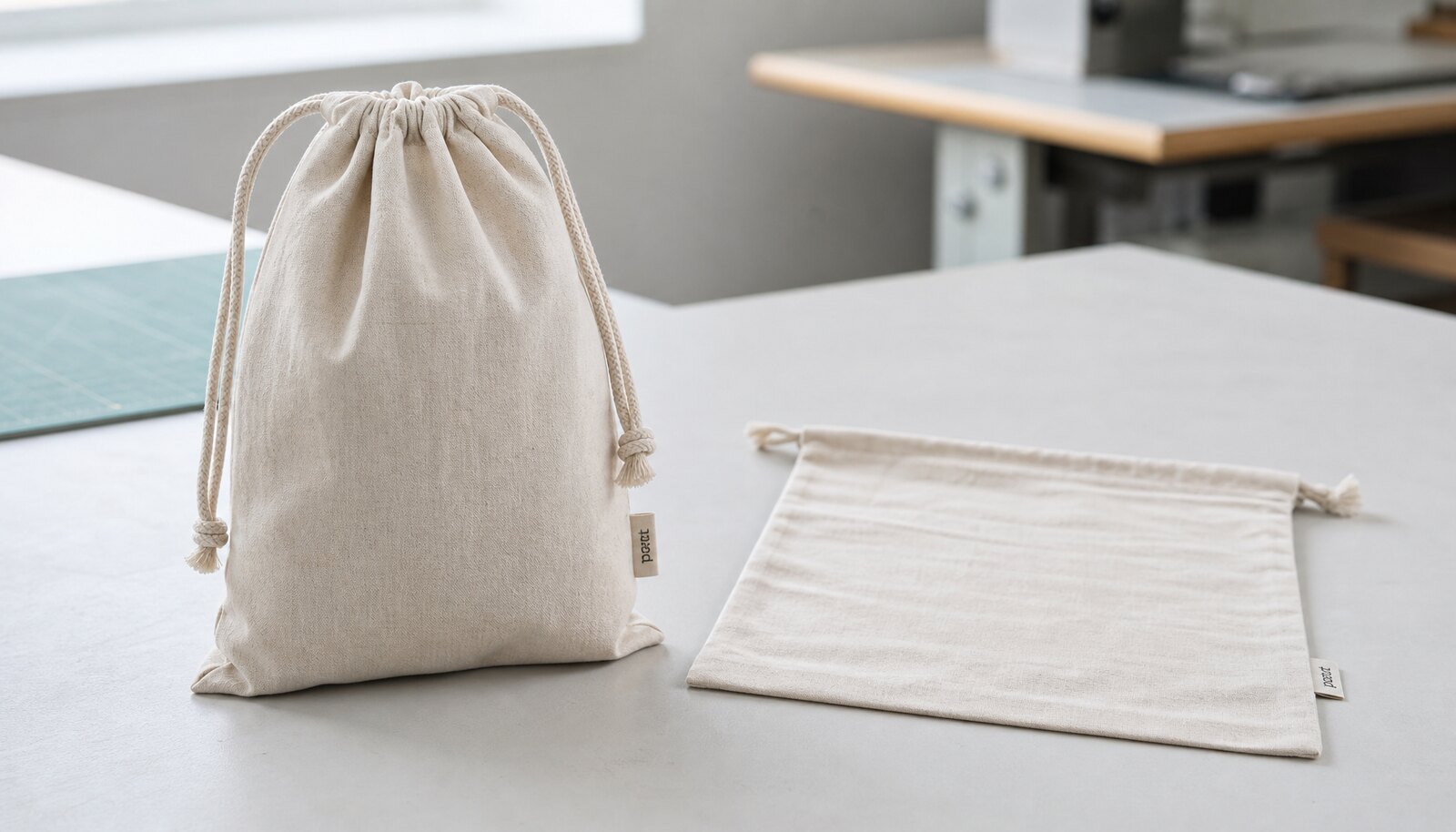
Why Logo Placement Changes the Buyer Decision
For boutique wineries, a cotton drawstring pouch is not just a carrying item. It becomes part of the shelf presentation, the tasting-room gift experience, and sometimes the first reusable piece of branded packaging a customer keeps. That means logo placement has to work when the pouch is photographed, tied around a small gift set, hung on a peg, or handed across the counter. If the logo sits too high, the drawstring gathers over it. If it sits too low, the pouch can look blank when it is filled. If it sits across a seam or cord channel, the print may look acceptable in the proof and poor in bulk.
Buyers get better results when they define the use case before they define the artwork. A pouch for bottle tags or small accessories needs different placement than a pouch for tasting-room gift sets. For winery programs, the front panel is still the default option, but the center point, print width, and gap from the top hem should be chosen around how the pouch is handled, not around a graphic designer’s preference. The practical objective is simple: the logo has to stay readable after the pouch is tied, filled, folded, packed, and opened again.
One more winery-specific point matters here: the pouch is often seen in low, warm light. Tasting rooms, cellar retail corners, and event tables do not always give the same bright visibility as a trade-show booth. That makes clean placement more important than decorative complexity. A logo that is centered, correctly sized, and set with enough breathing room usually performs better than a larger mark squeezed into the wrong spot. Buyers should think of placement as a functional requirement, not a styling choice.
- Use front-center placement when the pouch must read clearly on a shelf or in a gift basket.
- Shift the artwork lower only if the drawstring will cover the upper panel in use.
- Use a side label or woven patch when the fabric is too textured for a clean print.
- Ask whether the pouch will be sold empty, used as a gift wrap, or reused after purchase, because each use changes visibility.
Start With the Pouch Spec, Not the Artwork
Logo placement cannot be separated from fabric weight, pouch size, and closure style. A 120 to 150 GSM cotton muslin pouch behaves very differently from a 180 to 220 GSM canvas or drill pouch. Lighter fabric is easier to print and cheaper to ship, but it wrinkles more and can show uneven tension when the drawstring is pulled. Heavier fabric holds shape better for premium gift sets and repeated retail handling, but it raises material cost and can reduce print softness if the ink system is not matched to the cloth.
Boutique wineries often need more than one size, especially if the pouch is used for tasting-room items, gift add-ons, club inserts, or small bottle accessories. If the supplier offers multiple dimensions, ask them to quote each size separately rather than averaging the cost. A larger pouch changes the print area, seam position, and carton density. The same logo that works on a 6 x 9 inch pouch may feel too small on a 10 x 12 inch pouch unless the artwork is resized and recentered on purpose.
The closure style also affects what is possible. A single-drawstring top with a simple hem leaves a cleaner upper panel than a doubled cord channel with a thicker fold. If the factory uses a more rigid edge finish, the top area may resist printing or create a small visual distortion near the logo. That is why the RFQ should ask for the finished measurements, not only the flat cut size. Buyers need to know where the usable print window actually begins after sewing.
- 120 to 150 GSM fits light retail use and lower freight cost.
- 180 to 220 GSM fits premium presentation, more structure, and heavier fill weight.
- Ask for real sewn samples because cut-panel dimensions do not reflect the finished pouch opening.
- Confirm the closure style before artwork is resized or centered.
Choose the Decoration Method by Risk, Not by Habit
Screen printing is still the most common route for cotton drawstring pouches because it balances cost, clarity, and repeatability. It works well for one-color or two-color winery logos, especially on natural cotton where the print needs to be crisp and visible. Embroidery can look premium, but it adds thread cost, digitizing, and a thicker feel that may distort a light pouch panel. Heat transfer can handle detail, but it is often the least forgiving option if the buyer wants a long wear life or a low-cost repeat order. Woven labels and sewn patches shift the branding to a tactile finish, which is useful when the logo is small or the pouch fabric has a coarse surface.
The best method depends on how the pouch will be sold. If the pouch is part of a lower-cost retail pack, a clean one-color screen print is often enough. If the pouch sits in a wine club gift kit or premium tasting-room bundle, a woven side label or small embroidery mark can support the perceived value better than a large print. What matters is not the decoration method alone, but whether the method can hold registration on the actual fabric weight, with the actual logo size, at the actual MOQ.
For procurement teams, a useful way to compare methods is to ask which quality defect is most likely to appear first. Screen printing is usually strongest on cost but can show ink inconsistency if the mesh or pressure changes. Embroidery can shift the fabric and create puckering. Woven labels can solve print limitations but need clean stitch placement and edge trimming. The right choice is the one that minimizes the defect that would matter most to the winery buyer, whether that is shelf appearance, tactile premium feel, or repeat order consistency.
- Screen print: best for simple logos, lower setup complexity, and strong unit economics at scale.
- Embroidery: best for premium feel, but confirm stitch density so the fabric does not pucker.
- Woven label: best for subtle branding and long wear, but the logo area is smaller.
- Ask the supplier which defect they inspect first for the chosen method.
Place the Logo Where the Pouch Will Still Read After Use
For a flat pouch, the most reliable position is usually centered on the front panel with a measured gap from the top hem. That gap should be large enough to keep the logo away from the cord channel, the fold line, and any sewing waviness at the top edge. In practice, many buyers work from the finished pouch measurement and set a clear placement window on the dieline, not on a marketing mockup. That avoids disputes later, because the factory can measure from the same reference points during cutting, printing, and inline inspection.
If the pouch will be tied, packed loosely, or hung on a retail display, a slightly lower placement may be smarter than a logo that touches the drawstring channel. If the pouch is used for gift sets, the logo should survive being partially filled and still remain visible when the top is cinched. For side branding, keep the label away from the cord exit point and the bottom seam stress area. A side label can solve a poor print surface, but only if it does not interfere with the fold and stitch path.
As a working rule, buyers should define one primary logo location and one fallback option before sampling begins. The fallback might be a smaller front print or a side woven label if the first layout overlaps the cord channel or looks cramped on the finished size. This is especially helpful when the pouch size is still under review. Otherwise, the supplier may keep adjusting the mark by eye, and the result may vary by operator instead of by spec.
- Measure placement from the finished top edge, not from the cut fabric.
- Keep the logo outside the cord channel and top seam allowance.
- Use one master artwork position for all sizes unless the factory proves a better layout by sample.
- Set a fallback placement option before sampling to avoid repeated revisions.
Treat the Artwork File Like a Production Spec
A supplier can only print what the file and the placement sheet allow. The buyer should send a clean vector file, the Pantone references if color matching matters, and a marked dieline showing the safe zone, print size, and placement origin. Do not rely on a lifestyle photo or a screenshot of a previous pouch. Those references often hide the actual panel width, the seam allowance, and the way the fabric folds when the cord is pulled. A production-safe spec makes it obvious what the factory is expected to reproduce.
For logo placement on cotton drawstring pouches, the most useful proof is a flat sample overlay or a digital strike-off on the actual size template. The buyer should review how the logo sits relative to the center line, how much breathing room remains above and below the mark, and whether any small text will blur once the cloth is folded. If the logo includes fine lines or a small tagline, enlarge or simplify it before the sample stage. A design that looks good on screen can disappear once it is printed on uncoated cotton.
If the winery wants a premium look, keep the design discipline simple: one strong logo, one readable line of text if needed, and enough blank space for the pouch body to breathe. Overcrowded graphics are harder to center and easier to distort. Buyers should also ask whether the supplier has a preferred screen size or print boundary for the selected fabric. That answer will tell you if the factory is truly working from the production file or just trying to make the art fit later.
- Send vector art, not only a raster logo file.
- Mark the safe zone around seams, cords, and edge folds.
- Approve a proof against the actual pouch size, not against a generic template.
- Keep the composition simple enough to remain legible after folding and cinching.
Compare Supplier Routes Before You Compare Unit Price
A low quote means very little if the supplier route is wrong for the program. A direct factory is usually the best option when the buyer needs consistent placement, stable fabric, and one accountable party for sewing and printing. A trading company can help when the order covers several packaging items and the buyer wants one coordination point, but the buyer then has to verify who actually owns the artwork control and quality inspection. Domestic decorators can be useful for urgent pilots, while catalog importers may save time if the buyer can accept a standard pouch shape and a fixed decoration zone.
The comparison should be based on process control, not sales language. Ask whether the supplier makes the pouch body, applies the logo, and packs the cartons in the same facility or across multiple steps. The more handoffs there are, the greater the chance that the placement shifts, the color changes, or the sample no longer matches the bulk run. For boutique winery buyers, the right sourcing route is the one that can reproduce the same front-panel logo or side label at the same position every time the order repeats.
It also helps to ask who signs off on the first article. Some suppliers let the sales team approve a sample and then route production through a different workshop. That is a weak control model. The buyer should prefer the route where the same team that quoted the job can show the cutting, printing, and packing checkpoints. If a supplier cannot explain where the logo is measured and who checks it, the quote is too early to trust.
- Direct factory: best for control and repeatability.
- Trading company: best for broader sourcing, weaker for process transparency.
- Domestic decorator: best for speed, not always best for long-run unit economics.
- Ask who signs off the first article and who checks the bulk run.
What Drives Cost and MOQ on Custom Cotton Pouches
Most quote differences come from five items: fabric weight, decoration method, size complexity, color count, and packing spec. A heavier GSM cotton raises raw material cost and can reduce the number of pouches per carton. More print colors add screen setup or extra labor. A larger pouch uses more cloth and may need a different cutting layout, which can create waste if the factory is not nesting efficiently. If the quote also includes woven labels, hangtags, or special inner packing, those charges should be listed separately so the buyer can compare suppliers on the same basis.
MOQ logic matters because small custom runs often hide setup cost in the unit price. A supplier can look competitive if the pouch price seems low, but the final number changes once the buyer adds printing, sampling, carton marks, and freight. The better RFQ asks for a line-item quote: blank pouch, print setup, sample charge, packing, outer carton, and export terms. That structure tells the buyer whether the supplier is actually efficient or only quoting a narrow piece of the job.
For wineries, there is one more hidden cost to watch: rework. If the logo position is not fixed early, the factory may waste sample rounds or hold production while art is reapproved. In small and mid-sized programs, that delay can be more expensive than a slightly higher unit price from a better-controlled supplier. Procurement teams should think in total landed cost and risk cost, not only ex-factory price. A low-cost pouch that arrives with uneven placement is still a costly pouch if it cannot be used in the retail program.
- Request separate pricing for each size and each decoration method.
- Ask how the unit price changes when the order volume crosses the MOQ threshold.
- Keep packaging and freight separate from the sewn product price.
- Ask the supplier to identify the biggest cost driver before issuing the final quote.
Approve Samples Like a Production Buyer
A sample is not approved because it looks good on a desk. It is approved when it proves the factory can repeat the logo placement, fabric handling, and stitching standard in volume. The buyer should compare the sample against a checklist that includes panel width, print center, cord length, stitch uniformity, and label position. If the pouch will be washed, rubbed, or handled in a humid cellar, test the sample under the same condition before signing off. One clean sample on new fabric is not enough if the bulk run will be cut from a different roll or printed with a different ink batch.
The safest approval sequence is simple: pre-production sample, placement confirmation, and then bulk seal sample or first-article sign-off. If the first sample comes back with the logo too high, too small, or too close to a seam, do not assume the factory will correct it later by feel. Put the corrected dimension back into the artwork sheet and resubmit the proof. The sample stage is where the buyer locks the tolerance, not where the factory guesses it.
It is also worth checking the pouch in its real use position. Fill it with the approximate item weight, cinch the cord, and look at the logo from a customer’s eye line. A design that is centered on a flat sample can appear offset when the pouch is tied. This simple hands-on test helps buyers catch issues before the order moves into bulk. For wineries, that matters because the pouch often sits in front of the product, so a slightly off-center mark can make the whole gift look less considered.
- Inspect a sample under neutral light, not just under showroom lighting.
- Compare the actual print to the approved digital proof and the measured placement sheet.
- Sign off the sample only after the supplier repeats the same build on the same fabric.
- Test the pouch filled and cinched, not just flat.
Packing, Cartons, and Lead Time Need Their Own Line in the Quote
Cotton drawstring pouches are light, but they still suffer from poor packing. A pouch that arrives packed flat but overly compressed can pick up crease memory and look tired at retail. If the order is for boutique wineries, the pack plan should protect the logo face, preserve fabric texture, and keep the cords from snagging. Inner polybags, moisture protection, and consistent folding direction all matter, especially if the goods are moving through humid warehouses or long ocean transit. Carton size should be chosen to balance freight efficiency against crushing risk, not just to fit the maximum number of units.
Lead time should be broken into material, sampling, production, inspection, and export handling. Buyers often lose time because a supplier quotes one total number without explaining where the bottleneck sits. If the fabric is custom dyed, the schedule is usually driven by textile lead time. If the logo is complex, the delay may come from sample revisions. If the order requires carton marking or retail inserts, the final packing step can become the hidden risk. A strong supplier quote makes those steps visible before the purchase order is released.
The packaging spec should also answer two practical questions: how the pouch is folded and which face is outward in the carton. If the buyer wants the logo visible on first opening, that should be stated clearly. If the winery is using the pouch as part of a gift presentation, the fold direction and inner packing matter as much as the print itself. A neat pouch can still arrive looking wrong if the best-looking side is hidden in every pack.
- Specify inner pack count, outer carton count, and acceptable carton weight.
- Ask for a production calendar with sample, bulk, inspection, and dispatch milestones.
- Confirm whether the quoted lead time starts after artwork approval or after deposit receipt.
- State which side should face outward after folding and packing.
Specification comparison for buyers
| Spec decision | Recommended option | When it fits | Buyer risk to check |
|---|---|---|---|
| Direct factory with in-house screen printing | Best when the logo must sit in one exact position on every pouch | Repeat programs, stable artwork, and buyers who want one supplier responsible for fabric and print | Confirm they control both cutting and print registration, not just sewing |
| Factory plus outside decorator | Use only when the pouch body and decoration are split across different specialists | Projects needing embroidery, woven labels, or a print method the sewing factory does not run well | Watch for handoff errors, color drift, and blame between vendors |
| Trading company or sourcing agent | Works when the buyer needs multiple products in one shipment | Smaller procurement teams that want fewer vendors and can accept another margin layer | Ask who actually owns the artwork proof, sample sign-off, and defect claims |
| Domestic decorator for the first order | Good for very low volume or urgent retail tests | Pilot runs, event kits, or seasonal winery launches with short timing windows | Higher unit cost and limited fabric choice can distort the final buying decision |
| Standard catalog pouch with logo added | Acceptable for buyers who can live with fixed dimensions and fixed cord style | Fast replenishment and simple promotion packs where speed matters more than exact spec | Placement may be constrained by the existing panel size and seam layout |
| Fully custom OEM pouch | Best when presentation, size, and shelf appearance all matter | Boutique winery gift sets, tasting-room retail, and branded packaging that must feel premium | Allow extra sample rounds and confirm every dimension before production starts |
| Woven side label or sewn patch branding | Strong choice when the pouch will be reused and handled often | Subtle premium branding, dark fabrics, or logos that should survive abrasion better than ink | Brand visibility is smaller, so confirm it still reads at arm's length |
| Small front logo versus large front panel print | Small logo for understated retail; larger centered print for shelf impact | If the pouch must support gifting, club mailers, or photo-friendly retail display | Large prints show fabric tension and centering errors very quickly |
Buyer checklist before sampling
- Lock the finished pouch size, fabric GSM, cord type, seam allowance, and closure style before sending artwork.
- Mark the exact logo position from the top edge and side seam on a flat dieline, not on a folded pouch photo.
- State the print method, number of colors, and acceptable color tolerance in the RFQ.
- Ask for a pre-production sample with production fabric, not a white sample on substitute cloth.
- Confirm shrinkage expectation if the pouch will be washed, steamed, or handled in a humid cellar environment.
- Specify packing count per inner bag and carton so the supplier cannot improvise at the end.
- Request carton marks, carton weight limit, and master carton dimensions before approving shipment.
- Define the defect threshold for crooked prints, loose cords, skipped stitches, stain marks, and broken yarns.
Factory quote questions to send
- What fabric GSM and weave are you quoting, and can you show the actual bulk cloth swatch?
- Where exactly will the logo sit on the flat pattern, and what placement tolerance do you hold?
- Which print method is included in the quote, and what setup charges apply for each color?
- Does the price include sampling, screen fees, embroidery digitizing, or woven label tooling?
- What is the MOQ per size, per color, and per logo version?
- How many production days are needed after sample approval, excluding freight time?
- What is the carton pack count, gross weight, and outer carton dimension for this quote?
- Which inspection standard or in-line control points do you use before packing?
- What is the overrun or underrun policy if the sewn quantity changes after cutting?
- Which Incoterm is quoted, and what costs are excluded from the unit price?
Quality-control points to confirm
- Measure logo placement from the finished top edge and side seam on random units, not from the cut panel.
- Keep placement tolerance within the agreed range, usually 3 to 5 mm for standard pouch sizes.
- Inspect print sharpness, ink coverage, and color consistency against the approved sample under neutral light.
- Check cord movement, knot security, and top hem stitching so the drawstring does not snag or slip.
- Verify seam strength at the bottom corners and stress points where the pouch will be loaded and tied.
- Confirm that fabric shade, stitch thread, and label color match across cartons from the same production lot.
- Review carton count, inner pack count, and piece count per color before warehouse receipt.
- Reject any lot with oil stains, broken yarns, skipped stitches, crooked logo alignment beyond the agreed limit.