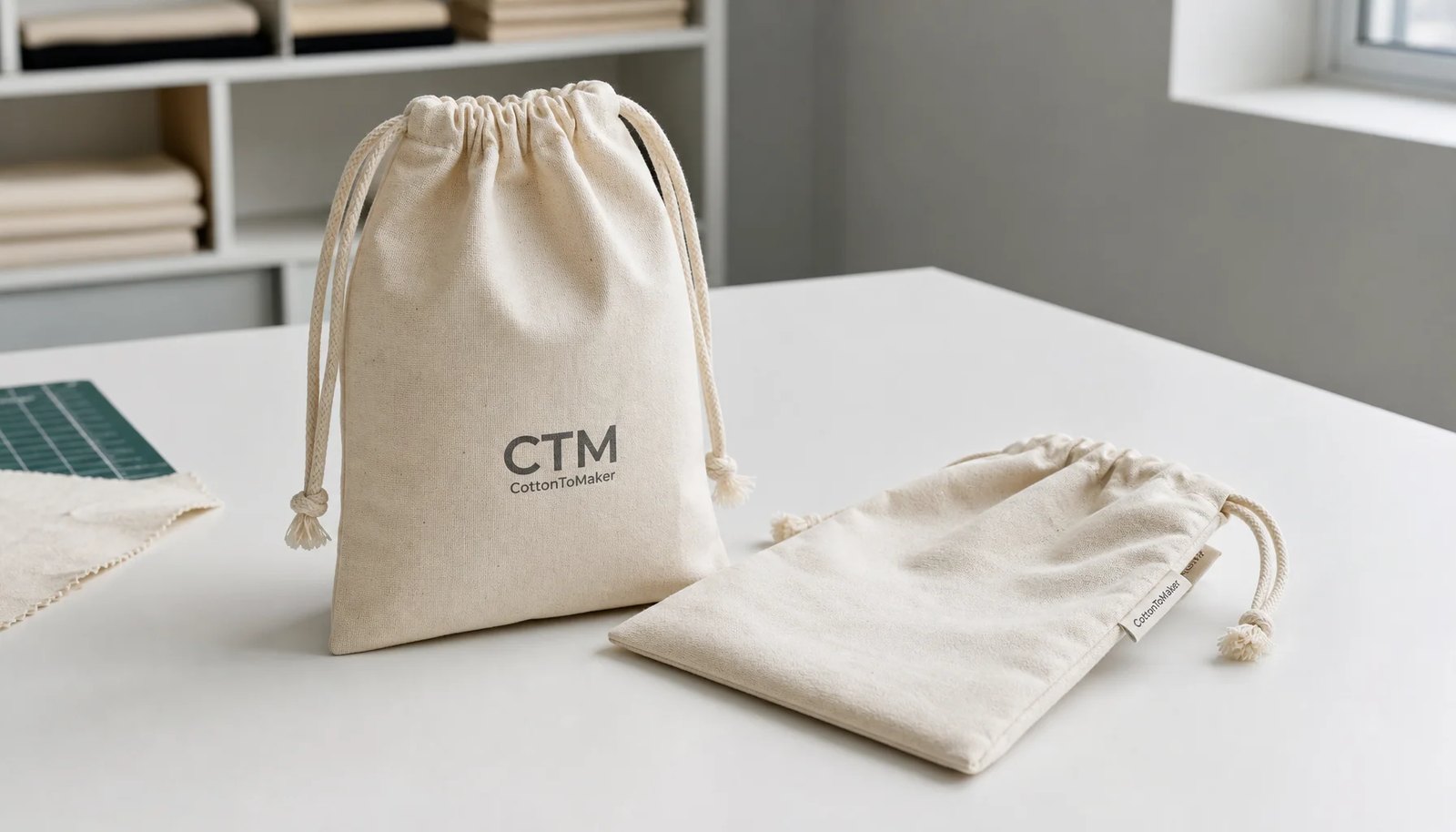
The Buying Problem Behind Bookstore Pouches
Wholesale cotton drawstring pouches for university bookstores are usually small-ticket items, but the order can create outsized problems when the RFQ is treated like a generic promotional bag purchase. Campus bookstores may use the pouches for branded gift packaging, graduation merchandise, reusable stationery kits, dorm move-in bundles, lab accessories, or apparel add-ons. Each use changes the fabric weight, print durability, packing method, and compliance documents needed from the supplier.
The biggest sourcing mistake is comparing quotes by unit price only. A cheap pouch may be based on stock fabric, loose bulk packing, a lower GSM, no print curing report, no barcode label, and a wider size tolerance. A more complete quote may include custom cutting, pre-production sample correction, retail packing, carton marks, and inspection support. Procurement teams need a supplier compliance checklist that separates real cost from missing scope.
- For retail sale, prioritize consistent appearance, barcode readiness, and carton labeling.
- For event giveaways, prioritize lead time, basic print durability, and budget control.
- For merchandise packaging, prioritize fabric handfeel, drawcord function, and logo placement.
- For licensed university marks, prioritize approval routing, artwork control, and documentation.
Set the Pouch Specification Before Comparing Suppliers
A cotton drawstring pouch quote should start with the finished pouch size, fabric weight, cotton type, drawcord style, print method, packing, and order quantity. If those fields are missing, two suppliers may quote very different products while appearing to compete on the same item. A 5 oz cotton pouch and a 10 oz cotton pouch can both be called a cotton drawstring pouch, but they do not have the same weight, sewing behavior, print surface, or landed cost.
For university bookstore programs, common pouch sizes range from small accessory pouches around 10 x 15 cm to medium merchandise pouches around 20 x 30 cm and larger kit bags around 30 x 40 cm. Buyers should state whether the size is finished outside measurement or usable internal space. The drawcord channel reduces practical capacity, and thick contents can make a pouch look undersized even when the flat measurement is correct.
- Lightweight option: about 120-140 GSM cotton for small packaging pouches and low-cost giveaways.
- Balanced option: about 150-180 GSM cotton for bookstore gift pouches and branded retail packaging.
- Heavier option: about 200-280 GSM cotton canvas for reusable merchandise pouches or higher perceived value.
- Common tolerance: specify ±5 mm to ±10 mm depending on pouch size and fabric construction.
- Important wording: define finished size, cotton GSM, color, drawcord type, print area, and packing in the RFQ.
Fabric GSM and Cotton Finish Decisions
Fabric GSM affects cost, print result, seam strength, and how the pouch hangs on a bookstore display. Low-GSM cotton is economical and folds easily, but it may show contents through the fabric and can feel too soft for a retail gift item. Higher-GSM cotton or cotton canvas gives better structure and perceived value, but increases material cost, carton weight, and freight cost. The right choice depends on whether the pouch is sold as a product, used as packaging, or bundled free with other merchandise.
Natural cotton is popular because it signals a simple reusable material, but buyers should not expect optical white. Natural cotton often includes seed flecks, shade variation, and small slubs. If the bookstore brand standard requires a clean white or exact campus color match, the RFQ should call for bleached, dyed, or custom-color cotton with shade approval. Dyed cotton adds MOQ and lead time because fabric dyeing and color approval happen before cutting.
- Natural cotton: lower dyeing complexity, visible cotton flecks, easier for simple one-color prints.
- Bleached cotton: cleaner background for detailed artwork, but needs shade approval and may cost more.
- Dyed cotton: better brand alignment, but usually requires higher MOQ and lab dip approval.
- Cotton canvas: stronger shelf feel, better for reusable retail items, higher freight weight.
- Organic cotton: useful only if the buyer requires documented organic chain claims and accepts higher evidence requirements.
Print Method and Artwork Control
Most university bookstore cotton pouch orders use screen printing because it is cost-effective, durable when properly cured, and suitable for one to four solid colors. Screen printing works best on cotton when the artwork has clear edges and the print area avoids bulky seams or the drawcord channel. Buyers should specify Pantone references, print dimensions, and location from the top edge or bottom seam. Without those details, a supplier may center the print visually, which can shift after the pouch is filled.
Digital print, heat transfer, embroidery, and woven labels can also fit certain programs. Digital print is useful for gradients or full-color artwork but needs fabric and wash expectations clarified. Heat transfer can reproduce detail but may feel like a film on soft cotton. Embroidery gives a premium result but can distort lightweight pouches and is usually slower. A woven side label is often a good option when the bookstore wants a subtle branded finish without a large front print.
- Screen print: best for solid logos, bulk orders, and cost control.
- Digital print: useful for detailed art, but test color sharpness on cotton before approval.
- Heat transfer: good for complex graphics, but review handfeel and edge durability.
- Embroidery: premium look, but avoid very thin cotton and tiny lettering.
- Woven label: consistent branding, good for repeat programs, requires label MOQ planning.
Supplier Compliance Evidence That Matters
A supplier compliance checklist should focus on evidence that affects the actual bookstore order. A general company profile is not enough. Buyers need to know who controls fabric sourcing, cutting, sewing, printing, inspection, and packing. If the supplier subcontracts printing or stitching, that is not automatically a problem, but it must be declared so responsibility is clear when print curing, stitch quality, or packing labels fail.
For campus retail, compliance may include restricted substance declarations, material composition statements, social compliance documents, product safety statements, and licensing requirements for university marks. Buyers should avoid asking every supplier for every certificate at the first email stage. Instead, separate mandatory order documents from optional company documents. This keeps the RFQ practical and prevents suppliers from padding quotes with paperwork that does not apply to cotton pouches.
- Material declaration: cotton content, fabric type, GSM range, and drawcord material.
- Restricted substances: declaration or test report when required by buyer policy.
- Factory profile: production process, in-house versus subcontracted steps, monthly capacity.
- Social compliance: available audit reports or buyer-specific audit readiness where applicable.
- University licensing: process for artwork approval, trademark control, and approved vendor routing if needed.
MOQ Logic and Cost Drivers
MOQ for wholesale cotton drawstring pouches is driven less by sewing and more by material sourcing, printing setup, color batching, and packing labor. A factory can stitch small quantities, but fabric purchasing, screen setup, dyeing, label production, and carton preparation have minimum practical costs. That is why a 500-piece quote may look disproportionately expensive while 3,000 or 5,000 pieces become more competitive.
Procurement teams should request price breaks at realistic quantities instead of forcing one target quantity. For example, ask for 1,000, 3,000, 5,000, and 10,000 pieces using the same spec and packing. This reveals which supplier has real manufacturing efficiency and which one is simply reselling stock. Also separate tooling, sampling, screen charges, label charges, and special packing from the unit price so internal stakeholders understand the full cost.
- Fabric GSM increase raises material cost and freight weight.
- Custom dyed cotton usually raises MOQ and adds lab dip time.
- Multiple print colors add screen setup, alignment risk, and curing control needs.
- Individual packing adds labor, materials, carton volume, and receiving convenience.
- Hangtags, barcodes, and inner assortments reduce bookstore handling but increase pre-shipment data control.
Sample Approval With Real Acceptance Criteria
A pre-production sample should not be a decorative mockup. It should prove that the supplier can produce the bulk pouch using the intended fabric, drawcord, stitching, print method, and packing. For bookstore buyers, the sample should be reviewed by procurement, merchandising, brand or licensing, and warehouse receiving if packing labels are involved. Approval should cover both appearance and function.
The most useful sample notes are measurable. Instead of saying the pouch should feel better, state the required GSM range or approved reference sample. Instead of saying the logo should be centered, state the print position, size, and tolerance. If the pouch will hold a specific product, test the contents inside the pouch before approval. Flat size approval alone does not guarantee practical fit.
- Measure finished width and height in at least three locations.
- Compare fabric shade under neutral light against the approved reference.
- Pull the drawcord repeatedly to test channel smoothness and knot security.
- Rub the print with a dry white cloth to detect poor curing or surface transfer.
- Place the intended merchandise inside the pouch and assess closure, shape, and presentation.
- Review final packing components, including barcode position, hangtag, inner bag, and carton mark.
Packing, Labeling, and Bookstore Receiving
Packing is often where a pouch order becomes expensive after the quote has already been approved. Loose bulk packing is cheapest and may work for backroom kitting, but it creates counting and handling work for bookstore staff. Individual polybags protect the pouch and support clean retail presentation, but they add material cost and may conflict with plastic reduction policies. Paper bands, belly wraps, hangtags, and barcode stickers can improve retail handling when specified early.
Carton labeling matters because university bookstores often receive mixed merchandise from several vendors near semester start. Cartons should show purchase order number, item description, size, color, quantity, gross weight, net weight, carton number, and destination data if required. Mixed SKUs should use inner labels or separated cartons. When pouches are packed in the wrong assortment, the receiving team may reject or delay the goods even if the pouches themselves are acceptable.
- Loose bulk: lowest cost, best for internal kitting, weakest retail presentation.
- Individual polybag: clean protection, but review plastic policy and suffocation warning needs.
- Paper band: better presentation with less plastic, but less moisture protection.
- Hangtag and barcode: useful for retail sale, requires accurate SKU data before production.
- Inner carton assortment: helpful for multi-campus distribution and warehouse receiving.
Lead Time Risks and Approval Sequence
Lead time should be built from decision points, not only counted from purchase order date. For custom cotton drawstring pouches, the real schedule often includes artwork checking, fabric sourcing, lab dip if dyed, sample making, sample shipping, buyer approval, bulk cutting, printing, sewing, inspection, packing, export booking, and transit. Delays usually happen before production starts because artwork, trademark approval, barcode data, or packing instructions are incomplete.
A practical RFQ should request separate timing for sample production, sample transit, bulk production after approval, and shipping. It should also name the latest approval date needed to meet the bookstore delivery window. If the goods must arrive before orientation week, graduation, homecoming, or semester start, the buyer should leave buffer for inspection findings and customs clearance. Rush production can work only when the specification is fixed and materials are available.
- Fastest route: stock natural cotton pouch with one-color print and loose packing.
- Moderate route: custom size, standard fabric, screen print, simple retail packing.
- Slowest route: dyed cotton, complex artwork, woven label, barcode packing, licensing approval.
- Common blocker: artwork approved visually but not supplied as production-ready vector file.
- Schedule safeguard: approve a sealed pre-production sample before bulk cutting and printing.
Quote Data for Landed-Cost Comparison
A clean supplier quote should let the buyer calculate landed cost and compare service level. The quote should not stop at unit price. It should include MOQ, quantity price breaks, sample cost, setup cost, packing cost, carton dimensions, carton weight, pieces per carton, production lead time, Incoterm, payment terms, quote validity, and what documents are included. Without carton data, freight estimates can be wrong, especially for bulky retail packing.
For importers and distributors, compare the cost impact of heavier GSM, individual packing, and air shipment against the selling plan. A pouch that is inexpensive at the factory can become costly when packed one piece per bag with hangtag and shipped by air. Conversely, a slightly higher factory unit price may be cheaper overall if the supplier packs store-ready cartons correctly and reduces domestic rework.
- Request EXW, FOB, or FCA terms clearly; do not compare mixed Incoterms as equal.
- Require carton dimensions and gross weight for every packing method quoted.
- Separate print setup, sample, label, and packing charges from the unit price.
- Compare ocean, air, and courier only after carton volume is known.
- Include inspection cost, rework risk, and domestic relabeling labor in the landed-cost view.
Specification comparison for buyers
| Supplier option | What to verify | Commercial advantage | Buyer risk to control |
|---|---|---|---|
| Direct sewing factory | cord material proof, reinforcement close-ups, load-test photos, approved sample tag, and bulk-line first-piece record | Better sample-to-bulk control and faster production feedback | May be weaker on export paperwork or branded packing unless checked early |
| Trading company | Factory name, production photos, trim-source proof, and who owns QC decisions | Can coordinate small mixed orders and extra services | Markup can hide real factory capability and slow defect decisions |
| Specialized bag workshop | cord diameter, eyelet or reinforced channel, bottom corner reinforcement, seam allowance, bar-tack position, and load target | More practical for detailed construction, trims, and repeat programs | Capacity may be limited during peak seasons |
| Low-price general supplier | 6-10 oz cotton canvas, 210D polyester, rPET, or blended cotton with shrinkage and colorfastness expectations set before sampling | Useful for simple promotional runs with loose specs | Material downgrades, weak packing, and vague inspection scope can erase savings |
| Retail-ready supplier | fold direction, cord protection, bundle count, carton compression, moisture bag, and retail label position | Can handle labels, SKU separation, carton marks, and receiving rules | Higher unit cost must be compared against reduced warehouse work |
| Compliance-focused supplier | Fabric records, labeling review, test plan, and production traceability | Safer for retail programs and repeat brand orders | Documentation claims need evidence, not only sales language |
| Local sample room plus bulk factory | Signed sample, bulk factory handoff, first-piece photos, and deviation owner | Good for complex branding before large production | Sample room quality may not match bulk line unless handoff is controlled |
Buyer checklist before sampling
- Define pouch use before quoting: merchandise packaging, gift-with-purchase, dorm kit, orientation item, lab kit, or reusable retail product.
- Specify finished size in width by height, with seam allowance understood separately from usable internal space.
- State cotton fabric GSM, weave expectation, color, shrinkage tolerance, and whether natural cotton flecks are acceptable.
- Choose drawcord material, cord diameter, exit style, knot or tipped finish, and whether the cord must match the pouch body.
- Provide artwork files in vector format, Pantone references, print size, print position, and minimum safe distance from seams and cord channel.
- List required compliance documents before price comparison, including material declaration, restricted substance statement, packing list format, and any campus licensing requirements.
- Require a pre-production sample using bulk fabric and the intended print method, not only a digital mockup.
- Set acceptance criteria for size tolerance, stitch density, print registration, print rub resistance, seam strength, and carton drop condition.
- Define retail packing: loose bulk, individual polybag, paper band, hangtag, barcode label, inner carton, or store-ready assortment.
- Request quote data in the same structure from all suppliers: MOQ, price breaks, sample cost, setup cost, packing cost, carton details, lead time, Incoterm, and validity period.
Factory quote questions to send
- Is your quote based on custom cut-and-sew production or available stock pouches, and which steps are performed in your own factory?
- What cotton GSM options are available for this pouch size, and how will GSM be tested or declared before shipment?
- What is the minimum order quantity by size, fabric color, print color count, and packing method?
- Which print methods do you recommend for our artwork: screen print, heat transfer, digital print, embroidery, woven label, or another process?
- Can you provide a pre-production sample using bulk fabric, bulk drawcord, correct print method, and final packing components?
- What size tolerance, stitch density, and print tolerance do you normally guarantee for cotton drawstring pouches?
- What documents can you provide for material compliance, restricted substances, social compliance, and export packing?
- How many pieces fit per carton under our packing method, and what are the estimated carton dimensions and gross weight?
- What is the production lead time after sample approval, and which materials or approvals can delay the schedule?
- How do you handle failed inspections, missing labels, print shade deviation, or carton damage found before shipment?
Quality-control points to confirm
- Finished size tolerance should normally be controlled within about ±5 mm for small pouches and ±10 mm for larger pouches unless the buyer accepts wider handmade variation.
- Fabric weight should be checked by GSM cutting test or supplier declaration from bulk roll data, not judged only by handfeel.
- Seams should be straight, without skipped stitches, open seams, broken thread, or puckering that affects shelf presentation.
- Drawcords should pull smoothly through the channel without tearing fabric, slipping knots, sharp cord ends, or uneven left-right length.
- Print should be positioned to the approved sample, with no heavy bleeding, cracking, poor curing, visible screen marks, or ink transfer during a dry rub test.
- Natural cotton shade, black specks, and slubs should match the approved tolerance because undyed cotton is not pure white and varies by lot.
- Needle detection may be required for some retail programs, especially if pouches are used near children’s products or apparel departments.
- Packing should protect against moisture, carton crushing, barcode loss, and mixed-size confusion during bookstore receiving.